Friday, March 14, 2014

MORE OF THAT WRITING STUFF...by L.J. Martin


WHAT IS GENRE?

GENRE: Genre is defined by my Random House Dictionary as:
  
A class or category of artistic endeavor having a particular form, content, technique, or the like.

Romance, science fiction, horror, fantasy, thrillers, historicals, mystery, and westerns are generally considered to be genre novels—and there’re more. And there are sub-genres: adult westerns, fantasy, gothic romance, regency romance, etc., etc.
Who determines genre? The market and a lot of preconceived notions. Editors who buy novels and guide them to finished form, and readers who buy them to consume. Readers expect such a novel, a western for instance, to be written a certain way and, because of those reader expectations, if it isn't written that way, editors generally won't buy it—because they believe it won't sell and their sales department, cast from the same mold, believes they don't know how to sell it. They'll say, "It falls through the slots."
If you want to sell your work to the established publishing houses, the first thing you have to realize is publishing is a business. Like other businesses, publishers want products that sell.
The editor's first obligation to the publishing house is to stock the shelves with the standard product, the proven sellers. Only once in every hundred books they edit will they reach out. And remember, they've probably read or partially read five thousand manuscripts to get those hundred they bought—the reality is that a million manuscripts a year get submitted and 3,500 published in mass-market fiction, numbers that are constantly changing. The odds against a truly unusual book getting to the market are huge. But when they do, they are sometimes the huge sellers. Take Fifty Shades of Grey as an example.
Jonathan Livingston Seagull, among the all-time best-selling novels, and the most translated novel, bar none, from the English language (at least when I wrote this, I’m sure this has changed), was turned down twenty-eight times before it found a home. It was a short, unusual story. Now it's a short, unusual story translated into more languages than any other novel ever published.
But if you want to get comfortably published, don't try to reinvent the wheel. Write to the market. Make it easy on the editors. Give them a product they're used to, one they can get on the shelf with little effort on their part or that of the copy editor. One that sells and makes money for the publishing house.
I once spoke at a college seminar on writing where the renowned science fiction writer Ray Bradbury was the featured speaker. After speaking to my small portion of the seminar, I attended Ray's keynote address—and found myself being berated for giving the exact advice above. Write to the market, although it had been related to him in a different manner than I’d represented. “I also said, write from the heart.” And “money isn’t everything.”
Bradbury, who sold his first brilliant novel, Fahrenheit 451, at the ripe old age of 21 or so, believed that all writers should be like him, brilliant, and merely write a brilliant novel and go on to fame and fortune. Thank you, Ray. But some of us have to grind it out the hard way, and would like to make a little money, and get a few pats on the head, along the path. Now that you’re gone, I truly hope you’ve found a place in heaven…which will only be heaven to you if there’s a word processor at hand.
Yes, if possible, write a brilliant unorthodox novel and be rich and famous—but the odds are you'll languor and slip away from writing when you find a pile of rejection slips building window-sill high beside your desk (or toilet). Many who might evolve into brilliant productive writers will go by the wayside if expecting, and being disappointed by, the lack of fame and fortune from a first novel or from not selling a first, or second, or third novel. Many now productive and successful writers did not sell a manuscript until they had written a half-dozen novels. I remember a story about Danielle Steel. It was reported that she sold her first novel, only to receive rejections on her next five. That would be even tougher in many ways than not selling your first.
Editors look forward to receiving their paychecks regularly and if they don't stock the shelves with products that sell, paychecks stop coming because they are looking for another job. They look for product to fill the slots they have open. Tried and true genre product that fits the slot.
But back to genre.
Romances end happily: girl gets boy and vice versa. Mysteries drip clues, and you don't know the solution until the last chapter. Sci-fi is about aliens and outer space, or inner space, including inside the body or the center of the earth. Horror better scare the hell out of you. Since I'm concentrating on the western and the historical, I'll zero in on them—and by the way, what's good for the western is generally good for the western romance, novels of the west, and historicals set in the old West. Most of it, of course, is common to all genres.
If I seem to be stuck on westerns, remember the same basics can be applied to all genres.

WHAT'S A WESTERN? WHAT'S A HISTORICAL? As its eighth definition of the non-capitalized word, Random House defines western as:

A story, movie, or radio or television play about the U.S. West of the nineteenth century.

It defines an historical novel as:

A narrative in novel form, characterized chiefly by an imaginative reconstruction of historical events and personages.

Let's look at those definitions as they apply to western/historical novels. And remember that a western romance may have different guidelines than those for a straight western or straight historical.
As appears on the paperback racks in thousands of book stores, truck stops, supermarkets, and drug stores, and now online, a western is a fictional story of forty five to sixty five thousand words. This is a rule. Rules are made to be broken, and the word-limit rule, like all rules in publishing as well as most other businesses, is broken often. One of the finest western novels ever written (in my opinion, and the only Pulitzer Prize winning western novel ever written) is much longer. We'll talk more about Lonesome Dove a little later.
Again, so much for rules.
The point I'm trying to make is, nothing is hard and fast. But if you want to sell your novel, it's the accepted beginning, accepted length, accepted subject matter, accepted time frame, accepted style, and accepted ending that will sell quickest. Don't fight city hall.
Get one sold, get famous (or at least established), then you can break the rules.
Stephen King wrote a three word chapter in Misery. Thomas Wolfe wrote a four hundred word sentence in Bonfire of the Vanities. Both were (silently or at least in low tones) chastised by New York editors for "grandstanding." But they can pull this kind of stuff because they are Stephen King and Thomas Wolfe.
Consistently put a few novels on the top of the NYT or the PW lists, and you can grandstand.
In the meantime, write fifty to sixty thousand words for your short genre or one hundred thirty thousand for your long one—or better yet, follow the guide lines of the publisher to whom you wish to sell.
Later, I'll tell you how to count words in the old and new ways so you know how long your work is.
But any work of fifty to eighty thousand words does not a western make. What makes the western a western?  Stay tuned....

To see the whole manual on writing compelling fiction, and to blow $.99, go here:

http://www.amazon.com/Write-Compelling-Fiction-L-Martin-ebook/dp/B006PVYN10/ref=sr_1_1?ie=UTF8&qid=1394628303&sr=8-1&keywords=write+compelling+fiction+l.+j.+martin


http://www.amazon.com/Write-Compelling-Fiction-L-Martin-ebook/dp/B006PVYN10/ref=sr_1_1?ie=UTF8&qid=1394653219&sr=8-1&keywords=Write+Compelling+Fiction+by+L.J.+Martin

Thursday, March 13, 2014

Ranger Jim's Ramblings for March

Finally got this blasted E#R$#R$%$ site to work. Been trying since last night. I hate the internet.

Anyway, this month is kind of a scattershot post, a true "ramblings", as it were.

First, happy birthday to Yankee. He turned 21 today. That's about 63 in people years. My boy's getting old.

Speaking of horses, how much do you know about horseshoes?  I'm no expert, but I'll bet most of you don't know how many different kinds there are. Just a few are the regular horseshoe, which most horses wear.  Then there's winter shoes. Unless you're a horse owner, you'd never know that in the wintertime horses can't wear regular shoes. They either have to go barefoot or wear special winter shoes. The reason for this is flat-bottomed regular shoes are extremely dangerous in the snow. They act like walking on glass, very slippery. In addition, snow compacts in the shoes and freezes into ice balls, so a horse can literally be walking on four inch thick balls of ice. So winter shoes are borium, with studs in them, much like studded snow tires. They are also nailed over a vinyl or rubber pad which has a bulge in it. This prevents the snow from sticking, and pops off what little does stick.  Only problem is those borium shoes are tres expensive. Yankee's getting his off and regular ones back on next week.

Then there are all sorts of corrective shoes. Bar shoes have a bar across the heels, or are oval shaped.  There are pads that go under shoes, shoes with squared fronts, and too many others to mention. That's why finding a good farrier is so important. He or she is the person who you count on to keep your horse sound.

Now, on to a bit about books. I've just had to read several Westerns, and it's a shame to see a well-written book spoiled because the author uses 21st century terms in the text, or even worse has their characters using dialogue and words that didn't exist in the 19th century. We've all been guilty of the same error, hopefully only once or twice, but it's something to keep in mind. For example, in most westerns, including some of my earlier ones, you'll see references to cowboys wearing jeans. I never knew, until my editor at Condor discovered after my first Cody Havlicek novel, that the term "jeans" came along after the 1800s. So my first Cody Havlicek novel has him wearing jeans, the second doesn't. Denims, pants, or trousers. Don't use "levis" either. Levi, Strauss, and Company still owns the trademark on that.

Bit of trivia. Remember Sherman and Mr. Peabody on the Rocky and Bullwinkle Show? One of the historical groups Sherman and Mr. Peabody visited with the help of the Wabac machine was the Texas Rangers. They also visited several other old West personages. I'll let you guess the others.

See you next month.

Jim


Wednesday, March 12, 2014

Who’s afraid of the big bad wolf


Been thinking about Wicked Wednesday lately. Well, maybe about wickedness in general. I’ve been working on my WIP, which doesn’t seem to move along in the same manner as a manuscript does for James Reasoner, for instance, or for Bob Randisi. But I plug on, and eventually the MSs get finished. Problem is, the bad guys are not too upfront about it, nor to they go blazing out in a flame of glory (or was that gory?). Still, someone made off with Real Lee (Gabriel Winston Lee, if you think the moniker doesn’t sound quite right), marshal of Payson.

Real Lee’s deputy, an eighteen-year-old youngster named Lightning of God Brewster, is left to take care of the town. Many think he can’t, a few think he can. Still, someone has made off with Real Lee, so Lightning needs to find him.

King Elliott’s the bad guy, but not the gunman. He’s got money, and he thinks it allows him to do anything to get power. As it says in the Writer’s Digest Book, Characters and Viewpoint (Orson Scott Card), If you want to bring the point home, “focus on a ‘bad guy’ who thinks of himself as a good guy.”

Elliott’s bringing a lot of money to Payson, but he thinks his way is the only way, and he hires real bad men to make things happen.

I went back to an old favorite author of mine, Cliff Huffaker. I’ve got some Pocket Books of his that cost me $1.25 back in the day, and I thought I’d take a look at the bad guys in some of his books.

Cowboy

Remember the movie? It starred Glen Ford and Jack Lemmon. Lemmon played the hero, if there is a hero in Cowboy. He wanted to be a cowman, and when Tom Reese, the legendary cowman, came to Chicago, Lemmon’s character—Frank Harris—caught him down on his luck and lent him $3,800 to get back in the game. With the loan, Harris bought a partnership in Reece’s cattle drive business.

Next morning, Reece tries to give Harris his money back. Harris won’t take it. So he’s on his way to Texas with Reece to get more cattle. The book is about Harris’s road to becoming a cowman. Every tough spot teaches him something else. And often the toughness comes from Tom Reese. But Reese doesn’t think he’s being mean to Harris, he thinks he’s making a cowman out of him.

They bought a herd in Mexico and one of the cowboys got to drinking in a cantina with a good chance of getting in a knife fight. Harris gets ready to ride to the cowboy’s rescue. Here’s the scene.


“Well, I’m leaving!” Frank faced the other men. “If Charley has any friends in this outfit they’ll come with me. Otherwise I’ll go back alone!”

“Nobody’s goin’ anyplace,” Reece repeated, his voice dangerously low.

“I am.” Frank turned his back on Reece and walked quickly toward his horse.

“Harris!” Reece said angrily. When Frank didn’t stop, the cowman reached down and grabbed a crowbar from near the chuckwagon. He threw it and the spinning iron bar hummed across the camp and slammed into the back of Frank’s knees. Before Frank could get up, Reece was on him.

Needless to say, Harris didn’t go help the cowboy Charley (don’t know why I feel for that cowboy), and he boiled at the tough lessons Reece taught him. Down the road a ways, out of Mexico and into Texas, Indians show up. Harris is out with a bunch of cows, between the main herd and the Indians. Reece decides to stampede the cattle into the Indians, which works, but gets Harris upset. Reece gets shot in the leg, and Harris, as partner, takes over.

Problem is, the herd is scattered and the men must round them up. Harris goes 72 hours without sleep. He pistol-whips a wayward cowboy. Reece calls him over.


From where he sat in a folding chair with his leg propped on a log before him, Reece said, “Come here, Harris.”

Standing before him, Frank said, “What you want?”

“Better slack off. Boys are getting’ mean.”

“I’ll slack off. The roundup’s finished as of this afternoon. Only got eight steers today. Not worthwhile to go on any more.”

“How many you figure got lost?”

“Better than three hundred.”

Reece shook his head. “A lot of cows.”

“Yeah. Too bad. Too bad for you, that is.”

“What about you?”

Harris shrugged. “We found all my cows. Turned out all the ones that ran off were yours.”

“Oh?” Reece frowned up at Frank. “That’s very interesting. How did you go about separating mine from yours?”

“Easy. I used a crowbar.”


Harris and Reece, of course, settle their differences and become true partners in the end.


Badge for a Gunfighter

Cash Jefferson takes on the job of sheriff at Yellowrock at the behest of Whitey Hall. Here’s how.


“The men you’ve killed so far have been gunfighters themselves. Our of curiosity, if the bet was, say, shooting a man in the back, would you take it?”

Cash grinned. “Just simpler to win. I don’t reckon the other fellow’s much happier one way or the other. Forward or backward, he’s just as dead.” He poured another drink. “Want a refill?”

“Yes.” Whitey watched as the steady, bronzed hand poured a second tumbler of gold-brown liquid. “I like to see a man who hates people. That’s a man you can count on.”

“Why, I don’t hate anybody in the whole wide world, Whitey. I just don’t give a damn about them. Let’s cut out all this palaver. What’s the deal?”

“I’m figuring on making you sheriff of Yellowrock.”

Cash gagged slightly on his whiskey and put the glass down sharply. “You’ve got a sense of humor after all,” he said, and coughed.

“Nothing funny about it. I’d like to have Duke in the job, but everyone knows he’s my man. I imported you because no one knows you around here. You can take over, and the town will be tickled pink. But you’ll enforce the laws the way I want them enforced and you’ll gun anyone I want you to gun—and always perfectly legally.

“The job pays one-fifty a month. I’ll match it with one-fifty on my own payroll. The job pays two dollars a head for any cowboys or miners you jail in the line of duty. Just to encourage you to look like a conscientious officer, I’ll match that money, too. We want you making plenty of arrests. But make sure you don’t bother me or my men or anyone who’s spending his pay in one of my places. And, from time to time, you’ll get a bonus for special jobs.”

“What sort of special jobs?”

Whitey leaned back in his chair and put his hands behind his head. “Remember the three men who were here when you came in? They did a little extra work for me today. So they’ve got a thousand dollars to split up between them.”

“For that kind of money I’m your sheriff. What job did they do?”

“Fine. You’re one of us.”


So we’ve got a hero who’s playing a bad man. Not in the undercover sort of way, but in a way that in the final analysis does not match his character. Whitey’s methods gradually get under Cash’s skin, and he makes a turn.


“I heard what you did for Virginia today,” Cash said. “Always admired a man who’d tackle somebody Ben’s size.”

“That little incident wasn’t all it took to turn you around. There was a lot of thinking building up to that” Williams coughed and spit blood. “Believe me, the town will be behind you. You’ll have all the help you’ll need cleaning up.”

“I’m not looking for help.”

“But Hall’s got a fair-sized army behind him.” Williams chocked and more blood trailed from his lips.

“He’s got plenty of errand boys around town. But only four dangerous men. Garf and Saul, and Ben and Duke.”

“That makes five with Whitey himself. You tackle them alone and you’re a dead man.”

“That’s the way it’s got to be.”

Williams noticed Cash’s arm for the first time. The shirt was torn, the arm bleeding. “You’re hurt.”

“Not much. Not nearly as much as you are after playing sheriff at Clymer’s today.”

“I played sheriff because we didn’t have one in town. I’ll never try a stunt like that again—now that we have got a sheriff.”


That scene comes about 80% toward the end of the book, and the final standoff between the reformed gunfighter sheriff and Whitey Hall’s minions comes in the last few pages, and a young boy saves his bacon on the next to the last page.

Clair Huffaker’s books are slim. A hundred fifty pages or so. No space for unnecessary words, and he doesn’t use any. Other than his name, there is hardly any description of Whitey Hall. Here’s the only description we get of this bad man:

At the ornate desk in the center of room sat a blond man with hard brown eyes and a scar that ran along his cheek and up to the bottom of his right ear. This, Cash knew, was Whitey Hall.

There’s an old saw: Actions speak louder than words. Huffaker’s baddies can be spotted by what they do.


One of the plotting tools listed by David Farland in his book Million Dollar Outlines is the Time Bomb. Farland says: A time bomb is really just a time limit, a deadline, by which some action in a story must fail or succeed.

And farther on down the page, he says: Whatever your time bomb, make sure that the time limit seems realistic, that it puts extreme stress on the characters, and that the consequences of failing to meet the deadline are devastating.

Guns of Rio Conchos

In Huffaker’s Guns of Rio Conchos, there’s a time bomb. Here’s where it is set. First Riot Holiday gets an arrow in the chest.


At the edge of the plateau he ran almost head on into one of the Indians on patrol. The brave had heard him coming in the dark and was waiting, almost invisible in the deep shadows of a huge rock. Riot saw a flick of movement and felt a savage pain in his chest, although he heard no shot. He raised his revolver and fired twice into the shadows, and heard the sound of a body thudding to the ground. Then he was free and galloping over a smooth gentle rise. The only trouble was that his head felt hollow, and he was very tired . . . .

Later, after he’s found by a rancher:

Closing his eyes, Riot drifted out into space, and when he came back to the solid world once more there was an elderly tight-faced soldier standing a

“Mister Holiday. I’m Dr. Gates, Army surgeon from Fort Davis.”

Mildly surprised at his own clarity of mind, Riot said, “What happened to Dr. White?”

“He’s been and gone. Thaddeus McCallister rode to the fort to bring me over here. Mr. Holiday, you’re in trouble. No point beating around the bush.”

“Trouble?”

Gates nodded. “You’ve got a steel arrowhead lodge next to your aorta—the large trunk artery directly above your heart. As I say, the arrowhead is steel, and it comes to a fairly sharp point. At least we can assume that. The arrow entered your chest, glancing slightly off one rib and entering deeply. Right now it’s located above the right ventricle.” He hesitated and rubbed his jaw, avoiding Riot’s eyes. “Reason I’m explaining all this is because . . .  and operation to remove that arrowhead would be impossible.”

“So?”

“Mir. Holiday, both Dr. White and I are veterans of the Civil War. We’ve each seen cases to one degree or another similar to yours. We are in agreement. Any attempt to remove the piece of steel would be fatal to you. You should be dead right now, by all rights. Moreover that steel will not remain where it is. It will move within you. And since it seems to be pointing toward the aorta, it will eventually pierce that vessel. Muscular exertion could cause it to move; so could a sharp blow above the arrowhead. The amount of time you have left is partly up to you. Dr. White and I agree—as a rough estimate—that if you don’t strain yourself too much, you should with luck, live about six months.


The time bomb is set. And the wicked one is the steel arrowhead next to his heart. For the next six months, we follow Riot through violent times. You see, he doesn’t care. He’s about to die anyway. But he doesn’t. And I’m not going to tell you what happens. But really, that steel arrowhead raises its painful head at the most importune times.

I’d picked The War Wagon from my Huffaker collection, too. But word count tells me I should put it off until another day. Have a great Wednesday, and may it be truly wicked to you.


Monday, March 10, 2014

Review Roundup: The Short Life of the Law


Some Gave All: Forgotten Old West Lawmen Who Died With Their Boots On
By J.R. Sanders
Moonlight Mesa Associates, November 2013
$19.95 paperback, ISBN 1938628233
(no e-book available)
262 pages

For all but a few, the life of a lawman in the 19th Century American West was far from glamorous. Overworked and underpaid, often overlooked and usually under-respected, the men who wore badges risked their lives to wrestle order from chaos on the frontier. They had no formal training, no instant communication, and often no backup … but one thing they possessed in abundance was guts.

A handful became legends — Wyatt Earp, Bat Masterson, Wild Bill Hickok — but for the vast majority, the job of sheriff, marshal, or policeman didn’t even pay a living wage. Many worked second jobs to support families.

When they died in the line of duty, most were given a hero’s funeral … and then quickly forgotten.

J.R. Sanders calls forth the ghosts of fourteen such men in Some Gave All: Forgotten Old West Lawmen Who Died With Their Boots On. Some of the real-life stories are touching, some sad, and some downright bizarre, but in every case the men behind the badges deserved better than to be consigned to historical footnotes.

Sanders does a good job of bringing the lawmen to life. In addition to illuminating the career leading up to each man’s death, he provides background on familial relationships and the other roles the subjects played in their communities. Then he does the unexpected: He follows the aftermath of each murder, revealing investigations and court proceedings by citing primary sources. In a surprising number of cases, the cop-killers escaped justice due to vagaries of the legal system. In an even more surprising number of cases, though local newspapers invariably eulogized the fallen officers as heroes, within a few years even they misremembered details or spelled the lawman’s name incorrectly. A hero’s glory, it seems, is fleeting.

Some Gave All is an educational read for anyone interested in law-enforcement history. Though non-fiction, each chapter brims with personality and wild-west action — shootouts, stabbings, and prisoner escapes. The subsequent courtroom shenanigans provide a great deal of evidence that miscarriages of justice and legal loopholes are nothing new.

This is not dry, “just the facts, ma’am,” reporting, thanks to Sanders’ lively voice and irrepressible editorializing. The book is worth a read.


Kathleen Rice Adams is a Texan, a voracious reader, a professional journalist, and an author. She received a review copy of Some Gave All from the author. Her opinions are her own and are neither endorsed nor necessarily supported by Western Fictioneers or individual members of the organization. Links in the review are for convenience only; they do not produce affiliate revenue.

Sunday, March 9, 2014

BRAND NEW RELEASE FROM PRAIRIE ROSE PUBLICATIONS! by CHERYL PIERSON

I'M GIVING AWAY A DIGITAL COPY OF THE HALF-BREED'S WOMAN TODAY! JUST LEAVE A COMMENT WITH YOUR CONTACT INFO IN IT TO BE ENTERED IN THE DRAWING!

U.S. Deputy Marshal Jaxson McCall tracks runaway debutante Callie Buchanan from Washington, D.C., into the unforgiving badlands of Indian Territory.  But once the sparks fly between them, can he bring himself to take the beautiful young woman in to face an attempted murder charge?

Callie's greedy stepfather, a powerful government official, has his own plans for her—a  fate much worse than jail. Jaxson must protect her at all costs—even if it means his own death—or losing his heart to “The Half-Breed’s Woman”.

Excerpt:

Callie stretched out on her bed, her thoughts scattering in all directions. She’d stayed here in Fort Smith too long. By now, she knew they’d be searching the entire country for her. But, maybe by coming west, she would elude the whole bunch of them. She sighed as she turned onto her stomach.
The hotel was nice, with a clean room and a comfortable bed. The people in Arkansas seemed so friendly. Much more so than in Washington. They wouldn’t be so friendly if they knew what she’d done.
Who would have thought she’d become a murderess before her eighteenth birthday? She had killed a man, but her stepfather had left her no choice. Not after the things he’d said to her.
Tears filled her eyes, and she flopped restlessly onto her back, staring up at the ceiling. A life for a life. Deep in her heart she knew Dunstan Treadwell had killed her mother. She just couldn’t prove it. And who would’ve believed her anyway?
Her stepfather was a very well-respected and influential man in Washington. He’d been in a hurry to marry her mother for her money, but Callie knew Treadwell already had run through most of it.
Did anyone else know? He’d kept it well-hidden. But, she was certain his gambling cronies knew what kind of financial distress he was in. That was why he was determined to—
She jerked her thoughts away quickly. Unbearable thoughts.

BIO:
Cheryl was born in Duncan, OK, and grew up in Seminole, OK. She graduated from the University of Oklahoma, and holds a B.A. in English. Cheryl lives with her husband in Oklahoma City, OK, where she has been for the past 29 years. She has two grown children, and a Great Pyrenees "granddog", Embry.

LINKS: 

Friday, March 7, 2014

Not Every Good Deed Goes Unpunished

by Phil Truman

Crawford "Cherokee Bill" Goldsby
It could be said, the only good thing Crawford Goldsby did in his short, miserable existence was to aid a fellow inmate in getting a presidential pardon.

Maybe in today’s society some folks would say he didn’t have much of a chance in life, but I’ve always felt one’s personal destiny is a matter of choice, not chance. Some contemporaries of Goldsby, men with perhaps even worse starts in life, stand as shining examples of rising to personal greatness by choice: Bass Reeves, Quanah Parker, George Washington Carver come to mind.

Crawford was born in 1876 to mixed race parents. His father, an ex-slave from Alabama, was a Buffalo Soldier with the 10th Cavalry in Texas. His mother was a Cherokee “freedman” with Indian, African, and European ancestry. Early in his childhood Crawford’s parents split-up, and his mother moved to Fort Gibson, IT. The boy was sent off to “Indian schools” in Kansas and Carlisle, Pennsylvania, but formal education didn’t take with him, and he returned to Fort Gibson. The rest of his short life he remained functionally illiterate.

At age twelve, Crawford killed his first man. In an argument over doing some chores, the boy grabbed a gun and shot his brother-in-law, although he was never prosecuted due to his age. Having already committed murder, Crawford didn’t have anywhere to go but down, so he fell in with a bad crowd, started drinking, and actively took up the life of an outlaw.

By the time he was eighteen, Goldsby shot another man, and joined up with the notorious Cook brothers, Jim and Bill, running whiskey into Indian Territory, which was, of course, illegal. After recruiting other outlaws into their gang (one of whom was the young rookie outlaw Henry Starr), the Cooks and Goldsby, who by then had acquired the moniker “Cherokee Bill,” advanced their outlawry into bank and other armed robbery with a ruthless touch—shooting anyone they felt like.

While still eighteen Goldsby, a.k.a. Cherokee Bill, shot and killed his second brother-in-law, this one in the back. By then he also had another killing to his credit, a lawman who’d been part of a posse chasing the Cooks and Goldsby.

The coldblooded Cook Gang continued to terrorize eastern Indian Territory robbing mercantiles,
Cherokee Bill with some say the Cook gang, some say his captors
banks, trains, and depots. In one instance, while robbing a store in the town of Lenapah, an innocent passerby stuck his head in the door to see what was going on only to have Goldsby shoot him between the eyes.

The law finally caught up with Cherokee Bill in January, 1895 and shipped him off to the federal court and jail in Fort Smith, Arkansas whereupon his crimes--most notably the murders--got him convicted, and promptly sentenced to hang by Judge Isaac Parker. That’s where he did his one good deed in his life…sort of.

Cherokee Bill planned an escape from the infamous Fort Smith jail. It was a simple plan: to shoot his way out. He had an accomplice. History isn’t certain who, but he or she somehow snuck a pistol to the killer. The plan got as far as Bill killing one of the guards, then it became a standoff. That’s where Henry Starr came in. It so happened at the time he was in the jail, too, and because he and Goldsby had once been trail mates, Starr volunteered to try to disarm Bill. The deal was, he’d see if he could get the killer to give up, if the guards would promise to not shoot Bill afterward. Starr succeeded. They didn’t shoot Cherokee Bill that day, but they did hang him six months later, as appointed.

Several years later, when Starr was serving time in a federal prison in Ohio, the story of his heroic intervention at the Fort Smith jail with Cherokee Bill made it to President Theodore Roosevelt’s desk, and for his actions, the president gave Starr a pardon.

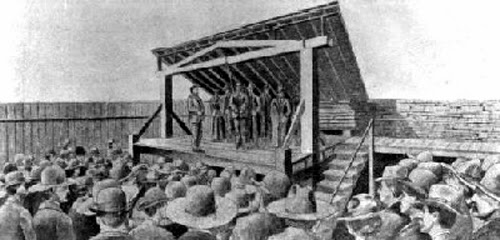
Fort Smith Gallows
The day twenty-year-old Crawford “Cherokee Bill” Goldsby stood at the gallows in Fort Smith, the U.S. Marshal asked him if he had any last words. Bill looked out at the crowd who usually gathered for these executions, and said, “I come here to die, not make a speech.” And he was then hung until dead.


You can read the fictionalized account of the Ft. Smith jailhouse meeting between Cherokee Bill and Henry Starr in Phil's award-winning novel,  Red Lands Outlaw, the Ballad of Henry Starr. Other novels by Truman include GAME, an American Novel, a sports inspirational about small town schoolboy football, and Legends of Tsalagee, a mystery/adventure in a small town. His western short story “Last Will for an Outlaw” appears in LaFrontera Publishing’s anthology, Dead or Alive, released June 2013. 
 
Phil’s website is: http://philtrumanink.com/  


Tuesday, March 4, 2014

Western Trail Blazer - new releases


We have several new things for you this month- including volume 2 of our ongoing anthology series Western Tales! that features several names that should be familiar to you. We also have three new short stories, the first published western by each of the three writers (though they've all done a good bit of writing.) Pay attention- these are names you'll be hearing a lot from in months and years to come.

Plus, we have a full-length novel from Dave P. Fisher, two-time winner of the Will Rogers Medallion Award!


We have a lot more in store for you next month -with several full-length novels on the agenda. Check us out at www.westerntrailblazer.com
 
Troy D. Smith


Writing about Indians When You're Not One: The Environment

Troy D. Smith

You remember the commercial. Iron Eyes Cody was paddling a canoe along a polluted, sludged-up river. The narrator -I think it may have been William Conrad -says: "Some people have a deep, abiding respect for the beauty that was once this country. And some people don't."

At this point, a passing car throws the remnants of a happy meal at the Indian's feet, and we see a single tear rolling down his cheek.


CRYING INDIAN on Youtube

It is a familiar message. Native American Indians are often presented as, not only stewards of nature, but intrinsically a part of it. It is what Thoreau called "Indian wisdom" -being at home in nature, not a visitor to it.

On one hand, there is a lot of truth to that imagery. American Indians tended to be more in balance with their surroundings than were the European colonists who showed up one day in their world. Many Indian cultural groups believed in something scholars call "ordained killing," the idea that every element in the food chain is aware of their role and submissive to it, for the greater good of everything. Hence hunters would often have rituals to thank the spirits of the animals they killed, and some cultures practiced above-ground "burial" to make it easier for the animals to eat their flesh, thus ensuring that the great circle would continue.

Many of their practices fly in the face of the modern American images of them as people who did not transform their environment, but rather lived in tune with it. Indians around North America engaged in controlled burning, for example, transforming the forests and prairies. One effect of this practice was to remove underbrush that would otherwise provide kindling to lightning storms and lead to wildfires. Another was to aid in hunting; the sprouts that appeared in recently burned areas were especially enticing to many animals, making it easier to hunt them- the new growth brought your prey to you rather than you having to chase them down. The controlled burns were also conducive to transportation, for the great forests east of the Mississippi -cleared of underbrush -were much easier to travel through than they would be later. Early colonists marveled at the fact a man could gallop through a forest on horseback.

The Hohokam of the Southwest practiced extensive irrigation. Eastern Woodland Indians understood the concept of crop rotation, and of mixing several kinds of plants together in a field so that each could symbiotically aid the other -the tall corn provided stalks for bean vines to wrap around, and shade for gourds and pumpkins.

And of course, as western fans, we are all familiar with the bison culture of the Great Plains, in which Indians used "every part of the buffalo," never being wasteful.

But there is another side to the story.

Let's look at bison. Before the horse made hunting buffalo easier and more practical, Indians who lived and hunted on foot had to use other strategies. Many of you are probably familiar with the practice of frightening whole buffalo herds into stampeding over cliffs. Did the Indians use every piece of the buffalo, sometimes dozens or more, who crashed to their deaths? Of course not, there was far more meat there than the average band could use, or transport, so it was left to rot. This was due in part to the seemingly unending supply of bison on the plains, and partly due to the common belief that they were a gift to humans from the gods; so long as the right rituals were being practiced, they would always be provided for human beings. As Jay Leno might have put it, keep eating those Doritos. We'll make more. Therefore, there was no reason to conserve. Some historians, most notable Dan Flores, have suggested that over time the more efficient methods of hunting brought on by the horse, coupled with those cultural attitudes, might well have led to bison becoming endangered even without the help of white people.

Controlled burning was not always all that controlled, and sometimes resulted in disastrous forest fires. Large settlements like those of the Hohokam and Anasazi in the arid southwest, and at Cahokia in the Midwest, may have been abandoned due to the fact that their populations were unsustainable by the resources available, leading people to abandon them and reorganize into smaller bands.

Over time, many Indian groups abandoned their balance-oriented traditional hunting methods once they were introduced to the European trade system. Trade items previously viewed as luxuries came to be viewed as necessities -and the only way to get them was to give Europeans what they wanted. Which was furs (and sometimes captives to buy as slaves.) This led to an abandonment of the old ways and hunting practices that led to many species becoming endangered. Few people realize that white-tailed deer were hunted almost to extinction in the American South in the late eighteenth century, in large part by Indians who desired their skins as trade items to get European goods. I have often wondered if that is why deer in the South tend to be much smaller than those in the upper Midwest and Great Lakes region; because only the smallest and fleetest managed to survive that period of overhunting and reproduce.

I think the best explanation is this: American Indians, by and large, were a whole lot more responsible with their resources than the white colonists were. But they were not perfect, and do not really conform to our "Crying Indian" view of them; when push came to shove, they often behaved like -well, human beings. In fact, that last sentence could aptly sum up the overarching theme of this whole blog series. Indians were not (and are not) the "red devils" and savages they were often accused of being (side-point: the English word savage comes from the Latin word for forest.) Nor were they the romanticized, supra-human ideal "noble savages" that observers have wanted them to be since the earliest period of colonization. They were, and are, human beings. Which means that sometimes -many times -they did not do the right thing. That may be viewed as the deconstruction of a myth, but I believe it is, rather, the reconstruction of reality.

Saturday, March 1, 2014

More on Clay Allison

Charlie and Yoko Yoshida
of Western Union, Tokyo, Japan
You might be surprised, but Clay Allison killed his first man on the side of the law. A man named James Kennedy, whose trial for murder resulted in a hung jury, was locked in a butcher shop pending a new trial. Allison and friends did not want a new trial, did not want Kennedy acquitted, and so they broke into the butcher shop the night of October 7, 1870, and strung Kennedy up to a nearby beam.

Allison then returned to his normal occupation of stealing other people’s livestock. The very next year, in late April, Allison and a couple more cowpokes ran off with a dozen government mules, which belonged to General Gordon Granger. This was the very same General Granger who had been in charge of reconstruction in Texas 1865-1870. Clay Allison became angered at his policies and his presence in New Mexico may have made Allison so mad that he balanced the scales a tad by taking the mules and selling them in Mexico.
 
General Gordon Granger
Later in the year, he tried to partake of government stock again. Everything went wrong, and he shot himself in the foot. He limped after that until the day he died, and it made him harder to get along with than ever, if that is possible.

Still, the first man Clay Allison killed with a sixgun was "Chunk" Colbert. In Colorado, a month before he met his demise, Colbert had killed a man named George Waller in a dancehall somewhere near Trinidad. Colbert met Allison in Otero, New Mexico, January 19, 1874. They ate together and drank together, warily, it seems. They bought oysters, the story goes, and while eating them, Colbert drew and fired a shot at Allison. But he was in such a hurry that the gun’s barrel hit the table and the bullet missed. Allison shot Colbert in the head. Sheriff John Turner, who was chasing Colbert, arrived in Otero after he’d been dead just one hour.

Some days later, Charles Cooper, a friend of Colbert’s, who may have known something about the killing that would put Allison in a bad light, came up missing. They say Allision killed him. But no one will ever know.

Clay Allison’s name is mixed up with the Colfax County War, too. The reasons for the war have nothing to do with Allison, and about all that needs to be said is that the Santa Fe Ring and the Colfax Ring both wanted control of the Maxwell Grant. As the war heated up, the Santa Fe Ring brought Clay Allison in. No one knows what the terms of the Santa Fe-Allison agreement were, but right away, he and his cowboys started raiding ranches at night and actively supporting the Santa Fe Ring’s three Republican nominees—Elkins for reelection to Congress, Longwill for probate judge, and Mills for state legislature—in the 1875 election.
Elkins of Santa Fe Ring

The gunman we’re talking about once joined a cattleman’s association. Despite being a cattleman’s association, its name was The Industrial Association of New Mexico. Its president was Tom Stockton. Henry Porter and Finis “Fine” Ernest, both of Denver in later days, were directors. Ernest was set on running homesteaders off, and swore out warrants on 25 of them. He jerked them around so badly that Allison got angry (as he was wont to do). He accosted Ernest, tapped him on the hat, turned him around a couple of times, and gave him a bit of advice. “. . . you dirty son of a bitch, don’t let the sun set on your ass in this town.” Ernest moved back to Colorado the following spring, taking his 7,000 head of cattle with him. No one knows why Allison sided with the farmers on that occasion. But it seems that his decision to ride for the Santa Fe Ring stemmed from personal spite, not some idealistic idea of himself as a hero of the downtrodden.

Reverend Tolby
A Methodist Ministry, Franklin J. Tolby, was killed in Cimarron Canyon as he was returning from Elizabethtown. Ambushed, he was found lying by the tributary that now bears his name. It was not robbery as his horse and personal belongings were untouched. But he was anti-Santa Fe Ring and was suspected of sending letters to the New York Sun exposing corrupt methods of the Ring. Later, the Daily New Mexican of Santa Fe had an article that said, “It is thought the murderer is a white man and paid for the job.” There was also a rumor that it was Allison, and he did lie low for some time. Shortly thereafter, Allison broke with the Santa Fe Ring.


Wow. The Clay Allison story winds onward. There is at least enough for another blog. See ya next month (notice Clay has nothing to do with Wicked Wednesday).