Showing posts with label #WildTexasHearts. Show all posts

Thursday, April 4, 2019

Carved in Stone—or Shell


 I have always loved cameos. I received one as a birthday gift years ago, white carving on a brown background set in an antique gold broach, and it’s one of my favorite pieces of jewelry. Not because I wear it all the time, but because of the history of the gift. My history.

Recently my mother, sister and I were sorting through my grandmother’s jewelry. Among the dozens of bird and animal pins—she loved wearing them for her kindergarten students—were several cameos. Some were plastic, others looked to be rather old. Since GGG (she signed her cards this way for years—it stands for Great Grandmother Grace) didn’t collect fine jewelry, the old pieces were probably her mother’s. Looking at those wonderful pieces got me thinking about the history of the cameo.

The cameo is much older than I thought. Though the origins are still under dispute, most think the word “Cameo” comes from the Hebrew word KAMEA, meaning a charm or amulet, or from the Latin CAMMAEUS, meaning "engraved gem".

Historians believe this carving tradition came from Alexandria, Egypt, nearly three centuries before the birth of Christ. Early Greek and Roman carvings featured images of gods and goddesses, mythological scenes and biblical events. Some immortalized rulers or heroes. During the era of Helen [323BC – 31/30BC], women wore cameos depicting a dancing Eros as an invitation to perspective lovers.


Queen Victoria popularized the cameos made of sea shells. Napoleon wore a cameo to his own wedding and founded a school in Paris to teach the art of cameo carving to young apprentices.

Stone, shell and coral are the materials most often used for the carvings. In stones, you’ll find agate and less often, turquoise.

Shell is probably the most commonly used material, because of its availability to carvers in all locations and financial situations. Among the shells used are Cornelian, Cassis Madagascariensis, Empire Helmet or Conch, Sardonyx, and Strombus Giga

The cameos we’re most familiar with show a young woman, hair and dress appropriate to the period of the carving, in various colors.

I still don’t know the origin of the lovely pieces in my grandmother’s collection, but that doesn’t matter so much. I appreciate them for their beauty and the history they represent—my history.

Do any of you own cameos? Do you know where they came from?

www.tracygarrett.com

Thursday, February 7, 2019

LULU BELL PARR, CHAMPION LADY BUCKING-HORSE RIDER OF THE WORLD


“Bronco busting isn’t a game for the timid and weak,” Buffalo Bill Cody told newspaper reporters in January 1912. “Death lurks close every time a rider mounts up.”

Lulu Bell Parr thrilled audiences around the world with her daring rides on unbroken ponies. Born in 1876, she was only three when her parents died and she and her brother were sent to Ft. Wayne, Indiana to live with their uncle, William Sheehan. She burst onto the Wild West Show scene in 1903, when newly divorced Lulu Bell joined Pawnee Bill’s Wild West Brighton Tour and traveled to Europe where she performed for King Edward VII.
Lulu Bell moved from one wild west show to another, from Pawnee Bill’s to Buffalo Bill Cody’s, to the 101 Ranch Wild West program. With them she toured South America and charmed Argentina’s President Jose Figueroa Alcorta, who showered her with flowers and gift. She moved back to Pawnee Bill’s show in 1916, riding the decline of the entertainment form until her retirement in 1929. Fifty-three and broke, Lulu moved to Dayton, Ohio, to live with her brother and his wife. She spent her days entertaining children in the neighborhood with stories of her travels and the horses she’d ridden.
Lulu Bell Parr died on April 24, 1960, from complications she suffered from a stroke. Among her possessions was an ivory-handled Colt single-action revolver engraved with the words “Buffalo Bill Cody to Lulu Parr – 1911.” Newspapers reported she had so many souvenirs of her career you could hardly walk into her room.
In 2005, Lulu Bell Parr was inducted into the Hall of Fame at the National Cowgirl Museum and Hall of Fame in Fort Worth, Texas. She was, and is, considered the “Champion Lady Bucking Horse Rider of the World.”


Tracy Garrett

Facebook  TracyGarrett.author
Bookbub  @TracyGarrett
Twitter  TGarrett_Author

Thursday, October 4, 2018

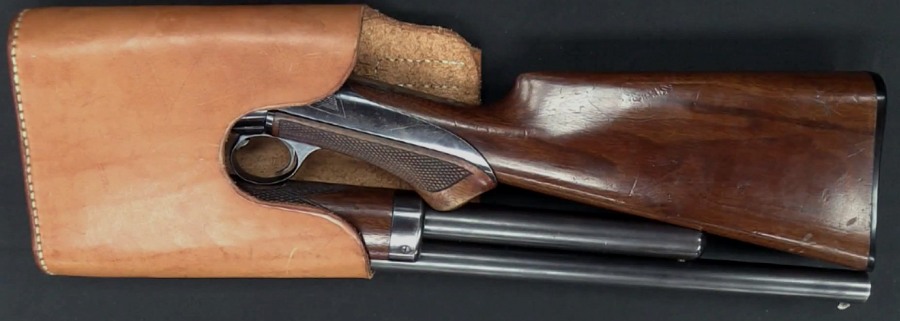
Burgess Folding Slide-Action Shotgun


Have you ever heard of a folding shotgun? I hadn’t until I was introduced to the Burgess Folding Slide-Action Shotgun, made in the 1880s.


Andrew Burgess (1837-1908) was a photographer, arms inventor and manufacturer, who apprenticed with Mathew Brady in 1855. In late 1864, he undertook an extended tour of the war-torn South following the American Civil War, photographing as he went. He is said to be the one who took the photograph of President Abraham Lincoln that is used on our currency.


Burgess received his first patent (no. 119,115) on September 19, 1871 on an improvement to the Peabody rifle. In all, Burgess registered 894 patents. In addition to manufacturing his own guns, he produced designs for Colt, Marlin, and the Whitneyville Armory. He founded the Burgess Gun Company in Buffalo, NY, in 1893, to produce his folding shotgun. In 1899, Burgess sold the company to Winchester, who promptly discontinued production of folding shotgun, reportedly to eliminate the competition.


The folding slide-action shotgun went into production in 1884. It had a 6-round maximum load in the magazine below 19-20” barrel. The shotgun has an iron sleeve over the stock wrist that activates the bolt and breech mechanism when slid backwards. It’s hinged on the underside of the receiver with a lift lever on top to release the barrel so it can be folded. A waist holster was made to go with it with loops to secure it to a belt.


These shotguns could be purchased in in Arkansas, Texas, Oklahoma and New Mexico. It was advertised as being especially adapted for police service, express messengers like Wells-Fargo agents and shotgun messengers, U.S. Marshals, prison and bank guards. Pat Garrett had one in his wagon the day he was killed.


The shotgun was also used by police and prison guards in New York. In 1895, a zealous gun showman and salesman arrived at the New York City’s Board of Police Commissioners office of Theodore Roosevelt with a Burgess folding slide-action shotgun concealed under his coat. He proceeded to pull the gun and fire six shots—blanks, thankfully--into the ceiling. An impressed Mr. Roosevelt placed an order for the guns for the guards at the Sing-Sing prison, among others.


VIDEOS AND PHOTOGRAPHS

NRA Museum:


The Burgess Folding Slide-Action Shotgun


See you next month!
Tracy

Thursday, August 2, 2018

The Crash at Crush


Have you ever heard of the Crash at Crush? It started as a publicity stunt. Crash two locomotives together and sell tickets. They’d done it before to the accolades of  spectators.


William G. Crush, agent for The Missouri-Kansas-Texas “Katy” (MKT) Railroad knew that the public was fascinated by train wrecks. They seem to be the California Police pursuits of the 19th century. People would travel from miles away just to get a look at the twisted metal and destruction, the victims scalded by the explosion of the engine’s boiler.


[This is Mr. Crush as sketched for the Galveston Daily News on September 16, 1896.]


So, William pitched an idea to Katy Railroad officials: intentionally crash two trains in full view of spectators. It had been done successfully a few months earlier in Ohio, to the delight of spectators.


Needless to say, his superiors loved the idea.


The town of Crush, Texas, complete with a depot, was constructed just for the event. A special branch line of tracks was laid about 4 miles outside of the town of West. Wells were dug, water was run, food and drinks were available for purchase, and a huge tent was borrowed from Barnum & Bailey Circus to serve as a grandstand and protect the elite guests from the weather and the common spectators.
Rather than charge admission to the event, the railroad decided to make the event free—and charge $2 round-trip for a ride to site of the crash.


Everything was ready when dawn came on September 15, 1896. The train engines, #999 and #1001, were painted bright green and bright red, respectively. Both had been stripped down to ensure nothing went wrong. Six cars were attached to each engine to enhance the crash.


The organizers expected around 20,000 spectators to show up and planned accordingly. By the time the event started, more than twice that number jammed the small valley. Every inch of ground was jammed with people waiting to see two trains smash each other into scrap metal. A carnival atmosphere prevailed, complete with medicine shows, game booths, politicians and souvenir stands. The men, women and children were given until late afternoon to listen to speeches and spend their money.


At 5pm, the two trains nosed together as if shaking hands and posed for pictures. They then backed up the low hills to opposite ends of the four mile track, and at ten minutes after 5pm, as Mr. Crush sat on horseback and waved a white hat as a signal, the engineers opened the steam to the predetermined setting and put the trains into motion before jumping off.


I’ll let the reporter for The Dallas Morning News describe what happened:


      "The rumble of the two trains, faint and far off at first, but growing nearer and more distinct with each fleeting second, was like the gathering force of a cyclone. Nearer and nearer they came, the whistles of each blowing repeatedly and the torpedoes which had been placed on the track exploding in almost a continuous round like the rattle of musketry. ... They rolled down at a frightful rate of speed to within a quarter of a mile of each other. Nearer and nearer as they approached the fatal meeting place the rumbling increased, the roaring grew louder ...


      "Now they were within ten feet of each other, the bright red and green paint on the engines and the gaudy advertisements on the cars showing clear and distinct in the glaring sun.


      "A crash, a sound of timbers rent and torn, and then a shower of splinters.

      "There was just a swift instance of silence, and then as if controlled by a single impulse both boilers exploded simultaneously and the air was filled with flying missiles of iron and steel varying in size from a postage stamp to half of a driving wheel ...


      "All that remained of the two engines and twelve cars was a smoking mass of fractured metal and kindling wood, except one car on the rear of each train, which had been left untouched. The engines had both been completely telescoped, and contrary to experience in such cases, instead of rising in the air from the force of the blow, were just flattened out. There was nothing about the cars big enough to save except pieces of wood, which were eagerly seized upon and carried home as souvenirs." 


The plan was for the trains to reach approximately 10mph by the time they met in the middle. Instead, they were traveling closer to 45mph. The impact sent shrapnel flying more than 100 feet into the air—and into the crowd. Miraculously, considering the size of the crowd, only three people were killed.


William Crush was fired the evening of the crash, but Katy Railroad officials rehired him the very next day, and he worked for the company until he retired.


The "Crash at Crush" was immortalized by famed Texas ragtime composer Scott Joplin in his march, "The Great Crush Collision March." Click here to listen to the music  – complete with crash and scream:  http://www.perfessorbill.com/covers/crush.htm


It was a publicity stunt that will never be attempted again – but the stories remain, told over and over by those who were there for the Crash at Crush.


Tracy Garrett
UNDER A WESTERN SKY

Thursday, July 5, 2018

Who Knew There Were Stock Detectives?


I love research. Story ideas, setting, even characters can come from one of those tidbits I discover when I fall down the rabbit hole of research.


The other day I was reading an article by Dennis Adler in Guns of the Old West magazine. The article talked about a revolver that is engraved with more than 50 cattle brands. A line in the article mentioned stock detectives, men who were employed by ranchers to sort out an “discussions” that came up about which cattle belonged to which rancher.

I’ve never heard of a stock detective. So, of course, I started digging through cattlemen’s association articles, the Anti Horse-Thief Association website (that’s another blog, right there), books and some Oklahoma history publications. Fascinating stuff.

When the problem of cattle rustling grew bigger than a town’s law could handle, ranchers often hired their own enforcers. Retired lawmen, like Retired Special Texas Ranger Augustus Judson Votaw, became livestock inspectors. They had to recognize the dozens of brands at a glance and ensure the men in possession of the stock were actually the legal owners. 

I can already imagine a hero whose job was to ride into danger with nothing but his wits and weapons, can’t you?


Until next time,

Tracy


Thursday, May 3, 2018

You're Invited to a Gunboat Tea


On my first trip ever to Charleston, SC, I wanted to see as much history as we could squeeze into the few days we were there.  On our trip to the Fort Sumpter Visitor’s Center, I spotted a partial French porcelain tea set from the 1830s.


Seeing cups and saucers that would have been part of Charleston life wasn’t unexpected. However, the reason these artifacts were included in the museum was.  The set had been donated for a Gunboat fair. Families gave up their prized possessions to be sold or raffled off to raise money for the war effort, in this case, to raise funds to build a gunboat for the Confederate Navy.


Items such as a tea set, a linen fan, even a string of pearls—anything that might bring in some needed cash. Mary Boykin Chestnut, raised the daughter of a planter and married to Brigadier General James Chestnut, Jr., an aide to Confederate President Jefferson Davis, the frivolousness of such heirlooms when lives were at stake:  “Our silver and gold, what are they?—when we give up to war our beloved.”


Here’s the picture I took through the display case so you can see the colors of the tea service. Pretty, isn’t it?


For more information, check out “Stolen Charleston--The Spoils of War” by J. Grahame Long.

Tracy