Showing posts with label Larry J. Martin. Show all posts

Friday, January 10, 2014

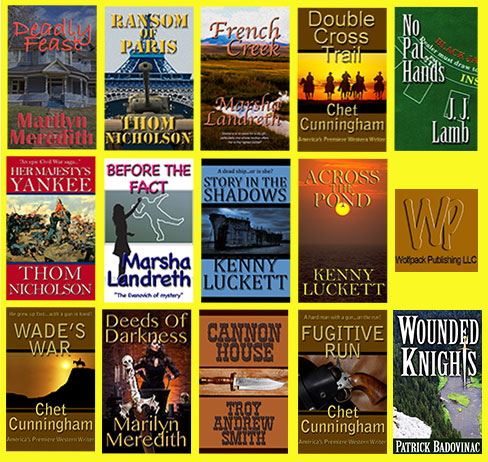
WOLFPACK PUBLISHING LLC BY L. J. MARTIN


Twenty eight years ago I sold my first book, a western. I'd like to report that I made lots of money, but the fact was for seven more years I found myself staying in the real estate sales/appraisal/contracting biz so we could eat. My wife, Kat, sold her first book six weeks or so before I sold mine. She wrote what she read, which I recommend to any reader/writer, and was smart enough (or sexy enough) to read romance, which was selling 55% of all mass market books at the time, and I'm sure still is. She was able to write full time after a few years, and I'm thrilled she was.
And I was smart enough to spend half my time promoting her career. She's now two dozen times on the NYT, the last eight on the top 15 published portion. But that's now. She had a webpage, thanks to my writing one longhand before there were programs to do so, at the inception of that discipline, as did I, and she had a opt-in mailing list before it was the norm, and on and on. We tried to stay ahead of the curve, and still do.

Back then, 27 years ago, brick and mortar publishers were the only way to go if you wanted to make a living in the biz, and having both been salespeople most our lives, we jumped right into promoting our work, mostly via the 1,200 independent distributors who were then in the biz, each with their own in-house book-buyers. We watched that change to about 20 bookbuyers who made a difference over the next 20 years.

As radical a change as that was, it didn't hold the proverbial candle to the inception of eBooks. WOW! Now, almost overnight, you could get in front of millions of bookbuyers, not those who bought thousands of books, but those who bought only one at a time...but there were and are so many more of them. Not only 20, but 20 times a hundred million. And you don't have to go to a 5:00 AM meeting of delivery drivers and buy the donuts to win their favor. All you have to do is get a book in front of them that they want to buy.

As a western writer who drifted in and out of mysteries and other genres, I had no great tie to the legacy publishers in NY, so I embraced the internet opportunity.
Oops, but how to you do that, get a book in front of them, when millions, that's MILLIONS of other authors want to do the same thing?

That's the question.

I started selling on the web several years ago, and never made more than beer money, until I partnered up with a guy who'd been selling on the web since it's inception. But he'd never sold books. He'd sold poker parlors, tools, politicians, etc., etc. But never books. When asked if he could sell books, he shrugged his shoulders and asked me, "what's special about books?" The fact is, not much. Yes, you have to target a market who likes to read, but then he'd been targeting specific markets for years. After tying up with him I was, almost immediately, selling hundreds more books per month than I had been on my own, and making forty times as much dough. I'm not buying a yacht or airplane, but I've got some spare dough I didn't have before, and I've put those old Bantam, Avon and Pinnacle books back to work, as well as anything I care to write currently.

And he and I are Wolfpack Publishing LLC.

We worked my books for a year or so, selling many thousands per year which we're still doing, then decided to entertain selling other writers as well...and we're doing well, very well, doing so. So far this month we have two writers with over 2,000 books sold, and that's for less than a third of a month. Some old friends of mine are again making money in the book biz, money they deserve after years of writing, and I LOVE that fact. WOW, is my only response, and we're still learning the book selling biz on the net.

The end of December we had 16 of the top 100 action adventure novels on Amazon's action adventure lists, and that's up against the big boys in the biz. To be frank, I'm astounded, and you can't wipe the kakaeatin' grin off my face.

I spent a lot of valuable writing time on the internet trying to learn the ins and outs of selling on that venue...and I'd been a hell of a good, no great, salesman in real estate before I started writing, having sold over a hundred million in product my last year in that biz, but this was different. It wasn't face to face interaction, but my partner, Mike Bray, had been at it for years. Did I want to go through the several year learning curve he went through? No, I wanted to write. However, I also love designing covers, and so far they've been pretty damn successful...however as you well know, a good book is a good book, no matter the cover. But you've got to have the cover and great cover copy to get them to pick it up, unless you've got great word of mouth, and great exposure brings great word of mouth to a good book, and that's where exposure to the market comes to the forefront. Somebody's got to read it in order to recommend it.
We'll entertain your single title, but if you have multiple titles in your blacklist, you're the writer we want to run with.

And we don't give a hoot who else is selling your book. There will be a time when we want exclusivity, but that time will come when you see that you'd be foolish to choose someone else.

Yeah, we're confident. Give us a try.

These went up yesterday:

Saturday, November 9, 2013

A REVIEW OF WOLF CREEK: BOOK 1, BLOODY TRAIL BY CHARLIE STEEL


When I first heard that Western Fictioneers was going to write a series of books about a fictional western town in Kansas by multiple writers under one name, I thought, yeah—right, that’ll work. My cynicism was wrong. IT DOES WORK.

Under the fertile mind of Dr. Troy Smith, (current Western Fictioneers President and Professor of American Indian History at Tennessee Tech University) he single handedly developed the original concept of having multiple writers create a series of books under the fictional name of Ford Fargo. The imaginary town where interaction of the multiple characters would take place was Wolf Creek, Kansas. Spending a great deal of time and creative thinking, Dr. Troy Smith developed a “bible” of names, dates, and history of the town and its characters. With each character having a back story, the participating multiple writers of Western Fictioneers utilized this data and plot information to write individual chapters that could be combined into one cohesive book. The result, Voila! As to date: Nine Wolf Creek series books have been written and published by Western Fictioneers.

Not only is this a new concept in writing (for westerns), it’s one that has caught on with the readers---and the book series is reportedly selling well.

In reading the first book of the series, Wolf Creek: Book 1, Bloody Trail, I was blown away with the complex plot and multiple characters introduced in the first two chapters by writer Clay More (Dr. Keith Souter). There is a plethora of western characters introduced, such as you would find in any other town. Many of these individuals have been hardened by life, struck with grief, tragedy, and scarred by the Great Conflict. They have fled their secret pasts to start anew in Wolf Creek, a thriving community established on the stream by the same name. With the coming of the Atchison, Topeka, and Santa Fe Railroad, shortly after the Civil War, Wolf Creek became a growing cow town.

Chapter Two is one of the most exciting and dramatic episodes I have ever read in any book. Wolf Creek is suddenly raided by over twenty ex-soldiers, all experienced killers, former members of Quantrill Raiders. They ride into town, guns blazing, and in the process of thieving and robbing the bank, they execute a well planned military type raid by shooting down men, women, children, and horses and setting fire to various buildings. How the town endures and barely survives this unwarranted attack of over twenty killers, is an unforgettable and complex scene no reader will want to miss.

Chapters Three and Four are written by James J. Griffin. An experienced horseman himself, Griffin describes in detail how a posse is formed and rides out and begins to chase down the town killers, thieves, and bank robbers. Griffin’s expertise and horse knowledge show the importance of proper rest and treatment of the equines along the trail, or else their chase would end before it began. The interaction between the members of the posse describes men with tragic and hardened pasts, which as westerners, ends up serving them well in their long bloody chase after the outlaws.

The book then, in the following consecutive chapters, as the title indicates becomes a bloody tale of pursuit and justice.

However, this is no ordinary story of outlaw versus good guy. Intertwined in the following chapters written by Troy D. Smith, James Reasoner, L. J. Martin, and Cheryl Pierson, is a well developed interplay of specific characters who reveal their hidden pasts along the outlaw’s trail.

Quickly we learn that there are no innocents, even among the posse. We follow their rugged pursuit as they face ambush. Some in the posse are killed, others are wounded, all face hunger, thirst, and deprivation in their pursuit of the killers. Conflict arises between former union and confederate soldiers. The character interaction increases in intensity as the posse moves forward. It is only the ambushes and dangers they face from traps left by the outlaws that manage to keep them focused and together.

With each chapter we continually learn more about many of the posse members. Of most interest, were four distinct characters. The first is Dr. Logan Munro, a man of the world. He served as a physician and British soldier in the Crimean War and was later stationed in India, where he encountered the Indian Mutiny of 1857. During that time, his beloved wife became ill and died. Grieved that he could not save her, Dr. Munro ended up traveling to America and serving as a doctor in the Great Conflict. Having served in so many wars, and operated on countless wounded young soldiers, Munro is tired of death. He wants only to settle down in Wolf Creek and treat the town’s patients and live out the remainder of his life peacefully. With the raid on Wolf Creek and with so many of his acquaintances killed, he again picks up his Beaumont-Adams revolver and joins the posse to serve as doctor and experienced soldier.

Charley Blackfeather, half black/half Seminole has been hardened by the circumstances of his birth. At an early age he fought American soldiers who had come to Florida to forcibly remove and combat his tribe. In the swamps of Florida he learned stealth and the abilities to silently use knife and tomahawk. Having seen his family, friends, and fellow half black Indians stolen and sold into slavery, murdered, or forcibly assimilated and sent west, and to escape slavery himself, he joined an Indian Union regiment and fought in the Civil War. During the conflict he fought members of Quantrill’s Raiders who murdered many of his best friends. For Charley Blackfeather, this raid is not just to seek vengeance for the attack on Wolf Creek. It was to seek justice and find and kill those who murdered his friends. Above all those in the posse, Blackfeather is the most skilled in the art of weapons and death.

The third most interesting character for me, is Spike Sweeney. He is Wolf Creek’s blacksmith, and an ex-confederate soldier. Scarred by the war, he plans to live out his life tending to his trade and minding his own business. When the raid on Wolf Creek occurs, he sees he must act. Using his former military skills, he is a great asset to the posse, although somewhat distrusted. This trail of justice and revenge has hidden rewards for Sweeney as he learns to heal, through coming to the realization that many soldiers he fought against were human beings much like himself.

Last, Bill Torrance, the livery owner, watches as his best friend was shot down and killed, as was the woman he had great affection for. Putting on guns he swore he would never use, he joins the posse. On the trail a secret of his past was revealed, making him uniquely suited for this lawful pursuit.

This review does not in any way begin to do justice to this first book of the Wolf Creek series. The reader will have to take my word that regardless of genre interest, everyone will find this a well-written and exciting book. I predict a great future for the Wolf Creek series and easily see a Hollywood movie, or a long playing television program come from this exciting creation.

So, without reservation, I say: Wake up America! Pay attention Hollywood! This is an extraordinary Western epic of Americana and a great story any reader of any genre would want to buy and enthusiastically consume.

Review by Charlie Steel, author of Desert Heat, Desert Cold and Other Tales of the West.

Sunday, August 11, 2013

Why Jump Into The Rat Race of Publishing? by L.J. Martin

After 30 years of writing and over 30 book length works, dozens of short stories and articles, a blog with over 3,500 postings, a half-dozen screenplays (only one of them optioned) and helping my wife become an NYT best-selling, internationally published romantic suspense author (who's convinced I'm nuts), why would this fool rush into where angels fear to tread?

Publishing is easy; the work involved in bringing a digital book to market. Selling books, be they paper or digital, is damn hard. However, I couldn't pass up the opportunity to suddenly be able to have someone in a mud hut in Zimbabwe be able to buy my book without me spending a damn dime on advertising. And be able to buy it for $.99 with my cost being a fraction of a mil…that's a tenth of a cent. And I'm going to make $.34 on that sale. That's the power of the web.

When Kat and I jumped into the writing biz, shortly after I'd had a real estate sales year exceeding a hundred million bucks, the biz was a totally different animal than it is today. Then I quickly developed a mailing list of over 1,200 independent distributors. About 1,100 of them (or more) are now out of the business as individual entities, now consolidated into huge companies. Then, 25 years ago, you may recall that every 7-11 store had a ten or twelve-shelf high four-foot wide book-rack, or a spinner holding an equal amount. Every truck stop had a rack of books twice that number. Kat and I signed for many years at NATSO, the National Association of Truck Stop Operators, and it was a powerful sales tool. Now you can't find a paperback in most truck stops. We were able to visit those independent distributors who stocked supermarkets, drug stores, and chain stores where 80% of all mass-market books were sold. And we could actually talk with—schmooze—book buyers, who made the buying decisions for their area. Now, from 1,200 there are about 20 who make those buying decisions for the WalMarts, Krogers, and Targets of our world. Waldenbooks had 1,100 stores…I don't know of one today, but then I'm happily located in the boondocks. Bantam, who did a wonderful job with seven of my titles, had over 250 salesmen in the field…I bet that number is far, far less today.

I cannot tell you how many drivers meetings I dragged Kat to (kicking and screaming) at 5 a.m. so we could buy the donuts for the guys who actually racked the books in all those supermarkets and drug stores.

You get the point. The business of real hold-in-your-hand paper books, or hardbacks, has changed dramatically. It's becoming a digital world. The bad news? Anyone can get published. The good news? You can rise above all those bad books with good, entertaining, compelling novels that people want to read. But even the best books may not get read if they're lost in that plethora of lousy writing.

Yes, I'd still love to get a million dollar advance from Bantam or one of the other big publishers, and, yes, Kat does very, very well with over 15 million books in print and nice advances, but this wonderful opportunity is out there called the web. And I just couldn't ignore it, for I'm a salesman at heart.

But it, too, has its challenges. Now, due to the ease of getting a book "in print" digitally (and anyone can) every Tom, Dick and Harry (including those who write badly about hairy Toms and their dicks) are getting published. And some of them are doing very, very well with product that would have never gotten published by the so called legacy publishers…those are the big boys in the multi-storied high-rise buildings in Manhattan. There no longer is the filter of acquiring editors between the writer and the reading public.

How does one overcome that plethora of bad books that stand in the way of yours getting read?

One has to get his/her books in the hands of readers, and those books have to urge that reader to buy another…which leads us to the obvious problem: most authors only have one book. No matter how much a reader loves your book, if there's not another one of your titles for that reader to purchase, your ability to make real money is very, very limited. Particularly if you've offered that single book for a low, low price in order to get it widely read. The other side of that coin is the fact you've made $.34 on a $.99 book, one half of what you might have made had a legacy publisher sold your book for $7.00 and paid you a 10% royalty…and then you wouldn't see that royalty for two years, and sometimes not then.

The really good news: Amazon, the world's largest bookseller, has 250,000,000 (that's 250 million) credit cards on file. And if you do a good job promoting and consequently selling your book on their platform, they'll do an even better job doing it for you, and boy-oh-boy, they know how.


Wolfpack Publishing LLC, our new company, has just begun to publish with a dozen authors in our stable and twice that many books. We pride ourselves in selling books, not in editing, but in proofing, not in trying to judge what readers want, but in giving them a choice. Yes, we want compelling books that are properly formatted and without obvious errors, but to tell you the truth, I'm no judge of sci-fi, and not much of a judge of romance; my area of interest is westerns and thrillers, so I'll pass your book onto readers who read that particular genre and who will proof the book for obvious mistakes. And if they say there's someone out there who's a consumer for what you write, we'll publish it.

Our contract is an "author's" contract, after all that's where I come from. I revised the contract so any author could feel confident in signing it. We pay 50% of what we receive, primarily from Amazon Kindle, Amazon CreateSpace (paper), Smashwords, and Nook Press, and we pay within 30 days of our receipt of the money. We, or the author, can cancel the contract anytime with 30 days written notice. You don't like what we've done with your book, cancel. It's as easy as that. We don't expect to make much money from paper books. We attack that side of the business so the author will have something in hand to show mom, grandma, and that brother-in-law who's laughed at the author's attempts to get published. The money, large or small, will come from digital publishing.


As I said earlier in this blog, publishing is easy, you can get your book formatted for Amazon, Smashwords, or Nook Press for $35.00. Selling it is the hard part, for there are millions and millions of books out there on the digital market, and many, many more coming. There's lots of competition.

We signed an author a little over a month ago, and we sold over 450 of his books in July. Some 446 more than he'd sold for himself the month before. And we're still learning. We'd love the opportunity to help you do the same thing with your book. Find us on facebook at:

https://www.facebook.com/WolfpackPublishingLLC?ref=hl

I'm available at ljmartin@wolfpackpublishing.com if you'd like to learn more.


Tuesday, January 8, 2013

COOKING WILD AND WONDERFUL--LARRY J. MARTIN


I'm looking forward to talking cooking with y'all and hope you'll shoot me some of your favorite recipes from time to time.

I've been a cook all my life, starting, believe it or not when I was the ripe old age of eight, if you can call mixing up a box cake cooking, which was my first chore. My mom, a single parent, worked hard and had a thirty-mile drive, a long ways in 1947, and came home dog tired. My older brother, at twelve, decided we were going to have supper awaiting her, and we did from then on. I cooked my way through college, the only fry cook for 1,600 at lunch, and owned and cooked in a couple of restaurants. I've camp cooked since I packed and wrangled for a boy's camp at seventeen, and for lots of hunting camps since…including this year, fifty-five years later, with nine hunters in two sidewall tents.

And I've loved most of it, and here's why:
Somewhere close behind air and water is the need for food.


It’s a basic requirement of life, and when that requirement is met, then and only then, does art enter the equation.

A gruel of oats can satiate hunger, while a delicately wrought oatmeal cookie laced with walnuts and elusive chocolate chips can not only accomplish the same but also please the palate, the eye, the nose, the finger tips…and human curiosity. Sometimes, even an emotional need.

So great cooking, unlike all other art forms, fulfills not only the most basic needs and requirements, but also becomes art when it tantalizes and teases with smell, sight, taste, touch, and yes, sound that entices, entertains, even exhilarates.

And unlike all other art forms, it accomplishes all those things—but unlike most other arts, it’s transitory, and needs to be repeated over and over, in short order. Consequently the very repetition of the effort lends itself to becoming mundane. A menu repeating itself over and over, no matter how delightful at first, is soon boring. The trick is to tease and titillate and entice with new and exciting combinations and discoveries. There’s no need to bore yourself or friends and family…after all, there are hundreds if not thousands of ways to prepare even the humble potato.

There are many masters of the art of fine cooking all over the world, from every culture and country, from every race and religion, from every economic level. Great cooking is not a result of exotic and expensive ingredients, but more of sometimes delicate, sometimes rough, sometimes intricate, sometimes simple, combinations of flavors, textures, colors, and bouquets. The French have become internationally renowned for their cuisine, and it’s not because of expensive ingredients or elaborate preparation. It’s because of a respect for some basics.

There’s a time for all things, and all things in their time is probably the number one basic of good cooking. Spring is the time of awakening, the time for fresh asparagus, for fish fresh from streams and lakes newly reborn from winters ice, of lamb so tender it makes you want to weep and shout for joy simultaneously; Summer is rich, ripe tomato time, it’s earthy mushrooms from meadows recently kissed by warm rain, of seeds and nuts of hundreds of varieties; Fall is a celebration of stone fruit, of grapes, and sweet corn on the cob, and game from the hills and high mountains; and Winter is the time of the root and other late developing healthy, hardy vegetables—cabbage, broccoli, and cauliflower—of meat from the smoker, and of warming stews and pot roasts.

Yes, even here in Montana we can get a tomato in January, probably with a sticker extolling its birth in Peru or Mexico, but its been picked green as the proverbial gourd and will never develop that wonderful mesmerizing flavor of the vine ripened fruit. The fruit from Peru, like you after a many thousand mile journey, will be tired. Not like the one you’ve watched mature on a vine in your garden while guarding against horn worms which value it almost as much as you, or even one from your local farmers market picked ripe that morning.

Thoughtful and respectful menu planning is probably number two in the roster of basics of good cooking. A meal composed of sharp tastes from beginning to end is not particularly pleasing to the palate. A spicy soup, salad, entrĂ©, and desert does not give the palate time to recover, to relax, to prepare for the next gastronomic pleasure. Rather a mild soup, a sharp flavored Caesar salad tickled by crushed anchovy, a slice of medium rare roast beef smothered in brown gravy accompanied by asparagus lightly poached in butter and wine and a crusty bread lathered with creamery butter on the side, all followed by a rich cream brulee with a beautifully browned, tenderly torched, cinnamon kissed top, is the pace of a great yet relatively simple menu—and a pace respected by the wonderful cooks of Provence, of much of Italy, and of many other places across this fascinating world of ours.

Looking forward to our next visit. Here's a great little recipe for you if you love a GREAT steak. This is a marinade, applied to the meat just before you take it off the BBQ. Lather it on one side, flip it and lather it on the other, flip it so the fire hits it for twenty seconds, and take it off. You'll love the flavor, and your guests will have no idea why that fillet tastes so damn good.

Simple Sauce (the best for red meat)

Note: I originally got this simple recipe from a place I frequented for steaks when I was just a pup. Oft times the very best is the simplest, and this is one of those times.

• 1 cube butter
• ½ cup soy sauce
• 2 beef bullion cubes

Heat until cubes are dissolved. I use this on steaks and chops, basting them just before I take them off the fire, and if the fire flames up, all the better. I occasionally add garlic powder, lemon pepper, or other spices, depending upon my mood.

See you soon for more from The Kitchen at Wolfpack Ranch and Cooking Wild & Wonderful.