By Troy D. Smith
Westerns have been a staple genre of comic books –with some ups and downs –since almost the beginning of the medium. Two regular titles started in February, 1937 (over a year before Superman ushered in the superhero age) –Chesler/Centaur Publications’ Star Ranger and Comics Magazines Company’s Western Picture Stories, which featured the artwork of the legendary Will Eisner. It was a few years, though, before Westerns became huge, with their glory years running from the mid-40s until the early 60s.
Many comics were based on movie cowboy heroes or TV westerns, but there were also plenty of characters who originated in the four-color version of the Old West. Superheroes, horror, and science fiction started pushing Westerns to the margins in the late 1960s, and by the late 70s even the longest running stalwarts had been canceled.
Only DC’s Jonah Hex survived into the 80s –and in 1985 the character was transferred to a Road-Warrior-esque apocalyptic setting. Prospects were pretty dim for Western comics in the 80s and 90s, with a few very noteworthy miniseries representing the genre (including several starring the aforementioned Hex.) In the new century, however, Western comics have made something of a comeback. They don’t dominate the market by a longshot, but it is no longer shocking to hear that a new Western series has started up.


I have compiled a “greatest of” list of Western comics. Such a venture is always very subjective, of course. I have sought the input of other professional western authors and/or comics professionals, and carefully tabulated the votes –some of the results surprised me. For one thing, I wasn’t expecting so many titles from outside the United States. Half-a-dozen European comics are listed –four from France and one each from Italy and Spain. This just goes to show that the appeal of the Western is universal.
I am including below the Top Ten, with background information about each title or character. After that I have included the runners-up, in ascending order according to how many “points” they got in the poll (#1 picks got more points than #10 picks, and etc.)
How did we do? Did we forget any, or include any that you believe undeserving? Do you have a list of your own? Leave a comment, please!
Also, go here to read an interview I conducted a few years ago with comics icon Stan Lee, on the subject of Western comics:
http://tnwordsmith.blogspot.com/2011/03/1996-interview-with-stan-lee-about.html
First, our panel of respondents:
Peter Brandvold
Tony Isabella
Jeff Mariotte
James Reasoner
Troy D. Smith
Duane Spurlock
Timothy Truman
And now, the winners.
1. Jonah Hex
Bounty hunting anti-hero Jonah Woodson Hex has been slinging lead at DC comics since his creation by John Albano and Tony DeZuniga in 1972. While other western characters fell by the wayside in the late 70s, Jonah kept going till 1985 (after which the character was injected into a time-traveling Mad Max-like series that is best forgotten.) He returned in the 90s with three acclaimed miniseries by Joe R. Lansdale and Timothy Truman, and has once more starred in his own ongoing title since 2005, written by Justin Gray and Jimmy Palmiotti and illustrated by several different artists. Fans were excited to learn that, in what seemed like perfect casting, Josh Brolin was to portray the scarred gunslinger in the 2010 film; Brolin was good, but unfortunately the movie wasn’t.
Jonah Hex has a lot more in common with amoral spaghetti western characters like Eastwood’s “Man with No Name” than with the cowboy do-gooders of previous eras. His past is checkered, one half of his face is horribly scarred, his very name suggests that he is cursed, his revenges are often cruel, his Confederate heritage affects him in various ways (depending on the writer), and the hardest outlaws are justifiably terrified to learn they have become his quarry. He has been known to come to the aid of the helpless, but unlike other western heroes he does so reluctantly, against his better judgment. He is also unusual in that his ultimate fate was revealed early in the character’s existence; a 1978 story informed readers that a sixty-something Hex was murdered during a card game in 1904, and that his stuffed body was displayed in a traveling Wild West show.
2. Bat Lash

When Bartholomew “Bat” Aloysius Lash first appeared in DC comics in 1968, the tag-line read “Will he save the West, or ruin it?” In many ways, Bat seems like a character that could only have been created in 1968: A peace-loving gambler with a penchant for flowers (often wearing one in his hat and/or lapel.). Like the television character Maverick, he was never in a hurry to confront trouble, but could handle it when he had to. There were a lot of editorial hands in his creation, but Sergio Aragones and Nick Cardy were the creators most closely associated with the character. The Bat Lash comic only lasted seven issues, but the character did not fade away, frequently showing up in other books. He has appeared often in Jonah Hex comics, both in back-up series and as a guest star –the two very disparate characters have an uneasy (and often comical) friendship. An elderly Lash appeared in the 1998 miniseries by Timothy Truman, Guns of the Dragon, which was set in the 1920s; Lash had his own miniseries in 2006, Guns and Roses, by co-creator Sergio Aragones (of MAD Magazine fame), Western novelist Peter Brandvold, and legendary western comics artist John Severin.
3. Rawhide Kid
The Rawhide Kid first appeared at Marvel Comics (then known as Atlas) in 1955, lasting until 1957. The first issue was drawn by Bob Brown, and (probably –no one remembers) written by Stan Lee. That early incarnation of the kid was a stern blond man in buckskins. The title was re-worked in 1960 by Stan Lee and Jack Kirby, with much greater success. This Rawhide Kid was a diminutive, red-haired 18-year-old named Johnny Bart. Johnny was orphaned in a Cheyenne raid and raised by a Texas Ranger named Ben Bart, whose murder led the teen on a quest for justice and a career as a gunfighter. A misunderstanding caused the Kid to be a wanted fugitive, wandering the West and righting wrongs while trying to avoid the law. The title lasted until 1979. For most of those years, it was written and drawn by Stan Lee’s brother Larry Lieber.
The Rawhide Kid, along with most of Marvel’s western heroes, encountered the time-traveling superhero group The Avengers a couple of times in the 1970s (or the 1870s. Whatever.) He had his own miniseries in 1985, set around 1900; in the early 2000s he appeared in two miniseries by John Ostrander and Leonardo Manco, Blaze of Glory and Apache Skies. The Ostrander / Manco Kid had long hair and dressed in a much more realistic style. In 2003 the Rawhide Kid made national headlines with the release of the miniseries Slap Leather, written by Ron Zimmerman and drawn by John Severin. Zimmerman’s Kid was flamboyantly gay, and the story was a combination of slapstick and broad innuendo. It was interesting to watch Stan Lee on CNN, promoting a gay-themed western written by a Howard Stern regular. (In my opinion, a story about a gay Rawhide Kid –that was not written like a Howard Stern bit –could have actually worked.) More recently, Zimmerman teamed with artist Howard Chaykin in a 2010 miniseries called Rawhide Kid: The Sensational Seven, which saw the Kid leading a group of comic book cowboys and real-life western figures on a mission to rescue the Earp brothers.
4. Kid Colt
Blaine Colt, alias Kid Colt, Outlaw, was a Marvel western mainstay from 1948 until the late 70s. His origin story was very similar to the one later written for the Rawhide Kid (and, in fact, for several Marvel western heroes); after gunning down his father’s killer in a fair fight, Colt is falsely accused of murder and goes on the run rather than face a corrupt legal system. He travels the West fighting injustice and trying to clear his name. That theme –an outsider protecting people who distrust him, while pursued by the authorities –would be replicated by Stan Lee and Marvel Comics in their 1960s superhero comics, with Spider-man, the Hulk, and the X-men also being misunderstood outsiders on the right side of justice but the wrong side of the law..
Kid Colt was one of the Big Three Marvel Westerns in the 60s and 70s, along with Rawhide Kid and Two-Gun Kid. The title was canceled in April, 1979, one month before the Rawhide Kid. Kid Colt did not appear again –except as part of a large group of western heroes in a time-traveling Avengers story in the 1980s –until the 2000 John Ostrander / Leonardo Manco miniseries Blaze of Glory. That story featured most of Marvel’s most well-known western heroes in a last stand against an army of bad guys, and Kid Colt is one of several characters to perish. Nonetheless, he appeared as part of the Rawhide Kid’s posse in 2010’s Sensational Seven.
5. Two-Gun Kid
The Two-Gun Kid was the first Marvel hero to headline a title, beginning in March, 1948, drawn by Syd Shores. He was also the first Marvel gunslinger to have the origin story that became an imprint for most of the company’s western heroes: blond, black-clad Clay Harder was framed for murder, and spent his days on the run, lending a hand to downtrodden folks along the way. The character was around for years, but by 1962 –much like the Rawhide Kid –Marvel decided he needed to be re-booted.
The new Two-Gun Kid, created by Stan Lee and Jack Kirby, was radically different than his predecessor. Matthew J. Hawk (it was later revealed his real last name was Leibowicz) was an idealistic young Boston lawyer who was inspired by the fictional dime novel exploits of Clay Harder, the Two-Gun Kid, and decided to adopt the identity himself. He went west, dividing his time between the courtroom and fighting injustice as (the now masked) vigilante.
Like the other major Marvel western heroes, the Kid met the Avengers in their 1970s Wild West adventure; unlike the rest, though, he returned with his new friends to the “present,” an experience that would become an important part of his character’s backstory. After several adventures with the superhero group, Hawk returned to his own time –with a cache of 20th century weapons, as shown in the miniseries Sunset Riders.
In the 2000 Ostrander / Marcos miniseries Blaze of Glory, Hawk had retired and was living under the pseudonym Clay Harder. The Rawhide Kid talks him into joining his mission, in which Matt Hawk perishes along with Kid Colt and the Outlaw Kid. In yet another convoluted time-traveling plotline, a pre-Blaze of Glory Two-Gun is once more transported to the 20th century and the company of the Avengers (having a short career as a modern-day bounty hunter), returning to the 19th century after he had technically “died” and dying again in a 1930s nursing home. Most recently he joined another of the Rawhide Kid’s “posses” in 2010’s Sensational Seven.
6. Desperadoes
Desperadoes is a Weird Western title that has been released periodically since 1997 as a succession of miniseries and one-shots (five to date.) Each story has been written by Jeff Mariotte, and the title has been illustrated by various artists, including John Cassaday and John Severin. Originally published by Homage Comics, it has since moved to IDW Publishing.
The “desperadoes” in question are former Texas Ranger Gideon Brood, ex-slave and buffalo soldier Jerome Alexander Betts, Pinkerton detective Race Kennedy, schoolmarm-turned-prostitute Abby DeGrazia, and (beginning in the third installment) roguish gunfighter Clay Parkhurst. Their adventures take place in a realistic Western setting which has a way of turning rather strange: they have encountered zombies, ghosts, and a vicious serial killer with magic powers. The resultant combination of Western adventure and atmospheric horror has garnered wide praise.
7. Lone Ranger
The Lone Ranger was created for radio in 1933, by writer Fran Striker and radio producer George W. Trendle. Soon there were novelizations, movies, and eventually the successful television series starring Clayton Moore and Jay Silverheels. The masked man’s comic book career began in January, 1948, in Dell Comics. Gold Key took over as publisher in the early 60s, and the title lasted until 1977. The Ranger had a brief four-color comeback in the mid-90s with a Topps Comics miniseries by Joe R. Lansdale and Timothy Truman, followed by an ongoing series from Dynamite Entertainment by Brett Matthews and Sergio Cariello that started in 2006 and continues today.
As all western fans know, John Reid was the sole survivor of a Texas Ranger company that was massacred by Butch Cavendish and his gang. Rescued by an Indian named Tonto, he dons a mask, molds bullets from silver in a secret mine, and rides a white stallion named Silver in his pursuit of justice in the Old West. An in-depth review of the Dynamite title appeared in a previous Western Fictioneers blog.
8. Boys’ Ranch
Boys’ Ranch was a “kid’s gang” comic by writer Joe Simon and artist Joe Kirby which appeared in 1950 from Harvey comics. It only had a six issue run, but is considered one of Simon and Kirby’s most significant ventures –which is really saying something. Simon and Kirby co-created Captain America in the 1940s, and Kirby would go on to co-create, with Stan Lee, a large number of the most famous Marvel superheroes in the 60s, as well as the New Gods at DC in the 70s. Boys’ Ranch was unmistakable Kirby: splash pages, dramatic poses, and dynamic action.
The ranch in question is donated by its dying owner to be a sanctuary for homeless boys, under the supervision of former cavalry scout Clay Duncan. The boys are an eclectic mix: Dandy, Wabash (a hill boy), Angel (longhaired and hot-tempered), and several others. Simon and Kirby had produced other kid-gang titles –Newsboy Legion and Boy Commandos, for example –but with Boys’ Ranch they were in top form.
9. Ghost Rider
The Ghost Rider has had several incarnations (spooky, huh?) The Ray Krank/Dick Ayers-created character first appeared in Magazine Enterprises comics, as a guest-star in Tim Holt #6 (May, 1949.) He was the costumed alter ego of Marshal Rex Fury, who struck fear into the hearts of outlaws. He appeared in several ME comics, and had his own (more supernaturally themed) title which ran in the early 50s; he encountered witches, demons, and even the Frankenstein monster. This incarnation was a casualty of the backlash against horror comics, and like many such titles it did not survive the creation of the Comics Code Authority. Magazine Enterprises itself went out of business a few years later (which also freed the copyright to Ghost Rider.)
In February of 1967 Marvel Comics published their own version of the Ghost Rider –with the same appearance and basic approach, but a new backstory and alter ego. The new book was written by Roy Thomas and Gary Friedrich, and drawn by Dick Ayers (the original Ghost Rider artist from 1949.) In this incarnation, the Ghost Rider was secretly Carter Slade, who covered himself and his horse Banshee with phosphorescent dust to achieve a glowing, ghostly effect. In the 20th century, his descendant Hamilton Slade would be possessed by Carter Slade’s spirit and also become the (literally) Ghost Rider.
The western Ghost Rider was canceled, however, and in the early 1970s (due to the Comics Code relaxing where supernatural story elements were concerned) Marvel introduced the Ghost Rider most people are familiar with –Johnny Blaze, the biker with a blazing skull. The Western hero was still making guest appearances at Marvel, though, so Carter Slade’s name was changed to avoid confusion. At first Marvel called him Night Rider –a very unfortunate choice for a man riding around with a white mask on –and later settled on Phantom Rider. In the 2007 Ghost Rider film, the western ghost and the demonic motorcyclist were linked, with the former passing the baton to the latter. Sam Elliot played the spectral cowboy, probably the best thing about the movie.
10. Blueberry

Blueberry is the most famous Western comic to originate outside the U.S. Created in 1963 by the Belgian writer Jean-Michel Charlier and widely acclaimed French artist Jean Giraud (better known by his pen name, Moebius), Blueberry’s adventures have been widely translated. Mike Donavan was the disowned scion of a racist Southern family, who wound up fighting for the Union. He chose his new name randomly, when he saw a blueberry bush –much like the samurai in the 1961 film Yojimbo named himself after a mulberry bush. The comics follow his cavalry career and his adventures as a lawman after that; the character still appears regularly in French graphic novels and series. There are several English translations of the original Moebius editions, and if you are a francophony like me you can still follow the new adventures. There was a Blueberry film released in 2004 –it was retitled Renegade for American release, though. The best thing about the film version is seeing the 87-year-old Ernest Borgnine as Mike’s crusty sidekick. Generally speaking, though- just like with Jonah Hex –you’re a lot better off sticking with the comics.
11. (Son of) Tomahawk
12. Cheyenne Kid
13. Firehair
14. Graveslinger
15. Ringo Kid
16. Gunhawks
17. Johnny Thunder
18. El Diablo
19. Bouncer
20. Amargo
21 (tie) Ken Parker
21 (tie) Scalphunter
21 (tie) The Presto Kid
24. Loveless
25 (tie) The Kents
25 (tie) Comanche
27 White Indian
28 Nighthawk
29 Outlaw Kid
30 Pow-wow Smith
31 Black Rider
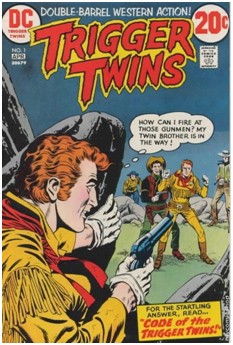
32 (tie) Trigger Twins
32 (tie) Lobo
32 (tie) Jim Cutlass