Thursday, June 15, 2017

WESTERN FICTIONEERS ANNOUNCES THE 7TH ANNUAL PEACEMAKER WINNERS

2017 PEACEMAKER AWARD WINNERS

(For Westerns Published in 2016)

BEST FIRST NOVEL:

ECHOES OF MASSACRE CANYON by Ben Goheen aka Ben Tyler (Five Star Publishing)

Finalist:
Silence Rides Alone by Charles Millsted (Sundown Press)
The River of Cattle by Alice V. Brock (Pen-L Publishing)
The Silver Baron’s Wife by Danna Baier Stein (Serving House Books)
The Wanted Lawman by A.C. Smith (Gray Ghost Publishing)


BEST NOVEL:
FAR WEST: THE DIARY OF ELEANOR HIGGINS by Linell Jeppsen (Wolfpack Publishing)


Finalist:
Dead Man’s Boot by Patrick Dearen (Five Star Publishing)
Gun Devils of the Rio Grande by James Reasoner (Rough Edges Press)
Killing Blood by Robert D. McKee (Five Star Publishing)


BEST WESTERN YA/CHILDREN FICTION:
THE RIVER OF CATTLE by Alice V. Brock (Pen-L Publishing)


Finalist:
Calamity Jane: How the West Began by Bryan Ney (Dragon Tree Books)
Good Water by John Nesbitt (Five Star Publishing)
Grandpa and the Kid by Cliff Hudgins (Wolfpack Publishing)
Lone Star Ranger 7: A Ranger Redeemed by James J. Griffin (Painted Pony Books)


BEST SHORT FICTION:

Museum Piece by Brian Koukol (The Missing Slate)

Finalist:
Jake Silvershorn's Revenge - Vol. 10 Final Showdown, by Big Jim Williams (High Noon Press)
Odell's Bones by Troy Smith (Cane Hollow Press)
Widelooping a Christmas Cowboy by Livia J. Washburn (A Cowboy under the Mistletoe, Prairie Rose Publications)


Western Fictioneers would like to thank Awards Chair Kathleen Rice Adams, and the judges for the excellent job they did and the long hours they devoted to the task of endless reading.

Friday, June 9, 2017

Dime Novels

The dime novel is a distinctly American type of fiction. In 1860, publishers Erastus and Irwin Beadle released a series of cheap paperback stories called Beadle's Dime Novels. They cost, of course, ten cents each.


            The first book in the series was Malaeska, the Indian Wife of the White Hunter by Ann Stephens. This was essentially a reprint of the earlier serial story published by Stephens in the Ladies' Companion magazine (February, March, and April 1839). As a dime novel, the story sold more than 65,000 copies in the first few months.
            The first 28 dime novels were published with a salmon-colored cover and no cover illustration. They varied in size, but averaged about 6.5 by 4.25 inches (16.5 by 10.8 cm). A woodcut print was added to the cover with edition 29, and at that time, the first 28 stories were reprinted with illustrations.
            The series ran for 321 issues and established nearly all of the conventions of the genre: lurid (often outlandish) plotlines, exotic locations and characters (sea stories, Wild West tales, railway and even circus adventures), and even the melodramatic double titles used throughout the series. The term "dime novel" quickly became a general term for the any sort of cheap, sensationalized fiction.


            Around the time of the Civil War, the national literacy rate increased, and the dime novel was immediately popular with the young, working-class reader. By the end of the war, numerous publishers had jumped on the dime novel bandwagon. The various novels could be distinguished only by the titles and the color of the cover wrappers.
            Examples of the genre included Bunce's Ten Cent NovelsBrady's Mercury StoriesBeadle's Dime Novels, Irwin P. Beadle's Ten Cent StoriesMunro's Ten Cent NovelsDawley's Ten Penny NovelsFireside SeriesChaney's Union NovelsDeWitt's Ten Cent RomancesChampion NovelsFrank Starr's American NovelsTen Cent NovelettesRichmond's Sensation Novels, and Ten Cent Irish Novels. Not all novels cost a dime, either. Some ran as high as fifteen cents, but were still lumped into the "dime novel" category.
            Highbrow critics derided the dime novel, but the pocket-sized adventure tales were an instant success. You might even say they were the television of their day. Most Americans at that time were busy earning a living, with no time for "literary" novels. They wanted something easy to obtain, easy to read, and requiring no higher education to understand.
            In 1874, Beadle added the novelty of color to their covers and began the New Dime Novels, which were often reprints of the original stories. Like the first run, the New Dime Novels ran for 321 issues, until 1885.


            Much of the content, especially of the early dime novels, came from story papers: weekly eight-page newspaper-like publications usually costing five to six cents. These began in the mid-1850's and were immensely popular. Some of the titles continued for over fifty years on a weekly schedule. As the popularity of the dime novel grew, more original stories appeared. Most were stand-alone stories, but in the late 1880's, series characters like Jesse James and Buffalo Bill began to pop up.
            In 1873, Beadle and Adams introduced a new format for their dime novels, 9 by 13.25 inches (229 by 337 mm), with only 32 pages and a black and white illustration on the cover. The first venture wasn't a success, but the format was so much cheaper to produce that they tried again in 1877 with The Fireside Library and Frank Starr's New York Library. Both titles caught on and soon the markets were flooded with ten-cent weekly "libraries." Frontier stories, which evolved into Westerns, were still popular, but the urban crime novel was gaining ground.
            By the turn of the century, new high-speed printing techniques combined with cheaper pulp paper allowed publishers to switch gears and begin producing pulp magazines instead of dime novels. The last of the dime novel serials, Fame and Fortune and Wild West Weekly, were converted into pulp magazines in 1927, ending the era of the dime novel.
            For those interested, the Stanford Library has an online collection of over 8,000 dime novels you can peruse.

            Another good online collection is Nickels and Dimes by Northern Illinois University, with over 2,000 dime novels.

J.E.S. Hays
hays.jes@gmail.com 

Wednesday, June 7, 2017

One-room Schoolhouses Blog #4
Curriculum
By Julie A. Hanks, Ph.D. aka Jesse J Elliot


Could you have passed the Eight Grade in 1895?
Take a look at a few SAMPLE questions. HOW WELL COULD YOU DO????
Grammar
1. Give nine rules for the use of Capital Letters.
2. Name the Parts of Speech and define those that have no modifications.
3. Define Verse, Stanza and Paragraph.
Arithmetic
1. Name and define the Fundamental Rules of Arithmetic.
2. A wagon box is 2 ft. deep, 10 feet long, and 3 ft. wide. How many bushels of wheat will it hold?
3. If a load of wheat weighs 3942 lbs., what is it worth at 50 cts. per bu., deducting 1050 lbs. for tare?
4. District No. 33 has a valuation of $35,000. What is the necessary levy to carry on a school seven months at $50 per month, and have $104 for incidentals.
U.S. History
1. Give the epochs into which U.S. History is divided.
2. Relate the causes and results of the Revolutionary War.
3. Show the territorial growth of the United States.
4. Describe three of the most prominent battles of the Rebellion.
5. Name events connected with the following dates: 1607, 1620, 1800, 1849, and 1865?
Orthography
1. What is meant by the following: Alphabet, phonetic orthography, etymology, syllabication?2. What are elementary sounds? How classified?
3. What are the following: Alphabet, phonetic orthography, etymology, syllabication?
4. Give four substitutes for caret ‘u’.
5. Give two rules for spelling words with final ‘e’. Name two exceptions under each rule.
Geography
1. What is climate? Upon what does climate depend (HA! This is rather timely)
2. How do you account for the extremes of climate in Kansas?
3. Name all the republics of Europe and give [the] capital of each.
So how many of you think you passed?????
        
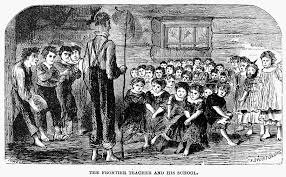
         In some of the more isolated schools in the west, curriculum and methods reflected the available materials that teachers possessed in trying to teach the 3 Rs and geography, the main content areas.
Many of the earliest western schools had dirt floors, and while we look back at these primitive conditions and shake our heads, wondering how the students learned anything, resourceful teachers used these dirt floors as tools for students to learn their numbers, for blackboards, and for places where their children could practice their penmanship. One innovative teacher tethered a ball from the ceiling in order to teach astrophysics!
         Reading, good penmanship, and arithmetic were stressed more than the other subjects. These subjects have been referred to as the Three Rs of education Reading, Riting, and Rithmetic. By adding recitation, an important element of the reading lesson, teachers would sometimes call it the Four Rs. With the scarcity of books and paper, much memorization and oral drilling took place. Students would learn by rote, which meant to memorize and recite. To cipher meant to do arithmetic problems, either orally or on slate boards. To parse sentences meant to explain the meaning and function of each word in a sentence, a precursor to diagramming sentences in the twentieth century (Oak Hill School Teachers Resource and Curriculum Guide).
TYPICAL DAY:  Upon entering the classroom, the students would acknowledge the teacher. Class usually began with a Pledge of Allegiance, the Lord’s Prayer, and possibly a moralistic reading from the Bible. Sometimes the class would sing a song and then be seated for roll. Then the various groups would turn, rise, and pass to the recitation bench, other grades would work on assignments at their desks. Reading was always the first subject taught. Students would be called individually to toe the mark and recite a passage from memory or read aloud from a textbook” (Smith).
         In the beginning, curriculum was often not determined by pedagogical theory but rather by the materials available and the creativity and knowledge of the one-room classroom teachers.  Interestingly, the students learned because of the logistics in a one room school and not in spite of them.  “In one room, there was space for only one teacher, one salaried teacher, that is. Yet nearly everyone who ever attended a one-room schoolhouse will tell you that the students themselves turned into teachers. There was no room to segregate grades, so the older and the younger children mingled” (Rocheleau, p. 7) and helped one another.
MATH:  Often without textbooks, teachers taught hands-on, practical math that would challenge today’s eighth graders. Students were taught practical information that they were able to use on a daily basis, applying it to their success as farmers, merchants, and bankers.
READING: Horace Mann, inspired by educational techniques in Prussia, brought new methods and progressive ideas about education to the United States. Holistic education covering science, geography, nature study, and history joined the American textbooks—now presented in an appealing format. McGuffey's Readers were among the first textbooks in the United States designed to be increasingly challenging with each volume.
        
When using the McGuffey Reader, again influenced by Mann’s discoveries in Europe, students were reading essays, treatises, literature, science, and philosophy.  Some of the contributors to McGuffey’s Fifth Eclectic Reader were Shakespeare, Charles Lamb, Bret Harte, Audubon, Irving, Longfellow, Tennyson, H.D. Thoreau, and the Bible—to name just a few.  
         Of course the curriculum varied from one school to the next.  While some classrooms were steeped in religious lessons, others emphasized more academic pedagogy, and still others were eclectic. Some of the teachers taught in their former schools at the age of fourteen while other teachers were trained in Normal schools. However, learning took place in our one-room schoolhouses, and today’s America is in debt to that institution and those amazing educators.

Best, John Hardin (February 2000). "McGuffey, William Holmes"American National                                 Biography Online.

This is the eighth-grade final exam from 1895 from Salina, KS. It was taken from the original
  document on file at the Smoky Valley Genealogical Society and Library in Salina, KS and
  reprinted by the Salina Journal.

Oak Hill School Teachers Resource and Curriculum Guide.

Rocheleau, P. (2003). The One-Room Schoolhouse: A Tribute to a Beloved National Icon,    Universe:NYC, NY.

Smith, N.B. (1986). American Reading Instruction.  International Reading Association:Newark,    Delaware.  


Sunday, May 28, 2017

HIDDEN CACHE: EXPLORING THE CACHE LA POUDRE SCENIC BYWAY by VONN McKEE


The rental car agent was not talking me out of my six-dollar-a-day Tahoe.


“How about upgrading to that Camaro out by the curb?” He chin-pointed to a spot beyond the window. “Pretty day for a convertible.”


I don't think so...
I glanced at the chrome yellow muscle car, complete with a Transformer Bumblebee stripe on its rakish hood. “No, thanks.” I was smug in the knowledge that the ridiculously low rate I’d scored on a discount travel site was actually for real.


Focused on the add-on sale, he threw out more bait. “You’ll need GPS, right? And the insurance?”


I felt a crack in my smugness. “Um, no insurance. But…how much is the GPS?”


“Fifteen a day.”


“Nope.” Whew. He almost had me. “I’ll just keep what I’ve got.” Meaning, my smart phone and a file folder stuffed with maps and notes I’d printed at home. Grudgingly, he slid the key across the counter.


“Gold Tahoe. Space 441.”


No “have a nice day, thanks for choosing us,” no “take a left outside the lot to get to I-25,” no nothing.


Fifteen minutes later, I was hopelessly lost in a shadowy Denver warehouse district, looking for a place to turn a Tahoe around. By the time, I surfaced into sunshine on an interstate ramp and shoehorned into the northbound stream of traffic, I was running an hour behind my projected schedule. But what's a little lost time and traffic, when there's a meander along a two-lane, mountain highway on the agenda?


I planned to drive the 101-mile Cache la Poudre Scenic Byway from east to west via Highway 14, which hugs the river from the foothills near Ft. Collins to the North Park region of Colorado. The Cache la Poudre has been designated as Colorado’s only National Wild and Scenic River and its name translates roughly to “hide the powder,” possibly in reference to early fur traders who stashed their gunpowder along its banks. Brown and rainbow trout are plentiful, making it a popular spot for anglers. Rafting enthusiasts enjoy the Poudre’s thrilling rapids and there are outfitters located along the route.

That's why we call them the Rockies.
Highway 14, west of Ft. Collins

For the first several miles, the river burbled amiably to my left – then the gentle shale outcroppings along the highway merged into sheer granite walls as the road began to climb toward the river’s headwaters in the Rockies. The vertical slabs were only a few feet from the road’s edge. This was where the Cache la Poudre began to tout its “wild and scenic” status. High and fast with June snowmelt, the river roiled and tumbled over boulders. I lowered my windows to better hear the roar of the rapids.
Peaceful Poudre
Picking up the pace

The striking thing about this byway is the way the terrain changes every few miles. I drove out of the rocky pass into a wide valley, rimmed by peaks still glistening with snow. The river ran flat and broad. Brown-vested fishermen stood knee-deep, casting fly lines into long, high spirals. I passed numerous cottonwood-shaded campgrounds, scattered with tents and travel trailers.
Fly fishing heaven


Beyond the valley, the highway snaked up into the peaks of the beautifully named Never Summer Mountains. Patches of snow lay in the shadows of evergreens. The Poudre was back to whitewater, pounding against the sides of the canyon and constantly switching from one side of the highway to the other. I stopped on one of the bridges to take photos, aware of the incredible force of the rapids below me.


Eventually, the highway straightened onto a high basin 8,800 feet above sea level. Just before I reached Chambers Lake, the Poudre veered off to the south and the road curved into the billowing North Park grasslands. I spotted herds of antelope grazing alongside cattle. The plains encompass over 1,600 square miles and are rimmed by the Rabbit Ears and Medicine Bow mountain ranges. From those distant peaks flow the headwaters of several rivers of Western lore: the North Platte, the Michigan, the Illinois, the Canadian.
North Park plains


I ended my Cache la Poudre adventure with an Angus burger at River Rock CafĂ© in Walden, the “Moose Viewing Capital of Colorado.” I took a stroll through the delightful North Park Pioneer Museum – three floors and twenty-seven rooms packed with incredible artifacts and memorabilia donated by the area’s first settlers. The curator was a native son and seemed glad to field my many questions. (I sheepishly revealed that my curiosity was part and parcel of being a writer.)


After my tour, he followed me outside to point me toward my next stop, Wyoming. I waved farewell and started the engine. The Tahoe picked a sure footing through the potholes and sharp rocks of the parking lot, and nosed onto the road to Cheyenne.


Nope. We wild-hearted mountain explorers don’t drive no stinking yellow Camaros.


Click here for more information on the Cache la Poudre Scenic Byway.

All the best,

Vonn McKee
“Writing the Range”

2015 WWA Spur Finalist (Short Fiction)
2015 Western Fictioneers Peacemaker Finalist (Short Fiction)
Follow me on Facebook!


My trusty Tahoe...
The best six dollars a day I ever spent.

Thursday, May 25, 2017

A SHORT HISTORY OF NOSE SURGERY FROM EGYPT TO THE OLD WEST


THE DOCTOR'S BAG

the blog about the medicine and surgery of yesteryear

Keith Souter aka Clay More


You may think that Plastic Surgery only started in the twentieth century. Well, it is true that it advanced dramatically, but its origins go back to antiquity and surgeons over the centuries gradually pushed back its frontiers.

Ancient Egypt
The Ebers papyrus, which was reputedly written by a physician called Hesy-Ra in about 1550 BC, contains 110 pages about diseases and treatments known to the Egyptians.

 The Ebers papyrus

It contains methods for removing wrinkles and correcting squints.

Ancient India
In 600BC the Indian surgeon Sushruta wrote his book the Samhita, which describes the operation of nasal reconstruction, using the 'forehead method.'

Sushruta - father of plastic surgery

Cutting off the nose  was the official punishment for adultery and other transgressions and crimes. It was because of this that Indian surgeons developed the technique.


The forehead method of nasal reconstruction

In Susruta's operation a flap of skin from the forehead was made and brought down to cover the deficit. Nostril tubes were left in place until the skin flap healed.

He also described a method of repairing torn ears by rotating a cheek flap of skin.

The first actual rhinoplasty
In Italy in the early 15th century Antonio Branca developed the first real nasal reconstruction rhinoplasty). The method was described in a book by Heinrich von Pfolspeundt, 'Buch der Bundth-Ertznei,' published in 1460.

He used several stages:

1) A model of the nose was constructed from parchment of leather.

2) This model is laid on the forearm and a line drawn around it.

3) The marked area is then cut and separated from the underlying tissues in such a way that the bottom of the nose flap remains attached to the arm.

4) The arm is raised to the head with the nose flap positioned on the face and is then stitched in place.

5) The arm is bound to the head .

6) After 8-10 days when the skin has healed to the defect, the lower part of the skin flap is cut, freeing the arm and allowing for the reconstruction of the nostrils.

Although Antonio Branca had developed it, in the 15th century, it was not until Gasparo Tagliacozzi published his book De Curatorum Chirurgia in 1583 that the method was picked up and used by surgeons throughout Europe.  The reason for the operations were mainly injury, but also the ravages of diseases like syphilis or cancers.

The Old West
We come now to Tombstone and my surgical hero,  Dr George Goodyear, thee renowned 'physician to the gunfighters.' One of his best friends was George Whitwell Parsons, a licensed attorney who kept a diary from 1869 until 1929. It gives a detailed picture of life during the Earp era.

George Whitwell Parsons

On June 22, 1885 a fire erupted at the Arcade Saloon, which spread until half of Tombstone's business district was on fire. Fortunately no-one lost their life in the blaze, but George Parsons was badly injured. While trying to fight the fire he was on a balcony that collapsed when the beams fell. He sustained injury to his head, nose and jaw.

Over a period of several months Dr George Goodfellow performed a series of innovative operations to rebuilt his smashed nose.

He describes it himself in his diary:

"I was knocked senseless by a dislodged beam and a large splinter had entered just under the skin glancing upward and just missing the eye, face quite flattened and nose all over it. Dr Goodfellow made a plaster cast, cut away the deformity in the cast and then cut my nose loose from the bone and tacked it up in place so that the case, with the aide of a wire run through my nose, held it in place. I eventually recovered emerging with a fine Roman nose, free from disfigurement."

Dr George Emory Goodfellow

Dr George Goodfellow was a truly pioneering surgeon. Throughout his career he established a reputation as the foremost expert on gunshot wounds, as well as being the first surgeon to perform a perineal prostatectomy (he actually performed 78  prostatectomies and compiled statistics about them), along with other 'first' operations. His work on George Parson's nose fits in there.

He wrote and published many medical papers in the journals of the day. His work on the impenetrability of silk would lead to the actual bulletproof vests of the future.

It probably took a special sort of man to be a physician-surgeon in the Old West. Goodfellow seems to have been a very complex man. Apart from being a doctor, he was a scientist, geologist, rancher and gambler. He was pugnacious, short- tempered, but also exceedingly kind. He also had a wry western sense of humour, as evidenced by his autopsy report on a gambler who was shot during a card game. He reported that he had 'done the necessary assessment and found the body so full of lead, but too badly punctured to hold whiskey.'

***

THE DOCTOR'S BAG - MEDICINE AND SURGERY OF YESTERYEAR has been published by Sundown Press, available in ebook or paperback.


Clay More's novel about Dr George Goodfellow is published in the West of the Big River series by Western Fictioneers.