Showing posts with label A Bad Place to Die. Show all posts

Tuesday, May 7, 2019

Barbers and Barbershops in the Old West Part Two by Vicky J. Rose, aka Easy Jackson, V. J. Rose


Part One discussed what a young cowboy might experience in a barbershop at the end of a long trail drive. Part Two focuses on the barber’s experience.  

Barbers have always conjured up mixed feelings, even in the Old West. On one hand, a good barber who could be trusted was a treasure never be discarded. On the other, he was in a position of being able to slit one’s throat with a stroke of the blade. He was just as prone to vices as any ordinary man, gambling and womanizing were two. A barber who had a shaky hand and alcohol on his breath did not last long in the profession, however, so that usually wasn’t one of them.

Particularly in a one-chair shop, the barber became almost like a father confessor. His
Wyoming barbershop ca 1905
customers related their personal problems. Elderly men would talk constantly of the deceased wife they missed. Ranchers holding on by a thread would discuss their problems with the bank. He had to listen to everyone else’s difficulties and keep his mouth shut about them. Often, he was called upon to give advice. He might be asked for a loan, and many times, he would allow a man who was down on his luck to sweep out the shop in exchange for a haircut. He would have to listen to a preacher exhort him to come to Jesus even if he felt plenty religious enough. He was expected to know all the news of the world, everything going on in his town, and the latest jokes. And he often did.

In addition, if there was no doctor in town, he might be asked to use his sharp instruments to remove a bullet, pull a tooth, or even do an amputation.
Ambroise Paré was a French barber surgeon, 
serving four French Kings, who is often called 
the Father of Modern Surgery. He left a lasting 
legacy of the ethics of gentleness in surgery. 
He is famous for the quote: 
“Je le pansai, Dieu le guérit (I bandaged him, God cured him)”

The barber stood on his feet with his hands up in the air for long hours at a time and soon learned in order to make it through the day, he had to sit and rest when he could. A cowboy used to the rough outdoors would walk into a cozy shop, see the barber sitting and think what a lazy, cushy life he had, having no idea of the physical demands placed on a barber working 12 hours or more a day.

In order to make ends meet, a barber might combine his business with that of selling cigars, a shoe shine stand, or a gun shop. Some of the less scrupulous ones might use a back room for a bookie parlor or other unsavory deeds. In cow towns, a bathhouse would most likely be the barber’s other business.
This nineteenth century barber pole sold for $1000 in a 2013 online auction.
If offered in 2019, the starting price would likely be $2000 or over.

 A lot of money was made in selling tonics, and many barbers used their own recipes for bay rum, shampoo, hair dye, and baldness preparations. Some of them were extremely dangerous, but no conscientious barber would purposely poison his customers. His livelihood depended on their health. His counters might be lined with ornate bottles with fancy labels he had printed, or just plain bottles to hold his mysterious preparations. But they added to the atmosphere and mystique of his shop.
The barber might buy a fancy bottle,
and then use his own recipe to fill it.

As mentioned in Part One, music was often an integral part of a barbershop. That particular harmonizing known as a “barbershop quartet” evolved in the middle of the 19th century—probably with roots in African-American singing. However, the term was not coined until early in the 20th century. 


Fashion

            The powdered wigs of Colonial America had disappeared by 1837. The barber was no longer required to own a scarificator or other bloodletting instruments. The only socially acceptable men who could wear beards before 1858 were writers, artists, and pioneer settlers. A Massachusetts man in 1830 was arrested for refusing to shave his off.
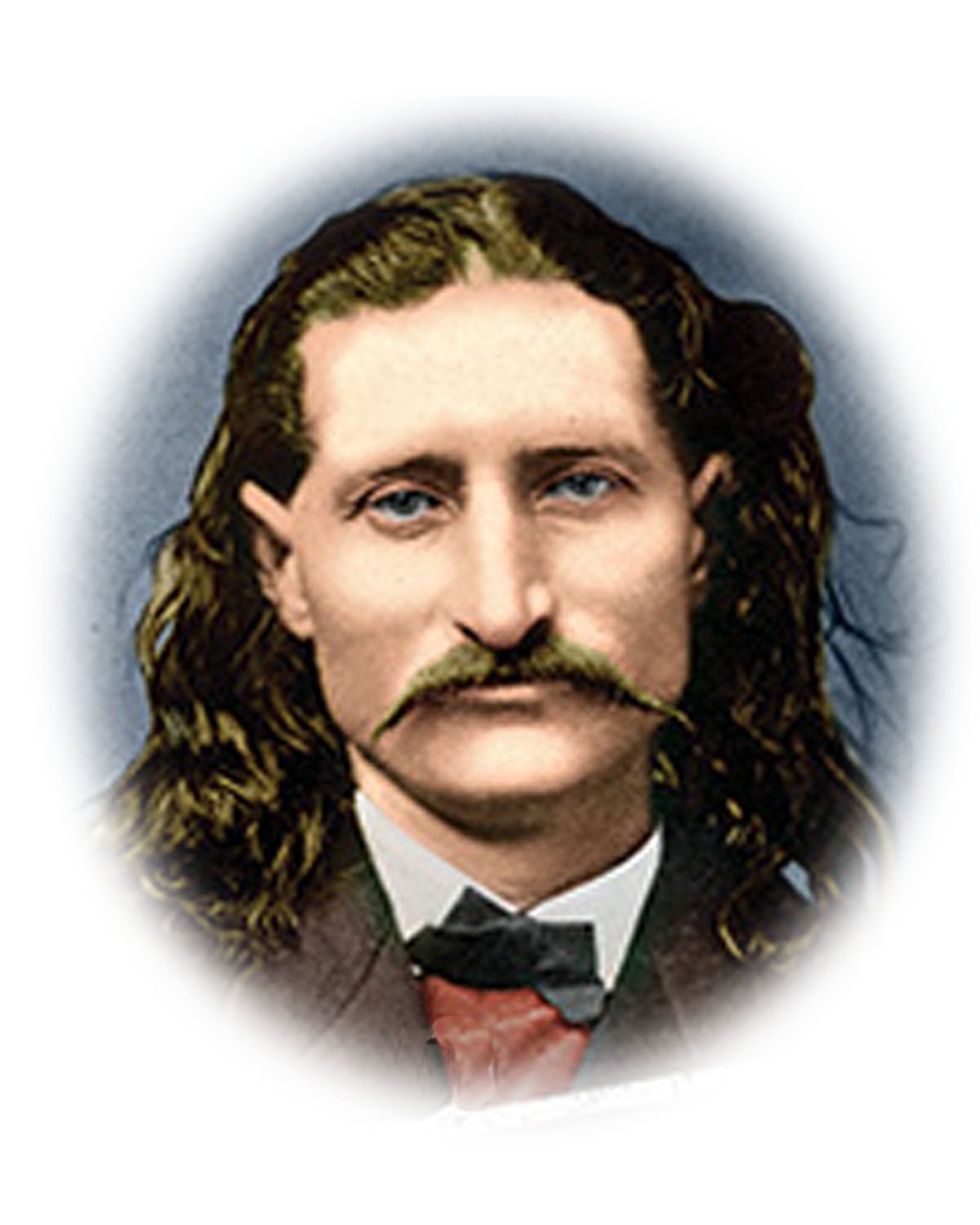
Wild Bill Hickok did not achieve this look without the help of mustache wax.

            Out West, it was a different matter entirely. Beards served as good protection against sunburn and frostbite. A miner panning for gold could not have cared less if his beard was long and his hair scraggly, but put women into the mixture, and suddenly everything changed. By the time the Civil War started, beards and mustaches had once again become popular. They stayed that way until the end of the 1800s. But to stay neat and attractive, mustaches and beards still required the services of the barber. His tools now included a mustache curler and an alcohol lamp for heating curling irons, and he carried mustache wax to sell to his customers.
Yes, your grandma
had a reason for
all those crocheted
doilies on her chairs.

            Having shiny, slicked back hair also became highly fashionable. The main ingredient in these pomades was bear fat, and it would literally drip down the collar at times. Women got busy crocheting doilies known as antimacassars to protect their furniture.
Rowland's Macassar Oil replaced bear grease, mainly
because it was touted as preventing baldness.
This bottle was found by archaeologists at
Fort Vancouver in Washington. Bottles
like this were often throw down privies when empty.

Problems

            With little understanding of germs, and without licensing inspections, patrons could give and receive impetigo, scabies, erysipelas, favus, tinea barbae, and head lice. These fell under the heading of “Barber Itch,” all easily spread by unclean towels, unsterilized razors, combs, brushes, and shaving mugs. Most barbers had special treatments for barber itch—vinegar mixed with tincture of muriatic iron applied with a feather being one. Coal oil soaked on the scalp for thirty minutes was the standard treatment for head lice, but the barber was well within his rights to tell the afflicted to treat themselves at home before coming back into his shop.

Minorities
After the Civil War, African-American men entered the barbering profession in droves. There were no fees or licenses at that time, and setting up shop was a relatively inexpensive way to start a business. Most Anglos had no problem having a negro cut their hair or shave them. Because of the prejudice of the time, however, a negro man could not walk into a white barbershop and get a haircut, nor would he really want to. That type of curly hair takes a different training to learn to cut properly, and very few whites even today can do it without butchering it up. Because of its properties, head lice cannot survive in it, however. (By the way, head lice and body lice, known as “crabs,” are two different creatures.)

Indians had their own ideas about how to wear their hair and rid their body of it, so the majority of them would have no interest in entering a barbershop of any kind for years to come. However, if they had, during that time period, they probably would have been refused service in a white barbershop.

Mexicans, with their incredible eye for detail, made excellent barbers, but they too would rarely cross the color barrier with whites or blacks. Many of them used a process called singeing, using candles or singeing papers to give haircuts and shaves. It was believed to be beneficial for the hair and keep it from falling out. When done properly the customer only felt a little warmth on his face as his whiskers were being singed away. Anglo barbers adapted the process, doing it after the haircut to seal the ends of the hair. Burning hair smells terrible, and barbers would usually try to talk their customers into a shampoo afterward. This was accomplished by having the customer stand, leaning his head over a basin.


In 1867 Galveston, a thirty-year-old immigrant woman who called herself Madame Gardoni was doing a thriving business as a barber and employed two males in her shop. In 1870, a female barber in Detroit made the news in Emporia, Kansas. In 1883, a Spanish proprietor hired four girls to work in his Sedalia, Missouri, shop. Although the newspapers were complimentary to these women, in the general public, they were viewed more or less as shady ladies.
Madame Gardoni and client. Notice the sly way
the illustrator drew the position of the man's
head and eyes.
Danger
The barber was often called out to cut the hair of an ill man at his home, or go to the funeral parlor to clean up the deceased for a wake. The sick man was often sicker with an infectious disease than his relatives had let on, and the preparation of a dead body is only for the strong in stomach.

A wealthy cattle baron might pay a barber to come to his hotel room to give him a shave and a haircut. These hotel trips were not without risk, however. If the person requesting his services turned out to be a wanted man, the barber could very well be caught in the crossfire of a gun battle with the law. Young barbers, especially, were exposed to peril. In large cities, a young barber might suddenly find his privates being fondled. A quick way to put a stop to that was to put a cold razor on the offender’s neck and whisper how much one hated the sight of blood. The barber was also in peril of being attacked by a gang of ruffians once inside the hotel room.

The barber in the West was just as civic minded as his fellow citizens. In 1892, a barber joined in the attack on the Dalton Gang in the Coffeyville Raid, firing a load of buckshot that knocked Emmett Dalton off his saddle, effectively ending the raid.
After getting out of prison, Emmett Dalton got religion
and went Hollywood. He’s shown here with legendary
western movie star Tom Mix.
In John D. Fitzgerald’s novelization of his mother’s reminisces about a Wild West mining town, he tells of a system of deputies the local sheriff organized to keep law. When one young punk came into town touting how many men he had killed, the sheriff gave him until sundown to get out of town. Ignoring the warning, he made the mistake of getting a haircut instead. The banty-sized barber, one of the sheriff’s deputies, loved to talk and didn’t seem to mind when the outlaw sat in his chair for a shave and a haircut. The process was considerably slowed by the barber’s loquacity, and when the sun went down on the other side of the mountain range, only half of the outlaw’s face had been shaven. The barber put down his razor, removed a Smith & Wesson from a drawer, proceeded to put the barrel in the gunman’s ear, pulled the trigger, at the same time saying, “I kill you in the name of the law.” 
Hollywood often depicts outlaws as scruffy creatures,
but in reality, they often looked better than the people
they robbed. Shown above: The Sundance Kid,
John Wesley Hardin, Bob Younger, Jesse James,
and Sam Bass. Hardin, who had ears
that stuck out, was almost always photographed
with hair over his ears.

Guns were for killing outlaws; the razor was held in sacred trust for the barber’s chosen profession.


Bob Wills was a barber before making it
big as "The King of Western Swing."
End of Part Two of Two
To Read Part One, click here: Barbers and Barbershops in the Old West Part One

Click here to buy A SEASON IN HELL
Click here to buy A BAD PLACE TO DIE
Click here to buy TESTIMONY
Click here to buy TREASURE HUNT IN TIE TOWN


And coming in February 2020 from Five Star Publishing

MUSKRAT HILL

A Frontier Mystery


Resources: The Vanishing American Barbershop: An Illustrated History of Tonsorial Art, 1860-1960 by Ronald S. Barlow; http://www.kristinholt.com/archives/7229; http://www.kristinholt.com/archives/7413; https://whatdoeshistorysay.blogspot.com/2014/01/history-of-american-barbershop.html; http://www.todayifoundout.com/index.php/2013/10/bloody-history-barber-pole/; http://www.nationalbarbermuseum.org/about/barbering-timeline; https://www.instructables.com/id/Fire-Shaving/; https://www.historynet.com/dalton-gang;
Papa Married a Mormon by John D. Fitzgerald; Barber Instructor and Toilet Manual by Frank C. Bridgeford; Shannon Hartsnagel Interview; http://www.acappellafoundation.org/essay/bbshistory.html


Sunday, April 29, 2018

Pioneer Food: Cooking Coons, Possums, and Armadillos by Vicky J. Rose, aka Easy Jackson


Although the thrust of my research has been in the Republic of Texas era, I think the following can be of use to anyone writing about frontier life.

Pioneers on the way to Texas loaded their wagons with hard tack, a flat bread lasting a long time.

Hard Tack Biscuits

2 pounds (8 cups) flour
1 teaspoon salt
¼ pound butter or lard ( ½ cup ) cut up
3 gills ( ¾  pint) milk.

Mix flour and salt, mix in lard. Add milk and knead dough for ½ hour. Cut into cakes about the size of a small teacup and ½ inch thick. Prick with a fork and bake in a moderate oven until they are a delicate brown.

At night, women would wait until the campfires died down before burying potatoes in the warm ashes to be eaten the next morning. White potatoes were commonly called “Irish potatoes,” as opposed to sweet potatoes which were sometimes referred to as “yams.” Sweet potatoes were much more common in Texas because they were easier to grow than Irish potatoes.

At first, cattle were used mostly for oxen or milk, not to be slaughtered. Cheese, usually a soft version, was often made every day when there was excess milk. Chickens were for eggs and usually only slaughtered when they could no longer lay.

Because of the amount of meat one got for the least amount of effort, pork reined as king. Pigs could be turned out to forage for themselves in the summer and butchered in the fall. The meat, when smoked and cured, kept well. Hams hung in smokehouses, while bacon might be covered with a cloth and thrown on a shelf. The saying was they used “everything but the squeal.”

Sausages and any cooked meat could be preserved by drying or placing in a stone crock and covering with lard.

Poor sanitation caused raw vegetables to be looked upon in disfavor as something that could cause disease, and the vegetables pioneers ate were consequently cooked much longer than we do today. The abundance of wildlife made it difficult in the first few years of settling a new land to be able to have a garden. If pork was king in the meat department, corn ruled in the vegetable world. Cornbread was often served at every meal, as corn was much easier to grow than wheat.

Dewberries - a wilder, smaller version of blackberries
Because oven temperatures were difficult to regulate, cakes often turned out dry and unappetizing. The pioneer woman counteracted this by making heavy cakes filled with dried fruits and nuts. Pies were much more forgiving, and they became the dessert of choice. The pioneer woman used whatever she had on hand for pies: wild fruits, buttermilk, sweet potatoes, vinegar, and even the ubiquitous cornmeal.

Wild Mustang Grapes

Mustang grapes are distinguished by the white velvety underside of their leaves. The fruit when ripe is dark purple with a bitter, acid taste. With enough sugar added, they are fine for making jellies, wines, and grape juice. When mixed with molasses and allowed to ferment, mustang grapes made a homemade wine referred to as “Busthead Whiskey.”
Mustang Grapes Growing Wild in the Trees on a Country Lane

Mustang Green Grape Pie

3 cups green mustang grapes
1 ½ cups sugar
3 tablespoons flour
3 tablespoons butter
Unbaked pastry for two 9-inch pie crusts
Melted butter and sugar for sprinkling over top crust

Pick the grapes when they are still a beautiful green color, just before the seed is formed. Wash them and put in a saucepan. Cover with water and bring to a boil.
Mix the sugar and flour together, add to the grapes when they begin to boil. Add butter and cook over medium heat. Stir, and when mixture begins to thicken, pour into an unbaked 9-inch pie crust. Add top crust or lattice crust. If desired, brush the top crust with melted butter and sprinkle sugar on top.
Bake at 400° for 10 minutes. Reduce heat to 325° and continue baking for 20-30 minutes.

Game was plentiful. Buffalo tongue was considered a special treat. Bear grease is sweeter and much better tasting than pork lard, but it turns rancid quickly.

Bear

Mature bear is usually too tough to eat and should only be used in long cooking stews. However, some cooks believe all bear, except for perhaps black bear, is edible as long as it is soaked in an oil-based marinade for at least 24 hours before cooking. The fat must be removed immediately, as it turns rancid quickly. Cook after marinating as you would beef pot roast or stew. Bear, like pork, can carry trichinosis, so be sure the meat is always well cooked through.

Other wild game was consumed with relish, as it was free and only had to be caught. Mexicans living in Texas also ate armadillo, although I do not think this was common among the Anglos. Armadillo is supposedly a very light, tender and tasty meat.
Hondo peers into an armadillo hole.

Armadillo

Water
½ cup vinegar
Salt
1 cup water
Black Pepper

Lay armadillo on back. With a sharp knife, slit from throat to tail and then across from shoulder to shoulder. Skin leg and shoulder close to the shell. Keep working close to the shell until the whole armadillo is out of shell. Then, being careful not to break the intestines, gut the armadillo. Wash well and cut in half. Place armadillo in a pan, cover with water. Stir in ½ cup of vinegar and about that much salt to make a brine. Soak overnight, drain and rinse. Place in roasting pan and sprinkle with black pepper. Add about 1 cup of water, cover and bake as you would a roast. Add more water as needed until done.

Raccoon & Muskrat

Raccoon and muskrat are both dark meat, and like bear, every bit of the fat must be removed after skinning. Also, like bear, they should be thoroughly cooked to prevent infections by worms. There are several small scent glands that must also be removed before cooking—under the armpits of the front legs, on either side of the spine, and in the small of the back.
Raccoon can be simmered, roasted, fried, or barbequed.  

1 raccoon
Cayenne pepper—to taste
Salt and pepper—to taste
Vinegar
3 garlic cloves, chopped
1 cup celery, chopped
1 large onion, chopped
1 medium green pepper, chopped
Cooking oil
Flour
6 sweet potatoes, peeled

Dress the raccoon and soak it for 1 hour in a mild vinegar and water solution. Drain and cut into pieces. Cover with water. Add salt, peppers, and chopped vegetables. Under medium heat, bring to a boil and reduce heat to a simmer.  Cook until tender. Drain, pat dry, and brown in a small amount of cooking. Place in a roaster.  Prepare a brown gravy with flour and drippings; pour over the raccoon, placing the sweet potatoes around it. Bake at 350° until potatoes are done, 30 to 40 minutes.

Opossum (Almost always referred to as “Possum”)

Cooks prepare possum in various ways. The fat is not objectionable in taste or odor and does not have to be removed. The meat is light-colored and tender. 

Method One:
Drain the blood, remove the entrails and wipe clean. Hang for 48 hours. Skin and cook. Roasting is the preferred method. The liver may be chopped up and added to the gravy.

Method Two:
Trap the possum and feed it for 10 days on cereal and milk. Clean but do not skin. Immerse into water just below the boiling point. Pluck the hair, when it slips out readily, remove the possum and scrape the hair off. While scraping, occasionally pour cool water over the surface of the animal. (Much like you would a hog.) Remove the small red glands in the small of the back, and under each foreleg between the shoulder and rib. Parboil for 1 hour. Cook like you would a pork roast.

Rabbit

A young rabbit has a narrow cleft in the lip and smooth, sharp claws. The ears will be soft and bend easily.

After the kill, drain the blood and remove entrails immediately. Leave the skin on if not cooked immediately. The body cavity can be cleaned with a cloth or dry grass. To ensure tender meat, hang by the feet for 1 to 4 days. They can be eaten immediately if not stiff. Once stiffened, they can still be edible as long as the hind legs are rigid.

Many people like to soak rabbit in either vinegar, wine, or salted water before cooking. Soaking or not is a matter of taste. Brining in salt water is a popular way to keep meat juicy.
Rabbit can be prepared in much the same way as chicken—fricasseed, baked, roasted, or boiled and diced to serve in a salad. For a unique and special sauce, the blood can be used as a thickener.

Squirrels might not be the easiest things to shoot, but they
were highly favored. 
Squirrel

Gray squirrels are preferred; red squirrels are small and gamey in flavor.

Squirrel is one of the finest and tenderest of all game meat. Only the oldest and toughest need to be parboiled. Clean as soon as possible, wipe the body cavity with grass, cloth or paper. Let the body heat dissipate. As with rabbit, it doesn’t have to be skinned until it is ready to be cooked. Squirrels are commonly fried like chicken or put into stews like Brunswick Stew. However, they are delicious broiled, baked, and cooked with dumplings.

My son’s grandfather told him that as a boy, he would kill squirrels and share them with an old black gentleman he knew. He would get angry at him and tell him not to shoot the squirrels in the head—the brains were the best part. (When I repeated this in a speech to a Daughters of the Republic of Texas chapter, several women nodded their heads, saying their grandparents had loved squirrel brains.)

Almost all the blacks living in Texas during the early 19th century were slaves, and they were given the ears, feet, neck bones, and intestines of the hog to eat. Chitterlings (pronounced “chit-lins”) were made with the intestines. They have a strong aroma when cooked that many people find objectionable.

            Chitterlings

After slaughtering a young pig, empty the large intestines while still warm by turning them inside out and scraping as clean as possible. Cover with salted water, keep cool for 24 hours. Drain and wash in 5 or 6 waters. Any excess fat can be removed but leave some for flavor.

            10 pounds chitterlings
            1 garlic clove or 1 teaspoon of minced garlic
            1 onion sliced or coarsely chopped  
            ½ teaspoon salt
            ½ teaspoon pepper
            Enough cold water to cover

Optional ingredients:
 ½ sliced lemon
½ teaspoon each: thyme, clove, mace, and allspice
            1 bay leaf       
1 teaspoon red pepper flakes
            2 tablespoons fresh parsley
            2 tablespoons white wine vinegar
           
Cut chitterlings up in 2-inch lengths. Bring slowly to a boil, add other ingredients. Reduce heat and simmer for about 3 hours. A half a cup of catsup can be added the last thirty minutes of cooking time if desired. Most people like to douse their chitterlings with vinegar or hot sauce.

When ranger companies were formed in Texas, they would live for weeks at a time on nothing but wild game, honey if they could find it, and coffee “the favorite drink of Texans.”

People living near the coast of Texas not only feasted on wild game, but fish, shellfish, and oysters as big as your hand. The wealthy planters living near the port cities had access to a wide variety of food, including coffee, London ale, and champagne. It seems strange to us thinking about the frontier days, but where it was available, champagne was a popular drink.

Almost all the stagecoach stops in Texas served much the same food, salt pork and cornbread. The
The Nicholson Hotel in Bastrop near the river burned down in
the late 1800s, but the Old Stagecoach Inn by the El Camino
Real in Bastrop still stands. Davy Crockett and Sam Houston
were visitors.
Tremont House in Galveston was known for its good food. Nevertheless, one Frenchman coming to the New World ate one meal there, turned around and went back to France. A few others, such as the Nicholson Hotel in Bastrop, became renowned for exceptionally good fare. They all served alcohol, and although the bar was a good source of revenue for innkeepers, murders and fights were not uncommon, much to the dismay of many of the innkeepers’ wives.

Tableware could vary widely from place to place. Some people ate off tin plates using utensils made from cane. In other places, people used fine china and silver cutlery. Most people had steel utensils with wooden handles. Pearlware and creamware, types of decorated pottery, were not uncommon, and shards of pearlware believed to have come from a kiln in Mexico have been found at Presidio La Bahía, a Spanish fort in Goliad.

 Although forks were on the table, knifes were often used to pick up food. It wasn’t considered rude to pour coffee from a cup into a saucer and drink it from the saucer.

Although eastern travelers may have complained about the monotony and unpretentiousness of corn pone, greens flavored with side meat, and bacon, they remarked there always seemed to be an abundance of it. And that, I think, speaks well for the old pioneers of Texas.

Sources:
The Daughters of the Republic of Texas, District VIII:  A Pinch of This and a Handful of That, Historic Recipes of Texas 1830-1900, Eakin Press, Austin, 1988

Joy of Cooking, Irma S. Rombauer, Marion Rombauer Becker, 1962 edition

Recipe Roundup—Compiled by the Whitehead Memorial Museum, Del Rio, TX

Cooking Texas Style, Candy Wagner & Sandra Marquez, University of Texas Press, Austin, 1993

Stagecoach Inns of Texas, Kathryn Turner Carter, Waco, Texian Press, 1972

Mary Austin Holley: The Texas Diary, 1835

Mrs. Blackwell’s Heart of Texas Cookbook, Louise B. Dillow & Deenie B. Carver, Corona Publishing, San Antonio, 1980

Wild Game Cookbook, Edited by L.W. “Bill” Johnson, Grosset & Dunlap Publishers, New York, 1968


Coming in November, 2018, Pinnacle Books

A Bad Place to Die by Easy Jackson