Showing posts with label Cash Laramie. Show all posts

Tuesday, September 14, 2021

Favorite Movies and TV Featuring Railroads by Scott D. Parker

When you think of what makes a western a western, railroads and trains naturally make it onto the Top 10 list. They may not be in the Top 5, but they certainly play a significant role. I know they did when it came time for me to write my own western stories, especially with the creation of Calvin Carter, Railroad Detective. You see? It's right there in his title.

David Cranmer (aka Edward A. Grainger) and I emerged on the scene more or less at the same time, now over a decade ago. We each ended up creating a western hero. He created Cash Laramie, the Outlaw Marshal, who, along with his partner, Gideon Miles, deal with outlaws and desperadoes wherever they rear their ugly heads. For me, I spawned Calvin Carter, a former actor who, in the course of tracking down the man who killed Carter's father, learned he had a knack for detecting. He often dons disguises and uses his acting abilities to bring a certain amount of flair to the role of his lifetime.

A while back, David suggested we team up our heroes and, after a decade of stops and starts, the first pairing of Cash and Carter will be published this fall. In Cash Laramie and the Sundown Express, owlhoots have hijacked the inaugural run of the fastest train in the west, and it's up to Cash and Miles to retake the train. Unbeknownst to them, Carter is on board, in disguise, as he, too, attempts to thwart the hijackers while saving the passengers, including the renowned actress Lillie Langtry.

David thought it a fun idea if I made a list of favorite trains in movies and TV. I agreed, but then quickly realized something. Not only did my list almost instantly get filled with non-western ideas, but some of the more well known westerns to feature trains were movies or TV shows with which I am not familiar. Thus, you won't find Hell on Wheels on this list because I simply haven't watched it. And while I have watched both versions of 3:10 to Yuma, I can't speak with any authority because I can't remember a lot of the plot. 

So, with these caveats in mind, here's my list.

The Great Train Robbery (1978)


If I'm being honest, this might be the first heist film I ever saw. From the opening of Sean Connery's voiceover explaining how the gold is transported and secured, you sit on the edge of your seat wondering if he and his team will pull off the robbery from a moving train. 

Many of the scenes I first saw in my youth remained with me, but two always rose to the top. The ending, when Connery's Pierce, escapes on the police carriage as he was destined for jail, smiling all the way, his arms extended in a sort of bow, really stuck with me. Only now that I think of it do I think a part of Carter's DNA must have emerged from Connery's performance.

The other scene that has always stuck with me is Donald Sutherland's Agar as he runs into the train office and makes wax impressions of the keys, all within 75 seconds. I was enthralled by that kind of thinking and ingenuity. I think this film might've set the stage for my continued enjoyment of heist films, and it undoubtedly enamored me with the charming con man.

Once Upon a Time in the West (1968)


I only saw this film for the first time this century as it is my wife's favorite western. And really, what more is there to say about this Sergio Leone epic that hasn't already been said? Ennio Morricone's score is brilliant, giving the film not only its epic feel but saying, through music, how the modern world is encroaching on the frontier in the form of the railroad.

I appreciate how the locomotive and the building of the railroad serve as the central character in this film, a character that is, in effect, the march of time and we people must adjust to it or get out of the way. And, unlike many westerns that feature railroads, it was a dirty, hot, and mind-numbingly brutal job, but a job that needed to be done, no matter the cost. Of all of Leone's films, this one remains a favorite.

From Russia With Love


I love James Bond and nearly all of his films, but as I've gotten older, I've become more interested in the movies with smaller stakes. This film, the second in the franchise, has a pretty spectacular train sequence that the historian in me loves. 

After Bond and Tatiana Romanova have escaped with the Lektor cryptograph machine, they flee on one of the most famous trains: the Orient Express. In these scenes in the middle of the film, you get to see what it was like to travel in style in what is probably the last major decade where train travel was considered a viable economic means of transportation before planes surpassed it.

Key to my enjoyment of the train sequence is the fight between Bond and Red Grant (Robert Shaw). It is the close confines of a train compartment that give the fight its brutal nature. No gadgets, just fists and brawn and brains. A different Bond (Roger Moore) would again fight in a train (Moonraker), but this Sean Connery version--look at that; two Connery films--is my favorite.

The Wild Wild West


No discussion of westerns and railroads would be complete without a mention of The Wanderer, the train and tricked out rail car of James West and Artemus Gordon. Again, TWWW was my first, favorite western TV show. Being a Star Wars kid, I loved the gadgets, the steampunk-before-steampunk-was-a-thing vibe, and West and Gordon's "home." No matter how many time owlhoots or Dr. Miguelito Loveless boarded the train, you knew there was something the Secret Service agents could do to get themselves out of any predicament. 

Not only the gadgets, but I also appreciated how there was science equipment for Gordon to do his investigations and his disguises. 

Like the bridge of Star Trek's Enterprise, so many episodes either began or ended on board The Wanderer that it became a crucial component of a wonderfully entertaining TV show.

Back to the Future: Part III


When David asked me the question about railroads in the old west, this is the first one that came to mind. 

I consider the first film to be one of those perfect films not only as a time capsule of its time, but the storytelling mechanics within the movie itself. The second one gave us three looks: their future (2015, now our past), an alternate 1985, and a trippy return to the events of the 1955-part of the first film. 

But I have a special love for Part III. Set almost entirely in the old west, director Robert Zemeckis basically made a western that held true to all the aspects we have come to love about westerns, but with a twist. Doc Brown not only makes a steam-powered ice machine but he also gets a delightful love story.

Act III's central action sequence is on a train, one they have to get up to 88 MPH as it pushes the futuristic Delorean down the tracks and back to the future. Plus we get a spectacular crash as the locomotive in 1888 falls off the incomplete bridge and crashes into Eastwood Ravine.

As fun as that is, however, it's in the movie's closing moments when we get a truly over-the-top train. Doc Brown, his wife, and two boys (Jules and Verne) return to 1985 to say good-bye to Marty McFly in a *flying train*. 

Well, those are my favorite trains in movies and TV. What about yours?


Scott Dennis Parker lives, works, writes, and listens to music way too loud in his native Houston, Texas, with his wife and son. He is the Saturday columnist at DoSomeDamage.com and has a long-running blog at ScottDParker.blogspot.com. Learn about his other books at ScottDennisParker.com.


Tuesday, October 13, 2020

An Appreciation for MAN OF THE WEST (1958)

Anthony Mann (1906-1967) directed some of the most respected western films of the 20th century (WINCHESTER '73, BEND OF THE RIVER) and arguably his crowning achievement was MAN OF THE WEST (1958). Somehow, this extraordinary cinematic gem starring Gary Cooper and Lee J. Cobb escaped my viewing until last month. I've now watched it three times (it's currently streaming on Amazon Prime) and plan to watch it even more. In my ever shifting top five, MAN OF THE WEST joins McCABE & MRS. MILLER, MONTE WALSH, WILL PENNY, and THE OX-BOW INCIDENT.

The demonstrative screenplay by Reginald Rose was based on THE BORDER JUMPERS (1955) by Will C. Brown. I savor so many aspects of this narrative with the King Lear hat tip, the cowboy who can't escape his past trope (but packaged fresh here), and how, once bitten, you can never quite rid yourself of the venom that flows through your psyche. No character is so minor as not to have a well developed backstory, helping to drive the overall plot.

Inspired by MAN OF THE WEST, I wrote this little free verse homage. I hope you enjoy. And I'm interested in what you think of Mann's movies.

Like a Sickness Come Back (after Man of the West)


Growing up killing, thieving,
and running, was all Link Jones
had known—his uncle Dock Tobin
saw to that, teaching him outlawing.
Uncle Dock would laugh, reminisce
of that time they stole eleven grand
and Link held on to an innocent man
as Dock took the guy's head off.

Dock's self proclaimed “right arm”
grew weary of notched guns,
fast draws, and wanted poster fame.
He had more of his late ma and pa's
grit in him—more Jones than Tobin spit.
It took time but Link came into his own
learning to not bet everything on the throw
of the dice, border jumping and the wild life.

Yes, indeed, Link escaped those blood ties
"Rot or become better," he said,
and believed what he preached, for a time.
Until, by bad luck, he saw Uncle Dock again
and the rest of his knuckle dragging kin
Link felt like killing them and that’s just
what he did saying that it was,
“Like a sickness come back.”


David Cranmer is the editor of the BEAT to a PULP webzine and whose own body of work has appeared in such diverse publications as The Five-Two: Crime Poetry Weekly, Needle: A Magazine of Noir, LitReactor, Macmillan’s Criminal Element, and Chicken Soup for the Soul. Under the pen name Edward A. Grainger he created the Cash Laramie western series. He's a dedicated Whovian who enjoys jazz and backgammon. He can be found in scenic upstate New York where he lives with his wife and daughter.

Tuesday, September 8, 2020

Forgotten Western Classics: The Spikes Gang (1974)


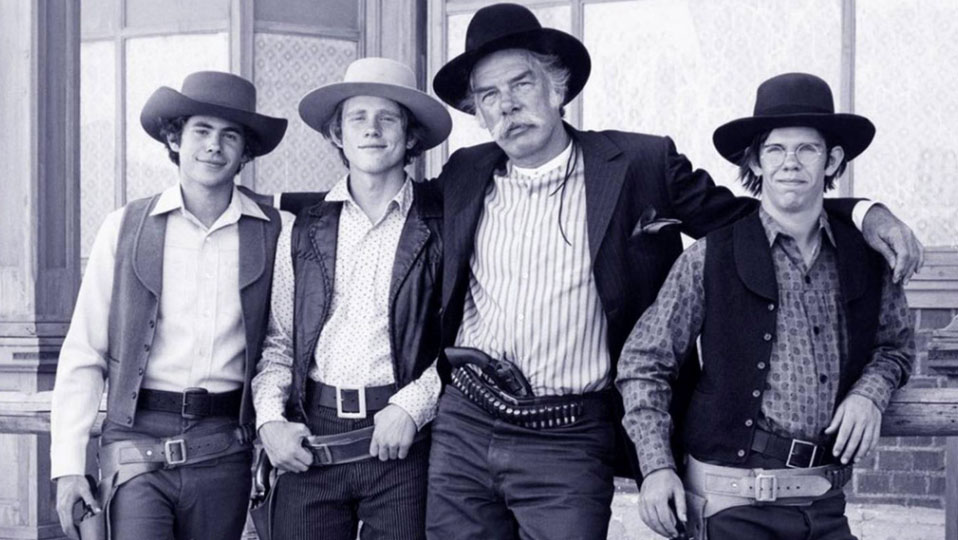
Lee Marvin had star power in droves. I sat through The Spikes Gang, an episodic western, and was never bored when he was on screen. That’s not to say the other actors were slacking because everyone turns in heartfelt performances—including cameos by Arthur Hunnicutt and Noah Beery, Jr. It's just that Marvin is one of those heavy hitters, like Robert Mitchum or Katharine Hepburn, that chews up every frame he graces. I promptly forgot the screenplay's limitations that plays more like a television movie of the week than a vehicle worthy of a legend who starred in some of the best westerns of his time: The Man Who Shot Liberty Valance (1962), Cat Ballou (1965), Monte Walsh (1970) and my personal favorite, The Professionals (1966).

The plot concerns impressionable Will, Tod, and Les (Gary Grimes, Charles Martin Smith, and Ron Howard), restless teens, who come to romanticize Harry Spikes (Marvin) after finding him near death and nursing him back to health. Eventually they throw in with the charismatic outlaw but instead of high adventure, that Spikes promises, they wallow in hardships, blood, and bank robbing that goes more often awry than turning any kind of sustainable profit. Along the way, they come to realize, too late, that Spikes is no one to admire. The Spikes Gang is based on The Bank Robber, a novel by Giles Tippette, that I'll probably track down at some point. I suspect based on the discursive story that made it to the screen that I'd enjoy the book even more.


Monday, August 23, 2010

BEAT to a PULP: ROUND ONE

By David Cranmer

I’m involved in putting together a print anthology that will hopefully be of interest to western aficionados and to pulp fiction fans in general. At just under 400 pages, BEAT to a PULP: Round One is a gargantuan collection jam-packed with twenty-seven stories running the gamut of crime fiction, noir, sci-fi, hardboiled, western, literary, ghost and fantasy genres as well as a foreword by Bill Crider and a history of pulp by Cullen Gallagher.

For western enthusiasts is the inclusion of three gunslinger adventures. The first by Scott D. Parker is “You Don’t Get Three Mistakes,” a fast-paced oater in The Wild Wild West style with a twisty ending. The next sees the return of Cash Laramie, who made his first appearance in A Fistful of Legends, in a traditional western called “The Wind Scorpion” by Edward A. Grainger where revenge comes in unexpected forms. In the third story, if you favor the genre turned upside-down and inside-out, Chap O’Keefe sends everyone’s favorite outlaw through space and time in “The Unreal Jesse James.”

Authors well-known for their westerns, and writings in other genres too, have stepped onboard with some brain-teasing, spine-tingling tales for Round One. Ed Gorman weaves a psychological yarn about a broken-down marriage and infidelity called “Killing Kate.” Robert J. Randisi brings back Miles “Kid” Jacoby where the detective gets in deep with a case involving the paparazzi in “Crap is King.” Then James Reasoner takes us to Pearl Harbor where a beautiful nurse carries a deadly scent of “Heliotrope” for a haunting tale.

Plus there is an original short story by pulp legend Paul S. Powers. Mr. Powers had a prolific and successful career in pulp fiction, writing over 400 stories for such magazines as Wild West Weekly, Weird Tales, Thrilling Western and dozens of others spanning four decades. His granddaughter Laurie kindly supplied us with the never-before-published “The Strange Death of Ambrose Bierce.” Mr. Powers’ brilliant homage to the fiery editor and writer Bierce grounds our anthology and bridges pulp-of-the-past to the present.

I had hoped for an August release, however, due to some last minute additions to the cover design, we are looking at middle to late September but the extra time will be well worth the wait. Credit for the sensational cover goes to James O'Barr of The Crow fame and John Bergin.

A complete list of authors and story titles can be found on the BTAP website ( http://www.beattoapulp.com/roundone.htm ) and updates will be posted on my blog, The Education of a Pulp Writer, ( http://davidcranmer.blogspot.com/ ) as details become available. Updates will also be announced on the BEAT to a PULP Facebook page setup by Hilary Davidson and Patricia Abbott. ( http://www.facebook.com/pages/Beat-to-a-Pulp/120622367985562 )

Hope you enjoy!