Showing posts with label Lee Marvin. Show all posts

Wednesday, June 19, 2024

FAVORITE WESTERN MOVIES--PART 1 by Cheryl Pierson

I know we have a lot of western movie lovers here—heck, we love just about ALL THINGS western, don’t we? Today I thought I’d talk a little bit about some western movies that are wonderful (for all kinds of different reasons) and one that, though it was highly acclaimed, is not among my favorites. (Please, hold the rotten tomatoes, and be kind!)

No one is ever going to agree with everyone about what makes a movie “great” or more meaningful, because viewers look for different concepts when they sit down and watch a movie. Some values, and “points to ponder”, are more meaningful to some than to others. There is no right or wrong here, just a fun discussion, so y’all chime in and don’t be shy!

I really don’t have a particular order for these except my favorite, and I’ll start with that one. I would definitely have to say my favorite is The Man Who Shot Liberty Valance, starring John Wayne, James Stewart, Vera Miles, Woody Strode (as Pompey) and Lee Marvin—who was absolutely perfect for the Liberty Valance character. I realize that not everyone has seen all these movies, so will try not to give any spoilers. It’s very rare that I enjoy a movie more than the book it was taken from, but The Man Who Shot Liberty Valance is one of those for me. It was taken from a short story by Dorothy M. Johnson. Although the actors who were slotted in the key roles were much more “mature” than they were in Johnson’s story, I can’t help but think of those portrayals as more realistic—probably because John Wayne’s Tom Doniphon and James Stewart’s Ransom Stoddard were embedded in my mind long before I ever read the short story.

An idealistic lawyer, Ranse Stoddard (Stewart) comes west to bring some law to a place that has none. Tom Doniphon (Wayne) generally pokes fun at him and the naïve way he handles himself. Stoddard changes Doniphon’s opinion as he shows the courage and backbone he’s brought with him to accompany his law books. At first, Doniphon faces down the ruthless Liberty Valance (Marvin) to protect Stoddard, but Stoddard learns how to use a gun and in the end, goes out on the street to face Liberty Valance in a fight he’s sure to lose. As the Gene Pitney song goes: “When the final showdown came at last/A law book was no good.” But…who really shot Liberty Valance? This is a movie you will not want to miss.


Another favorite is Purgatory—the story of outlaws who have died going to a place where they must be good for the length of their “sentence” if they ever hope to make it to heaven. So…what happens when some ruthless outlaws who are NOT dead find the town of Refuge? Is there any way the inhabitants can defend themselves without voiding the time they’ve spent there trying to do good?

The final showdown between both groups will have you on the edge of your seat. Now, bear with me. This sounds hokey, in a way, but it’s really a very interesting movie with a premise that I would not have thought of in a million years. Stars include Sam Shepard, Eric Roberts, Randy Quaid, Donnie Wahlberg (a few years before Blue Bloods) and musician/songwriter J.D. Souther, one of my favorite singer/songwriters, and one of my favorite characters in this movie. I hope if you haven’t seen this one, you’ll give it a chance—it is very entertaining and different.

Another classic, The Magnificent Seven—starring heavy hitters such as Yul Brynner, Robert Vaughan, Steve McQueen, Charles Bronson, and James Coburn—also makes my list of best westerns. A group of mercenaries band together to protect a small Mexican village from a marauding outfit of outlaws who will stop at nothing to take over. But…there are only seven of them and they must stand against what looks to be unbeatable odds.

Although it’s somewhat predictable, it’s one you won’t want to miss. Realistic, but avoids a lot of gore, and it’s well worth watching if for no other reason than the beautiful score by Elmer Bernstein. (Well, and who DOESN’T want to watch Yul Brynner in anything he’s in!)

John Wayne has made a LOT of western movies, but one of my favorites is El Dorado—probably because I really enjoy seeing Robert Mitchum in just about anything. This flick also includes James Caan in one of his very early appearances on the silver screen. In a nutshell, Cole Thornton (Wayne) is a hired gun who comes to the aid of an old friend, J.P. Harrah (Mitchum), a sheriff who has become a laughingstock because of his drinking. A wealthy cattle baron is determined to steal water from another ranching family, the MacDonalds, and hires his own gunfighter, Nelse McLeod, (Christopher George), an old nemesis of Thornton’s.

Is there any way that Thornton and Harrah can protect the McDonalds? It’s been common knowledge for years that Thornton and McLeod are evenly matched in their shooting abilities, and Thornton has a bullet lodged near his spine that sometimes affects his ability to draw and shoot—a secret he must hide if he has any hope of surviving and saving the MacDonalds.

As for western movies that didn’t make it to my “favorites” list, probably my number one pick for this week would be, surprisingly, a John Wayne movie that he often said was his own personal favorite—The Searchers. Many readers will disagree with me on this, I know.

Ethan Edwards (Wayne) returns to his brother’s home after an eight-year absence. In a nutshell, his brother’s daughters, Debbie (Natalie Wood) and Lucy, are abducted by Comanches. The Comanches have killed almost everyone else in the family and burned down the house.

Edwards goes in search of the girls, finding Lucy murdered. When, five years later, he and Martin Pawley (Debbie’s adopted brother) find Debbie, she refuses to leave with them. Edwards tells Debbie he’d rather see her dead than living as a Comanche and tries to kill her! Martin saves the day, and in the chaos, Edwards is wounded by a Comanche.

There’s a lot more to this before the end of the movie, but I don’t want to give away the last part of it. The main reason I don’t enjoy this one is because of Edwards’ obsession with finding Debbie, even to the point of wanting to kill her because she’s chosen to stay with the Comanche. Also, it just seems like this entire movie goes on and on and on…That being said, there’s no denying that I’m definitely in the minority. The Searchers won many awards and is filmed beautifully, and it’s hard to say anything bad about any movie John Ford directed. It’s a masterpiece, but it’s not my cup of tea, mainly because I was so disappointed in Edwards.

We’ll do more on this next month! I have really enjoyed revisiting these movies and I always see something I never saw before when I watch them. Hmmm…maybe I better give The Searchers another chance…

What’s your least favorite western movie and why?

Wednesday, June 21, 2023

REVISITING THE MAN WHO SHOT LIBERTY VALANCE by CHERYL PIERSON


Favorite western movies? I’ve got a few. But if I had to choose, I think it would have to be The Man Who Shot Liberty Valance.

This Hollywood classic, starring John Wayne as Tom Doniphon, Lee Marvin as Liberty Valance, Vera Miles as Hallie Ericson, and Jimmy Stewart as Ransom “Ranse” Stoddard has just about everything a western cinema fan could hope for: action, romance, right-over-might…and an unforgettable theme song.

Dorothy M. Johnson’s short story was made into a movie in 1962. It’s one of my oldest “movie” memories, as I was five years old when it made the rounds to the movie theaters and drive-ins.

Here’s the description of the movie according to Wickipedia:b>

Elderly U.S. Senator Ransom "Ranse" Stoddard and his wife Hallie arrive by train in the small western town of Shinbone, to attend the funeral of an apparent nobody, a local rancher named Tom Doniphon. Prior to the funeral, Hallie goes off with a friend to visit a burned-down house with obvious significance to her. As they pay their respects to the dead man at the undertaker's establishment, the senator is interrupted with a request for a newspaper interview. Stoddard grants the request.

As the interview with the local reporter begins, the film flashes back several decades as Stoddard reflects on his first arrival at Shinbone by stagecoach to establish a law practice.

A gang of outlaws, led by gunfighter Liberty Valance, hold up the stagecoach. Stoddard is brutally beaten, left for dead and later rescued by Doniphon. Stoddard is nursed back to health by restaurant owner Peter Ericson (John Qualen), his wife Nora (Jeanette Nolan) and daughter Hallie. It later emerges that Hallie is Doniphon's love interest.

Shinbone's townsfolk are regularly menaced by Valance and his gang. Cowardly local marshal Link Appleyard (Andy Devine) is ill prepared and unwilling to enforce the law. Doniphon is the only local courageous enough to challenge Valance's lawless behavior.


"You, Liberty...I said YOU pick it up..."

On one occasion, Doniphon even intervenes on Stoddard's behalf, when Valance publicly humiliates the inept Easterner. Valance trips Stoddard who is waiting tables at Peter's restaurant. Stoddard spills Doniphon's order causing Doniphon to intervene. Valance stands down and leaves. Doniphon tells Stoddard he needs to either leave the territory or buy a gun. Stoddard says he will do neither.

Stoddard is an advocate for justice under the law, not man. He earns the respect and affection of Hallie when he offers to teach her to read after he discovers, to her embarrassment, she's had no formal education. Stoddard's influence on Hallie and the town is further evidenced when he begins a school for the townspeople with Hallie's help. But, secretly, Stoddard borrows a gun and practices shooting.

Doniphon shows Stoddard his plans for expanding his house in anticipation of marrying Hallie, and reminds him that Hallie is his girl. Doniphon gives Stoddard a shooting lesson but humiliates him by shooting a can of paint which spills on Stoddard's suit. Doniphon warns that Valance will be just as devious, but Stoddard hits him in the jaw and leaves.

In Shinbone, the local newspaper editor-publisher Dutton Peabody (Edmond O'Brien) writes a story about local ranch owners' opposition to the territory's potential statehood. Valance convinces the ranchers that if they will hire him, he can get elected as a delegate to represent the cattlemen's interest. Shinbone's residents meet to elect two delegates to send to the statehood convention at the territorial capital. Valance attempts to bully the townspeople into electing him as a delegate. Eventually, Stoddard and Peabody are chosen. Valance assaults and badly beats Peabody after Peabody publishes two unflattering articles about Valance and his gang. The villains destroy Peabody's office. Valance also calls Stoddard out for a duel later in the evening after Valance loses his bid for delegate. Valance leaves saying "Don't make us come and get you!" Doniphon tells Stoddard he should leave town and even offers to have his farmhand, Pompey, escort him. But when Stoddard sees that Peabody has been nearly beaten to death, he calls out Valance. Stoddard then retrieves a carefully wrapped gun from under his bed and heads toward the saloon where Valance is. Valance hears he has been called out and justifies going out in self-defense. His wins his last poker hand before the duel with Aces and Eights.


"Pompey..."

In the showdown, Valance toys with Stoddard by firing a bullet near his head and then wounding him in the arm, which causes Stoddard to drop his gun. Valance allows Stoddard to bend down and retrieve the gun. Valance then aims to kill Stoddard promising to put the next bullet "right between the eyes," when Stoddard fires and miraculously kills Valance with one shot to the surprise of everyone, including himself. Hallie responds with tearful affection. Doniphon congratulates Stoddard on his success, and notices how Hallie lovingly cares for Stoddard's wounds.

Sensing that he has lost Hallie's affections, Doniphon gets drunk in the saloon and drives out Valance's gang, who have been calling for Stoddard to be lynched for Valance's "murder." The barman tries to tell Doniphon's farmhand Pompey (Woody Strode) that he cannot be served (due to his race), to which Doniphon angrily shouts: "Who says he can't? Pour yourself a drink, Pompey." Pompey instead drags Doniphon home, where the latter sets fire to an uncompleted bedroom he was adding to his house in anticipation of marrying Hallie. The resulting fire destroys the entire house.

Stoddard is hailed as "The Man Who Shot Liberty Valance" and based on this achievement, is nominated as the local representative to the statehood convention. Stoddard is reluctant to serve based upon his notoriety for killing a man in a gunfight. At this point, in a flashback within the original flashback, Doniphon tells Stoddard that it was he (Doniphon), hidden across the street, who shot and killed Valance in cold blood, and not Stoddard in self-defense. Stoddard finds Doniphon and asks him why he shot Valance. He did it for Hallie, he says, because he understood that "she's your girl now". Doniphon encourages Stoddard to accept the nomination: "You taught her to read and write, now give her something to read and write about!"

Stoddard returns to the convention and is chosen as representative. He marries Hallie and eventually becomes the governor of the new state. He then becomes a two term U.S. senator, then the American ambassador to Great Britain, a U.S. senator again, and at the time of Doniphon's funeral is the favorite for his party's nomination as vice president.

The film returns to the present day and the interview ends. The newspaper man, understanding now the truth about the killing of Valance, burns his notes stating: "This is the West, sir. When the legend becomes fact, print the legend."

"Hallie, who put the cactus rose on Tom's coffin?"

Stoddard and Hallie board the train for Washington, melancholy about the lie that led to their prosperous life. With the area becoming more and more civilized, Stoddard decides, to Hallie's delight, to retire from politics and return to the territory to set up a law practice. When Stoddard thanks the train conductor for the train ride and the many courtesies extended to him by the railroad, the conductor says, "Nothing's too good for the man who shot Liberty Valance!" Upon hearing the comment, Stoddard and his wife stare off thoughtfully into the distance.


As a side note, one of the many reasons this film holds a special place in my heart is because I remember it as being the first time I made the connection between a scene onscreen representing a flashback. Remember the “flashback within a flashback” that the Wikipedia article mentions? The smoke from John Wayne’s cigarette moves and flows to take over the screen as he tells Jimmy Stewart, “You didn’t kill Liberty Valance. Think back…” That smoke took us back to the truth of what had happened, and my five-year-old brain was shocked—and enamored, even then, with the idea that time passage, or remembrances could be shown through the haze of cigarette smoke. It was the moment of truth for Ransom Stoddard.

For me, The Man Who Shot Liberty Valance embodies the core of the west—good and evil, and how sometimes “the point of a gun was the only law”—and it all depended on the man who held the weapon.

Liberty represented the purest evil. Ranse was determined to fight him with the law he treasured—the desire to do things the legal way blinding him to the fact that Liberty didn’t respect that. In the beginning, his naivete is almost painful to watch, providing Liberty some rich entertainment. Though Tom finds it amusing, his growing respect for Ranse’s perseverance is portrayed to perfection by that familiar downward glance of John Wayne’s. Accompanied by the half-smile and his slow advice-giving drawl, the character of Tom Doniphon is drawn so that by the point at which he sees the handwriting on the wall and burns down the house he built for Hallie, the viewer’s sympathy shifts, briefly, to the circumstances Tom finds himself in.

But Ranse is determined to vanquish Valance one way or the other—with a lawbook or a gun—whatever it takes. In the final showdown, the lines of resignation are etched in Tom Doniphon’s face, and we know he is honor-bound to do the thing he’ll regret forever: save Ranse Stoddard’s life and lose Hallie to him.

I love the twist. Ranse truly believes he’s killed Valance. Again, to do the honorable thing, Tom tells him the truth about what really happened.

What do you think? If you were Ranse, would you want to know you really were not the man who shot Liberty Valance? Or would you want to be kept in the dark? If you were Tom, would you have ever told him? It’s a great movie!


Now you can sing along!

THE MAN WHO SHOT LIBERTY VALANCE

When Liberty Valance rode to town the womenfolk would hide, they'd hide
When Liberty Valance walked around the men would step aside
'cause the point of a gun was the only law that Liberty understood
When it came to shootin' straight and fast---he was mighty good.

>From out of the East a stranger came, a law book in his hand, a man
The kind of a man the West would need to tame a troubled land
'cause the point of a gun was the only law that Liberty understood
When it came to shootin' straight and fast---he was mighty good.

Many a man would face his gun and many a man would fall
The man who shot Liberty Valance, he shot Liberty Valance
He was the bravest of them all.

The love of a girl can make a man stay on when he should go, stay on
Just tryin' to build a peaceful life where love is free to grow
But the point of a gun was the only law that Liberty understood
When the final showdown came at last, a law book was no good.

Alone and afraid she prayed that he'd return that fateful night, aww that night
When nothin' she said could keep her man from goin' out to fight
>From the moment a girl gets to be full-grown the very first thing she learns
When two men go out to face each other only one retur-r-r-ns

Everyone heard two shots ring out, a shot made Liberty fall
The man who shot Liberty Valance, he shot Liberty Valance
He was the bravest of them all.

The man who shot Liberty Valance, he shot Liberty Valance
He was the bravest of them all.

Tuesday, September 8, 2020

Forgotten Western Classics: The Spikes Gang (1974)


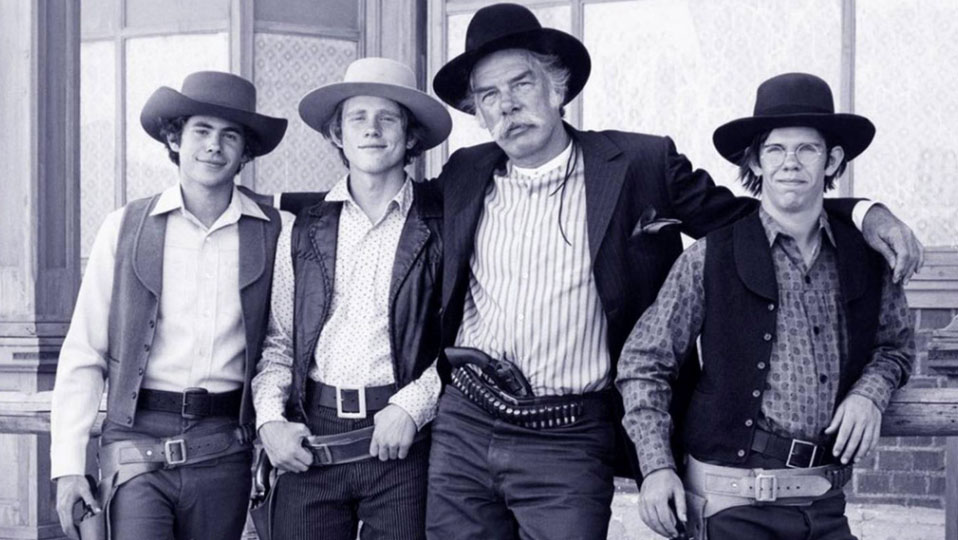
Lee Marvin had star power in droves. I sat through The Spikes Gang, an episodic western, and was never bored when he was on screen. That’s not to say the other actors were slacking because everyone turns in heartfelt performances—including cameos by Arthur Hunnicutt and Noah Beery, Jr. It's just that Marvin is one of those heavy hitters, like Robert Mitchum or Katharine Hepburn, that chews up every frame he graces. I promptly forgot the screenplay's limitations that plays more like a television movie of the week than a vehicle worthy of a legend who starred in some of the best westerns of his time: The Man Who Shot Liberty Valance (1962), Cat Ballou (1965), Monte Walsh (1970) and my personal favorite, The Professionals (1966).

The plot concerns impressionable Will, Tod, and Les (Gary Grimes, Charles Martin Smith, and Ron Howard), restless teens, who come to romanticize Harry Spikes (Marvin) after finding him near death and nursing him back to health. Eventually they throw in with the charismatic outlaw but instead of high adventure, that Spikes promises, they wallow in hardships, blood, and bank robbing that goes more often awry than turning any kind of sustainable profit. Along the way, they come to realize, too late, that Spikes is no one to admire. The Spikes Gang is based on The Bank Robber, a novel by Giles Tippette, that I'll probably track down at some point. I suspect based on the discursive story that made it to the screen that I'd enjoy the book even more.


Monday, February 17, 2020

A doo-wop singer, a hard-as-nails actor, and the western movie that connects them by Kaye Spencer #westernfictioneers #hollywood #moviemusic


February 17th  and February 19th  have a primary and secondary connection that makes the trivia-loving nerd in me happy as a dog wagging two tails.

I’ll begin with the secondary connection, which is simply February birthdays— 

Musician Gene Pitney was born on February 17th

Gene Pitney (reference below)

and actor Lee Marvin was born on February 19th.


Lee Marvin (reference below)

First, a little about Gene Pitney—

Born on February 17, 1940 (died April 5, 2006), Pitney was an American singer-songwriter and musician. Over the course of his career (1961 – 2006), Pitney experienced musical success with songs he wrote for others and with songs that he wrote and performed himself. He was inducted into the Rock and Roll Hall of Fame in 2002.

He referred to himself as a doo-wop singer. According to the website www.britannica.com:

‘doo-wop is a style of rhythm and blues and rock-and-roll vocal music popular in the 1950s and ’60s [with roots in the 1930s and 1940s]. The structure of doo-wop music generally featured a tenor lead vocalist singing the melody of the song with a trio or quartet singing background harmony. The term doo-wop is derived from the sounds made by the group as they provided harmonic background to the lead singer.’

Notable and successful songs he wrote for others:

  • Hello Mary Lou by Ricky Nelson
  • Rubber Ball by Bobby Vee
  • He’s a Rebel by the Crystals
  • Today’s Teardrops by Roy Orbison
Notable and successful songs he performed:

  • Only Love Can Break a Heart
  • Twenty-four Hours from Tulsa
  • Half Heaven, Half Heartache
  • It Hurts to Be in Love
  • I’m Gonna Be Strong
  • Town Without Pity from the Kirk Douglas movie of the same name. Pitney performed this song during the 1962 Academy Awards as it was nominated for Best Song (lost to Moon River)
 Pitney recorded two albums with country music entertainer George Jones. They were voted the ‘most promising country-and-western-duo of the year’ in 1965.

He also recorded in Italian, Spanish, and German and competed in Italy’s annual Sanremo Music Festival to critical acclaim comparing his voice to that of Italian opera tenor Enrico Caruso.

A radio disc jockey nicknamed Pitney “The Rockville Rocket” because of his meteoric rise in the music charts. (Pitney grew up in Rockville, Connecticut.)

Next, a few words about Lee Marvin—

He was born on (February 19, 1924 (died August 29, 1987). He was an American film and television actor with a military background of having enlisted in the Marines at the beginning of World War II. His military experience, which included receiving the Purple Heart Medal, Presidential Unit Citation, American Campaign Medal, Asiatic-Pacific Campaign Medal, WWII Victory Med, and the Combat Action Ribbon.

His military experiences affected him deeply for the rest of his life. He disliked acting in many of his war-related movies as he felt the movies glorified war, and he was picky about which war movies he took. He often spoke out against U.S. involvement in Viet Nam.

These two quotes from the IMDb website (link in references below) illustrate his entire Hollywood career.
  • He was typecast as a heavy before graduating to unsympathetic heroes.
  • He often played tough, hard bitten anti-heroes.
Also from his bio on the IMBd website, here are three of his quotes regarding the violence in some of his movies and the violence in the characters he’d played.

Because real violence is a thing that must not be tolerated, and in order not to tolerate it, you must be educated in knowing what it is. Violent films come out with value… When I play these roles of vicious men, I do things you shouldn’t do and I make you see that you shouldn’t do them.


...But most violence on the screen looks so easy and so harmless that its’ like an invitation to try it. I say make it so brutal that a man thinks twice before he does anything like that.


I’ve always been against senseless violence myself. When I incorporate violence in my performances, I make sure there’s a point to it. If I were playing a heavy, say a cowboy bad guy, I could commit some senseless crime to that I’d have to be destroyed in the third or fourth reel Holding up the stagecoach, for example, and shooting the old lady because she turned her back on me. So I’m against pointless violence, too.

Just a few of Lee Marvin’s movies: (deliberately left out his numerous television appearances)
  • You’re in the Navy Now (1951 film debut - uncredited)
  • Bad Day at Black Rock
  • Not as a Stranger
  • Pillars of the Sky
  • Raintree County
  • The Comancheros
  • Donovan’s Reef
  • Cat Ballou (Oscar win)
  • Ship of Fools
  • The Professionals
  • The Dirty Dozen
  • Paint Your Wagon
  • Monte Walsh
  • Pocket Money
  • Prime Cut
  • The Iceman Cometh
  • Death Hunt
  • The Delta Force

Finally, the primary connectionThe Man Who Shot Liberty Valance

Pitney had a hit with the Burt Bacharach / Hal David song The Man Who Shot Liberty Valance.

Marvin played the villain Liberty Valance in the western film The Man Who Shot Liberty Valance.

…and now you know the nerdy connection.

Side note: The song was not included in the movie because of a publishing dispute. However it did reach No. 4 on the music charts.

Gene Pitney singing the theme song to The Man Who Shot Liberty Valance:


We meet Lee Marvin as Liberty Valance in all his villainous glory:


Until next time,
Kaye Spencer

Writing through history one romance upon a time


Stay in contact with Kaye—


References:
Gene Pitney
https://en.wikipedia.org/wiki/Gene_Pitney
https://www.allmusic.com/artist/gene-pitney-mn0000200882/biography
Image: William Morris Agency (management), Gene Pitney 1967, marked as public domain, more details on Wikimedia Commons

Lee Marvin
https://en.wikipedia.org/wiki/Lee_Marvin
https://www.imdb.com/name/nm0001511/bio
Image: NBC Television Uploaded by We hope at en.wikipedia, Lee marvin 1971, marked as public domain, more details on Wikimedia Commons

Film: The Man Who Shot Liberty Valance
https://en.wikipedia.org/wiki/The_Man_Who_Shot_Liberty_Valance
https://www.britannica.com/topic/The-Man-Who-Shot-Liberty-Valance-film-1962
https://www.imdb.com/title/tt0056217/

Song: The Man Who Shot Liberty Valance
https://en.wikipedia.org/wiki/(The_Man_Who_Shot)_Liberty_Valance
https://www.songfacts.com/facts/gene-pitney/the-man-who-shot-liberty-valance

Tuesday, April 7, 2015

THE MAN WHO SHOT LIBERTY VALANCE by CHERYL PIERSON (SATURDAY MATINEE)


Favorite western movies? I’ve got a few. But if I had to choose, I think it would have to be The Man Who Shot Liberty Valance.

This Hollywood classic, starring John Wayne as Tom Doniphon, Lee Marvin as Liberty Valance, Vera Miles as Hallie Ericson, and Jimmy Stewart as Ransom “Ranse” Stoddard has just about everything a western cinema fan could hope for: action, romance, right-over-might…and an unforgettable theme song.

Dorothy M. Johnson’s short story was made into a movie in 1962. It’s one of my oldest “movie” memories, as I was five years old when it made the rounds to the movie theaters and drive-ins.

Here’s the description of the movie according to Wickipedia:b>

Elderly U.S. Senator Ransom "Ranse" Stoddard and his wife Hallie arrive by train in the small western town of Shinbone, to attend the funeral of an apparent nobody, a local rancher named Tom Doniphon. Prior to the funeral, Hallie goes off with a friend to visit a burned-down house with obvious significance to her. As they pay their respects to the dead man at the undertaker's establishment, the senator is interrupted with a request for a newspaper interview. Stoddard grants the request.

As the interview with the local reporter begins, the film flashes back several decades as Stoddard reflects on his first arrival at Shinbone by stagecoach to establish a law practice.

A gang of outlaws, led by gunfighter Liberty Valance, hold up the stagecoach. Stoddard is brutally beaten, left for dead and later rescued by Doniphon. Stoddard is nursed back to health by restaurant owner Peter Ericson (John Qualen), his wife Nora (Jeanette Nolan) and daughter Hallie. It later emerges that Hallie is Doniphon's love interest.

Shinbone's townsfolk are regularly menaced by Valance and his gang. Cowardly local marshal Link Appleyard (Andy Devine) is ill prepared and unwilling to enforce the law. Doniphon is the only local courageous enough to challenge Valance's lawless behavior.


"You, Liberty...I said YOU pick it up..."

On one occasion, Doniphon even intervenes on Stoddard's behalf, when Valance publicly humiliates the inept Easterner. Valance trips Stoddard who is waiting tables at Peter's restaurant. Stoddard spills Doniphon's order causing Doniphon to intervene. Valance stands down and leaves. Doniphon tells Stoddard he needs to either leave the territory or buy a gun. Stoddard says he will do neither.

Stoddard is an advocate for justice under the law, not man. He earns the respect and affection of Hallie when he offers to teach her to read after he discovers, to her embarrassment, she's had no formal education. Stoddard's influence on Hallie and the town is further evidenced when he begins a school for the townspeople with Hallie's help. But, secretly, Stoddard borrows a gun and practices shooting.

Doniphon shows Stoddard his plans for expanding his house in anticipation of marrying Hallie, and reminds him that Hallie is his girl. Doniphon gives Stoddard a shooting lesson but humiliates him by shooting a can of paint which spills on Stoddard's suit. Doniphon warns that Valance will be just as devious, but Stoddard hits him in the jaw and leaves.

In Shinbone, the local newspaper editor-publisher Dutton Peabody (Edmond O'Brien) writes a story about local ranch owners' opposition to the territory's potential statehood. Valance convinces the ranchers that if they will hire him, he can get elected as a delegate to represent the cattlemen's interest. Shinbone's residents meet to elect two delegates to send to the statehood convention at the territorial capital. Valance attempts to bully the townspeople into electing him as a delegate. Eventually, Stoddard and Peabody are chosen. Valance assaults and badly beats Peabody after Peabody publishes two unflattering articles about Valance and his gang. The villains destroy Peabody's office. Valance also calls Stoddard out for a duel later in the evening after Valance loses his bid for delegate. Valance leaves saying "Don't make us come and get you!" Doniphon tells Stoddard he should leave town and even offers to have his farmhand, Pompey, escort him. But when Stoddard sees that Peabody has been nearly beaten to death, he calls out Valance. Stoddard then retrieves a carefully wrapped gun from under his bed and heads toward the saloon where Valance is. Valance hears he has been called out and justifies going out in self-defense. His wins his last poker hand before the duel with Aces and Eights.


"Pompey..."

In the showdown, Valance toys with Stoddard by firing a bullet near his head and then wounding him in the arm, which causes Stoddard to drop his gun. Valance allows Stoddard to bend down and retrieve the gun. Valance then aims to kill Stoddard promising to put the next bullet "right between the eyes," when Stoddard fires and miraculously kills Valance with one shot to the surprise of everyone, including himself. Hallie responds with tearful affection. Doniphon congratulates Stoddard on his success, and notices how Hallie lovingly cares for Stoddard's wounds.

Sensing that he has lost Hallie's affections, Doniphon gets drunk in the saloon and drives out Valance's gang, who have been calling for Stoddard to be lynched for Valance's "murder." The barman tries to tell Doniphon's farmhand Pompey (Woody Strode) that he cannot be served (due to his race), to which Doniphon angrily shouts: "Who says he can't? Pour yourself a drink, Pompey." Pompey instead drags Doniphon home, where the latter sets fire to an uncompleted bedroom he was adding to his house in anticipation of marrying Hallie. The resulting fire destroys the entire house.

Stoddard is hailed as "The Man Who Shot Liberty Valance" and based on this achievement, is nominated as the local representative to the statehood convention. Stoddard is reluctant to serve based upon his notoriety for killing a man in a gunfight. At this point, in a flashback within the original flashback, Doniphon tells Stoddard that it was he (Doniphon), hidden across the street, who shot and killed Valance in cold blood, and not Stoddard in self-defense. Stoddard finds Doniphon and asks him why he shot Valance. He did it for Hallie, he says, because he understood that "she's your girl now". Doniphon encourages Stoddard to accept the nomination: "You taught her to read and write, now give her something to read and write about!"

Stoddard returns to the convention and is chosen as representative. He marries Hallie and eventually becomes the governor of the new state. He then becomes a two term U.S. senator, then the American ambassador to Great Britain, a U.S. senator again, and at the time of Doniphon's funeral is the favorite for his party's nomination as vice president.

The film returns to the present day and the interview ends. The newspaper man, understanding now the truth about the killing of Valance, burns his notes stating: "This is the West, sir. When the legend becomes fact, print the legend."

"Hallie, who put the cactus rose on Tom's coffin?"

Stoddard and Hallie board the train for Washington, melancholy about the lie that led to their prosperous life. With the area becoming more and more civilized, Stoddard decides, to Hallie's delight, to retire from politics and return to the territory to set up a law practice. When Stoddard thanks the train conductor for the train ride and the many courtesies extended to him by the railroad, the conductor says, "Nothing's too good for the man who shot Liberty Valance!" Upon hearing the comment, Stoddard and his wife stare off thoughtfully into the distance.


As a side note, one of the many reasons this film holds a special place in my heart is because I remember it as being the first time I made the connection between a scene onscreen representing a flashback. Remember the “flashback within a flashback” that the Wikipedia article mentions? The smoke from John Wayne’s cigarette moves and flows to take over the screen as he tells Jimmy Stewart, “You didn’t kill Liberty Valance. Think back…” That smoke took us back to the truth of what had happened, and my five-year-old brain was shocked—and enamored, even then, with the idea that time passage, or remembrances could be shown through the haze of cigarette smoke. It was the moment of truth for Ransom Stoddard.

For me, The Man Who Shot Liberty Valance embodies the core of the west—good and evil, and how sometimes “the point of a gun was the only law”—and it all depended on the man who held the weapon.

Liberty represented the purest evil. Ranse was determined to fight him with the law he treasured—the desire to do things the legal way blinding him to the fact that Liberty didn’t respect that. In the beginning, his naivete is almost painful to watch, providing Liberty some rich entertainment. Though Tom finds it amusing, his growing respect for Ranse’s perseverance is portrayed to perfection by that familiar downward glance of John Wayne’s. Accompanied by the half-smile and his slow advice-giving drawl, the character of Tom Doniphon is drawn so that by the point at which he sees the handwriting on the wall and burns down the house he built for Hallie, the viewer’s sympathy shifts, briefly, to the circumstances Tom finds himself in.

But Ranse is determined to vanquish Valance one way or the other—with a lawbook or a gun—whatever it takes. In the final showdown, the lines of resignation are etched in Tom Doniphon’s face, and we know he is honor-bound to do the thing he’ll regret forever: save Ranse Stoddard’s life and lose Hallie to him.

I love the twist. Ranse truly believes he’s killed Valance. Again, to do the honorable thing, Tom tells him the truth about what really happened.

What do you think? If you were Ranse, would you want to know you really were not the man who shot Liberty Valance? Or would you want to be kept in the dark? If you were Tom, would you have ever told him? It’s a great movie!


Now you can sing along!

THE MAN WHO SHOT LIBERTY VALANCE

When Liberty Valance rode to town the womenfolk would hide, they'd hide
When Liberty Valance walked around the men would step aside
'cause the point of a gun was the only law that Liberty understood
When it came to shootin' straight and fast---he was mighty good.

>From out of the East a stranger came, a law book in his hand, a man
The kind of a man the West would need to tame a troubled land
'cause the point of a gun was the only law that Liberty understood
When it came to shootin' straight and fast---he was mighty good.

Many a man would face his gun and many a man would fall
The man who shot Liberty Valance, he shot Liberty Valance
He was the bravest of them all.

The love of a girl can make a man stay on when he should go, stay on
Just tryin' to build a peaceful life where love is free to grow
But the point of a gun was the only law that Liberty understood
When the final showdown came at last, a law book was no good.

Alone and afraid she prayed that he'd return that fateful night, aww that night
When nothin' she said could keep her man from goin' out to fight
>From the moment a girl gets to be full-grown the very first thing she learns
When two men go out to face each other only one retur-r-r-ns

Everyone heard two shots ring out, a shot made Liberty fall
The man who shot Liberty Valance, he shot Liberty Valance
He was the bravest of them all.

The man who shot Liberty Valance, he shot Liberty Valance
He was the bravest of them all.

Friday, February 27, 2015

AND THE OSCAR GOES TO... -- Meg Mims


Last weekend, the Oscars were awarded to films, directors, actors, writers, musicians, etc., nominated earlier this year. Fashion is huge, but so are the winners and losers. And let's face it -- it's an annual ritual that many love.


Usually, when that envelope is opened, the film or actor has not starred in a "genre" style flick. Dramas, epic blockbusters, war films or biopics have earned the most statuettes for Best Picture. Romance and musicals have fared so-so, depending on the era and Hollywood's mood. Despite the popularity of the other types of films - mystery/crime, fantasy, science fiction, horror, adventure, and especially westerns with American audiences (proof in the pocketbook), the Academy often withholds their votes.


Sorry, but it's true. You'd think, given the number of westerns that Hollywood has churned out since its earliest days, that there'd be a TON of golden statuettes lined up along the trail. Not hardly, pardner. Oh, don't get me wrong. There's been PLENTY of nominations - 129 westerns, in fact. Check out the list.

BUT only three, count 'em, THREE, won a Best Picture Oscar. Can you name them? Yes, the answer is below, but try to guess. I'll give ya the first one -- 1930's Cimarron, a "pre-code western", whatever that means, based on the Edna Ferber novel.


Start guessing! My first try, Butch Cassidy and the Sundance Kid, and one of my favorite films (okay, it might have played fast and loose with history, but it sure was fun!), didn't fare so well.


It earned plenty of nominations (and as I can attest, it's an HONOR to be nominated!), but only won the Best Original Screenplay (William Goldman, who also wrote The Princess Bride), Best Cinematography, Best Original Score, and Best Song. What film won Best Picture that year? Midnight Cowboy. Hmph. Controversy claimed the big prize.

My second guess, the 1956 film The Searchers, based on the book by Alan LeMay, received ZIP. Nada. Nothing! No nod to John Wayne, director John Ford, not a even a Cinematography nomination! That's criminal!


But it has withstood the test of time and is considered a masterpiece, plus one of the most influential films - inspiring David Lean in making Lawrence of Arabia and probably many other sweeping epics. So there.


How about Little Big Man, with Dustin Hoffman? Based on the book by Thomas Berger, by the way, but only Chief Dan George received a nomination for Best Supporting Actor. Hm. Okay, maybe it was "revisionist" history, but still.


Let's try another guess - one of my favorites, True Grit, based on the Charles Portis novel. Yes, John Wayne won a Best Actor Oscar in 1970 for portraying Rooster Cogburn (he deserved it, even though some people believed it to be a 'sympathy vote'). In fact, after accepting the golden statue, he said, "If I'd known that, I'd have put that patch on 35 years earlier." Ha!


Okay, skip a few decades. How about 1990's Dances With Wolves, based on the Michael Blake book? Kevin Costner, a Hollywood favorite. Come on! It had to win something out of TWELVE nominations. And it did pretty well - seven out of twelve. Best Picture. Best Director for KC. Best Adapted Screenplay for author Blake. Best Cinematography. Best Sound. Best Film Editing. Best Original Score. This was the HIGHLIGHT of the western Oscars! Surely it meant Hollywood was falling back in love with the genre? Er...


Two years later, Clint Eastwood claimed this 1992 film as his last western. Oh boy, talk about predicting the death of the genre. So how did Unforgiven fare? I mean, he's Clint Eastwood! CLINT EASTWOOD, best known for riding a horse, for heaven's sake. The film received NINE Oscar nominations, pretty decent, but claimed not even HALF that number. Hm. It did win four - Best Picture and Best Director, Best Supporting Actor, and Best Film Editing. Sigh.


Dare I mention this 2005 western film, which earned eight nominations and won three Oscars, for Best Director, Best Adapted Screenplay (from the short story by Annie Proulx), and Best Original Score? Sure spurred controversy, so maybe that's why... Let's see how did the Coen Brothers remake of Charles Portis's True Grit fare six years later in the 2011 Academy Awards.


The film received TEN, count 'em, TEN nominations. Lost every time. Hmph. Does this mean Hollywood has given up on western films? Well, Christoph Waltz received a Best Supporting Actor for Django Unchained in 2012. But when it comes to Best Picture? Three. Cimarron (1956). Dances With Wolves (1990). Unforgiven (1992). Sigh. Only three Best Picture Oscars. We'll see if Quentin Tarantino can pull off any nominations next January for The Hateful Eight.


Let's hope Best Picture #4 for a western is coming soon.


Mystery author Meg Mims lives in Southeastern Michigan with her husband and a 'Make My Day' Malti-poo dog. Meg loves writing novels, short novellas and short stories, both contemporary and historical. Her Spur and Laramie Award winning books - Double Crossing and Double or Nothing - are now among the Prairie Rose Publications book list. Meg is also one-half of the D.E. Ireland team writing the Eliza Doolittle & Henry Higgins Mystery series for St. Martin's Minotaur. Wouldn't It Be Deadly, Book 1, has been nominated for a 2014 AGATHA AWARD for Best Historical Mystery! Book 2, Move Your Blooming Corpse, will be released on September 22, 2015. You can find Meg (and D.E. Ireland) on Twitter, Facebook and Pinterest.