Showing posts with label Peacemaker Award. Show all posts

Sunday, January 28, 2018

COVERED WAGONS: THE FIRST TINY HOMES? By Vonn McKee


One of Thomas Jefferson's boldest acts as president was the negotiation of the Louisiana Purchase in 1803. He bought more than 800,000 square miles of land from France–sight unseen–for three cents an acre, doubling the size of the United States. The new lands stretched from the Mississippi River Valley to the Rocky Mountains. This initiated the great Westward Expansion of the 1800s. Between 1841 and 1869 alone, as many as half a million emmigrants braved the open prairies and rugged mountain ranges in search of a new start.
     The progress of a nation depends heavily on technology available at the time. As there were no roads, no steel rails, and little knowledge of navigable rivers, the hardy pioneers moved their possessions and loved ones west in freight and farm wagons, outfitted especially for the rigors of months-long travel. The covered wagon became a Westward Expansion icon, serving as a rolling storage room for food, water, tools, and furniture–as well as living quarters, birthing chambers, storm shelters, and sometimes the only available fortification in case of Indian attacks.
    
There were many kinds of covered wagons in use. It is a common misconception that all pioneers traveled in Conestoga wagons. That particular vehicle originated in Pennsylvania and was used more for moving heavy freight (up to 12,000 pounds of cargo). In fact, the sheer weight of the Conestoga made it unsuitable for travel across prairies, restricting its use mainly to the eastern states. That's not to say that no wagon train included Conestogas–only that they were not the preferred mode of transport. Its design was specialized, with a swooped, overhanging canvas top and a bed that was slanted up fore and aft to keep loads centered. 

oregontrailcenter.org

A lighter version of the covered wagon came to be known as the Prairie Schooner, since it resembled a ship with canvas sails crossing the prairie. These vehicles became the minivans of the West, if you will, or perhaps the first tiny homes. They were pulled by mules or oxen, the latter being favored for their strength, endurance, and lesser feed requirements. Most family members walked alongside. The wagon bed was crowded with supplies and usually reserved for small children, pregnant women, and the elder members of the party.
     Several covered wagon manufacturers sprang up in St. Louis, Missouri, the "Gateway to the West." The most popular was the Joseph Murphy wagon. There were many other makers including Luedinghaus, Linstroth, Gesting, Espenschied, and Studebaker (yes, the automobile manufacturer).

Interior of a covered wagon. Many dear possessions would be left along the trail.
     At an average speed of two miles per hour, and covering maybe fifteen miles on a typical day, the journey west often stretched from one season to the next. Even with inherent difficulties (river crossings, broken wheels, etc.), the covered wagon provided reliable transportation and a humble temporary home to the thousands of pioneer families who settled the American West.

All the best,

Vonn McKee

“Writing the Range”
2015 Western Fictioneers Peacemaker Award Finalist (Short Fiction)
2015 WWA Spur Award Finalist (Short Fiction)


From WOLFPACK PUBLISHING
Now available on Amazon:


Sunday, September 24, 2017

GRAVE HUMOR: AMUSING LAST WORDS IN THE WEST by Vonn McKee

 
While dying is not funny business, there’s no denying that some people utter some downright entertaining epigrams during their final moments on earth. Of course, there are plenty of unforgettably noble last words, but I submit that once Sam Houston summoned his remaining iron will to speak the words, “Texas––Texas! ––Margaret!” that nobody else could possibly top that. Why even try?


But those funny guys … especially the funny doomed guys, even if they didn’t mean to be amusing … they deserve special recognition, I believe, for using their last breaths to leave the crowd smiling, or at least wanting to smile. 

THIS IS FUNNY...
Some were famous, like Doc Holliday, who ended his life of gunfighting and wisecracking in a sick bed. With a glance down at his bootless feet, he declared, “This is funny.” You see, he always figured to die with his boots on, pistols blazing.


Some of the most interesting dying words were spoken by people who would have otherwise faded into Old West obscurity. Their memorable farewells are about all we know about them.


GALLOWS HUMOR
Sheriff Henry Plummer of Bannack, Montana, was hanged by vigilantes who suspected him of illegal activities. The sheriff held onto his bravado to the end and dryly remarked, “Give me a high drop, men.”


The Hanging Judge, Isaac C. Parker of Ft. Smith, Arkansas, dispensed of six murderers in a day. One of them, Sam Fooy, would have thumbed his nose at the judge and onlookers had his hands not been tied. He left them with, “I am as anxious to get out of this world as you are to see me go.”


John Owens murdered a man over five dollars in Buffalo, Wyoming, and couldn’t wait to get on with the show. “What time is it?” he said. “I wish you’d hurry up. I want to get to hell in time for dinner.”


A Nebraska farmer, Lee Shellenberger, was charged with killing his eleven-year-old daughter. Before the trial date, a lynch mob dragged him from the jail. Shellenberger was most indignant and delivered a threat just before the rope tightened. “If there is such a thing as haunts, I will do it, for I recognize several of you.”


We don’t know the name of the wise guy who was hanged at Yuma Penitentiary in 1887, but his punch line lives on. When asked why he was smiling, he replied, “Well, I was just thinking. You guys have got to walk back up there in the heat. I don’t.”


PARTING SHOT 
An outlaw named Bill Gallagher confronted tough rancher John Slaughter near Ft. Sumner, New Mexico, and decided to charge him on horseback. Slaughter coolly shot the man down. As Gallagher lay dying, he closed with a little self-analysis. “I needed killing twenty years ago, anyway.”


SHARP WIT

The Texas Panhandle produced plenty of tough characters. Sostenes L’Archeveque was one of them. Even his friends grew tired of his violent, troublemaking ways. They invited him over for a meal, then proceeded to ambush him. After being shot and stabbed, L’Archeveque still had plenty of fight left in him. He spat at his attackers, “You pull that knife out of my back and I’ll kill every one of you!”


➼  ➼  ➼  ➼  ➼  ➼  ➼  ➼  ➼  ➼  ➼  ➼  ➼  ➼  ➼  ➼  ➼  ➼  ➼  ➼
HEY, Y'ALL...WATCH THIS! 
Having been educated at a white man’s school, a Kickapoo woman named Oo-Lath-La-Hi-Na tried to avert an attack by soldiers who apparently didn’t realize her tribe as friendly.

“I will go out and talk with the white Captain. He thinks we are Comanches. The white men won’t shoot a woman.”

A caravan of wagons stopped for the night near Battle Mountain, Nevada, in August of 1857. One of the pioneers, Smith Holloway, declined to join the circle of wagons and camped away from the group, despite warnings of potential Indian attacks. After an uneventful night, Holloway arose and announced his last words, "Wake up, everyone. No redskins in sight!"


Four robbers were holed up in a cabin near Kokomo, Colorado when Deputy/Detective M. E. Conrad crashed through the door. Seeing no guns elsewhere in the cabin, Conrad grilled the men, forcing them to walk over to their beds, throw back the covers, and prove they weren’t bad guys. “Boys, we must see what you have got under those blankets,” he said, just before he learned the truth.


For more fascinating accounts of Western characters and their send-offs, I recommend Garry Radison’s book, LAST WORDS: DYING IN THE OLD WEST. And watch your words, my friends. They could well outlive you.


All the best,


Vonn


VONN McKEE
“Writing the Range”
2015 WWA Spur Finalist (Short Fiction)
2015 Western Fictioneers Peacemaker Finalist (Short Fiction)


www.vonnmckee.com
Like Vonn McKee on Facebook!

Sunday, August 28, 2016

ANCIENT VOICES AT SCOTTS BLUFF By Vonn McKee


"MITCHELL PASS" by William Henry Jackson
At the end of a recent trip to Wyoming, I decided to ramble over to western Nebraska and investigate Scotts Bluff National Monument. I have a couple of short works in progress set in the area and needed to see and smell it for authenticity’s sake.


     Scotts Bluff, named for a fur trader who died at its base, is actually a chain of sandstone/limestone rock formations covering 3,000 acres and towering 800 feet above the North Platte River. It’s a spot rich in history. From 1860 to 1861, Pony Express riders thundered by every ten days or so. 
     Between 1841 and 1869, some 350,000 people traveling the Oregon Trail squeezed through Mitchell Pass–with only sixty feet of clearance– in the shadow of majestic Eagle Rock, the southernmost peak of the bluffs. Westbound pioneers would have seen the pale hulk of Scotts Bluff for days before they reached it. It was an important landmark; it meant that they were a third of the way to Oregon and the prairie was about to give way to mountain ranges.

     It’s interesting to note that Mormon emigrants traveled and camped on the opposite, northern bank of the Platte, to avoid unpleasant encounters with those who opposed them. For that reason, the Mormon Pioneer Trail parallels the Oregon Trail for much of its length.

'THE HILL THAT IS HARD TO GO AROUND"

     Of course, the Native American tribes in the area had known about Scotts Bluff for a long time, although they may have had mixed feelings about its significance. Their name for it was “Me-a-pa-te,” or “hill that is hard to go around!”

     Scotts Bluff has been managed by the National Parks Service since 1919. The Civilian Conservation Corps constructed an access road during the 1930s. The drive to the top of the bluffs is dramatic, beginning with a lazy arc across the plains, then rising steeply through outcroppings and passing through three tunnels carved in the sandstone cliffs. (I recommend that you postpone enjoying the breathtaking view of the plains until after you’ve negotiated the switchbacks and are safely parked at the top!)

     Hiking trails allow visitors a closer look at geological features and vegetation. Numerous overlooks afford sweeping views of the plains and another rocky area known as the Badlands, lesser to those located in South Dakota. The Oregon Trail Museum and Visitor Center, located at the park entrance, provides a wealth of historical and scientific resources, along with some gorgeous oil paintings by noted Western artist William Henry Jackson.


     While it’s always fascinating to walk in the footsteps of our pioneer forefathers, sometimes the line between present and past feels mysteriously blurred. As I hiked up the rocky trail to the overlook, I stopped to take pictures of a determined little pine tree that had contorted itself into existence in the rocky ground. As its branches swayed in the wind, I heard what sounded like a faraway song…but only for a few seconds. As the breeze ebbed, I heard it again and, this time, it sounded like a chant––a Native American chant.

     I was sure I’d become weak-minded from altitude sickness, but just as I gave up on hearing the chants, they drifted by once more. I crawled up on a flat boulder and looked eastward down into the valley. I saw a grouping of buildings next to a large grassy park, roughly the shape of a baseball field. It was packed with people…and, even at that distance, I could see that most of them gathered in a circle. The chants drifted up again. A pow wow!


     Later, I drove past the Legacy of the Plains Museum and confirmed that my first visit to the summit of Scotts Bluff had coincided with the closing ceremonies of the Lakota tribe’s Circle the Bluffs Pow Wow, or wacipi, as the natives call it. How lucky can a writer girl be?


     Of course, I left with an overflowing well of inspiration. While I do all my writing from a converted bedroom office in the southeastern United States (at least, for now), I try to make the most of trips out west. Stories emanate from the land and the people of a place. I take hundreds of pictures, talk to locals, and drive down backroads. I have learned the hard way how to identify roads on the map that peter out into gravel. I’ve been known to sneak pine cones and bags of rocks into my carry-on bags. You do what you have do to make the West come alive in your writing!


MODEL OF AN OXEN-POWERED PRAIRIE SCHOONER (EAGLE ROCK)
 Learn more about Scotts Bluff National Monument at www.nps.gov/scbl.
                                                           
                                                           All the best,
                                                           Vonn


Vonn McKee
“Writing the Range”
FIND VONN ON FACEBOOK

2015 WWA Spur Finalist (Short Fiction)
2015 Western Fictioneers Peacemaker Finalist (Short Fiction)

Sunday, May 15, 2016

NOMINEES for the Sixth Annual (2016) Peacemaker Awards

 Western Fictioneers (WF) is pleased to announce the NOMINEES for the sixth annual (2016) Peacemaker Awards.


The Lifetime Achievement Peacemaker will be presented to Robert J. Randisi.


** Nominees are in no particular order.

6TH ANNUAL PEACEMAKER NOMINEES
2016 PEACEMAKER JUDGING RESULTS


BEST FIRST NOVEL:

DAKOTA TRAILS by Robert McKee (Pen-L Publishing)
PISTOL MAN by Daniel Cassidy (Whimsical Publications, LLC)
THE SKELETON WALKERS by Derek Burnett (Derek Burnett)
STRONG CONVICTIONS by GP Hutchinson (The Hutchinson Group, LLC)

BEST NOVEL:

A BRIDE FOR GILL by Dusty Richards (Galway Press)
BONE DIGGER by Douglas Hirt (Five Star Publishing)
LAST WILL by Ron Schwab (Poor Coyote Press)
LEGEND OF CALEB YORK by Mickey Spillane and Max Allan Collins (Kensington Books)
NIGHT OF THE COYOTE by Ron Schwab (Poor Coyote Press)

BEST WESTERN YA/CHILDREN FICTION:

A RANGER TO STAND WITH by James J. Griffin (Painted Pony Books)
DOGBREAD AND DIAMONDS  by Richard Prosch (Painted Pony Books)
THE ORPHANAGE by Sara Barnard (Painted Pony Books)
RAWHIDE ROBINSON RIDES THE TABBY TRAIL by Rod Miller (Five Star Publishing)
REDBUDS AND BULLETS  by Richard Prosch (Painted Pony Books)

BEST SHORT FICTION:

THE BOX MAKER by Scott Parker (Quadrant Fiction Studio)
FIVE SHOTS LEFT by Ben Bridges (Bookends)
HIDDEN TRAILS by Cheryl Pierson (Sundown Press)
HIGH MEADOW STORM by Wayne Dundee (Bil-Em-Ri Media) 
LONGEST WAY HOME by Lorrie Farrelly (Prairie Rose Publications)

Winners will be announced June 15, 2016 on the WF website (www.westernfictioneers.com) and on this blog.

Western Fictioneers (WF) was formed in 2010 by Robert J. Randisi, James Reasoner, Frank Roderus, Jory Sherman, and other professional Western writers, to preserve, honor, and promote traditional Western writing in the 21st century.  Entries were accepted in both print and electronic forms.  The Peacemaker Awards are given annually.  Submissions for the Peacemaker Awards for books published in 2016 will be open in July, 2016. Submission guidelines will be posted on the WF web site.  For more information about Western Fictioneers (WF) please visit: http://www.westernfictioneers.com

Western Fictioneers would like to thank Robert Vardeman for being Awards Chair and for the excellent job he has done.

Wednesday, October 21, 2015

HALLOWEEN WESTERN READING! by CHERYL PIERSON


I wanted to talk a bit about my single author anthology, DARK TRAIL RISING that came out recently! Dark Trail Rising is a collection of four of my short stories, The Keepers of Camelot, The Kindness of Strangers, Shot for a Dog, and Hidden Trails.

These are all historical western stories with no romance except for Hidden Trails. Oh, shoot. How can I say any story that has Guinevere, Arthur, and Lancelot as characters ISN’T romantic? So I suppose in one sense of the word, The Keepers of Camelot has romance in it too, but not in the conventional way we think of when we think of western historical romance.

You know that question people always ask you about “Which one of these stories is your favorite?” In this case, I’d have to truly say they all are, but for different reasons.

The Keepers of Camelot was a favorite because it was so different. I love the concept of the three main characters of the Camelot legend meeting centuries later, and finally being able to understand that forgiveness will bring them peace. It’s a Christmas tale, but one of redemption, and keeping the legend of Camelot alive in a young boy who loves it –hundreds of years later—just as Arthur did in the beginning. The Keepers of Camelot was a finalist in the Western Fictioneers short story category in the 2013 Peacemaker Awards.

The Kindness of Strangers is a favorite because it’s the first one I wrote that had no romance in it. A man is searching for the raiders who killed his wife and daughters. But when he finds them…will revenge keep him from saving three children who need him now that their parents are dead? This story was my first submission to a Western Fictioneers anthology—another reason it’s special to me.

Shot for a Dog…you know, this one was one of those stories that just came to me—you know the type. You try to put it off, say “Let me finish this other one first…” But it just won’t leave you alone until you give it what it wants—to be written! So I did, and it really was one of those that just twisted me up inside and wouldn’t let go. Lucas is jealous of his younger brother to the point of madness. Once he goes over the edge, he doesn’t know if he’s got hydrophobia or if he’s going insane.

Hidden Trails is the “true” romance of the bunch. It’s one I had thought I would put in the Valentine anthology last year…but sometimes, a story just gets out of hand and won’t let you end it where you’d thought you might. It’s got a lot of twists and turns in it, and I really loved the way it turned out for everyone.

What I’m really happy about is that these were all single sells or in other anthologies, but this is the first time they’re all together and IN PRINT!

I’m giving away an e-copy to a lucky commenter!

Here are the blurbs to whet your appetite for more!

These four incredible western tales with a twist by Cheryl Pierson won’t let you rest until you’ve read the entire single author collection. DARK TRAIL RISING is an anthology of old west stories that will keep you wondering and thinking long after you read the last line.

THE KEEPERS OF CAMELOT—When King Arthur, Guinevere, and Lancelot are again united on the 1880’s western frontier, can forgiveness bring them the peace that has eluded them for centuries? It’s an unforgettable Christmas brought about through one young boy’s steadfast belief in rekindling the glorious hope of the greatest legend of all time. THE KEEPERS OF CAMELOT was a 2013 Western Fictioneers Peacemaker Award finalist in the short story category.

THE KINDNESS OF STRANGERS—Jericho Dean has one thing on his mind: revenge for the murders of his wife and two little girls. As he closes in on the ruthless gang of Comancheros responsible for the crime, he is joined by an odd cowboy, Freeman Hart, who possesses some powerful magic. The two men come upon the outlaw band as they are attacking another homestead, and Jericho must make a decision. Will the relentless pursuit of vengeance destroy him, or will he find redemption and a reason to live in the eyes of three orphans who are left with no one to care for them but him?

SHOT FOR A DOG—At sixteen, Lucas Marshal is eight years older than his half-brother, Jeremiah. His hatred and jealousy of Jeremiah is all-consuming, until one dark day, it gets the best of him. Luke does the unthinkable, and shoots the family dog, Shadow. In trying to prevent it, Jeremiah is killed, as well. Forced to leave home by what he has done, Luke finds he has a companion he didn’t count on, and can’t get rid of. A river runs with blood, he hears voices—does he have hydrophobia, or is he losing his mind? The doctor is his only chance. But when he gets to town, somehow, the townspeople already have learned what he’s done—and the sheriff has a terrible secret of his own that may, indeed, be the death of Lucas Marshal.

HIDDEN TRAILS—Levi Connor has never run from anything in his life, and he doesn’t intend to start now. Wounded and riding through a blinding February snowstorm, he discovers a reason to exist when a beautiful mixed-blood girl takes him in and heals him. Valentine Reneau lives in fear that her father will find her someday. Time runs out when a stranger shows up on her land with two hired guns—and the devil in his plans. Will Levi kill for a woman he barely knows? The chips are down, the guns blaze, and everything finally comes clear along these HIDDEN TRAILS…but who’ll be left alive?

Now if you just can’t wait to see if you won a copy, here are the links to jump over and snap one up!


BUT WAIT, THERE'S MORE!

For a limited time, our PRAIRIE ROSE PUBLICATIONS editions of COWBOYS, CREATURES AND CALICO (twelve--count 'em--TWELVE wonderful novelettes involving romance, Halloween, and some mighty spooky goings-on) is available for only NINETY-NINE CENTS!

Halloween is here along with some romantic western-y ghost tales to share around a campfire! This boxed set of Cowboys, Creatures, and Calico, Vol. 1 and 2 is guaranteed to make you wonder what in the world–or in the “other” world—is going on. But are you sure you really want to know?

The Sheriff of Hel’n Gone by Lorrie Farrelly is a supernatural tale of a western lawman who must live one hellish Halloween night over and over, until a young woman from the future finds her way back to save him.

In Tanya Hanson’s The Bridesmaid, a bridegroom is doomed to marry a woman he becomes terrified of…but finds her bridesmaid is the love he’s been dreaming of. But will his sleeping or waking hours become his true nightmare?

Sarah J. McNeal’s The Beast of Hazard is a story about a predator that stalks the small community where veterinarian Joey Wilding practices. But is the vicious animal-killer on the loose of this world, or another?

Author Shayna Matthews makes a riveting debut with her tale of The Legend of Venture Canyon, about an exotic young woman who dances in the circus…where the show must go on—at all costs—and love survives everything.

Cher’ley Grogg’s story, Wild Injuns, Wicked Trains, and Cerulean Blue is an unforgettable tale of a young woman who comes west to get a sensational newspaper article and pictures, but in doing so, finds out that she will never leave.

Veteran author Linda Carroll-Bradd’s story, Wanderer, Come Home, is a poignant tale of the discovery of true love and trust amidst some strange Samhain happenings on a small farm.

Cheryl Pierson’s Spellbound will have you on the edge of your seat as safecracker Brett Diamond and witch Angie Colton take on a border gang leader who is pure evil. Can Angie’s supernatural powers save them? No matter what, Brett and Angie are hopelessly Spellbound.

C. Marie Bowen’s Hunter and Lily Graham is an unforgettable tale of a beautiful school marm’s love for her children that surpasses all. When a Cajun bounty hunter known only as “Hunter” shows up, Lily Graham knows he, and no one else, can help her save a young girl.

Have Wand — Will Travel is Jacquie Rogers’s offering about a handsome young mage, Tremaine Ramsey, who has a wand and knows how to use it…sometimes. Will his magic be strong enough to pull off a daring rescue of his father from the evil Gharth? Or will he need the warrior Nora’s love to help him see his Fate through?

Will Kaye Spencer’s character, Mercy Pontiere, be able to break a centuries-old curse and find true love all at the same time? It all depends on Reid Corvane and what he’ll do For Love of a Brystile Witch.

In Kristy McCaffrey’s story, The Crow and the Coyote, Hannah Dobbin is after an evil Navajo sorcerer who murdered her father, and she’s determined to see him dead. But she’ll need a bounty hunter, The Crow—to help find this vile man. With Hallowtide upon them, more evil is afoot than they can handle; but love will find a way.

A failed bank robber, Tombstone Hawkins, along with a fake gypsy fortune teller, Pansy Gilchrist, set out to make both their deceased fathers proud in one final spectacular heist. Family Tradition is Kathleen Rice Adams’s tale of the discovery of true love amid the commission of a crime—or the failure to commit a crime—while being overseen by the ghosts of the couple’s fathers. How can there be a happy ending? It’s Halloween, and anything can happen!

COME ON OVER TO AMAZON AND SNAP IT UP! Makes a great gift, too!

Monday, December 30, 2013

The Western Fictioneers Peacemaker Awards Submissions for 2013 Books


Just a reminder: Submissions to the Peacemaker Awards are open until midnight January 31, 2014.

Qualifications: Copyright dates must be between January 1, 2013 and December 31, 2013. To be submitted in the Best Western Novel category, works must have been published by a reputable publisher that pays advances and/or royalties. Proof of the viability of the publisher is the submitter’s responsibility and must be provided on request. Publishers that cannot be verified to meet the above standards will not be considered for a WF Peacemaker Award in the Best Western Novel category. Books and short stories may be published in any country in the world (submissions must be in English) in print or electronic format. Electronic submissions must be made with Word or PDF files. WF reserves the right to decline any submission for consideration of an Award.

Authors, agents, or publishers may submit a work for consideration of an Award. 

At least three entrants in the Best Western First Novel must be received during the submission period for an Award to be presented.

Novels and short stories must be set in the time period between 1830-1920 to be considered Westerns under WF guidelines.  

Nominees for the WF Peacemaker Award will be announced on 04/15/2014 and the winners will be announced on 06/01/2014.

The WF Peacemaker Award will be awarded in four categories:

Best Western Novel – Any novel published during the award year set in the appropriate time period (1830-1920), 30,000 words and higher. There are no format requirements. The novel may be a hardcover, trade paperback, mass market paperback, or eBook, as long it has been published by an appropriate publisher. 

Best Independently Published Western Novel  – Any self-published novel published during the award year set in the appropriate time period (1830-1920), 30,000 words and higher. There are no format requirements. The novel may be a hardcover, trade paperback, mass market paperback, or eBook. 

Best Western Short Fiction – Any short story, novelette, or novella published during the award year set in the appropriate time period (1830-1920), 500 words to 29,999 words. There are no format requirements.The short story may be published in any publication, print or electronic, and can be self-published. 

Best Western First Novel – Must meet the same requirements as Best Novel or Best Independently Published Novel, and must be the author’s first published Western novel. If the author has published novels in any other genre they will not disqualify the author from the Best Western First Novel Award competition. Submissions for Best Western First Novel may also be submitted in the appropriate Best Novel category in the same year.

Procedures: If in print form, one copy of the work must be sent to each judge (3 per category), accompanied with the appropriate form. One copy of the work should be sent with the appropriate form to the Awards Chair, along with an emailed electronic version of the work in Word or PDF format. If a work was published only as an eBook, an electronic version should be emailed to the Awards Chair. The electronic submissions will be distributed to the judges by the Awards Chair. All entries must be postmarked by January 31, 2014, or received by email by midnight, CST, January 31, 2014. Judges should not be contacted by any entrant concerning their entry during the consideration period. Doing so may result in disqualification of eligibility for the WF Peacemaker Award. Works submitted will not be returned after the awards have been announced. There is no fee to enter. There will be no exceptions made to the submission procedures, for any reason.  

You can find information about how to submit on the Western Fictioneers website.

Wednesday, July 3, 2013

Western Trail Blazer Day: WAYNE DUNDEE


Troy Smith here. Today, Wayne Dundee has graciously agreed to talk a bit about his works available from Rebecca Vickery's WESTERN TRAIL BLAZER imprint. I'll turn it over to Wayne in a minute, but first I want to say a few words about HIM.

Wayne has been a force in the crime fiction genre for some time, but in just the past few years a lot of us have discovered him to be one of our favorite western authors, as well. In 2010, the first year of the Peacemaker Awards, Wayne's "This Old Star" won for best short story. The next year, his first western novel, Dismal River, won for -well, best first western novel. Then this year he won another Best Short Story Peacemaker, for "Adeline."


I just wanted to throw all that in, because it oughtta be said. Now here's Wayne, to talk about WTB.


On the long and rocky road that I laughingly refer to as my "writing career", I have dealt with a handful of different editors and publishers. For the most part (putting aside the subject of copy editors), these dealings have been pleasant enough—except for those occasions when my sales didn't warrant continuing a business relationship. 
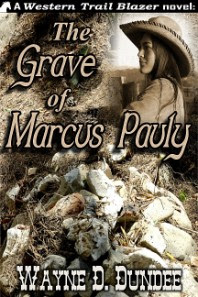
But I have never come close to dealing with anyone more personable or genuinely charming than Rebecca "Becca" Vickery and her staff at Western Trail Blazers. Having only just broken into the Western genre a few months prior, with the publication of my first novel, I submitted a novella entitled "The Grave of Marcus Pauly" to WTB for consideration as part of their Dime Novel line. In this age of e-mails, I heard back very promptly from Becca and was delighted to hear she wanted to publish "Grave". That was in June of 2011. In quick order, Becca also accepted two more works I submitted: "O'Doul", another short Dime Novel; and HARD TRAIL TO SOCORRO, my first novel-length work for WTB and the first title in my Bodie Kendrick – Bounty Hunter series. These all appeared in 2011, and another Dime Novel, "This Old Star", came out in 2012. [Note: "This Old Star" originally appeared in a 2010 anthology, Bad Cop...No Donut (Padwolf Publishing.)]

"O'Doul" spent a nice amount of time in Amazon's Top 100 sales ranking for Westerns, and I often joked that I wished to heck I hadn't killed off the title character by the end of that tale. But, alas, it was too late. My Bodie Kendrick character, however, I definitely did not kill off in HARD TRAIL TO SOCORRO. He was planned right from the get-go as an ongoing series protagonist. And while HARD TRAIL didn't enjoy much time in the Top 100, its sales were nevertheless encouraging enough for me to continue with more adventures featuring Kendrick. Hence, RIO MATANZA appeared in 2012 and Book #3 in the series, DIAMOND IN THE ROUGH, came out just last week.


I can't overstate the importance Becca and WTB has been to my writing in the Western genre. Through much of it, Becca has been fighting health issues yet in no way has this affected her charm or professionalism. The prayers and best wishes—certainly including mine—of all who know Becca on a personal or professional level (and the two are really one and the same) are with her in her brave battle. When the battle is won, I look forward to working more with her in the future. The world of Western fiction needs Becca and WTB.

Persevere-   Wayne Dundee


Note: To find all these works and many more, check out Wayne's Amazon Home Page and check out his BLOG

Friday, May 31, 2013

Review Roundup: Oh, Canada!

High Stakes
By Chad Strong
Clio, May 2012
$4.99 Kindle, ASIN B00826OAGE
230 pages

What’s a professional gambler to do when the new preacher's wife forms a high-handed morality committee to run all the brothels, saloons, and gambling dens out of town? Fight back by infiltrating the preacher's family and compromising the reputation of his innocent daughter, that’s what. But deceit carries a tremendous price…especially when both sides of the cat-and-mouse game are running their own covert ops.

Chad Strong’s High Stakes, nominated for the 2013 Best Western First Novel Peacemaker Award, stands out among the nominees for two reasons: It’s set in a town, and that town is in Canada — Victoria, British Columbia, to be exact.

The author does a number of things well in his debut novel. Characterization is his strong suit, along with an ability to incorporate mountains of detail without annoying readers or slowing the story’s pace to a crawl. A few anachronisms in exposition and dialogue (“uptight,” an Americanism dating to the 1960s, for example) may jangle some readers, but overall Strong does an excellent job of capturing a time (1877), place, and society largely overlooked in the western genre.

The author also blends elements from several subgenres extremely well. Strong language and marginally explicit sexual content prevent an “inspirational” label, though much of the story focuses on the preacher’s earnest attempts to turn the protagonist away from a life of sin. The interactions between the two characters skirt the edge of proselytizing, but not closely enough to annoy readers who avoid the inspirational category. The novel meets all the qualifications to bear the label “western historical romance” quite well, but romance traditionalists may object to the love triangle that forms the fulcrum of the plot, since a certain amount of bed-hopping is involved. (Men, by the way, can read this one without endangering their man cards. Did I mention the gunfights, knife fights, and fistfights?)

Even at 230 pages, High Stakes is a quick read. And it’s fun. The ending, balanced on a thin line between expectation and surprise, shines.


Kathleen Rice Adams is a Texan, a voracious reader, a professional journalist, and a novelist in training. She received a review copy of High Stakes from the author. Her opinions are her own and are neither endorsed nor necessarily supported by Western Fictioneers or individual members of the organization.

Thursday, May 30, 2013

Review Roundup: Grave Dealings

Sipping Whiskey in a Shallow Grave
By Mark Mitten
Sunbury Press, November 2012
$16.95 paperback, ISBN 1620061465
$4.99 Kindle, ASIN B00A62VXYY
338 pages

As the brutal winter of 1887 descends upon Colorado’s high country, cowhands, miners, townsfolk, lawmen, and even outlaws go about their daily routine, never suspecting their disparate lives are about to intersect in a freakish, though inevitable, series of events that will change them all forever. Metaphorically speaking, no one escapes this tale alive.

Mark Mitten’s debut novel is not for the squeamish or the faint of heart. The landscape is harsh; some of the people even harsher. From the outset, Mitten pulls no punches in depicting death, destruction, and a hollowness of the soul that is difficult to confront. Perhaps that’s the essence of the book, though: By forcing readers up close with both the innocent and the twisted, he forces them to consider the dichotomies inherent in being human.

Sipping Whiskey in a Shallow Grave, nominated for the 2013 Best Western First Novel Peacemaker Award, is not an easy, recreational read. That is a warning, not criticism. Mitten’s voice is distinctive; his characterizations are fresh, engaging, and genuine. Dialogue and actions resonate with authenticity. The cast list is extensive, though, and the novel’s uncommon format frequently leaps between locations, subplots, and character subsets without a hint of segue. Everything ties together in the end, but keeping track of the various threads and players may be a bigger challenge than casual readers feel comfortable undertaking. This book requires a commitment — not that commitment is a bad thing.

Ultimately, Sipping Whiskey is a story of perseverance and survival; of redemption and damnation. As his style matures, Mitten will be an author to watch … if only to ensure one of his characters doesn't sneak up behind you with a weapon.


Kathleen Rice Adams is a Texan, a voracious reader, a professional journalist, and a novelist in training. She received a review copy of Sipping Whiskey in a Shallow Grave from the publisher. Her opinions are her own and are neither endorsed nor necessarily supported by Western Fictioneers or individual members of the organization.

Saturday, May 11, 2013

Review Roundup: Peacemaker Nominees (Short Stories)

The third-annual Peacemaker Awards winners will be announced June 1. Between now and then, I aim to review all the nominees in four posts. Let’s start with the nominees for 2013 Best Western Short Story, shall we?

I don’t envy the judges their task. All of the nominees in the category are so strong that choosing a favorite or defining “best” seems well-nigh impossible.

The reviews appear in alphabetical order by story title.


“Adeline”
By Wayne Dundee
in Protectors: Stories to Benefit PROTECT
Goombah Gumbo Press, August 2012

Wayne Dundee’s short story about a hardened bounty hunter and a jaded madam who band together to preserve a child’s innocence is the only nominee not set at Christmastime. The heartwarming tale explores themes of regret and redemption as the bounty hunter and the madam embark on a plan to rescue a precocious pre-teen girl from the sexual slavery they suspect awaits her after a farmer claims the girl during an Orphan Train stop. The writing is top-notch, emotive, and action-packed, but never maudlin or preachy. Proceeds from the sale of the anthology benefit the National Organization to Protect Children, a non-profit supporting non-partisan legislative that protects children from abuse, exploitation, and neglect.


“Christmas Comes to Freedom Hill”
By Troy D. Smith
in Christmas Campfire Companion
Port Yonder Press, November 2011

Troy Smith’s fiction always is notable for the way it breathes life into little-discussed slices of American history. This tale, told in first-person as though an elderly black man were recounting one of the seminal moments in his life, combines two such slices: The Works Progress Administration’s Great Depression effort to document the memories and experiences of former slaves, and the Exodusters, former slaves who headed west after the Civil War with the hope of escaping bigotry and oppression. Filtering a child’s sense of wonder through the wisdom of age, the narrator describes for a WPA interviewer how his sheriff-father’s faith saved the upstart Exoduster town of Freedom Hill, Kansas, from destruction at the hands of a white cattle baron. Not a shot is fired; instead the story brims with a High Noon-type of tension as it becomes apparent the lawman will confront the ruthless baron and his gang alone. Smith’s prose is eloquent and evocative, ultimately making the point that no matter how different the external trappings, inside all men share the same hopes, dreams, desires, and needs.


“Christmas for Evangeline”
By C. Courtney Joyner
in Six-Guns and Slay Bells: A Creepy Cowboy Christmas
Western Fictioneers, October 2012

The creepiness in C. Courtney Joyner’s contribution to Six-Guns and Slay Bells creeps up on readers. Haunted by a bank robbery that went awry two years earlier, a banker and a reformed outlaw share a drink on Christmas Eve, only to discover the crime they thought they got away with won’t go unpunished. While the banker sinks ever deeper into madness and the increasingly spooked outlaw tries to talk him back from the edge of a cliff that will destroy them both, the ghostly presence of a beautiful suicide — collateral damage from the bank robbery — manipulates both men…with gruesome results. The twist at the end is sure to leave a chill.


“Keepers of Camelot”
By Cheryl Pierson
in Six-Guns and Slay Bells: A Creepy Cowboy Christmas
Western Fictioneers, October 2012

Cheryl Pierson’s genre-blending time-travel tale overlays her usual gritty style with a softer, more psychological veneer. Exploring themes of loyalty, love, and forgiveness, “Keepers of Camelot” finds King Arthur, Guinevere, and Lancelot “reborn” in the Old West as, respectively, a gun-toting drifter, a stagecoach way-station owner’s wife, and an Apache warrior. Though they’ve caught glimpses of one another several times during their centuries of life-hopping, this Christmastide is the first time all three have come face to face since Lance and Ginny’s betrayal of Arthur killed Camelot. According to legend, the Once and Future King will return when and where he’s needed, but Arthur is weary of returning again and again. An orphaned teenage boy’s unshakeable belief in the legend holds the key to peace for all of them. Even those who are not fond of time-travel stories will enjoy this bittersweet tale.


“The Toys”
By James J. Griffin
in Six-Guns and Slay Bells: A Creepy Cowboy Christmas
Western Fictioneers, October 2012

James J. Griffin’s “The Toys” presents another descent into madness at the hands of the supernatural. This time, a gunman hired by powerful cattlemen intent on ridding the open range of nesters discovers ruthlessness at Christmas carries a steep price. Pitting guilt against innocence and might against right in the microcosm of one man’s thoughts, Griffin delivers ironic retribution from an unlikely source — leaving readers to decide whether the gunman destroyed himself from within. The style and theme are fairly typical for Griffin, though the outlaw protagonist is something of a departure. Griffin’s badmen always get what’s coming to them — no surprise there. The difference here lies in the way the inevitable justice is delivered.


Kathleen Rice Adams is a Texan, a voracious reader, a professional journalist, and a novelist in training. She received review copies of all except Protectors: Stories to Benefit PROTECT from the author or publisher. Her opinions are her own and are neither endorsed nor necessarily supported by Western Fictioneers or individual members of the organization.

Sunday, January 27, 2013

Last Call for Peacemaker Awards Submissions

Submissions have to be postmarked by January 31, 2013.  Any postmarked after the 31st will not be considered.  More information about rules and where to send entries can be found at the Western Fictioneers Website.

Sunday, January 6, 2013

Peacemaker Awards Submissions


Just a reminder: Submissions to the Peacemaker Awards are open until midnight January 31, 2013.

Qualifications:

Copyright dates must be between January 1, 2012 and December 31, 2012. Works must have been published by a reputable publisher that pays advances and/or royalties. No self-published works will be considered for a WF Peacemaker Award. This includes works published directly by the author on web sites and programs such as iUniverse, Kindle, or Lulu. Proof of the viability of the publisher is the submitter’s responsibility; author, agent, or publisher, and must be provided on request. Publishers that cannot be verified to meet the above standards will not be considered for a WF Peacemaker Award. Books and short stories may be published in any country in the world (submissions must be in English) in print or electronic format. Electronic submissions must be made with Word or PDF files. WF reserves the right to decline any submission for consideration of an Award.

Authors, agents, or publishers may submit a work for consideration of an Award.

At least three entrants in the Best Western First Novel must be received during the submission period for an Award to be presented.

Novels and short stories must be set in the time period between 1830-1920 to be considered Westerns under WF guidelines.

Nominees for the WF Peacemaker Award will be announced on 04/15/2013 and the winners will be announced on 06/01/2013.

The WF Peacemaker Award will be awarded in three categories:

Best Western Novel – Any novel published during the award year set in the appropriate time period (1830-1920), 45,000 words and higher. There are no format requirements. The novel may be a hardcover, trade paperback, mass market paperback, or eBook, as long it has been published by an appropriate publisher.

Best Western Short Story – Any short story published during the award year set in the appropriate time period (1830-1920), 500 words to 10,000 words. There are no format requirements. The short story may be published in any publication, print or electronic, as long as it has been published by an appropriate publisher.

Best Western First Novel – Must meet the same requirements as Best Novel, and must be the author’s first published Western novel. If the author has published novels in any other genre they will not disqualify the author from the Best Western First Novel Award competition. Submissions may be made in both novel categories in the same year.

You can find information about how to submit on the Western Fictioneers website.

Sunday, July 1, 2012

Western Fictioneers Peacemaker 2012 Award Submissions


Submissions for the 3rd Annual WF Peacemaker Awards are being accepted for works published in the year 2012.


Qualifications:

Copyright dates must be between January 1, 2012 and December 31, 2012. Works must have been published by a reputable publisher that pays advances and/or royalties. No self-published works will be considered for a WF Peacemaker Award. This includes works published directly by the author on web sites and programs such as iUniverse, Kindle, or Lulu. Proof of the viability of the publisher is the submitter’s responsibility; author, agent, or publisher, and must be provided on request. Publishers that cannot be verified to meet the above standards will not be considered for a WF Peacemaker Award. Books and short stories may be published in any country in the world (submissions must be in English) in print or electronic format. Electronic submissions must be made with Word or PDF files. WF reserves the right to decline any submission for consideration of an Award.

Authors, agents, or publishers may submit a work for consideration of an Award.

Rules, judges,and submission forms are on the WF website.