 (PHOTO CREDIT TO RON MCGINNIS PHOTOGRAPHY)
A couple years ago I started a group page on Facebook called “Western Movie Fans.” It has become a pretty big hit, garnering over 2,100 members, with people all over the world sharing photos and thoughts about their favorite, or least favorite, Western movies or actors. Of course there are a variety of tastes, but it is great to see this coming-together of Western movie fans.
We all tend to gravitate towards those movies that influenced us in our youth. The baby boomers seem to gravitate towards the earlier John Wayne/John Ford classics, like The Searchers, The Man Who Shot Liberty Valance, or She Wore a Yellow Ribbon. Being from a later generation, I gravitate more toward the ‘60s and‘70s John Wayne films, like True Grit, The Cowboys, or The Shootist. But my favorite Western movie is about that Missouri Bushwhacker, The Outlaw Josey Wales, based on the novel Gone to Texas by Forrest Carter.

The Clint Eastwood Westerns were part a new generation of fans, and during a time period of the ‘60s and‘70s when the Golden Age of the Western was starting to pass away. But Clint helped keep it alive for a while, and The Outlaw Josey Wales, to me, had every good quality a Western film should have.
A friend of mine, Todd Allen, who has acted in several Western films, likes to say, “It’s all about the story.” The Outlaw Josey Wales certainly is a great story, full of hardship and conflict, colorful characters with steadfast purpose, and a plot that is driven by a hero that plays them all well. But to me a movie is more than a story. A movie also has to be visually stimulating, and when dialogue is present, it has to be original and compelling.
The Story
In The Outlaw Josey Wales, the story and the dialogue come mostly from Forrest Carter. If you’ve read the novel, you will know this. It’s the quintessential Western story. The Civil War is over, and westward expansion is paramount. The war honed men for battle and conflict, and it bred the stamina needed to tame the frontier and fight for justice. We have a man, Josey Wales, who is minding his own business, plowing his Missouri field, when a group of Kansas Redlegs ride in, murder his wife and child, and pillage and loot his property. There is no reason for living if you can’t get revenge. There’s no surrendering to anyone who can do such a thing to your family. So it becomes a quest to fight them off, as guerilla fighters, but they can’t win. So in end, it’s just beginning for Josey Wales, as he tries to outrun and outwit the men who are chasing him, the very ones who destroyed his life.
The Characters
Besides Josey Wales, we have the kid, Jaime, who is passionate about their cause, but who is also symbolic of the tragedy of war. There’s Fletcher, the hard but reasonable man who was once on their side, but has worked out a deal with the Union to bring them in. Terrill, the vicious, corrupt Redleg who will stop at nothing to hunt Josey down. Lone Watie, the Cherokee sidekick, who is as much of a burden to the journey as he is helpful. Grannie Hawkins, the salt of the earth, pipe-smoking hillbillie, and wise beyond her years. The carpetbagger in an all white suit, loyal only to himself, a representative of the times. The “pilgrims from Kansas,” an outspoken elderly woman and her “odd” granddaughter, bound for New Mexico to a promised paradise. And last but not least, the notorious Ten Bears, the Comanche Chief, who finds himself in a peculiar, if not ironic, situation with Josey Wales, as they are both victims of dishonesty and greed.
The Dialogue
Though none of us have lived in the 1860s, or knew anyone who did, we really don’t know how they talked to one another, but we can surely imagine through diaries and journals of those times somewhat what it was like. I believe Carter captured it wonderfully in the novel, and Clint Eastwood, who also directed the film, incorporated it perfectly onto the screen.
Some examples are:
Senator: Fletcher, there's an old saying, to the victors belong the spoils.
Fletcher: There's another old saying Senator. Don't piss down my back and tell me it's raining.
~
Jamie: You can't get 'em all, Josie.
Josey Wales: That's a fact.
Jamie: How come you're doing this, then?
Josey Wales: Because I ain't got nothin' better to do.
~
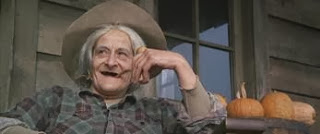
Granny Hawkins: They say you're a hard put and desperate man, Josey Wales. They're goin' to heel and hide you to a barn door. You know what I say?
Josey Wales: What's that?
Granny Hawkins: I say that big talk's worth doodly-squat. Now, them poultices be laced with feathermoss and mustard root. Mind you drop water on 'em occasional and keep 'em damp.
~
Jamie: [after Jamie and Josie kill Abe and Lige] I figured you could use some help.
Josey Wales: You get those holes a-leakin', I'm gonna whomp you with a knotted plow line.
~
Jamie: I wish we had time to bury them fellas.
Josey Wales: To hell with them fellas. Buzzards gotta eat, same as worms.
~
Josey Wales: When I get to likin' someone, they ain't around long.
Lone Watie: I notice when you get to DISlikin' someone they ain't around for long neither.
~

Lone Watie: I didn't surrender, but they took my horse and made him surrender. They have him pulling a wagon up in Kansas I bet.
~
Josey Wales: Are you gonna pull those pistols or whistle Dixie?
There’s plenty more, strong, rich dialogue, but that is a good taste. The only movie since The Outlaw Josey Wales, ever to produce such well-known, repeated dialogue, is the ‘90s film Tombstone. Though no one will ever forget the originality of “I’m your huckleberry,” neither will they forget, “Well, Mr. Carpetbagger. We got somethin' in this territory called the Missouri boat ride.”
The Visuals
Movies are a visual art, and the trick is to take a story and adapt it in a way that the film watcher can’t take their eyes off the screen. The auditory part—the dialogue, background sound, sound effects, music (which in this film, an original score was nominated for an Academy Award)—take on a similar role of attraction, but what stimulates the eyes is truly what makes a good story a great film. The Outlaw Josey Wales gave us all of the elements of period culture during the post Civil War era. The costume was authentic, as were the weaponry. The cap and ball pistols, as many as they could stuff in their waistbands, loaded and ready. The “lindsey, woolsey, shirt” with all the fancy stitching, also known as the “guerilla shirt,” was treated authentically. Close attention was paid to the landscape, and the scenery, which was captivating as much as it was authentic.

Not many will argue about the quality of this film, though many will disagree as to what their favorite is, and there’s nothing wrong with that. I gauge the quality of a film on whether or not I want to watch it again. The Outlaw Josey Wales stands as my most-watched Western, and there’s not been one since that has risen above all that this film has to offer. Due to the sparse releases of Western films today, and Hollywood’s addiction to remakes, there’s not much competition for its place, either. But just like those John Wayne/John Ford loyalists, I’m fond to my era as well, and it will take an incredible film to rise above my expectations. Yep, I reckon so.
Steven Law is the author of Yuma Gold (Berkley, November 2011) and El Paso Way (Berkley, October 2013). Visit his website at
www.stevenlaw.com.


 Matthew Pizzolato's short stories have been published online and in print. He writes Western fiction that can be found in his story collection, The Wanted Man and the novella Outlaw as well as his newest release, Two of a Kind.
 Matthew Pizzolato's short stories have been published online and in print. He writes Western fiction that can be found in his story collection, The Wanted Man and the novella Outlaw as well as his newest release, Two of a Kind.


