Tuesday, May 22, 2018

JUST EAST OF THE WEST Part One #WesternFictioneers

For many of us, the West begins west of the Mississippi River. I grew up just East of that Mighty River in Illinois. There were many a time I fished, swam and traversed across that water. I also grew up surrounded by history. I'm sharing a bit of that history here and Part Two on the Sweethearts of the West blog.

Technically, the area I'm speaking about is called the tri-state area. It's where Illinois, Missouri, and Iowa meet. I was about 70 miles from Hannibal Missouri, where Samuel Clemens also known as Mark Twain grew up. The Mormon settlement of Nauvoo was about 20 miles away from my hometown. Added to that were the towns of Keokuk, Iowa and Quincy, Illinois which I will discuss in part two.

Painting of early Nauvoo
So let's start with the Mormon settlement of Nauvoo, and of course the town of Carthage Illinois where Joseph Smith met his untimely end. In his book, published in 1847 "A Summer in the Wilderness: Embracing a Canoe Voyage up the Mississippi and around Lake Superior", author Charles Lanman says when he first sees Nauvoo, " The Mormon city occupies an elevated position, and, as approached from the south, appears capable of containing 100,000 souls. But it's gloomy streets bring in most melancholy disappointment. Where lately resided no less than 25,000 people, there are not to be seen more than about 500; and these, in mind, body and purse, seem to be perfectly wretched." This loss of population came after Joseph Smith's death in 1844 in the town of Carthage, Illinois.

Shortly after the Mormons had left Nauvoo, the Icarian's moved to the townsite of Nauvoo to start their own settlement. Initially those who came to the area planned to start a commune based upon the novel "Icaria" by Victor Hugo. They were faced with illness, lack of food, and an unkind mother nature. Still they persevered even going so far as using some of the stones from the Temple ruins to build the colony's schoolhouse. By 1855 the colony began to lose population and the town of Nauvoo barely maintained its existence until 1873 when the sisters of St. Benedict chose Nauvoo as the place for their convent and school.

However, Nauvoo was not the first settlement on the site. The area was first called Quashquema, in honor of a chief who headed a Sauk and Fox band of Indians, and numbered approximately 500 lodges. Around 1827 the white settlers were building cabins and by 1829 there were enough settlers for a post office and by 1832 they called their town Venus. Then in 1834 they changed the name to Commerce as the residents felt it was a better suited name for what they hoped the town would become.

Mark Twain's boyhood home in Hannibal
Mark Twain Home, Hannibal, MO. (Wikipedia.org)

The town of Hannibal was originally laid out by Moses Bates in 1819. But prior to Mr. Bates, the site had been used by the indigenous peoples of the area. The town itself was rather slow to find its footing but by 1845 it had become a city. A lot of the growth be attributed to its access to the Mississippi River and the growth of the railroads. What many people may not know is that in 1846 the Hannibal and St. Joseph Railroad was organized by John M Clemens, Mark Twain's father, and his associates. It was built to connect Hannibal with St. Joseph in the West. Story is the railroad was to have transported mail for delivery to the first outpost of the pony express.

One interesting fact about the town. During the Civil War, a number of black units were from Missouri, that fought campaigns outside of the state. There was one unit in the Missouri state militia about one hundred strong from the town of Hannibal.  

This is just a brief overview of a rich and varied history of my hometown area. Thanks to newspaper and state digital archives along with access to older books, the stories have only become more exciting to me. When I write, I find that this 'inherited' history informs my stories. In the latest novel "Chasing A Chance" my characters are originally from this tri-state region, although they end up in Colorado, much like myself.


https://amzn.to/2ID1Nq2


Doris Gardner-McCraw -
Author, Speaker, Historian-specializing in
Colorado and Women's History
Member of National League of American Pen Women,
Women Writing the West,
Pikes Peak Posse of the Westerners

Angela Raines - author: Where Love & History Meet
For a list of Angela Raines Books: Here 
Photo and Poem: Click Here 
Angela Raines FaceBook: Click Here


Wednesday, May 16, 2018

VILLAINS AND TREACHERY! by Cheryl Pierson

Oh, how I love a good villain! Whether I’m reading about one or watching him/her on film, or best of all—WRITING ONE!

What makes a good villain? Well, in my opinion, first and foremost he can’t be one-dimensional. I know in our “real world” there are those people that seem to be evil just for the sake of it and some of them probably are. But in our reading/writing, we want to know WHY. What made this person turn out like he did—a diabolical, cunning, demonic person that will stop at nothing to accomplish what he’s set out to do?

This leads to the question, is there anything at all that would stop him from carrying out his evil plans? Would a memory stop him, or trigger him? Would any one person be able to reason with him? Would a “new plan” divert him from carrying out the blueprint for disaster for the hero/heroine that he’s already come up with?
But there are other things that have to be reckoned with. Those things that might have happened to him in his past to create and mold him into the kind of person who would be so bold and determined to use anything—no matter how it hurts others—to his own advantage are important. But what are the factors that drive him presently? A circumstance of opportunity? A long-seated need for revenge and the path to that revenge being presented? Greed? Burning jealousy? Maybe even the death of a loved one that he may not have wanted to embarrass by his actions while they were still living—now that they’re gone, all bets are off!

THE DEVIL AND MISS JULIA JACKSON has the heroine caught between a distant relative who throws her and her niece out of their home and the job as nursemaid she takes in Indian Territory, working for a man who is, at first, cold and unresponsive. The villain in this story shifts between the man who threw Julia out of her home to someone else who means to destroy her employer.


I’ve had so many villains I’ve created in my writing that were motivated by different things. My first one, Andrew Fallon, appeared in FIRE EYES. He was just pure evil. He didn’t care about anything or anyone—even his family, as his brother found out when he came looking for him.


In TIME PLAINS DRIFTER, the villain is paranormal—a demon who can shape-shift. How in the world will the innocents he’s after survive? They have a reluctant angel or two on their side, but the demon is powerful. Can they overcome his strength?


In my first contemporary romantic suspense, SWEET DANGER, Tabor Hardin has his revenge handed to him on a silver platter, being in the right place at the right time to turn the tables on the undercover cop who put him in jail—before his escape. He’s a man with nothing to lose at this point, and Jesse Nightwalker, the cop, has a new life hovering on the horizon—if he can survive.


Greed comes in to play in BEYOND THE FIRE, when undercover DEA agent Jackson Taylor’s cover is blown and a drug lord comes after him, trying to use Jack’s undercover partner against him. But there is a secret that even Jack hasn’t known about his partner—and the woman he’s falling in love with. Is it enough to defeat the powerful drug cartel and keep Jackson, Kendi, and his partner safe?


Treachery comes in all forms and it’s most often quite a surprise. No matter how vigilant our heroes are, they come up against some very foreboding, sharp cunning from the villains—after all, they have to have a worthy opponent, right?


Speaking of worthy opponents, I’ll talk a little about my contemporary romantic suspense CAPTURE THE NIGHT—where the villain, Kieran McShane, runs his own rogue faction of the Irish Republican Army and plans to murder Great Britain’s Prime Minister while he’s on vacation in Dallas. Johnny Logan is an undercover Dallas cop, staying in the hotel as added protection for the prime minister; Alexa Bailey is treating herself to a one-year divorce anniversary vacation. When McShane takes over the entire hotel, it’s only a matter of time before he discovers them up on the roof in the maintenance housing—and collateral damage means nothing to him. With the hostages brought to the roof, McShane threatens to begin throwing them over one by one—unless his demands are met. Can Johnny and Alexa survive the whims of a madman, bent on political revenge?


One of my favorite recent stories is SABRINA, one of four novels that appears in the boxed set MAIL ORDER BRIDES FOR SALE: THE REMINGTON SISTERS. Four sisters are at the mercy of their stepfather who plans to sell them to the highest bidder now that their mother is dead. But these girls have other plans. Can they manage to get away? Will they be able to keep themselves safe from Josiah Bloodworth no matter how far away they go? This is a very fun set of four full length novels, each sister’s story penned by a different author. Livia Washburn Reasoner—Lizzy; Jacquie Rogers—Belle; Celia Yeary—Lola; and Cheryl Pierson—Sabrina.


Here's an excerpt of Sabrina facing down the villain, her stepfather, in the dressmaker's shop. Cam is listening to it all from the back, waiting for his chance to save her, his sister, and the proprietor of the shop. Here's what happens:

“So you see, dear Sabrina, you have no true choice about what you do—and neither do your sisters.” Bloodworth spread his hands as he spoke. “You will, indeed, come home to Pennsylvania from this godforsaken place and do exactly as you are told. You will marry a man—a proper gentleman—of my choosing.” He took a step closer to her.

She faced him unflinchingly, her head held high. “I will no more return to Philadelphia with you than fly to the moon. You would do well to carry your pompous, maggot-ridden self away from here and get as far east as you can go posthaste—before my husband returns for us—and sends you straight to hell.” She spoke as regally as a queen to the lowliest dregs of society, without a trace of fear.

A thin smile touched Bloodworth’s lips, but the calm iciness in his pale eyes was what put Cam on alert. This man was determined, and he believed no one could stop him.

His muscle-bound cohort stood near the door, keeping watch so that Bloodworth didn’t need to worry about any distractions—from the two other women, or from any of the townspeople.

“My dear Sabrina, you are most definitely going to do exactly as I tell you. Or else.”

“Else what? You’ll drag me back by my hair like the brute that you truly are?”

Bloodworth chuckled. “Well, well. Our little Sabrina has come into her own, hasn’t she?” He stroked his chin. “Actually, I don’t believe I shall have to drag you back. I think you most likely will do anything I say once I lay my hands on that half-breed husband of yours…even if I tell you to climb up on this counter and spread your legs like the whore you are…just like your mother was—”

The slap Sabrina gave Bloodworth echoed through the room, and brought a spot of blood to the corner of his mouth. Unruffled, he took out his handkerchief and dabbed at it.

“I’m going to kill your husband, Sabrina Rose. It will be a long…slow…and very, very painful death. And you will have only yourself to blame."


So many wonderful reasons for becoming a villain! The motivations are just endless, aren’t they? It’s a fine line to walk, making them evil, yet sympathetic in some instances, and letting our readers see a glimpse of their humanity—if they have any left.

Do you have a favorite villain you’ve written or read? What about your favorite film villain?

PRAIRIE ROSE PUBLICATIONS WEBSITE: https://www.prairierosepublications.com

FACEBOOK: https://www.facebook.com/cheryl.pierson.92

CHERYL'S AMAZON AUTHOR PAGE:https://www.amazon.com/Cheryl-Pierson/e/B002JV8GUE/ref=sr_tc_2_0?qid=1520475061&sr=8-2-ent

Tuesday, May 15, 2018

8th Annual Peacemaker Awards Finalists


On behalf of Western Fictioneers, I’m pleased to announce the finalists in the 8th annual Peacemaker Awards for the best in Western fiction published in 2017. Finalists are in alphabetical order by author.

BEST WESTERN NOVEL
BILL RILEY’S HEAD, Douglas Hirt (Five Star Publishing)
OUT OF THE DARKNESS, Robert D. McKee (Five Star Publishing)
HARD TO QUIT, Mark Mitten (Milford House Press)
DESTINY AT DRY CAMP, John D. Nesbitt (Five Star Publishing)
THE PECOS UNDERTAKER, Mel Odom writing as Colby Jackson (Colby Jackson)

BEST FIRST WESTERN NOVEL
THE BLOODLETTING, Greg Barth (Greg Barth)
EL RENO, Kevin L. Evans (Kevin L. Evans)
COYOTE COURAGE, Scott Harris (Dusty Saddle Publishing)
THE OPEN ROAD, M.M. Holaday (Five Star Publishing)
GALLOWAY’S GAMBLE, Howard Weinstein (Five Star Publishing)

BEST YOUNG ADULT/CHILDREN’S WESTERN NOVEL
WEST FROM THE CRADLE, Brigid Amos (Clean Reads)
A RANGER’S RETURN, James J. Griffin (Painted Pony Books)
THE CRY NOT HEARD, Cliff Hudgins (Wolfpack Publishing)
CLOAKED, Rachel Kovaciny (White Rook Press)
STRANDED, Matthew P. Mayo (Five Star Publishing)

BEST WESTERN SHORT FICTION
“Tibby’s Hideout”, Frank Kelso (THE POSSE: A WESTERN ANTHOLOGY, Intellect Publishing)
“Firewater”, Olivia Norem (Olivia Norem)
“The Armadillo’s Hole Saloon”, Mel Odom writing as Colby Jackson (Colby Jackson)
“Train Robbery”, Mel Odom (BASS REEVES, FRONTIER MARSHAL, VOLUME 2, Airship 27 Productions)
“The Society of the Friends of Lester McGurk”, Richard Prosch (BEST OF THE WEST, Sundown Press)

Congratulations to all the finalists! The winners of this year’s Peacemaker Awards will be announced on June 15. Thank you to all the authors and publishers who submitted work to the awards, and special thanks to the judges, whose diligent efforts make the Peacemaker Awards possible.

And last but certainly not least, the 2018 Peacemaker Award for Lifetime Achievement in Western Fiction goes to . . .

MICHAEL NEWTON


Monday, May 14, 2018

Today in U.S. History: May 14, 1856 - Military camels set foot on Texas soil by Kaye Spencer #westernfictioneers #OldWestHistory


The Great U. S. Military Camel Experiment unfolds, briefly, this way:

By the 1830s, American westward expansion was going nowhere fast. Difficult terrain and often inhospitable climates made traveling a daunting challenge at best, especially in the southwest.

But in 1836, an outside-of-the-box thinker had a bold plan. The then Lieutenant, and later Major, George H. Crosman proposed to the U.S. War Department:

For strength in carrying burdens, for patient endurance of labor, and privation of food, water & rest, and in some respects speed also, the camel and dromedary (as the Arabian camel is called) are unrivaled among animals.  The ordinary loads for camels are from seven to nine hundred pounds each, and with these they can travel from thirty to forty miles a day, for many days in succession.  They will go without water, and with but little food, for six or eight days, or it is said even longer.  Their feet are alike well suited for traversing grassy or sandy plains, or rough, rocky hills and paths, and they require no shoeing..

The War Department ignored the report.

However, the War Department's attitude did an about-face in 1847 when the right people were in the right place at the right time. Crosman met Major Henry C. Wayne, who shared his camel enthusiasm. Together, they submitted another report to the War Department and Congress. At this point, Senator Jefferson Davis took up their cause.

There wasn’t a western railroad system at this time, and horses and mules needed water in a water-scarce environment. All three men reasoned that since camels thrived in deserts elsewhere in the world, they would also thrive in the American southwest. Congress listened and appropriated $30,000 for “...the purchase and importation of camels and dromedaries to be employed for military purposes.”¹

The task of sailing to the Middle East and North Africa to bring back camels fell, willingly, to Major Wayne. It took Wayne about a year to gather up camels for the voyage back to America. While the ship carrying the camels, “Supply”, arrived at the port in Indianola, Texas on April 29, rough ocean waters prevented unloading the camels. It wasn’t until May 14 that the ocean calmed enough to safely move the camels into small boats and deliver them to shore. From the Texas coast, the camels moved out under Army control for Camp Verde. Not too long after that, another group of 41 camels also made their home at Camp Verde.

 State Historical Marker - Indianola, Texas
Image by Larry D. Moore (citing below) -
As a side note, a civilian, Mrs. J. J. Watson, attempted to bring camels to America as a cover for her slave trade, but she wasn’t allowed to unload them. So she dumped them out in Galveston and sailed for the slave markets in Cuba.²  Two private shipments of camels arrived not long after but, like Mrs. Watson's camels, these camels were turned loose on the Galveston shore and were doomed to wander in neglect.

The military used the camels for the next ten years for hauling supplies to different locations as well as using them for the in-camp tasks. The camels were also important during cross-country military expeditions. One expedition involved surveying what is now the historic Route 66. Another was a scouting mission to identify possible fortifications in southwest Texas. While the soldiers brought feed and water for the horses and mules, the camels were content to forage off the land and drink when water was naturally available. Despite being naturally adapted to the American Southwest’s climate and terrain, realistically, camels had a terrible smell, horses were terrified of them, and handlers detested them because of their surly temperaments.

The War Between the States brought the camel corps to an end in 1866 through lack of funding and general neglect. The camels were auctioned to private owners. Some camels ended up on supply trains as pack animals, others went to miners and prospectors, and some went to circuses. A few ended their days on private ranches. However, many camels escaped. Camel sightings continued for decades. “For years, travelers in the Southwest told tales of camels looming up in the flickering light of campfires.”³

From that comment, an idea sparked, and I wrote a scene involving camels in my novel, The Comanchero's Bride. Here is a teaser from the camel encounter:

A horse snorted.

Mingo came wide awake with a revolver already in his hand. A glance without looking directly at the diminished fire told him he’d slept for two or three hours. The sound of heavy breathing and grunting drew his attention beyond their lean-to. Peering into the darkness, he ran through his mental catalog of sounds to identify the source while simultaneously planning a defense against whatever—or whoever—was out there. He separated the soft whisper of drizzle from the normal night noises, ruled-out humans, while sensing a vague familiarity that wasn’t horse, but he was certain it had four legs. And there was more than one.

Careful in his movements, he eased his arm along his thigh and down his leg to grasp the handle of his knife tucked in the sheath on the inside of his tall boot shaft. Shifting his position, he waited. In the glow of the orange embers of the fire, he could make out hulking, ghoulish shadows hovering just at the edge of camp. When a whiff of breeze swirled around their shelter, stirring up ashes at the edge of the fire, Mingo picked up a pungent odor of urine and manure mixed with the tang of wet, dead carcass. There was no mistaking the visitors now, and he relaxed, chuckling softly.

Slipping from under the blankets with slow, deliberate care, he placed a light touch on Isabel’s shoulder. Her eyes popped open, and he spoke in a low tone. “I must calm the horses. Do not make a sudden move or noise, and keep your voice quiet. Build up the fire and stay close without looking into it.”

She rolled to her knees, grabbing Mingo’s arm as she whispered, “Eww, what’s out there? The stench is horrid.”

Speaking close to her ear, he replied, “Camellos.”

Isabel jerked her head around. “Wha— Camellos? Camels?” She looked across the coals into the darkness. “Here? In Texas?”

Mingo’s grin widened at her bewilderment, and he handed her a piece of firewood. “At least two of them. I do not think they will come closer, but it is also not wise to startle them. The horses are already frightened, and we do not want them to bolt. Trying to catch a camel to ride it to our ranch is not how I want to finish this journey...”


The Comanchero's Bride
available on Amazon.com

See you next month on the 2nd Monday for another episode of ‘Today in U.S. History’,

Kaye Spencer


Website/Blog- https://www.kayespencer.com
Instagram - kayespencer
Twitter - http://www.twitter.com/kayespencer
Pinterest - http://www.pinterest.com/kayespencer
Facebook - https://www.facebook.com/kayespencer23
Amazon - http://www.amazon.com/author/kayespencer
LinkedIn - https://www.linkedin.com/in/kayespence
Prairie Rose Publications - http://prairierosepublications.com/
YouTube Channel - https://www.youtube.com/c/kayespencer0203

References and Resources:

I would direct you HERE for an excellent article about the camel corps.

1. National Museum-United States Army. Vince Hawkins, “The U.S. Army's ‘Camel Corps’ Experiment”, accessed May 12, 2018, https://armyhistory.org/the-u-s-armys-camel-corps-experiment/


2. Handbook of Texas Online, Chris Emmett and Odie B. Faulk, “Camels”, accessed May 12, 2018, http://www.tshaonline.org/handbook/online/articles/quc01.

3. Smithsonian Magazine. Owen Edwards, “Camelot”, accessed May 12, 2018. Smithsonian.com. https://www.smithsonianmag.com/science-nature/camelot-121505856/

*Larry D. Moore, US Camel Corps State Historical Marker, CC BY-SA 4.0

*Texas Highways. The Travel Magazine of Texas. The Great Camel Experiment.
http://www.texashighways.com/history/item/7475-the-great-camel-experiment-texas-camel-corps. July 2014. Accessed: May 12, 2018.


Wednesday, May 9, 2018

Ranger Jim's Ramblings Return

After too long a hiatus (or perhaps too short a hiatus, depending on your opinion), I've returned to the Western Fictioneers blog, to once again post about horses, Texas Rangers, or whatever might happen to cross my mind. Lately, I've been working on modern day Texas Ranger novels, the recent release TEXAS JEOPARDY, and its sequel, to be released later this year by Livia and Cheryl's Fire Stare Press, TOUGH MONTH FOR A RANGER. Both feature sixth generation Ranger James C. Blawcyzk, a direct descendant of my original Texas Ranger character, James J. Blawcyzk. Of course, a present day tale doesn't exactly make a good fit for a traditional Western blog. So, I've been pondering about this month's topic. As usual, I ended up coming back to horses, specifically, horses' ages.

As do humans, horses today live much longer lives than they did in the late 1800s. Today, it is not unusual to hear of horses that live into their thirties. However, the more usual longevity for a horse is twenty-five to thirty years. Since a horse ages approximately three years for one human year, a twenty-five year old horse is about seventy five years old in human years.

The other issue with aged horses is how long they can still be used as a saddle or carriage horse. Once a horse is in its late twenties, it is usually no longer able to carry a rider. Right now, Yankee is twenty-five, and I'm still riding him, although not as long or as hard as I used to, for both his sake, and mine. I can't ride for eight hours at a stretch any longer, either. My friend's mustang mare is thirty-one, and was ridden until last year. Now, however, the effects of Cushing's disease are taking their toll. Joya is having difficulty maintaining her balance, so she'll be spending her final days in pasture. Generally, every year past twenty-five is a bonus year. Interestingly, few horses die from heart, brain, or lung issues.Yankee just has his annual checkup and shots. His vet says he has the heart and lungs of a two year old. However, as happens to all of us, his joints, teeth, and legs are showing their age. Sadly, this means that most horses do nit die a natural death, but are humanely put down to relieve their pain. Unlike humans, a horse can't survive if its legs no longer work.

As far as horses in the frontier West, a fifteen year old horse would be elderly, indeed, just as a sixty year old man would be living on borrowed time. The same things that took human lives early also took horses' lives: disease, parasites, particularly worms, and accidents. Gunshot wounds were also the demise of many horses, since they made a much better target than their rider. Down the horse, you down the rider.

As a general rule of thumb, which I have violated many times, when writing a horse as a character into your Western, keeping its age under ten years is a safe bet.

One final fact: Mares continue to go into heat for their entire lives, and theoretically can conceive and give birth no matter how old they are. However, having a foal for an elderly mare is dangerous, both for the mare, and the foal, so breeding old mares is definitely seldom done.

Until next month, happy trails.

"Ranger" Jim

Monday, May 7, 2018

NEW RELEASE—AND HOW I CAME TO WRITE A SERIES by J.L. Guin


My new novel, Lawman's Gun was released by Sundown Press on May l. Lawman's Gun is Volume 2 of the James P. Stone series. Volume 1, Pushed Too Far, was released January 23. Volume 3, Bounty Poachers, will be available in August of this year. It is planned as a four-volume series. I am currently writing the final volume.

I never really had the idea of writing a series in my mind—one day, it just came about.

I always liked a good challenge. When I first began writing westerns, I had it mind to just write short stories. After doing over three dozen “shortys”, I felt that I was ready to do more, so I challenged myself to step up to the next level. I wrote a couple of novellas, then further challenged myself to write novels. I'd have to say that writing a series has been at the top of my list.

When I first began writing this tale, I didn't want to do another fast gunman story; so, I came up with an ordinary guy (James P. Stone), a freight driver, running his freight between Missouri to various points in Texas. In a night-time camp, out on the prairie, in the Indian Territory, Stone awakens in time to witness an intruder shoot his partner. He is able to hear the name 'Laird' spoken, by a second intruder, just before being knocked unconscious. The next morning, Stone awakens to find his mentor partner Eldon Greyson murdered; their wagons, mules and the entire camp has been cleaned out of anything of value.
GET IT HERE: https://www.amazon.com/Pushed-Too-Far-J-Guin/dp/1983689211/ref=sr_1_3?ie=UTF8&qid=1522958270&sr=8-3&keywords=Pushed+Too+Far


Stone does the best he can to bury his friend, then walks fifty miles to Denison, Texas, to report the crimes. When he learns that the local authorities have no jurisdiction to chase after someone in the Indian Territory, he swears a vendetta to find Laird, the killer, and exact his own justice. Volume one is the beginning of Stone's quest for vengeance.

When I was fifty thousand words into the story, I could have had Stone somehow locate his nemesis and, in a cloud of gun smoke, end the tale. But, I didn’t want to have my hero find the man so quickly. I felt so strongly about the story that I decided to continue with a second book. I ended the first story by having Stone, while serving as a temporary deputy county sheriff, meet with Deputy U.S. Marshal Jackson Millet. The federal lawman suggests that when Stone’s tenure as a county deputy is completed, he might give consideration to becoming a fellow deputy U.S. marshal. He gives Stone an address to contact him.

In the sequel, Stone meets with Jackson Millet at his Dodge City office. Stone is sworn in as a deputy U.S. marshal, as well. Both men agree that locating Laird will be on their mind while doing their deputy duties.
GET IT HERE:


A second book made more sense to me than stretching the original into a ninety-thousand-word tome.

By the time I was near the end of Lawman's Gun, volume two, I saw the opportunity to turn Stone's hunt for Laird into a mini-series, so volume two's ending was written as the lead-in to number three.

I contacted Cheryl and Livia at Sundown Press to see if they might have an interest. Fortunately, for me, they agreed to take a look at my presentation. Sundown Press, headed up by Cheryl Pierson and Livia Washburn Reasoner, does exceptional work. They were very helpful in everything from editing to the cover of the book. The ladies are hardworking, supportive, tolerant, understanding, and very professional in their presentations. I am very pleased to be included in the Sundown Press line up.

How about you? Do you plan a series out before you begin your story? Or, like in my case, take advantage of the opportunity to turn the tale into a series as the story progresses?


Saturday, May 5, 2018

GUNSLINGER 6: Author GORDON L. ROTTMAN


by Tom Rizzo


Gordon L. Rottman’s latest novel—MARTA’S RIDE—represents an excellent blend of action, adventure, and romance against a backdrop of the Texas-Mexico border in the late 1860s. 

Marta’s Ride—the third in Gordon’s outstanding Ride series—features a mute 16-year old Mexican girl as the protagonist who finds herself alone after Indians massacre her family.

During her quest for survival, she meets Bud Eugen, an unemployed cowboy. Although suspicious and afraid, Marta and this young cowhand form what might be considered a cautious relationship. 

As in the previous two novels, The Hardest Ride and Ride Harder, the characters in Marta face life and death choices amid a harrowing adventure pitting them against brutal weather, ambushes, attacks, and shootouts with evil bloodthirsty banditos.

Gordon gives his resourceful mute teenage heroine a powerful voice in a vivid and memorable tale of kidnapping, murder, friendship, and re-awakening. 

The fourth book in the series, Marta's Daughter, is slated for publication later this year. 

                       GUNSLINGER 6

  
1. A lot of people say heroes/heroines are in short supply these days. Tell us about your protagonist Marta. And, was there a real-life inspiration behind her?  

That's a difficult question. There was no one single person that inspired Marta Amora Hinojosa. She is much like my wife, but she's not as prone to violence...thankfully. Many of her characteristics are derived from my daughters and nieces. All are strong outgoing women and girls. I've spent thirty-five years on the family ranch in Mexico and have watched all these girls working and playing there, it’s a different world.
I've never bought into the concept that most women of the Old West, and especially on the Texas-Mexican Frontier, were mostly passive and subservient. There were, of course, subservient women, but there were just as many if not stronger women. If not, they would never have established a civilized society in that wild land. Marta wanted what most women wanted, security, and safe place to live. She was willing to fight for that and make sacrifices to achieve it.

2. What was the biggest challenge you faced about writing the viewpoint of a character from the opposite sex?   
That's another tough one. It wasn't easy. I did not want this to be just something about how a guy thought a woman would think and react. Of course, Marta's previous life in a family of migrant workers had a big impact on how she responded. It had been a hard and challenging life living rough on the road. She's been physically and verbally abused, looked down upon, assumed to be a prostitute and thief, starved, suffered the weather, had no permanent home and had seldom spent a night under a roof. She did have a loving and hardworking family, and that brought her through many trials: How would she think, how would she deal with situations, most of which we have never experienced.

A major factor in regards to Marta is that she's mute, not because of the trauma of a murdered family, but an accident when she was nine. Being mute Marta has to find ways to express herself and being an "outspoken," and passionate girl makes that a special challenge. 

Because she is forced to find ways to express herself and make her wants and needs to be known, she has become more forceful and outgoing than a "typical" 16-year old Mexican girl. Bud Eugen is quite perplexed by the feisty girl, not only because of her strong personality, but he's had basically no experience with girls.

One example, begging. Marta finds begging one of the most abhorrent tasks she occasionally has to undertake. I talked to some beggars in Mexico and once I got them to open up I was stunned that they actually had strategies and very precise do's and don'ts.

When Marta sets out to beg in a town less than hospitable to Mexicans we learn how she picks the business she would sit at with the pros and cons between businesses and even churches. Where she sat was important, how she protected herself, and what she would do when invariably chased off were on her mind. We learn what threats she was on the lookout for ranging from self-righteous white women, gangs of young boys, and stray dogs. And what would she do when a certain young out of work cowpoke who she never expected to see again showed up? Relatives enlighten me on that reunion.

While a sensitive subject, it is no secret that Marta and the other kidnapped girls were raped and abused in many ways. That, of course, is a difficult subject and writing about it is an uncomfortable challenge. I read numerous articles about depicting this in narrative writing. Most complain that authors present it no better than a porn scene and to varying degrees of explicit description. I don't describe it, you know it happens, and you see the anguish and devastation the girls have to endure afterward, and they each are affected by it and deal with it in different manners just as real people.


3. Some might consider "Marta’s Ride" a retelling of "The Hardest Ride." What’s your take on this?

Marta's Ride is in a way a retelling of The Hardest Ride but from Marta's point of view. It has given her a "voice" of sorts to tell her story--she's the narrator. It does have to cover some of the ground crossed early in The Hardest Ride, but that part's shortened and of course seen from Marta's much different perspective. Too, there are numerous events that Bud never saw and that Marta had to deal with herself. For her, it is the first time she actually lived in an Angelo environment, and there is much that is new to her, some good, some bad.

Once she and the other girls are kidnapped and taken to Mexico, it is a completely different story. There are subplots, characters, terrifying events, and places visited that are not even alluded to in The Hardest Ride. At one point she's kidnapped from her kidnappers. One event sets the stage for a future title that will come to its conclusion three years later. Marta's Ride also gives us "the rest of the story" of what happened once they returned to what Marta now thinks of as home. It provides more on this than even found in the second book, Ride Harder.


4. Tell us something we don’t know about Marta and Bud. What makes them tick? Tell us one thing about them that we don’t learn from the book, perhaps a secret in their past.

Through all three novels, we hear mention of Bud's hateful and abusive mother whom he's not seen in nine years. While he's not making any effort to find her, deep inside he would at least like to know what became of her no matter how dysfunctional she was and how dangerous life with her had been.

Bud has a soft spot in his heart, which he reluctantly admits to. If he didn't, he would have turned his back on a mute, abandoned Mexican girl. Marta has a hidden desire. She wishes to see the ocean, simply because she does not believe such a thing exists. And, eventually, Marta also wishes for a family, her own children, which she never mentions to Bud and something a simple cowpoke like him never dreamed of.


5. Your series is quite popular. Reviews are outstanding. From your perspective, how do you judge the quality of your work? 

I was quite surprised at how popular the books, or rather Bud and Marta, became. I had read barely any Westerns, and the few that I had were mainly Cormac McCarthy. I do like traditional Western movies. I was putting together a story idea for a present-day story set on the Texas-Mexico border. It changed a great deal, and three factors changed it to a traditional Western: 1) Traditional gave me more flexibility in all what occurs without so many present-day real-world constraints, 2) I liked the idea of researching the period, which is not all that different than the present way of life in Morelos, Coahuila, and 3) I liked the challenge of writing a Western something totally new.


6. What was the first story you ever published and what was it like and what do you think of it now?

I'd never done any short stories until I had one punished in Sundown Press's "Sundown Western Tales." I started writing articles for military journals and magazines in 1975. That got me recognized as an "authority." My first military history non-fiction book was in 1984. I've since published about 130 military history books, mostly very dry technical subjects. 

I learned how to do historical research though, which is beneficial in researching Westerns. In the early 1990s, I co-authored three Tom Clancy-style WWIII techno-thrillers, which let me put to use my training as a Soviet military specialist and later as a Special Forces and SEAL war-games writer for 11 years. (I was in the Army for 26 years, and that's a great experience for writers.) 

The Hardest Ride was my first real fiction effort. I made a lot of mistakes including too slow of a start, a bit too much backstory, and included a lot of detail. Of course, that detail was beneficial too. Many reviewers like this subtle insertion of the details of what they ate, what they wore, and how they lived in the 1880s.


I've tried to learn and improve with each subsequent book of the Ride-series. I hope and think the next novel, Marta's Daughter, released by this summer, shows major improvement, although one of my nieces said she was emotionally and morally exhausted proofreading it. 

As a bit of a preview, Marta's Daughter takes place during the Mexican Revolution. Bud is 47 and Marta 41 and makes cameos. Their 17-year old daughter, Arsenia Renee Eugen, is sucked into the storm.
_______

Gordon’s first book of the series—The Hardest Ride—achieved bestseller status at USA TODAY and Amazon. The novel won the Western Fictioneers' Peacemaker Award for Best Western Novel 2014 and also ranked as a Western Fictioneers Peacemaker Award Finalist for Best First Western Novel 2014. Western Writers of America also honored The Hardest Ride, naming it a finalist for a Spur Award for Best Traditional Western Novel for 2013.    


Finalist for the 2013 Western Fictioneers' 
Peacemaker Award for Best First Novel  
_______


Thursday, May 3, 2018

You're Invited to a Gunboat Tea


On my first trip ever to Charleston, SC, I wanted to see as much history as we could squeeze into the few days we were there.  On our trip to the Fort Sumpter Visitor’s Center, I spotted a partial French porcelain tea set from the 1830s.


Seeing cups and saucers that would have been part of Charleston life wasn’t unexpected. However, the reason these artifacts were included in the museum was.  The set had been donated for a Gunboat fair. Families gave up their prized possessions to be sold or raffled off to raise money for the war effort, in this case, to raise funds to build a gunboat for the Confederate Navy.


Items such as a tea set, a linen fan, even a string of pearls—anything that might bring in some needed cash. Mary Boykin Chestnut, raised the daughter of a planter and married to Brigadier General James Chestnut, Jr., an aide to Confederate President Jefferson Davis, the frivolousness of such heirlooms when lives were at stake:  “Our silver and gold, what are they?—when we give up to war our beloved.”


Here’s the picture I took through the display case so you can see the colors of the tea service. Pretty, isn’t it?


For more information, check out “Stolen Charleston--The Spoils of War” by J. Grahame Long.

Tracy


Tuesday, May 1, 2018

Western Fictioneers Book Review


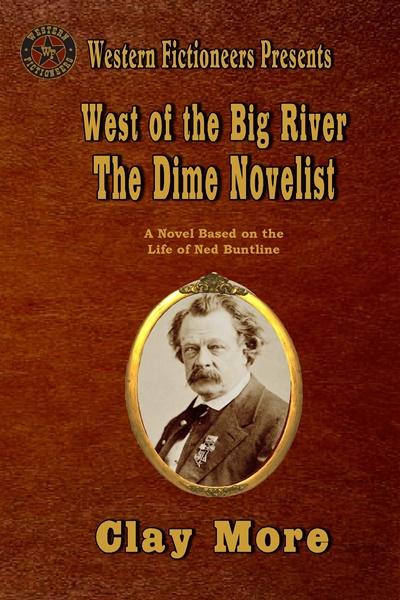
West of the Big River: The Dime Novelist
by Clay More

The historical novels in the West of the Big River series from Western Fictioneers have centered around a number of actual figures from the Old West, exploring the realities of their existence as well as some of the myths and legends that have grown up around them. Now, in THE DIME NOVELIST, the latest volume in the series, acclaimed Western author Clay More takes a closer look at someone who knew many of those historical figures and helped mold their myths and legends: Colonel Edward Zane Carroll Judson, better known to the millions of readers of his hundreds of dime novels by his most famous pseudonym, Ned Buntline.

Judson lived an adventurous and exciting life himself, running away from home at an early age to become a sailor and going on to a career packed with events. Married six times—or was it seven?—he dabbled in business and politics but more than anything else was a writer, publishing several different magazines as well as authoring millions of words of dime novels, articles, and essays. More’s narrative, as Judson reminisces about his life to a young journalist, is one fascinating and colorful story after another, most of them with a germ of truth but also a great deal of embellishment. Buffalo Bill, Wild Bill Hickok, Wyatt Earp, and many more come into and out of Judson’s life, strutting their stuff in the words of a great yarn-spinner. Judson yearned for literary success and respect that he never quite achieved, but in its place he entertained countless people who read his work.

As Ned Buntline, Edward C.Z. Judson is sometimes credited with creating the mythic version of the Wild West. THE DIME NOVELIST is a fascinating exploration of that legend and a brilliant portrayal of a largely forgotten but hugely influential figure in American popular culture. Those of us who write Westerns owe a lot to him, whether we know it or not.


—James Reasoner author of  Outlaw Ranger


Marta’s Ride 

by Gordon L Rottman

Brutal and violent, but beautifully written, Marta’s Ride is both a love story and a story of survival. The tale is told in the first person by Marta, a young, mute, Mexican girl who manages to create a “normal” life for herself in spite of the circumstances of her birth, her infirmity, and her lack of family and money. After meeting Bud, an Anglo man on the road, they become inseparable and their life assumes a semblance of normalcy as she becomes a cook and he becomes a rider for a successful rancher.  Life, however, takes a horrific turn as four young girls, including Marta, are kidnapped by a ruthless band of bandidos that terrorizes the borderlands between Texas and Mexico. Can and will Marta and the other three girls be able to survive daily assaults, rapes, hunger, and fatigue makes up the major part of this story. First person narratives are difficult to execute, but Rottman not only undertakes the task but proves to be efficacious in doing so.

For those readers who enjoy a good western; a strong, well-developed protagonist; and rich imagery, I suggest they tackle Marta’s Ride. I must warn the readers that many of the scenes are brutal, but they only corroborate the strength of Marta’s and the other girls’ characters. One caveat: do not begin reading in the evening, because you’ll be in for an all-nighter. As with so many first-rate novels, I had difficulty putting it down. 

 —Jesse J Elliot, author of Death at Gran Quivera


Showdown at Squaw Pass 

by  Robert B McNeill


When two drovers are found dead on the Western Trail near the Texas town of Cutter's Crossing, marshals Hank Ross and Abe Naylor aim to find their killers and bring them to justice. But their task is complicated when the local schoolteacher, Alice Carnaby, is kidnapped by the drovers' killer, who heads for Mexico with her. Ross and Naylor join forces with George Bowman, a half-breed Indian tracker, and set out after them. However, an unscrupulous local rancher has his own reasons for making sure the marshals don't succeed in freeing Alice, and sends four men to kill both her and the marshals. The rancher is determined there will be no witnesses - and therefore no trial …

This was a great, easy to read story with enough action to keep the pages turning.

When the son of a wealthy man takes it into his head to kill a drover who shows some attention to the woman he loves, it leads to an abduction and chase towards the border.

Except the father has his own agenda and sends his foreman after the wanted and the posse with the instructions that no one apart from his son should return.

After a bloody pursuit it all comes down to one day in court where the only thing from setting two killers free is the word of a woman.

This author knows his stuff and I'll be reading more of his stories.

—Brent Towns Author of Lightning Strike!

Beneath A Horse-Thief Moon

by Elizabeth Clements

Chase Reynolds is on the trail of stolen gold -- but he runs into a woman from his past. A woman he'd long believed dead. Can he find romance with Sara again, or is she somehow involved in the theft? 

This is an exciting read, with outlaws, kidnappings, missing gold and stolen horses. If you like a good romantic adventure, this is a good choice.Chase and Sara are believable characters, and you want everything to work out between them. I can tell you that you'll be satisfied with the ending without giving away any of the surprises along the way.

—J.E.S. Hays Author of Devon Day and the Sweetwater Kid: Down the Owlhoot Trail