

THE DOCTOR'S BAG
- the blog about Medicine in the 19th Century
A PRIMER ABOUT SOME OF THE DRUG THAT DOCTORS COULD MAKE UP
Keith Souter

In he Doctor's Bag this month we shall look at some of the drugs that the town doctor in the Old west could dispense to his or her patients.
In how many movies have you heard a character ask the town doctor for some medicine to cure some complaint or another. Very often it is a request for a painkilling drug and more often than not the doctor just happens to have a bottle of laudanum all ready in his bag. When you write a Western novel and have such a scene intended, you may want to stretch the request beyond a need for laudanum. Having your town doctor treat other conditions may make the doctor-patient interaction more realistic.
Doc Adams in Gunsmoke could always make and dispense a remedy. At a recent visit to the National Cowboy Museum in Oklahoma City I sought out Doc Adams and found him with some of the accoutrements of his trade. As I am sure you all know, he was played beautifully by Milburn Stone.

The G stood for Galen. Interestingly, this was a name chosen by Milburn Stone when the show transferred from radio to television. It was a great choice, since Galen of Pergamum 131-201 AD) was an ancient Greek physician whose teachings dominated medical thought for well over a thousand years. He moved around a lot and at one time was the physician to a gladiator school.
A group of medicines were referred to as Galenicals, after him. Essentially, these were drugs that were used to balance the four vital fluids of the body, or humours as they were referred to. This was an archaic belief that the body contained these four fluids - blood, black and yellow bile and phlegm - an that imbalance resulted in disease associated with the excess or deficiency of one or other of them. various herbs and minerals were known to have particular effects, so they were given to correct perceived imbalances. The cucumber, for example was used in medicines as a cooling galenical - hence, as cool as a cucumber. There is some rational, actually, since it is rich in natural salicylates, which like aspirin the modern day wonder drug, has anti-inflammatory effect and reduces abnormal temperature. Doctors in the 19th century were still practising the art of medicine rather than the science. It was a mixture of theories, empirical observation and peddling of treatments passed on from one generation to the other.
Just look at the bottom of the picture of Doc Adams and you will see his pestle and mortar. This is something that most doctors would have, for pounding ingredients when making medicines.

Mortar and pestle from author's collection
The mortar is the bowl and the pestle is the club-like implement used to grind and pulverise. They are tools that have been used to compound medicines for millennia.
A brief history of the pill
It probably comes as no surprise to learn that the ancient Egyptians invented the pill as a means of taking medicine. The Ebers papyrus of about 1550 BC outlines different ways of taking medicines, by enema, lozenges or pills. The pills were made of clay reread with the medication mixed through. Often they used the feces of animals as a binder and as a medicine.
The Persian physician Rhazes (865-925 AD) improved it by using a psyllium-seed mucilage that made the pills less bitter and nauseating.
A century later, the Persian polymath Avicenna (980-1037 AD) improved it further by using a fine coating of gold or silver foil.
Over the following centuries, other coatings were used, but they all had a disadvantage in that they allowed for only partial absorption of the active ingredient into the body. The problem was that many coatings were too difficult for the body to digest and much of the medication could simply pass straight through. On the other hand, sometimes too much would be released and absorbed, producing side effects from too much. We refer to a drug's bioavailability. That means the readiness with which it is made available to the body.
In 1834 the French pharmacist Mohes invented the gelatine capsule, which is rapidly digested allowing good bioavailability. We still use these today, of course.
One of the greatest advances came in 1884 when Dr William Upjohn (1853-1932) patented a 'friable pill,' which was made by compressing powder into a pill shape. This would then dissolve in the stomach and be absorbed quickly. It had good bioavailability.

Dr Upjohn lived, qualified and practiced in Michigan. He knew that his invention was a winner, the problem being to persuade other doctors to use his friable pills rather than their own hard pellets. He did it by sending thousands of pine boards along with traditionally made pills and his own friable pills to doctors all over the country, inviting them to try to hammer the traditional pills into the board. They often did so without breaking, showing how hard it was for the body to absorb. In comparison, one of his friable pills could be turned into powder, ready to be absorbed, merely with the pressure of the thumb. It was a brilliant and persuasive image which became the logo of The Upjohn Pill and Granule Company that he and his brother formed in Kalamazoo in 1886. It was to become one of the pharmaceutical giants of the 20th Century.

It changed the face of medicine.
The town doctor of the Old West had some effective medicines
Nowadays with our modern drugs is is easy to be smug and think that the town doctor on the frontier would have little to offer the patients under his or her care. That actually is not quite true. In fact, there were quite number of medicines that he was able to obtain or manufacture. Your town doctor in some future novel may lie to use one or two of these.
In preparing drugs he would probably have a copy of the Pharmacopoeia of the United States of America. A Pharmacopoeia is a book of drugs with all their ingredients, actions and side effects.The first London Pharmacopoeia of 1618 contained recipes for 38 pills. In the early 19th century doctors in the USA used the European ones, until the first American one was published by the Massachusetts Medical Society in 1808. Another was published by the New York Hospital in 1816. Then in 1817 it was decided to produce a national one. This went through a lengthy production and was finally published in English and Latin in 1820.The fifth edition was produced in 1873. I use the sixth edition (in writing Western novels) of 1880.
A frontier town doctor could compound his medicines using some rudimentary equipment, a mortar and pestle, some pipettes, flasks etc. He would need a set of balance scales and various measuring devices. And he would need various reagents. All are listed in the Pharmacopoeia.
Digitalis
This is one of the most effective drugs that the doctor would have had. It was used to treat dropsy, or heart failure. We still use it as digoxin. It is one of our oldest effective drugs in cardiology. It is a type of drug called
a cardiac glycoside.
In preparing drugs he would probably have a copy of the Pharmacopoeia of the United States of America. A Pharmacopoeia is a book of drugs with all their ingredients, actions and side effects.The first London Pharmacopoeia of 1618 contained recipes for 38 pills. In the early 19th century doctors in the USA used the European ones, until the first American one was published by the Massachusetts Medical Society in 1808. Another was published by the New York Hospital in 1816. Then in 1817 it was decided to produce a national one. This went through a lengthy production and was finally published in English and Latin in 1820.The fifth edition was produced in 1873. I use the sixth edition (in writing Western novels) of 1880.
A frontier town doctor could compound his medicines using some rudimentary equipment, a mortar and pestle, some pipettes, flasks etc. He would need a set of balance scales and various measuring devices. And he would need various reagents. All are listed in the Pharmacopoeia.
Apothecaries’ measurement
Weighing out ingredients for remedies
was a complex business and a whole system of Apothecaries measures were used.
One pound or one grain
One pound = 12 ounces
One ounce = 8 drachms
One drachm – 3 scruples or 60 grain
An apothecary’s teaspoon was used to
measure one fluid drachm. This was
equivalent to a quarter of a tablespoon.
When the household teaspoon size
increased it became the equivalent of a third of a tablespoon, which it remains
to this day. The Apothecary’s teaspoon, however, remained the same measure.
One could imagine the potential
dangers that could ensue with drugs, many of which were extremely toxic, if the
wrong spoon was used.
It is a purified
drug that was first extracted from the foxglove plant, Digitalis lanata. It was discovered by William Withering (1741-1799),
an English physician in 1785. He had noted that an old woman who practiced
herbal medicine used a concoction for treating dropsy, which was the archaic
name for heart failure. She achieved dramatic results and he analysed her
concoction of twenty ingredients and worked out that the digitalis was the
active beneficial agent. Digoxin increases the
strength of the heart contractions and slows down the heart. Its effect would have been almost miraculous.
Dover's Powder
This is a mixture of opium, ipecacuanha and sugar of milk. It was sedative in action, so could calm folk down. It also induces a perspiration reaction. We call these diaphoretic drugs. Back then it was believed that you could sweat an illness out. It was commonly used.
Arnica
This was made from the fried flowers of the plant, a native of the Old west. Made into a tincture, it dealt with strains and bruises.
Tartar emetic
Rather like giving a diaphoretic to induce sweating, it was thought that making someone sick could get poison out of their system. We cal these drugs emetics. This one was made from crystals of antimony and potassium tartrate. The antimony is emetic and also a diaphoretic.
Ipecacuanha emetic
This is another general purpose emetic. We used it a lot in casualty departments (Emergency Rooms in the USA) in hospital, after someone was brought in having taken a drug overdose or poison.
Laudanum
Of course, this is tincture of opium. It contains about ten per cent opium and it is reddish-brown. It was very bitter. It was an analgesic and sedative. In small doses it is also a cough suppressant. Indeed, the doctor could make up various types of cough remedy, often incorporating this.

Carrying case from the author's collection. It has a spring inside the bottom of the cylinder to cushion the medicine bottle inside. A good idea if it was in the doctor's bag being jostled in a buggy or a special medical saddlebag
This is an extremely old medicine. It was a white powder of mercuric chloride. It had profound laxative qualities and was a mainstay of treatment for infective conditions and syphilis.
Nux vomica
This was another of the multi-use medicines. It is prepared from the beans of an east Indian tree. It contains strychnine, which of course, is a highly poisonous agent. It was used as a stimulant, as indeed other poisonous substances like arsenic were used throughout the 19th century. It was used for digestive problems, heart disorders, depression (referred to as melancholy then), and erectile dysfunction in men.
Here are the Pharmacopeia of the United States of America, 1880 instructions:
ABSTRACTUM NUCIS VOMICJE.
ABSTRACT OF NUX VOMICA.
Nu x Vomica, in No. 60 powder, two hundred parts...., 200
•Sugar of Milk, recently dried and in fine powder,
Alcohol,
Water , each, a sufficient quantity,
To make one hundred parts.... 100
|
This was an effective antacid for stomach acidity. It was effervescent when added to water, because it contained an acid and an alkali. They react to produce carbon dioxide.
PULVIS EFFERVESCENS CQMPOSITUS,
COMPOUND EFFERVESCING POWDER.
|
|
|
|
|
|
|

Herbal preparations
In addition to the formal medicines of the day, many doctors would also use herbal preparations. remember that frontier doctors were a disparate group, many having had no formal training, or perhaps having simply served as an assistant to a doctor until they acquired sufficient experience and training to go it alone. Some, of course, merely bought a qualification from one of the many diploma mills. If you are interested in what types of doctor practiced back then, you can refer back to my very first Doctor's Bag blog.
Herbal medicines have been used for centuries and there were many such preparations used by Native American medicine men. We shall have a look at some of the herbal remedies used in a later blog.

Samuel Thomson (1769-1843) the founder of Thomsonian Medicine
My alter ego Clay More has a couple of recent releases.
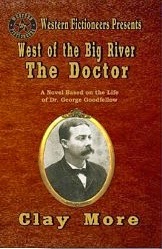
The Doctor published by Western Fictioneers in the West of the Big River series
Redemption Trail published by Western Trail Blazer
- a novelette- novella

Sam Gibson used to be a lawman, until the day he made a terrible mistake that could never be taken back. Since then, he has alternated between wishing there were a way he could redeem himself and believing he deserved punishment.
He’s about to get both…

The Doctor published by Western Fictioneers in the West of the Big River series
- my novel based on events in the life of Dr George E. Goodfellow
Redemption Trail published by Western Trail Blazer
- a novelette- novella
Sam Gibson used to be a lawman, until the day he made a terrible mistake that could never be taken back. Since then, he has alternated between wishing there were a way he could redeem himself and believing he deserved punishment.
He’s about to get both…
And coming soon from Hale
Fate handed Hank Hawkins the opportunity of achieving his ambition of buying a ranch, and all he has to do to make it happen is to make it easy for a gang to rob the stage in Devil's Bones Canyon. Hank soon realizes, however, that the robbers never had any intention of leaving anyone alive and had planned a dry gulching. He survives but regains consciousness back in Hastings Fork, he vows to track down the murderers who betrayed him and have his revenge. But, when he sets off, he finds he has a companion - Helen Curtis, the fiancee of the messenger whose death lies on his conscience. Hank has many things to figure out, such as why there was one body missing and things are about to get even more complicated with the threat of death for both of them never far away.


