Showing posts with label High Noon Press. Show all posts

Thursday, December 26, 2013

THE DOCTOR'S BAG


I THINK IT'S BUSTED, DOC!

By Keith Souter  aka CLAY MORE


It is a dangerous business being a character in a western novel. You can get shot at, tossed off a horse, hurled through a saloon window or be pushed over a ravine. You have seen it on the movies, read it in the novels or written about it yourself. Any of them can have fatal consequences, but more often than not in this fictional world that we love so much the result is a broken bone somewhere. And then the Doc comes along just in time to hear that speculative diagnosis - "I think it's busted, Doc!"


                                           A Dash for the Timber by Frederic Remington

And of course, an examination reveals all, a splint is manufactured, a dose or two of laudanum and "You'll be up and about in no time at all."

But in real life it is often more complex than that.

 
                                             The BroncoBuster by Frederic Remington

The birth of orthopaedics
We know that doctors have been setting bones since the days of the ancient Egyptians. We have surgical papyri outlining treatments and mummies have been found with splints made of bamboo, reeds, wood or bark, padded with linen.

The roman physician Galen (129-199 AD) treated gladiators and recorded his treatments in his medical and surgical encyclopaedias. His treatments were used as the basis for treatments all the way up the the Renaissance.

The name orthopaedics was first used  in 1741 in France, when Nicholas Andry, a professor of medicine at the University of Paris coined it from the Green words 'orthos,' meaning 'bone' and 'paideia' meaning 'rearing of children'. His book OrthopĆ©die was about the prevention and correction of musculoskeletal deformities in children. There was a real need for this since there were many diseases that could cause problems like scoliosis (curvature of the spine), abnormalities in the growth of bones (e.g., tuberculosis), various infections (osteomyelitis), vitamin disorders (e.g. vitamin D deficiency causing rickets or bowed legs), and conditions that could cause paralysis, such as poliomyelitis.


                                                     Professor Nicholas Andry (1658-1742)

So, the specialty of orthopaedics was originally all about treating children to prevent problems. The treatment of fractures became added along the way.

The frontispiece for his book showed a sapling supported by a staff. This has been taken as the logo of orthopaedic institutions and organisations across the world ever since.


In   Jean-Andre Venel established the first orthopaedic institute in 1781 for the treatment of children.

Splints and supports
As mentioned above, splints of various forms have been used from the times of antiquity. The purpose of them is simply to support the leg and prevent movement of the broken ends of the broken bone.

In medieval times surgeons knew that fractures bones had to be kept in place. One method of doing this was to soak bandages in horses' urine. As the bandage dried it would stiffen into a splint.

Plaster of Paris casts
This was a fantastic addition to the surgeon's armamentarium of treatments. It was the invention of Antonius Mathysen, a Dutch military surgeon in 1851. Essentially, a continuous bandage is wound round and round the limb then soaked in Plaster of Paris. It is called this because it was first used extensively in Paris in medicine and in building.


Essentially, it is made from gypsum, which is heated to produce anhydrous calcium sulphate. When water is added to this it forms gypsum again and hardens.  Hardening takes place very quickly, but it has to dry out. The larger the cast, the longer it takes. An arm cast will dry out in 3-6 hours and a leg cast may take up to 6 hours.Yet full drying may not be complete for 72 hours.

Diagnosis of fractures
Nowadays we are very dependent on x-rays, but in the old West there was no such thing. William Roentgen discovered them in 1895. Only a year later, Dr John Hall-Edwards in Birmingham, England started to use the so-called X-rays in medical diagnosis.

In the Old West doctors relied on physical examination to diagnose fractures. Then, and now fractures would be divided into two broad types:
  • Closed or simple fractures - when the skin is intact.
  • Open or compound or - when the broken bone protrudes through the skin.
The type of fracture can vary immensely. We talk about a 'clean break' meaning a simple transverse fracture. But it can also be oblique, as can happen with a torsion injury. Or it can be comminuted, meaning fragmented, It can be complicated by causing blood vessel or nerve damage. And it can be a 'greenstick' (as happens in youngsters, when a bone gets bent and only partially fractures).


The principles of treatment of fractures was relatively simple then. If moving the part of the body distal to (furthest away from the site of the pain) caused extreme pain or if  grating could be felt, then a fracture would be diagnosed. 

The bone had to be set. That is, the limb had to be stretched in order to make sure it was the same length as the other. This would give the best chance to get the two broken ends in position against one another to allow healing to take place.

Without the use of x-rays it is very likely that all manner of injuries would end up being diagnosed as a fracture. The treatment would involve immobilising the part and hopefully, the injured part would just 'knit together' and be whole again after a few weeks. Remember, that nature actually does the healing, not the doctor, surgeon or nurse. All that they do is create the best circumstances for nature to do its job.

And of course if the 'broken bone' healed up all right, it would bring nothing but kudos to the doctor, whether it actually had been a fracture or not.


Bone healing
What actually happens when the bone ends are back in opposition is that a large haematoma, or blood clot forms around the ends. This is rather like jelly. After a few days blood vessels grow into it and cells called phagocytes start digesting any debris and tissue that won't heal. Then other cells called fibroblasts start to lay down collagen, that forms a frameworks around the bone ends. This secures the  one ends and new bone is laid down. As a rule of thumb, most bones will have knitted in about 6 weeks.

Some fractures worth knowing about
There are lots of different fractures, many of which are named after the doctors or surgeons who first described them. Some of the ones which our western doctors would have known about are as follows:

Colles fracture
A fracture of the distal radius one inch (2.5 cm) above the wrist. It was described by Abraham Colles an Irish professor of anatomy in 1814. It is sustained by falling on the outstretched hand as when you try to break your fall. The problem is that the broken bone gets displaced and causes a dinner-form abnormality if it is not replaced in posit and immobilised. It takes 4- 6 weeks to heal.

Bennett's fracture 
This is one that could occur in saloon brawls, or whenever a really hard surface was punched. If you swing at someone and they duck, causing you to punch the wall, you may end up with a Bennett's fracture. It can also occur if someone punches someone else's skull! It is a fracture of the first metacarpal, the big bone at the base of the thumb. It is also common in people who have never learned how to punch correctly - which is most people! It was described by Edward Hallaran Bennett, professor of surgery at Trinity College Dublin in Ireland in 1882. It needs immobilisation of for 4-6 weeks.

Scaphoid fracture
This is not named after anyone, but is the name of one of the bones of the wrist. It also occurs when you try to break your fall. It causes pain in the 'anatomical snuffbox.'  This is an area at the base of the thumb. It is called this because in days of yore when folk took snuff, they placed a pinch in the lilt depression on the ice of the wrist formed when you elevate the thumb perpendicular to the hand. The problem with this fracture is that the scaphoid has a variable blood supply and in many people the blood supply comes distally. That is, blood vessels do a U-turn to supply the bone from its far end. If they do not also have a blood supply going directly into the base of the bone (that is, from the top and bottom) then non-union of the bone can occur and the piece without the blood supply can die.

Monteggia fracture
This is a fracture of the proximal third of the ulna (the larger bow in the forearm) with dislocation of the head of the radius (the smaller bone). It was named after Giovanni Monteggi, (1762-1815) an Italian professor of anatomy and surgery. It occurs with a fall and a twist. It is a difficult one to treat because the breaks and the two bones are hard to get in the right positions.  Nowadays it may necessitate operation.

Clavicle fracture
The collar bone is commonly injured in contact sports and fights. A direct blow to the upper chest can  fracture it, most usually at the junction between the middle and outer thirds. They heal up very well generally. We used to use figure of eight bandages and a sling, but really they generally just heal without any intervention.


Fracture of neck of femur
The femur is the thighbone. The two main parts are the neck of the femur, where it forms the hip joint and the shaft, the main part of the thigh.  This is the sort of fracture that happens in older people who may have osteoporosis, or thinning of the bone. This is nowadays treated by internal reduction and fixation. It is probably not going to occur to your hero or heroine in the western novel, but could to another character. It classically causes a great deal of pain after a fall or twist, and the leg will show external rotation due to the weight of the limb.


Fracture of the shaft of the femur
This can occur with any large trauma, either directly from a blow or from a fall. Depending upon which part of the shaft is affected the muscles will move the two parts ion different directions. The first aid treatment would be to strap the two legs together, so that the good leg acts as a splint.

Skull fracture
The big thing here is the possibility of a hemorrhage inside the skull or into the brain. In terms of the novel, the big question would be whether to trephine or not. That is, whether to make a hole in the skull to release blood.

This just happens to be one of the questions that Doc Logan Munro is forced to consider in Wolf Creek 8: Night of the Assassins. But you will find no spoilers here!

And it is also a question posed to Doc Marcus Quigley in Dead Man's Game.
______________________________________________________________________________
 Clay More's character of Dr Logan Munro, the town doctor is appearing in several of the Wolf Creek novels


And his other new character, Doc Marcus Quigley, dentist, gambler and occasional bounty hunter continues in his quest to bring a murderer to justice, in DEAD MAN'S GAME the last in his  ebook short stories THE ADVENTURES OF DOCTOR MARCUS QUIGLEY published by High Noon Press.


Thursday, November 28, 2013

THE DOCTOR'S BAG

THE PILL AND THE SYRINGE 

- pushing back the frontiers of Medicine


If you are a Gunsmoke fan you will doubtless have been amazed at how many medicines Doc Galen Adams crammed into that old black bag of his. He was prepared for any eventuality and would always have something that he could give to relieve the sick or injured.

Back in Wolf Creek Doc Logan Munro tries his best to stay up to date with modern medicine and surgery. He makes up all of his own medicines, often using herbs or traditional remedies that he has picked up along the way or been alerted to by Charlie Blackfeather.

But the way that the medicines were given is interesting, because in medicine you want to present a drug to the body in the most effective way that you can. 


The invention of the pill
We must go back into the mists of time to look at a great boon to mankind, the development of the pill as a means of delivering medicine. 

The ancient Egyptians seem to have been the first to come up with the idea. There are ten medical and surgical papyri, which detail treatments used in the days of the pharaohs. The Ebers papyrus, written about 1550 BC contains recipes for all manner of enemas, lozenges and pills. These early pills were hard compressed balls of clay or bread. In addition, they sometimes used the faeces of various creatures.

Now I guess you may have turned your nose up in disgust at that last sentence. But consider the times they lived in, with a pantheon of over 400 gods and goddesses. The world was a mystical place organised by the deities, and the priesthoods had rituals that covered just about every activity that could be undertaken. 

The scarab, the dung beetle rolled a ball of dung in order to lay its eggs inside it. This the Egyptians believed was symbolic of the god Khepri, the scarab-headed god, who rolled the sun across the heavens each day. 


The dung beetle rolling the ball was thought to be symbolic of the god Khepri


The scarab was the ancient Egyptian symbol of birth, regeneration and renewal as well as being used as a powerful talisman for health. It has been suggested that priest physicians invoked Khepri when they made their remedies, which they did as these crude pills, like the dung beetle.


Coating the pill
The basic design for the pill lasted almost 2,500 years until the Persian physician Rhazes (865-925 AD) improved upon it by giving it a coating. By using a psyllium-seed mucilage the solved the problem of the nauseating or bitter tasting pill.


                                                                 Rhazes (865-925 AD)

A  century later another Persian polymath, known as Avicenna (980-1037 AD) further improved it by coating his pills in silver or gold leaf. In an age of alchemy, precious metals were thought to enhance the effectiveness of medicines. An interesting boost to the placebo effect.


                                                           Avicenna (980-1037 AD)

The first London Pharmacopoeia
A Pharmacopoeia is a book of drugs with all of their ingredients, actions and side effects. The first London Pharmacopoeia of 1618 contained recipes for 38 pills. Of these, 23 were derived from medical works written in Arabic. Two were from Avicenna and one from Rhazes. 


This photograph shows a sample page detailing a purgative pill devised by Avicenna - Pilule Pestilentiales Ruffi.


The problem of bioavailability
Bioavailability means the readiness with which a drug can be absorbed and allowed to reach its target organs. The pills that had been in use for centuries often had poor bioavailability because the material they were encased in didn't break down in the intestines. In many cases it would be like swallowing and trying to absorb buckshot.

In 1834 the French pharmacist Mothes devised the gelatin capsule, which could be used to contain liquids or powders.These are still used today.

A real breakthrough came in 1884 when Dr William Upjohn (1853-1932) patented a 'friable pill,' which was made by compressing powder into a pill shape. This would then dissolve in the stomach and be absorbed quickly. It had good bioavailability. 


Dr Upjohn lived, qualified and practiced in Michigan. He knew that his invention was a winner, the problem being to persuade other doctors to use his friable pills rather than their own hard pellets. He did it by sending thousands of pine boards along with traditionally made pills and his own friable pills to doctors all over the country, inviting them to  try to hammer the traditional pills into the board. They often did so without breaking, showing how hard it was for the body to absorb. In comparison, one of his friable pills could be turned into powder, ready to be absorbed, merely with the pressure of the thumb. It was a brilliant and persuasive image which became the logo of The Upjohn  Pill and Granule Company that he and his brother formed in Kalamazoo in 1886. It was to become one of the pharmaceutical giants of the 20th Century.


It changed the face of medicine.


The hypodermic syringe
We now come to a relatively recent invention, the hypodermic syringe. Being the sort of man that he is, Dr Logan Munro would certainly grasp its potential and soon be giving the citizens of Wolf Creek the benefits of the latest science.

Hypodermic comes from the Greek hypo, meaning 'under' and derma, meaning 'skin'. It therefore means syringing under the skin into the body.

This is one of the most important inventions in medicine, for it gave doctors a means of delivering drugs into the patient's system, by-passing the gastro-intestinal tract. That is often a good thing to do, especially if the person has an inflamed stomach or if they are vomiting and unable to keep anything down. But it wasn't invented until the mid-nineteenth century.

Syringes had been used in medicine for centuries, but for introducing fluid into bodily orifices, or to suck out fluids or pus. Some attempts to give drugs by injecting them into the body were made in the early seventeenth century, but they were not successful and fatalities did occur. In those days it would be highly likely that infections would have been directly introduced to the tissues.

The first necessity was to produce a hollow needle. This was done by Dr Francis Rynd (1801-1861) an Irish surgeon in 1843. He successfully develop a technique with a hollow needle for injecting opiates to treat neuralgia.

Dr Thomas Wood (1817-1884) a Scottish physician invented the first hypodermic syringe in 1853. Apparently he tried to copy the cation of a bee sting, so he used a hollow needle that could be attached to a metal syringe.  He used t to inject morphine and other opiates in the treatment of neuralgia, which was at that time  an umbrella label for all manner of painful conditions.


                                                      Dr Thomas Wood (1817-1884)

During the Civil War most surgeons simply dusted morphine into wounds or gave opium pills. Dr John Billings (1838-1913), a Lieutenant Colonel in the Union Army was the first doctor to use a hypodermic syringe in the field. Despite his advocacy of it, however, probably less than a dozen were used during the war.


                                                          Dr John Billings (1838-1913)

Dr Billings would go on to become one of the most prominent physicians and librarians in American medicine.


                                                 A mid-19th century hypodermic syringe

Syringes are used to inject subcutaneously (just under the skin), intra-muscularly (into the muscle) and intra-venously (directly into the blood stream through a vein). It is important to expel any air when giving an intra-venous injection, sine an air bubble can travel throughout the circulation as an air embolism. It can have the same effect as  a blood clot and could produce a heart attack, stroke or chest pain. They can be rapidly fatal. It is for this reason that you see doctors invert a syringe, as in the position in the photograph, tap it to get any air to the top of the syringe, below the aperture of the needle, then squirt some fluid out. This is to get rid of air bubbles to prevent an embolism.


Hell on the Prairie, the sixth Wolf Creek book features Keith (Clay More's) character Dr Logan Munro, the town doctor in THE OATH, a story about a spectre from his past. 


Logan has been in Books 1, 4 and 6, and 8 and appears in the second Christmas anthology O DEADLY NIGHT in the story THE SPIRIT OF HOGMANAY 


And his other new character, Doc Marcus Quigley, dentist, gambler and occasional bounty hunter continues in his quest to bring a murderer to justice, in RATTLER'S NEST in his  ebook short stories THE ADVENTURES OF DOCTOR MARCUS QUIGLEY published by High Noon Press.


DOUBLE-DEALING AT DIRTVILLE was originally published by Hale as a Black Horse Western, but is now available as an ebook from Western Fictioneers Library.


Thursday, August 22, 2013

THE DOCTOR'S BAG


BOIL THAT WATER, SHE'S GONNA HAVE A BABY!

By Keith Souter, aka CLAY MORE


How many movies have you watched and heard those words? Quite a few, I imagine. Did you wonder exactly what the water was for? I mean, boiling water? Surely not to apply to the mother-to-be? But of course, you never find out because as soon as the water is brought in, the menfolk are rushed out and the expectant mother and her female neighbour, midwife or doctor are left to do their magic. Then you see the anxious father pacing up and down, acting clumsily or irrationally as he awaits that slapping noise, which was always followed by the cry of a newborn babe. Then the door opens and either a neatly wrapped baby is presented to the father or he is ushered in to see his wife with the baby ready for  the proud father to see.

WARNING! THE REST OF THE ARTICLE IS GOING TO LOOK AT CHILDBIRTH, A SUBJECT THAT STILL MAY CASE FOLKS SOME ANXIETY. IF YOU ARE OF AN ANXIOUS DISPOSITION THEN READ NO FURTHER.

A natural birth
Nowadays most fathers attend antenatal classes and so they have a good idea of what is happening throughout the pregnancy. They know what to expect when labour begins, what they need to do, and a lot of fathers are present during the birth of their children. Some may been have delivered the baby themselves.

In the 19th century things were very different. Fathers didn't tend to have much to do with the pregnancy, apart from the obvious conception, of course. Most women received no antenatal care. When they went into labour they may have just gone somewhere on their own and given birth, or may have had a willing relative or neighbour that they could have help from. The father may have kept on working the land. A day or two after the birth she may have been back there helping him. Interestingly, this is still pretty much what happens in rural areas in the developing world.


Explanation of the birth mechanism from Fleetwood Churchill's 'On the Theory and Practice of Midwifery,' 1850.

So let's look at what happens
Pregnancy
This lasts 40 weeks, on average. A rule of thumb for calculating the expected date of delivery (EDD) is to take the first day of the last menstrual period (LMP) and add seven days, then subtract 3 months. This is working on the basis of conception occurring about two weeks before that, when ovulation, or the release of the egg from the ovary occurs.

During the first twenty weeks the baby is developing. During the second twenty weeks the baby's organs have all developed and it grows.

Another rule of thumb - the average mother will put on 28 pounds in pregnancy, 8 pounds only in the first 20 weeks, then a pound a week until term (ready to give birth).

Labour
There are three stages of pregnancy:

First stage - from the onset of contractions until the mouth of the womb (uterus) has opened up fully enough to allow for delivery. This can take 12-16 hours in a primiparous womb (first timer), but only 6-8 hours in a multiparous (a mother having had at least one previous pregnancy).

Second stage - the birth of the baby. This lasts 3-4 hours in a primiparous women, but may be very fast in a multip.

Third stage - the delivery of the placenta, or afterbirth. It usually comes away within half an hour of the birth of the baby.

After the baby is born the cord is ligated and separated. This is done a few inches from the umbilicus. This umbilical stump will gradually shrivel and separate after a few days. It used to be advised to cut quickly, but modern research suggests that waiting until the placenta has delivered gives a premature baby more blood and more stem cells, all of which is better for them.

Complications 
While the majority of pregnancies do go through to an uncomplicated labour and birth of a child, yet there are still a considerable number that have complications. There can be problems with the baby as the result of failure to develop one organ or another. The result can be miscarriage, when nature ends the pregnancy or stillbirth of a dead baby, or birth of a baby with a congenital malformation.

There can be problems with the pregnancy itself; for example, difficulties with the mother's blood pressure, which can lead to kidney failure, convulsions and even death. Nowadays we are familiar with pre-eclampsia, toxaemia of pregnancy and the various related problems, but back in the mid-nineteenth century there was no conception about blood pressure, so no way of helping.

Then there can be problems about the position of the placenta. If it is too low, which we call placenta praevia, then this can produce hemorrhage either before labour or during labour if it detaches from the uterine wall.

The cord can prolapse during labour. That means it can come out before the baby and the baby's own head can therefore obstruct its own blood supply.

And there can be problems about going over term, or just not progressing during the labour. These are things that we can do a lot about nowadays, but back then there were a limited number of drugs and herbs that could be used. [I'll be looking at herbs and drugs in a later blog.]

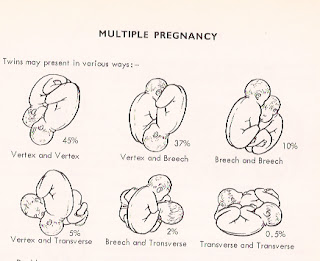
Multiple births 
Twin and triple pregnancies occurred and would challenge whoever was assisting the mother. These are more likely to be difficult labours and there is a lot of potential for things to go wrong with both babies. You may think that if a baby is born quickly then all will be well. Not necessarily. If a baby is born too quickly there can hemorrhage into the baby's brain.


Twins presentation in The Rose Garden, a 1513 publication for midwives

And of course, there can be problems from the twins' positions. Caesarian sections would not have been a ready option and a good midwife or doctor would be essential.


Good old Doc Adams was adept at delivering babies and looking after the newborn. Indeed, in The Baker's Dozen, from Gunsmoke's season 13, in 1967, he is involved in the aftercare of triplets who were born to a woman who arrived in Dodge City on a stage that had just been robbed. The mother sadly dies in the process, and it transpires that the father was a stage robber who has been killed. Doc looks after the triplets and is determined that they should be kept together and not sent to the State orphanage.

Malpresentations
When we assess a mother's abdomen we talk about the presentation. That means the anatomical part of the baby that is leading and which is likely to be born first. There are whole number of ways that we refer to them - cephalic, meaning the head first. This is the one we always want to find. There are variations, of course, so you can have vertex (top of head), sinciput (forehead), face, chin, occiput (back of head) and others.

Other presentations are called malpresentations. Thus a foot, a shoulder, a hand or a bottom (breech) all present difficulties for the doctor or midwife. Indeed, nowadays with good antenatal care you aim to know precisely how a baby is lying well in advance of the due date and plans can be made. This may well be a planned Caesarian Section. Back in the 19th century there were no scans, everything had to be worked out through clinical acumen alone and the use of a simple foetal stethoscope.

The author's foetal stethoscope - which is more or less obsolete today, since most doctors have an ultrasound gadget

A breech presentation occurs in about one in every 40 cases. It is a common position early on in about a quarter of pregnancies, but a fair number will turn round before the critical 36 weeks stage. In the 19th century the first inkling of this would probably be at term, when the woman was going into labour. Again, nowadays we would aim to know well ahead and plans would be made.

External cephalic version is the name of the technique used in trying to turn a baby from the outside. It would be done from 32 weeks to 35.


External Cephalic Version - an attempt to gently turn the baby from breech to cephalic presentation in advance of term

The instruments
Most frontier doctors would carry obstetric instruments with them. That is they would have obstetric forceps to help to deliver the baby's head when it is is in the vagina and effect delivery by traction  without causing injury.

There are several types, but the common features are the two curves. They have a cephalic curve  to be applied to the baby's head, and they are have a pelvic curve to fit the pelvic curve of the birth canal.


Not only would a doctor carry forceps, but he would have instruments to perform an episiotomy, an incision needed to allow room for the forceps and often also to give a baby enough room to get out. He would also have to have sutures and instruments to repair the episiotomy.

Yet sadly, he would also have to carry other instruments in case things had gone wrong and the baby had died. I think that is as far as I need explain, but if anyone would wish for further information, then I can be contacted off-line.

Sepsis - the great killer
At this point we really have to talk about maternal mortality. Here I am going to talk about the situation in the UK, since I am more familiar with it and have figures. I believe that the points are still germane when applied to the USA and the frontier.

At the beginning of the 19th century pregnancy and childbirth carried significant risks for the health of a woman. One in 200 women died in childbirth. In part this was to do with complications of being poor, of not having enough money for food. Rickets, due to vitamin D deficiency caused skeletal problems and pelvic distortions, so labour could be difficult and become obstructed with catastrophic results for mother and child.

Yet the maternal mortality in hospitals was actually greater! That is right, you had a higher risk if you went into hospital for treatment. They did not realise it, but the problem was puerperal fever - which they recognised - but they still did not understand the problem of sepsis.

In fact, a Scottish physician, Dr Alexander Gordon, working in Aberdeen had made the link at the end of the 18th century when he deduced that there was a connection between puerperal fever and erysipelas (an infection later found to be due to Streptococcus). He wrote a treatise about it, but it had no impact. He drew a significant conclusion and stated that he believed that somehow doctors and midwives spread the problem. Yet along with his fellow physicians he advocated that the treatment should be venesection or bleeding.

Oliver Wendell Holmes (1809-1894), a doctor, poet and writer, sometime dean of Harvard Medical School, also made the connection and suggested that doctors in particular were the problem. He went so far in a paper of 1843  to suggest that doctors who conducted autopsies should not also practice obstetrics.

Professor Oliver Wendell Homes

Yet history proclaims Ignatz Semmelweis (1818-1867) as the man who made the breakthrough. He published a treatise in Budapest in 1861, entitled ‘The Cause, Concept and Prophylaxis of Puerperal Fever.’ It was based on work he conducted in the 1840s. He suggested that women who died from puerperal fever (childbearing fever) had been contaminated by doctors who had not washed their hands between attending morning autopsies and going to the labour wards. He was castigated by his fellow practitioners for daring to suggest that they should wash their hands, without any 'scientific evidence' as to why. It was said that he  was not saying anything new, it was just the same thing that Holmes had been saying. 

He actually suffered a nervous breakdown and was committed to an asylum in Vienna, where he died a fortnight after his committal, after having been beaten by guards. 


 Dr Ignatz Semmelweis

Semmelweis was vindicated after his death when Lister started using carbolic acid sprays and advocated strict hygiene. And most importantly, Louis Pasteur proved the germ theory of infection. 

Another reason for morbidity in hospitals was the tendency to make women 'lie-in,' or stay in bed for a couple of weeks after birth. This is not a good idea, since the risk of blood clotting is increased. Yet again, the women on the frontier who needed to get going to fix the corral or feed the animals, possibly fared better.

Caesarian sections
These are operations performed to remove the child from the mother's womb through an incision in the abdomen. They first one to be done in which the mother survived was in Ireland in 1738. The first in England was performed by Dr James Barlow in 1797 and the first in the USA was by Dr John Richmond in 1827. These were all done without anaesthetic and so when anaesthesia became generally used, together with aseptic surgical techniques, Caesarian Sections became viable operations.

In the 1880s the classical Caesarian Section method was developed, which involves a longitudinal incision in the upper uterine segment. That is, in the upper part of the womb. These do not heal well, so they were replaced in 1906 by the lower segment Caesarian section. This is the method favoured today, although under certain situations the classical may be performed.


So what about that boiled water?
Well, it would be useful. Not only to sterilise as best one could the instruments, but also to use to make warm(not booing) compresses to place over the perineum prior to labour. This would tend to soften the tissues, which get stretched, of course, and lessen pain and reduce tearing of the tissues.

And of course, it would be for washing hands and swabbing everything down afterwards. On the point of washing hands, it should be noted that the frontier doctor's hands would probably have a greater need of being washed than would a midwife. Quite simply, the midwife would not be handling purulent matter, operating on diseased tissue or conducting autopsies. Nor would she have been exposed to coughs and sneezes to the same extent as the doctor.

And that slap on the back?
Well, we don't do that any more either. Doctors and midwives used to do it to stimulate the baby, in the belief that you needed it to help it to breathe and to cry to clear all those secretions out of nose and mouth. Now we just suck it out with a tube and if needed, give controlled oxygen.

A couple of final points about cutting the cord
This is really if you ever find yourself having to deliver a baby. Don't go searching for a scissors of anything else to cut that cord. nature generally does a good job. Don't cut it, or tie it off, just call the emergency services and let them clamp it off for you.  As noted above, a slight delay is no bad thing, and may be quite beneficial to the baby.

Lastly, any cutting of a cord has to be done with a clean instrument. I say this from experience of many moons ago, when I was working in a fever hospital in India. There was a whole ward devoted to cases of neonatal tetanus. Almost all of them had been due to injudicious severing of the cord with any sharp object hat was at hand- knives, scissors, sickles!

Tetanus or Lockjaw is a horrid condition - which I'll be getting round to at some stage.
__________________________________________________________________________

Hell on the Prairie, the sixth Wolf Creek book features Keith (Clay More's) character Dr Logan Munro, the town doctor in THE OATH, a story about a spectre from his past. Logan has been in Books 1, 4 and 6, and is due to appear in books 8 & 9.


And his other new character, Doc Marcus Quigley, dentist, gambler and occasional bounty hunter continues in his quest to bring a murderer to justice, in AMBUSH AT DEAD MAN'S RAVINE, the fourth in his monthly ebook short stories THE ADVENTURES OF DOCTOR MARCUS QUIGLEY published by High Noon Press.

Vol 5 THE SHOOTER should be out soon.

Thursday, June 27, 2013

THE DOCTOR'S BAG


 DIG IT OUT, DOC!

Part 2    BULLETS

Keith Souter aka CLAY MORE


Doc Galen Adams was really adept at digging out bullets. With his spectacles perched on the end of his nose, his sleeves rolled up, a look of intense concentration and a bit of fiddling with a forceps he would deposit yet another slug into a metal tray. The same scenario has been played out in countless novels and movies over the decades. 

 Not all doctors are portrayed as benevolently as Doc Adams. Some are hardened drinkers, who either need to be revived with a bucket of water, or fortified with a good drink. Doc Willoughby (played by Ken Murray), in The Man Who Shot Liberty Valance is a doc of the latter school. He is called to see Liberty Valance after he has been shot. He calls out: "Whiskey, quick!"

A willing aid appears with a bottle, which the good doc puts to his lips and takes a hefty swig. Thus, restored and ready for action, he turns Valance's body over with his foot, then announces: "Dead!"

The Minie bullet
A few blogs ago, Matthew Pizzolato showed us some Minie bullets, found on the Civil War battlefields. What an advance that was on the type of balls that were used in earlier times. The Minie ball was the brainchild of Claude-Etienne MiniĆ©, a French Army officer. He invented the Minie ball in 1847 and soon it enhanced the accuracy and the ability to maim and kill. Essentially it is a muzzle-loaded, spin stabilised bullet. It was made slightly smaller than the bore of the weapon. Its hollow base would expand so that it would fit the spiral grooves of the bore. Its head was conical, so it cut through the air at higher velocity.


They made a mess when they hit a person. Inevitably, out of necessity, War service increased the surgical expertise of surgeons on both sides. And of course, after the War this meant that many doctors who went west would have considerable experience in removing the various types of bullets.

Digging it out
This description is in keeping with the stoical nature of the good folk that we see depicted in novels and movies. But actually, even in the days of the old west, surgeons tried to remove bullets in the most efficient and least painful way that they could. I will be dealing with pain and anaesthesia (that's how we spell it over this side of the Pond), so for now I'll simply talk about the surgical process. 
                            
Hippocrates, the father of Medicine advised doctors to 'first, do no harm.' He meant, don't make the patient worse off through bad or incompetent treatment. This is certainly the case in the treatment of bullet wounds. You don't dig, but you assess, then locate, then remove, having as clear an idea as possible of the anatomical structures in the vicinity, which may have been damaged by the bullet, or which could be damaged in its removal.


            Note the wooden handle on the scalpel. Pre-sterilisation days

The assessment took into account the clothing and the wound itself. Clothes or anything that was in the bullet's path could be lodged inside the body. Some materials caused more problem than others. Indeed, Dr George Goodfellow, whom we shall come to in a moment, studied materials and bullet wounds and considered that silk could be a potential material for making bullet-proof vests. He even wrote a paper on it, entitled 'Notes on the Impenetrability of Silk to Bullets.'

Bullets were felt for by inserting a finger into the hole and prodding. We shudder at this nowadays, but there was no concept of microbes until the end of the  century. Indeed, a bullet would be pretty well sterilised as it came out of a gun, thanks to the immense heat that was generated. The risk of infection was actually increased by the surgeon's probing fingers.

Surgeons used a variety of probes and  forceps to locate bullets and to retrieve them.

The Nelaton bullet probe  was a French design. It had a porcelain knob at the end. When it came in contact with a firm object, it was rotated against it and withdrawn. If it was a bullet it would leave a lead mark on the porcelain. If it did not then there was a strong likelihood that it was a fragment of bone and the search had to continue.  Remember there were no such things as x-rays and so the doctor had to build up a picture of what had happened as the bullet went through the body.


              The Nelaton probe, invented by Auguste Nelaton (1807-1873)


Some extractors had a screw, so that they could be screwed into the soft lead to remove it. Others had a sort of spoon that could be passed beyond so that they could scoop the bullet as it was withdrawn. Others could be passed beyond the bullet and then rotated so that a hook-like end-piece could pull on the far end of the bullet, allowing it to be retrieved. And a whole variety of forceps were developed. In general they had long thin blades with serrated ends to grasp the end of the bullet. But of course, often other instruments could be adapted for the task, including dental or gynaecological forceps.

Dr George Goodfellow


The doctor who achieved greatest fame with regard to bullet wounds was Dr George Goodfellow (1855-1910). He was a remarkable character; a doctor, naturalist, writer and intellectual. He became the acknowledged expert on gunshot wounds, as well as a pioneer in other types of surgery. He was no shrinking violet, however, but a man of his times. He would gamble, drink and on occasion, fight. Indeed, he had been the boxing champion at the US Naval Academy (from which he was dismissed) before he took up the study and practice of medicine.

He is famous as the doctor who treated both Virgil and Morgan Earp after the Gunfight at The OK Corral. Some months later he had to operate on Virgil again, after another gunshot wound, this time removing three inches of his left humerus. And a few months after that he performed a post mortem examination on the body of Morgan Earp, who was fatally wounded in Tombstone.

Dr Goodfellow shared his expertise in papers that he published in the medical journals. His paper, Cases of Gunshot Wound of the Abdomen Treated by Operation, published in May 1889 in The Southern California Practitioner is an erudite account of several cases that he personally treated.

His descriptions are excellent and he describes the exact path of the bullet in each case, describing the anatomical structures that had been damaged, and outlining how he treated them. He details how he closes intestinal holes, mesenteric vessel damage, liver tears and liver holes. He even talks about repairing the rectum in one case

But by this time he had absorbed the scientific discoveries that had been made and he understood the need for sterility in the operation. He talks about this in one case.

"At the time of operating in '81-82 I used Lister's method in its entirety. The intestines were sutured with gut; and in my cases the continuous Glover suture was used. In Mathews' the silk interrupted."

He is referring to Lord Joseph Lister, the pioneer of aseptic surgery. He advocated using carbolic acid to sterilise instruments and to cleanse wounds. George Goodfellow was therefore at the forefront of aseptic surgery.

[A Glover's suture is a means of bringing together two surfaces of a wound by making a continuous suture, with each stitch passing through the loop of the preceding one. When he talks about Mathews, he is referring to a Dr Mathews who had operated on another case. Matthews used individual sutures or stitches. It is the surgeon's individual preferences]

Caliber of bullets
He talks at some length about the type of bullets and the damage that they do. He mentions that the caliber of weapons and the amount of powder behind the ball is greater in the West than the East.

"the 44 or 45-caliber Colt revolver, cut off or long, with the 45-60 and 44-40 Winchester rifles and carbines, are the toys with which our festive and obstreperous citizens delight themselves; and it may be stated as a truism that, given a gunshot wound of the abdominal cavity with one or other of the above caliber balls, if the cavity be not opened within an hour (I here put a very long limit on the time to be allowed) the patient by reason of hemorrhage is beyond any chance of recovery, and this without anything injured of greater moment than vessels of capillary size or a trifle larger, in either mesentery or intestines. With smaller caliber balls, 32 downward, there may be more propriety in waiting, and the smaller the ball, the more advisable it may be. Any ball from 32 up may be expected to inflict damage enough to necessitate immediate operation; at least such has been my experience."


A surgical rule of thumb
He also makes a broad distinction between upper and lower abdominal wounds.

"With wounds of the pelvic portion of the abdominal cavity more time is accorded the surgeon in which to make up his mind, and he can more justifiably act upon the laissez faire principle. Even here too much waiting proves disastrous in a majority of instances, and it is usually found when too late that surgical interference would have been advisable. Barring the cutting of a considerable vessel in the lower cavity there is no danger of immediate death from hemorrhage. The danger usually lies in the subsequent inflammatory action  caused by fecal or urinary extravasation from wounds of bowel or bladder. Even where these are wounded, death is by no means inevitable without surgical interference. In these cases, however, the nature of the wound and the gravity of the symptoms must be the surgeon's guide. The same may be said of wounds of the extreme upper portion of the abdominal cavity which chance to pass the hemorrhagic stage without interference. I can just now recall but one that I have ever seen do so; and she must have been bullet proof to have stopped a 45-caliber Colt pistol ball with her stomach.

"This is the exception. The rule is that wounds of the abdominal cavity produce death immediate or remote, generally immediate."

[In other words, you can delay perhaps with lower abdominal wounds, but never with upper ones. Surgery is needed]

And finally - the gunman's maxim
He  concludes his discussion with his emphatic view, based on his experience, about the need for surgery in abdominal gunshot wounds and mentions the gunman's maxim:

"I feel more than ever that a surgeon who delays longer than for necessary preparation is guilty of criminal neglect. A 44-40 or 45-35 Winchester pistol bullet through the abdomen gives no chance for life. Death is the inevitable result, usually within an hour. And the laity need no learned dicta upon this point, particularly those who live by the pistol and die by the pistol. Their maxim is "shoot for the guts", knowing that death is certain, yet sufficiently lingering and agonising to afford a plenary sense of gratification to the victor in the contest."


*******************************************************************************

Writing as Clay More, Keith Souter  is currently writing his series of ebooks about  The Adventures of Doctor Marcus Quigley, dentist, gambler and bounty hunter, published by High Noon Press.  The third in the series The Covered Trail is due today, June 27th.


He also writes the character of Dr Logan Munro in the Wolf Creek series and has a short story about Doc Munro in the forthcoming Wolf Creek 6,  Hell on the Prairie.

His latest project is a novel about Dr George Goodfellow, entitled The Doctor for the West of the Big River series, published by Western Fictioneers.