

 |
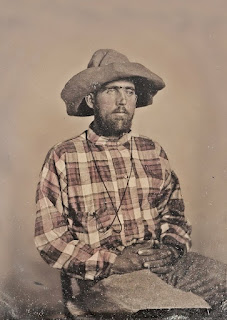
| Cicero Rufus Perry |
Whenever someone comes up to me and says something like, “Your relatives were horse thieves,” I grin and give my shoulders a little shrug. My reply is: “Maybe some of them were, but I love my family anyway,” and that usually shuts them up.
The Texas Rangers have been taking quite a hit lately from qualified historians, the armchair variety, and the sensation seekers, mostly the latter. Whenever I read about their supposed brutality, racism, etc., my response is the same. I love them anyway.
In Texas during the 1800s, there was a group of Indians who loved to steal horses and a group of white men who loved to chase them. Let them hear of a neighbor being scalped, horses stolen, or women and children kidnapped, and they would drop the plow handles so fast the dust didn’t even have time to settle before they would be gone—riding as good and as fast a horse as they could saddle in the race to catch the perpetrators. Most entered into the service of the Texas Rangers at one time or another.
Certainly, the Indians, the women,
the slaves, the children, and the old people who were forced to stay behind and
do the everyday work deserve to have their stories told—but this blog is about
Texas lawmen. And Cicero Rufus Perry was one of those men.
“Old Rufe” as he came to be called, left Alabama and arrived at Bastrop, Texas, in 1833 when
Gen. Edward Burleson

he was 11 years old. Bastrop, situated on the banks of the Colorado River along the Old San Antonio Road, had Indian raids every “light moon.” Indians stole all the Perry horses as soon as they arrived. Consequently, young Rufe developed a case of hero worship for one of the best Indian fighters of the time, Edward Burleson. Burleson later led the Bastrop men in the charge at the Battle of San Jacinto and became vice president of the new Republic of Texas. At one time, he was just about the most popular man in Texas.
Gen. Sam Houston

But whereas Sam Houston was an attention grabber who jumped in front of the camera in showy clothes at every opportunity, Burleson only had his picture taken once, and that was at the insistence of his daughter. He was a down-to-earth man who accepted responsibility but never trampled anybody to get it. Much to the disgust of his longsuffering wife, however, he was always willing to drop everything to pursue Indians.
If Rufus Perry wanted to be an Indian fighter, soldier, and Ranger,
he learned from the best. At age 13, he and
his father were with the other Texican soldiers as they retreated toward San
Jacinto after the fall of the Alamo. Maj. Alexander Somervell approached the
boy—they needed someone to go to Capt. Mosely Baker’s camp at San Felipe some 30
miles away and give him a dispatch from Gen. Houston. He was to burn the town
so the advancing Mexican army couldn’t profit from it. No one else wanted to go.
Would Rufe be afraid to take it?

San Felipe was second only to San Antonio as a commercial center - its destruction upset many Texans. Houston would later claim he never gave the order to burn it, infuriating Capt. Mosely Baker.
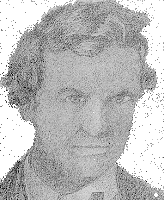
“I toald I woold take it whitch I did” the semi-illiterate Perry
wrote later.
Perry continued to run dispatches for Houston, and after the
Battle of San Jacinto, he joined the Texas Rangers, continuing in that capacity
as a regular and volunteer for the next 40 years, chasing marauding Indians,
Mexican bandits, and thieving outlaws. He first volunteered for duty under Capt.
William W. Hill whose company was attached to Gen. Edward Burleson’s Rangers.
They were all that stood between the settlers returning home and rampaging
Indians emboldened by their evacuation.
While Perry honed his Ranger skills under the tutelage of
Burleson, he was receiving an education about life on the raw frontier. He
watched in disgust as one “desperado” they had riding with them jumped on the
first dead Indian he came to and began stabbing him. Perry remarked wryly, “I
think if hee had of bin a live hee woold have went the other way.” Another
shock came when an old backwoodsman cut the thigh off a dead Indian and tied it
to his saddle, saying he was going to eat it if they did not get anything in
the next few days. Fortunately, they made it to someone’s house, and “got beeaf
and raostinears then wee dun fine.”

It is important to note, according to historian Donaly E. Brice,
that up until the Battle of Plum
Creek in 1840, the fight against Indians in
Texas was a defensive one. Horses would be stolen, people killed or kidnapped,
and then the Rangers would go after them. In 1839, 16-year-old Rufe joined Col.
John Moore’s company of men that included 42 Lipans for an expedition against
the Comanche. At San Saba, they were able to surprise the enemy, and a battle
ensued. Comanche women and children fled wildly into thickets. Andrew Lockhart,
whose daughter had been kidnapped, ran ahead, screaming her name. Although the
men were brave and experienced, the expedition had been poorly planned and
executed. Under a white flag, a parley
was held between the whites and Comanche, with the Lipans translating.

The Comanche tried to bluff the whites with a threat of nearby Shawnee, while the Lipan translator convinced them the whites had no wounded. Badly outnumbered by the Comanche, they agreed to a truce. When they returned to where their horses had been, it was to find that every horse, blanket, and saddle had been stolen. Rufe joined the others in walking the 150 miles home.
This humiliating episode did nothing to dampen Perry’s
fighting spirit, and he continued to serve and scout for the Rangers. In his
memoirs, he talks openly about taking a scalp because a young lady in Bastrop
asked him to bring her back one. “hee fell as tho hee was dead and wee thaught
hee was but when I went to raze his top not hee razed with me I tell was had a
liveley time for a while until oald butch got the best of him.”
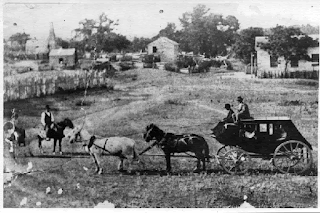
Punch Nash is about to drive his stagecoach across the Colorado River in Bastrop, TX
Perry relates an incident that happened the next day just as
frankly. The Rangers, along with some Lipan Indians, were on the trail of
Comanche, killing two. The Lipans took a woman prisoner. “the way the friendly
Indions did to ceap hur was to Sleap with hur each one evry night as their time
come young Flaceo toald mee to tell Coln Lewis hee and mee could sleap with hur
when thay all went around as he was commander and I interpretor but wee did not
but let them have hur to them selves.”
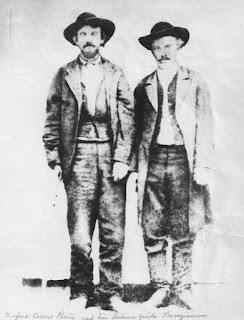
Rufus Perry and his Indian guide Banzincum
In the meantime, an obsessed Santa Anna was unwilling to let Texas go and would continue to send soldiers in attempt after attempt to conquer the Texans, and Perry participated in stopping them. Although the Mexican American War is now deemed unconscionable by some historians, it was the only thing that finally put a halt to Mexico’s invasions into Texas.

After three predatory raids by Mexican soldiers into Texas,
in a political move intended to stop the outcry of settlers, Gen. Houston
allowed Alexander Somervell to lead a raid into Mexico. Perry again joined up,
and as Houston expected, with little equipment and supplies, it showed how
futile a raid into Mexico could be, and it had to be aborted. Perry was one of
the 189 men who obeyed Somervell’s order to return home—308 men disobeyed and
continued on in what became known as the Meir Expedition, leading to
imprisonment and the infamous black bean episode.
Capt. Jack Coffee Hays, a great nephew of Andrew Jackson's wife, was the first to use the Navy Colt Paterson five-shot. He later helped Samuel Walker get to New York so he could meet with Samuel Colt and redesign it into the legendary Colt Walker six-shoot revolver.
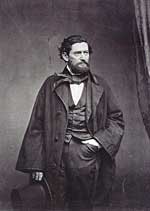
In 1844, Perry joined the legendary John Coffee Hays’s Ranger company and participated in many more Indian battles. On the Nueces River, an incident happened with three other Rangers that was to add Perry’s name to the legend.
The Rangers were on
the trail of horse thieves, and Perry told the other men to camp on a bluff
while he continued a short distance ahead. When he returned, he saw they had
not camped on the bluff, but closer to the river. He told them Indians would
not have camped in such a spot, and he felt they weren’t far off. He rode up a
hill to have a look, but couldn’t see signs of any Indians nearby. He went back
to camp to eat, all the while having a premonition that things were about to go
wrong.
Two of the men went to the river to bathe, but Perry and the
other ranger, Kit Acklin, refused to join them. The men had just shucked off
their clothes when Perry and Acklin were attacked by about 25 Comanche. Perry
received one shot through his left shoulder, all the while firing his five-shooter
at the enemy. He received another shot through his belly, and the third on his
temple, cutting an artery so that he temporarily fainted from loss of blood.
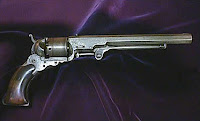 |
| Although the Colt Paterson gave the Rangers an advantage in the field, it had to be disassembled into three pieces before it could be reloaded. |
John Holland Jenkins,
Perry's boyhood friend.
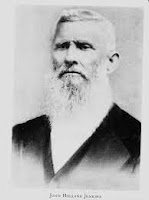
Perry later told his friend and fellow Bastropian John Holland Jenkins that when he came to, he put the gun to his head, considering suicide with the last bullet rather than be taken by the Indians and tortured. But Perry realized he could move, and he was able to join Acklin at the river, and he pulled the arrow out of his shoulder, leaving the spike. Perry caught hold to the tail of one of the horses and got across the river to where the other Rangers were, but he fainted once more. One of the Rangers had taken Perry’s gun to reload it when they were attacked again. Panicking and thinking Perry wouldn’t live anyway, they took his gun and ran off, leaving him and Acklin to the Indians. Perry was able to crawl to a nearby thicket and hide while Acklin made his escape. (Another account has Acklin being much more proactive in helping Perry—only leaving after both agreed that splitting up and going for help separately would be better.)
Perry could hear the Indians talking and walking around the
thicket, but perhaps thinking he was armed, decided to leave him alone, and
they soon left. He stuffed his wounds with dirt and little sticks to staunch
the bleeding, and once it was dark, he crawled on his hands and knees down to
the river for water. It was only about 200 yards, but it took him from dark to
daylight to get there. After getting his fill of water, and filling up his boot
with more, he crawled to a hole left by a fallen tree and stayed there all day.
At nightfall, Perry started for San Antonio on his own. On
the seventh day he reached San Antonio after walking 120 miles with nothing but
three prickly pear apples and a few mesquite beans to sustain him. People
stared at him as if seeing a grisly ghost, for the two Rangers who had taken
the horses and run away had arrived before him, naked and horribly burned from
the sun, telling everyone he and Acklin were dead. Acklin, who wasn’t in nearly
as bad a shape as Perry, made it into San Antonio the next day.
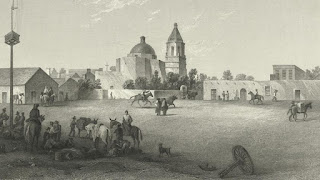 |
| San Antonio as it was a few years after Rufus Perry walked into town, a bloody, swollen mess. |
The women of San Antonio took such good care of Perry, to his
dying day he praised them, two in particular, a Mexican woman he called Madam
Androon, and a German woman named Mrs. Jakes. It took him two years to recover
from his wounds. They counted twenty holes in his clothes where arrows had
pierced them. The optic nerve in his right eye was severed, disfiguring it, and
for the rest of his life, it twitched. He was 22.
While recuperating at home in Bastrop, Perry married a beautiful
young woman described in later years as being somewhat haughty. But Perry must
have been perceived as something of a hero. As soon as he recovered enough to
ride, the people of Bastrop County presented him with a fine horse. He later served
two years in the Mexican War with the Texas Volunteers and afterward served again
with the Rangers, being stationed in the Texas Hill Country. In 1851, he left
Bastrop and began moving ever westward, finally settling in Blanco County.
Although the owner of four slaves, he sidestepped the Civil War, joining the
Confederacy but leading forces in frontier protection, preferring to fight
Indians, not Yankees.
The first time Samuel Walker
went out as a Ranger, he
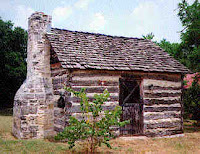
accompanied Rufus Perry.Half of the Perry cabin was restored
and brought to Johnson City, but
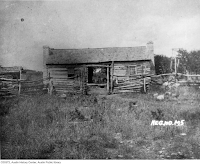
it has since fallen into disrepair.The Perry cabin would have originally
resembled this other Pedernales River cabin.
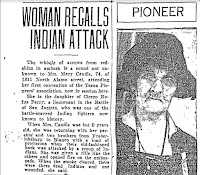 |
| Rufus Perry's daughter said when she was a little girl, they were attacked by Indians on their way home from Fredericksburg. Everyone was handed a rifle, including her and her two brothers. When the smoke cleared, three Indians lay dead and another wounded. |
 |
| Pedernales River - rugged and beautiful. |
The end of the Civil War brought about a social collapse in Texas and a period of unprecedented lawlessness. Not only were there bandits harassing ranchers on the border, Indians harassing citizens on the western and northern frontier, there were former soldiers wandering around, suffering from disillusionment and extreme trauma, falling into outlawry. Other ruffians used the defeat of the South as an excuse to go on crime sprees. When it became clear the U.S. government was only too happy for Texas to suffer for her misdeeds, Governor Richard Coke recommended Texas form her own forces to protect the frontier. When the citizens of Blanco County found out, they requested “Old Rufe” Perry be made captain of Company D, and his approval was soon forthcoming. In 1874, at age 53, he was back in the saddle again, wasting no time in raising a company of 75 men. He immediately put his men out in the field, arming them with shotguns for guard duty, 61 Sharps Carbines, 57 Colt revolvers, and 900 Winchester cartridges for those who carried their own 1873 Winchesters. Capt. Perry organized the fledgling company, getting it off the ground and leading it through skirmishes and battles, but when budget cuts came down from the legislature, he resigned in 1875. By 1881, life as a Ranger as he knew it had changed and passed him by.
 |
| Company D men on the Leona River |
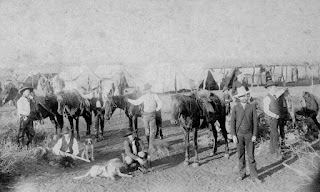 |
| A Ranger camp in the 1870s. |
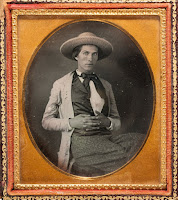
Cicero Rufus Perry began life as a young man full of vigor with a head full of gorgeous dark hair and a dancing gleam in his eyes. Before he died, his face was scarred, with one eye distorted and twitching, and he had to walk with a cane. But he never lost his love of the chase or his sense of humor.

As an old man, he wrote: “when I first wint thair (to Blanco
County), there was Indions nearly evry light moon I was oute verry often but never caught up
with them but once thair was but 2 of us
and 40 of them So wee dun the runing.”
Old Rufe had the courage and the grit, packing as much dangerous
and exciting service into his lifetime as any other Texas Ranger. People who
knew him well liked and respected him. So why isn’t he more famous?
Like his hero Gen. Edward Burleson, Rufus Perry didn’t chase
fame. His near illiteracy also held him back. In an era when men refused to say
the word “bull” around ladies, his frank earthiness didn’t always fit into
polite society. He hadn’t gone off to fight the Yankees with the rest of them,
but stayed to do battle on the frontier.
In addition to those drawbacks, Perry had become involved in
a relationship with a widow who had eight children. How a man, honorable enough
not to participate in the gang rape of an Indian captive on the frontier when very
few people would have ever known about it, managed to get himself entangled in
a public web of having offspring with a widow while still having children with
his wife, is a head-scratching mystery.
But Cicero Rufus Perry never let the opinions of others get
him down. What went on between him, his wife, and his lover, we’ll never know.
When he died, old and feeble, he was not at home in Hye with his wife or in Austin
with the mother of his other children. He was at a neighbor’s ranch, and they
buried him all alone in the Masonic Cemetery in nearby Johnson City, while his
wife, who outlived him by several years, chose to be buried in Hye.
At the time of his death, Rufe Perry’s body showed twenty
scars made from bullets, arrows, and lances in his quest to retrieve stolen
horses, to keep women from being kidnapped and raped, children from being
snatched from homes, and to rescue them when they were. If he stumbled
sometimes in life, it didn’t matter to his friends and neighbors. They
continued to hold him in high esteem.
Perhaps somewhere in another dimension, there are Indians stealing horses with glee from Anglo settlers, and Old Rufe Perry and his fellow Rangers are excitedly saddling up to chase them once again—and neither party gives an owl’s hoot about what we think. And that’s just as it should be.

Sources:
“Memoir
of Capt'n C.R. Perry of Johnson City, Texas: A Texas Veteran” by Cicero Rufus
Perry, edited by Kenneth Kesselus. “Recollections of Early Texas—The Memoirs of
John Holland Jenkins,” edited by John Holmes Jenkins III. “Edward
Burleson—Texas Frontier Leader” by John H. Jenkins and Kenneth Kesselus.
“Moore’s Defeat on the San Saba” Frontier Times Magazine Vol 3 No. 5 February
1926. “One Of Our Texas Queens” Frontier Times Magazine Vol 21 No. 04 - January
1944. “Thrilling Escape of Two of Hays’ Texas Rangers” Frontier Times Magazine
Vol 06 No. 11 - August 1929. “Perry, Cicero Rufus (1822–1898)” Handbook of
Texas Online. “Savage Frontier: 1838-1839” by Stephen L. Moore. “Winchester
Warriors—Texas Rangers of Company D. 1874-1901” by Bob Alexander. “Texas
Rangers—Lives, Legend, and Legacy” by Bob Alexander and Donaly E. Brice. Donaly
E. Brice Speech, November 8, 2019, Bastrop, Texas. Email Exchanges, Lisa D.
Bass, Rufus Perry Cousin, February, 2022.

www.vickyjrose.com www.easyjackson.com

BOOKS
As V.J. Rose
TREASURE HUNT IN TIE TOWN—Reader’s Favorite Five Star
Award
A rancher takes his nephews on an adventurous hunt for buried treasure that lands them in all sorts of trouble. https://www.amazon.com/Treasure-Hunt-Town-V-J-Rose-ebook/dp/B07GL2T2L6/ref=sr_1_1?crid=SFQM7U0AN3FF&keywords=treasure+hunt+in+tie+town&qid=1569773588&s=books&sprefix=treasure+hunt+in%2Cstripbooks%2C201&sr=1-1
TESTIMONY
Two lonely people hide secrets from one another in a May-December
romance set in the modern-day West. https://www.amazon.com/Testimony-V-J-Rose-ebook/dp/B07FBC971J/ref=sr_1_2?crid=SFQM7U0AN3FF&keywords=treasure+hunt+in+tie+town&qid=1569773615&s=books&sprefix=treasure+hunt+in%2Cstripbooks%2C201&sr=1-2
As Easy Jackson
A BAD PLACE TO DIE—Will Rogers Medallion Award and
A SEASON IN HELL
Tennessee Smith becomes the reluctant stepmother of three
rowdy stepsons and the town marshal of Ring Bit, the hell-raisingest town in
Texas. https://www.amazon.com/Bad-Place-Tennessee-Smith-Western/dp/0786042540/ref=tmm_mmp_swatch_0?_encoding=UTF8&qid=1569773439&sr=1-1
MUSKRAT HILL—Peacemaker Finalist
A little boy finds a new respect for his father when he
helps him solve a series of brutal murders in a small Texas town. https://www.amazon.com/Muskrat-Hill-Easy-Jackson/dp/1432866044/ref=sr_1_1?keywords=muskrat+hill+by+easy+jackson&qid=1581181324&s=books&sr=1-1
Short Stories:
WOLFPACK PUBLISHING - "A Promise Broken - A Promise
Kept"—Spur Award Finalist
A woman accused of murder in the Old West is defended by
a mysterious stranger.
A sassy stagecoach
station owner fights off outlaws with the help of a testy, grumpy stranger. A
Will Rogers Medallion Award Winner. https://www.amazon.com/Untamed-West-L-J-Washburn-ebook/dp/B07GH7WB58/ref=sr_1_3?keywords=the+untamed+west+anthology&qid=1569773750&s=books&sr=1-3
UNDER WESTERN STARS - "Blood Epiphany"—Will Rogers Medallion Award
A broke Civil War veteran's wife has left him; his father
and brothers have died leaving him with a cantankerous old uncle, and he's
being beaten by resentful Union soldiers. At the lowest point in his life, he
discovers a way out, along with a new thankfulness. A Will Rogers Medallion
Award Winner.
Seventeen-year-old Dulcie is determined to find someone to drive her cattle to the new market in Abilene. https://www.amazon.com/Six-Gun-Justice-Western-Stories/dp/B09FCCLTHQ/ref=tmm_pap_swatch_0?_encoding=UTF8&qid=&sr=
Reenactment Video on YouTube “Blood in the Streets” https://youtu.be/vrW_uFBGe8Q

WHY COWS NEED COWBOYS: AND OTHER SELDOM-TOLD TALES FROM
THE AMERICAN WEST
“Katie Jennings & John Holland Jenkins: Young Heroes
in the Fight for Texas Independence”


