Showing posts with label texas. Show all posts

Monday, February 21, 2022

Texas Outlaws and Lawmen - Texas Ranger Cicero Rufus Perry by Vicky J. Rose aka Easy Jackson


Cicero Rufus Perry
Cicero Rufus Perry

               Whenever someone comes up to me and says something like, “Your relatives were horse thieves,” I grin and give my shoulders a little shrug. My reply is: “Maybe some of them were, but I love my family anyway,” and that usually shuts them up.

              The Texas Rangers have been taking quite a hit lately from qualified historians, the armchair variety, and the sensation seekers, mostly the latter. Whenever I read about their supposed brutality, racism, etc., my response is the same. I love them anyway.

              In Texas during the 1800s, there was a group of Indians who loved to steal horses and a group of white men who loved to chase them. Let them hear of a neighbor being scalped, horses stolen, or women and children kidnapped, and they would drop the plow handles so fast the dust didn’t even have time to settle before they would be gone—riding as good and as fast a horse as they could saddle in the race to catch the perpetrators.  Most entered into the service of the Texas Rangers at one time or another.

             Certainly, the Indians, the women, the slaves, the children, and the old people who were forced to stay behind and do the everyday work deserve to have their stories told—but this blog is about Texas lawmen. And Cicero Rufus Perry was one of those men.

“Old Rufe” as he came to be called, left Alabama and arrived at Bastrop, Texas, in 1833 when

Gen. Edward Burleson

he was 11 years old. Bastrop, situated on the banks of the Colorado River along the Old San Antonio Road, had Indian raids every “light moon.” Indians stole all the Perry horses as soon as they arrived.  Consequently, young Rufe developed a case of hero worship for one of the best Indian fighters of the time, Edward Burleson. Burleson later led the Bastrop men in the charge at the Battle of San Jacinto and became vice president of the new Republic of Texas. At one time, he was just about the most popular man in Texas.

Gen. Sam Houston

But whereas Sam Houston was an attention grabber who jumped in front of the camera in showy clothes at every opportunity, Burleson only had his picture taken once, and that was at the insistence of his daughter. He was a down-to-earth man who accepted responsibility but never trampled anybody to get it. Much to the disgust of his longsuffering wife, however, he was always willing to drop everything to pursue Indians.

If Rufus Perry wanted to be an Indian fighter, soldier, and Ranger, he learned from the best.  At age 13, he and his father were with the other Texican soldiers as they retreated toward San Jacinto after the fall of the Alamo. Maj. Alexander Somervell approached the boy—they needed someone to go to Capt. Mosely Baker’s camp at San Felipe some 30 miles away and give him a dispatch from Gen. Houston. He was to burn the town so the advancing Mexican army couldn’t profit from it. No one else wanted to go. Would Rufe be afraid to take it?


San Felipe was second only to San Antonio as a commercial center  - its destruction upset many Texans. Houston would later claim he never gave the order to burn it, infuriating Capt. Mosely Baker.

“I toald I woold take it whitch I did” the semi-illiterate Perry wrote later.

Perry continued to run dispatches for Houston, and after the Battle of San Jacinto, he joined the Texas Rangers, continuing in that capacity as a regular and volunteer for the next 40 years, chasing marauding Indians, Mexican bandits, and thieving outlaws. He first volunteered for duty under Capt. William W. Hill whose company was attached to Gen. Edward Burleson’s Rangers. They were all that stood between the settlers returning home and rampaging Indians emboldened by their evacuation.

While Perry honed his Ranger skills under the tutelage of Burleson, he was receiving an education about life on the raw frontier. He watched in disgust as one “desperado” they had riding with them jumped on the first dead Indian he came to and began stabbing him. Perry remarked wryly, “I think if hee had of bin a live hee woold have went the other way.” Another shock came when an old backwoodsman cut the thigh off a dead Indian and tied it to his saddle, saying he was going to eat it if they did not get anything in the next few days. Fortunately, they made it to someone’s house, and “got beeaf and raostinears then wee dun fine.”

It is important to note, according to historian Donaly E. Brice, that up until the Battle of Plum
Creek in 1840, the fight against Indians in Texas was a defensive one. Horses would be stolen, people killed or kidnapped, and then the Rangers would go after them. In 1839, 16-year-old Rufe joined Col. John Moore’s company of men that included 42 Lipans for an expedition against the Comanche. At San Saba, they were able to surprise the enemy, and a battle ensued. Comanche women and children fled wildly into thickets. Andrew Lockhart, whose daughter had been kidnapped, ran ahead, screaming her name. Although the men were brave and experienced, the expedition had been poorly planned and executed.  Under a white flag, a parley was held between the whites and Comanche, with the Lipans translating. 

           The Comanche tried to bluff the whites with a threat of nearby Shawnee, while the Lipan translator convinced them the whites had no wounded. Badly outnumbered by the Comanche, they agreed to a truce. When they returned to where their horses had been, it was to find that every horse, blanket, and saddle had been stolen. Rufe joined the others in walking the 150 miles home.  

This humiliating episode did nothing to dampen Perry’s fighting spirit, and he continued to serve and scout for the Rangers. In his memoirs, he talks openly about taking a scalp because a young lady in Bastrop asked him to bring her back one. “hee fell as tho hee was dead and wee thaught hee was but when I went to raze his top not hee razed with me I tell was had a liveley time for a while until oald butch got the best of him.”

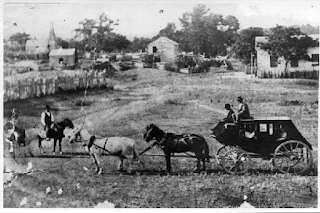
Punch Nash is about to drive his stagecoach across the Colorado River in Bastrop, TX

   
       Perry relates an incident that happened the next day just as frankly. The Rangers, along with some Lipan Indians, were on the trail of Comanche, killing two. The Lipans took a woman prisoner. “the way the friendly Indions did to ceap hur was to Sleap with hur each one evry night as their time come young Flaceo toald mee to tell Coln Lewis hee and mee could sleap with hur when thay all went around as he was commander and I interpretor but wee did not but let them have hur to them selves.”
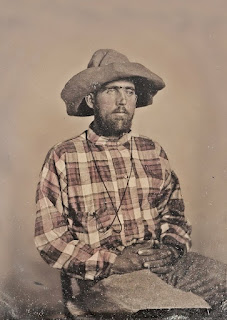
Rufus Perry and his Indian guide Banzincum
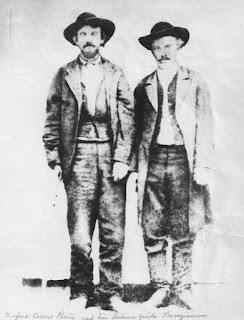
In the meantime, an obsessed Santa Anna was unwilling to let Texas go and would continue to send soldiers in attempt after attempt to conquer the Texans, and Perry participated in stopping them. Although the Mexican American War is now deemed unconscionable by some historians, it was the only thing that finally put a halt to Mexico’s invasions into Texas.


After three predatory raids by Mexican soldiers into Texas, in a political move intended to stop the outcry of settlers, Gen. Houston allowed Alexander Somervell to lead a raid into Mexico. Perry again joined up, and as Houston expected, with little equipment and supplies, it showed how futile a raid into Mexico could be, and it had to be aborted. Perry was one of the 189 men who obeyed Somervell’s order to return home—308 men disobeyed and continued on in what became known as the Meir Expedition, leading to imprisonment and the infamous black bean episode.

Capt. Jack Coffee Hays, a great nephew of Andrew Jackson's wife, was the first to use the Navy Colt Paterson five-shot. He later helped Samuel Walker get to New York so he could meet with Samuel Colt and redesign it into the legendary Colt Walker six-shoot revolver.
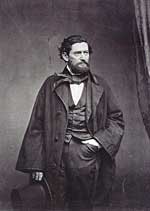
             In 1844, Perry joined the legendary John Coffee Hays’s Ranger company and participated in many more Indian battles. On the Nueces River, an incident happened with three other Rangers that was to add Perry’s name to the legend.

 The Rangers were on the trail of horse thieves, and Perry told the other men to camp on a bluff while he continued a short distance ahead. When he returned, he saw they had not camped on the bluff, but closer to the river. He told them Indians would not have camped in such a spot, and he felt they weren’t far off. He rode up a hill to have a look, but couldn’t see signs of any Indians nearby. He went back to camp to eat, all the while having a premonition that things were about to go wrong.

Two of the men went to the river to bathe, but Perry and the other ranger, Kit Acklin, refused to join them. The men had just shucked off their clothes when Perry and Acklin were attacked by about 25 Comanche. Perry received one shot through his left shoulder, all the while firing his five-shooter at the enemy. He received another shot through his belly, and the third on his temple, cutting an artery so that he temporarily fainted from loss of blood.
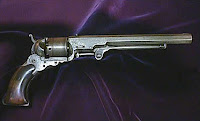
Although the Colt Paterson gave the Rangers an advantage in the field, it had to be disassembled into three pieces before it could be reloaded.

John Holland Jenkins,
Perry's boyhood friend.
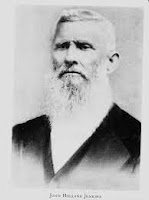
 

Perry later told his friend and fellow Bastropian John Holland Jenkins that when he came to, he put the gun to his head, considering suicide with the last bullet rather than be taken by the Indians and tortured. But Perry realized he could move, and he was able to join Acklin at the river, and he pulled the arrow out of his shoulder, leaving the spike. Perry caught hold to the tail of one of the horses and got across the river to where the other Rangers were, but he fainted once more. One of the Rangers had taken Perry’s gun to reload it when they were attacked again. Panicking and thinking Perry wouldn’t live anyway, they took his gun and ran off, leaving him and Acklin to the Indians. Perry was able to crawl to a nearby thicket and hide while Acklin made his escape. (Another account has Acklin being much more proactive in helping Perry—only leaving after both agreed that splitting up and going for help separately would be better.)


Perry could hear the Indians talking and walking around the thicket, but perhaps thinking he was armed, decided to leave him alone, and they soon left. He stuffed his wounds with dirt and little sticks to staunch the bleeding, and once it was dark, he crawled on his hands and knees down to the river for water. It was only about 200 yards, but it took him from dark to daylight to get there. After getting his fill of water, and filling up his boot with more, he crawled to a hole left by a fallen tree and stayed there all day.

At nightfall, Perry started for San Antonio on his own. On the seventh day he reached San Antonio after walking 120 miles with nothing but three prickly pear apples and a few mesquite beans to sustain him. People stared at him as if seeing a grisly ghost, for the two Rangers who had taken the horses and run away had arrived before him, naked and horribly burned from the sun, telling everyone he and Acklin were dead. Acklin, who wasn’t in nearly as bad a shape as Perry, made it into San Antonio the next day.
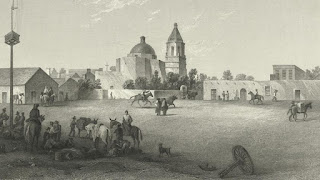
San Antonio as it was a few years after Rufus Perry walked into town, a bloody, swollen mess.

The women of San Antonio took such good care of Perry, to his dying day he praised them, two in particular, a Mexican woman he called Madam Androon, and a German woman named Mrs. Jakes. It took him two years to recover from his wounds. They counted twenty holes in his clothes where arrows had pierced them. The optic nerve in his right eye was severed, disfiguring it, and for the rest of his life, it twitched. He was 22.

While recuperating at home in Bastrop, Perry married a beautiful young woman described in later years as being somewhat haughty. But Perry must have been perceived as something of a hero. As soon as he recovered enough to ride, the people of Bastrop County presented him with a fine horse. He later served two years in the Mexican War with the Texas Volunteers and afterward served again with the Rangers, being stationed in the Texas Hill Country. In 1851, he left Bastrop and began moving ever westward, finally settling in Blanco County. Although the owner of four slaves, he sidestepped the Civil War, joining the Confederacy but leading forces in frontier protection, preferring to fight Indians, not Yankees.  

The first time Samuel Walker
went out as a Ranger, he
accompanied Rufus Perry.


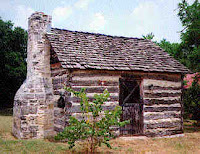
Half of the Perry cabin was restored
and brought to Johnson City, but
it has since fallen into disrepair.
 
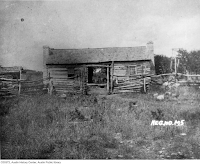
The Perry cabin would have originally
resembled this other Pedernales River cabin.


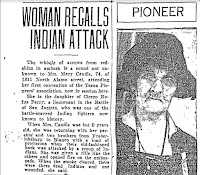
Rufus Perry's daughter said 
when she was a little girl, they were
attacked by Indians on their way
home from Fredericksburg. Everyone 
was handed a rifle, including her
and her two brothers. When the smoke
cleared, three Indians lay dead and
another wounded.

Pedernales River - rugged and beautiful.


The end of the Civil War brought about a social collapse in Texas and a period of unprecedented lawlessness. Not only were there bandits harassing ranchers on the border, Indians harassing citizens on the western and northern frontier, there were former soldiers wandering around, suffering from disillusionment and extreme trauma, falling into outlawry. Other ruffians used the defeat of the South as an excuse to go on crime sprees. When it became clear the U.S. government was only too happy for Texas to suffer for her misdeeds, Governor Richard Coke recommended Texas form her own forces to protect the frontier. When the citizens of Blanco County found out, they requested “Old Rufe” Perry be made captain of Company D, and his approval was soon forthcoming. In 1874, at age 53, he was back in the saddle again, wasting no time in raising a company of 75 men.  He immediately put his men out in the field, arming them with shotguns for guard duty, 61 Sharps Carbines, 57 Colt revolvers, and 900 Winchester cartridges for those who carried their own 1873 Winchesters. Capt. Perry organized the fledgling company, getting it off the ground and leading it through skirmishes and battles, but when budget cuts came down from the legislature, he resigned in 1875.  By 1881, life as a Ranger as he knew it had changed and passed him by.

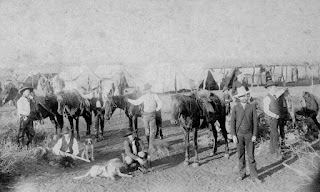
Company D men on the Leona River

A Ranger camp in the 1870s.


             Cicero Rufus Perry began life as a young man full of vigor with a head full of gorgeous dark hair and a dancing gleam in his eyes. Before he died, his face was scarred, with one eye distorted and twitching, and he had to walk with a cane. But he never lost his love of the chase or his sense of humor.


As an old man, he wrote: “when I first wint thair (to Blanco County), there was Indions nearly evry light moon  I was oute verry often but never caught up with them but once  thair was but 2 of us and 40 of them So wee dun the runing.”

Old Rufe had the courage and the grit, packing as much dangerous and exciting service into his lifetime as any other Texas Ranger. People who knew him well liked and respected him. So why isn’t he more famous?

Like his hero Gen. Edward Burleson, Rufus Perry didn’t chase fame. His near illiteracy also held him back. In an era when men refused to say the word “bull” around ladies, his frank earthiness didn’t always fit into polite society. He hadn’t gone off to fight the Yankees with the rest of them, but stayed to do battle on the frontier.

In addition to those drawbacks, Perry had become involved in a relationship with a widow who had eight children. How a man, honorable enough not to participate in the gang rape of an Indian captive on the frontier when very few people would have ever known about it, managed to get himself entangled in a public web of having offspring with a widow while still having children with his wife, is a head-scratching mystery.  

But Cicero Rufus Perry never let the opinions of others get him down. What went on between him, his wife, and his lover, we’ll never know. When he died, old and feeble, he was not at home in Hye with his wife or in Austin with the mother of his other children. He was at a neighbor’s ranch, and they buried him all alone in the Masonic Cemetery in nearby Johnson City, while his wife, who outlived him by several years, chose to be buried in Hye.

At the time of his death, Rufe Perry’s body showed twenty scars made from bullets, arrows, and lances in his quest to retrieve stolen horses, to keep women from being kidnapped and raped, children from being snatched from homes, and to rescue them when they were. If he stumbled sometimes in life, it didn’t matter to his friends and neighbors. They continued to hold him in high esteem.

Perhaps somewhere in another dimension, there are Indians stealing horses with glee from Anglo settlers, and Old Rufe Perry and his fellow Rangers are excitedly saddling up to chase them once again—and neither party gives an owl’s hoot about what we think.  And that’s just as it should be. 


Sources:

“Memoir of Capt'n C.R. Perry of Johnson City, Texas: A Texas Veteran” by Cicero Rufus Perry, edited by Kenneth Kesselus. “Recollections of Early Texas—The Memoirs of John Holland Jenkins,” edited by John Holmes Jenkins III. “Edward Burleson—Texas Frontier Leader” by John H. Jenkins and Kenneth Kesselus. “Moore’s Defeat on the San Saba” Frontier Times Magazine Vol 3 No. 5 February 1926. “One Of Our Texas Queens” Frontier Times Magazine Vol 21 No. 04 - January 1944. “Thrilling Escape of Two of Hays’ Texas Rangers” Frontier Times Magazine Vol 06 No. 11 - August 1929. “Perry, Cicero Rufus (1822–1898)” Handbook of Texas Online. “Savage Frontier: 1838-1839” by Stephen L. Moore. “Winchester Warriors—Texas Rangers of Company D. 1874-1901” by Bob Alexander. “Texas Rangers—Lives, Legend, and Legacy” by Bob Alexander and Donaly E. Brice. Donaly E. Brice Speech, November 8, 2019, Bastrop, Texas. Email Exchanges, Lisa D. Bass, Rufus Perry Cousin, February, 2022.


www.vickyjrose.com www.easyjackson.com


BOOKS

As V.J. Rose 

TREASURE HUNT IN TIE TOWN—Reader’s Favorite Five Star Award

A rancher takes his nephews on an adventurous hunt for buried treasure that lands them in all sorts of trouble. https://www.amazon.com/Treasure-Hunt-Town-V-J-Rose-ebook/dp/B07GL2T2L6/ref=sr_1_1?crid=SFQM7U0AN3FF&keywords=treasure+hunt+in+tie+town&qid=1569773588&s=books&sprefix=treasure+hunt+in%2Cstripbooks%2C201&sr=1-1 

TESTIMONY

Two lonely people hide secrets from one another in a May-December romance set in the modern-day West. https://www.amazon.com/Testimony-V-J-Rose-ebook/dp/B07FBC971J/ref=sr_1_2?crid=SFQM7U0AN3FF&keywords=treasure+hunt+in+tie+town&qid=1569773615&s=books&sprefix=treasure+hunt+in%2Cstripbooks%2C201&sr=1-2 

As Easy Jackson 

A BAD PLACE TO DIE—Will Rogers Medallion Award and A SEASON IN HELL

Tennessee Smith becomes the reluctant stepmother of three rowdy stepsons and the town marshal of Ring Bit, the hell-raisingest town in Texas. https://www.amazon.com/Bad-Place-Tennessee-Smith-Western/dp/0786042540/ref=tmm_mmp_swatch_0?_encoding=UTF8&qid=1569773439&sr=1-1

https://www.amazon.com/Season-Hell-Tennessee-Smith-Western/dp/0786042567/ref=pd_sbs_14_1/132-7644810-2844345?_encoding=UTF8&pd_rd_i=0786042567&pd_rd_r=f5f73ea9-df93-46e7-b002-87cd61097ca1&pd_rd_w=xTzD8&pd_rd_wg=OsUzo&pf_rd_p=d66372fe-68a6-48a3-90ec-41d7f64212be&pf_rd_r=FDF2CTCM49RMWFJ0WXXC&psc=1&refRID=FDF2CTCM49RMWFJ0WXXC

MUSKRAT HILL—Peacemaker Finalist

A little boy finds a new respect for his father when he helps him solve a series of brutal murders in a small Texas town. https://www.amazon.com/Muskrat-Hill-Easy-Jackson/dp/1432866044/ref=sr_1_1?keywords=muskrat+hill+by+easy+jackson&qid=1581181324&s=books&sr=1-1

Short Stories: 

WOLFPACK PUBLISHING - "A Promise Broken - A Promise Kept"—Spur Award Finalist

A woman accused of murder in the Old West is defended by a mysterious stranger.

https://www.amazon.com/Promise-Broken-Kept-Western-Short-ebook/dp/B07CYP3G3P/ref=sr_1_1?keywords=a+promise+broken+a+promise+kept+by+VJ+Rose&qid=1569773655&s=books&sr=1-1

 THE UNTAMED WEST – “A Sweet-Talking Man” —Will Rogers Medallion Award

 A sassy stagecoach station owner fights off outlaws with the help of a testy, grumpy stranger. A Will Rogers Medallion Award Winner. https://www.amazon.com/Untamed-West-L-J-Washburn-ebook/dp/B07GH7WB58/ref=sr_1_3?keywords=the+untamed+west+anthology&qid=1569773750&s=books&sr=1-3

UNDER WESTERN STARS - "Blood Epiphany"—Will Rogers Medallion Award

A broke Civil War veteran's wife has left him; his father and brothers have died leaving him with a cantankerous old uncle, and he's being beaten by resentful Union soldiers. At the lowest point in his life, he discovers a way out, along with a new thankfulness. A Will Rogers Medallion Award Winner.

https://www.amazon.com/Under-Western-Stars-Richard-Prosch/dp/B08KH3S2KR/ref=tmm_pap_swatch_0?_encoding=UTF8&qid=&sr=

 SIX-GUN JUSTICE WESTERN STORIES – “Dulcie’s Reward”

Seventeen-year-old Dulcie is determined to find someone to drive her cattle to the new market in Abilene. https://www.amazon.com/Six-Gun-Justice-Western-Stories/dp/B09FCCLTHQ/ref=tmm_pap_swatch_0?_encoding=UTF8&qid=&sr=


Reenactment Video on YouTube “Blood in the Streets”  https://youtu.be/vrW_uFBGe8Q


 Anthology:

WHY COWS NEED COWBOYS: AND OTHER SELDOM-TOLD TALES FROM THE AMERICAN WEST

“Katie Jennings & John Holland Jenkins: Young Heroes in the Fight for Texas Independence”

https://www.amazon.com/Why-Cows-Need-Cowboys-Seldom-Told-ebook/dp/B08YWJDGZ8/ref=sr_1_1?crid=2S1C6UIQO4IZ9&keywords=why+cows+need+cowboys&qid=1645144537&s=books&sprefix=why+cows+%2Cstripbooks%2C110&sr=1-1


Monday, December 14, 2015

‘You Take that Back!’ — Texas Feuds


By Kathleen Rice Adams

The notorious Hatfield clan, 1897
Although lesser known than the notorious Hatfield-McCoy fracas that claimed about a dozen lives along the West Virginia-Kentucky state line between 1865 and 1888, six and a half of the ten bloodiest American feuds took place in Texas.

Yes, six and a half. Just hold your horses and I’ll explain.

Two of Texas’s feuds were deadlier than the quarrel between the Hatfields and McCoys, and most of them erupted over a bigger insult than laying claim to a wayward pig.

In ascending order of body count, the feuds were…

Early vs. Hasley, 1865-69

Sam Hasley did not take it well when he returned from fighting for the Confederacy to discover his elderly father had been roughed up by a member of the Union occupation force sent to keep order in Texas during Reconstruction. Hasley vowed vengeance not only upon the culprit, John Early, but also on every other Federal in Bell County. He and the friends and family who gathered around him openly defied the authorities, leading the Early faction to accuse Hasley’s group of any crime of any kind anywhere in the vicinity. Yankee soldiers ambushed and killed one of the Hasley contingent in mid-1869, effectively disbanding the gang. One rogue member, however, pursued one of Early’s friends into Arkansas and killed him later that year. Sam Hasley went on to become a deputy sheriff. In 1889, drunk on duty, he was shot and killed by a deputy city marshal while resisting arrest in Temple, Texas. Body count: two.

Reese vs. Townsend, 1898-1907

A plantation house in Columbus, Texas, ca. 1840
The Reeses and the Townsends got crossways over politics. U.S. Senator Mark Townsend, the Boss Tweed of Columbus, Texas, withdrew his support from incumbent sheriff Sam Reese and threw his considerable political clout behind former deputy Larkin Hope instead. When Hope ended up on the wrong end of a broad daylight assassination in downtown Columbus, Reese was the most likely suspect, though no evidence surfaced. Townsend’s handpicked replacement won the election. Perturbed by the unanticipated turn of events, Reese picked a gunfight with a Townsend supporter, thereby moving out of politics and into a casket. The former sheriff’s family vowed to avenge him, provoking five shootouts in Columbus over the following six years. Four combatants died, including Sam Reese’s brother Dick. Body count: six.

Horrell vs. Higgins, 1874-1877

Lampasas, Texas, ca. 1882
When the five Horrell brothers—Ben, Mart, Tom, Merritt, and Sam—took it on the lam to Lincoln County, New Mexico, in order to avoid a murder rap in Texas, they probably didn’t plan to leave one of their number under six feet of dirt before scrambling back to Lampasas barely ahead of a posse. They fared no better in their hometown, running afoul of former friend and neighbor John “Pink” Higgins right away. Higgins accused the high-spirited Horrell boys of rustling cattle…and that’s when the trouble started. A jury acquitted the Horrells of all charges, but continuing ill will led to Merritt Horrell’s death at Higgins’s hand during a saloon fight. Folks lined up behind both families, swore to wipe the opposing faction from the face of the planet, and set about their task with admirable devotion. By the time the Texas Rangers put an end to the running gun battles in June 1877, four men were dead, dozens more were injured, and the three remaining Horrell brothers were behind bars. Although they were released in short order, two of the three were arrested on suspicion of murdering a shopkeeper less than a year later. A vigilante gang shot them to death in their jail cells. The feud ended when both sides signed a written promise to leave one another alone. Amazingly, they kept their word. Body count: seven.

Boyce vs. Sneed, 1911-1912

1912 New York Times report
about the Boyce-Sneed
disagreement. (Click to read.)
Wealthy ranchers John Beal Sneed and Albert Boyce, Jr. came to blows over Sneed’s wife. After more than a decade of marriage and two children, in 1911 Lena Sneed admitted to having an affair with Boyce and asked for a divorce. Sneed straightaway had her committed to an asylum. Boyce rescued the damsel in distress, and the couple ran off to Canada. Incensed when kidnapping charges were dropped, Sneed upped the ante: In early 1912, he murdered Boyce’s unarmed father in the lobby of a Fort Worth hotel. Widely publicized court proceedings ended in a mistrial, spurring a mob of Boyce supporters to storm the courthouse and kill four men. Sneed’s father was the next to go, in an alleged murder-suicide. Although John and Lena Sneed reconciled in mid-1912, he could not let the insult go: Wearing a disguise, he shot and killed Boyce in broad daylight on a Fort Worth street and then surrendered at the county courthouse. Juries later acquitted Sneed of all charges, calling the killings justifiable homicide. Body count: eight.

Sutton vs. Taylor, 1866-1877

former Texas Ranger Creed Taylor, ca. 1880
Dewitt County Deputy Sheriff William Sutton set off the longest-lasting and most widespread feud in Texas history when, in three separate 1866 incidents, he shot and killed three members of former Texas Ranger Creed Taylor’s family. In 1867, two more Taylors died while Sutton was attempting to arrest them on a minor charge. After adopting the motto “Who sheds a Taylor’s blood, by a Taylor’s hand must fall,” the Taylors retaliated by killing two Sutton allies. Mob violence, ambushes, prison breaks, and lynchings ensued. Sutton himself was gunned down while attempting to board a steamboat and high-tail it out of the area. After numerous attempts at peacemaking failed, Texas Ranger Captain Leander McNelly and his Special Force put a stop to the violence. Body count: at least 35.

Lee vs. Peacock, 1866-1871

Fighting Over a Stolen Herd, Frederic Remington, 1895
Only Arizona’s Pleasant Valley War, which took the lives of twenty to fifty men between 1887 and 1892, outstripped the Lee-Peacock feud of northeast Texas. Like the Early-Hasley dustup, the Lee-Peacock fandango grew out of lingering animosity over the Civil War. Confederate veteran Bob Lee butted heads with an organization of Union supporters, leading Lewis Peacock, the leader of the Union bunch, to round up a posse and arrest Lee for alleged war crimes. To “settle the charges,” Peacock seized Lee’s valuables and exacted a promissory note for $2,000. Lee won a subsequent lawsuit, earning an assassination attempt along with the money. His doctor was murdered while Lee convalesced in the medic’s home. Thereafter, Northeast Texas fractured along Union-Confederacy lines and bands of armed men proceeded to track down and do away with their ideological opponents. The Fourth United States Cavalry’s arrival to end the fracas only made things worse: Although a house-to-house search failed to turn up Lee, it sparked several more gun battles. Lee was betrayed by one of his own men in 1869 and died during the cavalry’s attempt to arrest him. Fighting continued until Peacock’s shooting death in 1871. Body count: about fifty.

And now for the one-half Texas feud…

Brooks vs. McFarland, 1896-1902

Although most of the violence took place on Oklahoma land belonging the Creek Nation, a fatal attempt to rob a former Texas Ranger started the fight. After would-be robber Thomas Brooks was killed, family patriarch Willis Brooks accused neighbor Jim McFarland of planning the unsuccessful crime and then tipping off the Ranger. Not disposed to sit idly by and watch the family name besmirched, the McFarlands lined up behind Jim and faced off with the Brooks clan. Both sides vowed to shoot members of the other on sight. The conflict came to a head in a Spokogee, Oklahoma, gunfight in September 1902, when Willis Brooks and his son Clifton were killed along with a McFarland family ally. The survivors were arrested, but allowing them to make bail may have been a mistake: One month later, Jim McFarland died in an ambush at his home. McFarland’s death put an end to the feud.


A Texan to the bone, Kathleen Rice Adams spends her days chasing news stories and her nights and weekends shooting it out with Wild West desperados. Leave the upstanding, law-abiding heroes to other folks. In Kathleen’s stories, even the good guys wear black hats.

Her short story “The Second-Best Ranger in Texas” won the coveted 2015 Peacemaker Award for Best Western Short Fiction. Her novel
Prodigal Gun received a 2015 Peacemaker nomination for Best First Western Novel.

Visit her hideout on the web at KathleenRiceAdams.com.


Monday, April 13, 2015

Wild West Words: Outside the Law


Thomas Mitchell, Jack Buetel, and Walter Huston in
The Outlaw (HowardHughesProductions, 1941)
By Kathleen Rice Adams

The American West provided fertile ground for mangling the English language. I suppose that shouldn’t surprise anyone. After all, when folks weren’t shooting it out, rounding up ornery cattle, protecting their scalps, or gambling, they had to fill the empty hours somehow.

Some Old West words and phrases represented modifications to the meaning of existing terms. Others arose from mispronunciation. Quite a few someone simply made up. Many remain in use today, though sometimes only in regional dialect.

Some of the following terms applied to outlaws and outlawry are older than one might imagine. Western authors may be dismayed to find others are newer than they hoped.


Buscadero: gunfighter. From the Spanish buscadero, literally a searcher. The origin of the slang usage is obscure; possibly “seeking trouble.”

Bushwhacker: cowardly enemy who strikes from ambush. Americanism; arose c. 1809. Oddly, the verb “bushwhack” arose later, c. 1837. During the American Civil War (at least from 1862-1865), “bushwhacker” acquired a less-pejorative connotation, meaning any irregular who took to the woods to strike from cover and then vanish. The term was applied in equal measure to both friend and foe.

Release flier for The Law
and the Outlaw
, 1913
CabrĂ³n: an outlaw of low breeding and even lower principles. In Spanish, the word means “goat.” Origin of the slang usage is obscure.

Cold-blooded: unfeeling, dispassionate, cruel. Arose c. 1828 from the old (1600s) notion that excitement increased human blood temperature. Reptiles have been called cold-blooded since about 1600, and the reptilian image also played into the description as applied to killers and other reprehensible sorts who acted without apparent regret.

Cold lead: from the mid-1800s until the 1920s, a bullet. About 1920, usage changed and “hot lead” became slang for bullets. The reason is unclear.

Cowboy of the Pecos: rustler, based on the notion safety could be found in the lawless area around Texas’ Pecos River.

Dressed to kill: double entendre meaning not only that a man wearing two guns most likely was a killer, but also that wearing a double rig (a holstered pistol on each hip) made it difficult for a gunman to do anything with either hand without implying a threat; therefor, dudes who adopted the practice were likely to be killed.

Dry-gulch: to ambush someone, particularly in a cowardly manner.

Get the drop on: to obtain a marked advantage, especially with the help of a gun. Probably dates to the California gold rush of 1849, when claim-jumpers sometimes seemed to materialize from the ether before hijacking a profitable claim at gunpoint. First documented appearance in print 1869 in Alexander K. McClure’s Three Thousand Miles through the Rocky Mountains: “So expert is he with his faithful pistol, that the most scientific of rogues have repeatedly attempted in vain to get ‘the drop’ on him.”

GTT: on the wrong side of the law. Short for "gone to Texas," this usage dates at least to the Civil War, when deserters and other former soldiers from both armies — suddenly unemployed and inured to violence — migrated to still-wild, wide-open Texas, “lost” their names, and took up outlawry. (Originally, “Gone to Texas” was the phrase families ruined by the financial panic of 1819 painted on doors and fence signs before lighting out to begin anew in greener pastures south of the Mexican border.) In his 1857 book Journey through Texas, Frederick Law Olmstead noted that many newcomers to the state were suspected of having skipped out on something “discreditable” back home. Thomas Hughes, in his 1884 book G.T.T., wrote “When we want to say that it is all up with some fellow, we just say, ‘G.T.T.’ as you’d say, ‘gone to the devil,’ or ‘gone to the dogs.’”

Days on the Range (Hands Up!)
by Frederic Remington
Gun: until the early 20th Century, cannon or long guns like shotguns and rifles. Handguns were called pistols or — after Samuel Colt introduced his first patented repeating revolver in 1836 — six-guns or six-shooters.

Gunman: shootist; gunfighter. First recorded use 1903 in a New York newspaper. (Gunsman, with an S in the middle, arose on the American frontier during the Revolutionary period.)

Gun shark: gunfighter. Arose mid-1800s from the earlier (1700s) use of “shark” to indicate a voracious or predatory person, based on the reputation of the fish.

Heeled up: armed. Arose ca. 1866 from the 1560s usage of “heel” to mean attaching spurs to a gamecock’s feet.

Hogleg: large revolver. Originally referred to the Bisley single-action Colt (first manufactured 1894), but later generalized to any big pistol.

Holdup: a robbery. American English colloquialism, 1851. The verb “to hold up,” meaning “to stop by force and rob,” didn’t arise until 1887, apparently from the robbers’ command to raise hands. “Hold up,” meaning to delay, dates to 1837.

Hustler: thief, especially one who roughs up his victims. Arose 1825. Sense of “energetic worker” is from 1884; sense of “prostitute” dates from 1924.

Lam: to run off. U.S. slang dating to 1886; of uncertain origin. “On the lam,” meaning flight to avoid prosecution or consequences, arose c. 1897.

On the cuidado:
running from the law. From the Spanish warning ten cuidado, which means “be careful.”

Owlhoot: outlaw. “Riding the owlhoot trail” referred to a man who had left the straight and narrow to become an outlaw. One explanation of origin came from a man living in the Indian Territory of eastern Oklahoma around 1870. He claimed the name came about from the Indians in the area using owl hoots to signal danger or someone’s approach. Another tale indicates outlaws were called “owlhoots” because, when they were getting ready to ambush somebody in the dark, they would imitate the hooting of owls to signal one another.

Jesse James' Oath, or Tracked to Death by W.B.
Lawson (Street & Smith Publishers, Dec. 1897)
Pecos swap: theft. Again, based on the reputation of Texas’s Pecos River area.

Pistolero: expert with a handgun. Adopted from Mexican Spanish, in which the word has the same meaning.

Rattlesnaked:
ambushed (literally or figuratively) in a particularly devious or cunning way. Dates at least to 1818.

Safecracker (also safe-cracker): individual with a talent for liberating money from locked vaults. Arose ca. 1897, as a reference to robbers who used dynamite to thwart security boxes.

Shootist: expert marksman. Arose 1864.

Sidewinder:
dangerously cunning or devious person. Arose American West ca. 1875 as a reference to some species of rattlesnakes’ “peculiar lateral movement.”

Stickup:
robbery at gunpoint. Arose 1887 from the earlier (1846) verb “stick up,” meaning to rob someone at gunpoint. The phrase “stick up for,” meaning defend, is from 1823. The archaic noun “stick-up” arose ca. 1857 as a colloquial term for a stand-up collar.


A Texan to the bone, Kathleen Rice Adams spends her days chasing news stories and her nights and weekends shooting it out with Wild West desperados. Leave the upstanding, law-abiding heroes to other folks. In Kathleen’s stories, even the good guys wear black hats. Vist her home on the range at HoleInTheWebGang.com.


Thursday, September 18, 2014

Two Cowboys, Two Sisters, Two Crazy Authors: MAIL-ORDER TANGLE #NewRelease #western #romance


The Birth of 
by Jacquie Rogers

What would you do if you had a chance to work with one of your most favorite authors? Jump at the chance, that’s what! And I even got to talk to her on the phone.

Caroline Clemmons
I’m talking about Caroline Clemmons, who wrote the first book of Mail-Order Tangle, about Ellie and Kage, Mail-Order Promise. I wrote Laura and Matt’s story in the second book, Mail-Order Ruckus. I’m going to let you in on some of our early notes.

We already knew that whatever idea we had, Caroline would set her story in Texas and I’d set mine in Owyhee County, Idaho Territory. But that’s pretty much all we knew. Neither of us had characters or any sort of plot in mind. We had several ideas, none of which hit us as the right one. Truth is, I’m not sure who came up with the two cousins and two sisters idea, but I think it was a result of our conversations about how to connect the stories. We’d thought about twin heroes, or stories connected by the heroes’ jobs. Several ideas were batted back and forth.

But in the end, cousins Kage and Matt marrying sisters, Ellie and Laura, won the race. Once those characters showed up, we knew they were the ones. Writers have to fall in love with their characters—Caroline and I were both in love with Kage and Matt immediately. Ellie and Laura took a little longer to form but we love them no less.

First, we had to decide when the stories would be set. Here’s what Caroline said: “What year are we talking about? I was thinking around 1870 – 1873, but I write 1870 – 1890s, ...so I’ll to defer to you there. I’m happy with any date in the above time frame of 1870 - 1890.” I split the difference and chose 1880. We had to have a year when ranching was relatively well established in Owyhee County. Most of the ranches were started in the 1870s to feed the miners in Silver City, and since the Johanssens had been there three years before Caroline’s story started, 1880 was just about right. Texas, of course, was no problem in that regard, since ranching had been established by the Spaniards in the 1700s, so Texas has a long history in the cattle business.

But why would Kage and Matt have a ranch in Idaho in the first place? And then, why would they leave their Idaho ranch to visit their Texas home? These are mostly final notes, a compilation of suggestions and ideas from each of us. “The Johanssens are cousins. Kage’s father ran the ranch (brand could be Bar AJ, he passed on several years before book one starts. {Note: we hadn't come up with titles yet.}  Kage’s older brother Erik Jr took over the ranch operation—their grandfather Adalbert is still alive so still owns it, and Kage’s mom, Inga, is still alive and keeps house for her father-in-law. Kage and Matt had driven cattle to Silver City and decided to settle in Owyhee County where land was cheap and the need for beef was high. They’ve worked hard to build the ranch and endured four snowy winters, varmints, and Indians. They’re just starting to break even when an especially hard winter hurts their herd.”

And why would Kage stay? Well, that’s when we decided to kill off his beloved older brother. It’s a sad thing, but writers have to do these things. That was Caroline’s job.

Once we fiddled around with the Dickerson sisters’ backstory and a few details about peripheral characters, we were set to go. We shared characters, backgrounds, and some setting, but we didn’t have much input in the plot of each other’s story. One reason for that is we wanted to leave room for both of us to write what we write best and not be too hog-tied by a story bible.

And that’s how Mail-Order Tangle was born. It’s up on Amazon now and we’re really excited about it. I hope you enjoy our co-writing adventure. I’m still tickled to have my name on a cover with the fabulous Caroline Clemmons. Wow!