Showing posts with label Colorado. Show all posts

Monday, August 23, 2021

Who’s Really Buried in Buffalo Bill’s Grave?


The Author at Buffalo Bill's Grave on Lookout Mountain
(Photo Credit: Tami Ritt)


A few years ago, during a trip to Colorado, I took the opportunity to visit the gravesite of that iconic western figure, William Fredrick Cody, better known as Buffalo Bill. The grave is prominently placed on top of Lookout Mountain outside of Golden, Colorado.

Rising 7,377 feet, Lookout Mountain is part of the eastern foothills of the Rocky Mountains and is located about two miles southwest of Golden, Colorado. Aptly named, from its summit you have an imposing view of a large part of Colorado’s eastern plains, including an impressive view of the city of Denver twelve miles to the east.

Buffalo Bill passed away from kidney failure on January 10th, 1917, while visiting his sister in Denver. The first draft of his will indicated that he wanted to be buried on Cedar Mountain near the town that he founded – Cody, Wyoming. However, in the final draft of his will, Cody had changed the choice of his eternal resting place to Lookout Mountain.


The view from Lookout Mountain. The city of Golden is in the foreground and Denver can be seen on the horizon.

(Photo Credit: Michael R. Ritt)


In January of 1917, the road to Lookout Mountain was impassible because of the snow, so the undertaker at Olinger’s Mortuary in Denver kept Cody’s body on ice until June when the roads could clear and the summit to Lookout Mountain could be reached. During those six months, Olinger’s embalmed Cody’s body six times to prevent decomposition and keep it looking “fresh” until they could hold the funeral service.

Here’s an interesting side note about the Olinger Mortuary. It is now “Linger Eatuaries.” That’s right. If you are up for a little macabre dining experience, you can visit Linger’s and dine in the same building where Buffalo Bill was embalmed. (It actually looks like a beautiful restaurant).

There has been some ill-will, and not a little controversy, between Colorado and their neighbor to the north over the burial of Buffalo Bill Cody. There were rumors that some fearless Wyoming patriots stole Cody’s body from the mortuary and replaced it with the body of a vagrant who looked like Buffalo Bill. This is highly unlikely and these rumors were never taken very seriously. During his funeral in June of 1917, Cody’s family and friends, as well as thousands of mourners, viewed his open casket. Someone surely would have recognized if there had been an imposter in the casket instead of the famous scout and showman.


Buffalo Bill Cody circa 1875


In 1921, Cody’s wife, Louisa, died and was buried next to her husband on Lookout Mountain. Shortly thereafter, Cody’s niece, Mary Jester Allen accused Denver officials of conspiring to bury Cody on Lookout Mountain rather than sending his body to Cody, Wyoming. People on both sides of the Colorado-Wyoming border were enraged by the new allegations. As a result, John Baker, Cody’s foster son, had Buffalo Bill and Louisa reburied under tons of concrete to ward off any attempts to steal the bodies.

The controversy continued in 1948 when members of the American Foreign Legion in Cody, Wyoming offered a $10,000.00 reward to anyone who could steal Cody’s body and return it to Wyoming. This prompted the state of Colorado to call out the National Guard to be stationed around the gravesite to protect it from being pilfered.

As recently as 2006, Wyoming state legislators were still “joking” about retrieving Cody’s body through covert means.

Always the showman and consummate entertainer, I think that Cody would have enjoyed the hullabaloo and the attention that he is still drawing, more than 100 years after his death.


Buffalo Bill's Casket


About the Author:


Mike is an award-winning Western author currently living in a 600 square foot cabin in the mountains of Western Montana. He has been married to his redheaded sweetheart, Tami, since 1989. He is a Western Fictioneers Peacemaker Award Finalist three years in a row and his short stories have been published in numerous anthologies and are available through Amazon, Barnes and Noble, and other online retailers as well as brick and mortar bookstores. His first Western novel, The Sons of Philo Gaines, was released in November of 2020. It is available everywhere books are sold. Mike is a member of Western Writers of America and Western Fictioneers. You can find him on Facebook at https://www.facebook.com/MichaelRRittAuthor, or at his website https://michaelrritt.com.

Tuesday, March 9, 2021

My Visit to Red Rocks in Colorado

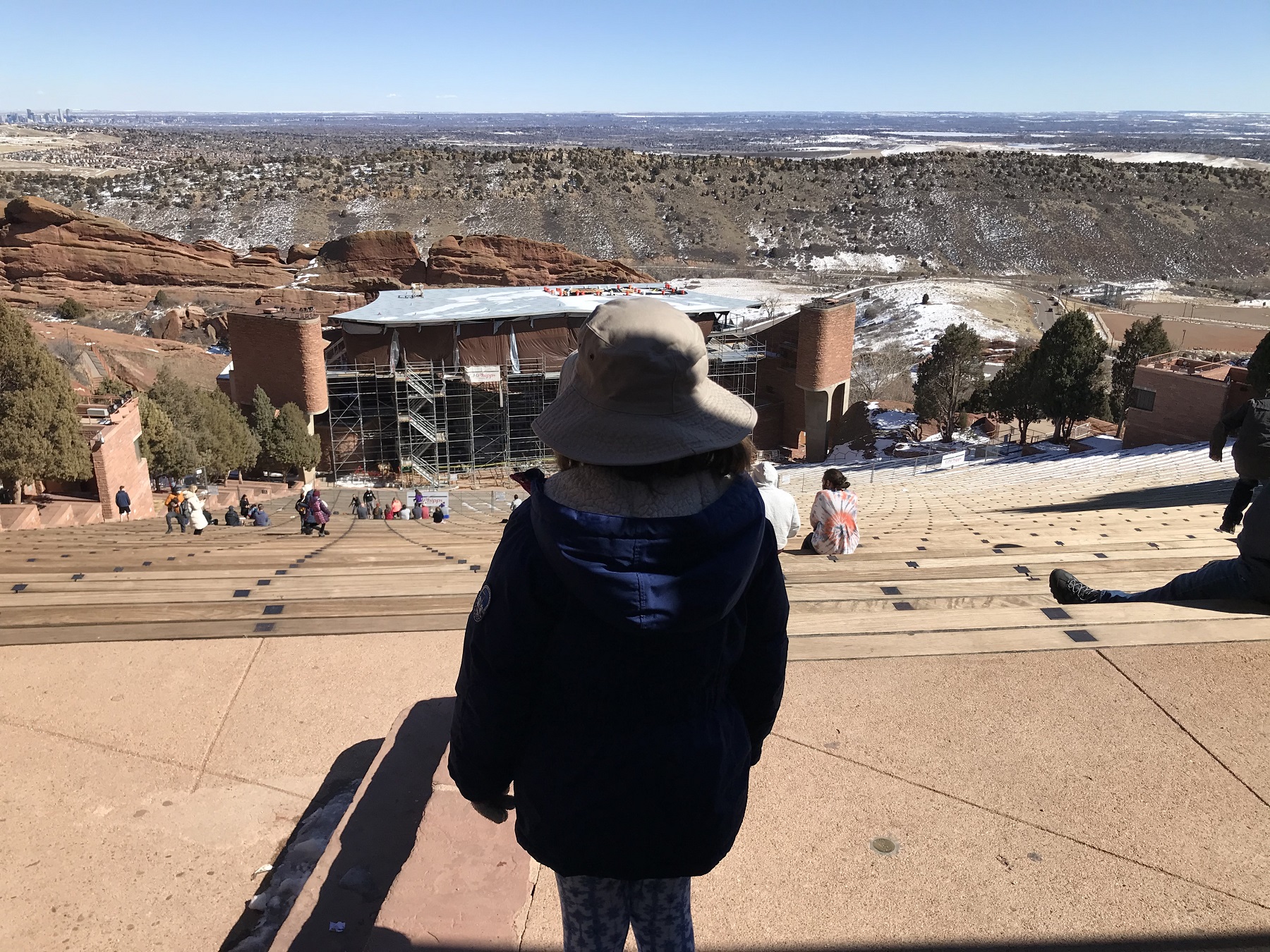
I’ve done a fair bit of traveling around the states and to other countries, but two weekends ago, a trek to Red Rocks Park and Amphitheatre in Morrison, Colorado, was one of the few that left a plastered-on WOW! expression long after soaking up the breathtaking vistas. I only wish my iPhone photos did justice to this dazzling attraction.

My family and I hiked the scenic trails, enjoyed the museum that’s a who’s who of my music collection, and stood at the top of the amphitheater looking down to the stage where so many legends have performed. This may be a tired cliche, but sincerely, I left a part of my soul there.

A little piece of interesting history (for me, anyway): a Cranmer played a big role in the development of this space into a park and music venue. Building on the foundation of another visionary, George Cranmer, Manager of Denver Parks, recognized the potential of the rock outcropping, and became the motivational force behind the land purchase in 1927 and ovesaw the project to its opening event in 1941. I wonder if he's possibly a distant relative.

Who else has enjoyed this amazing terrain, maybe even fortunate enough to experience a live musical performance?


David Cranmer is the editor of the BEAT to a PULP webzine and whose own body of work has appeared in such diverse publications as The Five-Two: Crime Poetry Weekly, Needle: A Magazine of Noir, LitReactor, Macmillan’s Criminal Element, and Chicken Soup for the Soul. Under the pen name Edward A. Grainger he created the Cash Laramie western series. He's a dedicated Whovian who enjoys jazz and backgammon. He can be found in scenic upstate New York where he lives with his wife and daughter.


Tuesday, February 25, 2020

REMEMBER THE LADIES

Post by Doris McCraw
writing as Angela Raines

View on the route up Pikes Peak which was submitted by
Julia Archibald Holmes in 1858
Photo property of the author
On March 31, 1776, Abigail Adams wrote a letter to her husband in which she said, "I long to hear that you have declared an independency. And, by the way, in the new code of laws which I suppose it will be necessary for you to make, I desire you would remember the ladies and be more generous and favorable to them than your ancestors. Do not put such unlimited power into the hands of the husbands. Remember, all men would be tyrants if they could. If particular care and attention is not paid to the ladies, we are determined to foment a rebellion, and will not hold ourselves bound by any laws in which we have no voice or representation."

Those were strong words and in 1920 the nineteenth amendment to the constitution was passed. This year we celebrate the centennial of that event. Although the suffrage movement started on the Eastern coast, it was the women of the Westward movement who exercised those rights prior to 1920.

In Colorado, even before becoming a state, the papers were discussing the suffrage movement. The Central City newspaper in the 1860s was publishing articles on the subject. The Colorado State Medical Society as early as 1876 introduced the idea of women being admitted to that organization. On a side note, the American Medical Society admitted a female doctor from Illinois in 1874.

Image result for alida avery
Dr. Alida Avery
image from Wikipedia
Although women doctors were not admitted to the Colorado Medical Society in 1876, they started their own society. Alida Avery, MD, left Vassar College, where she was a professor and physician, moved to Colorado in 1874, and was heavily involved in the early suffrage movement.

Dr. Mary Helen Barker Bates, who had moved to Colorado from Utah in 1878 with her attorney husband, was instrumental as part of the group of women who reorganized the movement to work for the passage of suffrage in Colorado. The result, in 1893, Colorado added the right of women to vote to the state's constitution.

Image result for colorado suffrage movement images
Colorado Suffrage Movement 1893
image from Wikipedia 
Women in Western states enjoyed more rights and freedoms than their sisters in the East. Wyoming and Utah allowed women to vote before Colorado. Additionally, California began licensing physicians as early as 1876 and women were licensed just the same as men.

Most of my research is on those early Colorado women doctors, but there were women ranch owners, business owners, outlaws and teachers whose lives made an impact on the state. So the next time you watch an early Western and see a strong female character, don't think it was an anomaly, it was probably truer than you realize. When you read between the lines of some of the news reports from the time, you will find, we need to remember the Ladies.


Doris Gardner-McCraw -
Author, Speaker, Historian-specializing in
Colorado and Women's History
Angela Raines - author: Where Love & History Meet


Tuesday, August 28, 2018

Which Dr. Bates?


For those who might not make it to the Western Fictioneers Convention this September, I thought I would share a bit of information about two Colorado women doctors who had a medical practice prior to 1900, who just happened to have the same first and last names. Here are the brief stories of  the Doctors Mary Bates.


First, a bit of context for their stories. Colorado became a state in 1876, hence the name 'The Centennial State'. The theory about Colorado's lateness in mass settlement is that people did not believe you could cross over the many fourteen thousand foot peaks. Of course there were the mountain men in the early 1800s, but it took a gold rush in 1859 to prove that theory wrong. From that point on the state saw an influx of gold seekers, and businesses that provided goods and services to said prospectors. 

Following the gold and silver seekers were the health seekers. Many found the clear, cold and thin air of Colorado to be beneficial to their health. With the health seekers came the physicians and others who offered their services to the ill. Into that mix came the women physicians who also wished to practice medicine. There were many women who took advantage of the opportunities afforded them in this new area. The first Dr. Bates arrived around 1878.

Dr. Mary Helen Barker Bates was born December 17, 1845 in Hannibel, Oswergo County, New York. She was the daughter of Dr. Ezra Barker and Jane Ruth Freeman. Mary graduated from the Women's Medical College in Philadelphia in 1873.  That same year she moved to Utah, where some sources say she began an Obstetrics School for women in Salt Lake City. The family site states she was 'Brigham Young's Family Physician'. While still in Utah she met and married attorney George Clinton Bates in 1876. By 1878 Mary and George moved to Leadville, Colorado. There the two practiced their vocations. In the 1879 Leadville City Directory, Dr. Bates is the only female physician listed along with the other thirty-four doctors.

Image result for images of leadville colorado 1881
Leadville 1881- from Pinterest
Leadville sits at 10,152 feet above sea level in the Colorado Rockies. It is currently the highest incorporated town in North America. (The honor for highest town originally went to Altman, Colorado at 10,630 feet, but it is now a ghost town). During the 1870s and 80s it was a booming mining town. It was in Leadville that the Guggenheims, and Horace Tabor made a fortune in silver. Doc Holliday and possibly even members of the James gang were in Leadville for a time.  

By 1881 Dr. Bates and husband moved to Denver, Colorado for George's health. It was also 1881 that Colorado started licensing physicians and Mary Helen was one of the early one. (Her license number was 271). It was in Denver Dr. Mary Helen Barker Bates made history as the first woman in Colorado to be appointed to the staff of the Women's and Children's Hospital in 1885. She also was a member of the Denver Board of Education, Vice-President of the Colorado Medical Society and Colorado's Delegate to the Pan-American Medical Congress. Dr. Mary Helen Barker Bates passed away on August 3, 1924 in Denver at the age of 78.


Dr. Mary Elizabeth Bates was born in February 25, 1861 in Manitowoc County, Wisconsin to William Wallace Bates, a ship builder, and Mary Cole Bates, a physician. She arrived in Denver in 1891. Prior to arriving in Colorado she was the first woman intern (1882-1883) at the Cook County Hospital in Chicago, Illinois. She achieved this position after a grueling exam in which she beat out a number of male candidates. After her internship she studied in Vienna from 1883-1884, which a number of physicians both male and female did. Upon her return to Chicago she was a professor of anatomy at the Woman’s Medical College in Chicago from 1884-1889. In Colorado she was involved in the Woman’s Suffrage movement and was part of the group that affected the passage of the 1893 referendum which gave Colorado women the right to vote. In 1909 Dr. Bates developed a bill “The (Bates) Colorado Law for the Examination and Care of Public School Children” which passed in June of 1909. Dr. Bates also championed a strict adherence to the liquor and gambling laws of the state. 

Cook County Hospital, 1900 W Harrison, 1882, Chicago
Cook County Hospital-Chicago Illinois 1882 - from Pinterest
Of her time as an intern at Cook County Hospital, Dr. Bates says of the nineteen months she worked as in intern, she worked in the morgue, took part in fourteen amputations. Of her time there she later said “the first six months were hell, the second six months were purgatory, the next six months were heaven; when it came time for me to leave, I wept bitter tears..."  Dr. Mary Elizabeth Bates passed away September 18, 1854 at the age of 93. 

For those who think women had a hard time practicing medicine, they did, but in Colorado the hard times were probably not a tough as other areas of the country. The West was opening up and doctors were needed, regardless of there gender.

Of course I've included women doctors in my writing. 


Chasing A Chance (Lockets & Lace Book 7) by [Raines, Angela, Lace, Lockets and , Sweethearts, Sweet Americana]
ebook

Josie's Dream (Grandma's Wedding Quilts Book 9)
eBook
Doris Gardner-McCraw -
Author, Speaker, Historian-specializing in
Colorado and Women's History
Member of National League of American Pen Women,
Women Writing the West,
Pikes Peak Posse of the Westerners

Angela Raines - author: Where Love & History Meet
For a list of Angela Raines Books: Here 
Photo and Poem: Click Here 
Angela Raines FaceBook: Click Here


Tuesday, March 27, 2018

COLORADO'S UNCOMFORTABLE HISTORY - LYNCHING


When you think of Colorado, you think skiing, mountains, and hiking or driving some remarkably beautiful scenery. However, as I work on my paper for the PPLD Annual History Symposium, this years topic, 'Remarkable Rascals, Despicable Dudes, & Hidden Heroes of the Pikes Peak Region', I ran across the need to research lynching for my despicable dude. While an uncomfortable subject, it became important to the story. You see, the 'Despicable Dude' I'm researching was allegedly almost lynched twice.

It is said that lynching as we know it took its name from from Lynch Law, usually attributed to Charles Lynch of Virginia. There are also those who claim it was William Lynch, also of Virginia, that should be accredited. Either way, there seems to be no evidence that either were responsible for the death of any person they sentenced. Lynch law was considered as imposing extrajudicial punishment.


In Colorado, lynching usually resulted in the death by hanging. In the book "Lynching in Colorado, 1859-1919" by Stephen J. Leonard, the author states there were 175 documented cases where a lynching occurred, although most agree there were more that were not documented.


As seen by this article from the Fairplay Flume Aug 30 1888, lynching was a much used word in the papers and for certain areas of Colorado, a not unusual, although not frequent, occurrence.

"The following special appeared in the Leadville Journal : Glenwood Springs, Aug . 24 .James Riland Sr., well known throughout Colorado, especially in Leadville, was shot through the breast by C . A . Babcock. The cause of the shooting is unknown. Babcock has given himself up . Jamea Riland Jr. has gone to his father's ranch to look after tbe old gentleman . It is said that lynching may follow if the wounds prove fatal."

Or this short notice in the Ft, Collins Courier from April 19, 1888

"A lynching took place at Cheyenne Wells, on Monday, a man named Franklin Baker being the victim. Baker had the day before killed two young men, named J . B . McConnell and John C . Morrison because in looking for land they bad crossed Baker's field contrary to his orders. Baker was hung to a coal chute a short distance from the depot."

A more complete story of lynching appeared in the Colorado Springs Gazette on July 28, 1877


"LYNCHING AT LA VETA . A dispatch from La Veta , dated last Tuesday, says: The jail guard at this place was overpowered last night by a vigilance committee, and Marcus Gonzales, the murderer of the Browns, taken from custody and lynched to a telegraph pole in the public square. The murder, which occurred near this place in November last, was one of the most brutal recorded in the annals of crime, an aged couple being the victims and money the incentive. Gonzales went to the house of the unfortunate family and asked to stay over night, and killed Mr. Brown while he was caring for his horse . Returning to the house the wretch killed Mrs. Brown and left their daughter, Mrs . Rice, for-dead, obtaining the paltry sum of four dollars for his butchery; The murderer escaped to New Mexico, but was hunted down by detectives and brought back here for trial, and upon a preliminary examination was positively identified by Mrs. Rice, who, pointing to Gonzales, said : You are the man who murdered my father and mother and nearly killed me. He was also suspected of several other murders. The lynching took place at 11 pm . About seventy five men participated. They were quiet and orderly but determined ."

The idea of lynching was not wholly accepted by the populace as evidenced by this piece in the Colorado Daily Chieftain from January 22, 1884.

:"The saddest thing about the Ouray lynching is the fact that it made an orphan of a little two year old girl. It is said that the people of Ouray endorse the action of the mob, but we predict that they will soon regret it. That act has placed a stigma upon Ouray which will require many years to outlive and wipe from the memories of law abiding people."

Yet, searching the early newspapers during the time my 'despicable dude' was suppose to be active show no reports of his being threatened with a lynching in the regions he was active in. Colorado has a history of extrajudicial punishment. An author friend had a relative who was 'lynched' in Canon City, Colorado. She has researched and written about the event, including the writing of a song. 

As Colorado went from birth to statehood and beyond, it was paved with many events including lynching. Not pretty, not necessarily something you talk about, but a part of the history.

For those who want to find out more about Lynching in Colorado, the book mentioned above is a place to start. There is also those searchable resources such as 19th Century Newspapers, Newspaper Archives and Colorado Historic Newspapers. 

Doris Gardner-McCraw -
Author, Speaker, Historian-specializing in
Colorado and Women's History
Member of National League of American Pen Women,
Women Writing the West,
Pikes Peak Posse of the Westerners

Angela Raines - author: Where Love & History Meet
For a list of Angela Raines Books: Here 
Photo and Poem: Click Here 
Angela Raines FaceBook: Click Here

Saturday, May 24, 2014

Books and maps are like dear old friends - by Kaye Spencer

In 1976 or thereabouts, I came across two advertisements in the back of a Louis L'Amour novel. You’ve seen them. They all look something like this:

One of the ads was for a set of a Time-Life books about the Old West, and the other ad was for old west maps drawn by Perry C. Van Arsdale. I wanted the entire set of books so badly that I scrimped and saved pennies so I’d have enough saved up to get a money order to buy the next one. Each month, when a new volume arrived, I read it cover-to-cover and back again. They probably cost around $13 each, and I bought them one at a time in a book-of-the-month type situation.

Over the years, I've carted this set of books around throughout my many moves. They’ve made it through a basement flood; a partial house fire; an aquarium slowly leaking on the shelf above them; toddlers with crayons and scissors; and puppies with sharp teeth. ;-) I still rely on them in my writing.

This is an etsy.com image of the complete set, since mine are in storage due to the still-on-hold basement remodel after our flood last fall.

I purchased four Van Arsdale maps in 1978-ish. I don't recall how much they cost at the time, but maybe $10 or so. They, too, have their battle scars, but they're all still in good shape. My four maps are: Pioneer Texas, Pioneer Colorado, Pioneer New Mexico, and Pioneer Arizona. I kept the four maps rolled together and in a mailing tube until 2012. So about 35 years after purchasing, my dad mounted them in frames with protective glass. I cherish these maps even more now, because the framing was the last woodworking my dad did before he died in 2013. 

The pictures below give you somewhat of an idea of the hand-drawn, detailed, historical information they contain: dates of railroads, telegraph and stage lines, stage stops, freight roads, water holes, forts, etc. This map measures 35 inches tall by 28 inches wide (inside the frame). My four maps aren't the same dimensions, but they are similar in size.

Full view Pioneer Texas map
 
Close-up details San Angelo area

 Legend example

I visited the Perry C. Van Arsdale website, and I was so pleased to see the maps are still available for purchase, that I bought three. ;-) Talk about a trip down memory lane. This is the website: http://www.vanarsdalemaps.com/

Back when I bought the set of books and the four maps, I really couldn't afford them. But something urged me to buy them, but not in an impulse purchase sort of way. My commitment for the books was about two years, and I bought the maps one at a time as I could afford them. It was more of a "you need to buy these because you'll use them in your writing someday".

I'd written short stories ever since I was in elementary school, and I wrote my first novel in high school (it has mercifully disappeared it was so terrible). So being a writer/author was something I'd yearned for ever since I can remember. I started writing my first western novel in 1979, originally titled "Epitaph for a Bounty Man", and I finally published it in 2006 as a western romance called "Lonely Places", under my other pen name, A.L. Debran.


In the early years of writing this story, I plotted the character’s travels on my Pioneer Colorado and New Mexico maps, while relying heavily upon the information in the Time-Life books to make sure my details were as accurate as I could make them. Back then, these were my only sources for historical research.

I treasure my Time-Life Old West books and my Van Arsdale maps as I treasure and appreciate my oldest and dearest friends. They've been with me through the clichéd 'thick and thin', and they've never let me down.

Until next time,

Kaye

Fall in love...faster, harder, deeper with Kaye Spencer romances
www.kayespencer.com
Twitter - @kayespencer