Wednesday, October 18, 2023

Several years ago, about ten or so, I wrote a book called “The Half-Breed’s Woman” about our hero, U.S. Deputy Marshal Jaxson McCall, who was the son of a white man and an Indian woman. Brought up in Indian Territory, he’s lived a very hard-knock life with his younger brother, Brendan, who is also a deputy marshal.

The heroine is a young debutante from Washington, D.C., Callie Buchanan, whose stepfather, Dunstan Treadwell, has nefarious plans for her now that she is eighteen. She is on the run (who wouldn’t be?) and Treadwell hires Jaxson to track Callie down and return her to him.

Jaxson takes the job, but things get complicated, and soon they are both in danger.

As the years passed, I thought of so many things I wanted to change in this book. Writers do that, many times—and a “do-over” is not always possible. BUT, in my case, I was able to do just that, and what fun I had with this!

I’m re-releasing this fabulous story under a new title and cover, A MARSHAL FOR CALLIE. It’s full of surprises and action, and one of the most poignant love stories ever.

It’s one of my favorite stories, and I have plans, still, to write sequels as to what happens to these characters—they are some of my very favorite creations. I hope you will feel the same.

Here’s the blurb—it tells the gist of the story much better than I can in the space I have:

A MARSHAL FOR CALLIE--A sensual western historical romance that draws you in and won't let go.

  U.S. Deputy Marshal Jaxson McCall is hired by Dunstan Treadwell, a powerful government official, to track down his runaway stepdaughter, debutante Callie Buchanan. When Jax realizes he’s been double-crossed by Callie’s stepfather, he doubles down to protect Callie from an evil nemesis from his own past who has been hired to kill them both.

The stakes have changed: Treadwell doesn’t want Callie back—he wants her dead. And the man coming after them is a master at murder.

Jax catches up to Callie in Fort Smith, and none too soon, for Wolf Blocker, the man Treadwell has hired to murder his stepdaughter and Jax, is one step ahead of them—and he’s got assassination on his mind. Jax and Callie set out on the stagecoach for Texas, neither of them able to be honest about their circumstances. With Blocker on their trail and Apaches ahead of them, the future is uncertain.

One thing Jaxson knows: he cannot take Callie back to Washington to face an attempted murder charge. Matters are further complicated when Jax and Callie are forced into marriage by worried Cavalry Captain Alan Tolbert to avoid the trouble he believes Treadwell could cause.

Through all the pretense, the hardships, and the deadly danger, one thing becomes obvious. Callie and Jaxson were meant to be together for this new beginning, for this new forever love that neither of them had ever hoped to find. Will they live long enough to see it through?

Have you ever read a story or seen a movie that had characters so REAL that they stayed with you long after the book was finished, or the movie had ended? What characters have stayed in your heart and mind long after the story was over?

A MARSHAL FOR CALLIE--KINDLE LINK: https://tinyurl.com/yn85vnkk

A MARSHAL FOR CALLIE--PAPERBACK LINK: https://tinyurl.com/mryt2fwf

CHERYL'S AMAZON AUTHOR PAGE:  https://tinyurl.com/2k7xeddt


Thursday, October 12, 2023

On This Day in the Old West: October 13

 October 13, 1792 marks the beginning of an American institution: The Old Farmer’s Almanac. The periodical’s first editor, Robert B. Thomas, published the very first edition on this date in 1792, during George Washington’s first term as US President. Although many other almanacs were being published at that time, Thomas’ The Old Farmer’s Almanac became an instant success. It cost only 6 pence (about 9 cents), and by the second year, circulation had tripled (from 3,000 to 9.000). Published every year since, it is now the oldest continually published periodical in the United States.


An almanac, by definition, records and predicts astronomical events (like sunrise/sunset), tides, weather, and other phenomena with respect to time. So what made The Old Farmer’s Almanac so different? Since Thomas’ format wasn’t all that original, we can only surmise that his astronomical and weather predictions were more accurate, the advice more useful, and the features more entertaining. 


Thomas used a complex series of natural cycles to devise a secret weather forecasting formula, still in use today, which brought amazingly accurate results, said to be as much as 80 percent accurate. His last edition, in 1846, was not that much different from his first, over 50 years earlier. However, in those 50 years, Thomas established The Old Farmer’s Almanac as America’s leading periodical by outselling and outlasting the competition. Thomas died at the age of 80, supposedly reading page proofs for the 1847 edition of the almanac.


Every September, The Old Farmer’s Almanac publishes weather forecasts, planting charts, astronomical data, recipes, and articles. Topics include gardening, sports, astronomy, folklore, and predictions on trends in fashion, food, home, technology, and living for the coming year. Few people, other than the Almanac’sprognosticators, have ever seen Thomas’ secret formula for predicting the weather. It is kept in a black tin box at the Almanac offices in Dublin, New Hampshire.


The publication was not always “Old,” however. At first, it was simply known as The Farmer’s Almanac. However, in 1832, with his publication having survived longer than similarly-named competitors, Thomas inserted the word “Old” in the title, later dropping it from the title of the 1836 edition. After his death in 1846, John Henry Jenks was appointed editor, and, in 1848, changed the title of the book permanently and officially to The Old Farmer’s Almanac. In 1851, Jenks made another change to the Almanac when he featured a “four seasons” drawing on the cover by Boston artist Hammatt Billings, engraved by Henry Nichols. Jenks dropped the new cover for three years, but then reinstated it permanently in 1855. This trademarked desing is still in use today.


An interesting anecdote has lawyer Abraham Lincoln using The Old Farmer’s Almanac to free his client from murder charges in 1858. William “Duff” Armstrong was on trial for murder in Beardstown, Illinois. Lincoln used an almanac, supposedly The Old Farmer’s Almanac, to refute the testimony of Charles Allen, an eyewitness who claimed he had seen the crime by the light of the moon. The book stated that not only was the Moon in the first quarter, but it was riding “low” on the horizon, about to set. There was no way Allen could have seen Lincoln’s client.


With The Old Farmer’s Almanac in continuous publication since 1792, any of your characters could have read this periodical, depended on its forecasts, or just noted its articles. You could even use the information contained in this post to date the exact cover and title your character would have seen. Robert B. Thomas’ creation has withstood the test of time.


J.E.S. Hays

www.jeshays.com

www.facebook.com/JESHaysBooks

Wednesday, October 4, 2023

Classic Country Ballads of Lost Love – Long Black Veil #westernfictioneers #countryballads #classiccountrymusic


I grew up in the late 50s and 60s listening to the country music of that era. I stuck with country music through the 70s. I made it into the 80s but, by the late 80s, country music as I knew and loved was headed in a direction that, with a few exceptions, I wasn’t interested going. So I didn’t. (Get off my lawn.)

The old west gunfighter and trail ballads, drinking songs, and revenge songs had an influence on me that was, and still is, every bit as strong as the impact Louis L’Amour’s books left with me. My lifelong interest, perhaps fascination bordering on obsession, with everything old west—truth, legends, and myths alike—have roots in those old cowboy and country songs.

I’m inviting you to read along with me this year as I post one or two nostalgic-for-me country ballads on the first Wednesday of each month. I will share a snippet of trivia about each song along with a YouTube video.

Each month, I will include a link back to the previous month’s article as reference to those songs. The common thread that runs among the songs I’ve chosen for this musical memory lane excursion is tragic lost love.

January – Marty Robbins – El Paso and Feleena
February – Faron Young – TheYellow Bandana
March – Willie Nelson and Ray Charles – 
Seven Spanish Angels
April – Marty Robbins – San Angelo
May – Billy Walker – Cross the Brazos at Waco
June – Billy Walker – Matamoros
July – Marty Robbins – Running Gun
August – Willie Nelson – Red Headed Stranger
September – Marty Robbins – They’re Hanging Me Tonight

I planned this month’s song specifically for October, since the song has a paranormal slant. The song is [The] Long Black Veil by Lefty Frizzell.

Lefty Frizzell promo 1957


Long Black Veil is a 1959 country ballad written by Danny Dill and Marijohn Wilkin. Lefty Frizzell was the original artist who recorded and released the song.

The story is sung from the perspective of a man who has been falsely accused of murder and has been executed. He declined to provide the alibi that would have exonerated him, because he was having an extramarital affair with his best friend’s wife at the time of the murder ‘neath the town hall light. He chose death over dishonor and took their secret to the grave with him.

The woman mourns his death by walking the cemetery and visiting his grave while wearing a long black veil and enduring the unforgiving, wailing night wind.

This song is equal parts tragic, achingly sad, and otherworldly. Otherworldly, because the singer is dead, and he’s telling their story, which is creepy-fabulous.

Now, hear me out.

I have a theory about the woman and why she visits his grave when the night winds wail. Nobody knows. Nobody sees. Nobody knows but me.

If nobody knows and nobody sees and nobody knows but the dead man, then I say the woman is also dead, and her soul can’t rest because she stood in the crowd at his hanging and ‘shed not a tear’. Her guilt for allowing an innocent man to die, a man she evidently cared about, drove her to suicide.

So why does she wear a long black veil? Maybe she wore a black dress with a long black mourning veil after the man died, and that’s what she was wearing when she died.

 I didn’t make up the afterlife wardrobe rules.

But, I do know that ghosts are stereotypically depicted as an entity of flowing, draped, white cloth because, for hundreds and hundreds of years, people were buried in white linen shrouds as the proper care for the deceased and also as an affordable alternative for a ‘coffin’. White shrouds eventually became associated with spirits that can’t rest...aka... Ghosts.

It’s not unreasonable that her eternity outfit included a long black veil.

Back to the song…

Evidently, the man and woman are unable to communicate directly with each other in the afterlife. But, he can watch her visit his grave and walk the hills, and she can visit his grave and walk the hills for all eternity. Almost together, yet always apart.


Country Music Trivia:

Marijohn Wilkin was known as “The Den Mother of Music Row”. She toured with Red Foley, co-wrote ‘Waterloo’ (Stonewall Jackson’s No. 1 country hit), and co-wrote ‘Cut Across Shorty’ and ‘I Just Don’t Understand’ (big hit for Ann Margaret). Most famously, she wrote ‘One Day at a Time’ (big gospel hit of the 1970s).

She was the first to publish Kris Kristofferson’s songs (specifically, ‘For the Good Times’ which was a huge hit for Ray Price). Her son, John “Bucky” Wilkin was front man for the surf rock group Ronny & the Daytonas who had a 1964 hit single with ‘G.T.O.’

Wilkin and Dill said the inspiration behind Long Black Veil came from a Red Foley gospel song called ‘God Walks these Hills with Me’; a newspaper story of an unsolved murder of a priest; and the legend of the mysterious woman who visited Rudolph Valentino’s grave.

Lefty Frizzell’s version of Long Black Veil was selected by the Library of Congress in 2019 for preservation for being ‘culturally, historically, or aesthetically significant’.

Image: Lefty Frizzell promotional image attribution by Columbia Records, derived from Public Domain.

Until next time,
Kaye Spencer
Lasterday Stories
writing through history one romance upon a time
www.kayespencer.com

Tuesday, September 26, 2023

Still On the Trail

Post by Doris McCraw

aka Angela Raines

Tandem Ox Yoke
 Photo (C) Doris McCraw

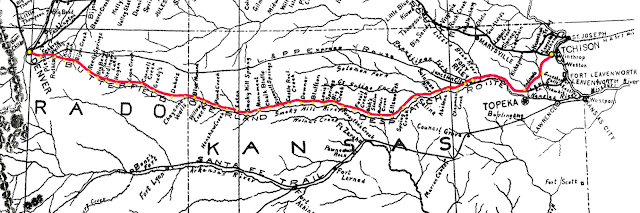
The Smokey Hill River Trail, one of the more treacherous routes to the Colorado Gold Fields, gave way to the Butterfield Overland Dispatch in 1865. This stage line only ran for about a year before its purchase by Ben Holliday, known as the "Stagecoach King". Holliday in turn sold to Wells Fargo who sold to the United States Express Company.

According to records, the cost for an individual ticket was $175.00 one way. There were a total of thirty-nine stage stops along the trail. It was here passengers could purchase a meal for an additional fifty cents to one dollar.

Map of the Smokey Hill Trail 
from Legends of America

Additionally, the Army built several forts along this route to protect travelers from attacks. The Smokey River was a favored hunting ground for the Plains Indians. Some of the Forts along the trail were: Fort Downer, Fort Hays, Fort Harker, Fort Monument, and Fort Wallace.

Despite the presence of the Army, the attacks cost the stage line but ultimately it was the railroad that resulted in the end of the travel on the trail but what stories you find when you start researching.

From the Smokey Hill River Trail exhibit at the Elbert County
Historical Society & Museum
Photo (C) Doris McCraw

As for the forts, some of the names probably sound familiar and many are now museums.

For those who might be interested here is a link to a PBS show talking about Four-Mile-House, the last stage stop before arriving in Denver. Four-Mile House

Until Next Time Stay Safe & Stay Well

Doris


Thursday, September 7, 2023

On This Day in the Old West: September 8

School in the 1800s was a far different thing than it is today. For one thing, did you know that most schools didn’t even have an American flag flying over the schoolhouse? This began to change starting in 1888, when Daniel Sharp Ford, the owner of the patriotic circular The Youth’s Companion, began a campaign to sell United States flags to public schools. The magazine sent out 100 free cards to each student who wished to obtain a school flag, printed with these words: This Certificate entitles the holder to One Share in the patriotic influence of the School Flag. The students then sold the certificates for 10 cents each, and when they had sold all 100 of them, they would send the money to The Youth’s Companion and receive “a good-sized, substantial flag” to display at their school.

Four years later, the magazine had sold US flags to approximately 26,000 schools across the country. The market at this time was slowing, but Ford felt it was not yet saturated. Ford had already hired Christian Socialist Baptist minister and author Francis Julius Bellamy to work with Ford’s nephew, James B. Upham, in the premium department of the magazine. Upham had begun his campaign with an essay contest for students: “The Patriotic Influence of the American Flag,” with one winner chosen from each state and that winner’s school receiving a large US flag. Upham now had the idea of using the 400th anniversary of Christopher Columbus’ landing in the Americas in 1492 to further bolster the schoolhouse flag movement. 


The Youth’s Companion called for a national Columbian Public School Celebration to coincide with the World’s Columbian Exposition, scheduled for 1893 in Chicago, Illinois. Forty-six countries from all over the world were sending exhibitions to this World’s Fair. A flag salute was to be part of the official program for the Columbus Day celebration on October 12th, to be held in schools all over the United States. Francis Bellamy created a special pledge, published in the September 8, 1892 issue of the magazine.


Bellamy’s original pledge read as follows:


I pledge Allegiance to my Flag and to the Republic for which it stands, one Nation indivisible, with Liberty and Justice for all.


This pledge was immediately put to use in the magazine’s campaign. Bellamy went to speak to a national meeting of school superintendents to promote the Columbian celebration. The superintendents liked the idea and selected a committee of leading educators to implement the program, including the immediate past president of the National Education Association. Bellamy was selected as the committee chair.


With the official blessing of the American educators, Bellamy’s committee now had the task of spreading the word around the nation and of designing an official program for schools to follow on the day of national celebration. Bellamy structured the program around a flag-raising ceremony and his pledge, which was accompanied with a salute known as the Bellamy Salute. Unfortunately, this salute resembled the later Nazi salute, so during World War II, it was replaced with the now-familiar hand-over-heart gesture.


Bellamy described his thoughts as he crafted the language of the pledge:


“It began as an intensive communing with salient points of our national history, from the Declaration of Independence onwards; with the makings of the Constitution…with the meaning of the Civil War, with the aspiration of the people…


The true reason for allegiance to the Flag is the ‘republic for which it stands.’ …And what does that last thing, the Republic mean? It is the concise political word for the Nation—the One Nation which the Civil War was fought to prove. To make that One Nation idea clear, we must specify that it is indivisible, as Webster and Lincoln used to repeat in their great speeches. And its future?


Just here arose the temptation of the historic slogan of the French Revolution which meant so much to Jefferson and his friends, ‘Liberty, equality, fraternity.’ No, that would be too fanciful, too many thousands of years off in realization. But we as a nation do stand square on the doctrine of liberty and justice for all…”


Bellamy thought of his Pledge as an “inoculation” that would protect immigrants and native-born but insufficiently patriotic Americans from the “virus” of radicalism and subversion. Whether or not this has worked, your characters could have either read The Youth’s Companion as a child, or may have perhaps participated in the Flag Day celebrations that the magazine encouraged after September 8, 1892.


J.E.S. Hays

www.jeshays.com

www.facebook.com/JESHaysBooks

Wednesday, September 6, 2023

Classic Country Ballads of Lost Love – They’re Hanging Me Tonight #westernfictioneers #countryballads #classiccountrymusic

 I grew up in the late 50s and 60s listening to the country music of that era. I stuck with country music through the 70s. I made it into the 80s but, by the late 80s, country music as I knew and loved was headed in a direction that, with a few exceptions, I wasn’t interested going. So I didn’t. (Get off my lawn.)

The old west gunfighter and trail ballads, drinking songs, and revenge songs had an influence on me that was, and still is, every bit as strong as the impact Louis L’Amour’s books left with me. My lifelong interest, perhaps fascination bordering on obsession, with everything old west—truth, legends, and myths alike—have roots in those old cowboy and country songs.

I’m inviting you to read along with me this year as I post one or two nostalgic-for-me country ballads on the first Wednesday of each month. I will share a snippet of trivia about each song along with a YouTube video.

Each month, I will include a link back to the previous month’s article as reference to those songs. The common thread that runs among the songs I’ve chosen for this musical memory lane excursion is tragic lost love.

January – Marty Robbins – El Paso and Feleena
February – Faron Young – TheYellow Bandana
March – Willie Nelson and Ray Charles – 
Seven Spanish Angels
April – Marty Robbins – San Angelo
May – Billy Walker – Cross the Brazos at Waco
June – Billy Walker – Matamoros
July – Marty Robbins – Running Gun
August – Willie Nelson – Red Headed Stranger

This month’s song is ballad They’re Hanging Me Tonight by Marty Robbins.

The story expresses the lamentations of a man facing his hanging for murdering Flo (ex-girlfriend?) and ‘her new love’. It’s also interesting to note that the man apparently didn’t evade arrest after he killed Flo and her new man, since they’ll bury Flo tomorrow, but they’re hanging me tonight. Not much time has elapsed between murder and punishment.

Conversely, if he did flee the scene at the dimly lit café, he wasn’t on the lam for long. Reading between the lines suggests Old West ‘justice’ happened to bring about his hanging so quickly after Flo is buried. No lengthy trial for this man. Was this a case of vigilante justice for the double murders—these crimes of passion—since he freely admits what he did wasn’t right? Either way, his heart is filled with fear as he faces his imminent execution.

James Lowe and Art Wolpert wrote They’re Hanging Me Tonight. Marty Robbins released it in September 1959 on his album Gunfighter Ballads and Trail Songs. The album’s peak position on the country music chart for 1960 was No. 6 in the U.S. and No. 20 in the U.K.


Until next time,
Kaye Spencer
Lasterday Stories
writing through history one romance upon a time
www.kayespencer.com

Tuesday, August 22, 2023

Some Articles about the Smokey Hill Trail


Post by Doris McCraw

aka Angela Raines

Photo (C) by Doris McCraw

A few years back I ran across an article about the Smokey Hill River Trail. This month I thought I'd share just a couple that mentions that trail here in Colorado. The stories continue to call me back again and again. Of course, the trail came through an area just north of where I live so...

Parker Old Fashioned Fourth (The Aurroa Advocate, June 30, 1971)

The Parker Jaycees will hold an “old ^ fashioned celebration” Saturday, July 3, in Parker, celebrating the Smokey Hill Trail. In September 1874, Mr. and Mrs. James Sample Parker bought the land and ranch on which the Twenty-Mile House stood. The Smokey Hill Trail provided heavy traffic from the people heading for the gold fields of Clear Creek and Pikes Peak. Ox trains loaded with lumber from the sawmills in the area were particularly active on the Smokey Hill Trail. Mr. Parker opened a blacksmith shop to shoe oxen. It was very difficult to shoe oxen because they had to be suspended in the air. This was done by hoisting them up with a wide belt from a four-posted scaffold. 

Photo (C) Doris McCraw

A BRIEF HISTORY OF ROAD BUILDING (The Salida Mail, March 3, 1914)

Written for the Colorado Good Roads Association by Dr, F. L. Bartlett I

All the early histories of the mountain and plains region of the Rocky Mountains are strangely silent regarding the building of. the first roads, and such information as 1 have is mostly gleaned from the old settlers. The first wheeled vehicles came over the Santa Fe Trail in 1828 eu route for Santa Fe, New Mexico, just touching the extreme southeast corner of our state, following the Cimmaron River. A few years later, about 1852, the trail was changed and went by the way of Fort Bent and down Timpas Creek, with a branch running up the Arkansas River to Canon City for the purpose of reaching the trapping stations located along the river. For twenty years great wagon trains, often numbering as high as 400 teams passed over this great natural highway, each caravan doing its own road work as the case demanded, which was just sufficient to get them through. Five thousand pounds of freight was about the limit for eight mules or three yokes of oxen. There were no bridges and it often required 40 or 50 head of mules to pull one wogan across the river beds, while at flood times the caravans simply had to camp and wait. For a long time, the lowest going rate for freight from Independence, Missouri to Slant Fe was 10 cents per pound. The first overland stage and mail line was started from Independence on July Ist, 1849. These stagecoaches were elegantly built and beautifully painted, designed to carry eight passengers, with a guard of eight men on the outside fully armed. They were built water-tight in order to use them for ferries when the streams were too high for fording. The fare per passenger was $240 each way, 40 pounds of baggage being allowed, any excess being at the rate of 50 cents per pound. The trip was made in two weeks when the Indians were not too thick and the weather was fairly good. There are many places to be seen even at this late day on the old trail, showing the deep ruts made by the old coaches, covering sometimes a space 200 feet In width. Meantime, along between 1850 and 1858 two other trails were laid out, one from Leavenworth, called the “Smokey Hill” Trail, headed towards Denver, the other from Atchlnson along the Platte River towards Colorado and Utah, called the “Overland Trail.” The first real stage line to Colorado was the Leavenworth and Pike’s Peak Express Line, which made its first starting March 27th, 1859, reaching Denver June 7th, a trip of 71 days; this was mainly over a new and untravelled route, the stage company having to build the road as they progressed. A short time afterwards Horace Greeley was a passenger over this line and helped out with the shovel and pick. The route followed was along the divide between the Solomon and Republican River, thence northwest to the south side of the Republican to its source, thence southwest to the headwaters of the Beaver, Bijou, and Kiowa Creeks, thence along the pine ridge to Cherry Creek, thence along the high ridge on the north side of Cherry Creek to Denver. The route was laid out by B. D. Williams, our first territorial delegate to the Congress of the United States, who certainly knew his business as he kept on high, dry ground all the way. The total distance was 687 miles; afterwards the distance was reduced to 600 miles, and the average time each way reduced to 10 or 12 days. About 1860 the line was reorganized and called the Central Overland California and Pike’s Peak Express Company, a survey was completed over Berthoud Pass and along the Green River to Utah, and the road was partially completed, but after spending enormous sums of money the company went broke and the line was abandoned for the time being. In 1861 Ben Holliday had bought up many of the old stage lines and then controlled 3,300 miles of stage routes. Between 1861 and 1865 the Government was paying Holliday $1,000,000 yearly for carrying a daily mail from the Missouri River to Placerville, California, a distance of about 2,000 miles over the Overland Route. D. A. Butterfield was running a line from Leavenworth via the Smokey Hill Route to Denver and Salt Lake, while Holiday was sending a branch line from the Overland Trail into Denver via Juleshurg and Fort Morgan. There was much rivalry and many record runs were made. Holliday made the trip himself for a test from Atchison, Kansas, to Placerville, California, 2,000 miles in 12 days. Albert Richardson made the run from Atchison to Denver in 4 1-2 days, and Butterfield was advertising regular trips from the Missouri River to Denver in 8 days and often made them in 6 days. In these times (the early sixties), the stage roads were said to be excellent, far better than at the present time. This must have been true, otherwise, no such records could have been made. In view of the fact that we are now trying to select the best routes for transcontinental travel, it may be well to look up the routes of old trails. Very little change has been made in the old Santa Fe Trail. The Smokey Hill Route followed what Is now known as the “Golden Belt” Route, as far as Oakley, Kansas, thence followed directly west to Cheyenne Wells, Hugo, Liraon, Deertrail, and Bennett to Denver. It is exactly the Kansas Pacific Railroad route, or the Union Pacific Railroad of the present day. The old Leavenworth and Pike's Peak stage route is now practically extinct. The Overland Trail has been changed somewhat; it now starts from Omaha, and is partly on the north side of the Platte, while in the stage-coach days, It ran from Atchinson and kept on the south side of the river through Julesburg to a point near Greeley, then to La Porte near Fort Collins, thence to Virginia Dale, thence to Rock Springs, Wyoming. Three branches connected the Overland Trail with Denver, one across the plains to a point near Fort Morgan, another connecting at Latham near Greeley, another connecting at La Porte near Fort Collins; these old roads are practically the same as our present roads. Thus It will be observed that the present Lincoln Highway does not follow the Old Overland Trail, had it done so we should have had nearly 200 miles of it traversing Colorado, instead of being side-tracked on an alternative loop as is now the case. I have been much interested in statements of the old timers that in the stage-coach days the roads did not become muddy even around Denver, where we now have after a slight rain very muddy roads, it is stated that In old times such was not the case. The reason given for this is that the top soil undisturbed for millions of years had become covered with a layer of sand, which packed hard under the wide tires of the freight wagons and stagecoaches and became impervious to water. At all events, they were careful not to disturb the natural road bed and their only complaint was of sand. The Overland roads were so good that in 1860 a man by the name of Fortune built a steam wagon 20 feet long with driving wheels 8 feet in diameter intended to run between Atchinson and Denver. It worked well on Its trial trips, making 8 miles per hour. Its first trip to Denver was scheduled for July 4th, 1860. Then, just as in modern times, something went wrong with the steering gear and the excited driver in attempting to get out of town ran in through a building, wrecking both the building and the wagon. The disgusted Mr. Fortune concluded his name was “misfortune,” and abandoned the scheme. Except for this, we might have had the automobile forced upon us 40 years earlier, thus advancing our prosperity to a tremendous degree. Now comes a period from 1862 to 1870 when many stage lines were built The first stage line was built between Denver and Pueblo in 1862, then followed the famous Barlow and Sanderson Lines, which were built throughout Colorado wherever there seemed to be a demand. The first toll road in the state was built in 1863 from Bijou Creek near Fort Morgan by the way of Living Springs, Bennett and Watkins to Denver. It was called the “ cut off.” In 1866, Uncle Dick Wooton built a toll road over Raton Pass and took tolls there for several years. In 1867 the Union Pacific Railroad reached Julesburg, and in June 1870, the Denver Pacific Railroad was completed from Denver to Cheyenne, connecting with the Union Pacific, thus practically ending Overland Staging. Stagecoach roads, however, continued to be built in Colorado for many years. They were built jointly by the stage companies and the settlers.  (there is more to the article, but it covers later constructions)

(C) Doris McCraw


Until Next Time: Stay safe, Stay happy, and Stay healthy.

Doris


Thursday, August 10, 2023

On This Day in the Old West: August 11

On August 11, 1860, the first successful silver mill, in Virginia City, Nevada, began operation. An ore mill consisted of machinery and materials that were set up in order to recover the profitable metals in the ores. These mills were usually enclosed in buildings with their equipment arranged in levels with the lower level last, so that gravity moved the product downward. Between the 1860s and 1880s, many different processes for separating ores were tried and abandoned before successful methods were hit upon. Each ore had its own peculiarities to contend with, and methods that worked with one mineral could be a waste of time and money with others.

Whatever the method, water was the key liquid to carry the crushed “pulp” to the next stage of the milling process. The ores were crushed by stamps, often weighing up to 750 pounds. This was akin to a mortar and pestle, with the pestle being a long metal rod with a heavy iron “shoe” at the crushing end. At one time, the Vulture Mill in Arizona ran 80 different stamps and on a clear day the clamor could be heard fifteen miles away!


While the stamp mills were all similar in the way they crushed ore, the second stage—separation of metals from the crushed ore—varied widely based on several factors. Basic ores (sometimes called “free milling ore”) could be separated by relatively simple processes like amalgamation. Complex ores required more elaborate methods, and as technology advanced, many new processes were introduced in western stamp mills.


The process of separating valuable metals from waste rock is called concentration. Stamp mills would either ship the bullion produced from free-milling ores, or it would ship a concentrate, which was the product of a more complex ore, that would need further processing at a smelter. Amalgamation involved combining the gold or silver with mercury. A time-consuming and dangerous process, as mercury (particularly the vapor) is poisonous. Amalgamation “plates,” long plates of mercury-coated copper, were placed directly underneath the discharge of the stamp mills. The finely-crushed rock, along with water, was slowly distributed over these plates, where the mercury combined with the metal ore. Cleanups (scraping the plates to recover the amalgam) were frequent. This was strained to try to recover a little of the liquid mercury, while the bulk of the “glob” was sent to a retort and heated to vaporize the mercury, which was then condensed for reuse. What remained in the retort or large crucible was called “sponge” as it was not heated enough to melt the metals.


The sponge was then melted in small, brick furnaces, often with the addition of a flux to speed up the process. The end result was a “dore,” which was a non-pure bar of gold and/or silver. These bars were further refined at the mill, or sent to a smelter. Some of the different amalgamation processes were called the Patio Process, the Washoe Process, the Sagebrush Process, and Reese River Process. For the silver ores of the Comstock, both iron and salt could promote a chemical reaction with the silver. The Washoe Process was especially effective in liberating silver from sulfides. 


Here’s what the famous Mark Twain had to say about the milling process at the time: “From our bricks a little corner was chipped off for the “fire assay”—a method used to determine the proportions of gold, silver, and base metals in the mass. This is an interesting process. The chip is hammered out as thin as paper and weighed on scales so fine and sensitive that if you were to weigh a two-inch scrap of paper on them and then write your name on the paper with a coarse, soft pencil and weigh it again, the scales will take marked notice of the addition. Then a little lead (also weighed) is rolled up with the flake of silver, and the two are melted at a great heat in a small vessel called a cupel, made by compressing bone ashes into a cup-shape in a steel mold. The base metals oxydize and are absorbed with the lead into the pores of the cupel. A button or globule of perfectly pure gold and silver is left behind, and by weighing it and noting the loss, the assayer knows the proportion of base metal the brick contains. He has to separate the gold from the silver now. The button is hammered out flat and thin, put in the furnace and and kept some time at a red heat; after cooling it off it is rolled up like a quill and heated in a glass vessel containing nitric acid; the acid dissolves the silver and leaves the gold pure and ready to be weighed on its own merits. Then salt-water is poured into the vessel containing the dissolved silver, and the silver returns to palpable form again and sinks to the bottom. Nothing now remains but to weigh it; then the proportions of the several metals contained in the brick are knows, and the assayer stamps the value of the brick upon its surface.”


There are also mills famous for being spectacular failures. One such was the Gould & Curry Mill of Virginia City, Nevada. Built in 1863 at a cost of over $900,000, then rebuilt just a few years later at an additional cost of $560,000, the mill was “the most conspicuous monument of inexperience and extravagance ever erected in a mining district,” according to Eliot Lord (Comstock Mining and Miners, 1883).


If your character had a silver claim, they could have gone to an assayer, who would have sent their silver to a mill for processing. Even if they didn’t work with silver themselves, they may have lived near a noisy silver or gold mill.


J.E.S. Hays

www.jeshays.com

www.facebook.com/JESHaysBooks

Wednesday, August 2, 2023

Classic Country Ballads of Lost Love – Red Headed Stranger #westernfictioneers #countryballads #classiccountrymusic

I grew up in the late 50s and 60s listening to the country music of that era. I stuck with country music through the 70s. I made it into the 80s but, by the late 80s, country music as I knew and loved was headed in a direction that, with a few exceptions, I wasn’t interested going. So I didn’t. (Get off my lawn.)

The old west gunfighter and trail ballads, drinking songs, and revenge songs had an influence on me that was, and still is, every bit as strong as the impact Louis L’Amour’s books left with me. My lifelong interest, perhaps fascination bordering on obsession, with everything old west—truth, legends, and myths alike—have roots in those old cowboy and country songs.

 I’m inviting you to read along with me this year as I post one or two nostalgic-for-me country ballads on the first Wednesday of each month. I will share a snippet of trivia about each song along with a YouTube video.

 Each month, I will include a link back to the previous month’s article as reference to those songs. The common thread that runs among the songs I’ve chosen for this musical memory lane excursion is tragic lost love.

January – Marty Robbins – El Paso and Feleena
February – Faron Young – TheYellow Bandana
March – Willie Nelson and Ray Charles – 
Seven Spanish Angels
April – Marty Robbins – San Angelo
May – Billy Walker – Cross the Brazos at Waco
June – Billy Walker – Matamoros
July – Marty Robbins – Running Gun

This month’s song is the ballad of tragically lost love as told in Red Headed Stranger by Willie Nelson.

Photo of Kaye Spencer's CD

This song is so closely linked with Willie Nelson that one would think he wrote it. That is not the case. Red Headed Stranger was published in 1953 and originally written for Perry Como, who never recorded it. Arthur “Guitar Boogie” Smith released his version in 1954 to decent listener reception. Eddy Arnold recorded it in 1959, as did John. D. Loudermilk in the same year.

Then along came Willie Nelson, who performed the song as a ‘cradle song’ for children on an episode of his show (1954). In 1974, he wrote a concept album called Red Headed Stranger based on the song. In 1976, the song was certified gold, and in1986, it was certified double-platinum. Not too shabby.

An aside on the spelling  I came across all of these: Red-headed Stranger, Redheaded Stranger, and Red Headed Stranger. I chose to use Red Headed Stranger, since that is the spelling on Willie’s concept album.

The basic story of Red Headed Stranger is that of a stranger who rides into town on a black stallion. The stranger is leading the bay horse that once belonged to his dead wife. A woman with greedy intent, makes a grab at the bay, and the stranger shoots her dead. He’s found not guilty, because  no one…I mean no one… gets away with even attempted horse theft without serious punishment.

This is as close to a perfect lost love ballad as I think possible. It’s also so terribly, terribly sad. The stranger must have adored his late wife for the gentle and loving care he shows her little bay. Her horse keeps her memory fresh for him, almost as if she's still with him, as he wanders the west, always riding, always on the move, because he’s wild in his sorrow, ridin’ an’ hidin’ his pain...


Until next time,
Kaye Spencer
Lasterday Stories
writing through history one romance upon a time
www.kayespencer.com