The older I get, the more I find myself battling chronic illnesses. Although not life-threatening, they often leave me weeping at the most inappropriate times or wanting to figuratively yell, “Put up your dukes!” at the slightest perceived cross word or act.
As a writer, it is frustrating to have to struggle to put sentences on paper when unwell. Christians are reminded of the Biblical verse: "My grace is sufficient for you, for my power is made perfect in weakness." But sometimes I don’t always feel very Christian, and it helps to remember that others fought infirmaries and overcame them, one way or another, to make their mark in history.
After being shot in the pelvis, Bat Masterson was forced to use a cane. The cane became one of his famous trademarks.
 |
| Bat Masterson took part in the Second Battle of Adobe Walls when 28 buffalo hunters defended themselves against an Indian alliance 700 strong led by Quanah Parker. Billy Dixon called it a “splendidly barbaric sight.” Masterson went on to become a gunfighter, gambler, sheriff of Dodge City, and journalist. |
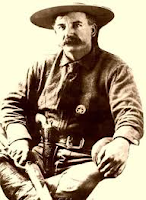 |
| Heck Thomas |
Heck Thomas’s career as a soldier ended with a bout of typhoid fever. Instead, he became a U.S. deputy marshal in Indian territory under Judge Isaac Parker. Tired of the frontier, his wife took their children and left. After being nearly killed in a shootout, a young schoolmarm fell in love with Heck while he recuperated, giving him a second chance at happiness.
Doc Holliday suffered from tuberculosis and carried a cane on his way to the Gunfight at the O.K. Corral.
 |
| Doc Holliday |
 |
| Beefcake actor Victor Mature was totally miscast as the 122-pound tubercular Doc Holliday in “My Darling Clementine.” Mature gave it his best shot, however, and one of his most endearing qualities was his unpretentiousness. When rejected from membership in a country club because he was an actor, Mature replied: “Not true. I’ve never been an actor—and I’ve got 70 movies to prove it.” |
 |
| Frank Hamer intended on becoming a preacher. After the rancher he was working for offered him $200 to kill somebody, later unloading a shotgun in his back for refusing, Hamer decided on a career in law enforcement instead. |
Texas Ranger Frank Hamer was wounded 23 times in the line of duty and left for dead four times. He overcame bullet wounds and near death to find fame as the man who finally brought down Bonnie & Clyde.
Robert McAlpin Williamson was crippled as a youth, his leg bent back at the knee. Rather than amputate it, he fitted a peg leg to the knee and became affectionately known as “Three-Legged Willie.” He studied law and came to Texas, establishing one newspaper and editing three others. Stephen F. Austin urged him to use his newspaper to promote peace with Mexico; instead, the firebrand became such a proponent of independence, he was known as “The Patrick Henry of Texas.”
Despite his handicap, Willie served as a Texas Ranger and fought at the Battle of San Jacinto, along with loving to dance and playing the banjo. He also liked to perform a rhythmic thigh-patting, hand-clapping, and foot stomping entertainment known as pattin' juba.
 |
| Robert McAlpin Williamson—Three-Legged Willie was known as a delightfully eccentric character with a colorful oratory style. When asked to offer a prayer to a group of drought-stricken farmers, he beseeched the Lord “to send a drencher that will … make corn ears shake hands across the row and not one of those little rizzly-drizzly sprinkles that’ll make nubbins that all hell can’t shuck.” |
The First Congress of the Republic of Texas elected Williamson judge of the Third Judicial District, automatically making him a Supreme Court Justice. He once held court in a region known for its lawlessness, with two rival gangs fighting for control. One attorney made a motion that court should not be held. When Willie asked on what grounds, the man plunged a Bowie knife in the desk Willie sat at and said, “This is the law that governs here.” Willie pulled out a long-barreled pistol and said, “This is the constitution that overrules it.”
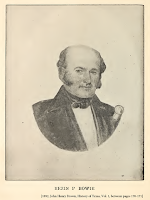
James Bowie
 |
| Jim Bowie, tall, heavy framed and raw-boned, rode alligators and trapped bears in Louisiana. He reportedly had an open and frank disposition, but when he felt he had been insulted, his temper was a terrible sight to behold, his gray eyes transforming into those of a tiger. |
I know what you are thinking. “Is she crazy? Jim Bowie was a despicable human being, an illegal slave trader and land speculator. And besides, he wasn’t a lawman.” He also went on a two-day drunken spree when voted commander of volunteers at the Alamo, fighting with Col. William B. Travis and wreaking havoc on the city of San Antonio by releasing prisoners and harassing citizens. An angel he was not. But he possessed an energy and charisma that other men admired, along with undeniable courage.
 |
The 1950s are criticized for trying to make a buck glamorizing men like Bowie, but
I don’t know if the 2000s are any better off trying to make a buck tearing them down. |
 |
| The first Bowie knife was made in Avoyelles Parish, Louisiana, according to Rezin Bowie’s specifications. He later gave it to his brother Jim who made it famous. Rezin basked in his brother’s fame and in the knife he had designed. |
In frontier days, when engaged in close fighting, a man would fire his flintlock, and immediately draw his knife. To be a good knife fighter was much more important than being a good shot. Because of his high-stake speculations involving large sums of money, Bowie’s brother, concerned for his safety, gave him a long-bladed butcher knife for protection. When partaking in an infamous brawl known as the “Sand Bar Fight,” Bowie made history by successfully defending himself with the knife despite being shot twice and stabbed several times. A demand for the “Bowie Knife” was born.
 |
| "All the steel in the country it seemed was immediately converted into Bowie knives,” reported the Red River Herald of Natchitoches. Schools were opened to teach to teach the arts and dodges of Bowie knife fighting, especially in the Southwest. "In the history of American arms," wrote historian Harold L. Peterson (1958), "three weapons stand out above all the rest: the Kentucky rifle, the Colt's revolver, and the Bowie knife." |
Bowie recovered from his wounds, and three years later drifted into Texas, drawn by visions of vast sums to be made land speculating. He married a beautiful young woman, Ursula de Veramendi, the daughter of a powerful and influential Tejano family. Always on the move, looking to make a deal somewhere, Bowie was in Natchez recovering from a bout with malaria when word came his wife had died of cholera. Bowie recovered physically from his illness, but till the end of his life, his eyes would often tear up at the mention of his wife’s name.
 |
| A depiction of Jim Bowie’s Sandbar Fight is on display in the Natchez, Mississippi, Convention Center. |
Returning to Texas, Bowie and his brother Rezin searched for a supposed lost silver mine at an old Spanish mission, Santa Cruz de San Sába. Bowie didn’t find the mine, but he further enhanced his reputation by successfully fending off a large band of hostile Tahuacanos Indians for several days with the help of a few prospectors. (The numbers are estimated 124 to 11.)
 |
What’s left of the Santa Cruz de San Sába Mission sits near the San Saba River about three miles east of the present town of Menard and four miles from the ruins of San Luis de las Amarillas Presidio. |
Bowie was unhappy when General Santa Anna put a stop to his land speculating schemes in Texas, but it was more upsetting that the dictator overthrew the Constitution of 1824. Stephen F. Austin had preached for years to the Texans to try to get along with the Mexican government. Nevertheless, when Austin tried to get the Mexican government to recognize Texas as a state within that government so they could have representation, he was thrown into a Mexican prison and left there for months.
The majority of settlers in Texas were Anglos with a long history of the Magna Carta. Writ of Habeas Corpus and trial by jury were sacred to their ideas of freedom and liberty. They realized even if they were allowed to stay, they would be living under a volatile and everchanging government, subject not to laws but to the whims of whoever happened to be in power at the time. It was either leave and give up everything they had worked for, or stay and fight. Bowie threw his lot in with those determined to stay and wage war for the liberties they held dear, and he returned to San Antonio, the home of his beloved wife.
“There is no man on whose forecast, prudence, and valor, I place a higher estimate,” Sam Houston wrote of Bowie. He possessed leadership, charisma, and popularity in spades, and Texas needed him.
My
great-great grandmother Elizabeth Jackson Heffington said the Texas settlers
were much more afraid of the Mexican army than they were of the Indians. She
should know—her husband was killed by Indians in Waco, so for them to be worse
in her mind was a very real thing.
Bowie was determined to hold the line at San Antonio de Béxar and protect the bexareños from the same fate Santa Anna had inflicted on the rebellious Zacatecans: rape, murder, and pillage of rebels and innocents alike.
“In this war you know there are no prisoners.” General Santa Anna
Bowie volunteered to defend the Alamo and was put in charge of the volunteer forces, ready to “die in these ditches than give up this post to the enemy.”
 |
| The Alamo |
But Bowie became ill with an unknown respiratory disease, and he ceded command to Col. Travis, who was already in charge of the regular army. Despite his illness, Bowie continued to rouse confidence in the men. When he became too ill to move from his cot, he would often ask his men to carry his cot out so he could speak encouraging words to the soldiers, reminding them Travis was now their commander. The confidence given to the soldiers by having men like Bowie and Crockett at the Alamo is immeasurable.
 |
Statue on the grounds of
the Alamo of Wm. B.
Travis drawing the line
in the sand. |
At the darkest hour, knowing surrender would only mean death, Col. Travis declared his decision to sell his life as dearly as possible. He took his sword and drew a line in the sand.* Any man who wished to leave the Alamo under cover of darkness could do so, but he asked every man who would stay and perish with him to step over the line. Every man did so, except one, a Frenchman who wasn’t ready to die and thought he could pass for a Mexican if he had to, Louis “Moses” Rose. (No relation to me, at least, not that I know of.) A dying Bowie asked that his cot be taken over the line.
 |
| Louis Rose, nicknamed Moses because of his age (51), followed his friend Jim Bowie to the Alamo. He had served with distinction with Napoleon, but left the Alamo because he wasn’t ready to die. Until the day he did pass away, though, he suffered in pain from the thorns embedded in his flesh that he received during his perilous escape through rough country. |
 |
Bowie fighting from
his deathbed. |
It is generally believed that Bowie fought to the death from his cot in the Alamo, his body mutilated. We think of the cries of the men and women enslaved by Bowie, of the tears and anguish of the wives and children of the men he killed in fights, but we also remember the brave actions that helped the cause of freedom take another step down the road to a place where one day all men will be free. And that is the highest law of all.
 |
| When Texans regained control of San Antonio, the bones and ashes of the Alamo dead were still in visible piles. They were shoveled into a large coffin and secretly buried under the altar of what is now the San Fernando Cathedral. In 1936, the coffin was accidentally dug up. Two years later the remains were placed inside an ornate sarcophagus to be put on public view, where it can still be seen today. |
I will never participate in any defining moments in history, acquitting myself of sin as Jim Bowie did even in illness or limping into legend like Doc Holliday. But as an author, I can take the emotion so close to the surface when I am feeling unwell and turn it into fervor on the pages of a manuscript. My embarrassing impulse to fight anyone who crosses me can be transmuted to my characters, filling paragraph after paragraph with action and adventure for the enjoyment and inspiration of others.
“The measure of who we are is what we do with what we have.” —Vince Lombardi
*The veracity of Louis Rose and the line in the sand has long been a subject of hot debate.
William P. Zuber, who first wrote of the incidence, has been called both a lurid storyteller and a reliable individual. He claims Louis Rose did escape and made his way to Zuber’s family home, telling his parents the story. Zuber’s aged mother, known for her remarkable memory, attested it was true and
several neighbors remember hearing the Zubers tell it. Unfortunately, William Zuber had a tendency to embroider the truth in other areas, casting doubt over this one. However, the incident of the line is confirmed by Alamo survivors Susanna Dickinson and Enrique Esparza. Furthermore, documents in the Nacogdoches courthouse confirm the presence of a Louis Rose living there after the fall of the Alamo. Historian J. Frank Dobie saw the line in the sand as more important than any argument over it. “It is a line that not all the piety nor wit of research will ever blot out,” Dobie wrote. You may do as you wish, but as for me, I am not willing to call Grandma Zuber a liar.
Sources: The Blood of Heroes by James Donovan. Eyewitness to the Alamo by Bill Groneman. https://www.thealamo.org/remember/james-bowie; https://grandlodgeoftexas.org/robert-mcalpin-williamson-patrick-henry-texas-revolution/; https://tarltonapps.law.utexas.edu/justices/profile/view/116; https://www.tshaonline.org/handbook/entries/rose-louis-moses; https://www.tshaonline.org/handbook/entries/bowie-knife#:~:text=Bowie%20Knife.In%201838%20Rezin,been%20shot%20in%20a%20fight; https://www.roadsideamerica.com/story/46029; https://www.thealamo.org/remember/james-bowie/bowies-silver;
For more blogs see:
Texas Outlaws and Lawmen - Texas Ranger Cicero Rufus Perry https://westernfictioneers.blogspot.com/2022/02/texas-outlaws-and-lawmen-texas-ranger.html
Wild Bill Longley - The Lone Wolf https://westernfictioneers.blogspot.com/2022/03/wild-bill-longley-lone-wolf-by-vicky-j.html
My websites:www.vickyjrose.com www.easyjackson.com
BOOKSAs V.J. Rose
HELL WEST OF THE PECOS
A broke Texas rancher risks all to drive longhorns through the wilds of West Texas to sell to the government in New Mexico, but he’s hindered by the feuding relatives and green cowboys he is forced to hire as drovers. https://www.amazon.com/Hell-West-Pecos-Classic-Western-ebook/dp/B0B57H1YVP
TREASURE HUNT IN TIE TOWN—Reader’s Favorite Five Star Award
A rancher takes his nephews on an adventurous hunt for buried treasure that lands them in all sorts of trouble. https://www.amazon.com/Treasure-Hunt-Town-V-J-Rose-ebook/dp/B07GL2T2L6/ref=sr_1_1?crid=SFQM7U0AN3FF&keywords=treasure+hunt+in+tie+town&qid=1569773588&s=books&sprefix=treasure+hunt+in%2Cstripbooks%2C201&sr=1-1
TESTIMONY
Two lonely people hide secrets from one another in a May-December romance set in the modern-day West. https://www.amazon.com/Testimony-V-J-Rose-ebook/dp/B07FBC971J/ref=sr_1_2?crid=SFQM7U0AN3FF&keywords=treasure+hunt+in+tie+town&qid=1569773615&s=books&sprefix=treasure+hunt+in%2Cstripbooks%2C201&sr=1-2
As Easy Jackson
A BAD PLACE TO DIE—Will Rogers Medallion Award and A SEASON IN HELL
Tennessee Smith becomes the reluctant stepmother of three rowdy stepsons and the town marshal of Ring Bit, the hell-raisingest town in Texas. https://www.amazon.com/Bad-Place-Tennessee-Smith-Western/dp/0786042540/ref=tmm_mmp_swatch_0?_encoding=UTF8&qid=1569773439&sr=1-1
https://www.amazon.com/Season-Hell-Tennessee-Smith-Western/dp/0786042567/ref=pd_sbs_14_1/132-7644810-2844345?_encoding=UTF8&pd_rd_i=0786042567&pd_rd_r=f5f73ea9-df93-46e7-b002-87cd61097ca1&pd_rd_w=xTzD8&pd_rd_wg=OsUzo&pf_rd_p=d66372fe-68a6-48a3-90ec-41d7f64212be&pf_rd_r=FDF2CTCM49RMWFJ0WXXC&psc=1&refRID=FDF2CTCM49RMWFJ0WXXC
MUSKRAT HILL—Peacemaker Finalist
A little boy finds a new respect for his father when he helps him solve a series of brutal murders in a small Texas town. https://www.amazon.com/Muskrat-Hill-Easy-Jackson/dp/1432866044/ref=sr_1_1?keywords=muskrat+hill+by+easy+jackson&qid=1581181324&s=books&sr=1-1
Short Stories:
WOLFPACK PUBLISHING - "A Promise Broken - A Promise Kept"—Spur Award Finalist
A woman accused of murder in the Old West is defended by a mysterious stranger.
https://www.amazon.com/Promise-Broken-Kept-Western-Short-ebook/dp/B07CYP3G3P/ref=sr_1_1?keywords=a+promise+broken+a+promise+kept+by+VJ+Rose&qid=1569773655&s=books&sr=1-1
THE UNTAMED WEST – “A Sweet-Talking Man” —Will Rogers Medallion Award
A sassy stagecoach station owner fights off outlaws with the help of a testy, grumpy stranger. A Will Rogers Medallion Award Winner. https://www.amazon.com/Untamed-West-L-J-Washburn-ebook/dp/B07GH7WB58/ref=sr_1_3?keywords=the+untamed+west+anthology&qid=1569773750&s=books&sr=1-3
UNDER WESTERN STARS - "Blood Epiphany"—Will Rogers Medallion Award
A broke Civil War veteran's wife has left him; his father and brothers have died leaving him with a cantankerous old uncle, and he's being beaten by resentful Union soldiers. At the lowest point in his life, he discovers a way out, along with a new thankfulness. A Will Rogers Medallion Award Winner.
https://www.amazon.com/Under-Western-Stars-Richard-Prosch/dp/B08KH3S2KR/ref=tmm_pap_swatch_0?_encoding=UTF8&qid=&sr=
SIX-GUN JUSTICE WESTERN STORIES – “Dulcie’s Reward”
Seventeen-year-old Dulcie is determined to find someone to drive her cattle to the new market in Abilene. https://www.amazon.com/Six-Gun-Justice-Western-Stories/dp/B09FCCLTHQ/ref=tmm_pap_swatch_0?_encoding=UTF8&qid=&sr=
Reenactment Video on YouTube “Blood in the Streets” https://youtu.be/vrW_uFBGe8Q
Anthology:
WHY COWS NEED COWBOYS: AND OTHER SELDOM-TOLD TALES FROM THE AMERICAN WEST
“Katie Jennings & John Holland Jenkins: Young Heroes in the Fight for Texas Independence”
https://www.amazon.com/Why-Cows-Need-Cowboys-Seldom-Told-ebook/dp/B08YWJDGZ8/ref=sr_1_1?crid=2S1C6UIQO4IZ9&keywords=why+cows+need+cowboys&qid=1645144537&s=books&sprefix=why+cows+%2Cstripbooks%2C110&sr=1-1
Thanks for reading!


