Saturday, June 15, 2019

Western Fictioneers Announces the 9th Annual Peacemaker Awards


(For Westerns Published in 2018)

BEST WESTERN NOVEL:

GRIT by Ron Schwab (Uplands Press)


Finalists:
THE PISTOLMAN’S APPRENTICE, Linell Jeppsen (Wolfpack Publishing)
TIMBERLINE, Matthew P. Mayo (Five Star)
GYPSY ROCK, Robert D. McKee (Five Star)
FATHER UNTO MANY SONS, Rod Miller (Five Star)

BEST FIRST WESTERN NOVEL:

(Tie)
WHERE THE BULLETS FLY, Terrence McCauley (Kensington)        
I AM MRS. JESSE JAMES, Pat Wahler (Blank Slate Press)


Finalists:

THE CHAPMAN LEGACY, John Neely Davis (Five Star)
THE SCARRED ONE, Tyler Boone (Charles Gramlich) (Sundown Press)
REBECCA’S HOPE, Kimberly Grist (Winged Publications)

BEST WESTERN YA/CHILDRENS FICTION:

ESCAPE TO FORT ABERCROMBIE, Candace Simar (Five Star)


Finalists:
MYSTERY ON THE PECOS, Alice V. Brock (Pen-L Publishing)
RAWHIDE ROBINSON RIDES A DROMEDARY, Rod Miller (Five Star)
CASTLE BUTTE, John D. Nesbitt (Five Star)
THE CHRISTMAS BEAR, B.N. Rundell (Wolfpack Publishing)                                                                                   


BEST SHORT FICTION:

“The Lake Spirit”, Troy D. Smith (THE LONE RANGER AND TONTO: FRONTIER JUSTICE, Moonstone)


Finalists:

“Byrd’s Luck”, Jeffrey J. Mariotte (THE UNTAMED WEST, Western Fictioneers)
“The Gamble”, Cheryl Pierson (THE UNTAMED WEST, Western Fictioneers)
“Father Pedro’s Prayer”, Michael R. Ritt (THE UNTAMED WEST, Western Fictioneers)
“Peyote Spirits”, Ron Schwab (Uplands Press)

Western Fictioneers would like to thank the judges for the excellent job they did and the long hours they devoted to reading the submissions.


Monday, June 10, 2019

Michael Atkinson – American artist by Kaye Spencer #westernfictioneers #americanartist


In the early 1990s on one of my visits home to Fort Morgan, Colorado from where I’d moved to take a teaching position in the southeastern corner of the state (a 500-mile round trip), I stopped in Limon at a convenience store/souvenir shop. The shop had a bin of posters and prints that you could flip through. This is where I came across my first Michael Atkinson painting. I was immediately enthralled, captivated, and in love with Atkinson’s work. (The images I'm sharing are prints I've purchased.)

'Western Majestic' - Michael Atkinson
'Unknown Title' by Michael Atkinson

'Pueblo Sentinel' ceramic tile by Michael Atkinson


For the next several years, I checked that same shop for Atkinson prints every time I passed through Limon. I also looked in shopping malls, other souvenir shops, second hand stores, etc. Every time I found an Atkinson, I thought I had a treasure. It mattered not at all that the prints I bought weren’t originals or even expensive. Keep in mind, this was just as the Internet launched (1991), and years before eBay (1995) and Amazon (1994) started and it took these venues a few more years to gain their current popularity and convenience for finding what you want at the click of a few keyboard keys.

'Emerald Lake' by Michael Atkinson

L-R: 'Scouting Party' | 'Unknown Title' | Mountain Reflections
by Michael Atkinson

Upper Left to Right then Below:
'Spring Rider' | 'Thunderstorm' | 'Crystal Cliffs'
by Michael Atkinson

'Unknown Title' by Michael Atkinson

So, who is Michael Atkinson? He is a painter and sculptor, but beyond that, an Internet search produces scant information about him. These two websites, www.prints.com and www.galleryone.com, offer a tiny bit about him.


From his Smoky Ridge studio in Texas, Atkinson seeks to capture the emotion, be it subtle or exaggerated, a pursuit that has been in evolution since he started painting as a child in the northwest Texas town of Lubbock. Attracted early to the study of architecture, he earned a degree from Texas Tech University, then taught and worked in the field for a time. From the first, his art, prints and posters have reflected his training, experience, and wide-ranging interests, as he creates images buildings, oceanscapes, animals, and Southwestern landscapes through a unique, semi-abstract style and a mastery of watercolors, spontaneity, and freedom. White space is an essential element of the composition that characterizes Atkinson's art, prints and posters. The white is not empty. It is completely finished. Treating the paper as an element of design, the artist works from one concentrated area of detail and color, leaving much of the paper white and allowing the eye to focus on the central image without intrusion from the periphery.


The other source of information I have is this paper that is attached to the backs of several of my prints. There is a reference to ‘seven years ago’, but there isn’t a year listed, so there’s no point of reference. You’ll notice this information is stamped with Diversified Art, Inc., Tucson Arizona, but an Internet search didn’t reveal much about this organization.


I have a Pinterest board of Michael Atkinson’s artwork, and these few prints hanging on my living room walls are enough.


Kaye’s Michael Atkinson Pinterest board: https://www.pinterest.com/kayespencer/michael-atkinson-artist/


Are you familiar with Michael Atkinson’s works? 

I’ve labeled three of the pictures as “Untitled”, because the prints lack titles. I haven’t found them on the Internet, either. But I’ll continue to search. That’s part of the enjoyment of having a reason to browse through Michael Atkinson’s art.

Until next time,

Kaye Spencer

As I don’t send a newsletter, you might consider following me on these social media venues:

Thursday, May 30, 2019

21 'FACTS ABOUT THE PIKES PEAK REGION'

post by Doris McCraw
writing as Angela Raines


With Memorial Day weekend behind us, and summer just ahead, with all its strange weather, I thought a list of fun facts about the region I live in might be a nice diversion.


1    Colorado Springs is the county seat for El Paso county. In 1861, when President Buchanan signed the order creating the Colorado territory, El Paso became one of the original 17 counties.


2     Although other towns may have been planned, Colorado City, now known as Old Colorado City, was the first actual town in El Paso County.


3      Black Forest was part of an area that was called ‘The Pineries’. It was from here lumber for the building of Colorado Springs, Denver and the various railroads was logged.


4      Fox run park has many trees that are Ute Prayer Trees. The Ute and Comanche inhabited the area until about 1800 when the Kiowa took over the area. They in turn were run out by the Ute and Comanche about 40 years later.


        Canon City had a territorial prison in 1871, five years prior to Colorado becoming a state in 1876. At that time, it became part of the state system.

Arkansas River - Canon City
photo property of the author
    Although Cripple Creek has the honor of being the place where Bob Womack located gold and started the last great gold rush in the lower 48, most of the mines in the area were located on Battle Mountain near Victor Colorado.


7        Manitou Springs was originally founded as town to be fashioned after the resorts in Europe. The town was known for its healing mineral waters that visitors would drink to improve their health.


1        The Pikes Peak Hill Climb had its first race 1916 and is the second oldest race in the United States. It was promoted and conceived by Spenser Penrose, who had converted the old carriage road into an auto road.


2        The Pikes Peak or Bust Rodeo originated in 1937 and took place at the Will Rogers Stadium, across from the Broadmoor, until 1973 when it moved to the Pikes Peak Equestrian Center. (now known as Norris-Penrose)


3        Colorado Springs was chosen as the national headquarters in 1977. It established the Olympic Training Center at the old ENT Air Force Base at the corner of Boulder and Union. Colorado Springs is now known as Olympic City USA.


4        Prospect lake originally was used as a reservoir to water Evergreen Cemetery, and the east side of Colorado Springs. It was also the place for ice skating in the late 1800s.

Heasdstone - Evergreen Cemetery -  Colorado Springs
Photo property of the author
    Pro Rodeo Hall of fame opened in 1979 and is the only museum in the world devoted to the sport of professional rodeo.


6        Winfield Scott Stratton, Cripple Creek Millionaire, donated land for a baseball park and even purchased bicycles for laundry ladies.


          On Saturday June 7, 1873 the Base Ball Club played their first game. The newspaper had a reporter on site, but he was sad, for no accidents of note occurred. ( source - Colo. Springs Weekly Gazette)


          In 1879 ‘wool growing’ was one of the top industries in the region.


          Colorado Springs has seen Eight plus railway companies come and go during the heyday of train travel. The Manitou & Pikes Peak Railway and the BN&SF are still active


    Tourism has always been a part of the region. Cave of the Winds was ‘first’ discovered in 1880. It was called ‘Pickett’s Cave’ in honor of the minister whose group found it. *source Colorado Springs Weekly Gazette, July 3, 1880. Pg.7, col. 1 *

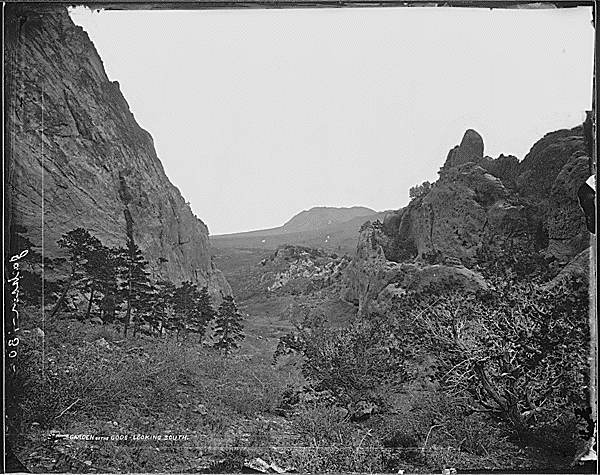
           Out West, the first newspaper for Colorado Springs, had this to say about Garden of the Gods in the June 20, 1872 issue. “ The Garden of the Gods is one of the best know wonders of Colorado, its characteristic features being so striking as to arrest the attention of even such as may not be susceptible to the grander beauties of the mountains.”


     Author Helen (Hunt) Jackson has this to say about Cheyenne Canyon in her essay of the same name. “There are nine “places of divine worship” in Colorado Springs, - the Presbyterian, the Cumberland Presbyterian, the Methodist, the South Methodist, the Episcopal, the Congregationalist, the Baptist, the Unitarian and Cheyenne Canyon.”   


           There were numerous coal mines in the area making it an early and profitable industry for the region.


           Early on, Ute Pass was considered one of the easiest routes to the gold and silver mines in the Leadville and South Park area.

            Enjoy your summer, writing and may your book sales and reading be even greater than you expect. 


Doris Gardner-McCraw -
Author, Speaker, Historian-specializing in
Colorado and Women's History
Angela Raines - author: Where Love & History Meet
For a list of Angela Raines Books: Here 
Angela Raines FaceBook: Click Her


Monday, May 27, 2019

The Mule-Made Man

Nacogdoches, TX 

It all started with a mule.

I’m going to take a chance and exercise a little literary license by posting this story on a blog dedicated to the American West, and I feel justified in doing this for two reasons: First, this story takes place in 1912 during the tail-end of what is considered the time period that we associate with the west (usually from the end of the Civil War to the beginning of WWI). Second, whereas the “west” is generally considered to be located west of the Mississippi, this story takes place just inside that border, about eighty miles west of the Mississippi River in the east Texas town of Nacogdoches.

But before we get to the part with the mule and what exactly happened in Nacogdoches in 1912, we need to back up a little and get some context to the story and introduce our main character, Julius.

Julius was born on a chilly day in October 1890 in a room above a butcher shop in the poor Yorkville section of New York City’s Upper East Side. His parents, Sam and Minnie, were Jewish immigrants from Germany. Sam and Minnie already had two sons (a third had died of influenza at the age of seven months) and, by 1901, would add two more sons to the family.

By all accounts, Julius had a happy childhood and dreamed of becoming a doctor someday. However, the family was poor. His father, Sam, worked as a tailor, but apparently, was not a very good one. Julius wound up dropping out of school at the age of twelve to help support the family. He worked at several different jobs, but his
Minnie and Sam with their five boys
big break came when his mother realized what a pleasant singing voice he had. Actually, all of Minnie’s boys were musically inclined. Her oldest son, Leonard, played the piano and her second oldest son, Adolph, eventually learned to play six different instruments. Minnie was ambitious for her sons and came up with an idea. She had a brother who worked in vaudeville. Maybe she could use that connection to get her boys on the stage.

On July 16, 1905, 14-year-old Julius took to the stage as part of the Le May Trio, debuting at the Ramona Theatre in Grand Rapids, Michigan. Entertaining on the road wasn’t all glamour for the young Julius. At one point after a show in Colorado, one of the other group members took off with all of his money, stranding him. He found a job in a grocery store where he worked until he had saved up enough money to go back home to New York.  

The Four Nightingales
Undaunted, by 1907 Julius joined with his older brother, Adolph, and a younger brother, Milton, to form a trio called “The Three Nightingales.” Sometimes they were joined by a friend, Leo Levine, and were known as “The Four Nightingales.” They toured all over the country with Minnie as their manager. However, it was still tough going for the family. They only experienced moderate success and felt like they hadn’t really discovered their place in the entertainment industry.

Here’s where the mule comes in.

One night in 1912 (some accounts have it as early as 1907 and others put it at 1914) the brothers were performing at the Opera House in Nacogdoches, Texas. Sometime during the middle of their performance, the show was interrupted by someone busting through the door of the Opera House and shouting, “The mule’s loose!” These Texans were a peculiar bunch who were either easily distracted or found the prospect of a mule tearing through town more entertaining than the singing brothers. At any rate, most of the audience jumped to their feet and ran outside to see what was going on.

Julius was seething at having lost the spotlight and his brothers were furious at what they considered rude behavior from the audience, so after the audience returned, Julius let them have it. The insults rolled off of his tongue. He told them that “Nacogdoches is full of roaches,” and that “The jackass is the flower of Tex-ass.” No matter how many insults he threw at them, to his amazement, rather than getting mad at him, the audience laughed. It was then that they realized that they could have a future as a comedy group, and that, as it turned out, was their destiny.

Although all five of Minnie’s boys would at one time or another be a part of the group, it was primarily the three oldest boys, Leonard, Adolph, and Julius who made a name for themselves in comedy. If it hadn’t been for that mule, they might have remained little-known singers. But because of that night in Nacogdoches, we all know them as comedic geniuses. They even made thirteen movies together and Julius wound up with a star on Hollywood Boulevard.

But if you don’t recognize their real names, you will undoubtedly recognize their stage names: Chico (Leonard), Harpo (Adolph), and Groucho (Julius) – the Marx Brothers.

*****


Mike Ritt describes himself as Conservative, Christian, Pro-life, and Pro-gun. He is a drinker of copious amounts of coffee. Happily married to his redheaded sweetheart, Tami, they live in the mountains of western Montana. He is a writer of western short stories, poetry, and humorous fiction and has been published in a number of anthologies and magazines. He has finished his first western fiction novel and is patiently waiting for publication. You can visit his Facebook page at https://www.facebook.com/MichaelRRittAuthor, and his blog at http://michaelrritt.blogspot.com.