Showing posts with label Colorado Springs. Show all posts

Tuesday, November 22, 2022

Collaboration -Invaluable


Post by Doris McCraw aka Angela Raines

McAllister House
Photo Property of the Author

Preservation and presentation of history is a vital foundation for civilization. While we think of history as something solid from the past, it is fluid. Its very fluidity adds to the richness that has come before. Much like the story of the early women doctors in Colorado that I myself have been researching for the past ten-plus years, this additional information, and fluidity if you will create a story that people can connect to. These connections we can find by sharing information will continue to give us a solid foundation upon which to grow our future.

As an example, the common story is that William J. Palmer founded Colorado Springs, Colorado. This is true, to a point. The city was his dream. The truth, he needed help to make that dream a reality. The collaboration he received was invaluable to creating the dream. Originally "The Fountain Colony" was a 'membership organization that one joined to purchase real estate during the city's formative years'.

Some of the people who helped Palmer realize his ambition to create a town at the base of Pike's Peak might have been lost to time had they not left legacies of their own.

Dr. William Bell had been part of the original survey party in which Palmer first saw the region. Dr. Bell was born in Ireland, studied at Cambridge University, and had a practice at St. George's Hospital in London. Dr. Bell was in the United States to continue studying homeopathy when he became part of Palmer's party. He continued with Palmer as the two along with others created the resort town of Colorado Springs and the health mecca Manitou Springs.

Pikes Peak
Photo Property of the Author

Henry McAllister, Also a Quaker who was also from Pennsylvania and a member of General Palmer's 15th Pennsylvania Calvary during the Civil War and rose to the rank of major. McAllister had a job as the secretary of the American iron and steel Association when he accepted Palmer's invitation to be a part of the founding company of Colorado Springs.

William Sharpless Jackson, also a Quaker from Pennsylvania, was part of Palmer's founding organization. He was working for a railroad in the Midwest when tapped by Palmer. It was Jackson who spent years in banking, was a Denver and Rio Grande railroad executive and like McAllister and Bell along with Palmer had a part in the creation of Colorado College.

Both Jackson's and McAllister's sons continued the legacy started by their fathers but their story is for another time.

As you can see, one person can have an idea, but in order to realize that idea it takes collaboration, it takes people willing to become part of something bigger. It is through the work of these men, their families, and researchers/historians that we understand how invaluable collaboration is. The more we know the richer our history becomes.

Perhaps you have a project you're working on, collaboration, asking for help, is invaluable. Growing this organization, and keeping it vital, takes more than just one person. Keep up the good work, we're on our way and with everyone's help will make it to the top.

For those who would like to know more here is a YouTube video from the director of "The McAllister House Museum" on 'The Development of the Fountain Colony...' Fountain Colony

Until next time.

Doris McCraw


Tuesday, July 27, 2021

Is It True, Mr. Adams? (Andy Adams)


Post by Doris McCraw
writing as Angela Raines

Many people talk about Andy Adams and his writings. Many speak in fond terms about his book, "The Log of a Cowboy". Manly Dayton Ormes (yes, that's his real name) in his book, "The Book of Colorado Springs" wrote the following about Adams:

            Andy Adams, another of our own, came to Colorado during the Cripple Creek gold excitement, after his Texas cowboy life. He took up mining and story writing; he lost a fortune in the first venture but retrieved at least part of it in the second; after he wrote "The Log of a Cowboy", his work was sought far and wide. His insight into cattle life "was not obtained from a Pullman car window, but close to the soil, and from the hurricane deck of a Texas horse." These are his words. He tells of seeing one night after his money was gone, Charles H. Hoyt's "A Texas Steer." The opera house was crowded with a delighted audience. With his 20 years in the West, 12 of them in the saddle, he told Henry Russell Wray, who was a great friend of his, that he felt he could contribute something of the real romance of the cattle trail which should please the public even more than the sensationalism of "A Texas Steer." So being encouraged by his friend, he tried his hand and one. He has since lived here, an interesting figure connecting present and past.

Andy Adams
photo from Wikipedia

Yes, the iconic book, "Log of a Cowboy", if not written, was probably finished in Colorado Springs, Colorado, and published in 1903. The play of Hoyt's he spoke of played in both Pueblo and Leadville around 1900. In 1903 he was rooming in the St. James Hotel. He later moved to The Albany Hotel, which was built in 1902, where he remained until his death in 1935.

Photo Property of the Author

The local papers would note when Mr. Adams was writing another book. He was a celebrity in what was then a modest-sized town. Yet, almost all speak of Adams with great affection. Of Scotch/Irish heritage, Adams was six foot tall and was said to have a kindly smile and modest manner. The biographical/obituary articles after his death had this to say:

             He did not give the impression that he was one of the world's greatest literary figures either. With his rather wide-brimmed Stetson, his black string tie, and slightly oversized caller, he seemed more the big ranch owner or foreman than one who had written the finest novel of the cowboy and the trail that has ever been written. Like his friend Rhodes, he did not regard the writing of a good book as constituting any greater distinction than the writing of a good horse or the capable driving of a trail herd.
            And he rarely "talked literature." He alluded once in a while to the novels by Rhodes and Hough, as he mentioned now and then the paintings by Russell and Charles Craig, because he admired them and saw in them true portrayals of the West and the cattle range as he knew them. But literature as a thing separate from reality met little if anything to him.
            "I don't know anything about fancy writing," he said once, "any more than I know about this fancy writing you see in the pictures. When I sit down and write I go about it the best I can, tell what I have to say and quit. That's the way I did when I wrote a horse. I leave the fancy stuff to the fancy fellows."
            Which is one of the reasons why Andy Adams was a great — a great writer and a great cowman.


Photo of Adams from The Colorado Springs Gazette
around 1926

In 1923 Adams received a letter from a Mr. B. Youngblood from the Texas Agricultural  Experiment Station in College Station, TX. requesting some biographical information as they were using his books to teach about Texas ranch life. Adams reply read:


Adams had joined the Masons after moving to Colorado. He is buried in Evergreen Cemetery in Colorado Springs.  He died on September 26, 1925, of a heart attack, the following was posted in the biography/obituary that appeared in the paper:

            Andy Adams, the last of the great cowmen who abandoned the cattle drives and roundups to travel the trails of Western literature and art, has gone to join the other members of that noble brand — Emerson Hough, Charlie Russell, an old Gene Rhodes. Andy headed down the last trail early yesterday morning.
            "Just get an early start, well before sunup, as any good cowboy out to do," he himself would probably have said that had he known that the bars were down for the last, lone trek.
            Though his death was unexpected by his friends, he himself seemed to of had a premonition that the end was near. Only a few days ago, when informed in the course of one of those short walks he was in the habit of taking daily, that his health appeared to be improving, he smiled and asked, "Do you really think so?" Then he shook his head. "The old pump's worn out," he said. "I'll have to junk it one of these days."
            But he didn't look as if the "old pump" was worn out. Large of body, full of determination to keep going, he did not give the impression of a man who stood at the brink of the grave.

Thus ended the days of Andy Adams, a writer many know, and an unknown to so many others. Yet, like all writers, his words live on in the stories he told. 

Photo property of the Author

For those who might be looking for an ebook copy of "Log of a Cowboy". There are also newer versions and paperbacks.

Doris Gardner-McCraw -
Author, Speaker, Historian-specializing in
Colorado and Women's History
Angela Raines - author: Telling Stories Where Love & History Meet

(c) Doris McCraw  All Rights Reserved.

Tuesday, October 27, 2020

The Union Printers Home - A Place to Live Out Your Life, however long it might be

 Post by Doris McCraw writing as Angela Raines

Headstones of members of the National Typographical Union
Evergreen Cemetery
photo property of the author

In 1892 the International/Nationa Typographical Union built a facility in Colorado Springs for the care of its ill members. Part of the reason for the choice was the reputation Colorado and Colorado Springs had for curing diseases of the lungs. 

Image from Pinterest

It was during the founding of the town in the Pikes Peak region during the early 1870s that those suffering from lung problems found that the clean air helped alleviate the symptoms. Dr. Samuel Edwin Solly and his wife arrived in the region hoping the cure the tuberculous they both were suffering from. Dr. Solly survived. His wife did not. Still, Dr. Solly remained and did much to promote the region as a cure. He published papers and articles on the subject. 

At the time the typographical union decided to build its facility in Colorado Springs, a number of its members were suffering lung problems as a result of the carbon-based ink used in their profession. Due to this problem, the average life expectancy of a printer was about forty-one years. The facility and its grounds grew over the years to encompass more than 260 acres and included a dairy farm, gardens, and a power plant.

Image from the Historic Preservation Alliance, 
Colorado Springs

The Printers Home also had/has a large area in the local cemetery for their deceased members. Although the home is now closed, its presence and history continue to fascinate. And for those who might be interested, it is located close to where Nikola Tesla had his laboratory in 1899.

One such resident was Ezekial H Brady. Born in 1852 and he worked as a book-binder and printer in Des Moines, Iowa. The census shows he was still in Iowa in 1925 with his wife Mary, who he married in 1872, and still working as a printer. Sometime between 1925 and 1937, he moved into the home to live out his remaining years. He died in 1937 and is buried in the Printers Home section of the cemetery.

Image property of the author

My short story in the Western Fictioneers anthology "Under Western Stars" is about a newspaperman. Although the work of reporters, printers, and others involved in the dissemination of the news is what we know, there was so much that we don't think about. Histories of places like the Union Printers Home help us to understand. 


Amazon

Doris Gardner-McCraw -
Author, Speaker, Historian-specializing in
Colorado and Women's History
Angela Raines - author: Telling Stories Where Love & History Meet


Thursday, May 30, 2019

21 'FACTS ABOUT THE PIKES PEAK REGION'

post by Doris McCraw
writing as Angela Raines


With Memorial Day weekend behind us, and summer just ahead, with all its strange weather, I thought a list of fun facts about the region I live in might be a nice diversion.


1    Colorado Springs is the county seat for El Paso county. In 1861, when President Buchanan signed the order creating the Colorado territory, El Paso became one of the original 17 counties.


2     Although other towns may have been planned, Colorado City, now known as Old Colorado City, was the first actual town in El Paso County.


3      Black Forest was part of an area that was called ‘The Pineries’. It was from here lumber for the building of Colorado Springs, Denver and the various railroads was logged.


4      Fox run park has many trees that are Ute Prayer Trees. The Ute and Comanche inhabited the area until about 1800 when the Kiowa took over the area. They in turn were run out by the Ute and Comanche about 40 years later.


        Canon City had a territorial prison in 1871, five years prior to Colorado becoming a state in 1876. At that time, it became part of the state system.

Arkansas River - Canon City
photo property of the author
    Although Cripple Creek has the honor of being the place where Bob Womack located gold and started the last great gold rush in the lower 48, most of the mines in the area were located on Battle Mountain near Victor Colorado.


7        Manitou Springs was originally founded as town to be fashioned after the resorts in Europe. The town was known for its healing mineral waters that visitors would drink to improve their health.


1        The Pikes Peak Hill Climb had its first race 1916 and is the second oldest race in the United States. It was promoted and conceived by Spenser Penrose, who had converted the old carriage road into an auto road.


2        The Pikes Peak or Bust Rodeo originated in 1937 and took place at the Will Rogers Stadium, across from the Broadmoor, until 1973 when it moved to the Pikes Peak Equestrian Center. (now known as Norris-Penrose)


3        Colorado Springs was chosen as the national headquarters in 1977. It established the Olympic Training Center at the old ENT Air Force Base at the corner of Boulder and Union. Colorado Springs is now known as Olympic City USA.


4        Prospect lake originally was used as a reservoir to water Evergreen Cemetery, and the east side of Colorado Springs. It was also the place for ice skating in the late 1800s.

Heasdstone - Evergreen Cemetery -  Colorado Springs
Photo property of the author
    Pro Rodeo Hall of fame opened in 1979 and is the only museum in the world devoted to the sport of professional rodeo.


6        Winfield Scott Stratton, Cripple Creek Millionaire, donated land for a baseball park and even purchased bicycles for laundry ladies.


          On Saturday June 7, 1873 the Base Ball Club played their first game. The newspaper had a reporter on site, but he was sad, for no accidents of note occurred. ( source - Colo. Springs Weekly Gazette)


          In 1879 ‘wool growing’ was one of the top industries in the region.


          Colorado Springs has seen Eight plus railway companies come and go during the heyday of train travel. The Manitou & Pikes Peak Railway and the BN&SF are still active


    Tourism has always been a part of the region. Cave of the Winds was ‘first’ discovered in 1880. It was called ‘Pickett’s Cave’ in honor of the minister whose group found it. *source Colorado Springs Weekly Gazette, July 3, 1880. Pg.7, col. 1 *

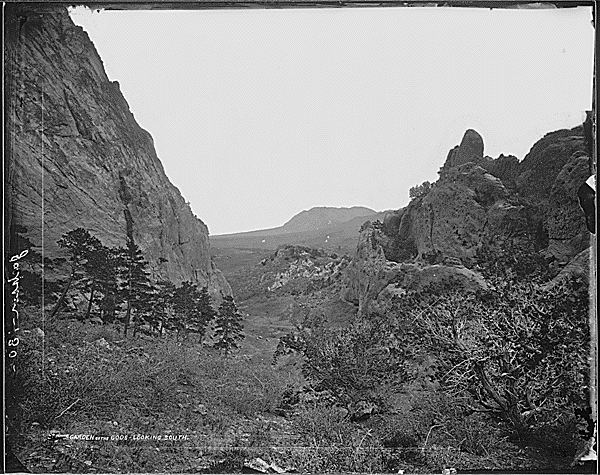
           Out West, the first newspaper for Colorado Springs, had this to say about Garden of the Gods in the June 20, 1872 issue. “ The Garden of the Gods is one of the best know wonders of Colorado, its characteristic features being so striking as to arrest the attention of even such as may not be susceptible to the grander beauties of the mountains.”


     Author Helen (Hunt) Jackson has this to say about Cheyenne Canyon in her essay of the same name. “There are nine “places of divine worship” in Colorado Springs, - the Presbyterian, the Cumberland Presbyterian, the Methodist, the South Methodist, the Episcopal, the Congregationalist, the Baptist, the Unitarian and Cheyenne Canyon.”   


           There were numerous coal mines in the area making it an early and profitable industry for the region.


           Early on, Ute Pass was considered one of the easiest routes to the gold and silver mines in the Leadville and South Park area.

            Enjoy your summer, writing and may your book sales and reading be even greater than you expect. 


Doris Gardner-McCraw -
Author, Speaker, Historian-specializing in
Colorado and Women's History
Angela Raines - author: Where Love & History Meet
For a list of Angela Raines Books: Here 
Angela Raines FaceBook: Click Her