Tuesday, June 27, 2023

FINDING STORY INSPIRATION FROM THE NEWS

Post by Doris McCraw

aka Angela Raines

Photo (c) Doris McCraw

Have you ever seen a piece of news that just begged for further research? Sometimes you find enough for a nonfiction piece. Other times it ends up being a nugget for a story.

The below clipping is from San Franciso, CA. newspaper in 1879  that inspired a nonfiction piece on the death of Lafayette Shidleler and his murderer Joe Ward. 

That same Joe Ward was the model for one of my characters in the novel, "The Outlaw's Letter".


There are some other tidbits that may warrant further investigation. We will see. In the meantime, the Smoky Hill River Trail has caught my eye.

How do you find your story inspiration? I'd really like to know.

Until Next Time: Stay safe, Stay happy, and Stay healthy.

Doris


Wednesday, June 21, 2023

REVISITING THE MAN WHO SHOT LIBERTY VALANCE by CHERYL PIERSON


Favorite western movies? I’ve got a few. But if I had to choose, I think it would have to be The Man Who Shot Liberty Valance.

This Hollywood classic, starring John Wayne as Tom Doniphon, Lee Marvin as Liberty Valance, Vera Miles as Hallie Ericson, and Jimmy Stewart as Ransom “Ranse” Stoddard has just about everything a western cinema fan could hope for: action, romance, right-over-might…and an unforgettable theme song.

Dorothy M. Johnson’s short story was made into a movie in 1962. It’s one of my oldest “movie” memories, as I was five years old when it made the rounds to the movie theaters and drive-ins.

Here’s the description of the movie according to Wickipedia:b>

Elderly U.S. Senator Ransom "Ranse" Stoddard and his wife Hallie arrive by train in the small western town of Shinbone, to attend the funeral of an apparent nobody, a local rancher named Tom Doniphon. Prior to the funeral, Hallie goes off with a friend to visit a burned-down house with obvious significance to her. As they pay their respects to the dead man at the undertaker's establishment, the senator is interrupted with a request for a newspaper interview. Stoddard grants the request.

As the interview with the local reporter begins, the film flashes back several decades as Stoddard reflects on his first arrival at Shinbone by stagecoach to establish a law practice.

A gang of outlaws, led by gunfighter Liberty Valance, hold up the stagecoach. Stoddard is brutally beaten, left for dead and later rescued by Doniphon. Stoddard is nursed back to health by restaurant owner Peter Ericson (John Qualen), his wife Nora (Jeanette Nolan) and daughter Hallie. It later emerges that Hallie is Doniphon's love interest.

Shinbone's townsfolk are regularly menaced by Valance and his gang. Cowardly local marshal Link Appleyard (Andy Devine) is ill prepared and unwilling to enforce the law. Doniphon is the only local courageous enough to challenge Valance's lawless behavior.


"You, Liberty...I said YOU pick it up..."

On one occasion, Doniphon even intervenes on Stoddard's behalf, when Valance publicly humiliates the inept Easterner. Valance trips Stoddard who is waiting tables at Peter's restaurant. Stoddard spills Doniphon's order causing Doniphon to intervene. Valance stands down and leaves. Doniphon tells Stoddard he needs to either leave the territory or buy a gun. Stoddard says he will do neither.

Stoddard is an advocate for justice under the law, not man. He earns the respect and affection of Hallie when he offers to teach her to read after he discovers, to her embarrassment, she's had no formal education. Stoddard's influence on Hallie and the town is further evidenced when he begins a school for the townspeople with Hallie's help. But, secretly, Stoddard borrows a gun and practices shooting.

Doniphon shows Stoddard his plans for expanding his house in anticipation of marrying Hallie, and reminds him that Hallie is his girl. Doniphon gives Stoddard a shooting lesson but humiliates him by shooting a can of paint which spills on Stoddard's suit. Doniphon warns that Valance will be just as devious, but Stoddard hits him in the jaw and leaves.

In Shinbone, the local newspaper editor-publisher Dutton Peabody (Edmond O'Brien) writes a story about local ranch owners' opposition to the territory's potential statehood. Valance convinces the ranchers that if they will hire him, he can get elected as a delegate to represent the cattlemen's interest. Shinbone's residents meet to elect two delegates to send to the statehood convention at the territorial capital. Valance attempts to bully the townspeople into electing him as a delegate. Eventually, Stoddard and Peabody are chosen. Valance assaults and badly beats Peabody after Peabody publishes two unflattering articles about Valance and his gang. The villains destroy Peabody's office. Valance also calls Stoddard out for a duel later in the evening after Valance loses his bid for delegate. Valance leaves saying "Don't make us come and get you!" Doniphon tells Stoddard he should leave town and even offers to have his farmhand, Pompey, escort him. But when Stoddard sees that Peabody has been nearly beaten to death, he calls out Valance. Stoddard then retrieves a carefully wrapped gun from under his bed and heads toward the saloon where Valance is. Valance hears he has been called out and justifies going out in self-defense. His wins his last poker hand before the duel with Aces and Eights.


"Pompey..."

In the showdown, Valance toys with Stoddard by firing a bullet near his head and then wounding him in the arm, which causes Stoddard to drop his gun. Valance allows Stoddard to bend down and retrieve the gun. Valance then aims to kill Stoddard promising to put the next bullet "right between the eyes," when Stoddard fires and miraculously kills Valance with one shot to the surprise of everyone, including himself. Hallie responds with tearful affection. Doniphon congratulates Stoddard on his success, and notices how Hallie lovingly cares for Stoddard's wounds.

Sensing that he has lost Hallie's affections, Doniphon gets drunk in the saloon and drives out Valance's gang, who have been calling for Stoddard to be lynched for Valance's "murder." The barman tries to tell Doniphon's farmhand Pompey (Woody Strode) that he cannot be served (due to his race), to which Doniphon angrily shouts: "Who says he can't? Pour yourself a drink, Pompey." Pompey instead drags Doniphon home, where the latter sets fire to an uncompleted bedroom he was adding to his house in anticipation of marrying Hallie. The resulting fire destroys the entire house.

Stoddard is hailed as "The Man Who Shot Liberty Valance" and based on this achievement, is nominated as the local representative to the statehood convention. Stoddard is reluctant to serve based upon his notoriety for killing a man in a gunfight. At this point, in a flashback within the original flashback, Doniphon tells Stoddard that it was he (Doniphon), hidden across the street, who shot and killed Valance in cold blood, and not Stoddard in self-defense. Stoddard finds Doniphon and asks him why he shot Valance. He did it for Hallie, he says, because he understood that "she's your girl now". Doniphon encourages Stoddard to accept the nomination: "You taught her to read and write, now give her something to read and write about!"

Stoddard returns to the convention and is chosen as representative. He marries Hallie and eventually becomes the governor of the new state. He then becomes a two term U.S. senator, then the American ambassador to Great Britain, a U.S. senator again, and at the time of Doniphon's funeral is the favorite for his party's nomination as vice president.

The film returns to the present day and the interview ends. The newspaper man, understanding now the truth about the killing of Valance, burns his notes stating: "This is the West, sir. When the legend becomes fact, print the legend."

"Hallie, who put the cactus rose on Tom's coffin?"

Stoddard and Hallie board the train for Washington, melancholy about the lie that led to their prosperous life. With the area becoming more and more civilized, Stoddard decides, to Hallie's delight, to retire from politics and return to the territory to set up a law practice. When Stoddard thanks the train conductor for the train ride and the many courtesies extended to him by the railroad, the conductor says, "Nothing's too good for the man who shot Liberty Valance!" Upon hearing the comment, Stoddard and his wife stare off thoughtfully into the distance.


As a side note, one of the many reasons this film holds a special place in my heart is because I remember it as being the first time I made the connection between a scene onscreen representing a flashback. Remember the “flashback within a flashback” that the Wikipedia article mentions? The smoke from John Wayne’s cigarette moves and flows to take over the screen as he tells Jimmy Stewart, “You didn’t kill Liberty Valance. Think back…” That smoke took us back to the truth of what had happened, and my five-year-old brain was shocked—and enamored, even then, with the idea that time passage, or remembrances could be shown through the haze of cigarette smoke. It was the moment of truth for Ransom Stoddard.

For me, The Man Who Shot Liberty Valance embodies the core of the west—good and evil, and how sometimes “the point of a gun was the only law”—and it all depended on the man who held the weapon.

Liberty represented the purest evil. Ranse was determined to fight him with the law he treasured—the desire to do things the legal way blinding him to the fact that Liberty didn’t respect that. In the beginning, his naivete is almost painful to watch, providing Liberty some rich entertainment. Though Tom finds it amusing, his growing respect for Ranse’s perseverance is portrayed to perfection by that familiar downward glance of John Wayne’s. Accompanied by the half-smile and his slow advice-giving drawl, the character of Tom Doniphon is drawn so that by the point at which he sees the handwriting on the wall and burns down the house he built for Hallie, the viewer’s sympathy shifts, briefly, to the circumstances Tom finds himself in.

But Ranse is determined to vanquish Valance one way or the other—with a lawbook or a gun—whatever it takes. In the final showdown, the lines of resignation are etched in Tom Doniphon’s face, and we know he is honor-bound to do the thing he’ll regret forever: save Ranse Stoddard’s life and lose Hallie to him.

I love the twist. Ranse truly believes he’s killed Valance. Again, to do the honorable thing, Tom tells him the truth about what really happened.

What do you think? If you were Ranse, would you want to know you really were not the man who shot Liberty Valance? Or would you want to be kept in the dark? If you were Tom, would you have ever told him? It’s a great movie!


Now you can sing along!

THE MAN WHO SHOT LIBERTY VALANCE

When Liberty Valance rode to town the womenfolk would hide, they'd hide
When Liberty Valance walked around the men would step aside
'cause the point of a gun was the only law that Liberty understood
When it came to shootin' straight and fast---he was mighty good.

>From out of the East a stranger came, a law book in his hand, a man
The kind of a man the West would need to tame a troubled land
'cause the point of a gun was the only law that Liberty understood
When it came to shootin' straight and fast---he was mighty good.

Many a man would face his gun and many a man would fall
The man who shot Liberty Valance, he shot Liberty Valance
He was the bravest of them all.

The love of a girl can make a man stay on when he should go, stay on
Just tryin' to build a peaceful life where love is free to grow
But the point of a gun was the only law that Liberty understood
When the final showdown came at last, a law book was no good.

Alone and afraid she prayed that he'd return that fateful night, aww that night
When nothin' she said could keep her man from goin' out to fight
>From the moment a girl gets to be full-grown the very first thing she learns
When two men go out to face each other only one retur-r-r-ns

Everyone heard two shots ring out, a shot made Liberty fall
The man who shot Liberty Valance, he shot Liberty Valance
He was the bravest of them all.

The man who shot Liberty Valance, he shot Liberty Valance
He was the bravest of them all.

Thursday, June 15, 2023

Western Fictioneers Announces the Peacemaker Award Winners


Western Fictioneers is proud to announce the winners of the 13th Annual Peacemaker Awards, presented for the finest in Western fiction published in 2022. Congratulations to all the winners and finalists, and special thanks to the judges who make the Peacemaker Awards possible.


LIFETIME ACHIEVEMENT PEACEMAKER

L.J. Martin


BEST FIRST NOVEL

Winner: BONE NECKLACE, Julia Sullivan (Brandylane Publishing Inc)

Finalists

RAWHIDE JAKE, J.D. Arnold (Five Star)

A MAN CALLED JUSTICE, John Deacon (John Deacon)


BEST WESTERN NOVEL

Winner: FALLEN CHILD, Kathleen Morris (Dunraven Press)

Finalists

THE END OF NOWHERE, Patrick Dearen (Five Star)

ALL MY SINS REMEMBERED, Rod Miller (Five Star)

COLDWATER RANGE, John D. Nesbitt (Five Star)

BONE NECKLACE, Julia Sullivan (Brandylane Publishing Inc.)

BEST SHORT FICTION

Winner: “Run for Ruby Camp”, Vonn McKee (OVER WESTERN TRAILS, Western Fictioneers)


Finalists

“On the Trail With Packer”, Ben Goheen (SADDLEBAG DISPATCHES, Oghma Creative Media)

“Buckskin Trail”, John D. Nesbitt (Speaking Volumes)

“Irish Kelly and the Heartbreak Kid”, Sharon Sala (REBEL HEARTS, Wolfpack Publishing)

“No Quarter”, Kathleen O’Neal Gear (REBEL HEARTS, Wolfpack Publishing)

Thursday, June 8, 2023

On This Day in the Old West: June 9

 On June 9, 1860, the course of American literature was changed forever. Popular author Mrs. Ann Stephens (she wrote nearly 30 novels!) authored the very first Dime Novel, titled Malaseka, the Indian Wife of the White Hunter.


As most of us Western authors know, pulp magazines (or pulpwood, to give the full name) got their start in 1896, when Frank Munsey converted The Argosy, his magazine, to lower-cost pulp paper. From then until the 1950s, the pulps were the main source of “popular” fiction (as opposed to hardcover books and slick-paper magazines). Well, before pulps came the dime novel, a type of periodical which resembled today’s paperback book.


In the UK, this sort of publication was called the “penny dreadful.” “Story papers” for young men were also similar, and quite popular. Dime Novel is actually an umbrella term for several formats of popular fiction that existed until 1921. The name began when Beadle’s Dime Novels first published Mrs. Stephens’ tale in 1860, with a 4 -by 6-inch format. However, other formats were also used, such as an 8- by 12-inch size, running two to three columns of story (similar to the look of the UK’s “story papers”). The first works were serialized, then reprinted in single issues, but the series often ran several hundred weekly issues.


Later, some of the stories were reprinted in smaller formats, similar to today’s paperbacks, although they were usually saddle-stitched with a cover of the same material as the interior. Some of these reprints cost a nickel, so the term “nickel weekly” came into being. Color printing for the covers came still later.


Genres for the stories were mixed. In the 1860s and 70s, Western characters were the most popular, with Deadwood Dick and Buffalo Bill becoming ongoing popular protagonists. In the 1880s and 90s, crime and detective fiction became more popular, with characters such as “Old Sleuth” (the first time this term was used to mean a detective—the publisher even copyrighted the name so it couldn’t be reused). The most popular of these detectives was Nick Carter, who lasted all the way from dime novel to pulp fiction, radio, movies, TV, and even a later men’s paperback series. Science fiction also existed in the dime novels, beginning with the classic Steam Man of the Prairie, with a series of “Edisonade” characters who inspired the later Tom Swift stories.
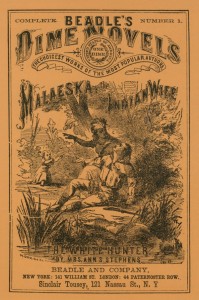


In the very first dime novel, Malaseka, was a tragedy of errors. A young frontier settler, Danforth, has secretly married Malaseka, an Indian princess, and their child is destined to be the future chieftain. However, when an Indian brave is killed by another settler, the tribe believes Danforth to be the guilty party. They attack the settlement and many are killed, including the Indian chief and his son-in-law, Danforth. With his final words, Danforth urges his wife to travel to Manhattan and live with his parents, who will welcome her and their son.


Of course, this turns out to be a terrible idea. Old Mr. Danforth now despises the Indians who have killed his son, so he takes the child away from Malaseka and he and his wife raise their grandson as their own, then send him to Europe for an education. Malaseka eventually returns to her home on the frontier, where she becomes friends with Sarah, the daughter of Danforth’s friend, who is the same age as her lost son. Eventually, of course, Sarah Jones goes to Manhattan to be educated as a lady, and she meets the elderly Danforths and befriends them. In due course, William returns home and he and Sarah fall in love and agree to marry.


When the happy young couple return to the frontier settlement to celebrate with her family, Malaseka tells William she is his true mother. William, raised to despise everything Indian, kills himself rather than “debase” Sarah with his blood. They liked their stories dark back then, and the idea of an Indian and a White actually having a happy marriage just couldn’t be imagined.


Your character could easily have read this story. They may have eagerly anticipated the next installment of the series. Even if they didn’t purchase the dime novel themselves, they could have heard it being discussed or had it read to them as a child. Malaseka’s tale would have been almost as familiar to people in that age as Star Wars & Star Trek is to us today.


J.E.S. Hays

www.jeshays.com

www.facebook.com/JESHaysBooks


Wednesday, June 7, 2023

Classic Country Ballads of Lost Love – June - Matamoros #westernfictioneers #countryballads #classiccountrymusic


I grew up in the late 50s and 60s listening to the country music of that era. I stuck with country music through the 70s. I made it into the 80s but, by the late 80s, country music as I knew and loved was headed in a direction that, with a few exceptions, I wasn’t interested going. So I didn’t. (Get off my lawn.)

The old west gunfighter and trail ballads, drinking songs, and revenge songs had an influence on me that was, and still is, every bit as strong as the impact Louis L’Amour’s books left with me. My lifelong interest, perhaps fascination bordering on obsession, with everything old west—truth, legends, and myths alike—have roots in those old cowboy and country songs.

I’m inviting you to read along with me this year as I post one or two nostalgic-for-me country ballads on the first Wednesday of each month. I will share a snippet of trivia about each song along with a YouTube video.

Each month, I will include a link back to the previous month’s article as reference to those songs. The common thread that runs among the songs I’ve chosen for this musical memory lane excursion is tragic lost love.

January – Marty Robbins – El Paso and Feleena
February – Faron Young – TheYellow Bandana
March – Willie Nelson and Ray Charles – Seven Spanish Angels
April – Marty Robbins – San Angelo
May – Billy Walker – Cross the Brazos at Waco

This month’s song is another one by Billy Walker, Matamoros.

Matamoros, a track on Walker’s album Cross the Brazos at Waco, made it to #59 on the country music charts in 1965. Matamoros was written by Kay Arnold, who also wrote Cross the Brazos at Waco.

This is one of those songs I've heard a gazillion times, but I didn't really hear the lyrics. It always seemed like a straight-up tragic love story ballad with the woman sacrificing herself to save the man she loves. Hearing this song with ‘new ears’, I now realize the depth of the jealousy and control that precipitates a death in this song parallels another familiar old west ballad.

I will come back to that.

Matamoros tells the story of a man recalling how the woman he loved died. These memories make him feel low as the beggar who sits on the street. He’s standing in the plaza listening to the music and watching the couples, while regretting that the woman he loved isn’t there with him.

Let’s pause to listen to the song, then I’ll resume my commentary.


The man is thinking back about how he fell in love with a woman with eyes black as midnight. He says he left her not long ago, but who knows what that really means. It could have been a week. It could have been a couple of years. Regardless, within the first few lines, he tells us she made promises to him. We assume they were promises of her undying love. But, in retrospect, he says her promises were fickle, yet he also changes his mind and says he realizes the moment she loved me more than life. This man is emotionally conflicted as he recalls what happened to this woman and his part in her death.

In the midst of this thinking that bounces from the present to the past and back to the present, we realize jealousy, and the perceived unfaithfulness (seems to me more imagined than real) of the woman is what brought him back to Matamoros …to claim what was mine and there’ll be bad trouble if I catch her cheating on me. The love of my woman is one thing that I’ll never share.

He gives us no rational reason to believe she hasn’t been faithful other than his too-much-alone-with-his-thoughts suspicions. This is somewhat similar to the reaction of the narrator in the El Paso lyrics and his perceived unfaithfulness of Feleena with the wild young cowboy. This Matamoros fellow jumps to jealous conclusions when he sees the woman laughing and dancing and tossing her raven black hair with a wild young vaquero similarly to …dashing and daring, the drink he was sharing with wicked Feleena, the girl that I loved.

Matamoros fellow confronts the young vaquero. A knife fight ensues. The woman jumps between them, and is killed. The man leaves town and never returns. I say he left out of guilt more than sorrow.

Any way you interpret this song, it’s an oldie, but a goodie when it comes to tragic love lost classic country ballads. I’m also delighted that I finally realized the loose similarities between El Paso and Matamoros.

Until next time,
Kaye Spencer
Lasterday Stories
writing through history one romance upon a time
www.kayespencer.com

Wednesday, May 24, 2023

Some Questions for the Future

Post by Doris McCraw aka Angela Raines


Photo (c) Doris McCraw


We are getting closer to the middle of 2023. It is usually a time of reflection for me. I take stock of where I am in my writing, publishing, and marketing. 

In line with that concept, I would appreciate feedback on what you would like to read in my blog posts. As a student of Colorado and Women's History and pretty much an expert on Early Women Doctors in Colorado, which of these three topics would be the most useful to you?

Would you like more marketing information?


Photo (c ) Doris McCraw

Is there interest in joining together to create a series of short 'novels' that tie together on a theme, time frame, or event?

Where would you like to see Western Fictioneers go in the future? 

What can I do as I finish my time as President to help make sure this blog and the organization continue to be a vibrant community? Please know, it does take a village to make things happen. 

Your feedback will help me to craft the remainder of 2023. 

We are getting ready to announce the Peacemaker winners and I want to say, it was a banner year and judging was some of the hardest I've faced. I want to thank everyone who submitted their work. It tells me the genre of the Western is alive and well. We just need to make sure the rest of the world knows what we know, these stories are the stories of not only the past but are a glimpse into the lives we live now.

Thank you each and every one for a great first half of 2023.

Until Next Time: Stay safe, Stay happy, and Stay healthy.

Doris


Friday, May 19, 2023

Taking Charge of My Career


I've written a lot of books for a lot of publishers. I've been published by the biggest ones--Penguin Random House, Simon & Schuster, HarperCollins, Macmillan--and by some of the smaller ones. I like the advance money from the big ones, and I still get some nice royalties now and again for a young-adult quartet I wrote for S&S. But beyond that, there can be some frustrations when dealing with the big guys.

I've also been published by smaller houses, which are usually friendlier. And honestly, the bigger ones aren't interested in Western fiction anymore. Five Star folded up its tent, except for the occasional large-print book for library sales. Kensington hasn't said what'll happen there when Gary Goldstein finally retires, but I don't have high hopes. I wrote six novels in 18 months for Wolfpack Publishing, which--along with a very demanding day job and family responsibilities, wore me out. The best novel-publishing experience I've had lately was when your friends and mine, the wonderful Livia Reasoner and Cheryl Pierson at Sundown Press, published my Peacemaker-finalist novel Blood and Gold: The Legend of Joaquin Murrieta.

But I was itching to take matters into my own hands. Talking with a friend in the same boat--Howard Weinstein, whose wonderful historical Western Galloway's Gamble, a Peacemaker winner, was published by Five Star (which wanted a sequel, but then closed the door on him before he could finish it)--we decided to try something a little bit different. We have another batch of friends who run a writer's cooperative publishing outfit called Crazy 8 Press, where they mostly published science fiction, fantasy, and "New Pulp" adventure fiction. They had never published Westerns, but they're lovers of genre fiction, as are Howard and I. So we all decided to launch a new Western imprint through Crazy 8, and Silverado Press was born!

Silverado Press officially launches on May 30, which is the publication date for its debut title, my short-story collection Byrd's Luck & Other Western Stories.
The book contains my Peacemaker and Spur finalist story "Byrd's Luck," first published by the Western Fictioneers, and a sequel to that story, "Byrd's Law," that teams Byrd up with Cody Cavanaugh, the protagonist of my Wolfpack series. There are some other reprints, several of which have been published in anthologies from our fine organization, and some from other anthologies. Half of the stories are traditional Westerns and half are weird Westerns, a subgenre I've been associated with since the mid-1990s. The book's final story is a prose story based on a weird-Western comic book series I wrote called Desperadoes, which ran from 1997 to 2007.

It's kind of hybrid publishing, I guess--essentially self-publishing, but within the established infrastructure of Crazy 8. Everybody helps promote everybody else's work, in-house people handle book design and some of the marketing, but I get to make most of my own decisions and sink or swim on my own abilities. Howard's Galloway's Gamble 2 will be along in a couple of months, the sequel to Galloway's Gamble. After that, who knows? Silverado Press isn't just the two of us--anybody who's interested can submit a proposal to the Crazy 8 gang (Howard and I don't have editorial control over anything but our own work) and see if it flies. Ideally, we'll be another outlet for Western fiction, in a field that's been contracting faster than it's growing.

I'm indebted to the Western Fictioneers for jump-starting my moribund Western writing career when you published "Byrd's Luck" to such acclaim, and for the friendships I've found here. I wanted to be sure to get my somewhat-monthly blog post in this time, to ensure that you'd all see the news, and to invite you to join us at Silverado Press if it seems like something you're interested in. I don't know if we'll make any money...but if not, it won't be for lack of trying!

Monday, May 15, 2023

13th Annual Peacemaker Awards Finalists and Lifetime Achievement Peacemaker

THE LIFETIME ACHIEVEMENT PEACEMAKER

Larry J. Martin


13th Annual Peacemaker Awards Finalists

For Western Novels and Stories Published in 2022


BEST NOVEL


THE END OF NOWHERE, Patrick Dearen (Five Star) 

ALL MY SINS REMEMBERED, Rod Miller (Five Star)

FALLEN CHILD, Kathleen Morris (Dunraven Press)

COLDWATER RANGE, John D. Nesbitt (Five Star)

BONE NECKLACE, Julia Sullivan (Brandylane Publishing Inc.)


BEST FIRST WESTERN NOVEL


RAWHIDE JAKE, J.D. Arnold (Five Star)

A MAN CALLED JUSTICE, John Deacon (Self-Published)

BONE NECKLACE, Julia Sullivan (Brandylane Publishing Inc.)


BEST WESTERN SHORT FICTION


“No Quarter”, Kathleen O’Neal Gear (REBEL HEARTS, Wolfpack Publishing)

“On the Trail With Packer”, Ben Goheen (SADDLEBAG DISPATCHES, Oghma Creative Media)

“Run For Ruby Camp”, Vonn McKee (OVER WESTERN TRAILS, Western Fictioneers)

“Buckskin Trail”, John D. Nesbitt (Speaking Volumes)

“Irish Kelly and the Heartbreak Kid”, Sharon Sala (REBEL HEARTS, Wolfpack Publishing)


Winners will be announced June 15, 2023 on the WF website (www.westernfictioneers.com) and on this blog.


Western Fictioneers (WF) was formed in 2010 by professional Western writers, to preserve, honor, and promote traditional Western writing in the 21st century. Entries were accepted in both print and electronic forms.


The Peacemaker Awards are given annually. Submissions for the Peacemaker Awards for books and stories published in 2023 will be open in July, 2023. Submission guidelines will be posted on the WF website. For more information about Western Fictioneers (WF) please visit: http://www.westernfictioneers.com


Western Fictioneers would like to thank the judges and James Reasoner for being Awards Chair and for the excellent job they have done.


Thursday, May 11, 2023

On This Day in the Old West: May 12

May 12 was a little sparse as an anniversary date for the 1800s, but in 1901, President William McKinley paid an historic visit to San Francisco. From the time California joined the Union until the 1920 census, San Francisco was the largest and most prominent city on the West Coast. Of course, this encouraged US Presidents to make the cross-country trip from Washington, DC to court the local power brokers and seek votes and influence. McKinley wasn’t’ the first president to make the trip—that was Rutherford B. Hayes in 1880—but his visit garnered a good deal of support for the president.

A Stereoscope of a young lady photographing the President


The original plan was that the president’s grand six-week “victory lap” around the country to celebrate his second term would begin in Washington at the end of April, head west by the southern route, and return home via the Northwest. San Francisco on the Pacific Coast and Buffalo on the East were to be the highlights of the trip. Unfortunately, by the second week of May, the First Lady took ill, and the official touring party of 43 (cabinet members, executive staff, friends, servants, and newspapermen) called a halt in the City by the Bay. For days, Ida McKinley hovered between life and death. When she finally regained consciousness, the entire city breathed a sigh of relief.


The presidential itinerary was, of course, delayed during Mrs. McKinley’s illness. Events were rescheduled for May 19 through the 24th, and the presidential party returned to the East Coast on May 25th. The highlight of his visit, apparently, was his visit to the Presidio for the dedication of General Hospital (later renamed Letterman Hospital). McKinley addressed veterans and patients from the Philippines on his visit. The San Francisco Call gave this account of the event:


President McKinley's visit to the Presidio yesterday will live long in the memory of the gallant soldiers who were greeted by the commander in chief. Three-thousand strong, the recently returned volunteers from the Philippines listened to stirring words from the head of the nation, while the wan and wasted faces of the sick soldiers in the General Hospital brightened as the President passed through the wards and gave a kindly word to the men who lost their health in faraway jungles while fighting for the stars and stripes.


Thousands of citizens flocked to the Presidio yesterday morning to witness the ceremonies. The big parade ground facing the General Hospital, was the spot where the volunteer soldiers gathered to listen to the words of the President.

Suddenly the thunder of the guns told of the approach of the commander in chief and a tumult of applause greeted him as his carriage and escort swept past thousands of sightseers. The band struck up "Hail to the Chief" as the President's carriage drew up at the reviewing platform. As he walked along, the President glanced with pride at the 2000 stalwart men who stood rigidly at attention. The soldiers wore blue coats and trousers, brown leggings and brown slouch hats and carried no arms. As the President advanced to the front of the platform, the buglers sounded the salute and the cheers of the soldiers rent the air in mighty volume. The President raised his hand in salute, and when the cheering subsided addressed the men in terms of glowing praise.

"I count myself very fortunate to have been in the city of San Francisco upon the arrival of your two regiments. I join with my fellow citizen of this city in giving you a welcome home, and at the same time express not only my own thanks as President of the United States but the gratitude of the American people for the splendid service you have rendered to your country in the past two years. Our hearts have been with you, our hopes have been with you; and we have realized in large measure peace as the result of the splendid work you performed in the Philippine Islands."


If your character was in San Francisco in 1901, they could have been in the crowd during one of McKinley’s appearances or speeches. They may even have voted for the man in the recent election.

J.E.S. Hays

www.jeshays.com

Wednesday, May 3, 2023

Classic Country Ballads of Lost Love – Cross the Brazos at Waco #westernfictioneers #countryballads #classiccountrymusic


I grew up in the late 50s and 60s listening to the country music of that era. I stuck with country music through the 70s. I made it into the 80s but, by the late 80s, country music as I knew and loved was headed in a direction that, with a few exceptions, I wasn’t interested going. So I didn’t. (Get off my lawn.)

The old west gunfighter and trail ballads, drinking songs, and revenge songs had an influence on me that was, and still is, every bit as strong as the impact Louis L’Amour’s books left with me. My lifelong interest, perhaps fascination bordering on obsession, with everything old west—truth, legends, and myths alike—have roots in those old cowboy and country songs.

I’m inviting you to read along with me this year as I post one or two nostalgic-for-me country ballads on the first Wednesday of each month. I will share a snippet of trivia about each song along with a YouTube video.

Each month, I will include a link back to the previous month’s article as reference to those songs. The common thread that runs among the songs I’ve chosen for this musical memory lane excursion is tragic lost love.

January – Marty Robbins – El Paso and Feleena
February – Faron Young – TheYellow Bandana
March – Willie Nelson and Ray Charles – Seven Spanish Angels
April – Marty Robbins – San Angelo

This month’s song is Cross the Brazos at Waco by Billy Walker.

Cross the Brazos at Waco was first recorded (May 1964) and released by Billy Walker (August 1964). The song was written by Kay Arnold, who also wrote his song Matamoros.

Here we have a story of an outlaw who chooses to put his guns away for the love of Carmela. 

His reputation as El Bandito had been too much for her, and she’d walked away from him. 

Time passed. Love endured. An opportunity to reunite came along when someone saw Carmela in San Antone, and that someone got that message to the outlaw. He interpreted her presence there as a sign that she wanted to see him. He sent a return message for Carmela to meet him on the banks of the Brazos River that very night. 

He rode toward San Antone with one eye on the trail ahead and one eye on the trail behind. He was guardedly hopeful that posse wouldn’t find him, but he’s a realist. He’s watching out for pursuit.

Ride hard and I’ll make it by dawn
Cross the Brazos at Waco
I’ll walk straight into old San Antone

He made it to the banks of the Brazos, saw Carmela waiting for him, and he dropped his gun belt to the ground to show his love for her and that he’d changed his outlawing ways. 

But, tragically, a Texas Ranger and a posse were waiting for him.

Then the night came alive with gun fire

He died in Carmela’s arms. His last words were, ironically... 

Cross the Brazos at Waco
I’m safe when I reach San Antone

I’m safe when I reach San Antone


Cross the Brazos at Waco, San Angelo, and Seven Spanish Angels have a common thread of the man being hunted and then killed by Texas Rangers or a posse.

Until next time,
Kaye Spencer
Lasterday Stories - writing through history one romance upon a time
www.kayespencer.com


Tuesday, April 25, 2023

Emma F. Langdon and the Power of Words

Post by Doris McCraw aka Angela Raines

Photo property of the Author

THE state of Colorado ceased under the administration of James H. Peabody, to be republican in its form of government, and became a military oligarchy. The expressed will of the people was ignored by their chosen representatives; thus bringing upon the state a series of calamities, the magnitude of which may now readily be seen.”

The above is taken from the introduction to Emma's book “The Cripple Creek Strike, A History of Industrial Wars in Colorado 1903-4-5”. Regardless of your belief in who was right or wrong during this tumultuous time, this book is considered the definitive work on the region and events of the time and area. That it is written by a woman makes it even more amazing.

Here then is the story of Emma F. Langdon.

Emma was born September 29, 1875, in Tennessee. She married Charles Langdon, born June 9, 1870, in 1896. She also became a stepmother to Lucille M. Lockett with this marriage. In 1900 the family was residing in Junction City Kansas.

In 1903 Emma and her husband moved to Victor, Colorado, and worked at the Victor Daily Record. Although Emma had said a woman belonged at home and not in public life, her sentiment was not to be.

On May 15, 1893, in Butte Montana, the Western Federation of Miners was born. It was comprised of forty delegates from fifteen unions from the states of Colorado, Utah, Montana, Idaho, and South Dakota. Approximately six months later the unions negotiated shorter work days (eight hours) and an increase in pay ($3.25 a day) in the Cripple Creek-Victor area. In 1903 the tensions between miners and mine owners increased. The union supported the smelter workers who were working long hours and less pay.

The situation became so volatile that the mine owners censored and arrested anyone who opposed their edits. This resulted in the workers at the Victor Daily Record being rounded up so that this pro-union newspaper could not put out the next issue. When Emma was told of the 'arrest' she went to the paper and that night barricaded herself in, set type, and put out the paper on schedule. When she delivered the issue to the men who had been taken to the 'bullpen' the laughter of the captors changed and the incarcerated rejoiced.

In 1904 when the strike ended those who had supported the union were requested to leave. Emma moved to Denver Colorado where she remained until her death on November 30, 1937. She continued her work on behalf of the union.

The story of the Labor Wars in Colorado is full of people from both sides that made their mark on the region's history. From 1893-1914 and the Ludlow massacre, Colorado was a hotbed of conflict between the haves and have-nots with errors in judgment on both sides. Not an easy read, but a fascinating one.

Until Next Time: Stay safe, Stay happy, and Stay healthy.

Doris