Showing posts with label joe r lansdale. Show all posts

Tuesday, October 29, 2013

Western Comics Focus: Timothy Truman


This month we turn our spotlight on writer/artist Timothy Truman, whose name has popped up more than once on this blog the last few months (he has worked often with Joe R. Lansdale and John Ostrander, both of whom we have also recently interviewed.)


Truman burst onto the comics scene in the early 1980s, when he and Ostrander co-created GRIMJACK for First Comics -a very influential title, which ushered in the "grim and gritty" movement that would dominate comics for the next decade. He has since worked on various comics, from TARZAN and CONAN to STAR WARS, as well as revamping the DC superhero Hawkman in HAWKWORLD. He has also created artwork for album covers and posters, doing several pieces for the Grateful Dead.


He has also been prolific in creating western and western-related comics, approaching the genre from several different angles. With Lansdale he produced several Jonah Hex "weird western" miniseries in the '90s, as well as a Lone Ranger miniseries. With Ostrander he created THE KENTS, a long miniseries following the western adventures of Superman/Clark Kent's adopted father's ancestors.


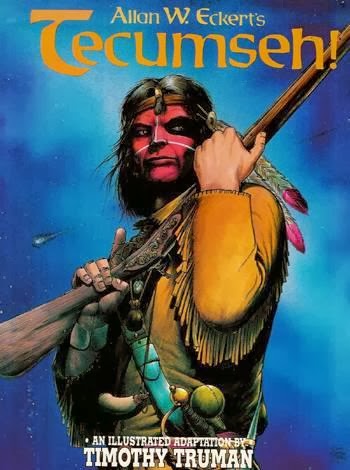
His 1985 series SCOUT was a dystopian, futuristic sci fi comic whose hero was an Apache. His two-part graphic novel about Revolutionary Era renegade Simon Girty won much critical acclaim; he also did a graphic novel adaptation of Allen Eckert's outdoor play TECUMSEH!


More recently, with his son Benjamin Truman, he has introduced HAWKEN- an aging Wild West hired killer who is haunted by the ghosts of everyone he has killed. Literally.


Timothy Truman has agreed to answer some questions for us today.

1. Simon Girty: Renegade was a very powerful work, and an unusual subject choice. What can you tell us about it, and why you chose Girty?
 
TIMOTHY TRUMAN: Growing up in West Virginia, along the Kanawha River and Ohio River country, Simon Girty was a historical figure that we used to read about in our state history classes. he was always described as a deplorable traitor, cutthroat, and lawless renegade. However, in the 1990's I started reading a lot of historical fiction and happened upon a book called the Frontiersman by the late, great Allan W. Eckert. Girty figures into the story as a secondary characater-- a friend of the great Ohio Valley scout, Simon Kenton. Allan's painted Girty as far more sympathetic and likeable person than the version of him I'd grown up hearing about. I became fascinated with Girty and decided to research his story. The more research I did, the more I saw how unfairly he'd been treated by American history. So I became determined to tell a more truthful history about the man. As a result of the work I did, many other people began reexamining his reputation and his place in history.  His relatives in Canada and the U.S.A. even made me an honorary "cousin." So I'm very proud of the Wilderness graphic novels, to say the least. 

2. How did you come to adapt the outdoor play
Tecumseh! as a graphic novel?
 

TT: Through the relationship that I established with Allan W. Eckert, mainly. I got to know Allan through my Wilderness work. He was very kind in suggesting some reference materials I might want to check out. We became friends. Allan was the writer of the Tecumseh! outdoor drama in Chilicothe, Ohio. Anyway, we thought that doing a graphic story adaptation would be a really cool thing to do. The promoters of the play were all for it. We made a deal with Cat Yronwode and Dean Mullaney at Eclipse Comics, and the graphic novel happened. As a result of the graphic novel and the research on frontier and Eastern American attire that I had to do for it, I was asked to redesign a lot of the costuming for the drama a few years after the graphic novel was published.  All in all it was a really rewarding experience. I just wish I could go back and redraw all that stuff! I'm such a better artist these days! My style has changed a lot.

3. Native American Indians figure prominently in your work, as do frontiers -even in some of your science fiction. Do you have a particular attraction to those themes, or did it just work out that way?


TT: I'd always been interested in Native American history and culture, even as a kid. I suppose it sprang out of stories I'd heard growing up about my great grandmother, Belle Truman, who was a Cherokee full blood who was raised in Kentucky. I've since learned that the stories were true. Anyway, the older I got, the more interested I became in Native culture, especially the Southwestern and Ohio Valley people.


4. You've been credited with helping launch the "grim and gritty" trend in comics in the early 80s. Why do you think so many other writers and artists followed your lead in this regard?

TT: I think it was a genre whose time had come. Remember that I was there in the beginning of the 1980's "independent" comics scene. The Indy movement was itself largely inspired by the '60's Underground and '70's-'80's European comics movements-- a fact that is unfortunately overlooked in most histories and documentaries about American comics. When we started doing creator owned stories and characters with the independent publishers, we gravitated towards creating material that was akin to the stuff people were doing in "respectable"  mediums such as novels and film. Still, for the material to be successful, it had to retain the action and more colorful, fantastical elements of comics, at least early-on. So it was a marriage of mediums, of sorts. Guys like me who enjoyed action films, science fiction and the like in the films and fiction we liked started doing our "movies on paper".  We proved it was possible and viable to own or co-own our own characters and get a fair share of royalties for the books and any merchandising or film that resulted from them. A few years later other folks got interested and started doing the same thing. Major publishers like DC and Marvel had to start offering creators better contracts. And "mainstream" folks like Frank Miller and the Image guys started jumping ship and getting better deals for the work they were doing.  

5. Your series Scout blended westerns with post-apocalyptic sci fi, and Hawken and Jonah Hex blended western with horror. Why do you think the western genre can be stretched into such diverse shapes, and yet still feel "western"?


TT: It's a question of environment and atmosphere,  I guess. Westerns speak to all of us. It involves certain character types and arch-types that are exciting to explore, whether you're a creator or a reader. There's an old adage that westerns are the American mythology, and I think that's true to a great extent. Myths are a reflection of history and culture. Westerns tell us a lot about America and Americans and are fertile ground for seeding stories of all types. In many ways, just giving a story a Western flavor or ambiance does about a quarter of the work for a writer or artist. It kind of "places" what it is you want to do. Of course, the most interesting stories take the tropes and expectations of the Western genre and play with them-- turn them on their heads, open them up, re-examine them. So mixing Westerns with other genres is probably an offshoot of that impulse. That was certainly the case with Scout, Hex and Hawken. Sometimes it works, sometimes it doesn't. I and the people I've worked with have been pretty lucky in that regard, I suppose.

6. We've recently interviewed John Ostrander and Joe R. Lansdale, both of whom you have worked closely with. Can you tell us about your professional relationships with them?

TT: They are like brothers to me. We're very, very close. John, Joe and my son Ben are my writers of choice if I'm not going to write a story myself. We operate on the same wavelength in many reagrds, yet we're also very different from each other. We each can bring new colors to the final mix. As far as John and Joe go, they're both very different from each other. We get into these gabfest story conferences to figure things out. Ideas fly like mad-- hot and heavy. Then we do our work and bring our differences into play. Since there's a lot of mutual admiration and respect there, we each trust what the other is going to do. The funniest thing about working with Joe and John is the fact that I handle their stories quite differently. For one thing, John and I work "Marvel" method-- plot first, then art, then John scripts what I've drawn. We've tried it a few times full script, but have found that the so-called Marvel method is the way we work best. It makes for a better mix. With Joe and me, it's the opposite. Full script all the way-- mainly because that's the way that Joe insists on working. Also, Joe is a really wild writer. Given the material I've done over the years, you might be surprised to know that I'm a tad more mild-mannered in the kinds of material I like and the types of things I like to portray. So I usually end up turning things down a notch for Joe, just to stay comfortable with my own sensibilities. With John, it's the opposite: John is more mild-mannered than me. So as a result I find myself turning up the wildness and violence factor about 20% in the stories we do. As far as Ben goes, we're pretty much on the same wavelength. The only difference is that I prefer to do characters who have some sort of nobility or redemptive qualities about them-- damaged angels, if you will. So we've learned to meet in the middle in that regard.  


7. Of all the western characters you've worked with, have you had a favorite?

TT: Kit Hawken, without a doubt. So far he's my favorite character I've ever drawn. He's the only character whom I've drawn six entire issues of and still wanted to go on and do more, more, more. I've loved them all, but Hawken is the best, and I'd love to continue his adventures someday. There's so much more to tell! Ben and I are putting together a new Scout project though, Scout: Marauder, and it seems like it will have just as much energy to it.


If you could choose one fictional or historical character you haven't done that you'd like to do, who would it be?

TT: Fictional? Hard to say. I'd really like to do a real crime drama one of these days-- some sort of hard-boiled thing. It might be via prose: A few years back I started writing a detective novel set in West Virginia in the 1920's-- constructing my own genre of "Appalachian Noir", as I call it...  and I'd like to get back to that. But it would be great to draw some crime stuff, too. I got a big taste of it when I was drawing plates for the box set by late Irish guitarist Rory Gallagher which just came out this month, Kickback City, where I got to do pulp crime style illustrations for a short story written by best-selling author Ian Rankin.  As far as historical charcaters go, I've always wanted to do the story of turn-of-the-century labor activist Mother Jones. She is a fascinating woman-- a real hell-raiser, way ahead of her time. I love her so much. That woulod probably be better done as a screenplay than a comic, though. Anyway, it's a dream project I'd love to be able to take some time off and get into. 

8. Not a western question- but I never thought an artist could approach John Buscema as the definitive Conan artist, and in my mind you have done so. You have said that the (very western-like) Robert E. Howard Conan story "Beyond the Black River" sums up the theme of the character: that "the powers of civilization will always end up praying for a man with a sword." Do you think this helps explain the enduring (though vacillating) popularity of the western, as well?


TT: To a degree, sure. Sounds good, for certain types of Westerns. Call it the High Noon syndrome, I suppose? Of course, there are some great tales that explore what happens when you pray for that guy and he finally comes: I'm thinking of The Unforgiven here, and a few others. Just goes to prove what I was talking abuot earlier: take the genre, turn it's conventions inside out, and fish through the guts awhile with your bare hands. You'll find a story that's worth writing about or drawing. 


9. Do you have any recent or upcoming projects you'd like to make us aware of?

TT: The two that I mentioned above: The Rory Gallagher box set that just came out. That was a really cool project to be involved with, since I'm such a Rory Gallagher fan, and also because of the fact that there's never, ever been anything like it ever done.; And the Scout: Marauder project that one of my publishers has asked Ben and me to work up a pitch for. That's really exciting. I've wanted to return to the Scout saga for a long time, and people are always asking me when I'm going to get back to it. So it seems the time has come. Stay tuned!


Visit Timothy Truman's website and order some of these great books! www.timothytruman.com

Many thanks to Tim for visiting us today!

-Troy D. Smith

Tuesday, April 30, 2013

Western Comics Focus: Joe R. Lansdale


Presented by Troy D. Smith

Joe R. Lansdale has had a pretty storied career (pun intended.) He has written in multiple genres: horror, science fiction, mystery, superhero comics, and (of course) westerns. Along the way he has won all kinds of recognition: the Edgar Award, eight Bram Stoker Awards, the British Fantasy Award, and the World Horror Convention Grandmaster Award. And the Horror Writers Association’s lifetime achievement award. Lansdale is also a martial arts instructor, and is in both the United States and International Martial Arts Halls of Fame.


I first discovered him in the early 1990s, when he wrote the first of three Jonah Hex miniseries for DC Comics, and, for Topps Comics, The Lone Ranger and Tonto. This led me to seek out his prose, and I was glad I did –his novella "Bubba Ho-tep" (later made into a movie starring Bruce Campbell) immediately became, and remains, one of my favorite stories of all time. "Incident on and off a Mountain Road" ranks pretty high on my list, as well.


Joe has been gracious enough to come visit us today, and answer a few questions about his work.


 What writers have influenced your work the most?
So many it’s hard to list. I loved early on Twain and Jack London and Edgar Rice Burroughs (he is my sentimental favorite writer), Robert Bloch, Raymond Chandler, James Cain, Dashiell Hammett, Ray Bradbury, Charles Beaumont, Richard Matheson. Jack Schaffer’s SHANE, Fred Gipson’s novels OLD YELLER, SAVAGE SAM and HOUND DOG MAN, the first two especially, Kipling, Flannery O’Conner, F. Scott Fitzgerald, Hemingway, some Faulkner, Larry McMurtry, primarily the novels that more directly related to the West, Brian Garfield, who seems to be mostly forgotten these days, Thomas Berger’s LITTLE BIG MAN, and I liked a lot of his other novels as well. Charles Portis,  man, the list can go on and on. At different times in my life different writers have influenced or inspired me, and at other times a whole different group, and then finally I found my voice, but that doesn’t keep me from still loving those writers, and certain ones I reread frequently just to clear the palate and for the most important reasons. I like good writing and I like good stories.


You’ve written Jonah Hex and the Lone Ranger- are there any iconic western characters, comics or otherwise, you’d like to tackle someday?
I also wrote the lesser known Marvel Western character Gunhawk. It was a short piece for Western anthology they did. I created a Steam Powered Cowboy for them as well, and I wrote a kind of moody short Zorro story for a Zorro Anthology. There are plenty of other Western characters in my own work. As for comics, I think Tomahawk was one I wanted to do, or the original Ghost Rider. But in many ways I feel like I’ve moved on and am wanting to do my own work exclusively, which is what 98 percent of my work has been anyway. Still, I’m glad I had the opportunity to write about those Western characters, and I never say never. Something came up that I really wanted to do, well, I just might do it. One of my own stories, THE CRAWLING SKY, was recently adapted to comics by my son, Keith, and that’s cool, to see the story come alive in that form, as well as the original story. The character is my Reverend from DEAD IN THE WEST and several novellas and short stories.


“Weird Westerns” have grown increasingly popular in the last few years- why do you think yours have been so well-received for so long?

Weird Westerns are really a very small part of my output, but fortunately most of the Weird Westerns I wrote impacted the field. I keep getting emails, letters, books from writers who read either Dead In The West, or one of my comics, something like that, and said, this led me to loving Westerns, especially Weird Westerns. I think the Western is so mythic to begin with, and adding horror elements makes it an even more amazing kind of myth. Of course, truth is, I love traditional and off-beat, but not supernatural Westerns even more. A new book of mine coming out this fall is something of a Western, THE THICKET, but it doesn’t contain any supernatural or fantastic elements, though it isn’t exactly traditional.


You write in a lot of genres- how do you approach a western differently?
I write in all genres the best I can. I don’t always know what it is I’m going to write until I start, but as for voice, I find that I often feel more comfortable writing about historical periods. My dad, long gone now, was born in 1909, and his voice, the stories he told me about the Old West, about growing up, about The Great Depression, the stories my mother told me, my grandmother, who was born in the 1880s and nearly lived to be a hundred, had actually seen Buffalo Bill’s Wild West Show when she was a child. I also grew up on TV Westerns and Western movies, read some Western short stories by O’Henry, Bret Harte, Twain had a few, though I didn’t actually start reading Western novels regularly until I was in my late teens, early twenties, and at first Max Brand and Zane Grey, but then I discovered Glendon Swarthout’s THE SHOOTIST, THE OUTLAW JOSEY WALES, by Forrest Carter, and SHANE by Jack Schaffer, LITTLE BIG MAN by Berger, and I wondered what had kept me from reading Westerns all along. I started devouring them after that. I also love reading Western history, and that’s something I always did read growing up, even before I was reading Western novels. So, a lot of my research was done early, though, of course if I feel I need to know something I make a point of looking it up.


I much preferred your East Texas approach to Jonah Hex than the other (very convoluted and unbelievable, in my opinion) approaches taken by other writers. What makes an East Texas western character unique when compared to other regions, do you think?
Thanks. Well, I think East Texas is such a mixture of cultures, and unlike the rest of Texas it is wooded and has lots of water, and is something of a less swampy Louisiana, though we have a bit of that as well. We’re a cross between Southern Gothic, Western, black and Indian and Mexican and Cajun culture. It’s unique, and very much unlike the rest of Texas.


What is the hardest part of writing a western?
All books are as hard or easy as the other. I don’t feel anything that especially hard about the genre, though that doesn’t mean I don’t work to make it as good as I can make it. I do. In some ways, Westerns are among the easiest things for me to write, and I’m surprised I haven’t written more of them, and hope to write more in the near future.


What projects of yours, out now or coming up, should we know about?
Well, the early 20th century Western/Fable, THE THICKET comes out in September, but right now, just out in paperback is EDGE OF DARK WATER, a novel about 1930’s East Texas, crime and Southern Gothic, and a journey novel. I’m really proud of both of them.


(Check out Edge of Dark Water here)

My thanks to Joe for joining us today!  -Troy D. Smith