Wednesday, March 1, 2017

#2 One-room Schoolhouse: The Teachers     
March 1, 2017
By Julie A Hanks, Ph.D. aka Jesse J Elliot

     “The San Francisco Board of Education has voted to discharge any female teacher who may commit the crime of marriage.” FLIN, June 16, 1870, 215-4.


We can romanticize all we want about the teachers in the one-room schoolhouse, but those intrepid souls faced many challenges. Their job descriptions often entailed cleaning, maintaining the classroom, and teaching. Their salaries were low, and often they had no home of their own. Yet in spite of these many challenges, these amazing pioneers were America’s main conductors of education for almost two hundred years.
Teachers in the one-room schoolhouse were both male (the schoolmaster) and female (the schoolmarm). Except in the mission schools, if a female teacher married, she had to quit teaching “because her most important job then became taking care of the household for her husband.” Every family in the community would take care of the teacher’s needs, often providing a place to live until he or she could establish one. In some rural communities, families paid the teacher’s salary while others provided food and staples (Oak Hill School Teacher’s Resource and Curriculum Guide.)
One might ask: why did anyone become a teacher at an isolated schoolhouse in an isolated community? One reason is teaching school was one of the few respectable jobs available for unmarried women (and men without means). Teaching offered a job and an opportunity to travel. Although the one-room schoolhouse appeared to be a fifty-hour workhouse, it often was more than that.
All through the nineteenth century the one-room school was frequently the focus for people’s lives outside the home. Besides being used for the daily routine of educating children, it was a place where church services, Christmas parties and hoe-downs were held. The school provided social contacts outside the family unit and became an extended family itself. (Oak Hill School Teacher’s Resource and Curriculum Guide).
Though the pay was little and the opportunity for advancement was almost nonexistent, the one-room schoolhouse was usually able to fill the position of schoolmarm or schoolmaster. Interestingly, the academic qualifications were not an issue, but the moral and job demands were. According to “Rules for Teachers – 1872” (an unauthenticated list):
RULES FOR TEACHERS - 1872
1. Teachers each day will fill lamps, clean chimneys.

2. Each teacher will bring a bucket of water and a scuttle of coal for the daily' session.

3. Make your pens carefully. You whittle nibs to the individual taste of the pupils.

4. Men teachers may take one evening each week for courting purposes, or two evenings a week if they go to church regularly.

5. After ten hours in school, the teachers may spend the remaining time reading the Bible or other good books.

6. Women teachers who marry or engage in unseemly conduct will be dismissed.

7. Every teacher should lay aside from each pay a goodly sum of this earnings for his benefit during his declining years so that he will not become a burden on society.

8. Any teacher who smokes, uses liquor in any form, frequents pool or public halls, or gets shaved in a barber shop will give good reason to suspect his worth, intention, integrity and honest.

9. The teacher who performs his labor faithfully and without fault for five years will be given an increase of twenty cents per week in his pay, providing the Board of Education approves.

10. You must be home between the hours of 8 p.m. and 6 a.m. unless attending a school function.

11. You may not travel beyond the city limits unless you have permission of the chairmen of the board.

12. You may not smoke cigarettes.

13. You may not under any circumstances dye your hair.

14. You may not dress in bright colors.                                                  Snopes.com
            
       However, the rules on this list must not have been far from the truth, because similar restrictions appeared on a 1923 Contract:

            Ironically, some of the earliest teachers on the frontier were mothers who taught the local children in her own home or wives of missionaries, but as communities grew, and one-room schools were built, the only women allowed to teach in classrooms were unmarried.

 “The marriage of Miss Alice Tomilson reminds us that our premium school teachers are being gathered into the matrimonial net by men who place self above the public welfare. Suppose all the marriageable female teachers in the world were to be married tomorrow, the country would go to rack and ruin.” Grand Island, Nebraska, Time, September 15, 1883.

Marriage aside, there was also the challenges of maintaining the school. As there was no custodial support, the teacher in the one-room schoolhouse was responsible for keeping it clean and heating it up in the morning. How extensive some of these duties were varied with the community. Some teachers even had to deal with cleaning the privies, while others did not.
Maybe, one of the advantages/disadvantages of teaching in the 19th Century was the lack of paper—too expensive, so at least the teacher didn’t have to take home piles of papers to correct every night and on week-ends. J

Next week:  Meeting some of the individuals who went out west to teach in the one-room schools.


Bibliography
Oak Hill School Teacher’s Resource and Curriculum Guide.
“Rules for Teachers – 1872” (an unauthenticated list), snopes.com
 Gittleson, Wendy.  “EARLY 20TH CENTURY TEACHERS CONTRACT PROVES WE HAVE COME A LONG WAY, BABY,” Feminist Issues, March 8, 2015. http://www.ifyouonlynews.com/feminist-issues/early-20th-century-teachers-contract-proves-we-have-come-a-long-way-baby/

Moulton, Candy. (1999). “Education,” in Writer’s Guide to Everyday Life in the Wild West from 1840-1900. Writers Digest Books: Cincinnati, Ohio.

Grand Island, Nebraska, Time, September 15, 1883.
FLIN, June 16, 1870, 215-4.  (Source unknown)


Sunday, February 26, 2017

WAR HORSES (Part Two) by VONN McKEE


"The history of mankind is carried on the back of a horse."
                                         –Author Unknown
In my previous blog, WAR HORSES: Part One, we took a look at notable horses ridden by prominent generals of the Civil War. This time, we travel further back in history to examine more war horses whose names and bravery in battle are nearly as legendary as those of their owners.


Alexander tames Bucephalus
     The year was 346 B.C. and Philip II of Macedon had just paid the exorbitant price of thirteen talents for a gorgeous black stallion, only to find that he could not be ridden. No one was able to even mount the huge beast. Philip’s ten-year-old son, Alexander, watched the proceedings and stepped forward, declaring the horse’s handlers spineless and challenging his father that he could ride the stallion. The boy was so adamant that he was granted the chance. Alexander took the horse’s reins, turned him to face the sun, and promptly leaped onto his bare back! Only Alexander had noticed that the stallion was afraid of his own shadow. He named the enormous horse Bucephalus and they became inseparable. Alexander the Great rode him into every battle from the conquest of Greece and Thebes through Guagamela into India.


Napoleon Bonaparte and Marengo
     Paintings of Napoleon Bonaparte often depict him on horseback (not surprising since the French general stood only five feet, six inches in height). A favorite mount was “Marengo,” a fierce, stocky grey who was wounded eight times without ever throwing his master from the saddle. It was aboard Marengo that Bonaparte met his Waterloo (1815), ending the Napoleonic Era of European history. His last horse was a white Arabian named Le Vizir, who lived to the age of thirty-three. He was mounted and is currently on display at the Army Museum in Paris.


     Closer to home, America’s founding father, George Washington was a revered horseman. Thomas Jefferson called him "the best horseman of his age, and the most graceful figure that could be seen on horseback." Most paintings of Washington show him astride “Blueskin,” a flashy white half-Arab with a dark mane. However, the General usually rode a chestnut gelding named “Nelson” into battle, since he was calmer under cannon fire. After his service during the Revolutionary War, Nelson lived out his days at Mt. Vernon and was reported to “…run, neighing, to the fence, proud to be caressed by the great master's hands.”
 
Washington on Blueskin
Washington and war horse, Nelson


     Speaking of the Revolution, Paul Revere’s midnight ride forever stands as the event heralding the beginning of the conflict between England and the fledgling colony of America. And who was the horse he rode? Unfortunately, we may never know. Revere borrowed a horse from a merchant named John Larkin for the hellbent-for-leather ride to Lexington. The steed’s name is lost to history.


Andrew Jackson and Sam Patch
     Tennessee native son Andrew “Old Hickory” Jackson favored thoroughbreds, raising and training them himself. Most well-known was “Truxton.” A favorite story of Jackson is that he engaged in a duel after a local rival forfeited a race between Truxton and a horse named “Ploughboy.” Old Hickory caught a bullet near his heart and, since doctors were afraid to remove it, there it stayed throughout the future president’s life. “Sam Patch” is the white stallion shown in Jackson’s presidential portrait and the horse who holds the title of being the General’s true “war horse.” Sam Patch was named for a daredevil celebrity of the era, who died attempting a jump across the falls of the Genesee River.


Kit Carson and Apache
     The Plains Indian Wars from the 1850s through the late 1870s are possibly the most iconic of all conflicts between mounted opponents. Christopher “Kit”Carson was one of the earliest Indian fighters. He was another leader who lacked in stature at five feet, one and a half inches tall but possessed an abundance of daring. According to the first Carson biography, The Life and Adventures of Kit Carson, the Nestor of the Rocky Mountains by De Witt C. Peters, the “Fighting Trapper” rode a horse with the ironic name of “Apache.”


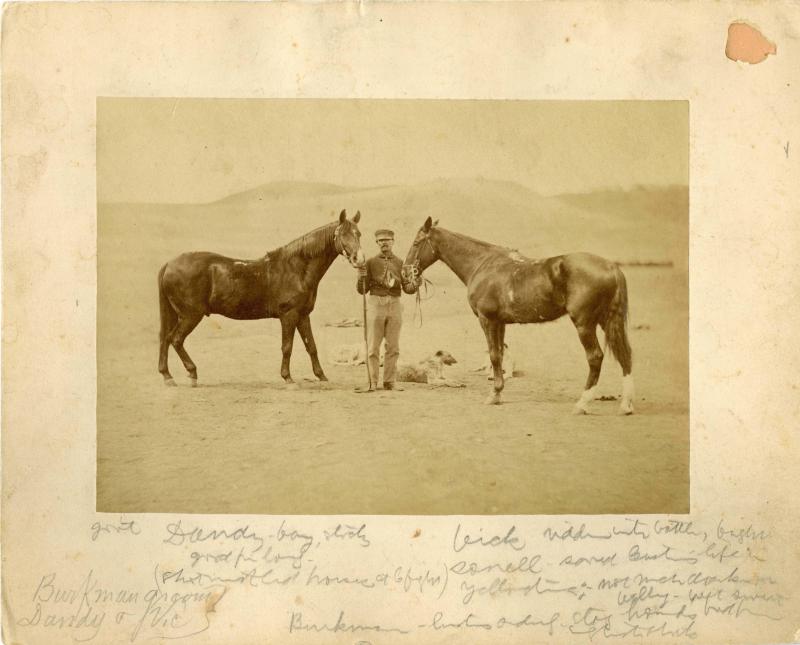
     General George Armstrong Custer’s most famous horses were “Dandy” and “Vic.” It was Vic, a stockinged sorrel with a blazed face, that Custer rode during the infamous Battle of the Little Bighorn. The Sioux claimed that Vic was captured after the massacre.
Dandy (left) and Vic (right), belonged to Gen. George Custer

 Rough Rider Teddy Roosevelt and Little Texas
     During the Spanish American War, Theodore Roosevelt led the charge of the Rough Riders in the Battle of San Juan Hill (July, 1898) on “Little Texas,” a chestnut described as a “pony” by historians. After the war, Roosevelt brought Little Texas back to the family's Sagamore Hill estate on Long Island where he lived out his days as playmate to the five Roosevelt children.


Two legends: Villa, Siete Luegas
     In the early 1900s, Francisco “Pancho” Villa blazed a rebel’s trail across Mexico (and one raid on U.S. soil) on his stallion “Siete Leguas,” which translates to “Seven Leagues.” Villa was proud of the horse’s stamina and speed. Supposedly, Siete Leguas regularly covered seven leagues (about twenty-four miles) during conquests.


     I have barely touched on the history of horses in warfare. Since the Greek myth of the Trojan Horse, the majestic animals have been a part of military battle lore. Did you know that, soon after the 9/11 attacks, a small band of U.S. Special Forces soldiers secretly entered Afghanistan and went to war against the Taliban…riding horses? Isn’t that thrilling? Here is Doug Stanton's book about the raid.


"Look back at our struggle for freedom,

Trace our present day's strength to it's source;

And you'll find that man's pathway to glory

Is strewn with the bones of the horse."


- Unknown author


 All the best,

Vonn 


2015 Western Fictioneers 
Peacemaker Finalist (Short Fiction)

2015 Western Writers of America
Spur Finalist (Short Fiction)

Keep up with Vonn:
Facebook 
(I just love "likes!")