Showing posts with label Vonn McKee. Show all posts

Saturday, March 27, 2021

Left-Handed with a Pencil - Interview with Vonn McKee


The final post for March's National Women's History Month is with Vonn McKee. Not only is she a wonderful writer, but she is also an amazing musician and so much more. I've enjoyed learning so much about and from the talented women in this series. Each of us has something we can share and I have appreciated the response from everyone from the authors to those who comment and share their stories and insights. So, without further ado, here is more wisdom to glean from the woman who is, as her tagline says, " Writing the Range". 


When did you realize you wanted to be a storyteller as a writer and musician?


Honestly, I was far down the writer/musician path before I realized what was happening. I was a scrawny asthmatic kid with a big strong singing voice. Go figure. I sang in church by age seven. Beginning at ten years old, I was a circuit funeral singer in Louisiana. I mean, probably hundreds of funerals! In that environment, I saw people at their most emotional and vulnerable, and I learned to observe it without reacting myself. They told me my songs brought them comfort, and that’s something I’ve never forgotten as a singer and a writer … that all of us are given gifts to be used to touch others in some way. At thirteen I joined a contemporary Christian band called the Jesus Christ Power & Light Company and, by fifteen, I was the headliner for Shreveport’s “Louisiana Hayride,” which was like a farm team for the Grand Ole Opry. I was privileged to record for MCA and tour nationally for several years, including two Opry guest appearances. Can you say, “no dating life?” That’s when I started writing my own songs, something I still do.

Entwined with all this was poetry and essay writing. During elementary school I wrote poems, one of which was published in the school newspaper. It was a clever piece, I thought, on dropping a marble during class and getting busted by the teacher. I made up whimsical Ogden Nash sorts of words. Would you believe the editor “corrected” those words, completely destroying the rhyme scheme? Sheesh. That wasn’t my last tangle with an editor, by the way.

My seventh-grade English teacher was the first to suggest I should consider writing as a career. Sometimes it only takes one person to encourage you to do the thing you’re meant for.


Did you chose the genre you write in or did it choose you?


I grew up in the Deep South, surrounded by stories and porch singings and plenty of Tennessee-Williams-type relatives. (Gee, I hope none of them read this.) My dad, however, was born in North Dakota and he and his Oklahoma-born father broke and sold horses. They were cowboys at heart and I got to spend summers on the family farm in northwestern Minnesota soaking up what I considered to be the Western life. In the kitchen, my grandmother told me stories from her childhood that rivaled those of Laura Ingalls Wilder.

I had a complete set of Zane Grey novels by the time I was eighteen and was writing a few cowboy songs. Fast forward to about 2012: I started going to writing conferences and eventually met Troy D. Smith, who asked me for some Western material. And off I went.


What was the nudge that gave you faith that you could and wanted to be published?


Songwriter Don Schlitz accepted his first CMA award for the Kenny Rogers recording of “The Gambler” by saying, “This is the first song of mine that anybody ever recorded, and I find all this very encouraging.” Although I didn’t kick off my literary writing career with a smash hit, my first short story published on Troy Smith’s Trailblazer imprint, “The Songbird of Seville,” was a WWA Spur finalist (2015). The same year, my second story, “The Gunfighter’s Gift” was a Western Fictioneers Peacemaker finalist. And I naively thought, “Hey, there ain’t nothin’ to this!”

I have since learned that no one has a Midas touch. It’s a little bit about talent and a lot about working hard to perfect your craft and also getting out and networking.


Is there a writing routine you follow or do you write when the muse strikes?


I’m a high-ADHD multitasker and discipline is a constant challenge. Also, I have many writing irons in the fire. I just finished judging for the Spurs (historical fiction) and am about to judge a short story contest. I’m a contributor and proofreader for Roundup magazine. Requests for short stories pop in, and I’m working on a novel. I belong to a writers critique group and I’m writing songs for a Western recording project. So I just try to spend time every day working on one or more of those. Just keep moving forward.


Is there a process where you find your next idea or does it just hit you?


Ideas are never a problem. It’s the getting them written that’s tough. Right now, I have four or five book ideas queued up in my head and, unfortunately, I’m a slow writer. The ideas spring up from research or sometimes from meeting someone. No kidding, people “bring” me stories all the time. My WIP was inspired by reading about artists like Albert Bierstadt, George Catlin and A.D.M. Cooper, who beautifully documented the 1800s Western landscape and people on canvas.


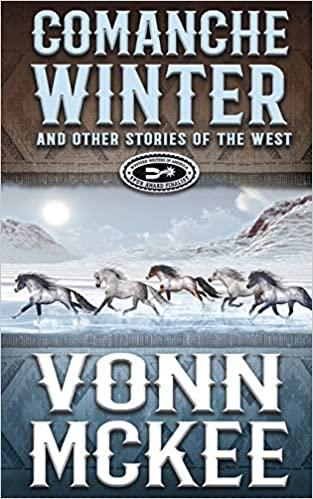
My anthology, Comanche Winter, was released on Wolfpack last year. Those stories are all over the place. A schoolboy has to defend his classmates against a Comanche attack. A circus troupe is caught behind enemy lines during the Civil War. An outlaw unwittingly steals a preacher’s identity.
Book Link

Do you ‘interview’ your characters before or at any time while telling their story?


Most characters show up with at least the essence of who they are and the story they wish me to tell. But I don’t like to start writing until I know them down to their bones. This is especially crucial when writing short stories. My goal is to make the reader feel very intimate with the character(s), as soon into the story as possible.

It’s all about believability and emotion with me. I work hard to stay accurate with historical and other details, but every story or song has to leave the reader or listener with an emotion. I’ve been told I write “with an ache,” and I do tend to write characters who carry both sweetness and pain inside them.


Is there anything you feel people would like to know or would be surprised to learn about you?


Gosh, I don’t assume anyone is interested. But, let’s see. I’m left-handed with a pencil but ambidextrous with most other things. I play baseball equally bad with either hand.


I have an engineering degree and worked in commercial construction as a precast project manager for several years at a time when there were virtually no women in the industry, so I have building babies across the Southeast. I’ve been a volunteer naturalist at a park and I’m a botany/zoology/astronomy nerd.


Do you consider music poetry and does the rhythm translate into your other writing?


Oh, I like this question. When people comment that I have a background in wildly different fields, I explain that I see countless parallels in music, math, architecture, and stories. Good design incorporates rhythm or pacing (visual or audible), color (even words have this!) and climaxes or highs and lows. And things have to add up at the end!


You’ve planned WF Conventions. What prompted you to take that on?


Well, when WF members first mentioned wanting to have a convention, I threw out a few suggestions. Next thing I knew, I was named convention chairman! (You know who you are, Cheryl Pierson.)


I’ve often said that every single thing you learn will be used later, eventually. I enjoy throwing big gatherings and have cooked for 50 people all by myself a number of times. Laying out a spread and making sure rooms and tables look good may or may not be a Southern thing. Also, my years working as a project manager taught me to break down a project into schedules, logistics and inventory needs.


That said, I nominate Cheryl Pierson to be chairman of the next WF convention.


Book Link

What advice would you give to those who dream of writing, or what advice would you give your younger self?


To aspiring writers … first, read your arse off. See what good, and bad, writing looks like. See which genre lights you up. Romance? (I leave that to the professionals.) Historical fiction? Nonfiction? Juvenile/YA? Mystery? Straight-up Western?


Read a few (but not too many) books on writing. Some of my favorites are How to Read Literature Like a Professor by Thomas C. Foster and On Writing by Stephen King. I loved Alexandra Sokoloff’s Screenwriting Tricks for Authors because it taught me about storyline pacing and to conjure up mental pictures of every scene as I write it.


Go to where other writers are. You’ll meet someone at every conference who will help you on your path. Might even be your next publisher. At the very least, you’ll spend time among your tribe.


Then, start typing. Yes, the page will be blank. And, no, you won’t have any idea what you’re doing. None of us did when we started. And some of us still don’t but we write anyway.


And to my younger self, I would say, “Have faith. It’s going to work out okay. But PLEASE don’t marry that curly-haired guy from California.”

For more, check out the following links: 

Facebook

Amazon 


Thank you to everyone who has been so gracious to take part in these interviews. I have enjoyed and appreciated every one of you.

See you all in April for more from our Western Fictioneers Members. Be safe, stay well, and keep those fingers moving.


Sunday, March 24, 2019

THE ANSWER IS BLOWING IN THE WIND by Vonn McKee


Vonn has been traveling for a few weeks and hopes you'll enjoy this reposting of THE ANSWER IS BLOWING IN THE WIND, first published on the blog site in November, 2014.


Much has been written about the Range Wars of the American West. The premise of cattlemen and farmers in conflict, sometimes violently, over grazing and water rights found its way into iconic books and movies such as To the Last Man (Z.Grey), The Virginian (O. Wister), Shane, Oklahoma!, and Chisum.

The invention of barbed wire served only to exacerbate the range wars for the next several years. Farmers built fences to keep open range cattle out of their crops, but that meant they also cut off access to water sources for the roaming herds. Not until the late 1880’s were laws passed that required, among other things, the addition of gates for every three miles of fencing.
To complicate matters, the western states and territories employed prior appropriation water rights, described as “first in time, first in rights.” The earliest landowner in the region held superior rights to waterways running through his property. Throw in a few irrigation ditches or a dam, and he could have some very disgruntled neighbors.

There were few water wells in the Old West, and for good reason. They had to be hand dug or drilled and the water table in those arid regions could be several hundred feet below grade.

Even as the fur and bullets flew over the right to water access, the solution to the problem was being devised in a New England machine shop. In the small town of Ellington, Connecticut, a mechanic named Daniel Halladay was tinkering with water pumps. His pump relied on steam engine power, which most everything did in those days.
Daniel Halladay
John Burnham, Jr.
He crossed paths with a visionary named John Burnham, Jr., who was fascinated with the use of wind power to run hydraulic machines. Halladay hired Burnham and, together, they invented the first wind engine that could pivot with directional wind changes by use of a tail vane. (Old European windmills were fixed, with enormous sails that required considerable winds to operate.)

Halladay’s first wind engine design, The Halladay Standard, utilized four paddle-like blades made of wood or sailcloth. This evolved into the self-regulating wind engine, which featured sections of narrow blades that could fold back in high winds, much like the action of an umbrella.

The Halladay Standard
(Original Patent)

Self-regulating Wind Engine
(shown with sections folded

The biggest problem facing Halladay and Burnham was that their wonderful invention was just not selling…at least not in Connecticut. Burnham suggested that they expand to the Midwest. While most of the manufacturing operations remained in Connecticut, they opened a shop in Batavia, Illinois. The move was a fortuitous one. Sales took off in America’s breadbasket and Halladay moved the rest of his company to Batavia.

Salesmen traversed the western states by train and wagons, carrying samples of windmills to farmers and ranchers on the parched plains. To say that the wind-powered water pumps all but ended the range wars would not be an exaggeration. More manufacturers entered the market and Batavia, Illinois, would become known as “Windmill City.”

Thomas O. Perry, an engineer who worked for Daniel Halladay, experimented with new, more efficient blade designs and lighter assemblies. He needed to test his new ideas and outfitted one of the factory’s buildings into a primitive wind tunnel, effectively producing two inventions that would revolutionize American industry.

Aermotor Windmill
Curiously, Halladay was not interested in the new design and Thomas Perry went on to work for the Aermotor Windmill Company. Perry’s cupped steel blade design became the standard for windmills. Ironically, the Aermotor Company is the only U.S. manufacturer of windmills still in business. They are based in San Angelo, Texas.

Great engineering marvels always come down to simplicity, elegance and functionality. Certainly, the humble windmill qualifies. Day after day, year after year, they catch the wind and turn it into power. They work when it’s raining, snowing…when the sun is high or the moon is dim…when it’s Christmas or just another Tuesday. What would the American West be without them?

For you road trippers, there are a number of windmill museums located across the U.S. (Texas, Indiana, Oklahoma, Nebraska and New Mexico) The state of Texas is especially known for its ubiquitous windmills. Here's a little story from the early Panhandle days:

"When one of the first windmills in the Texas Panhandle was installed and put into operation, the owner took his crew of riders out to see how it worked before acceptin' it from the contractor. When he saw the little trickle of water flowin' out he was as tickled as a cub bear with a honeycomb, and declared that the windmill would revolutionize the cow business. One skeptical cowhand eyed the small stream, and said, "Hell, Boss, I could get behind a bush and do a better job than that." ---- Ramon F. Adams, THE OLD-TIME COWHAND, 1948.

All the best,

Vonn


Short stories


Sunday, January 27, 2019

STEAMBOAT: "The Closest Thing to Perpetual Motion that ever Wore Hair" By VONN McKEE


DICK STANLEY ON STEAMBOAT, 1908


Sunfishing. End swapping. Windmilling. Crow hopping.

Those are a few of the stylish moves the toughest bucking horses (aka “arm jerkers”) use to throw off whoever dares to climb onto their backs. Most broncs pick one or two of those specialties and get consistently good results. But there was one horse, long long ago, who used every trick in the cowboy playbook and some that hadn’t been written…


In 1894, a big black Percheron/Mexican hotblood cross with three white stockings was foaled near Chugwater, Wyoming. The Two Bar ranch hands hoped he’d be a fine cowpony. He was, in fact, gentle enough to be led around by the rancher’s kid. The colt’s only mishap was suffering a broken nose when he was thrown down for gelding, giving him a distinct whistling sound—like a riverboat—when he exerted himself, and he was thereafter known as “Steamboat.”


At three years old, the day came when a saddle was put on him, and all hell broke loose. “He blowed up at me and we had one of the damnedest saddle fights you ever saw,” said top hand Jimmie Danks. It became clear, after no one could successfully ride the outlaw, that the horse was born to buck, not cut cattle.
 
Steamboat was sold to a bucking horse contractor named John Coble and was soon wowing crowds and tossing cowboys like ragdolls in Denver arenas, then the Cheyenne Frontier Days, where he became a wicked, twisting, celebrity bronc. He threw off the best riders in the circuit. In those days, a win did not constitute an eight-second ride. The contest wore on until either the cowboy was on the ground or the bronc stopped bucking.

GUY HOLT VS STEAMBOAT, 1903
In 1903, Guy Holt managed to stick on and also happened to be photographed by B.C. Buffum, a professor at the University of Wyoming. The image of the desperate battle between the horse and rider inspired the university’s logo and, most agree, the iconic bucking silhouette pictured on Wyoming license plates.


Only a few riders would stick out a ride on Steamboat over his long career. When he retired, he became an equine star in the Irving Brothers Wild West show. In 1914, he was badly injured on barbed wire during travel and contracted blood poisoning. Steamboat was taken to his native Wyoming but the prognosis was grim. One of rodeo’s greatest bucking broncs of all time was put to death with a rifle that had belonged to the notorious Tom Horn, in a dramatic end-twist of Wyoming history.
 
Rodeo buff Jack Bowers described the legacy of Steamboat in a 1970 Sports Illustrated article:
"I've seen 'em all for 65 years and I never saw a buckin' hoss to top Steamboat. First off, he was big and powerful—1,100 pounds—and tireless. Fact is, he was the closest thing to perpetual motion that ever wore hair. He'd start to squat when they threw the saddle on him and by the time the bronc buster was set in the stirrups Steamboat's belly'd be almost touchin' the arena dust. Then, the second they'd jerk that blindfold he'd explode! He'd bust out to the middle of the arena as if he wanted the stage all to himself and he'd put on the damnedest exhibition of sunfishing and windmilling I ever seen. His best trick was to swap ends between jumps and come down ker-slam on four ramrod legs. His head and forelegs would be twisted one way and his rump and hind legs another. When he was goin' all out, he seemed to be on a great big invisible pogo stick. Few men could stand that kind of battering without bleeding from the nose, and most became nauseated as well. Sometimes, no matter how tight a rider laced his buckin' corset, he'd wind up with broken ribs. Bronc riders are harder'n scrap iron, but ol' Steamboat put some of the toughest into the hospital for repairs."


Steamboat lives on in bronze perpetuity on campus at University of Wyoming-Laramie. “The horse has a lot of Wyoming history in him,” explained sculptor Chris Navarro. “He was born and bred here, and he was a champion bucking horse in Cheyenne. They designed the logo for the state from him. When you see that emblem, it’s Wyoming, and that’s what makes it cool.”


(Recommended reading: Steamboat, Legendary Bucking Horse: His Life and Times, and the Men Who Tried to Tame Him by Candy Vyvey Moulton and Flossie Moulton)


All the best,


Vonn McKee

“Writing the Range”
2015 Western Fictioneers Peacemaker Finalist (Short Fiction)
2015 Western Writers of America Spur Finalist (Short Fiction)


vonnmckee.com
Like Vonn on FACEBOOK!


CLICK HERE FOR
THE TRADING POST & OTHER FRONTIER STORIES


WESTERN SINGLES ON WOLFPACK
                 AT AMAZON

Sunday, September 23, 2018

WESTERN FICTIONEERS CONVENTION HIGHLIGHTS By Vonn McKee


If there was ever a time when I was especially proud to a member of Western Fictioneers, it was the weekend of our convention in Oklahoma City. Old friends did some catching up, and new friends were made. I lost count of the states represented. (Idaho, New Hampshire, Massachusetts, Nebraska, Colorado, California, Texas, Arkansas, Tennessee, Alabama, South Carolina, New Mexico, etc.) The discussions were intimate and open, and the session topics were deeply informative, thanks to our many knowledgeable presenters.
'EARLY ARRIVERS' DINNER
JES HAYS,
JIM GRIFFIN
(Photo, Jacquie Rogers)
Some of us thought we knew a thing or two about horses until Jim Griffin shared so many tidbits from his store of obscure equine trivia that we could barely write it all down. James Reasoner and Bob Vardeman (300+ novels each!) told us a thing or two about writing habits, serial novel continuity, and offered up anecdotes from their illustrious careers.

Speaking of continuity, our guest Diane Garland explained how her “Worldkeeper” business helps authors keep track of everything from character names and traits, timelines, names of supporting characters/walk-ons/towns/pets . . . well, you get the idea.

EDWARD MASSEY
(Photo, JES Hayes)
Edward Massey did a fine job of outlining the factors that influenced the West, including economics, modes of transportation, and developments in communication. (This discussion could have easily gone another hour!) The “Weird Westerns” panel featured James Reasoner, Jacquie Rogers, Caroline Clemmons, and Bob Vardeman.

W. MICHAEL MILOM
Michael Milom reprised his session on “Legal Labyrinths,” giving us updates on the latest changes to the copyright law and answering a wide range of questions from the group. JES Hays led an excellent panel on “Social Media,” while we heard about lady lawyers and doctors from Ron Schwab and Doris McCraw. (Forget everything you learned from “Doctor Quinn, Medicine Woman!”)
JAMES REASONER, DIANE GARLAND,
BOB VARDEMAN
(Photo, JES Hayes)
Vicky Rose and yours truly talked about some miscellaneous ways authors can market themselves and unearth non-traditional writing jobs.

The highlight of the convention was our group tour of the National Cowboy and Western Heritage Museum. Of course, the galleries were phenomenal (entire rooms devoted to works by Charles Russell and Frederic Remington). A favorite was the collection of western-related entertainment memorabilia, much of which was donated by Tom Selleck and the John Wayne family. Our docent shared a wealth of beyond-the-brochure information.
"END OF THE TRAIL"
(1918)
JAMES EARLE FRASER
 NATIONAL COWBOY & WESTERN HERITAGE MUSEUM
(Photo, Museum Archives)


JOHN WAYNE'S
"McCLINTOCK" COSTUME
Dinners were themed “Mining for Story Gold” (edible gold nuggets on every table!) and “Don’t Forget to Have Fun.” Who could resist party favors like fake mustaches and plastic cowboys and Indians?

At the close of Saturday’s dinner, Big Jim Williams announced the Peacemaker Award winners and finalists and recounted some fabulous stories from his early days in radio. We passed Dusty Richards’s big black hat around the room, filling it with donations for our hard-working banquet staff. (What began as a spontaneous act during our first convention has now become a tradition!)

Cowboy Church ran longer than expected, due to a lively discussion on the history of hymns. Guest Jim Crownover worked in some facts about circuit preachers and worship traditions of the West before reading from the book of Matthew.

Thanks to all who came from far and near to make our gathering a success.


All the best,


Vonn McKee

“Writing the Range”
2015 Western Fictioneers Peacemaker Finalist (Short Fiction)
2015 Western Writers of America Spur Finalist (Short Fiction)


vonnmckee.com
Like Vonn on Facebook!


Have you read "AN ASTONISHING HOST OF CURIOSITIES?
"Fast moving and entertaining..."
"Twists and turns galore." 
AVAILABLE HERE

Saturday, June 23, 2018

CUSTER RIDES AGAIN (Reenactment of the Battle of the Little Bighorn) by Vonn McKee

Even after 142 years, the Battle of the Little Bighorn—or the the Battle of the Greasy Grass, or Custer's Last Stand—remains a frequent topic of discussion among western historians and favored subject matter of both fiction and nonfiction works. Historian Paul Hutton called it "the most important battle in the history of the American West." The engagement between General George Custer's 7th Cavalry Regiment and the combined forces of the Lakota, Northern Cheyenne, and Arapaho tribes has been examined from every angle. No white survivors lived to tell the tale, and many accounts of the Natives have been discounted over the years. Archeological digs at the battlefield continue to reveal new details surrounding the bloody conflict, which occurred on Sunday, June 25, 1876.
Gen. George Custer
Chief Sitting Bull

As it happens, this weekend marks the anniversary of the Battle of the Little Bighorn. Reenactments are scheduled for June 22-24 at 1:00 PM each day. (I plan to attend the final reenactment on Sunday.) The "battle" will take place at the location of Chief Sitting Bull's camp along the banks of the Little Bighorn River, between Crow Agency and Garryowen (the latter was the actual site of the battle).

If you find yourself in the region this weekend, here are links detailing the history of the battle and information regarding the reenactment. 

www.littlebighornreenactment.com
Reenactment Video Promo

Historical reenactments are wonderful resources for authors and history buffs alike. They also present the opportunity to thank the dedicated volunteer reenactors who invest heavily (both in terms of money and time) so that viewers can get an authentic picture of period dress, customs, and details of historical events.

Also, search this blogsite for excellent posts on Custer and the battle by Western Fictioneers members Steve Kohlhagen and Tom Rizzo.

All the best,
Vonn McKee
"Writing the Range"

2015 Western Fictioneers Peacemaker Finalist (Short Fiction)
2015 Western Writers of America Spur Finalist (Short Fiction)


Visit Vonn on Facebook!
vonnmckee.com


Sunday, April 22, 2018

BIG LITTLE BOOKS: A CHILDHOOD TREASURE by Vonn McKee

Since I'm traveling this week, I hope you won't mind reading (or rereading) this post about Big Little Books, which first appeared a couple of years ago. I'll meet you all in May (fourth Sunday) for a fresh new blog post here at Western Fictioneers!
 

All the best,
VM


It’s possible that this book, Roy Rogers and the Mystery of the Howling Mesa, is the first western I ever read. It once sat on a crowded book shelf in one of the cozy, garret bedrooms of my grandparents' farmhouse in northwestern Minnesota, where I visited every summer of my childhood. I snuggled under handmade quilts at night, surrounded by the rag rugs, books and simple toys left from my father’s childhood days.

It’s just a little book … a Big Little Book, in fact. It’s chubby, about 4 inches square by an inch and a half thick, with a tough little hardboard cover. There were others on hand–Dick Tracy, Donald Duck and Mickey Mouse–and they were just the right length to read before nodding off.

Big Little Books were most popular during the 1930s and ‘40s. They actually came about through a series of mishaps. A young man named E.H. Wadewitz went to work for a commercial printer in Racine, Wisconsin, in order to pay for his evening bookkeeping classes (which would come in handy later). The company wasn’t doing so well and fell behind on his pay. (Mishap Number One) Finally the desperate owner offered Wadewitz ownership of the company, negotiating the back pay as part of the purchase price. He accepted and found himself in the printing business, complete with a couple of battered presses, some worn type fonts and a band-powered cutting machine.
Wadewitz christened the company “Western Printing and Lithographing.” He brought his brother onboard and they hired an experienced local printer and eventually a salesman. One of their early clients was Hammerung-Whitman, a publisher of children’s books. Western contracted to print thousands of their newly developed titles but, after the books were printed, Hammerung-Whitman defaulted on payment. (Mishap Number Two)


Western Printing Company, early days
(E.H.Wadewitz second from right)
The Wadewitz brothers had a warehouse full of children’s books and no retail experience. They decided to try selling all the books rather than writing off the cost and, over the next three years, managed to place all the inventory in various department stores.

By now, they were getting the hang of it and contracted with a major five-and-dime chain called S.S. Kresge to provide children’s titles. A miscommunication within the fulfillment department led to Mishap Number Three: Western printed TWELVE times too many books for the Kresge order! Their salesman, Sam Lowe, took a gamble. He persuaded the F.W. Woolworth Company to display the books in their stores, even though it wasn’t Christmas. (At that time, children’s books were only available for Christmas gift-giving.) Sales were brisk and Western Printing scrambled to provide more titles, even branching into boxed board games and puzzles.

With the Great Depression, the public turned to inexpensive forms of entertainment. They flocked to ten-cent movie matinees, gathered around RCA Victors to listen to free radio dramas, and bought cheap comics and pulp fiction based on popular Hollywood characters.

Western Printing hit upon the idea of providing licensed children’s books that featured the radio and cinema heroes the public loved so well. Salesman Sam Lowe designed the “Big Little Book,” a compact, chunky hardboard book, to suit the hands of small readers. After pitching the idea to some New York retailers, he walked away with orders for 25,000 books. Soon, Western had an exclusive licensing deal with Walt Disney to print books based on their cartoon characters. Some of those first edition Disney books are worth thousands of dollars today! Other titles featured Buck Rogers, Blondie & Dagwood and tons of cowboys including Tom Mix, Red Ryder, Gene Autry and Ken Maynard.
A few BIG LITTLE BOOK Western titles
Roy Rogers and the Mystery of the Howling Mesa now sits on a shelf at my mom’s house. (My dad passed away last year.) She says I’m welcome to take it home with me but, for now, I’m letting it stay there with the rest of his mementoes. Someday, I’ll read it again…just so I can say I’ve come full circle.

All the best,

Vonn

 Vonn McKee
"Writing the Range"

2015 Western Fictioneers Peacemaker Finalist (Short Fiction)
2015 Western Writers of America Spur Finalist (Short Fiction)


Facebook.com/VonnMcKee

Sunday, March 25, 2018

MIND YOUR STATES, AND DATES! by Vonn McKee


When plotting a new story or book idea, one of the western writer’s most important decisions is LOCATION. Will the story take place in the high deserts of Arizona or New Mexico? The Front Range of Colorado? The rolling plains of Wyoming? The geography can dictate the types of characters, weather, architecture, landscape, and historical events you intend to include.

But wait a minute. Is it Arizona you’re writing about . . . or Arizona Territory? Texas . . . or the Republic of Texas? The western “states” straggled into the Union, a few at a time, between the years of 1845 (Texas) and 1959 (Alaska). To make things even more confusing, much of the Midwest and some of the West once lay within the borders of the Louisiana Purchase. As a native Louisianian, I like to rib my Texas and Alaskan friends that my state was biggest, once upon a time. And what do you know? My current home state of Tennessee was once called the Southwest Territory!

The period of American history known as “the Wild West” lasted roughly thirty years . . . from 1865 to 1895. Several western states were admitted to the Union in the very late 1800s: North and South Dakota, Montana, and Washington (1889), Idaho and Wyoming (1890), and Utah (1896). It wasn’t until the 1900s that the United States admitted Oklahoma (1907), New Mexico and Arizona (1912), and Alaska (1959).

Advertisement for anti-slavery meeting
For some states, the journey to statehood came with great difficulty and sacrifice. The Kansas-Nebraska Act which became law on May 30, 1854, established Nebraska Territory and Kansas Territory. The region was attractive to both the slave and free states, where tensions were building to a fever pitch. Settlers from both sides began pouring into Kansas, hoping to swing the vote when Kansas citizens decided where their loyalties lay. When the so-called “Border Ruffians” from Missouri arrived (planning to stuff the ballot boxes with pro-slavery votes), a period of extensive violence began, lasting until 1858. At the end of these “Bleeding Kansas” years, the Wyandotte Constitution was adopted, assuring the anti-slavery status of the future state of Kansas.

Oklahoma is another state with an eventful history leading up to its statehood. Always a Native American stronghold, the U.S. government’s relocation of several tribes to this region created an expansive “Indian Territory” adjoining Oklahoma Territory. The tribes agreed to let the government open up “Unassigned Lands” for settlement in 1899. As discussions of statehood escalated, executive officers of the “Five Civilized Tribes” proposed that Indian Territory be name the new state of “Sequoyah,” separate from Oklahoma Territory. However, the U.S. government ultimately decided to combine both territories and President Teddy Roosevelt signed a proclamation naming “Oklahoma” as the nation’s 46th state in 1907.

Of course, every state has its own unique and fascinating history. Fiction writers can develop plotlines and characters that correspond with those historic events, making for a more authentic experience for readers. For the research convenience of those writers, here’s a list of all fifty states, along with their dates of admission to the Union, year of first settlement, and former territorial names.


State
Entered Union
Year Settled   Formed from:
Delaware
Dec. 7, 1787
1638                Colony of Delaware
Pennsylvania
Dec. 12, 1787
1682                Proprietary Province of Pennsylvania
New Jersey
Dec. 18, 1787
1660                 Crown Colony of New Jersey
Georgia
Jan. 2, 1788
1733                 Crown Colony of Georgia
Connecticut
Jan. 9, 1788
1634                 Crown Colony of Connecticut
Massachusetts
Feb. 6, 1788
1620                 Crown Colony of Massachusetts Bay
Maryland
Apr. 28, 1788
1634                 Proprietary Province of Maryland
South Carolina
May 23, 1788
1670                 Crown Colony of South Carolina
New Hampshire
June 21, 1788
1623                 Crown Colony of New Hampshire
Virginia
June 25, 1788
1607                 Crown Colony; Dominion of Virginia
New York
July 26, 1788
1614                 Crown Colony of New York
North Carolina
Nov. 21, 1789
1660                 Crown Colony of North Carolina
Rhode Island
May 29, 1790
1636                 Crown Colony of Rhode Island
Vermont
Mar. 4, 1791
1724                 Vermont Republic
Kentucky
June 1, 1792
1774                 Virginia; District of Kentucky (part)             
Tennessee
June 1, 1796
1769                 Southwest Territory
Ohio
Mar. 1, 1803
1788                 Northwest Territory (part)                
Louisiana
Apr. 30, 1812
1699                 Territory of Orleans
Indiana
Dec. 11, 1816
1733                 Indiana Territory
Mississippi
Dec. 10, 1817
1699                 Mississippi Territory
Illinois
Dec. 3, 1818
1720                 Illinois Territory (part)
Alabama
Dec. 14, 1819
1702                 Alabama Territory
Maine
Mar. 15, 1820
1624                 Massachusetts; District of Maine
Missouri
Aug. 10, 1821
1735                 Missouri Territory (part)
Arkansas
June 15, 1836
1686                 Arkansas Territory
Michigan
Jan. 26, 1837
1668                 Michigan Territory
Florida
Mar. 3, 1845
1565                 Florida Territory
Texas
Dec. 29, 1845
1682                 Republic of Texas
Iowa
Dec. 28, 1846
1788                 Iowa Territory (part)
Wisconsin
May 29, 1848
1766                 Wisconsin Territory (part)
California
Sept. 9, 1850
1769                 Unorganized territory (part); California Republic
Minnesota
May 11, 1858
1805                 Minnesota Territory
Oregon
Feb. 14, 1859
1811                 Oregon Territory (part)
Kansas
Jan. 29, 1861
1727                 Kansas Territory (part)
West Virginia
June 20, 1863
1727                 Virginia (Trans-Allegheny region)
Nevada
Oct. 31, 1864
1849                 Nevada Territory
Nebraska
Mar. 1, 1867
1823                 Nebraska Territory
Colorado
Aug. 1, 1876
1858                 Colorado Territory
North Dakota
Nov. 2, 1889
1812                 Dakota Territory (part)
South Dakota
Nov. 2, 1889
1859                 Dakota Territory (part)
Montana
Nov. 8, 1889
1809                 Montana Territory
Washington
Nov. 11, 1889
1811                 Washington Territory
Idaho
July 3, 1890
1842                 Idaho Territory
Wyoming
July 10, 1890
1834                 Wyoming Territory
Utah
Jan. 4, 1896
1847                 Utah Territory
Oklahoma
Nov. 16, 1907
1889                 Oklahoma Territory & Indian Territory
New Mexico
Jan. 6, 1912
1610                 New Mexico Territory
Arizona
Feb. 14, 1912
1776                 Arizona Territory
Alaska
Jan. 3, 1959
1784                 Territory of Alaska

Hawaii
Aug. 21, 1959

1820                 Territory of Hawaii; Republic of Hawaii;
                         Kingdom of Hawai’i


All the best,

VonnMcKee                                                                                          
“Writing the Range”
2015 Western Fictioneers Peacemaker Award Finalist (Short Fiction)
2015 WWA Spur Award Finalist (Short Fiction)


Website vonnmckee.com

From WOLFPACK PUBLISHING
Now available on Amazon