


"The history of mankind is
carried on the back of a horse."
–Author Unknown
In
my previous blog, WAR HORSES: Part One, we took a look at notable horses ridden by prominent
generals of the Civil War. This time, we travel further back in history to examine
more war horses whose names and bravery in battle are nearly as legendary as
those of their owners.
 |
| Alexander tames Bucephalus |
The
year was 346 B.C. and Philip II of Macedon had just paid the exorbitant price of thirteen
talents for a gorgeous black stallion, only to find that he could not be
ridden. No one was able to even mount the huge beast. Philip’s ten-year-old
son, Alexander, watched the proceedings and stepped forward, declaring the
horse’s handlers spineless and challenging his father that he could ride the
stallion. The boy was so adamant that he was granted the chance. Alexander took
the horse’s reins, turned him to face the sun, and promptly leaped onto his
bare back! Only Alexander had noticed that the stallion was afraid of his own
shadow. He named the enormous horse Bucephalus and they became inseparable.
Alexander the Great rode him into every battle from the conquest of Greece and Thebes through
Guagamela into India.
 |
| Napoleon Bonaparte and Marengo |
Paintings
of Napoleon Bonaparte often depict him on horseback (not surprising since the
French general stood only five feet, six inches in height). A favorite mount
was “Marengo,” a fierce, stocky grey who was wounded eight times without ever
throwing his master from the saddle. It was aboard Marengo that Bonaparte met
his Waterloo (1815), ending the Napoleonic Era of European history. His last
horse was a white Arabian named Le Vizir, who lived to the age of thirty-three.
He was mounted and is currently on display at the Army Museum in Paris.
Closer
to home, America’s founding father, George Washington was a revered horseman.
Thomas Jefferson called him "the best horseman of his age, and the most
graceful figure that could be seen on horseback." Most paintings of
Washington show him astride “Blueskin,” a flashy white half-Arab with a dark
mane. However, the General usually rode a chestnut gelding named “Nelson” into
battle, since he was calmer under cannon fire. After his service during the
Revolutionary War, Nelson lived out his days at Mt. Vernon and was reported to “…run,
neighing, to the fence, proud to be caressed by the great master's hands.”
 |
| Washington on Blueskin |
 |
| Washington and war horse, Nelson |
Speaking
of the Revolution, Paul Revere’s midnight ride forever stands as the event
heralding the beginning of the conflict between England and the fledgling
colony of America. And who was the horse he rode? Unfortunately, we may never
know. Revere borrowed a horse from a
merchant named John Larkin for the hellbent-for-leather ride to Lexington. The
steed’s name is lost to history.
 |
| Andrew Jackson and Sam Patch |
Tennessee
native son Andrew “Old Hickory” Jackson favored thoroughbreds, raising and training
them himself. Most well-known was “Truxton.” A favorite story of Jackson is
that he engaged in a duel after a local rival forfeited a race between Truxton
and a horse named “Ploughboy.” Old Hickory caught a bullet near his heart and,
since doctors were afraid to remove it, there it stayed throughout the future
president’s life. “Sam Patch” is the white stallion shown in Jackson’s
presidential portrait and the horse who holds the title of being the General’s
true “war horse.” Sam Patch was named for a daredevil celebrity of the era, who
died attempting a jump across the falls of the Genesee River.
 |
| Kit Carson and Apache |
The
Plains Indian Wars from the 1850s through the late 1870s are possibly the most
iconic of all conflicts between mounted opponents. Christopher “Kit”Carson was
one of the earliest Indian fighters. He was another leader who lacked in
stature at five feet, one and a half inches tall but possessed an abundance of
daring. According to the first Carson biography, The Life and Adventures of Kit Carson, the Nestor of the Rocky
Mountains by De Witt C. Peters, the “Fighting Trapper” rode a horse with
the ironic name of “Apache.”
General
George Armstrong Custer’s most famous horses were “Dandy” and “Vic.” It was
Vic, a stockinged sorrel with a blazed face, that Custer rode during the
infamous Battle of the Little Bighorn. The Sioux claimed that Vic was captured
after the massacre.
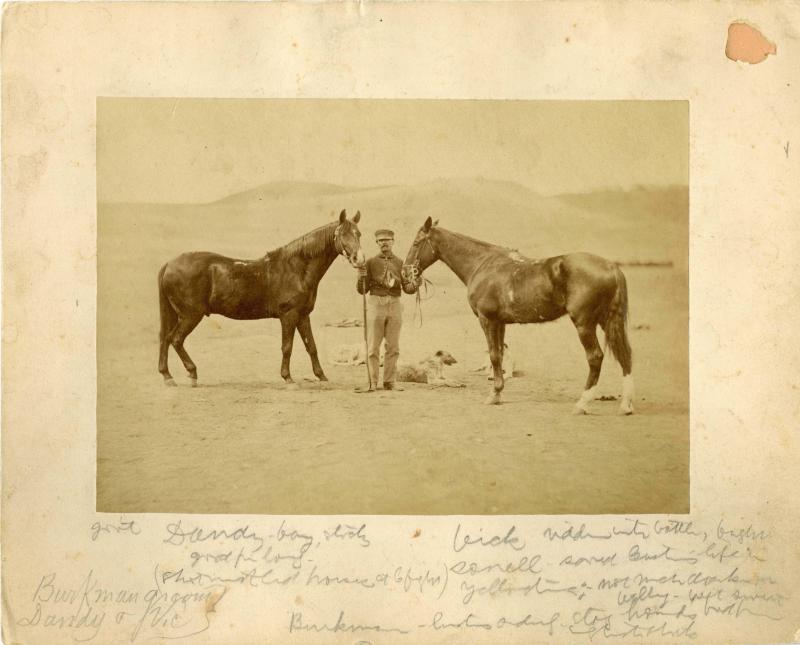 |
| Dandy (left) and Vic (right), belonged to Gen. George Custer |
 | |
| Rough Rider Teddy Roosevelt and Little Texas |
During
the Spanish American War, Theodore Roosevelt led the charge of the Rough Riders
in the Battle of San Juan Hill (July, 1898) on “Little Texas,” a chestnut
described as a “pony” by historians. After the war, Roosevelt brought Little
Texas back to the family's Sagamore Hill estate on Long Island where he lived
out his days as playmate to the five Roosevelt children.
 | ||
| Two legends: Villa, Siete Luegas |
In
the early 1900s, Francisco “Pancho” Villa blazed a rebel’s trail across Mexico
(and one raid on U.S. soil) on his stallion “Siete Leguas,” which translates to “Seven Leagues.” Villa was proud
of the horse’s stamina and speed. Supposedly, Siete Leguas regularly covered seven leagues (about twenty-four
miles) during conquests.
I
have barely touched on the history of horses in warfare. Since the Greek myth
of the Trojan Horse, the majestic animals have been a part of military battle
lore. Did you know that, soon after the 9/11 attacks, a small band of U.S. Special
Forces soldiers secretly entered Afghanistan and went to war against the Taliban…riding horses? Isn’t that thrilling? Here is Doug Stanton's book about the raid.
"Look back at our struggle for freedom,
Trace our present day's strength to it's source;
And you'll find that man's pathway to glory
Is strewn with the bones of the horse."
- Unknown author
All the best,

Vonn
2015 Western Fictioneers
Peacemaker Finalist (Short Fiction)
2015 Western Writers of America
Spur Finalist (Short Fiction)


