Showing posts with label Black Lightning. Show all posts

Tuesday, July 22, 2014

Western Comics Focus: Lobo, a comics first


Troy D. Smith

Are you familiar with the 1960s western comics hero Lobo?

If not, it's probably because the series only lasted two issues -and the reason for that is a story in itself.


Lobo was published by Dell Comics in 1965. The hero was a black cowboy whose true name was unrevealed, but who was known as Lobo. It featured scripts by D. J. Arneson (at that time Dell's editor) and art by Tony Tallarico. (As is often the case in such situations, the two creators disagree on which one actually first came up with the idea.)

Lobo is significant despite its short run because it was the first mainstream comic book in history to have an African American title character. (Starting in 1950, Atlas Comics -later known as Marvel- had "Waku, Prince of the Bantus" as one of their four rotating leads in Jungle Tales, but he was African not African American, and was not the title character.)


A few months after Lobo, the first black superhero debuted in a guest spot in the pages of The Fantastic Four: The Black Panther (actually predating the organization of that name by a few months.) But like Waku, Black Panther -alias T'Challa, King of the fictional African country Wakanda -was African, not African American. The first African American superhero was Sam Wilson, AKA The Falcon, who became Captain America's partner in 1969; the first African American superhero with his own title was Luke Cage, in 1972. DC Comics had their first black headliner with Black Lightning, created by Tony Isabella in 1977.


But Lobo preceded them all.

The first issue begins with a group of black Union soldiers being informed the war is over. The man who will become Lobo exclaims "After four years of being a soldier, I am a free man again! A free man!!" When the squad is attacked by Confederates who had not received word of Lee's surrender, and are forced to kill them, Lobo expresses his disgust with war and decides to head west and start a new life for himself.


He gets a job as a drover on a cattle ranch. Soon he is framed for murder, with no hope of clearing his name as the true killer dies before he can confess. The man known as Lobo wanders the West- "A fugitive on the side of the law" -righting the injustices suffered by others. There is some evidence he is a wealthy man, as he leaves as a calling card gold coins inscribed with a wolf's head and an "L" for Lobo (his exclamation about being free again now that the war was over might suggest he had been a successful free black man before the war.)
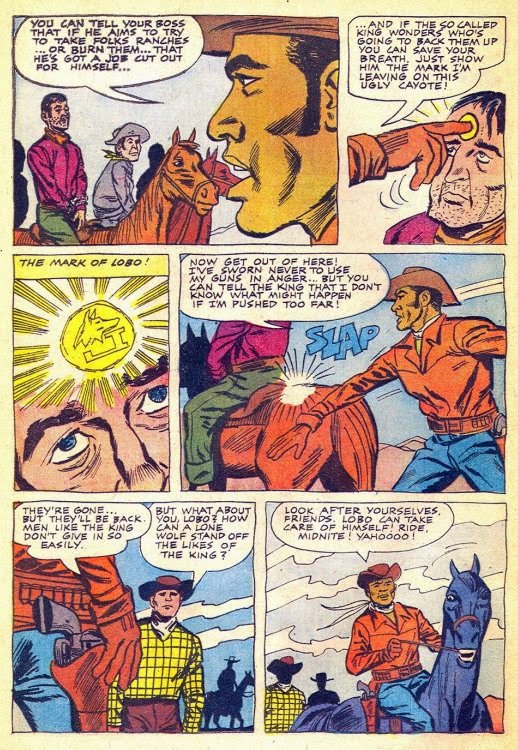

The book's creators were both white men who had been in the comics profession for some time- Arneson was from Minnesota and Tallarico was from Brooklyn. They believed that a black cowboy would generate interest and be a good hook. In fact, Lobo's race was never mentioned by himself or any of the other characters; he didn't behave or speak according to any stereotypical or stylized notions of black men. He was a competent, heroic man who just happened to be black.


But his race was going to matter.

By the time the second issue came out, sales were in for issue #1. And they were abysmal, not just for Lobo but for many of Dell's other titles. You see, a company's titles were tied together in a bundle to be delivered to newsstands. And all across the South, when newsstand owners saw Lobo they rejected the entire Dell bundle. The company had no choice but to cancel the title- they were just a little bit too ahead of their time.

Despite Lobo's brief career, he (and his creators) have received their due over the years, with accolades from many civil rights organizations. But even so, you will be hard-pressed to find another black cowboy headlining a western comic -unless I'm forgetting someone, the only character to come close was Marvel's Reno Jones. 1973 saw the debut of Reno Jones and Kid Cassidy: Gunhawks! The white partner, Kid Cassidy, was killed in issue #6, and in issue #7 the title of the book became Reno Jones, Gunhawk! But there was no issue #8, as the book was canceled.


Here's a tip of the sombrero to Lobo, and all the fun stories he could have appeared in.

Finding an actual copy of those two issues might prove to be a Tolkienesque quest, but you can read them in full at this blog.

On the bright side, there is apparently a comic-book crossover between Zorro and Django in the works. Really.


Tuesday, May 28, 2013

Western Comics Focus: Tony Isabella

By Troy D. Smith


If you haven't figured it out yet, I am a major league comic book geek. It started before I even learned to read, as  my older cousin (and my mom when I could draft her) would read them to me. I actually learned to read at an accelerated pace- because I didn't wnat to have to rely on someone else to tell me what the characters were saying.

NOTE: this helped my vocabulary as the years went by, as I often went to the dictionary to look up unfamiliar words. To this day, when I hear the word implacable I think of Galactus, and ubiquitous evokes an image of Doctor Doom's robots.


By the mid-70s I had advanced to the point that I not only could read the books, I was becoming familiar with the writers and artists. A name I saw a lot during that period (and later) was Tony Isabella. He must have made quite an impression on me, because the first things I tend to associate with his name are his short run on CAPTAIN AMERICA and the sadly short-lived BLACK GOLIATH. He wrote for a lot of  my favorite characters through the years, including a memorable run on GHOST RIDER; he also created the first major black DC Comics hero, BLACK LIGHTNING. He has also become well-known as an industry columnist and critic.

He's also author of 1,000 Comic Books You Must Read...


A couple of years ago Tony was gracious enough to serve on our panel of judges for our feature on the Top Ten Greatest Western Comics .  Turns out Tony is a big fan of western comics, particularly the Rawhide Kid- for some time now he has been writing a blog called "Rawhide Wednesdays."

Tony has agreed to be our guest today and share his perspective on western comics...

 1. From your own work, whatever the genre, what are you proudest of?

 ANSWER: Black Lightning. I wanted to create a positive role model
 who was also an interesting character. As I saw it, there weren't
 enough characters of color or diverse backgrounds in comics. That
 offended my sense of fairness. I wanted Jefferson Pierce to be a
 hero who readers young and old could relate to, could understand,
 could admire. Despite an uneven publishing history, my version of
 Black Lightning was and remains the hero I wanted him to be. The
 readers still consider my version to be the definitive take on the
 character. Especially on my second series, published in the 1990s, I
 think I did my best work on Black Lightning.


 2. Do you think westerns are different from other comics genres,
 other than setting?

 ANSWER: Yes and no. Obviously, the setting and the time make them
 somewhat different from other genres. But the best western comics
 are like the best comics of any genre...with intriguing characters
 and situations. That said, it should be noted there are very few
 "pure" western comics today. They are usually mixed with horror or
 other genres to increase their marketability. I'm surprised that we
 haven't already seen Kid Zombie, Outlaw or the Two-Gun Zombie.

 3. You've written a lot about western comics; in your career, have
 you had the opportunity to write any, or at least include some
 western elements?

 ANSWER: I've never had an opportunity to write western comics per se, but I wrote "Bounty for a Vampire" for Marvel's Dracula Lives! It was pitched as "Jonah Hex versus Dracula," changed a bit in the actual writing and drawn by Tony DeZuniga. For Marvel's Tales of the Zombie, I wrote "Voodoo War." That one was drawn by western comics legend Dick Ayers. And there was always a bit of cowboy in my version of Johnny Blaze in the modern Ghost Rider series.


 4. Are there any western characters you think you'd especially enjoy writing?

 ANSWER: I would have loved to have written several Marvel westerns. The Rawhide Kid was my favorite, but I also enjoyed Kid Colt, Two-Gun Kid and the company's version of ME's Ghost Rider. On my long bucket list of things I'd like to write before I kick the bucket is a western series that's not really a western series.


 5. You've said the Rawhide Kid is your favorite western comic
 character; in your eyes, what sets the Kid apart from other four-color cowboys?


 ANSWER: I relate to him better than the others. He's a short and feisty guy, not unlike myself. He's a loner, though not by choice. He's young enough that the reader wants to believe he can find the happy ending, the peace and quiet, the freedom from being hunted he seeks.


 6. Do you have any recent or upcoming projects you'd like to make our followers aware of?

 ANSWER: I try not to promote projects until they are getting close to realization. One of my main sources of income these days comes from assisting various comic-strip creators anonymously. I'll be asked to write a few weeks of a strip, plot out an extended story, come up with gags or just take a creator's ideas and put them into a more workable fashion.

 Online, I write the daily "Tony Isabella's Bloggy Thing" and often write about western comics, especially the Rawhide Kid, there. I also write a weekly "Tony's Tips" for the Tales of Wonder website.

 TONY ISABELLA'S BLOGGY THING:

http://tonyisabella.blogspot.com/


Many thanks to Tony for talking with us!