Showing posts with label Lake County War. Show all posts

Tuesday, November 25, 2025

And Now for Something Different?


Post (c) by Doris McCraw

aka Angela Raines

Image (C) Doris McCraw

We all encounter the unexpected. Usually fun, sometimes irritating, and occasionally an interesting blessing. This post is about the third, and, I think, interesting blessing.

Doctor Josephine Dunlop was born on December 3, 1875, in Colorado. Died September 15, 1970, at the age of 94 in Austin, Texas. She was the widow of William Dunlop and practiced medicine in Pueblo, Colorado.  One source has her as a graduate of the University of Michigan Medical School in 1898 and receiving her Colorado license that same year. This same source lists her as president of the Pueblo County Medical Society in 1918 and as having retired from the practice of medicine in 1946.  From 1919 to 1920, she served as the second vice president of the Colorado State Medical Society.

Dr Josephine Nachtrieb Dr. Jo Dunlop

Dr. Dunlop was one of the consulting pathologists for the Colorado State Hospital and the Colorado Fuel and Iron Company, both in Pueblo, Colorado.

The accomplishments of Dr. Dunlop fascinated me. It was as I researched her background that I found myself on a path I did not expect. Enter- the Unexpected. There I found her father, Charles H. Nachtrieb, an early settler in Colorado. Born in Germany on April 20, 1833, Charles came to the United States with his siblings. After settling in Colorado, Mr. Nachtrieb was a candidate from Lake County at the 1866 convention to establish a constitution to admit Colorado to the Union. (Colorado was not admitted until 1876). He was to have built the first grist mill west of the Mississippi and was one of the leaders in the Lake County War. (Which, according to records, was a particularly bloody conflict.) In 1879, he, along with Otto Mears and Issac Gothelf, filed an article of incorporation for the Poncho, Marshall, and Gunnison toll road, the object of which was to build a twenty-five-thousand-dollar toll road from Poncho Creek in Chaffee County to the Gunnison River.

An old school in Nathrop.

Charles Nachtrieb was also a rancher, having a large ranch in Gunnison County, Colorado. He and his family lived in Nathrop, Colorado (named for him), where he had a shop and was the postmaster. It was in Nathrop that, according to the newspaper report from the time, a man by the name of Burt (Bert) Remington shot and killed Charles on October 3, 1881. He was forty-nine. After searching, I have found no record of the trial or whether Remington was caught. But I have much more research to do. I did find a proclamation printed in the Daily Register-Call ( a Central City newspaper) on Thursday, October 6, 1881, which read.

The Governor’s Proclamation: Governor Pitkin, yesterday morning, made the following proclamation, offering a reward:

Wheras, On or about the third (3d) day of October, A.D. 1881, one Charles Nachtrieb was murdered in the county of Chaffee, and state of Colorado, and Wheras, Burt Remington has been charged with said murder, and, Wheras, said Remington has not been arrested, the proper officers have been unable up to the present time to find said Remington, Now, therefore, In pursuance of the statute in such cases made and provided, I do hereby offer the sum of three hundred dollars ($300) as a reward for the arrest and delivery to the sheriff of Chaffee, county, Colorado, of the aforesaid Burt Remington, so charged with the said murder.                                                      FREDERICK W. PITKIN, Governor.”

There is so much more to find out and research about this family, especially Dr. Dunlop’s father. I know I will be writing a great deal about her in the future. Her father’s story is a beautiful one of hard work and success, but ultimately a very sad one as well. In addition to Josephine, there were the wife, Margaret, and the children, Jake, Charles II, and Chris.

So you see, I was off down the ‘rabbit hole’ when I ran across Josephine Dunlop’s family tree. There is much more for me to find, and, as always, I love the unexpected pieces of history my doctor research is uncovering.

More about the war in another post.

Until Next Time,

Doris


Angela Raines - Amazon

Doris A. McCraw - Amazon


Tuesday, June 23, 2020

THE LAKE COUNTY WAR IN COLORADO

Post by Doris McCraw
writing as Angela Raines

Sharing again.

Nathrop, Colorado - Wikipedia
Church in Nathrop, Colorado
Wikipedia
The Lake County War, full of vigilantes, traveling preachers, judges, criminals, and chaos. To this day the true story isn't fully known. Into this mix is Charles Nachtrieb, an early settler in the area. While I knew of the Lake County War, I was unaware of Nachtrieb until research on his daughter, Dr. Josephine Dunlop, brought his story to my attention.

Mr. Nachtreib, born April 20, 1833, in Germany, arrived in the Lake County area around 1859. He was a candidate from Lake County to the convention to admit Colorado as a state in 1865, which was approved by the voters. Although a constitution was adopted, President Andrew Johnson rejected the petition in 1866. (Colorado was not admitted as a state until 1876, becoming known as the Centennial State)

In addition to having a business along with being postmaster in Nathrop, Colorado, Nachtrieb also owned land in Gunnison County where his large ranch was located. (Nathrop is an Anglicized version of Nachtrieb). He is also credited with having the first grist mill west of the Mississippi.

In 1879, Nachtrieb, along with Otto Mears and Issac Gothelf filed article of incorporation with the state for the Poncho (Poncha), Marshall and Gunnison toll road. The toll road was expected to cost twenty-five thousand dollars and run from Poncha Creek in Chaffee County to the Gunnison River. Apparently, there was a verbal agreement between Mears and Nachtrieb that Mears would build from the Gunnison side to the top of Poncha Pass and Nachtrieb would build from the Lake County side. This arrangement came about due to the above-mentioned grist mill and the farming, especially wheat, along with the higher price paid in places like Oro City and other mining communities in the area.

Otto Mears - Wikipedia
Otto Mears
Wikepedia
On October 3, 1881, according to newspapers of the time, a man named Burt (Bert) Remington shot and killed Nachtrieb in his store. Some reports say he was a disgruntled former employee. Remington escaped and the search was on. On Thursday, October 6, 1881, Governor Pitkin issue a proclamation and offered a reward of $300 dollars for the arrest of Remington. Nachtrieb was forty-nine at the time of his death.

How does the Lake County War fit into all of this?

In 1874 Elijah Gibbs and George Harrington quarreled over property, fencing, and water. About fifteen days later, one of Harrington's outbuildings was set of fire and when he went to deal with the blaze he was shot and killed. Due to the quarrel, Gibbs had with Harrington, he was the prime suspect. Tempers and gossip fueled the incident and soon Gibbs was marked for a lynching. Cooler heads prevailed and they were bound over for trial. With emotions running so high, a change of venue put the trial in Denver. There Gibbs and his hired hand McClish were found not guilty. McClish left the area, but Gibbs returned to his home in Lake County (Now part of Chaffee County).

Things appeared to return to normal, but in January of 1875 the vigilantes got a warrant for assault, for the first quarrel, and went after Gibbs. Gibbs, along with others made a run over South Park and ended up in Colorado City. The sheriff secured warrants and followed them to Denver. Gibbs and his cohorts left the Denver hotel, where the sheriff allowed them to stay, due to implied lynching stories put out by the papers in Denver.

Collegiate Peaks
Photo property of the author
At the end of January of that year, the Committee of Safety organized in response to Gibbs and the Regulators he was purported to be a part of. This Safety Committee, composed of most of the prominent men in the region, including Nachtrieb, intended to rid Lake County of all suspected murderers, cattle thieves, land grabbers, and any other undesirables. In following through with their agenda, the flames grew greater. Anyone coming into the area was questioned, and if they were determined to be 'undesirable' they were asked to leave. One of the men questioned was Judge Elias Dyer, son of the itinerant preacher 'Father' Dyer. He took exception to being told to resign when he told his inquisitors he believed Gibbs was not guilty. Dyer eventually returned to the area and while holding court was shot and killed. There were those who said Dyer, by his actions, brought about his own demise, while others said the opposite.

Judge Dyer, in writing his thoughts in the matter, indicated that the man who killed Charles Nachtrieb was the nephew of Mr. Harrington, the man whose murder started the whole affair. To this day, the who, whats, and wherefores are hidden in time and memories. Story after story offers conflicting information. In the end, was Charles Nachtrieb killed over 'wages' or the 'war'. We may never know. The Lake County War, a year-long, impacted the lives of so many. Like the death of Charles Nachtrieb, we may never know the whole true story.

What I've shared is just a small part of the story of Charles Nachtrieb and the Lake County War. For more on the War, the book by Don and Jean Griswold, “History of Leadville and Lake County Colorado” is a good place to start. There is additional information by Gayle Gresham, whose great great grandfather was also involved, in the book “Rush to the Rockies” published by the PPLD as part of the Regional History Series.


Doris Gardner-McCraw -

Author, Speaker, Historian-specializing in
Colorado and Women's History

Angela Raines - author: Telling Stories Where Love & History Meet
Photo and Poem: Click Here 
Angela Raines FaceBook: Click Here

Tuesday, March 26, 2019

HISTORY TRAVEL- COLORADO STYLE #ColoradoHistory

Post by Doris McCraw
writing as Angela Raines

Part of the Arkansas River, Canon City, CO
photo property of the author
Those who know me, or read my posts, know how much I love history. The history of my adopted state is a constant source of fun and great reading. Since I've been researching for an upcoming novel, I thought I'd share some stories of the places my characters travel.

The journey starts in Canon City, pronounced "Canyon". Founded late in 1859 as a 'way station' to the gold fields to the west. By 1860 the town started to grow and after gold was found in California Gulch, it exploded. (For those who wonder, California Gulch is the Buckskin Joe, Leadville area). According to Rosemae Wells Campbell in her book  From Trappers to Tourist – "that winter Canon City was a wide open, wild town. Every department of pleasure ran at capacity. Saloons became numerous and those who frequented them also found pleasure in ways that did not involve drinking or gambling. General courtesy and basic manners were lax or nonexistent, midnight brawls were commonplace, and gunfights occurred on a regular basis. Men were shot over petty grievances; still others, for less, such as the case of Charles Dodge "shot and killed three men who irked him." 

After that winter, the miners, prospectors and hangers on, returned to the mountains and the town was able to focus on growth. Sitting on the Arkansas River, and the mouth of the Royal Gorge, the town had its excitements. The territorial prison was built there in 1874 before Colorado became a state. In 1880 they were building a military academy. There were also a large number of Confederate soldiers who settled in the area. Of course, who can forget the Royal Gorge War between the Santa Fe and Denver & Rio Grande Railroads. That war, to be the first through the Gorge, was to get to the mines in Leadville to convey the ore out of the mountains.

Journeying onward, you travel that route through South Park, on into the mountains. Cripple Creek is just north of Canon City, although it didn't come into existence until the 1890s. You did have Nathrop and Buena Vista, the region of the Lake County War, which I wrote about some time ago. For those who'd like to read about that, here is the link: Lake County War

There have been many posts about Leadville, that town at 10, 152 feet, and the characters who spent time there. Of course, Horace Tabor, Doc Holiday, Wyatt Early, and possible the James brothers or members of their gang.  What many forget is places like St. Elmo, Como, Breckenridge, Gunnison and Virginia City.

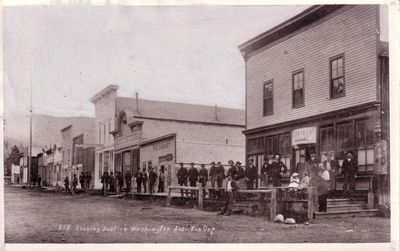
Image result for historic images of tin cup
Tin Cup, 1906 from a photo of the Tin Cup Civic Association
Yes, there was a Virginia City in Colorado. Of course since Montana and Nevada, the name didn't last long. So what was it changed to? Tin Cup. If you wanted a wide open town, this was the one for you in the late 1800s. In its early days, there was no true law. It was said they went through seven marshals in a very short period of time.

Here is a piece from the Gunnison Daily News-Democrat from July 12, 1882

Block image

In his book "Jeep Trails to Colorado Ghost Towns", Robert L. Brown had this to say:
"By 1879... There were plenty of saloons... Tin cup had several hotels, chief among them were the Pacific and the Eagle. … After the summer of 1879, tin cup was rated as the largest town in Gunnison County, next to Gunnison itself.

There were three physicians in town. One of them was Dr. McGowan, who always wore a full beard which resulted in his death while he was smoking in bed.

In the old days, Tin Cup was entered mainly from St. Elmo, over Tin Cup Pass, and frequently by way of Pitkin, Cottonwood, and Aspen. It was a rough trip from Tin Cup over the divide to St. Elmo.

No railroad ever served Tin Cup. In the summer time you rode the stagecoach and in the winter you skied."

So there you have a short trip though history along the Arkansas River and up to Leadville and Tin Cup. There is so much more history, but time and space limit the story.


Doris Gardner-McCraw -
Author, Speaker, Historian-specializing in
Colorado and Women's History
Angela Raines - author: Where Love & History Meet
For a list of Angela Raines Books: Here 
Angela Raines FaceBook: Click Here