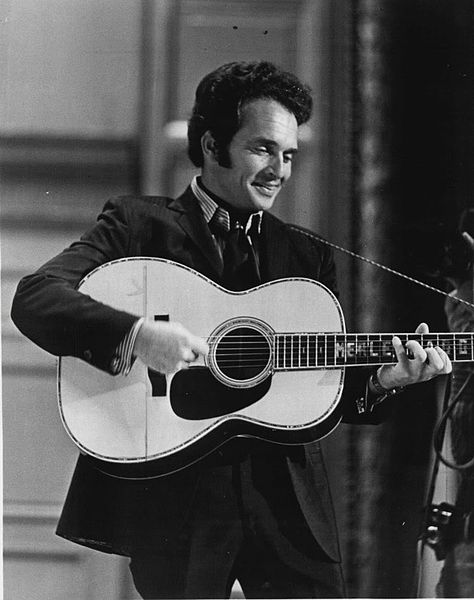
Merle Haggard’s
song Sing Me Back Home reached No. 1 on the Billboard country chart. Merle
wrote the song and recorded it with his band, The Strangers. The song ultimately spent two weeks at No. 1 and a total of 17 weeks on the Hot Country Songs (Billboard) chart.
This site – billboard.com– ranks Sing Me Back Home as
No.1 of Merle’s 20 Best Songs (Critic’s Pics). This website, Tennessean, lists Merle’s 38, No. 1 hits by
year. Sing Me Back Home is Merle's third No.1 hit.
In memory of Merle’s death on April 6, 2016 , which was coincidentally his
birthday (b. 1937), Rolling Stone magazine included Sing Me Back Home in the magazine’s
list of ‘30 essential Merle Haggard Songs’ - HERE
Merle Haggard - 2010 - citing below
A few artists who covered Sing Me Back Home are the Everly
Brothers, Joan Baez, Gram Parsons, Grateful Dead, and Don Williams.
In the song, the narrator sings from the perspective of
fellow penitentiary inmate, a singer and guitar player, who performs a final
song for a prisoner making the last walk. The condemned man asks the narrator to sing a song his mama used to sing, because he wants to hear it one more
time before he dies.
U.S. federal government (https://commons.wikimedia.org/wiki/File:Merle_Haggard_2010.jpg), „Merle Haggard 2010“, marked as public domain, more details on Wikimedia Commons: https://commons.wikimedia.org/wiki/Template:PD-US
I'm not going to talk about Merle's life in this article, as it is easy enough to do an Internet search and read more in depth biographies of his life than I need to synthesize and summarize here.
Merle Haggard - 2010 U.S. federal government, Merle Haggard 2010, marked as public domain, more details on Wikimedia Commons
What I am going to share is a comparison of his song Mama Tried to Johnny Paycheck's song of similar theme, The Only Hell My Mama Ever Raised.
Both songs are iconic of each artist and each song tells the lamentable story of grown men (or women) looking back on the bad choices they made in their younger lives despite the best guiding efforts of their mothers to raise them right and keep them on the 'straight and narrow'.
Both narrators have gotten sideways of the law and, while it seems what they are sorriest about is getting caught, there is a hint of guilt that they cause their mothers sadness and grief. But the dirty deeds they've done in their lives can't be undone so Que Sera Sera.
Mama Tried was released in July 1968 as the first single and title track from Merle Haggard's album, Mama Tried, and it became one of the cornerstone songs of his career.* The song entered the Grammy Hall of Fame in 1999. Two weeks before Merle died in 2016, the song was preserved in the National Recording Registry due to it's 'cultural, historic, and/or artistic significance"*.
While this song is not autobiographical, Merle did serve time in San Quentin and he did lament the pain it caused his mother. Merle was among the "Outlaw Movement" artists of the 1970s. The song was his fifth Number 1 hit on the Billboard magazine Hot Country Single chart in August 1968.
The Only Hell My Mama Ever Raised by Johnny Paycheck, who was also considered one of the members of the "Outlaw Movement" artists**. He received an Academy of County Music Career Achievement award in 1977**. The song was on is on the album, Slide off of Your Satin Sheets and, as a single, it reached Number 8 on the U.S. Country charts in 1977****.
For your viewing and listening entertainment...
Until next time,
Kaye Spencer
As I don’t send a newsletter, you might consider following me on these social media venues:
Resources Disclaimer – Reader discretion advised: Some information in this article relies primarily upon that model of excellence in accuracy itself, Wikipedia. *Wikipedia: https://en.wikipedia.org/wiki/Mama_Tried_(song) **Wikipedia: https://en.wikipedia.org/wiki/Johnny_Paycheck and https://en.wikipedia.org/wiki/Johnny_Paycheck_discography ***AllMusic: https://www.allmusic.com/song/im-the-only-hell-mama-ever-raised-mt0012001949 ****https://www.axs.com/the-top-10-best-johnny-paycheck-songs-86320
To kick off 2019, let's take a stroll down musical memory lane, and take a quick look at the show business career of a talented man named Woodward Maurice Ritter, better known as Tex Ritter.
He was born on January 12, 1905 and he died on January 2, 1974. He was father to actor John Ritter and grandfather to actors Jason and Tyler Ritter.
Tex was a popular actor and country music artist in the early years of both industries. He was inducted into the Country Music Hall of Fame, and he received a star on the Hollywood Walk of Fame. Tex was born in Murvaul, Texas and grew up on the family farm. After he graduated high school, he went to college with intent to become a lawyer. In 1928, he became interested in show business, and his law/government studies went to the back burner.
Tex Ritter - publicity image 1966*
Here is a timeline highlighting his business/music career:
Radio and Broadway
1928 - sang cowboy songs on radio in Houston, Texas 1928 - moved to New York City - sang in chorus of Broadway show The New Moon 1931 - appeared in the role of Cord Elam in Broadway show Green Grow the Liacs (basis for the musical Oklahoma!) 1932 - played role of Sagebrush Charlie in The Round Up 1934 - played role of Sagebrush Charlie again in Mother Lode 1932 - starred in New York City's The Lone Star Rangers radio show - sang and told Old West stories 1933-1936 - wrote and starred in Cowboy Tom's Roundup (daily radio children's cowboy program) During this time, he appeared on WHN Barndance and sang on NBC radio shows. 1965 - moved to Nashville - worked for WSM Radio and the Grand Ole Opry - cohosted late-night program with country disc jockey Ralph Emery
Recording Career
1933 - signed with Columbia Records - recorded "Goodbye Ole Paint" and "Rye Whiskey" 1935 - signed with Decca Records - recorded "Sam Hall" and "Whoopie Ti Yi Yo" 1942 - signed with Capitol Records - he was the company's first artist they signed and also their first western singer
Actor
1936 - moved to Los Angeles 1936 - movie debut - Song of the Gringo - followed by 12 B-movie westerns (40+) *Appeared in episodes of Death Valley Days and The Rebel 1938 - 1945 - starred in singing cowboy movies - teamed with Johhny Mack Brown (western actor) in several movies 1945 - starred as "Texas Ranger Tex Haines" *Hiatus 1950 - returned to show business in supporting roles or performing as himself 1966 - played himself in the film Nashville Rebel (side note: Waylon Jennings was also in this movie)
Musical Years
1944 - "I'm Wasting My Tears on You" - No. 1 on the country chart and No. 11 on the pop chart 1945 - "There's a New Moon over My Shoulder" - No. 2 country - No. 21 pop 1945 - 1946 hits: "You Two-Timed me One Time Too Often" and his cover of the song "The Deck of Cards", which is a recitation song 1952 - toured Europe 1952 - recorded the title track of the western movie, High Noon "Do Not Forsake Me Oh My Darlin'" 1955 - "Remember the Alamo" 1961 - "I Dreamed I was in Hillbilly Heaven" 1965 - moved to Nashville - one of the founding members of the Country Music Association
'High Noon'
Tex Ritter's contribution to the western genre--movie, television, and country music--is a legacy that I hope will never be lost or forgotten. I hope someday to visit The Tex Ritter Museum in Carthage, Texas. Here is a quote from the museum's website:
The museum started in 1993 as the Tex Ritter Museum and expanded to include friends of Tex and other Texas-born country music legends. In August 2004, the museum expanded to add a significant Jim Reeves display which features the radio equipment from Jim's radio station KGRI in Henderson.
I grew up listening to Tex on the radio or watching his western movies on Saturday afternoon matinees at the theater or on late night television. I still have two 78rpm records of his:When You Leave Don't Slam the Door/Have I Told You Lately That I love You and My Heart's as Cold as an Empty Jug/Rock and Rye. Sadly, I've lost track of my record of Blood on the Saddle.
I mean no disrespect to his memory or his singing, but I cannot listen to Blood on the Saddle without smiling, if not actually giggling. You listen and let me know if you kept a straight face.
As I don’t send a newsletter, you might consider following me on these platforms: Amazon (for new release notifications| BookBub (my book recommendations) | Blog (occasional posts)| Twitter (history trivia) Until next time,
Kaye Spencer Writing through history one romance upon a time
References: “Tex Ritter.” Wikipedia, Wikimedia Foundation, 17 Dec. 2018, en.wikipedia.org/wiki/Tex_Ritter. “Tex Ritter.” IMDb, IMDb.com, www.imdb.com/name/nm0728811/. Razor Tie Artery Foundation Announce New Joint Venture Recordings | Razor & Tie, Rovi Corporation, web.archive.org/web/20080618172239/http://www.carthagetexas.com/HallofFame/museum.htm. *Capitol Records, Tex Ritter 1966, marked as public domain, more details on Wikimedia Commons
Marty Robbins has a birthday anniversary this month—his 93rd, in fact. But, sadly, Marty died on December 8, 1982. He’d suffered his third serious heart attack a few days prior, but he didn’t survive the surgery to repair the damage.
I was living in Cleveland, Ohio and running thoroughbred race horses at Thistledown Racetrack when I heard it on the radio. The DJ broke down and cried. I cried along with him.
A little about Marty
Martin David Robbins was born in Glendale, Arizona on September 26, 1925. When WWII broke out, Marty joined the Navy. While serving, he taught himself to play the guitar. When the war was over, Marty returned home and embarked upon a singing and performing career around Phoenix in nightclubs, on the radio, and on television.
During his early club-playing and performing days, “…he heard a country singer featured on the local radio station KPHO. [Marty] was convinced that he could do better. He drove right down to the station and earned a place on the show.”
By the end of the 1940s, Marty had his own radio program, “Chuck Wagon Time”, and a television show, “Western Caravan”. By the mid-1950s, he was invited to the Grand Ole Opry radio show and was a regular performer for many years. He signed with Columbia Records in 1951 with his first Number 1 song coming in 1956, which was Singing the Blues.
El Paso released in 1959, and it garnered him his first Grammy Award. With the 1960s came, he pursued racing with such a passion that he progressed to NASCAR racing. It was in 1969 that he suffered his first heart attack. He recovered quickly and wrote, My Woman, My Woman, My Wife, which earned him his second Grammy. Then his second heart attack occurred in 1981.
Marty was inducted into the Country Music Hall of Fame in 1982. His last song was a single that same year—Some Memories Just Won’t Die—a bittersweet irony. Over the span of his career, he recorded over 500 songs and 60 albums.
When he was growing up, Marty wanted to be a cowboy singer like Gene Autry, and he credits his grandfather, “Texas Bob Heckle”, a traveling medicine show salesman and story-teller, as the main inspiration for many of the songs he wrote later.
In an interview, Marty said, “…I’ve done what I wanted to do… I’m not a real good musician, but I can write [a song] pretty well. I experiment once in a while to see what I can do. I find out the best I can do is stay with ballads.”
Marty Robbins:
By NBC Television (eBay item photo front photo back)
[Public domain], via Wikimedia Commons
When I was growing up and listening to Marty’s music, I wore out at least two 45 rpms of “El Paso” on Side A and “Strawberry Roan/160 Acres” on Side B. Marty’s gunfighter ballads influenced my love of the Old West. If I had to choose one artist’s music as the only music I could listen to, Marty Robbins would be that person. Yes, I love his music that much, and my musical tastes range from Vivaldi to Lin-Manuel Miranda’s ‘Hamilton’ and everything in between.
Marty was (still is) so influential to my writing that my historical western romance novel with Prairie Rose Publications, The Comanchero’s Bride, was inspired by his song, Meet Me Tonight in Laredo. This book is my little way of paying tribute to Marty and how much his gunfighter ballads mean to me. I sprinkled hints to many of his gunfighter songs throughout the story.
Below is an excerpt from The Comanchero’s Bride. For those of you familiar with Marty’s gunfighter ballads Running Gun and Big Iron, you’ll likely notice the small references.
Excerpt
At the livery, Mingo remained in the shadows where he could see both ways along the street. Opening the wagon doors just wide enough to allow him to pass through, he eased his way inside. Speaking in a low soothing tone to his horses, he packed and saddled them under the moonlight coming in from two windows. Opening half the double doors, he led the two riding horses out the back, tied them to a corral rail, and returned for the packhorse.
He no more than reached the packhorse when a cold voice in the shadows stopped him in his tracks.
“Don’t turn around, Valderas.”
Mingo froze. A few more steps and he would have been on the off side of the packhorse, but where he was, he had no protection.
“I’ve got a good bead right between your shoulders. I know about your fast draw and the price on your head. I’ve also heard stories about your throwing knives, so keep your hands where I can see them.”
“You know me. But who are you? What do you want?” Mingo didn’t care. He knew the challenge from the shadows was a bounty hunter. He needed the man to talk so he could pinpoint his location.
“I came out of El Paso. A man named Jack added to the price on your head—dead or alive—and some politician is offering a pretty penny on top of that to bring in the woman you have with you. He wants her alive.”
From the sound of the man’s voice, he hadn’t moved and was off to his right. Mingo fought the urge to whirl and fire, but shooting blindly was not his way. He wouldn’t risk wild shot that could injure a horse, and gunfire would bring others into the fray. Shadows were both his enemy and ally, depending upon how he used it.
“The way’s clear behind you, so back towards the open wagon door, and keep your hands away from your body. When I heard the talk of a Mexican man traveling with a white woman, and they were staying at the hotel, I figured I’d hit pay dirt. I was just supposed to worry you into making a wrong move. Never thought I’d be the one to catch you.
“I’m taking the woman to El Paso. You, I’m locking up in the back room of the saloon for safe keeping…unless you give me an excuse to kill you right now, which I’ve a yearning to do. I can’t miss at this range. It wouldn’t do my reputation any damage to be the man who took down Mingo Valderas.”
Now, he knew who he was up against. Earl Johns was vicious and a killer, a back-shooting coward. Mingo inched backward, buying thinking time.
“Where’s the woman, Valderas?”
“There is no wom—”
“She’s too close for your comfort.” Elizabeth’s voice cut through the night. The sound of a shotgun hammer pulling back was an angry, lethal sound that made the hairs on Mingo’s arms prickle.
The Comanchero's Bride is available on Amazon.com.
Marty Robbins Biography. Biography.com Editors. The Biography.com website. A&E Television Networks. http://www.biography.com/people/marty-robbins-20651271. April, 2, 2014. Accessed September 9, 2018.
Marty Robbins website. http://www.martyrobbins.com. Accessed September 9, 2018.
Country Music Television, Inc. http://www.cmt.com/artists/marty-robbins/biography/. Accessed September 9, 2018.
Let’s take a stroll along a nostalgic musical path for a brief look at the history of a song (melody, not lyrics) whose origin remains somewhat of a mystery. Perhaps this song was a traditional folk tune handed down through the generations. Maybe it was “born” in 1924. However it came about, over the years, this melody has experienced a host of lyrics put to its familiar, catchy tune.
While many singers recorded their versions of this song, between 1924 and 1952, this melody saw significant renditions of different lyrics and each new song enjoyed chart-topping hit status in the country music, hillbilly, bluegrass, and gospel music genres.
Seeburg Select-o-matic Jukebox (reproduction) c. 1949
Legend has it that in 1924, Vernon Dalhart copyrighted this song and lyrics in the name of his cousin, Guy Massey, after Vernon heard it sung by a family member who “may” have learned it while serving time in prison. This song went on to become a bit hit in the 1920s.
First line hint: Oh, I wish I had someone to love me…
In 1925, two songwriters/performers, Welby Toomey and Edgar Boaz, recorded their lyrics to this melody.
First line hint: Looking back on what we both had together…
In 1927, Roy Harvey and the North Carolina Ramblers released their version with a similar, but abbreviated title to the one the Carter Family would release in two years.
First line hint: I’ve been thinking today of my blue eyes…
Carter Family promotional portrait by the Victor Talking Machine Co. 1927
In 1929, the famous Carter Family recorded their version of this melody, but with different lyrics and title.
First line hint: ‘Twould been better for us both had we never…
In 1936, it was Roy Acuff who had a hit with the same melody and, again, different lyrics and title.
First line hint: What a beautiful thought I am thinking…
Then, in 1952, two country music artists—Hank Thompson and Kitty Wells—had hits with this same melody, and both with different lyrics and titles.
Hank Thompson – First Line Hint: You wouldn’t read my letter if I wrote you…
And the “answer” song:
Kitty Wells – First Line Hint: As I sit here tonight, the jukebox playing…
So, did you *Name that Tune*?
1924 – Vernon Dalhart – The Prisoner’s Song
1925 – Toomey and Boaz – Thrills that I Can’t Forget
1927 – Roy Harvey – Blue Eyes
1929 – Carter Family – I’m Thinking Tonight of My Blue Eyes
1936 – Roy Acuff – The Great Speckled Bird
1952 – Hank Thompson – The Wild Side of Life
Kitty Wells – It Wasn’t God Who Made Honky Tonk Angels
Over the years, these songs not only achieved ‘country music standard’ status, they have achieved ‘signature song’ identification for many musicians. Johnny Cash, Marty Robbins, Hank Locklin, Waylon Jennings and Jessi Coulter, Freddie Fender, Burl Ives, and Jerry Lee Lewis rank among the artists who come to my musical memory as having performed some version of this melody. I imagine you have your favorites, also.
A YouTube search will bring up a host of videos for each of these songs, and I am going to leave you with the one I associate the most with this tune.
**Music notes clipart courtesy cyberscooty.com **Jukebox image: "Seeburg Select-o-matic jukebox detail 01A" by Joe Mabel. Licensed under CC BY-SA 3.0 via Wikimedia Commons - http://commons.wikimedia.org/wiki/File:Seeburg_Select-o-matic_jukebox_detail_01A.jpg#/media/File:Seeburg_Select-o-matic_jukebox_detail_01A.jpg ** Carter Family photo: Creative Commons - http://www.bluegrassmessengers.com/the-carter-family.aspx