Showing posts with label phantom limb pain. Show all posts

Wednesday, October 26, 2022

FROGS, RATTLESNAKES AND PHANTOM LIMBS


DR SILAS WEIR-MITCHELL, Physician, poet, novelist and researcher

By Keith Souter aka CLAY MORE


One wonders how surgeons coped during the Civil War. After performing countless amputations on young men maimed by Minie balls, shrapnel and cannonfire how did they silence the screams and the suffering that plagued their dreams for years after?

Silas Weir-Mitchell  was a contract surgeon  with the US army in 1862 and operated on the wounded at Gettysburg and other battlefields. On his deathbed having contracted influenza he lapsed into delirium and it is said that he actually re-enacted operating on the wounded at Gettysburg. 
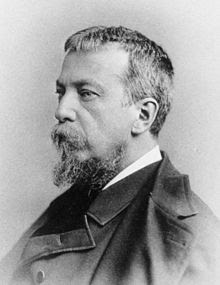
Dr Silas Weir-Mitchell (1829-1914)


He had come a long way from his wartime experiences and rose to become known as the father of American neurology. His contributions to medicine were  significant and numerous. He was the originator of Weir-Mitchell Therapy, known as The Rest Cure, a highly controversial therapy, but which for many decades became a standard treatment for psychoneurosis. 

In addition to his work in neurology, he was a scientific physiologist, a medical writer, poet and novelist. 

Early influence and rattlesnakes
Silas Weir-Mitchell was born into a wealthy Philadelphia family that had three generations of physicians. 

When he entered the University of Pennsylvania he had little interest in subjects like mathematics, which he was obliged to study. He apparently occupied his time playing billiards, reading and writing poetry and dodging many of his lectures. His father, a devoutly religious man told him that "you are wanting in nearly all the qualities that go to make a success in medicine."

Whether this gave him the impetus to change or whether it was just that the actual study of medicine opened his eyes, he applied himself to his studies at Jefferson Medical College in 1848 and qualified as a doctor in 1851.

He went straightaway to Paris and studied physiology under Claude Bernard, one of the greatest experimenters of the day. 

He was impressed by Bernard's maxim "Why think? Exhaustively experiment, then think."

Silas returned to the USA and worked with  another famous physician, Dr William A Hammond. They shared an interest in snake venoms and their effect on the nervous system. In 1859 they wrote a paper in the American Medical Journal on corroval and van, two substances used to poison arrows. 

There is a tale that one day while working at his desk a rattlesnake escaped and climbed the chair he was sitting on and put its head over his shoulder. Quite the sort of scene so beloved by the movie-makers, he was able to make a move to escape when the snake's swaying head touched the lamp. 


The speckled rattlesnake was named after him - Crotalus mitchellii


And frogs!
A year later he carried out more important experiments using frogs. He found that by feeding them sugar you can induce cataracts in the eyes. He published his findings in a paper  On the production of cataract in frogs by the administration of sugar in the American Journal of the Medical Sciences, in 1860.

The significance of this was not fully realised, as the pathology of diabetes mellitus was still ill understood. But cataracts are a well known long term complication of the condition.


The Civil War
Working with two other US army surgeons, George R Morehouse and William W Keen a vast amount of information was accumulated from the wounded brought back by them in wagons and operated upon. This resulted in a book published in 1864, written by all three - Gunshot Wounds and Other Injuries of the Nerves.


It contained the first description of  'causalgia',' an extremely painful condition now known as Complex Regional Pain Syndrome.

Phantom limb pain
After the War many amputees complained of pain, often excruciating discomfort where their amputated limb should have been. For example, they might have severe pain where they could still feel the foot that was no longer there. The year after the War  Silas opened a stump clinic in Philadelphia, where he made observations of these symptoms and he wrote a paper published  in Lippincott's Magazine of Popular Literature and Science, in which he described for the first time phantom limb pain. He speculated that it was the result of injury to the nerves during the operation.  This is hardly surprising considering that in those days when chloroform was new and in short supply a surgeon had to operate swiftly. The operative technique was gradually improved with better results, yet still the problem occurs. 

He was  quite correct about the cause, but there was little that could be done for the condition, as there were few effective drugs. Although we have a  better understanding of this phenomenon now and a greater range of therapeutic interventions, yet it is still a significant problem for many amputees.


The Weir Mitchell Rest Cure
I need to mention the Rest Cure that he popularised and which Sigmund Freud ad other European doctors were critical of. Essentially, Silas was highly interested in hysteria, from his work with soldiers. Indeed he frequently alluded to the fact that brave men in the heat of battle could develop paralysis. This he distinguished from malingering, which is also mentioned in the book.

There was great interest in hysteria and other neuroses in the nineteenth century. His Rest Cure consisted of complete rest in a room, during which the patient should do no work, except write their life history. A little light exercise was permitted and a 'nutritious' diet with a high fat intake. The patient had to drink two litres of milk a day. Electrotherapy was also used, as was a form of psychotherapy.

A final word on the latter, which seems to have been direct and authoritarian confrontation. Let me cite one case.

A patient was thought to be dying and he was sent for. He immediately sent the attendants out of the room and came out shortly after. They asked if the patient had any chance of survival, to which he replied that she would come out of the room within a few minutes. Surprised they asked how this was possible. He replied that he had set her bedclothes on fire. 

Apparently the Rest Cure had huge numbers of successfully treated cases and as I mentioned at the beginning it was the standard treatment for psychoneurosis for many decades. 


Poet and literary man
Silas Weir Mitchell is something of a paradox. In appearance he was often described as looking like Uncle Sam. He could be irrascible, but he was also compassionate. And he had a love of literature and poetry all his life. 

In addition to his medical and surgical writing he penned many novels, some of which were highly successful. So too, his poetry, which ranged over many subjects. I leave you with one.


A DOCTOR'S CENTURY

READ AT THE CENTENNIAL DINNER OF THE COLLEGE OF PHYSICIANS OF PHILADELPHIA, 1887. 

A DOCTOR'S century dead and gone! 
Good-night to those one hundred years, 
To all the memories they bear 
Of honest help for pains or tears; 

To them that like St. Christopher, 
When North and South were sad with graves, 
Bore the true Christ of charity 
Across the battles' crimson waves. 

Good-night to all the shining line, 
Our peerage,—yes, our lords of thought; 
Their blazonry, unspotted lives 
Which all the ways of honor taught. 

A gentler word, as proud a thought, 
For those who won no larger prize 
Than humble days well lived can win 
From thankful hearts and weeping eyes. 

Too grave my song; a lighter mood 
Shall bid us scan our honored roll, 
For jolly jesters gay and good, 
Who healed the flesh and charmed the soul, 

And took their punch, and took the jokes 
Would make our prudish conscience tingle, 
Then bore their devious lanterns home, 
And slept, or heard the night-bell jingle. 

Our Century's dead; God rest his soul! 
Without a doctor or a nurse, 
Without a "post," without a dose, 
He's off on Time's old rattling hearse. 

What sad disorder laid him out 
To all pathologists is dim; 
An intercurrent malady,— 
Bacterium chronos, finished him! 

Our new-born century, pert and proud, 
Like some young doctor fresh from college, 
Disturbs our prudent age with doubts 
And misty might of foggy knowledge. 

Ah, but to come again and share 
The gains his calmer days shall store, 
For them that in a hundred years 
Shall see our "science grown to more," 

Perchance as ghosts consultant we 
May stand beside some fleshly fellow, 
And marvel what on earth he means, 
When this new century's old and mellow. 

Take then the thought that wisdom fades, 
That knowledge dies of newer truth, 
That only duty simply done 
Walks always with the step of youth. 

A grander morning floods our skies 
With higher aims and larger light; 
Give welcome to the century new, 
And to the past a glad good-night.


Thursday, April 30, 2020

AMPUTATION OR NOT?

THE DOCTOR'S BAG

the blog about the medicine and surgery of yesteryear


Dr Keith Souter aka Clay More


[We are living through a difficult and worrying time  as we are in the midst of a global pandemic of Covid-19. I have been called out of retirement to go back into medical practice to help out, so I have not had time to write a new blog this month.  So forgive me for posting this blog from 2014, which may be of some interest to my fellow writers.] 


Tombstone, A.T, 1881
Just after Christmas, Marshal Virgil Earp was  gunned down on Fifth Street, between the Oriental Saloon and the Golden Eagle Brewery. Three men  blasted at him with shotguns from the cover of the adobe Huachuca Water Company building that was being erected. Virgil was badly wounded in the back and the upper left arm. It was clearly a reprisal shooting for the OK Coral gunfight, that had taken place in October. 


Virgil Earp (1843-1905)
Doctor George Goodfellow was called to attend on  him. His immediate assessment was that amputation of the arm would be needed, but Virgil steadfastly refused, saying that he wanted to go to his grave with two arms. And when he saw his wife, he told her not to worry, for he would still have one good arm to hug her with.

Dr George E. Goodfellow (1855-1910)

The following day, Doctor Goodfellow, assisted by Doctor Henry Matthews removed four inches of Virgil's humerus. The arm was saved, yet it was functionally useless ever after.

A brief history of amputation
The word amputation comes from the Latin amputare, meaning 'to cut away.' Surgical amputations were performed as far back as the days of Hippocrates, the father of medicine, in the 5th century BC.  Amputation of limbs was performed due to battle injury or after severe accidents.

In the 16th century the French military surgeon Ambroise Pare introduced the technique of ligation of blood vessels instead of artery with hot irons. This dramatically reduced the torrential loss of blood that was often fatal.


Wilhelm Fabry, regarded as the father of German surgery  was the first to emphasise the importance of amputating through healthy, rather than diseased tissue. He used cautery and also 'weapon salve'. This involved applying a salve to the weapon that caused the wound, not the weapon itself. It was based on 'sympathetic magic,' the belief that treating the blade that made the wound would cure the wound. Although it seems ridiculous to us, yet he achieved surprisingly good results, or at least results better than those surgeons who applied medication to the wounds after they had operated.  The reason of course is that he wasn't putting poisons and further bacteria into the wounds.

In 1674 the tourniquet was introduced, which allowed surgeons more time, and gave them the opportunity to work in a relatively bloodless field. This is of inestimable value, since surgeons could identify anatomical structures more accurately. 


To operate or not
Surgeons were of great value in wars, yet the experience of the British surgeons during the Crimea War (1853-1856) brought up the question of whether it was better to operate or not. That is, whether to adopt a conservative approach, or the dramatic one of surgery. The infection rate was extremely high as was the mortality rate after amputation. The British Surgeon General Guthrie advised against amputation except where the limb had been struck by a cannon ball. Nonetheless, individual surgeons operated and removed limbs when bones had been shattered by the Minie ball, the bullet that was to prove so effective in the Crimea and in the Civil War.

During the Civil War Dr D.D. Slade wrote a pamphlet that encouraged the orthodox view that amputation should be done immediately where there was great laceration of skin, or where there was a compound fracture (bone protruding through the skin), with splintering of the bone.

The germ theory had not been propounded at that time, so surgeons themselves often introduced infections. Instruments may have been merely wiped or washed, but not adequately sterilised (for there was not thought to be any necessity to do so). Added to this there was the problem of operating on men who may have been weakened by stress, disease or scurvy.

The Army position changed several times as the War went on. At the beginning, doctors from all sorts of disciplines were recruited, and only  a few had adequate surgical experience. They all had a baptism of fire and those that had little experience soon gained it. Amputations increased. The further the War progressed, the attitude changed again, with many surgeons adopting the conservative approach, to try to save the limb.

During the Civil War over seventy per cent of wounds involved the upper or lower limbs.

Circular or Flap operation?
Another debate that ran throughout the War was which type of amputation operation to use. The older method was called the 'circular' operation. This involved using a tourniquet and making a circular incision around the limb, cutting through the skin and the fascia. An assistant then retracted the skin and the surgeon made a further circular cut close the skin incision and went through all of the muscles to the bone. The amputation was then done, involving ligature of vessels, retraction of tissues and sawing through bone. The muscles were then drawn over the end and the skin brought down and strapped with adhesive, rather than sutured.

The newer method was the 'flap' operation. This had been developed in the previous century by William Cheselden (1688-1752), an English surgeon. This was favoured by sixty per cent of surgeons. It involved sacrificing more bone, but it gave a better stump, albeit it needed a large wound. Essentially, an oblique incision was made, so that a skin flap could be created in order to give better closure and better stump protection. It was also a faster operation and seemed to produce less post-operative pain. The skin was closed with interrupted sutures about an inch apart. Sometimes wire was used and sometimes silk. There were also single flap and double flap operations.

Phantom limb pain
After the War many amputees complained of pain, often excruciating discomfort where their amputated limb should have been. For example, they might have severe pain where they could still feel the foot that was no longer there. The year after the War Dr Silas  Mitchell of Philadelphia opened a stump clinic, where he made observations of these symptoms and he wrote a paper in Lippincott's Magazine of Popular Literature and Science, in which he described for the first time phantom limb pain. He speculated that it was the result of injury to the nerves during the operation.  
He was  quite correct, but there was little that could be done.

Although we have a  better understanding of this phenomenon now and a greater range of therapeutic interventions, yet it is still a significant problem for many amputees.

Doctor George Goodfellow
The Tombstone doctor was the right man to have operate on you in the wild days of Tombstone. He became the foremost authority on gunshot wounds and a surgeon who pushed back the frontiers in many areas. He did amputations, reconstructive facial surgery and he was the first surgeon to perform perineal prostatectomy. As I mentioned in my blog last month, his work on the impenetrability of silk to bullets led to the development of bulletproof vests.


But he was a scientist and he kept up to date with the developments of surgery, anaesthetics and medicine. He used Lister's aseptic methods and had a carbolic acid spray for use during operation. He was absolutely the right surgeon for Virgil Earp.
***


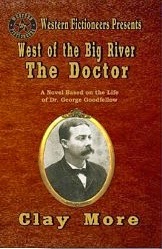
The Doctor published by Western Fictioneers in the  West of the Big River series

- my novel based on events in the life of Dr George E. Goodfellow


Thursday, June 26, 2014

THE DOCTOR'S BAG - I MAY HAVE TO TAKE IT OFF!


AMPUTATION OR NOT?


Tombstone, A.T, 1881
Just after Christmas, Marshal Virgil Earp was  gunned down on Fifth Street, between the Oriental Saloon and the Golden Eagle Brewery. Three men  blasted at him with shotguns from the cover of the adobe Huachuca Water Company building that was being erected. Virgil was badly wounded in the back and the upper left arm. It was clearly a reprisal shooting for the OK Coral gunfight, that had taken place in October. 


Virgil Earp (1843-1905)
Doctor George Goodfellow was called to attend on  him. His immediate assessment was that amputation of the arm would be needed, but Virgil steadfastly refused, saying that he wanted to go to his grave with two arms. And when he saw his wife, he told her not to worry, for he would still have one good arm to hug her with.

Dr George E. Goodfellow (1855-1910)

The following day, Doctor Goodfellow, assisted by Doctor Henry Matthews removed four inches of Virgil's humerus. The arm was saved, yet it was functionally useless ever after.

A brief history of amputation
The word amputation comes from the Latin amputare, meaning 'to cut away.' Surgical amputations were performed as far back as the days of Hippocrates, the father of medicine, in the 5th century BC.  Amputation of limbs was performed due to battle injury or after severe accidents.

In the 16th century the French military surgeon Ambroise Pare introduced the technique of ligation of blood vessels instead of artery with hot irons. This dramatically reduced the torrential loss of blood that was often fatal.


Wilhelm Fabry, regarded as the father of German surgery  was the first to emphasise the importance of amputating through healthy, rather than diseased tissue. He used cautery and also 'weapon salve'. This involved applying a salve to the weapon that caused the wound, not the weapon itself. It was based on 'sympathetic magic,' the belief that treating the blade that made the wound would cure the wound. Although it seems ridiculous to us, yet he achieved surprisingly good results, or at least results better than those surgeons who applied medication to the wounds after they had operated.  The reason of course is that he wasn't putting poisons and further bacteria into the wounds.

In 1674 the tourniquet was introduced, which allowed surgeons more time, and gave them the opportunity to work in a relatively bloodless field. This is of inestimable value, since surgeons could identify anatomical structures more accurately. 


To operate or not
Surgeons were of great value in wars, yet the experience of the British surgeons during the Crimea War (1853-1856) brought up the question of whether it was better to operate or not. That is, whether to adopt a conservative approach, or the dramatic one of surgery. The infection rate was extremely high as was the mortality rate after amputation. The British Surgeon General Guthrie advised against amputation except where the limb had been struck by a cannon ball. Nonetheless, individual surgeons operated and removed limbs when bones had been shattered by the Minie ball, the bullet that was to prove so effective in the Crimea and in the Civil War.

During the Civil War Dr D.D. Slade wrote a pamphlet that encouraged the orthodox view that amputation should be done immediately where there was great laceration of skin, or where there was a compound fracture (bone protruding through the skin), with splintering of the bone.

The germ theory had not been propounded at that time, so surgeons themselves often introduced infections. Instruments may have been merely wiped or washed, but not adequately sterilised (for there was not thought to be any necessity to do so). Added to this there was the problem of operating on men who may have been weakened by stress, disease or scurvy.

The Army position changed several times as the War went on. At the beginning, doctors from all sorts of disciplines were recruited, and only  a few had adequate surgical experience. They all had a baptism of fire and those that had little experience soon gained it. Amputations increased. The further the War progressed, the attitude changed again, with many surgeons adopting the conservative approach, to try to save the limb.

During the Civil War over seventy per cent of wounds involved the upper or lower limbs.

Circular or Flap operation?
Another debate that ran throughout the War was which type of amputation operation to use. The older method was called the 'circular' operation. This involved using a tourniquet and making a circular incision around the limb, cutting through the skin and the fascia. An assistant then retracted the skin and the surgeon made a further circular cut close the skin incision and went through all of the muscles to the bone. The amputation was then done, involving ligature of vessels, retraction of tissues and sawing through bone. The muscles were then drawn over the end and the skin brought down and strapped with adhesive, rather than sutured.

The newer method was the 'flap' operation. This had been developed in the previous century by William Cheselden (1688-1752), an English surgeon. This was favoured by sixty per cent of surgeons. It involved sacrificing more bone, but it gave a better stump, albeit it needed a large wound. Essentially, an oblique incision was made, so that a skin flap could be created in order to give better closure and better stump protection. It was also a faster operation and seemed to produce less post-operative pain. The skin was closed with interrupted sutures about an inch apart. Sometimes wire was used and sometimes silk. There were also single flap and double flap operations.

Phantom limb pain
After the War many amputees complained of pain, often excruciating discomfort where their amputated limb should have been. For example, they might have severe pain where they could still feel the foot that was no longer there. The year after the War Dr Silas  Mitchell of Philadelphia opened a stump clinic, where he made observations of these symptoms and he wrote a paper in Lippincott's Magazine of Popular Literature and Science, in which he described for the first time phantom limb pain. He speculated that it was the result of injury to the nerves during the operation.  
He was  quite correct, but there was little that could be done.

Although we have a  better understanding of this phenomenon now and a greater range of therapeutic interventions, yet it is still a significant problem for many amputees.

Doctor George Goodfellow
The Tombstone doctor was the right man to have operate on you in the wild days of Tombstone. He became the foremost authority on gunshot wounds and a surgeon who pushed back the frontiers in many areas. He did amputations, reconstructive facial surgery and he was the first surgeon to perform perineal prostatectomy. As I mentioned in my blog last month, his work on the impenetrability of silk to bullets led to the development of bulletproof vests.


But he was a scientist and he kept up to date with the developments of surgery, anaesthetics and medicine. He used Lister's aseptic methods and had a carbolic acid spray for use during operation. He was absolutely the right surgeon for Virgil Earp.

My alter ego Clay More has a couple of recent releases.  

The Doctor published by Western Fictioneers in the  West of the Big River series

- my novel based on events in the life of Dr George E. Goodfellow


http://www.amazon.com/West-Big-River-Doctor-Volume/dp/1499714335/ref=sr_1_cc_1?s=aps&ie=UTF8&qid=1402661489&sr=1-1-catcorr&keywords=west+of+the+big+river+the+doctor

Redemption Trail published by Western Trail Blazer
- a novelette- novella


Sam Gibson used to be a lawman, until the day he made a terrible mistake that could never be taken back. Since then, he has alternated between wishing there were a way he could redeem himself and believing he deserved punishment. 


He’s about to get both… 


http://www.amazon.com/Redemption-Trail-Clay-More-ebook/dp/B00KEHMV9C/ref=sr_1_1?s=books&ie=UTF8&qid=1402661588&sr=1-1&keywords=redemption+trail