Monday, April 25, 2011

THE TOP TEN WESTERN COMICS- and a whole slew of runners-up


 By Troy D. Smith

Westerns have been a staple genre of comic books –with some ups and downs –since almost the beginning of the medium. Two regular titles started in February, 1937 (over a year before Superman ushered in the superhero age) –Chesler/Centaur Publications’ Star Ranger and Comics Magazines Company’s Western Picture Stories, which featured the artwork of the legendary Will Eisner. It was a few years, though, before Westerns became huge, with their glory years running from the mid-40s until the early 60s.

Many comics were based on movie cowboy heroes or TV westerns, but there were also plenty of characters who originated in the four-color version of the Old West. Superheroes, horror, and science fiction started pushing Westerns to the margins in the late 1960s, and by the late 70s even the longest running stalwarts had been canceled.


Only DC’s Jonah Hex survived into the 80s –and in 1985 the character was transferred to a Road-Warrior-esque apocalyptic setting. Prospects were pretty dim for Western comics in the 80s and 90s, with a few very noteworthy miniseries representing the genre (including several starring the aforementioned Hex.) In the new century, however, Western comics have made something of a comeback. They don’t dominate the market by a longshot, but it is no longer shocking to hear that a new Western series has started up.


I have compiled a “greatest of” list of Western comics. Such a venture is always very subjective, of course. I have sought the input of other professional western authors and/or comics professionals, and carefully tabulated the votes –some of the results surprised me. For one thing, I wasn’t expecting so many titles from outside the United States. Half-a-dozen European comics are listed –four from France and one each from Italy and Spain. This just goes to show that the appeal of the Western is universal.
I am including below the Top Ten, with background information about each title or character. After that I have included the runners-up, in ascending order according to how many “points” they got in the poll (#1 picks got more points than #10 picks, and etc.)
How did we do? Did we forget any, or include any that you believe undeserving? Do you have a list of your own? Leave a comment, please!
Also, go here to read an interview I conducted a few years ago with comics icon Stan Lee, on the subject of Western comics: 
http://tnwordsmith.blogspot.com/2011/03/1996-interview-with-stan-lee-about.html


First, our panel of respondents:
Peter Brandvold
Tony Isabella
Jeff Mariotte
James Reasoner
Troy D. Smith
Duane Spurlock
Timothy Truman

And now, the winners.

 1.   Jonah Hex                         

Bounty hunting anti-hero Jonah Woodson Hex has been slinging lead at DC comics since his creation by John Albano and Tony DeZuniga in 1972. While other western characters fell by the wayside in the late 70s, Jonah kept going till 1985 (after which the character was injected into a time-traveling Mad Max-like series that is best forgotten.) He returned in the 90s with three acclaimed miniseries by Joe R. Lansdale and Timothy Truman, and has once more starred in his own ongoing title since 2005, written by Justin Gray and Jimmy Palmiotti and illustrated by several different artists. Fans were excited to learn that, in what seemed like perfect casting, Josh Brolin was to portray the scarred gunslinger in the 2010 film; Brolin was good, but unfortunately the movie wasn’t.

Jonah Hex has a lot more in common with amoral spaghetti western characters like Eastwood’s “Man with No Name” than with the cowboy do-gooders of previous eras. His past is checkered, one half of his face is horribly scarred, his very name suggests that he is cursed, his revenges are often cruel, his Confederate heritage affects him in various ways (depending on the writer), and the hardest outlaws are justifiably terrified to learn they have become his quarry. He has been known to come to the aid of the helpless, but unlike other western heroes he does so reluctantly, against his better judgment. He is also unusual in that his ultimate fate was revealed early in the character’s existence; a 1978 story informed readers that a sixty-something Hex was murdered during a card game in 1904, and that his stuffed body was displayed in a traveling Wild West show.


2.   Bat Lash                             

When Bartholomew “Bat” Aloysius Lash first appeared in DC comics in 1968, the tag-line read “Will he save the West, or ruin it?” In many ways, Bat seems like a character that could only have been created in 1968: A peace-loving gambler with a penchant for flowers (often wearing one in his hat and/or lapel.). Like the television character Maverick, he was never in a hurry to confront trouble, but could handle it when he had to. There were a lot of editorial hands in his creation, but Sergio Aragones and Nick Cardy were the creators most closely associated with the character. The Bat Lash comic only lasted seven issues, but the character did not fade away, frequently showing up in other books. He has appeared often in Jonah Hex comics, both in back-up series and as a guest star –the two very disparate characters have an uneasy (and often comical) friendship. An elderly Lash appeared in the 1998 miniseries by Timothy Truman, Guns of the Dragon, which was set in the 1920s; Lash had his own miniseries in 2006, Guns and Roses, by co-creator Sergio Aragones (of MAD Magazine fame), Western novelist Peter Brandvold, and legendary western comics artist John Severin.


3.   Rawhide Kid                     

The Rawhide Kid first appeared at Marvel Comics (then known as Atlas) in 1955, lasting until 1957. The first issue was drawn by Bob Brown, and (probably –no one remembers) written by Stan Lee. That early incarnation of the kid was a stern blond man in buckskins. The title was re-worked in 1960 by Stan Lee and Jack Kirby, with much greater success. This Rawhide Kid was a diminutive, red-haired 18-year-old named Johnny Bart. Johnny was orphaned in a Cheyenne raid and raised by a Texas Ranger named Ben Bart, whose murder led the teen on a quest for justice and a career as a gunfighter. A misunderstanding caused the Kid to be a wanted fugitive, wandering the West and righting wrongs while trying to avoid the law. The title lasted until 1979. For most of those years, it was written and drawn by Stan Lee’s brother Larry Lieber.
The Rawhide Kid, along with most of Marvel’s western heroes, encountered the time-traveling superhero group The Avengers a couple of times in the 1970s (or the 1870s. Whatever.) He had his own miniseries in 1985, set around 1900; in the early 2000s he appeared in two miniseries by John Ostrander and Leonardo Manco, Blaze of Glory and Apache Skies. The Ostrander / Manco Kid had long hair and dressed in a much more realistic style. In 2003 the Rawhide Kid made national headlines with the release of the miniseries Slap Leather, written by Ron Zimmerman and drawn by John Severin. Zimmerman’s Kid was flamboyantly gay, and the story was a combination of slapstick and broad innuendo. It was interesting to watch Stan Lee on CNN, promoting a gay-themed western written by a Howard Stern regular. (In my opinion, a story about a gay Rawhide Kid –that was not written like a Howard Stern bit –could have actually worked.) More recently, Zimmerman teamed with artist Howard Chaykin in a 2010 miniseries called Rawhide Kid: The Sensational Seven, which saw the Kid leading a group of comic book cowboys and real-life western figures on a mission to rescue the Earp brothers.

4.   Kid Colt                              

Blaine Colt, alias Kid Colt, Outlaw, was a Marvel western mainstay from 1948 until the late 70s. His origin story was very similar to the one later written for the Rawhide Kid (and, in fact, for several Marvel western heroes); after gunning down his father’s killer in a fair fight, Colt is falsely accused of murder and goes on the run rather than face a corrupt legal system. He travels the West fighting injustice and trying to clear his name. That theme –an outsider protecting people who distrust him, while pursued by the authorities –would be replicated by Stan Lee and Marvel Comics in their 1960s superhero comics, with Spider-man, the Hulk, and the X-men also being misunderstood outsiders on the right side of justice but the wrong side of the law..
Kid Colt was one of the Big Three Marvel Westerns in the 60s and 70s, along with Rawhide Kid and Two-Gun Kid. The title was canceled in April, 1979, one month before the Rawhide Kid. Kid Colt did not appear again –except as part of a large group of western heroes in a time-traveling Avengers story in the 1980s –until the 2000 John Ostrander / Leonardo Manco miniseries Blaze of Glory. That story featured most of Marvel’s most well-known western heroes in a last stand against an army of bad guys, and Kid Colt is one of several characters to perish. Nonetheless, he appeared as part of the Rawhide Kid’s posse in 2010’s Sensational Seven.


5.   Two-Gun Kid                    

The Two-Gun Kid was the first Marvel hero to headline a title, beginning in March, 1948, drawn by Syd Shores. He was also the first Marvel gunslinger to have the origin story that became an imprint for most of the company’s western heroes: blond, black-clad Clay Harder was framed for murder, and spent his days on the run, lending a hand to downtrodden folks along the way. The character was around for years, but by 1962 –much like the Rawhide Kid –Marvel decided he needed to be re-booted.
The new Two-Gun Kid, created by Stan Lee and Jack Kirby, was radically different than his predecessor. Matthew J. Hawk (it was later revealed his real last name was Leibowicz) was an idealistic young Boston lawyer who was inspired by the fictional dime novel exploits of Clay Harder, the Two-Gun Kid, and decided to adopt the identity himself. He went west, dividing his time between the courtroom and fighting injustice as (the now masked) vigilante.
Like the other major Marvel western heroes, the Kid met the Avengers in their 1970s Wild West adventure; unlike the rest, though, he returned with his new friends to the “present,” an experience that would become an important part of his character’s backstory. After several adventures with the superhero group, Hawk returned to his own time –with a cache of 20th century weapons, as shown in the miniseries Sunset Riders.
In the 2000 Ostrander / Marcos miniseries Blaze of Glory, Hawk had retired and was living under the pseudonym Clay Harder. The Rawhide Kid talks him into joining his mission, in which Matt Hawk perishes along with Kid Colt and the Outlaw Kid. In yet another convoluted time-traveling plotline, a pre-Blaze of Glory Two-Gun is once more transported to the 20th century and the company of the Avengers (having a short career as a modern-day bounty hunter), returning to the 19th century after he had technically “died” and dying again in a 1930s nursing home. Most recently he joined another of the Rawhide Kid’s “posses” in 2010’s Sensational Seven.   

6.   Desperadoes                    

Desperadoes is a Weird Western title that has been released periodically since 1997 as a succession of miniseries and one-shots (five to date.) Each story has been written by Jeff Mariotte, and the title has been illustrated by various artists, including John Cassaday and John Severin. Originally published by Homage Comics, it has since moved to IDW Publishing.
The “desperadoes” in question are former Texas Ranger Gideon Brood, ex-slave and buffalo soldier Jerome Alexander Betts, Pinkerton detective Race Kennedy, schoolmarm-turned-prostitute Abby DeGrazia, and (beginning in the third installment) roguish gunfighter Clay Parkhurst. Their adventures take place in a realistic Western setting which has a way of turning rather strange: they have encountered zombies, ghosts, and a vicious serial killer with magic powers. The resultant combination of Western adventure and atmospheric horror has garnered wide praise.


7.   Lone Ranger                     

The Lone Ranger was created for radio in 1933, by writer Fran Striker and radio producer George W. Trendle. Soon there were novelizations, movies, and eventually the successful television series starring Clayton Moore and Jay Silverheels. The masked man’s comic book career began in January, 1948, in Dell Comics. Gold Key took over as publisher in the early 60s, and the title lasted until 1977. The Ranger had a brief four-color comeback in the mid-90s with a Topps Comics miniseries by Joe R. Lansdale and Timothy Truman, followed by an ongoing series from Dynamite Entertainment by Brett Matthews and Sergio Cariello that started in 2006 and continues today.
As all western fans know, John Reid was the sole survivor of a Texas Ranger company that was massacred by Butch Cavendish and his gang. Rescued by an Indian named Tonto, he dons a mask, molds bullets from silver in a secret mine, and rides a white stallion named Silver in his pursuit of justice in the Old West. An in-depth review of the Dynamite title appeared in a previous Western Fictioneers blog.


8.   Boys’ Ranch                      

Boys’ Ranch was a “kid’s gang” comic by writer Joe Simon and artist Joe Kirby which appeared in 1950 from Harvey comics. It only had a six issue run, but is considered one of Simon and Kirby’s most significant ventures –which is really saying something. Simon and Kirby co-created Captain America in the 1940s, and Kirby would go on to co-create, with Stan Lee, a large number of the most famous Marvel superheroes in the 60s, as well as the New Gods at DC in the 70s. Boys’ Ranch was unmistakable Kirby: splash pages, dramatic poses, and dynamic action.
The ranch in question is donated by its dying owner to be a sanctuary for homeless boys, under the supervision of former cavalry scout Clay Duncan. The boys are an eclectic mix: Dandy, Wabash (a hill boy), Angel (longhaired and hot-tempered), and several others. Simon and Kirby had produced other kid-gang titles –Newsboy Legion and Boy Commandos, for example –but with Boys’ Ranch they were in top form.


9.   Ghost Rider                      

The Ghost Rider has had several incarnations (spooky, huh?) The Ray Krank/Dick Ayers-created character first appeared in Magazine Enterprises comics, as a guest-star in Tim Holt #6 (May, 1949.) He was the costumed alter ego of Marshal Rex Fury, who struck fear into the hearts of outlaws. He appeared in several ME comics, and had his own (more supernaturally themed) title which ran in the early 50s; he encountered witches, demons, and even the Frankenstein monster. This incarnation was a casualty of the backlash against horror comics, and like many such titles it did not survive the creation of the Comics Code Authority. Magazine Enterprises itself went out of business a few years later (which also freed the copyright to Ghost Rider.)
In February of 1967 Marvel Comics published their own version of the Ghost Rider –with the same appearance and basic approach, but a new backstory and alter ego. The new book was written by Roy Thomas and Gary Friedrich, and drawn by Dick Ayers (the original Ghost Rider artist from 1949.) In this incarnation, the Ghost Rider was secretly Carter Slade, who covered himself and his horse Banshee with phosphorescent dust to achieve a glowing, ghostly effect. In the 20th century, his descendant Hamilton Slade would be possessed by Carter Slade’s spirit and also become the (literally) Ghost Rider.
The western Ghost Rider was canceled, however, and in the early 1970s (due to the Comics Code relaxing where supernatural story elements were concerned) Marvel introduced the Ghost Rider most people are familiar with –Johnny Blaze, the biker with a blazing skull. The Western hero was still making guest appearances at Marvel, though, so Carter Slade’s name was changed to avoid confusion. At first Marvel called him Night Rider –a very unfortunate choice for a man riding around with a white mask on –and later settled on Phantom Rider. In the 2007 Ghost Rider film, the western ghost and the demonic motorcyclist were linked, with the former passing the baton to the latter. Sam Elliot played the spectral cowboy, probably the best thing about the movie.
 
10.         Blueberry                     

Blueberry is the most famous Western comic to originate outside the U.S. Created in 1963 by the Belgian writer Jean-Michel Charlier and widely acclaimed French artist Jean Giraud (better known by his pen name, Moebius), Blueberry’s adventures have been widely translated. Mike Donavan was the disowned scion of a racist Southern family, who wound up fighting for the Union. He chose his new name randomly, when he saw a blueberry bush –much like the samurai in the 1961 film Yojimbo named himself after a mulberry bush. The comics follow his cavalry career and his adventures as a lawman after that; the character still appears regularly in French graphic novels and series. There are several English translations of the original Moebius editions, and if you are a francophony like me you can still follow the new adventures. There was a Blueberry film released in 2004 –it was retitled Renegade for American release, though. The best thing about the film version is seeing the 87-year-old Ernest Borgnine as Mike’s crusty sidekick. Generally speaking, though- just like with Jonah Hex –you’re a lot better off sticking with the comics.

 11.  (Son of) Tomahawk       

12. Cheyenne Kid        
                 
  13. Firehair
                                                 
14. Graveslinger

15.  Ringo Kid
                                            
16.  Gunhawks
                  
17.  Johnny Thunder
                                 
18. El Diablo
             
 19.  Bouncer
                                          
 20. Amargo            
           

21    (tie) Ken Parker                    
              

21 (tie)  Scalphunter
         
  
21 (tie) The Presto Kid

24. Loveless
                        
                       
25 (tie) The Kents

25 (tie)   Comanche         


27  White Indian                       


28  Nighthawk               
              

29  Outlaw Kid
                              

30  Pow-wow Smith
              

 31  Black Rider                                  


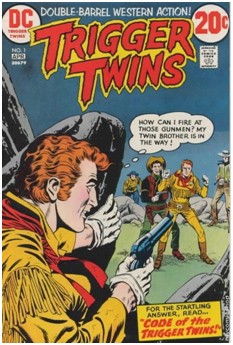
32 (tie)  Trigger Twins
                
 32 (tie)  Lobo
                                         
32 (tie)   Jim Cutlass


Monday, April 18, 2011

BOUND FOR THE PROMISE-LAND, 10th Anniversary


By Troy D, Smith.
I've written several books -I just had a new one come out last month, a mystery called Cross Road Blues. One of my proudest achievements, though, was a book that was released 10 years ago -Bound for the Promise-Land. It won a Spur Award for best original paperback novel from Western Writers of America, and was also a finalist in the "first novel" category (losing out to Stephen Harrigan's great novel Gates of the Alamo.) Doris Meredith, a reviewer for the Amarillo Globe-News and Roundup (official magazine of the WWA) called it a classic, a fact I have been known to point out from time to time (as any author would.)

This particular book meant a lot more to me, though, than awards or compliments. While there is no shortage of action in it, the novel is an examination of many of the things that are most important to me in life: freedom, and justice, and redemption. In many ways it is the polar opposite of another novel I'm proud of, Good Rebel Soil: The Champ Ferguson Story. Bound is about a black Union soldier and his story of redemption, and search for meaning, while the other book is about a white Confederate guerrilla and his story of damnation, and descent into fury. I have always regretted that Bound for the Promise-Land was in print for only a short time, and never really reached an audience.

That has changed now, and I had to take the opportunity to publicize that fact. Bound for the Promise-Land has been re-released, in both paper and ebook format, by Western Trail Blazer (Good Rebel Soil will follow in a few months.) I'd like to invite you to read it if you haven't; it's one of the accomplishments in this life I'm proudest of, and I'd like as many people as possible to check it out.

Buy it at Amazon

www.troyduanesmith.com

Tuesday, April 12, 2011

Strongheart by Don Bendell


Don Bendell had been writing mystery/thrillers until his editor mentioned that he might go back to Westerns. It seems the recent success of the remake of “True Grit” has brought sales back again for novels of the American West. 
  
Synopsis

A son of both Lakota and white worlds, Joshua Strongheart has two prized possessions--his father's Bowie knife and his stepfather's Colt .45 Peacemaker, entrusted to him by his dying mother.

In the Colorado Rockies, Strongheart falls prey to the cold-blooded McMahon brothers who steal his pistol and knife.  The brothers are unaware that hidden inside Josh’s money belt are crucial War Department documents, signed by the President, ordering a fair trial for Captain Jack, Chief of the Modoc tribe.  Josh must recover both his birthrights and the secret papers before violence erupts across the West.

  Excerpt from Strongheart

“Joshua stared into the eyes of Long Legs and the tall man got very nervous. He could see this man was trouble, wounded or not.

Westbrook said, “You’re barely able ta stand partner. Drop the hogleg, an I’ll let ya live.”
“Mister, you’ll never touch that woman while there is breath in my body,” Joshua said, “You gonna start the ball or are you gonna talk me to death?”

He saw the ears on Westbrook’s magnificent paint horse shoot forward honing in on something coming down the stage coach road behind him. He figured the gang came back and was slowly moving up behind him.

Joshua made a decision, he fired, fanned the hammer back and fired again, and saw a large stain of crimson in the center of Long Leg’s chest as he fell back dropping his gun. Joshua immediately went to the ground rolling to his right toward the bloody corpse of Chancy, but on his way down he felt a bullet slam into the back of his left shoulder which spun him. He crawled forward quickly to Chancy’s body and drew his gun and spun around, as another bullet slammed into his right thigh. He saw both Stumpy Shaw and Slim Dyer. One held a Winchester and the other a six-shooter.

Instead of firing wildly Joshua knew he had to save the woman no matter how many bullets hit him. He forced himself to stand and fired first at Dyer, the rifleman, and hit him in the right hip, and then a second shot hit Dyer right on the face tearing his lower jaw off. His eyes rolled back in his head, and he fell back dead.

Stumpy Shaw looked over and was terrorized by the sight of his dead riding partner, and he fired as quickly as he could, one bullet hitting Joshua in the upper left arm. Joshua pointed, aimed, fired, and the bullet hit Shaw in the right cheek, breaking the cheekbone and tearing the man’s ear off. Strongheart limped forward fanning the hammer back to a cocked position, and he squeezed a shot from the hip which hit Shaw’s upper torso center mass.
The outlaw thought to himself. “I’m dead,” and that was his last thought as his back slammed into the rocks.

Now, Joshua turned, and barely able to walk, started towards Long Legs. Annabelle ran forward, tears streaming, “Oh Mr. Strongheart. You have been shot over and over.”
He grinned, “They are just little holes in me. Don’t worry.”

Then he fell forward into her arms in a faint. His weight took both of them to the ground. She tried to lower him as gently as she could while falling with him on top of her. He opened his eyes, and was an inch from her face. They stared briefly into each other’s eyes, and he smiled.

“Annabelle,” he teased, “We just met.”

He stood, and she grinning, jumped up, helping him raise up on wobbly legs. She immediately started tearing shreds from her petticoat and started bandaging his wounds. Joshua smiling pushed her aside.”

Author Bio

Don Bendell is the top-selling author of 25 books, a television pilot, and a feature film, with over 2 and a half million copies of his books in print worldwide. He is also a producer, director, actor, stuntman, cowboy, poet, and speaker. Skilled in tracking, the former US Army Special Forces (Green Beret) officer, big game guide, and bow hunter, is often called upon, and has had success in, searching for missing hikers, hunters, prized animals, and fugitives.

Don is a 1995 inductee into the International Karate Hall of Fame and 1996 inductee into the Martial Arts Museum of America.  He owns and operates two karate schools in southern Colorado. He has served on the National Advisory Board of the American Indian Registry for the Performing Arts along with such notables as Burt Reynolds, Wayne Newton, Will Sampson, and Jonathan Winters. In 2007, Don was honored in a speech by US Secretary of Veterans Affairs James Nicholson along with NFL Hall of Fame quarterback John Elway.  He has worked extensively with Vietnamese Montagnard refugees and on Montagnard issues and has also been listed in Marquis' WHO'S WHO IN AMERICA and WHO'S WHO IN ENTERTAINMENT since 1992. Don is Past President of the Rocky Mountain Chapter of the Special Forces Ass'n where he is a Life member, is a member of the Special Operations Ass'n, Life member of VFW, American Legion, Life member of DAV, and is a Disabled Vietnam veteran. A former member of the International Platform Ass'n, and is a member of the Western Writers of America, where he was nominated for Spur Awards for 4 of his 10 Western novels. He is also a member of the Military Writers Society of America.

Don was appointed to the Colorado Governor's Council on Physical Fitness by former Governor Bill Owens and reappointed to the Council by current Colorado Governor Bill Ritter. Don has also testified for the Colorado Legislature on a bill about Search and Rescue and another bill Don had first suggested to Representative Tom Massey about economic and other incentives to attract film and TV producers to Colorado. Both bills were passed and made into state law.

A graduate of Colorado Christian University with a degree in Business, Don is currently in graduate school at Grand Canyon University in Phoenix pursuing a Master of Science in Leadership. Don is the father of 6 grown children and grandfather of 8. Don rides a big pinto National Showhorse named Eagle, and he and wife Shirley own the Strongheart Ranch south of Florence, Colorado. Don is currently writing westerns after publishing several military thrillers through Berkley Books (Penguin Group-USA) and is represented by the John Talbot Agency, Inc.


Thursday, March 31, 2011

Western Fictioneers 2010 Peacemaker Awards Nominations


Western Fictioneers (WF) is pleased to announce the nominations for the first annual Peacemaker Awards.

Nominees for the 2010 Best Western Short Story Award are listed in alphabetical order:

“Left Behind” by Carol Crigger from the anthology Roundup! Great Stories of the West (La Frontera Publishing

“This Old Star” by Wayne Dundee from the anthology Bad Cop…No Donut (Padwolf Publishing)  

 “Two-Bit Kill” by C. Courtney Joyner from the anthology Law of the Gun (Kensington) .

 “Scourge of the Spoils” by Matthew P. Mayo from the anthology Steampunk’d (Daw Books, Inc)

 "Catch a Killer by the Toe" by Pete Peterson published by Untreed Reads

Nominees for the 2010 Best Western Novel Award are listed in alphabetical order:

Manhunt (Berkley) by Lyle Brandt (Berkley)

Avenging Angels by Lyle Brandt (Berkley)

Settler’s Chase by D. H. Eraldi (Berkley)

Long Ride to Limbo by Kit Prate (Western Trail Blazers)

Wulf's Tracks by Dusty Richards (Berkley)

Congregation of Jackals by S. Craig Zahler  (Dorchester)

++++

There will be no Best First Western Novel Award awarded this year as there were not enough entries to complete the field of judging.

The Peacemaker Awards will be announced June 23rd, 2011 in Bismarck, North Dakota.  A place and time will be announced at a later date.

Western Fictioneers (WF) was formed in 2010 by Robert J. Randisi, James Reasoner, Frank Roderus, and other professional Western writers, to preserve, honor, and promote traditional Western writing in the 21st century.  Entries were accepted in both print and electronic forms.  The Peacemaker Awards will be given out annually.  Submissions for the 2011 awards will be open in July, 2011. Submission guidelines will be posted on the WF web site.  For more information about Western Fictioneers (WF) please visit:
or

Contact:  Larry D. Sweazy, WF Awards Chair, larrysweazy@prodigy.net, 317-773-9809

Friday, February 25, 2011

“NO COWBOYS OR TEXANS OF ANY SORT ALLOWED INSIDE TOWN LIMITS UNDER PENALTY OF LAW!”


Thus reads the sign posted on the outskirts of Redemption, Kansas. And they mean it.

Unfortunately, young cowboy Bill Harvey has sustained a serious leg injury in a stampede caused by rustlers, and his partners have little choice but to leave him in Redemption to convalesce. Bill wants to finish out his first cattle drive, but is forced to remain in the town he describes as a backwater settlement for at least a week until he is able to walk. He finds himself under the care of a grizzled storekeeper and his beautiful daughter, Eden… and it doesn’t take him long to realize that the local peace officers are not quite what they seem. There is a dark cloud over Redemption, Kansas –the citizens live in fear. The more questions Bill asks, the more dangerous life becomes for him… and for the family that has taken him in.

This is a suspenseful story, with well-drawn characters, that I found hard to put down. There is more action than you would expect in a tale with a stove-up hero, a strong young man who is not used to feeling helpless, and the tension builds as Bill figures out what is really going on but can’t quite figure out what he’s going to be able to do about it. Bill’s frustration at his physical limitations, his youthful innocence, his fears for his new friends, and the well-developed romance with Eden make him a very sympathetic character. The villains, especially the scar-faced deputy Zach Norris, are formidable.

This is the first new western to come out from James Reasoner under his own name for a while. He writes well no matter what name is on the cover, but I’m glad to see him getting full credit for this one. The name “James Reasoner” popped out at me in the ‘90s when I read several short story anthologies in a row that had tightly-written, powerful tales of his –“Wish Book” stands out particularly in my memory –and those, plus the classic Under Outlaw Flags, quickly made him one of my favorite writers. Reading his new book makes me remember why. If you want to read a good traditional western, I give this one a strong recommendation.

Review by Troy D. Smith, the award-winning author of RIDING TO SUNDOWN, BROTHERS IN ARMSTHE PEOPLE IN YONDER, and GOOD REBEL SOIL: THE CHAMP FERGUSON STORY, among others.  Troy is currently a Doctoral candidate in the History Department at the University of Illinois. He says, "I don't write about things that happen to people—I write about people that things happen to.")

Wednesday, February 2, 2011

The Snake Den - Chuck Tyrell (Charles T. Whipple)

THE SNAKE DEN, by Charles T. Whipple writing under his Chuck Tyrell pseudonym, is the first book in Solstice Publishing’s new Western line. It’s a fine debut for the line.

The protagonist of THE SNAKE DEN is fourteen-year-old Shawn Brodie, who is sent to Arizona’s infamous Yuma Prison for stealing beef, even though he’s actually innocent of the crime. Once he’s locked up, Shawn faces all sorts of trouble, mostly from the brutal and perverted head of the guards but also from the sinister, crippled inmate who runs the prison’s criminal underground, a Mexican outlaw determined to escape, and assorted other inmates who become Shawn’s enemies for one reason or another. After one ruckus, Shawn gets tossed in the Snake Den, the solitary confinement cell built into a cave where rattlesnakes can crawl in with the prisoners.

However, not everybody is out to make life miserable for Shawn. His cellmates turn out to be decent sorts: a gambler who teaches Shawn how to play cards, a gunfighter who gives him the fundamentals of handling a revolver, and a man everybody takes for Chinese but who really isn’t, who teaches Shawn the martial arts. Shawn also has allies in the warden’s wife, the prison doctor, and a girl from Yuma who visits the prison when it’s open to the public on Sunday so the prisoners can put on boxing exhibitions and sell things they’ve made.

The prison yarn is a staple of genre fiction, and Whipple has written a very good one in THE SNAKE DEN. Having researched and written a book partially set in Yuma Prison myself, I know he’s done an excellent job of portraying that notorious hellhole. Shawn is a very likable protagonist, and the other characters are fleshed out and well-developed. Given its setting and subject matter, it’s not surprising that THE SNAKE DEN is considerably grittier than the fine Black Horse Westerns Whipple has also written under the Chuck Tyrell name. If this is an example of what we can expect from the Solstice Western line, I’m certainly looking forward to the rest of the books.

-- James Reasoner
(James Reasoner is the author of TEXAS WIND, DUST DEVILS, and REDEMPTION, KANSAS.)

Monday, January 24, 2011

NOT YOUR FATHER’S LONE RANGER


Troy D. Smith

Not your father’s Lone Ranger –and that’s not necessarily a bad thing. In 2006 Dynamite Entertainment debuted its Lone Ranger comic, by Brett Matthews and Sergio Cariello. It was an immediate hit, with critics as well as fans. The title was nominated for an Eisner award for best new series, and was named “Best Western Comic Book of the Year” by True West in 2009. Matthews and Cariello have consistently managed to capture the spirit of the characters and give nods to their storied history while still providing depth and appealing to modern readers. As of this writing, in January 2011, the series has seen 24 issues and four story arcs. I would prefer to see the book coming out on a more regular basis, but waiting a couple of months for Cariello’s excellent artwork is more than worth it. The first three story arcs are available in trade paperback, and the fourth one will be soon; an upcoming miniseries will see the Lone Ranger interacting with an elderly Zorro (Dynamite also publishes Western comic series about Zorro and the Man with No Name.)

Of course, the Dynamite series is only the latest incarnation of the masked man. The character was originally created in 1933 by Detroit radio producer George W. Trendle and freelance writer Fran Striker (the two men argued publicly for years about which had the largest role.) Eventually the Lone Ranger galloped from radio to serials, movies, cartoons, and a long-running television series. He appeared in a newspaper comic strip (initially scripted by co-creator Striker, who also wrote several Lone Ranger novels) from 1938 until 1971, and again in the early ‘80s. The masked man first appeared in comic books in January, 1948; except for a brief hiatus in the early 1960s when the rights changed from Dell to Gold Key Comics, the title continued until March, 1977 (an interesting side note, at least to me: that other famous masked cowboy, Marvel Comics’ Two-Gun Kid, headlined his own comic from March, 1948 until April, 1977.) The Ranger had a brief four-color comeback in the mid-90s with a Topps Comics miniseries by Joe R. Lansdale and Timothy Truman.

The first story of Dynamite’s series closely follows the origin story from the original radio program: young Texas Ranger John Reid is the lone survivor of an ambush by the Butch Cavendish gang which kills five other Rangers, including Reid’s father and older brother Dan. The troop had been betrayed by a traitorous Ranger named Collins. The seriously wounded Ranger is rescued and nursed back to health by an Indian named Tonto, who becomes his partner. Reid buries his five dead comrades, and adds an empty grave –John Reid is dead to the world, and only the Lone Ranger survives. Before long there is a white stallion and a silver mine which produces material for the masked man’s bullets. I like the way Matthews and Carielo include more subtle Easter eggs to pay tribute to the character’s history. In the early issues he wears the red shirt which the Lone Ranger sported in the 1940s, and later switches to a more Clayton Moore-esque blue one. In one scene, the sheet music to The William Tell Overture sits prominently on a piano in the foreground. John Reid’s young nephew, Dan Jr., is obsessed by hornets –Fran Striker fans will immediately realize that little Dan will later be the father of Britt Reid, the 1930s Green Hornet.

There are a few changes, however, and a few modern touches. John Reid seems more sensitive, and less sure of himself, than the stalwart hero we are accustomed to. Like the hero of yore, he refuses to take a life –he uses silver bullets to emphasize the heavy price paid for every shot fired. I don’t remember that reasoning being part of Lone Ranger lore before, although perhaps it was there and I just missed it. The widow and son of his brother Dan are important supporting characters, and the Ranger’s tender feelings for them is a dramatic element in the series. The aging, melancholy Sheriff Loring is another prominent member of the supporting cast, providing a similar dynamic to Commissioner Gordon in Batman stories. Butch Cavendish is a far more interesting villain than he has ever been before –no longer a simple outlaw boss, he is portrayed as an unhinged, psychotic politician, given to grandiose soliloquys and sardonic conversations with God. He is sort of a cross between Al Swearingen of Deadwood and the Joker.

The biggest change –and really, how could it not be –is the depiction of Tonto. He is no longer the monosyllabic, pidgin-English speaking, loyal “Injun” sidekick. Nor does he get beaten up every time he goes to town alone, as Bill Cosby famously observed. This Tonto speaks fluent English, is a formidable and supremely competent hero, and is an equal partner –in many ways a mentor –to the Lone Ranger. He is also more likely than his partner to get the girl. Critics of the character have for decades pointed out that the very name “Tonto” is condescending, as it is a Spanish word meaning “fool.” Matthews’ script makes it clear that Tonto is not the man’s given name: “You can call me Tonto. People used to.” We later learn that he is an outcast from his tribe (hence the name Tonto, perhaps, as Apaches often spoke Spanish –though that has not yet been clarified in the comic.) At one point his old friends deride him for being a “faithful Indian companion.” It is only fair to point out that Lansdale and Truman’s 1994 version of Tonto was also articulate, capable, and aware of the public’s racist view of him: "Of course, Kemosabe. Maybe when we talked I should use that 'me Tonto' stuff, way they write about me in the dime novels. You'd like that, wouldn't you?"

I hear that some fans of the traditional Lone Ranger have complained about the violence in the latest comics version. To be certain, this is not the kids’ TV show or the 1970s cartoon; comics today are primarily aimed at people college-age and older (the younger kids are busy playing with their wiis.) The action and language are more realistic –one storyline involves catching a serial killer. Even so, this incarnation of the Lone Ranger is just as much a model of virtue, morality, and honor as any that have come before. If you have pleasant memories of the character, or if you just enjoy a good Western action tale, I strongly recommend you pick up an issue or one of the trade paperback reprints.

(Troy D. Smith is the award-winning author of RIDING TO SUNDOWN, BROTHERS IN ARMSTHE PEOPLE IN YONDER, and GOOD REBEL SOIL: THE CHAMP FERGUSON STORY, among others.  Troy is currently a Doctoral candidate in the History Department at the University of Illinois. He says, "I don't write about things that happen to people—I write about people that things happen to.")

Thursday, January 13, 2011

Deadline Approaching

Submissions for the Western Fictioneer Peacemaker Awards are being still being accepted for works published in the year 2010.  All entries must be postmarked by January 31, 2011.  For more information about the awards and the forms needed, check out the WF website.

Monday, January 10, 2011

Rancho Diablo Series by Colby Jackson

The Rancho Diablo series of original Western e-books was launched recently to great success so far. Written under the house name Colby Jackson, Rancho Diablo is the creation of veteran authors Mel Odom, James Reasoner, and Bill Crider, and tells the story of the creation of a Texas ranch by former army scout Sam Blaylock, his family, and his friends.


The first book, SHOOTER’S CROSS, written by Odom, finds Blaylock taking over an old, abandoned ranch that is thought to be cursed and having to battle not only new-found enemies who don’t want him to succeed but also the earth itself, since much of the water on the spread he dubs Rancho Diablo is polluted by sulfur. After triumphing over these threats, the arrival of Blaylock’s family sets the stage for the second book, HANGROPE LAW (written by Reasoner), in which an unexpected reunion with an old friend leads to danger for Sam and one of his sons.


These two books are now available for the Kindle through Amazon. The third book, DEAD MAN’S REVENGE, written by Bill Crider, will be available soon. These are action-packed stories that will appeal to fans of traditional Westerns and new readers alike. Check them out.