Showing posts with label Western Trail Blazer. Show all posts

Tuesday, January 13, 2015

SOUTH OF RISING SUN by JD MCCALL (AND A GIVEAWAY!)


If all went well, by now I should be the newest member of Western Fictioneers, so I would like to take this opportunity to say hello and introduce myself to the group. I'm John McCall, writing under the not-so-cleverly-disguised pseudonym of JD McCall (sounds a bit more like a western writer, don't you think?). The JD part isn't much of a stretch since that was the nickname some folks used to refer to me by when I was younger, those "folks' being my five older sisters. In November of 2014, Western Trail Blazer released South of Rising Sun, my second foray into the realm of the Old West. Since I have been graciously allotted the space to do so, I'd like to tell you a little bit about it, if I may.

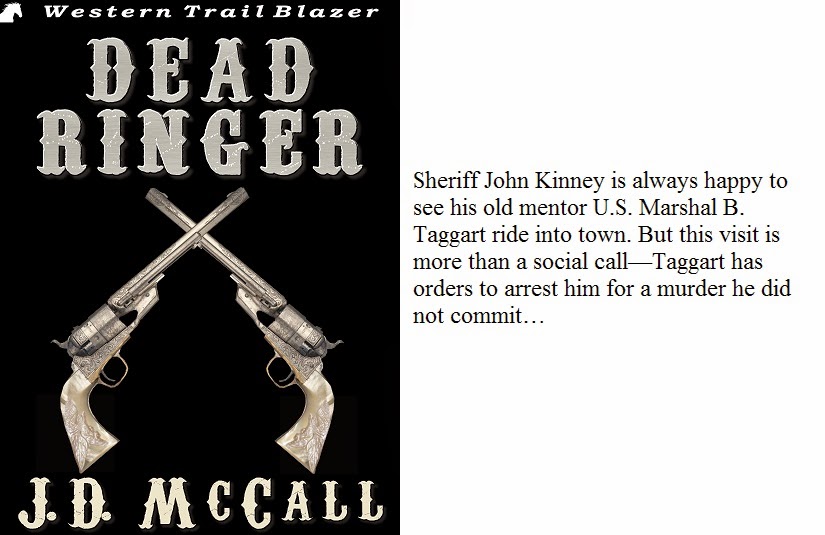
I have to credit the existence of South of Rising Sun to Rebecca J. Vickery, the former owner of Western Trail Blazer. You see, when I wrote my first western, Four Horses/Dead Ringer (now re-released under the new title, Borrowed Guns, as well as with a new cover), I was figuring on being a one-and-done author. Rebecca, bless her heart, just assumed I was like every other aspiring writer and expected I would be cranking out my next effort in short fashion. When I balked at doing a follow up by stating I wasn't any good at coming up with new plot lines (true), she suggested I make a short story out of an incident briefly mentioned in my first book. Once it was pointed out to me, I could see the potential there, but I immediately knew there was no way I could do it justice as a short story; hence, South of Rising Sun became a full-blown novel.

It was my accidental good fortune to have concocted the aforementioned incident as taking place some twenty-some years earlier in the historically important town of Lecompton, Kansas, only a few short months since Kansas had entered the Union as a free state and just weeks after the start of the Civil War. Good fortune indeed, for it lent this new story an interesting backdrop against which it could be told. I would be willing to wager that most of you have never heard of Lecompton, and you could not be faulted for that. Prior to writing SoRS, my only knowledge of the town was that it had been the first official territorial capital of Kansas. Despite living in Kansas for all of my fifty-nine years and having a cousin who grew up in Lecompton, a mere thirty-five miles from me, I, too, knew nothing about this city's major role in precipitating the election of Abraham Lincoln. You could, in fact, make a strong argument that the shenanigans which took place in Lecompton set in motion the chain of events which ultimately led to the Civil War. Lecompton was also the site of one of the biggest gunfights in the West, again something few people have any knowledge of. But back to the story.


Alistair B. Taggart, a former school teacher long ago turned U. S. Marshal, has been assigned to the territory of Bleeding Kansas since its inception in 1854. During one of his regular visits to the fading city of Lecompton, a local rancher asks for help in stopping the rustlers who have plagued his ranch for the last several months. But before Taggart can even get started solving James Harper's problems, he's coerced into helping track down a runaway slave, forcing him to choose between his lawman's oath and his own personal values. Taggart's fight to navigate his way through helping one man gain his freedom and the other violent complications thrown in his path will challenge his skills and the faith he has in his own aging abilities. By the time he unravels the rustler's unusual scheme, Taggart will forge new friendships, renew some old ones and pay a terrible toll to get the job done. Sometimes, justice only comes with a price...

Writing South of Rising Sun was a tremendous amount of fun for me. Along with getting to write rousing action scenes, I couldn't resist the many opportunities to balance the serious with a fair amount of humor where it was appropriate. I also enjoyed the research I was able to do for the book in the way of numerous field trips to Lecompton, learning something new about this now tiny but proud community every time I visited. Located several miles east of the Kansas capital of Topeka, Lecompton has a great little museum with a lot of helpful members of its historical society who aided me in my quest to find the names of former inhabitants and places I could use in my novel. I was also blessed in that Lecompton had two newspapers (both pro-slavery) operating in the years prior to the Civil War, both of which were archived in Topeka at the Kansas Historical Society. Several key bits of information were gleaned from those sources which made it into SoRS.

I think really you'll enjoy spending time between the pages of South of Rising Sun. What meaning lies behind the title? Give it a read and find out. Here's an excerpt:

Holliman wasted only a few moments watching them leave before he turned on Taggart. "That's all you're gonna do to ‘em, dammit? Make ‘em join the army? A few minutes ago those sons of bitches were gonna burn my place down with my wife in it, and all they're gonna get for it is to have to join up with the goddammed army?" He threw the stack of hats to the ground.

Taggart's eyes narrowed and shot their own brand of lead at the farmer. "Mr. Holliman, I stopped your place from being torched and killed a man in the process. What would you have me do, ride out and kill the rest of them?"

"You didn't kill the dirty skunk. He's still alive, ain't he?"

"Not for long," Taggart said, looking cold and angry. "I shot him square in the side, clear through the chest to the other side. He'll be lucky to make it to a doctor before he bleeds to death. If he does make it, there won't be anything a doctor can do for him. He's as good as dead already. Does that make you feel better?"

Holliman withered under Taggart's gaze. "Well . . . maybe . . . some."

Taggart continued to glare at him. "Well, maybe when those men spend day after day listening to the roar of gunfire and cannons assault their ears with no end; or when they've seen countless of their friends die in front of them, seen enough dead with eyes run through by bayonets and pierced through every other body part imaginable, seen men butchered and hacked to pieces with broadswords and bodies torn in half by cannon fire; perhaps when they've buried enough fly-ridden, maggot infested corpses, maybe then when the war is over, and the one or two of them who may make it home alive put up their guns and take up quiet lives raising families, maybe that will be enough for you, Mr. Holliman."

And one more, a scene where Taggart visits with the bartender at a saloon.


"The way you tell it, I've been missing out on all the fun by not stopping in on a regular basis."
"Maybe you should stop in more often. I could do with a little less fun of such kind, and things do seem to settle down some when you're in the place."

"Are you suggesting my presence puts a damper on the festivities in here? I never considered myself as much of a stick in the mud as you make me out to be."

Criqui grinned wide enough you could see his missing tooth. "I ain't sayin' you don't know how to have a good time, but ever since you about shoved your pistol up old Pete Talbot's nose when he started actin' up, there's a lot less fightin' to be had whenever you stop in."

"Served him right. Everybody knows you don't go wasting good whiskey by cracking the bottle over someone's head. I take special offense at the transgression when it happens to be my bottle."

"I think you got your point across to him. I can still see the look on his face when you had your gun to his snout, and he glanced down and saw the badge on your shirt. I ain't never seen him back in here since then whenever you're in town. And when he does come in, he behaves pretty much."

"Good," Taggart said. "I would hate to see him take out his orneriness on another innocent bottle of spirits, which by the way, would make good company while I sit at a table and fill in some papers this afternoon."


I'm giving away an e-copy of SOUTH OF RISING SUN today to one lucky commenter! Just be sure to leave a comment and your e-mail addy so I can contact you if you won. Meanwhile, here are the buy links if you just can't wait to see if you are my winner!

http://www.amazon.com/South-Rising-Sun-J-D-McCall-ebook/dp/B00QD0D332
http://www.amazon.com/South-Rising-Sun-J-McCall/dp/1505286522/ref=tmm_pap_title_0
https://www.smashwords.com/books/view/497440">https://www.smashwords.com/books/view/497440">https://www.smashwords.com/books/view/497440


AUTHOR WEBSITE:
http://www.mccalljd.com/

Wednesday, August 6, 2014

WESTERN TRAIL BLAZER New Releases


Troy D. Smith

We have several treats for you this month at Western Trail Blazer. In addition to our new novels and short stories, we have a special anthology edited by Jeremy L. C. Jones called Fathers, featuring three stories each by Wayne Dundee, John Duncklee, John Nesbitt, and Troy D. Smith. We also have a short story collection by Phil Dunlap, Diablo Smith, and four ebook singles that are previews of the collection Tie One to That! by Lynn Veach Sadler, due out later this month.

You won't want to miss any of them.

I've also tagged on a couple of new releases from our sister imprint, Windigo Books, for those who like their fiction on the eerie side.


AND FROM OUR HORROR IMPRINT...


And we have even more exciting things around the corner!


Sunday, July 20, 2014

A FEW OF MY FAVORITE WORDS by Vonn McKee


I’m watching my grandson, Noah, build one of his amazing Lego creations. He’s already constructed the 237-piece Star Wars-themed set, per the instruction booklet, in just over thirty minutes. (It would have taken me a week.) 
Lo and behold, he breaks down the finished assembly. Now he’s following his imagination and designing on the fly, using the same 237 parts. He calls the new incarnation an Alliance Night Blade. It has rakish wasp-like lines, a number of hinged and rotating parts, and several weapons of planetary destruction. Theoretically, it’s capable of speeds upwards of Mach 5, hovering indefinitely (with no apparent need for refueling), vertical takeoffs and landings, and possesses enough fire power to take out all the bad guys in all the known galaxies combined.
It occurs to me that, just as Noah fashions interlocking plastic shapes into spacecraft, I spend hours (most of them enjoyable) fitting words together…about the West.
My mother tells me that I began forming sentences in fairly comprehensible English at nine months. I love words, always have. They’ve gotten me into trouble on occasion, and out of trouble more times than I can remember. When you love words, it’s a no-brainer to also love books. I worked in the library through high school and college just to be near them. 
I majored in engineering (long story!) and grew accustomed to having professors return my laboriously-researched technical essays with the suggestion at the top: “Have you thought of becoming a writer?”
If you hang around words long enough, you begin to develop favorites. Yes, I know…every word has its place and what would we do without all the unglamorous workhorse words like invoice, vitamin, refrigerator, dentist and the like. I shouldn’t be biased. But, gosh…some words are just so darn gorgeous. For instance, who wouldn’t rather read about lingerie than underwear?
When it comes to literary genres, I can’t think of a more perfect one for the placement of pretty words than westerns. Take a look at the geography itself. Pronounce these words slowly: Arizona, Wyoming, the Dakotas, California, Montana, Colorado, Nevada, New Mexico.
ridermagazine.com
I was on the fence about Utah until I said it a few times. It does have a pleasing, ancient ring to it. But, Texas? I’m not so sure about that one. Guess it sounds prettier if you’re from there. Just joshing, Texans.
Oh, the places you’ll write! Coeur D’Alene, Santa Fe, the Sierras. Linguistic loveliness.
By the way, we’re talking about words that are euphonious, which sounds awfully nice itself. It means “pleasant of sound; agreeable to the ear.” Euphoooonnnnioussss. Mmmmm.
The Spanish gave us some beautiful western words with high roll-off-the-tongue factor. Consider canyon, vaquero, adobe, lariat, remuda, and adios, amigo. And, of course, we must remember…the Alamo.
Townes Van Zandt’s song, “Pancho and Lefty” would never have been a hit if not for the line, “All the Federales say they could’ve had him any day.” Just my opinion.
Even the French helped out western writers with ravine, cigarette, cheroot, belle and chignon. The dictionary is a writer’s jewel box.
No boring landscape descriptions for us. We can plant picturesque saguaro, sage, piƱon or willow wherever we want. On a mesa or a prairie or a few yards from home, arguably the sweetest of all names.
Why use ordinary colors when you can wordpaint with violet, saffron, vermillion, ivory, maroon, and cerulean or azure blue? Personally, I adore the word silver and use it every chance I get. Silver tongues, silver stars, silver nuggets. Love it.
I even love the sound of certain horse terms: withers, muzzle, dappled, sorrel, appaloosa. I am constantly looking for an opportunity to use the word fetlock. So under-utilized in modern literature, don’t you agree?
Some of my personal faves are silhouette, shadowy, velvet, statuesque, lithe, lilting, and realm. Oh, and demure, dalliance, and crystalline. I’m in porcine paradise. (And to think I could have settled for "hog heaven.")
There are many “Most Beautiful English Words” lists out there and they contain a lot of “ous” words such as mellifluous, voluminous, luscious, sumptuous, and tenuous. According to the Alpha Dictionary, their list-topper is ailurophile, meaning “cat lover.” I’ll have to disagree since I’m neither a fan of the word nor of cats.
Then we have those wolves in sheep’s clothing words that sound fetchingly exotic but, believe me, you want no part of: jaundice, influenza, anemia, shingles, seizures, and E. Coli, to name a few.
This compilation of words into a discussion of words themselves could stretch into infinity. However, I have deadlines and must set about arranging lovely words into, hopefully, even lovelier sentences, much the way my grandson digs for just the right Lego pieces to form an x-wing.

For my next western story, I’m determined to work in a silver fetlock reference or two. There must be a way.

Adios, 


Vonn
www.facebook.com/vonnmckee

READ THE LATEST FROM VONN McKEE HERE!


Sunday, April 20, 2014

A Sacred Path


I live a couple of miles from the northern terminus of the Natchez Trace Parkway, which the National Park Service describes as “a 444-mile drive through exceptional scenery and 10,000 years of North American history.” The two-lane billboard-free road meanders north from the delta lowland of Natchez, Mississippi, to the rolling hill country near Nashville, Tennessee. Motorists will meet no eighteen-wheelers and see no fast-food neon, but will probably have to brake for plenty of deer and wild turkey.

The parkway more or less follows an ancient footpath that began as an animal track thousands of years ago, maybe even ten thousand. Bison traversed between southern grazing lands and salt licks on the Cumberland Plateau. Later, prehistoric mound builders used the Trace to move between villages. Its native wanderers eventually included the Choctaw, Chickasaw and the Natchez. 

European explorers utilized the old path but its heaviest use was from about 1785 to the 1820’s when the “Kaintucks” of the Ohio River Valley floated goods downriver to the ports of Natchez and New Orleans and returned on foot via the Trace. It was notoriously dangerous: organized gangs of (literal) cut-throats lay in wait for the travelers. Robbery was the least crime feared on the journey.

Today, the biggest threat of traveling the Natchez Trace might be mindlessly enjoying the scenery rather than eyeing your speedometer. Park rangers abound. (I can vouch for the fact that the speed limit is a strict 50 miles per hour.


      The Natchez Trace Parkway at Birdsong Hollow, near Franklin, Tennessee           (USDOT Image)


Occasionally, I drive for a ways down the parkway just to relax and take in the sights. I think about those who walked here…the mysterious natives whose burial mounds can be seen along the route. John James Audubon may have sprawled on a boulder to sketch a cocky bluejay. I imagine the tramping of Andrew Jackson’s foot soldiers on their way to fight the Battle of New Orleans.

                                        A few sections of the Old Trace remain.

Near Mile 386, is a memorial to America’s greatest pathfinder Meriwether Lewis, who died here at Grinder’s Stand. The details are sketchy and historians are divided as to whether he was murdered or perhaps committed suicide. He was known to suffer from what President Andrew Jackson called “sensible depressions of mind.”


                    Here lies Meriwether Lewis. Milepost 385.9, near Hohenwald, Tennessee           (NPS Image)

Sometimes my Sunday drive over the Natchez Trace, and all those ancient footprints, turns philosophical. As a writer, I recognize that I follow a path that is not only well-worn, but that has been worn very well. Particularly in the western genre, we have just one time period to write about and just so many character types to choose from. The possible scenarios come (and please, Lord, let them come) from an unseen creative well.


My hope is that I can, now and then, find a new way to say the old thing, to delight a reader with a previously-unvoiced expression or description. But a look at my own bookshelf tells me the hard truth. Others have ridden this way. Bret Harte. Mark Twain. Grey…L’Amour. McMurtry…McCarthy. Wister…Leonard. I’m a piker…and I know it. A greenhorn, if you will.

Oh, but that doesn’t mean I shouldn’t take the journey. I’m not only writing for readers. I write for the love of the genre and the great period of American history that it represents.

There’s another reason I write too. You see, others ride behind. Someone has to point the way. With every story, we keep the old trail worn, revered, relevant.


Vonn McKee is Louisiana-born but has called Nashville, Tennessee, home for over twenty years. She has spent time in the music business, the construction business, and has even waited a few tables along the way. Vonn has written songs, radio jingles, magazine articles, short stories and is at work on her first novel. She has a real heart for historical fiction, especially the Old West.

You can keep up with the latest news at https://www.facebook.com/VonnMcKee.

http://www.amazon.com/s/ref=nb_sb_noss_1?url=search-alias%3Daps&field-keywords=vonn+mckee