Thursday, September 24, 2015

INFECTIOUS DISEASES IN THE 19th CENTURY


THE DOCTOR'S BAG

the blog about medicine and surgery in the 19th century

Keith Souter  aka Clay More


The 19th century saw monumental changes in medicine and surgery as the Germ Theory of disease and the discovery of the disease-making potential of micro-organisms gave doctors an understanding of how infections were caught. The development of aseptic surgery gave people a fighting chance of surviving operations and the infections that developed afterwards. Yet it would be public health measures based on hygiene, sanitation and fresh water supplies that would reduce mortality rates in towns and cities.

Epidemics were a problem for cities as the century advanced. With industrialisation, people moved to the cities to gain employment. Overcrowding in unsanitary conditions created the right conditions for infectious diseases to develop and pass rapidly through the population.

In London in 1854 there were 14,000 cases of cholera with 618 deaths. In the USA there were three cholera epidemics in the 19th century.

Yellow fever was a huge problem in the northeast states between 1793 to 1805. Then in the first half of the 19th century it hit the southern states, to reach a peak in the 1850s.

Infections and disease during the Civil War
The war had a devastating effect on the country, but there were more deaths from disease than from battle. This may seem surprising, until you consider that the assembling of armies with men living in close contact, with limited hygienic precautions, poor sanitary standards and sometimes inadequate nutrition and water.


Wounded Union soldiers being tended near the Marye house in Fredericksburg, Va, after the Battle of Spotsylvania

According to Medicine of the Civil War by Paul E Steiner, published  by the National Library of Medicine, there were almost 3 million enlistments to the Union Army and between 1.3 - 1.4 million to the Confederacy.

The deaths from various causes were highly significant:

UNION:

In battle                                    110,070
Disease                                     224,586
Accidents, suicide, etc               24,872

Total                                         359,528

CONFEDERACY:

In battle                                      94,000
Disease, etc                              164,000

Total                                         258,000


The total deaths in battle amounted to 204,070, compared to 388,586 deaths from disease. Effectively, diseases caused almost twice as many deaths as did  actual battle.

Figures for admissions to hospital for the Confederacy are not available, but for the Union:


DISEASE
CASES
DEATHS
Typhoid
       75,368
     27,050
Typhus
          2,501
           850
Typho-malarial fever
        49,871
       4,059
Acute diarrhoea
 1,155,266
       2,923
Chronic dysentery
       25,670
       3,229
Syphilis
       73,382
          123
Gonorrhoea
        95,833
              6
Scurvy           
        30,714
           383

These sickness figures show that some conditions had an alarmingly high mortality rate. The mortality rate for typhoid was over 35 per cent of cases. Typhus was less common, but had a mortality rate of 34 per cent. Typho-malarial fever, a common diagnosis, which showed the lack of understanding about the conditions of typhoid and of malaria (which are separate conditions) and the non-specificity of diagnosis, had a mortality rate of 8 per cent. Other conditions like acute diarrhoea caused huge numbers of cases, throwing a terrific drain on resources and taking so many men off the field of battle, without having a high mortality rate. Add to that the huge number of men who had to be treated for the venereal infections and the men who would have been very ill from scurvy, caused by lack of vitamin C and you can see how disease was just as much a dangerous enemy as the foe on the opposing side.

The figure are not complete, of course. There would be the added cases of tetanus and gas gangrene, both potential complications of being wounded and lying on a muddy battlefield where the wounds would be likely to get infected from organisms in the soil.

The Union, which lost control of the battlefields in the early stages battles took the greatest number of casualties with infected wounds, but gradually both sides developed ambulance services and field and general hospitals so the wounded fared better in the later stages of the war.


Surgeon General William A Hammond (1828-1900) was in charge of the Union medical services at the start of the war, but fell from grace and was court-marshalled on trumped up charges against him.

The Confederacy's medical services were overseen by Dr Samuel Preston Moore (1813-1889). He was able to build up the southern medical corps with comparatively little interference.


Dr Samuel Preston Moore - surgeon general of the southern medical corps

The 1854 London Cholera Outbreak and the Broad Street Pump
A very severe outbreak of cholera broke out in the Soho area of London in 1854. At the time the medical opinion was that cholera was caused by bad air and that one could acquire a miasm from this, that caused the disease. The idea that it was due to an infecting organism had not occurred to anyone.

Dr John Snow (1813-1858) did not accept this idea and wrote an essay On the Mode of Communication in Cholera in 1849, in which he postulated that cholera entered the body through the mouth, not through inhaling bad air.
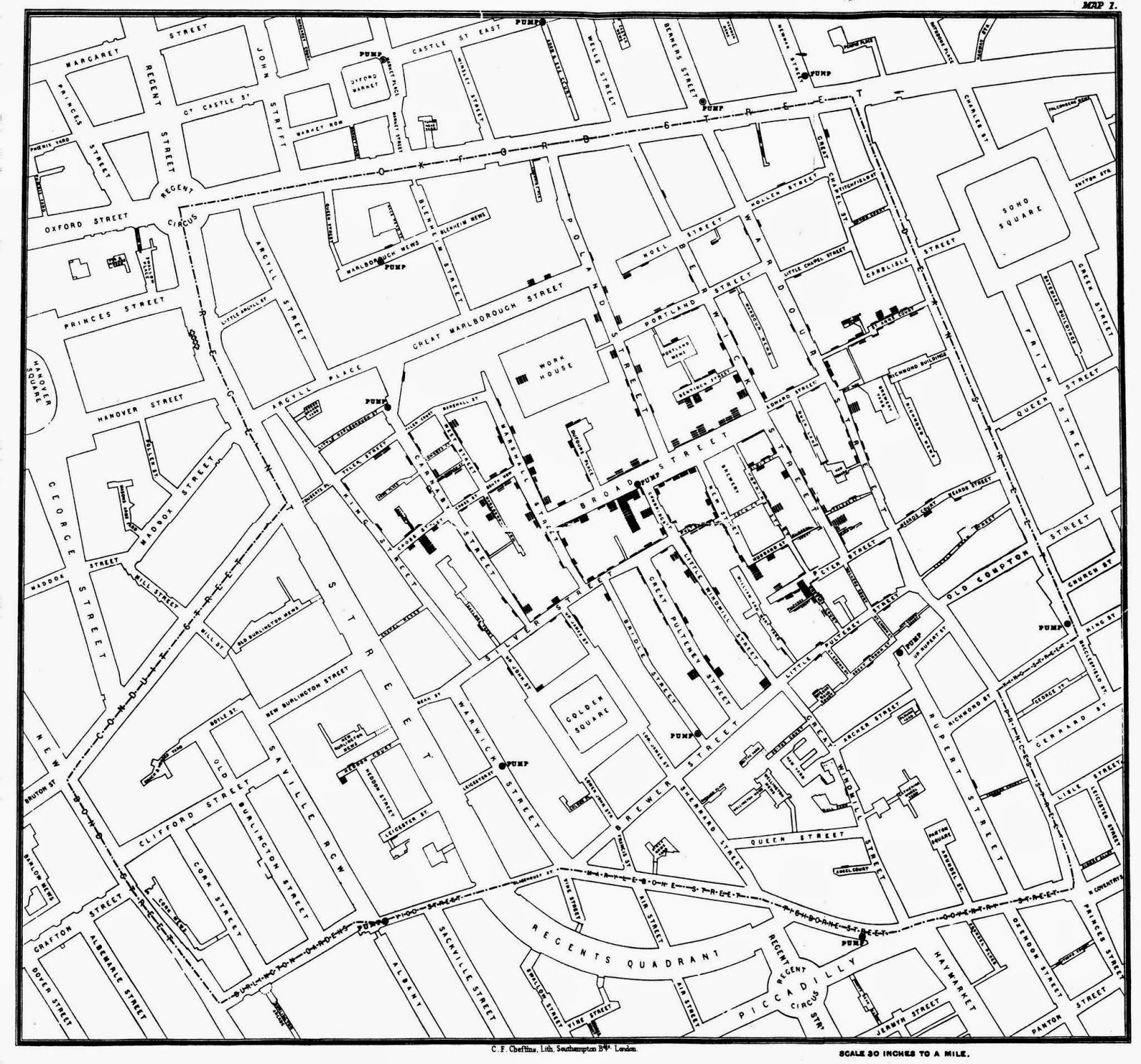

Part of the cholera death map of Soho in London, pinpointing the Broad Street Pump (centre of picture)

During the outbreak of cholera in 1854 he performed the first ever epidemiological survey. He charted all the cases of cholera and all the deaths, to produce a cholera death map. He was able to deduce that the commonality was that all deaths had occurred in an area supplied by a water pump in Broad Street. The water from it had been contaminated by a cracked sewage pipe. He had the handle of the pump removed so that it could not be used and the number of cases started to drop straight away.

Dr John Snow was also a pioneer in the development of anaesthetics and gave chloroform to Queen Victoria during one of her labours. Because it was so successful for the queen anaesthetics was given a much-needed boost in popularity.

Transmission of infection
Once the Germ Theory became accepted, doctors began the hunt for micro-organisms in all of the infectious diseases. Gradually, it became clear that there were various modes of transmission of these infections.

Airborne transmission
The organisms are transmitted in droplets from coughs and sneezes. These droplets are inhaled by  someone else, who develops the illness.

Diseases spread in this manner:

  1. The Exanthemata (the diseases characterised by a distinctive rash) - measles, rubella (German measles), chickenpox, smallpox, scarlet fever.
  2. Mouth and throat infections - diphtheria, tonsillitis, mumps, herpes stomatitis.
  3. Respiratory tract infections - pertussis (whooping cough), influenza and other respiratory virus infections, pulmonary tuberculosis.
  4. General - meningococcal and staphylococcal infections.
Intestinal
Infection present in the bowel excreta of a case or a carrier (someone who has the infection, but who has no symptoms) is ingested by a previously uninfected person. This transmission may be immediate and direct, via infected fingers and hands, eating utensils, clothing, toilets, or indirectly via infected food or water. 

Diseases spread in this way include - typhoid and paratyphoid, salmonellosis, dysentery, cholera, gastroenteritis, poliomyelitis, viral hepatitis.

Direct contact

This is from person to person by skin contact. These are mainly cutaneous (skin) conditions like impetigo, scabies and cowpox. But other serious conditions like anthrax can also be transmitted by direct contact.

Venereal route
These are infections by sexual contact. This includes syphilis, gonorrhoea, lymphogranuloma venereum, herpes genitalis and HIV.

Insect or animal route
Infections transmitted by animal and insect bites include malaria, trypanosomiasis, typhus and rabies.

Other infections like Weil's disease (leptosprosis icterohaemorrhagica) is excreted in infected rat's urine and contaminates stagnant water. This could later penetrate the skin of a bather. It causes jaundice and blood in the urine.

Tetanus can be contracted from the faeces of herbivorous animals which has contaminated the soil.

Other diseases can be transmitted by animals' milk. The bovine form of tuberculosis, for example can be transmitted by drinking infected milk.

Common infectious diseases of the 19th century
The following diseases were all common. The years that the infecting organisms were first identified have been included, where known.

Cholera
This is an infection of the small intestine caused by Vibrio cholera, a type of bacterium, which was discovered by the Italian anatomist Filippo Pacini in 1854. He did not realise that it caused cholera. This was concluded by Emile Koch in 1884.

It is transmitted by drinking or eating infected food or water. The incubation period is 4 -12 hours, so it is a fast-spreading disease.

It causes profuse diarrhoea and vomiting, abdominal colic and leg cramps. Fluid loss from the diarrhoea, classically described as 'rice-water stools', can produce a state of shock within 24 hours. Kidney failure can be a complication in those who recover. Death can occur within 24 hours to a few days without hydration.

The treatment depends on adequate fluid replacement. Nowadays this is with intravenous fluids. Some antibiotics are effective, but hydration is the essential.

Prevention depends on strict hygiene, the provision of pure water and safe sanitation.


Diphtheria
This used to be a common childhood disease, but is now uncommon, thanks to vaccination in childhood. It is still a danger however to those children who are un-immunised. It is caused by Corynebacterium diphtheria, discovered by Edwin Klebs and Freidrich Loffler in 1884. It is sometimes known as the Klebs-Loffler bacillus.

Diphtheria causes the formation of a grey membrane of exudate in the throat, which may completely obstruct the airway. It is characterised by high fever, increasing drowsiness and difficulty breathing.

When people were treated they were to be kept lying down and not sat up, because the bacterium can spread to the heart to cause damage to the heart. This would produce a myocarditis, or inflammation of the heart.  This makes abnormal heart rhythms develop at a point between 10 and 21 days. These could be fatal.  Recovery would not be considered complete until after that danger time.

Later complications at the third week up to the seventh week could affect the nervous system to paralyse muscles. This could affect speech or eye movements or the swallowing mechanism. Recovery would  eventually be complete.

The membrane and respiratory problems could cause suffocation and it could be necessary to perform the operation of tracheotomy, an operation to make a hole in the airway and insert a metal tube to by-pass the obstruction until the membrane resolved.

An antitoxin was developed by Emil von Behring in 1890. This would be given by injection. Nowadays all children are immunised against the disease as babies.

The mortality rate for diphtheria was 5-10 per cent. In 1881 and 1887, nearly 5,000 people died from diphtheria in the city of New York.

The tracheotomy operation
This is an operation to make a hole in the trachea. The word is sometimes used interchangeably with tracheostomy, although to be correct tracheostomy refers to the hole that is made, while tracheotomy is the operation to make the hole.

There were various methods of doing the operation, sometimes referred to as a high or a low tracheotomy. The easiest way would be to do an operation that is still used today in emergency rooms, involving making an opening in the cricothyroid membrane, a soft tissue just below the Adam's apple in the throat.

To do the high or low operations the following instruments would be required: scalpel, forceps, the more slender the better, 2 pairs of fine toothed forceps, a sharp hook. A tracheotomy tube with a retaining cuff, tongue forceps and gag.

The patient's head would be steadied on a sandbag, arranged so that the throat could be steadied. It is important to maintain the midline, so that the surgeon knows precisely the anatomy that he is going to work through.

To perform an emergency operation in the Old West, an incision would be made precisely in the median line of the neck, about one inch in length. The cricothyroid membrane would be identified and an incision made in it. Then the tracheotomy tube would be inserted. A fine feather would have been used to clear the tube.


Tracheotomy - the cricothyroid membrane is indicated by ll - an incision was made and the tube inserted


Upon making the tracheotomy there would be a noisy rush of air entering and escaping though the wound. The child would cough, expelling mucus and the grey membrane. It would be life-saving.

In my novel The Doctor, based on events in the life of Dr George Goodfellow, published by Western Fictioneers Library I have the good Tombstone doctor perform an emergency tracheotomy upon a patient lying on pool table.

Smallpox
This widely feed disease could affect people of all ages.  It had a very poor prognosis in young children.

It is caused by either the Variola major or the Variola minor virus. The Variola word means spotted or pimpled. Variola major caused a much more serious disease. It is now considered an eradicated disease by the World Health Organisation, thanks to the success of the smallpox vaccination programme.

After an incubation period of 11-12 days the rash of smallpox would develop. It had several clinical patterns, but effectively, they all produced a rash with multiple small blisters covering the body. They would burst and form scarring crusts.

There was no effective treatment, merely supportive care, adequate nutrition and hydration.

The mortality rate in the 19th century was high. Depending upon care facilities, the previous health of the population affected and a good measure of luck, it could kill 20 to 60 per cent of cases.

It would leave scarring and it caused a third of the blindness of the day.

Typhus
This was a disease that as we saw earlier caused significant mortality. It is caused by rickettsia bacteria transmitted by lice, leas, ticks and mites. It is the name given to a number of related illnesses. The insects are carried from person to person or are brought from other animals.

Epidemic typhus was called camp fever, jail fever or war fever.  Overcrowding in unsanitary conditions encouraged its spread.

The incubation period was about ten days, after which the person develops headaches, loss of appetite, malaise, raging fever, chills and nausea. Four to six days after the start a rash develops over the whole body.

The fever would continue until about the 12th day, then recovery would take place on about day 14.

Left untreated the circulation becomes sluggish and thromboses may occur, leading to areas of gangrene on the digits, genitals, nose and ears.  Pneumonia or kidney failure, or both, could develop.  The course may be progressively downhill, ending in death.

It is effectively treated with chloramphenicol and tetracycline antibiotics nowadays, but in poor sanitary conditions, overcrowding, as occurs in disaster areas around the world,  and without medical facilities the death toll can still be high.

A vaccine was developed during World War ll.

Yellow Fever
This viral disease is spread by the bite of infected mosquitoes. Humans and other primates can be affected. The usual mosquito involved is called Aedes aegypti. The virus is an RNA Flavivirus.

The incubation is 3 to 5 days, when symptoms begin. These include headache, severe muscle pains, high fever, nausea and vomiting. The condition usually resolves after 3 or 4 days, but 15 per cent go on to develop more severe symptoms, including jaundice, whence it gets its name, and bleeding from the  nose, eyesore stomach. Half of those suffering the severest form will die.

It had various names - yellow plague, bronze john or yellow jack.

Yellow fever caused many deaths in ares of the world prone to it during the 19th century. These were mainly South America and Africa, where it is still a problem.  The USA also was hit by numerous major outbreaks.

Dr Wilbur Sawyer developed the first effective yellow fever vaccine in 1931. A safer vaccine was produced in 1937 by Dr Max Theiler. In 1951 Dr Theiler won the Nobel Prize for Medicine for the yellow fever vaccine.  For some unaccountable reason Dr Wilbur Sawyer was not also given the prize.

The vaccine makes the disease entirely preventible and it is given 10 days before entering a yellow fever area. Protection will last for 10 years.

Poliomyelitis
This infectious disease mainly affects children, but is now preventible through vaccination. It attacks the central nervous system, often resulting in a child waking to be partially or totally paralysed. Bed rest was the only treatment, until people discovered the need for physiotherapy. When then respiratory muscles were affected people were left unable to breathe without assistance, so the 'iron lung' was developed in 1928. This was a large cylinder in which the person lay. Controlled negative pressure inflated and deflated the chest to assist breathing. Earlier wooden versions had been developed worked by hand cranked bellows.

The vaccine against polio was developed by Jonas Salk in 1952.

Malaria
We briefly referred to malaria in the post on Fevers and Pest Houses. Hippocrates described in beautifully, differentiating the different types of fever associated with it. He thought that it was caused by bad air, which thought persisted until the 19th century in the name 'mal' 'aria', literally meaning 'bad air.'

Malaria is still the most common and serious of all the tropical infectious diseases. It is still endemic in large areas of the Pacific, Southern Asia, Central and Southern America and Africa. If it is not treated promptly it is frequently fatal.

The author had experience of treating malaria while working in an infectious disease hospital in Southern India back in the 1970s, while still a medical student.

Malaria is caused by protozoal parasites of the Plasmodium group. They are spread by a single bite of an infected Anopheles mosquito. There are many different Plasmodium parasites, but only five of these cause the disease in humans.

Three of these, Plasmodium vivax, Plasmodium ovale and Plasmodium malaria cause a relatively benign illness with tertian (alternate day) fevers, or occasionally quartan (every third day) fever. Plasmodium falciparum causes a more serious  type of malaria, which used to be called 'malignant malaria' or 'blackwater fever.' In this the kidneys are affected and broken down blood appears in the urine to make it appear extremely dark, like black water. This is called haemoglobinuria.

The different types of fever, which Hippocrates described, relate to the life cycle of the malarial parasites in the blood. The condition causes the variable fevers mentioned above, chills, headaches, abdominal pains, muscles pains, vomiting and diarrhoea and general prostration. The spleen can become extremely enlarged, as outlined in the post on Fevers and Pest Houses.

In the 19th century before the malarial parasite was discovered it was found difficult to differentiate it from typhoid fever, hence it was often called typho-malarial fever. From experience, I can attest to the difficulty of distinguishing them on purely clinical grounds. Fortunately, we now have blood tests, which will distinguish them, as the parasites will be found in the blood.

Sir Ronald Ross (1857-1932) was a British doctor working in India. In 1895 he discovered the Plasmodium parasite in the stomach of the Anopheles mosquito. He conducted research over two years and managed to cultivate mosquitoes from eggs,  effectively elucidating the life cycle of the mosquito. He then had a volunteer patient who already had malaria and managed to get them to bite him. When they did they sucked up blood into their stomachs. He examined them over the following days and was able to see how the parasites developed in their stomach. He had found that the mosquito was an important link in the chain.

Notebook belonging to Ronald Ross, describing the parasites from the mosquito stomachs he had seen down the microscope

He realised their significance and wrote a poem to his wife about them:

This day relenting God
Hath placed within my hand
A wondrous thing; and God
Be praised. At His command,
Seeking His secret deeds
With tears and toiling breath,
I find thy cunning seeds,
O million-murdering Death.
I know this little thing
A myriad men will save.
O Death, where is thy sting?

Thy victory, O Grave?

He knew that he was on the verge of a discovery that could save countless lives. By attacking the life cycle of the mosquito which develops in stagnant water, the sort of surroundings that Hippocrates had thought produced 'mal' 'aria,' it was possible to reduce the number of cases.


Sir Ronald Ross, the discoverer of the malarial parasite

In 1902 he was awarded the Nobel Prize for medicine.

Quinine was used to treat malaria since the 17th century. The bark of the cinchona tree (quina quina) was called Jesuit's bark, Cardinal's bark or Sacred bark. It was discovered by a Jesuit priest in South America in 1630, although their are legends about it being used by the local native population before then. 

The introduction of quinine to Europe involves the Spanish Countess of Chinon, who contracted malaria in Peru.  She was given a draught concocted from the bark of a tree and recovered.  When she returned to Spain she introduced quinine to Europe in 1638. It was known as the Countess's powder. In 1742 the botanist Carl Linnaeus called the tree Cinchona in her honour. 

Supplies of quinine were critical during the Civil War. The Union Naval blockade cut off supplies to the Confederacy, who were forced to find alternatives. Dr John Chisolm, the inventor of the Chisolm inhaler was tasked with doing this, which he set about quite ingeniously, as described in the post on him. 

Consumption
The great writer and preacher John Bunyon wrote:


Yet the captain of all these men of death that came against him to take him away, was the consumption, for it was that that brought him down to the grave.

Consumption was a great catch-all diagnosis. It would have included all sorts of degenerative disease, including many cancers and respiratory conditions that could not be specifically diagnosed in days gone by. Nowadays we know it as tuberculosis.

Tuberculosis is highly contagious infectious illness cause by a bacterium called Mycobacterium tuberculosis. It exists as two main strains,  the human  and the bovine. The main source of infection of the human strain is from the respiratory tract of a person with the disease. Transmission takes place by droplet spread, in other words coughs and sneezes.

The  bovine form is contracted from ingesting infected milk or dairy products.

Even today, according to the World Health Organisation, WHO, tuberculosis is  second only to HIV as the greatest killer worldwide due to a single infectious agent.

Common symptoms of active TB are cough with productive sputum, sometimes with blood, general malaise, chest pains, weakness, weight loss, fever and night sweats.

Antibiotics are the treatment nowadays for active cases. A vaccine called BCG, which stands for the 'Bacillus of Calmette and Guerin,' is available, but is not much used in the USA.  It is often  given to young children in  Europe and in countries where it is a problem.

In the 19th century people often sought better climates to cope with their illness, hence many people suffering from it would head to the American southwest. Later, people who were very ill would be admitted to a  tuberculosis sanatorium.

Doc Holliday famously had tuberculosis and moved west, to Dodge City and Tombstone where the climate and the lifestyle suited him. One of the doctors he consulted in Tombstone was Dr George Goodfellow, the surgeon to the gunfighters. He had nothing to offer him, since the causative organism was not discovered by Robert Koch until 1892. Doc Holliday died in Colorado in the Hotel Glenwood. Many stories say that he died in a tuberculosis sanatorium, but the Glenwood Springs Sanatorium was not built until 1896, 9 years after his death.

Another person who had apparently travelled west because of her consumption, was the singer and actress Dora Hand. She went to Dodge City in 1878 and became extremely popular. Sadly, she was shot to death when a cowboy named Spike Kenedy fired into the cabin she was sleeping in,  because he believed that the mayor, 'Dog' Kelley was sleeping there. A posse was formed, the members including Wyatt Earp, Bat Masterson and Charlie Bassett. They caught him, wounding him in the process, but he was later acquitted, because there was deemed to be insufficient evidence.  His father, Mifflin Kenedy had come to the young cowboy's rescue, as he had done before.

Dora Hand was interred in Boot Hill.

Variolation to vaccination
The discovery of vaccination has been one of the greatest advances in the history of medicine. The ancient Greeks had observed that people who contracted and survived smallpox did not get a second attack. It seemed that once you had the disease you had protection.

The Chinese presumably noted the same thing and tried to do something to produce a milder form of the illness. They discovered a process called variolation in the 10th century AD. It was in effect a primitive form of vaccination against smallpox. It involved exposing healthy non-infected people to the scabs of people who had smallpox. These were either put under the skin or  inhaled up the nose. Variolation certainly seemed to protect against smallpox by inducing a milder illness. Even so, it   was not completely safe. It could still kill, although not as often as smallpox did.

The Chinese practiced this for centuries, but it was not until merchants from Turkey brought it back centuries later that it spread to Europe. This was very welcome, since the disease at that time killed one in five people during epidemics.

In 1717 Lady Mary Wortley Montague (1689-1763), the wife of the British Ambassador to Turkey heard about variolation in Constantinople. So impressed was she, and so convinced of its efficacy that back in Britain she and the princess of Wales persuaded the authorities to permit a hazardous and unethical experiment. A group of convicted prisoners and orphaned children were given variolation, by having scabies scabs inserted under their skin. A few months later they were deliberately exposed to smallpox. None of them contracted the disease and the procedure was deemed to be safe. Several members of the royal family were inoculated, the result being that variolation became fashionable.


Variolation was introduced to America by African slaves. Cotton Mather, a Boston theologian and Puritan minister learned about variolation from his slave, whom he had christened Onesimus. Mather discovered that other slaves had also been variolated and he found some literature that referred to the method employed in Turkey. When an epidemic  of smallpox hit Boston he was able to  encourage variolation, with good effect.

In 1796 Dr Edward Jenner (1749-1823) an English physician and scientist discovered vaccination.

He had been inoculated by variolation as a child. Unfortunately for him, he suffered complications from the process for the rest of his life, but wondered if there could be a more effective way of giving protection against the condition.


Dr Edward Jenner resting against a tree, by John Raphael Smith

Dr Jenner noticed that cow maids often contracted cowpox, a much milder condition than smallpox, but did not contract smallpox. He researched this and found that by inoculating pus from the lesions of cowpox onto a healthy person it gave them protection against smallpox.From this he established the principle of vaccination, which has since saved millions of lives.

In the 1880s, with the development of the Germ Theory a greater understanding of how micro-organisms caused disease was developed. This helped enlightened researchers to look for ways of curbing the ravages of these infectious illnesses. In 1884 Louis Pasteur discovered the rabies vaccine and put it into practice in humans in 1885.

In 1890 Emil von Behring added to the success story of vaccination when he discovered the diphtheria  vaccine and the tetanus vaccine. Then the Japanese physician Shibasaburo Kitasato dissevered the antitoxins of both diphtheria and tetanus, when he demonstrated that animals could be protected by injections of these antitoxins.

In the 20th century vaccination programmes were developed around the world against many of the dangerous infectious diseases, and in 1955 polio vaccination dramatically reduced the suffering from poliomyelitis.  Now this disease is very rare.

In 1980, one of the greatest success in medicine was achieved when theWorld Health Organisation declared that smallpox had been eradicated.

***
Some of Clay More's latest releases:

Redemption Trail published by Western Trail Blazer
- a novelette- novella


Sam Gibson used to be a lawman, until the day he made a terrible mistake that could never be taken back. Since then, he has alternated between wishing there were a way he could redeem himself and believing he deserved punishment. 

He’s about to get both… 

REDEMPTION TRAIL

And his collection of short stories about Doc Marcus Quigley is published by High Noon Press


Available at Amazon.com:


And his latest western  novel Dry Gulch Revenge was published by Hale on 29th August.


Thursday, September 17, 2015

CHARACTERS and DIALOGUE by Ken Farmer

I've got over forty years in film and TV mostly in front of the camera...I also have a degree in drama...Did write and direct one feature film, but like most actors...I wrote screen and teleplays. Always thinking I can write something better than some of the crap that was floating around.
   
     It is the silence between the words that makes it a story.

 After basically retiring from on-screen work...still do a lot of VO, but that's another story. Well, four years ago, a buddy of mine from the Marine Corps called and asked if I could adapt his novel to a screenplay. I said sure, John, send it down. He sent me a 974 page novel...over 350,000 words. Well, long story short, my partner, Buck Stienke (he executive produced the film I wrote and directed, "Rockabilly Baby") and I sat down and in twelve weeks, we adapted John's 350,000 word novel to a 125 page screenplay (that's about 25,000 words) that is currently making the round at Disney.


Buck and I looked at each other when we finished and said, "Hell, we can write a novel." We had written some twenty-five screen and teleplays over that last three or four years. Three months later, we finished our first novel, (110,000 words) "Black Eagle Force: Eye of the Storm"—it was published Feb. 14, 2012. We have just published novel # thirteen, "Black Eagle Force: ISIS", and are over half way finished with # 14 "BASS and the LADY". 


Our second novel was an adaptation of a western screenplay I wrote back in '86 entitled "The Tumbleweed Wagon". It was a full length script, 122 pages. The finished novel was over 75,000 words. And yes, we did have to add some scenes, but mostly when I write, I not only see a movie, but I also hear (the dialogue), feel, taste and smell the scene...I just write it down. The actual dialogue was almost identical to the screenplay, but the actor in me always comes out in the action lines. I write exactly what the camera would film. I like to create a visual...I call it writing word pictures. Oh, that novel, "THE NATIONS" was one of three finalists for the Elmer Kelton Award and it just won the Laramie Award for the best Classic Western - 2014.


The biggest problem I had in transitioning from screen/Teleplay writing to novel writing, was in my tenses. I was so used to writing in present tense for screen/Teleplay, I really had to watch that I maintained past tense when writing my novels…except for dialogue, of course. Other than that, I thought the transition was quite easy, especially in writing dialogue. Now, to be honest, I think the ease of writing dialogue came from my acting experience or skills and not from my script writing background. In forty years, I never did a movie or TV show that I didn't change my dialogue from what was in the script...with the director's approval, by the way.
The first movie I ever did was called "Split Image", directed by Ted Kotcheff. Starred James Woods, Brian Dennehy, Karen Allen...and me. One scene, Ted thought was real flat. My character didn't have any dialogue in that particular scene, he just stood there. (I was Woods sidekick) Kotcheff asked me, "Kenny, what would your character say in this scene?" I replied, "Hell, I don't know, Ted, let's run the God damned camera and find out." We did, I improved some lines, Woods improved back, Ted said, "Cut, print, star that." Farmer, you don't get writing credits...next set up." On the way over to the next scene, Ted walked beside me and said, "Kenny anytime you think your character needs to say something, go ahead...you have carte blanche. He gave me the same freedom in "Uncommon Valor." I actually made Gene Hackman break character in a scene we did with an ad-lib.

A good story comes from the heart…not the head.

My point is, as an actor, I relied on my instincts in playing the character to fix or correct the dialogue. As an author, I just play each of the characters in the story and create their dialogue as the story unfolds. I listen to them talk and write it down. That ability to play each character also holds me in good stead when I do the audio versions.
One of the things we do is to create a back story for each character. You can't know how they talk unless you know/create their personality, level of education, their job...what they do...their background, history, where they're from and so on. 
A little trick I use is as the author/creator (we get to play God), we can pick their birthday. Now, I don't really care if you buy into Astrology or not…it really doesn't matter. But, I found a book I used as an actor and now also use it as an author that can be an enormous help in creating your character's traits. "THE LITTLE GIANT ENCYCLOPEDIA OF THE ZODIAC", - ISBN 0-8069-9529-7. You pick the birthdate, go to that sign and there you'll find listed their Positive Characteristics and their Negative Characteristics…Handy as handles on a jug.

The Writer is the brush; Emotions are the Colors; the Character is the Canvas; the Palette…your Imagination.
Each character must have their own voice. As an actor and acting coach, I tell my students when they're working on characterizations, to OBSERVE people...at the mall, church, grocery store. Listen to how they talk, move, act. What makes them unique/interesting? Readers are always drawn to unique/interesting characters...As a writer, that's our job...create interesting characters.
Great writers don't just follow a formula or some manual...they create wonderful characters and let them tell the story.


Tuesday, September 15, 2015

MASKED RIDER OF THE SILVER SCREEN by Tom Rizzo


On this day, Sept. 15, 1949, The Lone Ranger—starring Clayton Moore, and Jay Silverheels as Tonto—premiered on ABC television and ran until September 12, 1957. Moore appeared in about 170 episodes between 1949 and 1957. 


Years ago, I met Moore to interview him after an appearance at a Columbus, Ohio, car dealership that paid him $275 an hour to “unmask” that year’s new car models. I knew the owner of the dealership and told him I would have done it for a hundred bucks.

“Appreciate the offer, but we’re trying to attract a crowd, not your friends and relatives.”

Hmm, touché.

Moore, born Jack Carlton Moore, September 14, 1914, grew up in Chicago and spent much of his youth practicing gymnastics. He eventually joined a trapeze act called The Flying Behrs at age 19.

Moore traveled to Hollywood in 1938 and found work in films as a stuntman and bit player. 


He appeared in a number of serials as well as B-westerns. After a serving in the military, he returned to Hollywood and took a number of supporting roles, mostly in westerns. 

According to IMDB, one of his movie roles caught the attention of George W. Trendle, who produced the successful Lone Ranger radio series. Trundle, in the process of casting the lead role, approached Moore to offer him the role.

“Mr. Moore, would you like the role of the Lone Ranger?”

“Mr. Trendle, I AM the Lone Ranger.”

If there was any hesitation about his confidence, his performance in this 1949 pilot for the Lone Ranger series quieted the doubters.  

The day I met the Masked Rider of the Plains, I spotted him standing on a riser surrounded by Lone Ranger fans. 


The aging actor wore the all-too-familiar Lone Ranger costume but, in place of the famous half-mask, he wore large sunglasses. 

“Before I say anything else,” he told the fans gathered inside the showroom, “I’m required by law to tell you that my name is Clayton Moore who used to portray The Lone Ranger.”

Later, during our interview, Moore couldn't mask his disappointment at losing the right to wear The Lone Ranger mask. 

The Wrather Corp., at that time, owned the rights to Moore's character and planned a feature film starring a younger man as The Lone Ranger. 

The issue ended up in court. Wrather won the argument that two Rangers would confuse the public. (Courts, movie producers, and politicians always seem to consider the public a bit feeble-minded and stupid in these kind of matters). 

During our conversation, Moore shook his head slowly as if still in disbelief at the disheartening turn of events.  


“Here's a company that said to me for all these years: 'as The Lone Ranger, don't to this, don't do that. Uphold the name of The Lone Ranger.' I've done that for 30 years. I have lived the part of The Lone Ranger.”


In what was believed a backlash of fan support for Moore, the movie flopped at the box-office, sort of giving Moore the last word. But, to his credit, he never displayed any public pleasure at the film's disappointing showing. 

In fact, in his 1996 autobiography—I Was That Masked Man—Moore said he would "never wish failure on anyone,” displaying strict adherence to The Lone Ranger persona. Always a class act. 

Moore counter-sued, but the legal proceedings went on for years until Jack Wrather—without explaining why—simply dropped the case. Wrather died a month later. His widow Bonita sent a letter to Moore, in which she wrote: “please be advised that Wrather Corporation hereby grants to Clayton Moore the rights to wear The Lone Ranger mask.”

I remember watching Moore that afternoon at the dealership captivate his audience as he revealed the legend of the masked rider's origin. And, he was more than believable. 


"From a personal perspective, what kind of impact has the The Lone Ranger character made on you?"

He flashed a warm smile. "I'm sure the character I've been portraying has helped make a better person of me. More tolerant. More considerate."

For a second, I was skeptical and thought he might have been carrying the Lone Ranger persona a little too far. But I was wrong. Clayton Moore was the real deal. Genuine and steadfast in his beliefs. 

“Sounds like you’ve taken a page out of The Lone Ranger Creed," I said.

“I tell the truth,” he countered in a soft but firm voice. “Part of the Lone Ranger Creed is: I believe that everything changes on this earth but the truth. And it goes on forever.”

If I had any doubts about the sincerity of the role he cherished, I remember watching The Late Show with David Letterman one evening. One of his guests, Jay Thomas—actor, sportscaster, and writer—told a great story about Clayton Moore.


Thomas said he appeared on a radio show where Clayton Moore was a guest back in the early 70s. At the end of the broadcast, Moore's transportation to the airport didn't show up so Thomas agreed to give him a ride. 

Moore, still wearing his LR outfit—including mask—climbed into the back seat of Jay’s Volvo. Thomas and his producer—both of whom wore extremely long hair that was stylish at the time—sat up front. 

During a stop in heavy traffic, the driver ahead of them backed up and hit the Volvo and then took off. Thomas decided to give chase and finally caught up the guy. Thomas and his producer jumped out of the car and confronted the other driver. 

“What are you going to do?” the man asked. 

“We’re going to call the cops,” Thomas replied.

“Oh really. Who do you think they’re going to believe, you two hippie freaks or me?”

At this point, Clayton Moore climbed out of the backseat of the Volvo, approached the hit-and-run driver, rested his hands on the handles of his six-shooters and said,  “They’ll believe me, citizen.” 

When I left the interview and made my way out of the showroom, one of the salesman corralled me.


“This guy really thinks he’s The Lone Ranger,” he said in a conspiratorial whisper, rotating his eyes to the ceiling.

Obviously not a believer.

"Stranger," I said to him, feeling the need to provide cover for one of my childhood heroes, “he is The Lone Ranger.”

____

Tom Rizzo blames the The Lone Ranger, Durango Kid, Randolph Scott, Tim Holt, and Paladin for triggering his lifelong obsession with the American Frontier—and for convincing him that outlaws must face justice, no matter how many guns they carry or how high the odds. 
A novelist and naturally curious amateur historian, Tom’s new three-volume collection, Tall Tales from the High Plains & Beyond features dozens of quick-read true stories featuring characters and events of the Old West, crafted with a fictional technique that drops readers into the middle of the action. If you enjoyed the story above, please share it with your friends. And visit Tom's Blog and rediscover the Old West.


Monday, September 14, 2015

Wild West Words: It’s a Gamble


Gamblers, c. 1900. Artist unknown.
By Kathleen Rice Adams

Gambling has been a popular way to fill empty time almost as long as people have existed. Many modern words related to gambling saw their genesis in the 1300s. “Pasteboards,” slang for playing cards, arose in the 1540s because the cards were made of layers of paper pasted together. Roulette, in the gambling sense, originated in about 1725. Terms like “game of chance” (1920), “snake eyes” (1930), and Lady Luck (1935), on the other hand, didn’t arrive until the early 20th Century.

The following words and phrases, most of them slang appropriations of previously mundane words and phrases, sneaked into the language during the 1800s.

Ante: opening bet; American English poker slang. Noun form arose 1838; verb, 1846. Both are based, appropriately, on the Latin ante, meaning before.

Baccarat: As a card game, arose 1848. Variant spelling of the French word for the same game, baccara, which is of unknown origin.

Bank: to put money on. American colloquial usage arose c. 1884, based on the 1833 meaning “to deposit in a bank.”

Bankroll: roll of bank notes. American slang from 1887 as a conflation of “bank” and “roll,” the latter of which gained the slang meaning “quantity of paper money” in 1846.

Beginner’s luck: explanation for wins by the inexperienced. American slang c. 1897.

Big deal: in poker, a game-changing turn of the cards. Arose mid-19th Century. The sarcastic phrase meaning “So what?” is American English from c. 1965.

Bilk: a cheat or to cheat. Although the 1651 edition of the Oxford English Dictionary defines the word as a cribbage term meaning to spoil an opponent’s score by playing unusable cards, in the western U.S. after the Civil War, calling someone a bilk was about the worst insult one man could bestow on another. “[T]he most degrading epithet that one can apply to another is to pronounce him ‘a bilk.’ No Western man of pluck will fail to resent such concentrated vituperation.” (A.K. McClure, Three Thousand Miles Through the Rocky Mountains, 1869)

"Gambling Down Below," illustration from
the Mark Twain story of the same name, 1883
Blackleg: gambler or swindler. Popular in the American West 1835-1870.

Bottom dollar: the last of one’s money; from 1882.

Bluff: the noun meaning subterfuge in cards dates to 1839 in the U.S., perhaps from the Dutch bluffen (to brag or boast) or verbluffin (to baffle or mislead). Bluff as an alternative name for poker is American slang from 1844. The verb bluffing, meaning misleading in poker, arose c. 1845; later generalized to misleading in any context.

Card sharp: shortened form of the American slang term card-sharper, which entered the lexicon in 1859.

Chip: counter used in a game of chance. Americanism; first recorded in print 1840. “When the chips are down” is from the 1940s as a reference to the pile of poker chips on the table after all bets are made.

Cleaned out: left penniless by losses; arose c. 1812.

Craps: game of chance employing dice. American English from the Louisiana French craps (“play a dangerous game”), based on an 18th Century Continental French corruption of the British “crabs,” which was slang for the lowest dice throw: two or three.

Crap out: a losing throw of two, three, or twelve in the dice game of craps. American slang, 1835-1845. Called “seven-out” when the player threw a seven instead of making his “point.”

Dead-man’s hand: a poker hand including two aces, two eights, and any other card. Yes, it really is based on the hand Wild Bill Hickock held at the moment of his 1876 assassination by Jack McCall.

Dough: money. From 1851.

Down on [one’s] luck: at a low point financially or personally. From 1832; possibly borrowed from gambling. “Be in luck” first appeared in print in 1900 but may be older; “push [one’s] luck” first appeared in 1911.

Draw a blank: come up with nothing. The image is from lotteries, c. 1825.

Face card: jack, queen, or king; c. 1826. Also called “court cards” because of the “royal” images.

"The Gaming Table," Thomas Rowlandson, 1801
Four-flusher: a cheater or sneak. Arose 1896 from the earlier verb four-flush (origin uncertain), meaning to bluff a flush while holding only four cards in the same suit.

Full house: poker term for three of a kind and a pair. 1887 American version of the 1850s term “full hand.”

Gamble: a risky venture. Arose as slang, 1823. By 1879, the act of gambling. Apparently a remnant of the dialectical Middle English gamel (1590s), “to play games.” The B may have been added due to confusion with “gambol.”

Gouge: to cheat, swindle, or extort. Verb form attested 1880, probably from the 1560s gouge, meaning to cut with the tool of the same name.

Grand slam: in suit-based card games, to win a series of games, 1814. First use as a bridge term 1892.

Have a card up [one’s] sleeve: originally, the poker term was literal. Poker players would hide a winning card under their sleeve cuff and exchange it for a losing card the sly. Arose c. 1898.

High-roller: extravagant spender. American slang by 1873, probably originally as a reference to throwing dice.

Jackpot/jack-pot: big prize. From 1881, a series of antes that results when no player has an opening hand consisting of two jacks or better. The slot machine sense arose 1932; slang for a big win in any situation from about 1944.

Joker: non-royal face card in a poker deck, 1868. Probably a reference to the generic British slang meaning any man, fellow, or chap. Black Joke, a card game in which all face cards were called jokers, is mentioned in Hoyle’s 1857 edition of Games.

Kitty: pool of money in a card game. Arose 1887 from 1833 “kit,” meaning a collection of necessary supplies, with a possible contribution from the 1825 British slang “kit” meaning prison or jail.

Lucky break/lucky strike: in billiards, at least one ball landing in a pocket after the opening collision of cue ball with the rack. Attested from 1884. Earlier meaning “fortunate failure” arose 1872. Lucky Strike as the name for a brand of cigarettes, 1872.

"Monte in the Mines," J.D.Borthwick, 1851
Monte: a particular card game, so called because of the heap of cards left after the deal. The game arose 1824, with the name probably borrowed from monte, Spanish for mountain. The game was especially popular during the California gold rush. Three-card version arose in Mexico in 1877.

Pass the buck: American slang, originally literal, 1865. A bone-handled knife, “or buck,” was laid on the table in front of the dealer to keep track during poker games. When a player wished to pass the deal, he passed the knife to the next player. Figurative sense “shift responsibility” first recorded in print 1912.

Penny-ante: insignificant; American slang. Originally an 1855 poker term for small stakes.

Play the trump card: slang for an unexpected winning move; from 1886. Originally “play the Orange card,” which meant “appeal to Northern Irish Protestant sentiment for political advantage.”

Poker: a particular card game that arose in America in 1834. Origin of the term unknown, but perhaps from the German pochen, “to brag,” which itself arose from a slang corruption of the verb spelled the same way which meant “to knock or rap.” May also be related to French poque, a card game similar to poker, though that is undocumented.

Poker face: expressionless by intent. 1874 slang from a poker tactic disguising a bluff.

Risky: dangerous. Arose 1825 from “risk,” which itself was a 1728 anglicized version of the 1660s French risqué. “Risk-taker” is from 1894.

Showdown/show-down: lay down a poker hand face-up. From 1873; American slang. Figurative “final confrontation” arose 1904.

Stack the deck: cheat by unfairly arranging the cards in a deck before the deal. First recorded 1825.

Straight: a poker hand containing any sequential run of cards from different suits; arose 1841 from 1640s use of the term to mean “level.” By 1864, “straight” became slang for the straight part of a horse-racing track.

Straightaway: the flat, straight home stretch of a horse-racing track; 1839.

Stud poker: a form of poker in which the first card is dealt face-down and the others face-up. From 1864; antecedents unknown. The related term “hole card,” meaning the card dealt face-down, is an Americanism from 1905.

Swindle: cheat out of money. American English colloquialism from 1826.

Take a chance/take chances: do something with an uncertain outcome. From the 1815 usage meaning “participate in a lottery.” The related “take a risk” is first documented 1826, but may be older.

Tinhorn: of no value, but flashy. By 1857, from the earlier use referring to low-class gamblers who used a tin can to shake dice.


A Texan to the bone, Kathleen Rice Adams spends her days chasing news stories and her nights and weekends shooting it out with Wild West desperados. Leave the upstanding, law-abiding heroes to other folks. In Kathleen’s stories, even the good guys wear black hats. Her short story “The Second-Best Ranger in Texas” won the 2014 Peacemaker Award for Best Western Short Fiction.

Visit her home on the range at HoleInTheWebGang.com.

Saturday, September 12, 2015

Confused and Tired - Summer in the Sun by Charlie Steel


My editor believes this article meanders too much and should not be published.  I disagreed and coerced her to lessen her standards and edit it.  Perhaps she is right.  So this article comes with a warning: Beware of the seemingly unrelated aspects.  The central thread of this article I believe IS: What I did, encountered, and thought about, while on vacation.  I KNOW, a bit of a stretch.
My summer home---a 27 foot Pearson sailboat, August 2015
 
Not so many years ago I owned a 45’ Columbia Sloop and sailed it from New Jersey up the Atlantic, past the Statue of Liberty and through the 32 locks of the Erie Canal to Lake Huron.  I anchored her off-shore near a home I have in Northern Michigan.  I do know how to sail, but that’s another story.  This one is about how I spent these last two months living on the Pearson sailboat, doing a lot of painting, cleaning, and repairing, along with a little fishing, some swimming...and thinking about writing, mortality, and the legacies we leave behind.
 
I was awakened early each morning to the raucous sounds of seagulls, the haunting call of loons across the bay, and water slapping onto the shoreline and hulls of boats.  I put on my trunks and hobbled around that little boat.  I ate oatmeal bars for breakfast, and swallowed the handful of pills that keep me alive.  A LOT OF THEM (18) and then got to work restoring the old, yet sturdy, craft.
 
Some repairs were superficial and cosmetic, others were necessary for the structure and integrity of the vessel.  I fixed a large leaking hole in the deck by drilling it out and filling it in with fiberglass.  It was a lot of work but turned out looking nearly like new.  I gelcoated over crazing and dug out blisters, painted the deck hatch blue, sanded the mahogany, varnished until the wood became a shiny golden brown.  The rest of the summer I waxed and polished until the old sloop shone.  This included the deck and hull.  Then before I left the marina, I winterized the boat, covering the wood with plastic and the deck and hull with a thick coat of wax to protect the finish.  I will remove the wax when I return in the spring.  (My neck and shoulder still hurt!)  Working on that boat was physical, but in many ways it was just like carefully constructing and writing a story. Like a good story, it took a lot of care and attention.
 
During those months on the boat, I spent time by myself. Being alone was nothing new for me. Until circumstances made it necessary to care for my elderly mother, I had lived alone for months at a time up on my Colorado mountain.  Living by myself on that craft all summer was a reawakening, it renewed my senses and made me feel alive.  I really had an enlightening time out there on the water, enjoying the crisp cool mornings, the hot sunny days, the gentle winds, and the strong summer storms with their heavy rains, lightning and thunder.  In a way, this summer invigorated me---it brought me back to life. 
 
You see, life has a way of throwing curves at us and the walls that we build around ourselves as people and as writers sometimes get torn down without warning.  I thought my walls were thick and strong and impenetrable.  They served me well when I worked behind the Iron Curtain for the government and later as a state Child Protection Worker.  I could escape from those stressful jobs and hide inside my emotional fortress to think, dream, and write countless stories.  Over the many years few people, not even my parents, were invited into my stronghold, and then, only so far---UNTIL---my strong-willed, widowed mother, was forced to live with me.
 
Last year my mother died.  She was 91 and for the last six and a half years I took care of her.   She was in fairly good health and came from a family known for its longevity.  I expected her to live many more years.  All that changed the day she fell and was injured in the doctor’s office.  Following a week of horrendous complications and treatment, she was gone.  Up until the solitary road trip to Michigan on U.S. Route 80, I hadn’t really recovered from her unexpected death.  On the trip, she was still much on my mind.
 
As far as I am concerned her death has everything to do with this blog.  And in those last six and a half years, she became one of my most honest, astute, and influential critics.  Besides I am proud of her and miss her, and I wanted to pay her tribute.  How often as writers do we use the various personalities of people we know when we create the characters in our books.  My mother lives in many of my stories as she certainly was a colorful character.
 
 
MOM – 90 years young - On the ranch.
 
It was the loss of her driver’s license (about six and half years ago) that caused me to step in and end up being her partner and to some extent caregiver.  (I promised to never allow her to reside in a nursing home).  Despite her age, she was quite active and acutely mentally alert.  As I said, all her life she had been a very strong-willed person.  After some adjustment to invading each other’s space, neither of us being particularly enthusiastic about the circumstances, we eventually worked out our differences.  To my amazement, we became buddies and close friends.  During those few years we did everything together: breakfast, lunch, supper, going out for dinner, to the movies, and staying home and reading books, watching  the news and Turner Classic Movies (her favorite pastime).  She also read my stories and made succinct and valid criticisms.
 
What insightful conversations we had about writing, life, and politics.  She was very opinionated and hated anyone who didn’t stand up for the working man.  As far as movies went, she had an endless knowledge of actors and was able to recall where she was when she first saw a particular film.  To my great surprise, my mother was always a stimulating companion.  When she died unexpectedly, I was greatly shocked, and returned to being alone once more on my Colorado mountain.  I found myself becoming pessimistic about the future.  Mortality is what I thought about as I started out on my summer trip and why Mother’s demise ended up being so significant to me.
 
Being there alone on the boat gave me time to reflect.  Apparently change is a good thing every once in a while.
 
All through the summer I thought about life, death, my mother, and the legacy a writer hopes to leave.  As an old man with a varied lifetime of experience, I have indeed, over these seven decades, formed some hard opinions.  Reflecting on my past, I once again thought about the many shameful choices that I have made.  I have come to realize how very important it is for a writer to leave a legacy of work of which one can be proud.
 
Perhaps all of us, as writers, are also preachers.  We WRITE what we THINK and what we BELIEVE.  In my opinion, as writers we have some power to do good in this world and effect change for the future.
 
Anyway, it has been a while since I have written a blog, and today this is my contribution.  I hope you found it somewhat interesting and not as my editor states: “disjointed and confusing.”
I wish all my fellow writers the very best and hope that the Western Fictioneers Convention will turn out to be a good and uplifting experience for all who attend. 
Not going this year but perhaps some time in the future.
All the best to everyone.

Charlie Steel 

Friday, September 11, 2015

Cowboy History

This is Part 1 of a series on everybody's favorite character: the cowboy.

The myth of the cowboy dates back to Colonial America. In western Massachusetts, the uplands of the Carolinas, in Florida and in the red clay hills of Georgia and Alabama, cattle-raising societies existed before the Great Plains had been cleared of buffalo. Much of the protocol of cattle branding actually evolved in Florida.  And yet, the cattlemen of the Southeast never became the national heroes that their Western counterparts did. They remained illiterate, and un-mounted, drifting from one grazing ground to another and trailing their herds to market in Savannah or Jacksonville, or to the Ohio River towns.


In the West, the Spanish imported cattle and horses, and ranching had spread into what is now Texas, Arizona and New Mexico by the 1700's. Few markets existed for meat, hides or tallow, and most ranchers shipped these products south to Mexico City. In the early 1800's, American ships began servicing the California ports, providing a ready market for the ranchers. Huge roundups were held to collect cattle, and hard-working vaqueros controlled the herds. Known for their expert riding and roping skills, vaqueros were said to dismount only for a chance to dance with a pretty senorita.

Ranching ceased to be a Spanish profession as more and more Americans flooded the West. Especially after the Mexican-American War, settlers moved into California and intermarried with the Hispanic ranchers, adopting their ranching style. As the livestock industry expanded, these horsemen found work in Oregon, Idaho, Nevada, Arizona -- and even Hawaii. Many of these cowboys retained strongly Hispanic styles ("buckaroo" comes directly from "vaquero"). 

The cowboy we know today had his roots in Texas. There, cattle grew wild and had few natural enemies. By the end of the Civil War, there were an estimated five million wild cattle in the territory. It was at this time that the Golden Age of the cowboy began. The era of the open range and the great cattle drives lasted from 1866 to 1886, and was ignited by the high price of beef in the North. Union armies had exhausted the supply there, and the urbanizing East provided a ready beef market. A steer worth four dollars in Texas might be sold for forty dollars in the North.


Beginning in 1866, Texans began moving long lines of longhorns northwards to market, using the techniques of the vaqueros. The primary railhead at that time was Sedalia, Missouri. Indian tribes protested the passage of the cattle, as did farmers who resented the animals trampling their crops and spreading the dreaded Texas fever. Outlaws made off with the cattle -- and were not averse to murdering the men driving them.

The Texans desperately searched for a route with better grass and fewer Indians, farmers and desperadoes. As the railroad inched across the plains, new trails -- among them the Chisholm, Western and Loving -- veered westward to intercept them. Cattle towns like Abilene, Wichita, Ellsworth, Caldwell and Dodge City enjoyed a brief heyday of prosperity (and violence). Later trails headed even further north to Ogallala, Cheyenne, Glendive and Miles City.

By 1886, the open-range cattle business had spread across the Great Plains and merged with cattle enterprises in Colorado, Idaho, Washington, Utah, Nevada, Arizona and California. The men who worked cattle on the treeless expanses of the West -- at least one-fourth of them were black men -- became known as cowboys. The image of the courageous, spirited horseman living a dangerous life carried with it an appeal that still refuses to disappear. Driving thousands of cattle hundreds of miles to market; facing lightning and cloudbursts and drought, stampedes and rattlesnakes and outlaws; sleeping under the stars and eating at the chuck wagon -- the cowboy became a true American folk hero.


Cattle ranchers staked out homesteads on the Plains, often centered in a cottonwood grove with ample water nearby. Their cattle grazed over thousands of acres of unclaimed land. This open-range industry, along with the great trails, was only ended by the arrival of barbed wire, a web of railroads throughout the Great Plains, and enforcement of federal land laws. By the mid-1880s, prudent cattlemen realized that the industry was over-expanded, the Great Plains overgrazed, and the price of beef declining. The Golden Age of the Cowboy was over.

Yet the myth still lives. Modern cowboys may ride a pickup truck with his horse in a trailer behind him. He may use a computer to determine his cattle's feed, weight and salability. But he still dresses like a cowboy, because the garb is practical. He still understands horses and cattle. He still gazes out over the treeless expanse, exactly as his predecessors did.

Sources:
The Reader’s Companion to American History. Eric Foner and John A. Garraty, Editors. Copyright © 1991 by Houghton Mifflin Harcourt Publishing Company.
American Cowboy magazine

Photos from cowboyshowcase.com - photographer Verl L. Hunt (photographs of a cattle drive in 1918, just before barbed wire became popular in Wyoming)