Monday, May 18, 2020

A Country Music Memory - 1949 and 1985 by Kaye Spencer #westernfictioneers #classiccountry #cowboysongs


May 8, 1949 and May 2, 1985 have a musical event in common— 

The same song was released by Vaughn Monroe (1949) and the Highwaymen (1985).

It was written and recorded by Stan Jones, and he released his recording of this song on June 5, 1948.

This song is often referred to as the ‘Number 1 country music song of all time’*. The song is...

 Ghost Riders in the Sky

There are numerous renditions of this song, some more memorable than others. Besides Stan Jones, Vaughn Monroe, and the Highwaymen, here are other artists from across the musical spectrum who have recorded this song.

Bing Crosby – Frankie Laine – Eddie Arnold – Peggy Lee – Duane Eddy – Sons of the Pioneers – Judy Collins –  Roy Clark – Lawrence Welk – Baja Marimba Band – Tom Jones – R.E.M. –  Elvis Presley – Blues Brothers – Chris LeDoux – Dean Martin – Marty Robbins – Spiderbait (in the Nicholas Cage and Sam Elliott movie, Ghost Rider) – and Christopher Lee (Some ideas are best left unfulfilled. It's a groaner. Look it up on YouTube.)

My favorite cover of Ghost Riders in the Sky is by Marty Robbins.  

Vaughn Monroe - His version reached No. 1 on Chart Toppers (pop chart).


Highwaymen - Ghost Riders in the Sky


 Historical roots of Ghost Riders in the Sky

The legend of the ghost rider has its roots in Europe, particularly Britanny, Ireland, Wales, Scandinavia, Spain, France, and Germany. Jacob Grimm of the fairy tales Brothers Grimm, developed the idea of the ‘wild hunt’ through comparative mythology that he published as Deutsche Mythologie (1835).

The warrior-leaders most associated with some form and version of the Wild Hunt are Wodin, Wodan, Odin, Herne the Hunter, King Arthur, and Old Nick. A few modern works of literature that use the Wild Hunt myth as part of the story are Sir Artur Conan Doyle’s The Hound of the Baskervilles, William Butler Yeats’1893 poem The Hosting of the Sidhe, and Susan Cooper’s 1973 book series The Dark is Rising.


The Wild Hunt: Asgårdsreien (1872) by Peter Nicolai Arbo
There are also comic books, movies, and operas with the wild hunt/ghost rider theme woven throughout or as the predominate story line. I’ve read that Ghostriders in the Sky was the inspiration for the song Riders on the Storm by the Doors.
 
My novel, The Gunfighter's Woman, is a paranormal western romance inspired by this legend and the song. I incorporated the wild hunt in the form of the cowboy ghost riders as a motivating force in the hero's life to change his ways before it’s too late. The ghost herd shows up in the following excerpt.


Excerpt:

“We have to leave. Your horse is still on the other side. We can ride my horse to the ranch.” Brenna pointed to her horse, Samson, and immediately felt silly for the gesture since the man’s eyes were clamped shut in a grimace of teeth-gritted pain.]

Lightning slashed the sky with an explosion of thunder that shook air and Earth and deafened ears. The man came off the ground in a lunge, feet planted wide, and his attention fixed on the black billowing cloud bank rolling along McBride Mesa to the west. Mesmerized, Brenna stared at the clouds as they transformed into a mighty herd of cattle stampeding along the mesa’s rim. As she watched, the herd curved east, dipping low along the ancient stone wall and then soaring into the sky. The herd doubled-back with the sinuous motion of a Chinese dragon in an undulating journey from ground to towering clouds and back down again.

On the second pass, the cloud-herd swung south and swooped down from Trinchera Pass, passing overhead on a blast of scorching wind. Brenna flinched and ducked as the lead steers overtook them. Samson snorted, bolted, but she held fast to his reins. Eyes blazing with the fires of Hell, the herd pounded the air with steely hooves on peal after peal of thunder as it swung out north across the prairie to come charging low over Pine Canyon on the east.

Then, the clouds split open into a sandy ravine that cut a wide, ragged path to a range in the heavens. Brenna felt their breath in a whoosh of hot wind and saw their black horns glistening and brands flaming with each lightning blaze as the ghost herd plowed up that draw.

“No! Not going. They’re not taking me!”

“What is that?”

The man snaked an arm around Brenna’s waist and tossed her to the saddle then swung up behind her. “Hang on!” Clamping one arm around her middle, he grabbed the saddle horn with his other hand, and slapped spurs to Samson.

The horse reared, leaped, and came down at a dead run, ears flattened against his head, and his neck stretched out. A mournful, skin-prickling cry cut through the air. Hot wind whipped their clothes; lightning-scorched air left an acrid sulphur stench in its wake. Brenna twisted to look behind. The sight coming at them was terrifying and fascinating.

Hurdling from the midst of the churning maelstrom of boiling black clouds came spectral cowboys riding hard and fast after the phantom herd on hollow-eyed, fire-snorting skeleton horses pawing the air as they roared toward them. A low keening wail rose on the wind.

Matthewwwww Matthewwwww Caddockkkkkkk.

The man warned, “Close your eyes! Don’t look!”

But Brenna couldn’t look away from the spectral cowboys charging over them, their gaunt eyes staring from fire-flaming faces as they swung around and away in their relentless pursuit of the ghost herd. Rain burst from the clouds; hail peppered down. A blast of frigid wind hit them broadside... 


The Gunfighter’s Woman


Until next time,
Kaye Spencer


Stay in contact with Kaye—

Amazon Author Page | Instagram | Blog |Twitter | Pinterest | Facebook | BookBub

Resources and Further Reading:
*Stan Jones - https://en.wikipedia.org/wiki/Stan_Jones_(songwriter)

Megalithic Myths - http://www.athenasweb.com/MegalithicMyths.html

Image of The Wild Hunt: Peter Nicolai Arbo artist QS:P170,Q353014, La caza salvaje de Odín, por Peter Nicolai Arbo, marked as public domain, more details on Wikimedia Commons


Saturday, May 16, 2020

What's the Score? A Fistful of Dollars by Ennio Morricone


Spaghetti Westerns.

Say that to any western movie fan and a dozen iconic images come instantly to mind. Actors wearing ponchos and sombreros. Gritty, barren Italian landscapes posing as the American southwest, unorthodox camera angles, ultra-violence and exploding blood squibs. The faces of some of our most beloved actors appear — Clint Eastwood, John Weis, and others.

Along with Eastwood and Weis, Sergio Leone’s 1964 A Fistful of Dollars, sets the standard for some of the above, but for me it’s also got the music that defined a sub-genre.

The sonic salvo here is composed and conducted with flawless originality by Enno Morricone, credited as Dan Savio in the picture. It’s an iconic sound that would be copied over and over during the next couple decades but never surpassed.

Originally, director Leone had committed Morricone to create something similar to Dimitri Tiomkin’s El Deguello used in 1959’s Rio Bravo. Instead of relying on that theme, Morricone used a lullaby he had composed and developed the arrangement based on that and Peter Tevis’ version of a Woody Guthrie song—"Pastures of Plenty."

Arranged by Morricone, Leone heard the Tevis song and reportedly said “That’s it!” With uncanny skill, the composer worked all of his influences together to create the opening title piece, “Titoli.”

The track has everything we’ve come to expect from Morricone, the now famous clip-clop beats, the odd whistling, the cracking whips and the background chorus, and always, the traditional solo instruments. Trumpets and acoustic Spanish-guitars, flutes and violins, they’re all here to evoke that lonely wide open solitude of the West that can—at a moment’s notice—burst into rousing action.


Peter Tevis eventually recorded lyrics to Morricone’s theme for the film, though United Artists Records released a different set of lyrics called "Restless One" recorded by Little Anthony and the Imperials in order to reach a wider audience.

Some tracks, like “Square Dance” resound with old European classical vibes. Others like “The Chase” are purely 1960s action-movie schlock, and it’s a credit to Morricone’s skill that he welds all of it together so beautifully.

If you buy one Western soundtrack this year, make it A Fistful of Dollars.

After growing up on a Nebraska farm, Richard Prosch worked as a professional writer, artist, and teacher in Wyoming, South Carolina, and Missouri. His western crime fiction captures the fleeting history and lonely frontier stories of his youth where characters aren’t always what they seem, and the windburned landscapes are filled with swift, deadly danger. In 2016, Richard roped the Spur Award for short fiction given by Western Writers of America. Read more at www.RichardProsch.com

Friday, May 15, 2020

Western Fictioneers Announces the Peacemaker Award Finalists


On behalf of Western Fictioneers, I’m pleased to announce the finalists in the 10th annual Peacemaker Awards for the best in Western fiction published in 2019. Finalists are in alphabetical order by author.

BEST WESTERN NOVEL

YESTER’S RIDE, C.K. Crigger (Five Star Publishing)
THIS NEW DAY, Harlan Hague (Graycatbird Books)
TWO THOUSAND GRUELING MILES, L.J. Martin (Wolfpack Publishing)
NICKEL’S LUCK, S.L. Matthew (Cinch Ranch Publishing)
THE LILY OF THE WEST, Kathleen Morris (Five Star Publishing)

BEST FIRST WESTERN NOVEL

A CROW TO PLUCK, Bob Giel (Oghma Creative Media)
SWEET TWISTED PINE, Lori R. Hodges (Outskirts Press)
THE SURVIVAL OF MARGARET THOMAS, Del Howison (Five Star Publishing)
UNFORSAKEN, John Dwaine McKenna (Rhyolite Press)
THE LILY OF THE WEST, Kathleen Morris (Five Star Publishing)

BEST WESTERN SHORT FICTION

“The Assassin”, Patrick Dearen (HOBNAIL, Five Star Publishing)
“Leaving the Lariat Trail”, John D. Nesbitt (JOHN D. NESBITT WESTERN DOUBLE, Sundown Press)
“Return to Laurel”, John D. Nesbitt (HOBNAIL, Five Star Publishing)
“Aces and Eights”, Michael R. Ritt (CONTENTION, Five Star Publishing)
“Major Reno’s Romance”, Susan Salzer (SADDLEBAG DISPATCHES, Summer 2019, Oghma Creative Media)

Congratulations to all the finalists! The winners of this year’s Peacemaker Awards will be announced on June 15. Thank you to all the authors and publishers who submitted work to the awards, and special thanks to the judges, whose diligent efforts make the Peacemaker Awards possible.

And last but certainly not least, the 2020 Peacemaker Award for Lifetime Achievement in Western Fiction goes to . . .

MICHAEL R. LINAKER

Thursday, May 14, 2020

Ranger Jim's Ramblings for May

This month, I thought I'd list a few of my pet peeves that occur al the time in Western fiction and films. I'm hoping some of you will add to the list with your comments/

1. The two man showdown where a lawman and outlaw meet in the street to face each other down. Sure, duels like this did happen, but very raerly. And probably not one involved a lawman attempting to capture an outlaw. Any lawman worth his salt would already have had his gun out, ready to catpure hes man, or shoot him onthe spot if he wouldn't surrender.

2. Horses that run forever and ever. A hors's range at a dead run is two miles, tops.

3. Tied-down holsters, worn low on the hip. Hollywood invention.

4. Men (and women() who are in the saddle all day, but never get dirty. The Lone Ranger in his darling powder blue outfit is a prime example.

5. Corollary to 4. Characters whose hair never gets out of place. And, for men, being on the trail for days, but their whiskers never grow. They always remain clean shaven.

6. Fist fights where no one ever shows a bruise or cut, or breaks a hand on someone's jaw.

7. "It's only a flesh wound." A cliche that drives me crazy.

8. Six-shooters that become 9, 10, or 20 ahooters.

9. Suicidal Indians who keep charging the circled wagons and keep getting mowed down.

10. Men getting shot and the bullet knocks them back half a mile before they hit the ground. Think of the physics. A one ounce piece of metal is not going to send a man flying. He'll just drop. (confirmed by  Ranger Jim Huggins). And it usually took more than one bullet to put a man down for keeps.

11. The wrong weapons for the time period.

12. Corollary to 11. Wrong clothing for the time period.

13. Stagecoach passengesr who never get sweaty or dusty.

14. Crazy ways to mount a horse, especially where a cowboy jumps on his horse by vaulting over its rump and into the saddle. The only thing that would have gotten the cowboy was two hooves planted in his belly.

15. Horsed that never get dirty or sweaty.

16. The stereotype of the drunker town doctor.

17. Robbers who chase a stagecoach after it goes by. Huh? Stage robbers would wait in hiding, then stop the stage before it could pass.

I'm certain there's more. And I'm certain we've all been guilty of using at least some of these false tropes. Let me know what some of yours are.

Friday, May 8, 2020

Cinco de Mayo!

Cinco de Mayo. The holiday long believed to have been imported (with Corona and Dos Equis) from Mexico – isn’t a Mexican holiday at all. According to Los Angeles Professor David Hayes-Bautista from the University of California, it’s an American holiday created by Latinos in the West during the Civil War.

Contemporary thinking has the holiday growing out of mass migrations from the Mexican Revolution (1910s) or even during Chicano Power during the 1960s. However, Hayes-Bautista, after poring over Spanish-language newspapers in California from the mid-1800s, discovered some surprising facts.


Cinco de Mayo does indeed mark a Mexican military victory, but it’s celebrated more in the US because in 1862, US Latinos of Mexican heritage interpreted the victory as a rallying cry that the Union could win the Civil War. "I'm seeing how in the minds of the Spanish-reading public in California that they were basically looking at one war with two fronts, one against the Confederacy in the east and the other against the French in the south," Hayes-Bautista said in an interview with CNN.

On both fronts, they were fighting for the same thing: freedom and democracy. The French, who sought to impose a monarchy over democratic Mexico, sided with the Confederacy. Hispanics sided with the Union in its fight against slavery and elitism.

Hayes-Bautista was combing newspapers in California and Oregon for vital statistics from the 1800s when he noticed how the Civil War and Cinco de Mayo were intertwined. “The French goal was to eliminate democracy – and remember that Mexico had democracy only for 30 to 40 years at that point,” he noted. Napoleon III’s plan was to instill a monarchy over Mexico and have that monarchy cooperate with the Confederacy.

In early Spring, 1862, the Union army was unable to move against the Confederates and American democracy was “apparently not doing too well,” Hayes-Bautista said. The French entry into Mexico troubled Hispanics. “Latinos in California were reading about every single battle of the Civil War,” he said. “They were very well-informed, and they were reading with a three-week delay of similarly detailed reports from Mexico.” 

By early May, the French were about 60 miles from Mexico City and some Latinos feared the Civil War might be over. But the rag-tag Mexican army withstood the much larger and better-equipped French army in the city of Puebla, and Spanish-language newspapers in California reported with such headlines as “HURRAH FOR MEXICO!!! HURRAH FOR INDEPENDENCE!”


In his book, El Cinco de Mayo: An American Tradition, Hayes-Bautista writes: "In town after town, camp after camp, mine after mine, ranch after ranch, Latinos eagerly absorbed the news. Those who could read shared the glorious details with their illiterate fellows, and up and down the state, Latinos savored the blow-by-blow reporting from the front lines of the conflict that had so riveted their attention."

The Cinco de Mayo victory was then memorialized through a network of Latino groups called “juntas patrioticas melicanas” (Mexican Patriotic Assemblies), mostly in California but also in Oregon, Nevada and Arizona. They had up to 14,000 members according to Hayes-Bautista. The juntas celebrated Cinco de Mayo with monthly parades, speeches, dances, banquets and bull fights as a morale builder for Abraham Lincoln and (Mexican president) Benito Juarez who, despite the Cinco de Mayo victory, was subsequently engaged in a three-year struggle against foreign occupation until 1867.

“From 1862 to 1867, the public memory of Cinco de Mayo was forged in the American West, Hayes-Bautista said. But by 1890, the grandchildren of the veterans and juntas had to be taught about Cinco de Mayo. “The meaning of the holiday changed over time, becoming a David versus Goliath tale among Mexican immigrants in the 1930s and embodying US-Mexico unity during World War II and Chicano Power in the 1960s and 1970s,” he added.


In Mexico today, Cinco de Mayo means the Mexican army defeated the French army, but in California and Oregon during the Civil War, the news was interpreted as the army of freedom and democracy winning a big one against the army of slavery and elitism. Cinco de Mayo is a truly American holiday – and a good excuse to lift a couple of Coronas in celebration.


J.E.S. Hays
www.facebook.com/JESHaysBooks

Wednesday, May 6, 2020

Old Fashioned Socials


My husband’s grandfather played the fiddle at many socials. He called dances and played, and told funny stories, and recited poems. He couldn’t read music, had thick-fingered, farmer paws, but he could play the fiddle with precision. He was an entertainer who lived in eastern Oregon until 1935 when they closed free range grazing and moved his family to Kings Valley, Oregon. My husband and I visited the Baker City, Oregon Natatorium in eastern Oregon, which is the Baker City Museum. The building used to house a huge swimming pool and up stairs is a large room used as meeting hall and dance floor. There is a balcony on the second floor that goes all the way around looking over what used to be the pool, now filled in and used to display the museum items. We looked through the old guest registers and there is was, my husband’s grandfather’s name. He actually preformed and called the dances in that building. The date was around the year 1918 or 1919, smack dab in the middle of a flu pandemic. We have his dance instruction book, along with my husband’s mother’s school reader and several other old books, and a full set of 1911 Encyclopedia Britannica. My husband’s grandmother taught school in 1916/17 and lived in an army tent for the first year of her career before she married. If you’ve ever visited eastern Oregon you have to know it get’s buggery cold out there during the winter.
Dancing Instruction and Etiquette 1911


Thursday, April 30, 2020

AMPUTATION OR NOT?

THE DOCTOR'S BAG

the blog about the medicine and surgery of yesteryear


Dr Keith Souter aka Clay More


[We are living through a difficult and worrying time  as we are in the midst of a global pandemic of Covid-19. I have been called out of retirement to go back into medical practice to help out, so I have not had time to write a new blog this month.  So forgive me for posting this blog from 2014, which may be of some interest to my fellow writers.] 


Tombstone, A.T, 1881
Just after Christmas, Marshal Virgil Earp was  gunned down on Fifth Street, between the Oriental Saloon and the Golden Eagle Brewery. Three men  blasted at him with shotguns from the cover of the adobe Huachuca Water Company building that was being erected. Virgil was badly wounded in the back and the upper left arm. It was clearly a reprisal shooting for the OK Coral gunfight, that had taken place in October. 


Virgil Earp (1843-1905)
Doctor George Goodfellow was called to attend on  him. His immediate assessment was that amputation of the arm would be needed, but Virgil steadfastly refused, saying that he wanted to go to his grave with two arms. And when he saw his wife, he told her not to worry, for he would still have one good arm to hug her with.

Dr George E. Goodfellow (1855-1910)

The following day, Doctor Goodfellow, assisted by Doctor Henry Matthews removed four inches of Virgil's humerus. The arm was saved, yet it was functionally useless ever after.

A brief history of amputation
The word amputation comes from the Latin amputare, meaning 'to cut away.' Surgical amputations were performed as far back as the days of Hippocrates, the father of medicine, in the 5th century BC.  Amputation of limbs was performed due to battle injury or after severe accidents.

In the 16th century the French military surgeon Ambroise Pare introduced the technique of ligation of blood vessels instead of artery with hot irons. This dramatically reduced the torrential loss of blood that was often fatal.


Wilhelm Fabry, regarded as the father of German surgery  was the first to emphasise the importance of amputating through healthy, rather than diseased tissue. He used cautery and also 'weapon salve'. This involved applying a salve to the weapon that caused the wound, not the weapon itself. It was based on 'sympathetic magic,' the belief that treating the blade that made the wound would cure the wound. Although it seems ridiculous to us, yet he achieved surprisingly good results, or at least results better than those surgeons who applied medication to the wounds after they had operated.  The reason of course is that he wasn't putting poisons and further bacteria into the wounds.

In 1674 the tourniquet was introduced, which allowed surgeons more time, and gave them the opportunity to work in a relatively bloodless field. This is of inestimable value, since surgeons could identify anatomical structures more accurately. 


To operate or not
Surgeons were of great value in wars, yet the experience of the British surgeons during the Crimea War (1853-1856) brought up the question of whether it was better to operate or not. That is, whether to adopt a conservative approach, or the dramatic one of surgery. The infection rate was extremely high as was the mortality rate after amputation. The British Surgeon General Guthrie advised against amputation except where the limb had been struck by a cannon ball. Nonetheless, individual surgeons operated and removed limbs when bones had been shattered by the Minie ball, the bullet that was to prove so effective in the Crimea and in the Civil War.

During the Civil War Dr D.D. Slade wrote a pamphlet that encouraged the orthodox view that amputation should be done immediately where there was great laceration of skin, or where there was a compound fracture (bone protruding through the skin), with splintering of the bone.

The germ theory had not been propounded at that time, so surgeons themselves often introduced infections. Instruments may have been merely wiped or washed, but not adequately sterilised (for there was not thought to be any necessity to do so). Added to this there was the problem of operating on men who may have been weakened by stress, disease or scurvy.

The Army position changed several times as the War went on. At the beginning, doctors from all sorts of disciplines were recruited, and only  a few had adequate surgical experience. They all had a baptism of fire and those that had little experience soon gained it. Amputations increased. The further the War progressed, the attitude changed again, with many surgeons adopting the conservative approach, to try to save the limb.

During the Civil War over seventy per cent of wounds involved the upper or lower limbs.

Circular or Flap operation?
Another debate that ran throughout the War was which type of amputation operation to use. The older method was called the 'circular' operation. This involved using a tourniquet and making a circular incision around the limb, cutting through the skin and the fascia. An assistant then retracted the skin and the surgeon made a further circular cut close the skin incision and went through all of the muscles to the bone. The amputation was then done, involving ligature of vessels, retraction of tissues and sawing through bone. The muscles were then drawn over the end and the skin brought down and strapped with adhesive, rather than sutured.

The newer method was the 'flap' operation. This had been developed in the previous century by William Cheselden (1688-1752), an English surgeon. This was favoured by sixty per cent of surgeons. It involved sacrificing more bone, but it gave a better stump, albeit it needed a large wound. Essentially, an oblique incision was made, so that a skin flap could be created in order to give better closure and better stump protection. It was also a faster operation and seemed to produce less post-operative pain. The skin was closed with interrupted sutures about an inch apart. Sometimes wire was used and sometimes silk. There were also single flap and double flap operations.

Phantom limb pain
After the War many amputees complained of pain, often excruciating discomfort where their amputated limb should have been. For example, they might have severe pain where they could still feel the foot that was no longer there. The year after the War Dr Silas  Mitchell of Philadelphia opened a stump clinic, where he made observations of these symptoms and he wrote a paper in Lippincott's Magazine of Popular Literature and Science, in which he described for the first time phantom limb pain. He speculated that it was the result of injury to the nerves during the operation.  
He was  quite correct, but there was little that could be done.

Although we have a  better understanding of this phenomenon now and a greater range of therapeutic interventions, yet it is still a significant problem for many amputees.

Doctor George Goodfellow
The Tombstone doctor was the right man to have operate on you in the wild days of Tombstone. He became the foremost authority on gunshot wounds and a surgeon who pushed back the frontiers in many areas. He did amputations, reconstructive facial surgery and he was the first surgeon to perform perineal prostatectomy. As I mentioned in my blog last month, his work on the impenetrability of silk to bullets led to the development of bulletproof vests.


But he was a scientist and he kept up to date with the developments of surgery, anaesthetics and medicine. He used Lister's aseptic methods and had a carbolic acid spray for use during operation. He was absolutely the right surgeon for Virgil Earp.
***


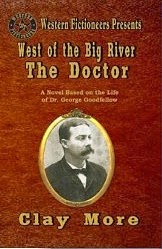
The Doctor published by Western Fictioneers in the  West of the Big River series

- my novel based on events in the life of Dr George E. Goodfellow