Thursday, October 4, 2018

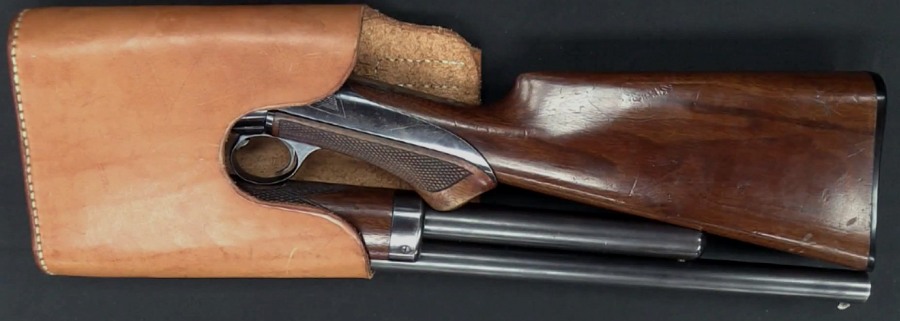
Burgess Folding Slide-Action Shotgun


Have you ever heard of a folding shotgun? I hadn’t until I was introduced to the Burgess Folding Slide-Action Shotgun, made in the 1880s.


Andrew Burgess (1837-1908) was a photographer, arms inventor and manufacturer, who apprenticed with Mathew Brady in 1855. In late 1864, he undertook an extended tour of the war-torn South following the American Civil War, photographing as he went. He is said to be the one who took the photograph of President Abraham Lincoln that is used on our currency.


Burgess received his first patent (no. 119,115) on September 19, 1871 on an improvement to the Peabody rifle. In all, Burgess registered 894 patents. In addition to manufacturing his own guns, he produced designs for Colt, Marlin, and the Whitneyville Armory. He founded the Burgess Gun Company in Buffalo, NY, in 1893, to produce his folding shotgun. In 1899, Burgess sold the company to Winchester, who promptly discontinued production of folding shotgun, reportedly to eliminate the competition.


The folding slide-action shotgun went into production in 1884. It had a 6-round maximum load in the magazine below 19-20” barrel. The shotgun has an iron sleeve over the stock wrist that activates the bolt and breech mechanism when slid backwards. It’s hinged on the underside of the receiver with a lift lever on top to release the barrel so it can be folded. A waist holster was made to go with it with loops to secure it to a belt.


These shotguns could be purchased in in Arkansas, Texas, Oklahoma and New Mexico. It was advertised as being especially adapted for police service, express messengers like Wells-Fargo agents and shotgun messengers, U.S. Marshals, prison and bank guards. Pat Garrett had one in his wagon the day he was killed.


The shotgun was also used by police and prison guards in New York. In 1895, a zealous gun showman and salesman arrived at the New York City’s Board of Police Commissioners office of Theodore Roosevelt with a Burgess folding slide-action shotgun concealed under his coat. He proceeded to pull the gun and fire six shots—blanks, thankfully--into the ceiling. An impressed Mr. Roosevelt placed an order for the guns for the guards at the Sing-Sing prison, among others.


VIDEOS AND PHOTOGRAPHS

NRA Museum:


The Burgess Folding Slide-Action Shotgun


See you next month!
Tracy

Monday, October 1, 2018

TO TRUST SPELL CHECK...OR NOT? by JERRY GUIN


I read with interest the excellent blog by Cheryl Pierson for Western Fictioneers, Sept. 18 (I'll be there for you even when I shouldn't be).

It was about the use of modern-day language and terms authors mistakenly use in their stories before the terms began being used in everyday talk.

Okay, to take this one step further, let's take specific word spelling and intended usage, for example.

The other day, I was reading a pretty good old west story. In a saloon sequence, one of the characters winced after he had taken a drink of whiskey.

Nothing unusual about that--however, that word, wince, rang a bell in my head. For some reason, I remembered that earlier that day, I had used the word in a similar setting, but spelled it differently. I was writing about a character who winced after he tasted his drink, but I had spelled it winched.

Per Webster’s, wince is to draw back or grimace as if in pain. Winch is defined as a machine for hoisting a heavy load. The two words have no similarity in meaning whatsoever.


I put my book down and immediately went to the computer and made the correction. I was relieved to know that, at least, the error was corrected before going further.

Almost everyone makes those kinds of mistakes. To the computer, both words are correct, and the spell check cannot pick up on your intended usage.

Lots of other words have plural meanings or are, at least, pesky to put into intended proper usage.

How about these: made and maid, or roam and Rome, or rhyme and rime?


Can you think of any?

I've always felt that I have a creative, open mind when writing, and try to think of the next sequence as I write. The first draft is just that. I figure to make corrections after I re-read the next day, but I have found that no matter how many times I read my own work, my mind doesn't allow me to see misused words or what would constitute a mistake. Therefore, I know that it takes an outside party to pick up on needed corrections.

I appreciate a good editor; someone, who can not only put the commas in the right place, but who is able to point out inconsistency or redundancy, and possibly advise on the story line, as well. Without a correction, at times, I could put out a story that would appear to be gibberish...and that would make me wince.


https://www.amazon.com/Livin-Jacks-Queens-Anthology-Gambling-ebook/dp/B07H38ZFJR/ref=sr_1_5?s=digital-text&ie=UTF8&qid=1537756306&sr=1-5&keywords=Jerry+Guin&dpID=51Nvl2YgF7L&preST=_SY445_QL70_&dpSrc=srch

Thursday, September 27, 2018

DOC SALISBURY, STRAW AND STEAK


The Doctor's Bag

The blog about Medicine and Surgery in the Old West 

By Keith Souter aka CLAY MORE


War is a time when medicine and surgery often advance. Physicians and surgeons are forced to find ways of treating patients in new ways, simply because of increased cases of trauma and increased incidence of disease. This month on the blog I would like to introduce you to Dr James Henry Salisbury, who I believe invented what would become an American institution - the Salisbury Steak!


First a stark fact

Over 620,000 soldiers died during the Civil War. Two thirds of that figure were not from enemy fire, but from disease. Although the diseases were broken down by type, yet the diagnoses did not have the specificity that we would expect today. This is not at all surprising, since the causes of most of the infectious diseases was not then known and diagnoses were made almost purely on clinical grounds. 

There was confusion about diseases and the statistics often refer to such diagnoses as typho-malarial disease, or diarrhoea-dysentery. The clinical pictures of diseases can be very similar, yet the causes may be completely different. Typhoid is a bacterial disease and malaria is a  protozoal infection. 

Measles

This condition is caused by a virus. Such infecting organisms were not even suspected back in the 1860s. The microscope was just coming into medical use, but it had its limitations. Only the larger infecting organisms could be seen and even then, their significance was not appreciated until the development of the science of bacteriology. 

Measles was a real problem. It is a condition a occurs in epidemics and it is not a trivial disease. It has both mortality and  complication rates that are significant. It can affect anyone who is not immunized. And of course, back in  the 1860s no one was immunized as there were no vaccines. Affected individuals feel unwell and miserable with a characteristic blotchy rash.


During the Civil War one in twenty soldiers who contracted Measles died, accounting for 11,000 deaths.   

In the 1860s it was a mystery how this condition spread. 

Dr J. H Salisbury and his Straw Hypothesis

John Henry Salisbury (1823-1905) was born in New York and graduated in medicine from Albany in 1850. He had a definite scientific  approach and was an experimenter and medical innovator. 

In July 1862 he wrote an article in the American Journal of the Medical Sciences about his observations on Measles in his practice.  He believed that Camp Measles, as the condition that affected institutions and orphanages was due to fungi that thrived on straw bedding.  It was an ingenious piece of reasoning.

To begin with he had made a study of fungi and in his article  he describes the conditions that they grow in and the odour that they emit during decay.  This he thought made them likely to be causative infecting agents. 

He began his article with a description of one case:

" ....of Newark, Ohio, came to my office on the evening of the 9th December last, and stated that he was just recovering  from what he believed to be an attack of measles. It was his opinion he had caught them from pitching straw from an old stack. "

He then goes on to describe a measles outbreak at the military Camp Sherman, Newark, Ohio. He described the tents and the bedding at the camp, which at that time had between six and seven hundred men.  The weather had been cold, wet and with sleet and snow. Bedding got wet and the straw became rank. 

" Bearing upon this may be mentioned the circumstance that in almost every instance (of the disease), where our soldiers have gone into camp; in a short time after - the disease - called camp measles, has made its appearance, without any previous exposure to the measles. It should be stated that their beds have usually been straw."

The article then goes on to describe the various types of fungi found in wheat and rye straw and their microscopic appearance, which he shows in 20 different diagrams. 


Straw inoculations

Dr Salisbury then outlines several experiments that he made. He inoculated himself twice and his wife once with spores and cells from the fungi found in straw that had started to decay. He described the symptoms they developed and his conclusion that they were like measles in miniature, albeit there was not a rash, other than slight blotchiness. Nevertheless, he felt that there was sufficient evidence for him to conclude that the fungi in decaying straw caused measles.

Next he started inoculating people who had been exposed to cases of measles in their families. He found that of the thirteen  people that he inoculated none of them  developed measles after the inoculation.  

Later, he wrote a further article after inoculating a further 27 individuals who were living on a state farm. There were four buildings, each of which was inhabited by a large, extended family. Each family had diagnosed measles cases within them. As none of the inoculated individuals developed measles he concluded that the fungi in the straw was the infecting agent and that inoculation of straw fungi protected against measles. 

Reasonable, but incorrect

We now know that measles is cased by a virus,  but Dr Salisbury's conclusions seemed reasonable. It was not until 1954 that the measles virus was isolated. 

The four principles of bacteriology are known as Koch's postulates. Had Dr Salisbury known about them he would have found that the straw hypothesis would collapse. 


Koch's postulates

These are 4 criteria that must be met to demonstrate a cause and effect between an organism and a disease:


1. The organism must always be present, in every case of the disease.

2. The organism must be isolated from a host containing the disease and grown in pure culture.

3. Samples of the organism taken from pure culture must cause the same disease when inoculated into a healthy, susceptible animal in the laboratory.

4. The organism must be isolated from the inoculated animal and must be identified as the same original organism first isolated from the originally diseased host


Salisbury Steak

During the Civil War Dr Salisbury became convinced that diarrhoea and dysentery could be cured by diet, specifically coffee and chopped beefsteak.

He continued his observations after the war and became convinced that poor diet was the cause of many diseases and that carbohydrates, vegetables and starches should be restricted  within a diet. He became convinced that chopped beef would prevent many diseases, all of which he wrote about in his 1888 book The Relation of Alimentation and Disease.


He invented the Salisbury Steak in 1897, which he believed could prevent disease. This consisted of finely minced beef, flavoured with onion and formed to look like a steak. This was usually taken with brown sauce or gravy. I am sure that many of you will be familiar with the food item.


Salisbury Steak


Dr Salisbury was, essentially, an advocate of the high protein and low carbohydrate diet, for general health and for weight loss. He was one of the first diet and health gurus.

***


If you are interested in reading more about medicine and surgery in the frontier days, including the work of Doctor George Goodfellow, then you may find The Doctor's bag useful. It is a collection of my past blog posts, published by Sundown Press.


The novel about Dr George Goodfellow, the Tombstone surgeon to the gunfighters


The novel about Ned Buntline, the King of the Dime Novelists


Tuesday, September 25, 2018

THE TALE OF CRIPPLE CREEK #WesternFictioneers #MiningHistory


Deserted Building between Cripple Creek & Victor, CO
(Photo property of  Doris McCraw)
I was asked to share some history of Cripple Creek, a mining town in the Colorado Rockies. Of course you can't share Cripple Creek's history without including the whole mining district, which sits in an extinct volcano caldera. So here we go.

It was during a time of volcanic eruptions some thirty-five million years ago, that lava flowed through what became the Cripple Creek Mining District. However for some unknown reason the flow did not bring gold to the surface. Richard M. Pearl, PhD, a geology professor at Colorado College, believed that when convulsions in the earth’s crust caused cracks in the underground granite to appear the gold salts were deposited into the cracks and seams of that granite. Those ores that were created by the various eruptions of the volcanic activity in the region were almost exclusively gold ores. There was some small amount of silver associated with the gold, but usually in negligible quantities.

Between 1842 and 1844 Capt. John C. Fremont explored the region and his travels around Pikes Peak took him into the Cripple Creek area. During the Hayden survey of 1870’s there was some gold specimens found by H.T. Wood, a member of that survey. In 1874, Wood returned to the Cripple Creek district with other prospectors set about trying to find the source of the gold he's intially found. Wood organized the district under the name of Mt. Pisgah. The hope was they could find the source of the gold 'float'. Despite their efforts, no one was successful in finding the source.

In 1871 the Welty family moved into the region. Welty and his sons built a cabin and corral near to the stream that flows through the Cripple Creek area. They were followed by the Womack family who purchased the Welty squatter rights for $500 and claimed a second homestead two miles south of the Cripple Creek stream with Robert (Bob) building a cabin at the bottom of a ravine the Hayden Survey had named Poverty Gulch.

High Mountain Ranching
 (photo property of Doris McCraw)
Other families moved into the region but by the mid 1880's most of the settlers had left and/or returned to places they had on the plains east of Colorado Springs, which had become active in the cattle and sheep industry. The homesteads were purchased by the Pikes Peak Land and Cattle Company, a partnership composed of three local residents and Phillip Elsworth, an eastern glove manufacturer. When Elsworth visited the area in 1885 he felt his partners had misrepresented the companies holdings. He forced them to quit claim their shares and he put the land up for sale. It was purchased by the Denver real estate firm of Horace W. Bennett & Julius A. Myers for $5,000 down and $20,000 if and when it could be paid.

That same year, 1885, Myers & Bennett created the Houseman Cattle and Land Company and renamed the area the Broken Box Ranch. George Carr was hired as foreman and within two years a profitable ranching operation was in place. Bob Womack, however remained on the piece of the Womack homestead in Poverty Gulch.

Of all the towns affected by the Cripple Creek volcano perhaps the most impacted were Cripple Creek and Victor. Although at the height of the mining boom, around 1900, there were approximately 10 additional towns. Cripple Creek became the financial center and Victor the mining area.

The land that Bennett and Myers platted out, from their Broken Box Ranch site, after gold was found again, was originally planned to sell for $25 and $50 for corner lots. By 1891 when the boom hit, those $25 lots were selling for $250. Buildings were put up very quickly, using wood, with wood pulp or newsprint for insulation. Some of the poorer buildings had rugs or tent canvas for insulation. This set the stage for the devastation that was to come. As Dr. Lester Williams said in his book Cripple Creek Conflagrations “Neither time nor money had been wasted on a mere town, or living accommodations, there wasn't much emphasis on safety from fire, and the end result was that Cripple Creek was ripe to burn...”

And burn it did. By April of 1896 when the first fire hit, the area was so crowded that to get a room meant you had to hustle to find a place to stay. The streets were crowed with all manner of people from all walks of life. The hotels were unable to accommodate the influx, so travelers were having to resort to lodging houses, which were being built at an average of a dozen or so a week. The first fire started on April 25, 1896 and by nightfall approximately fifteen acres had burned. On April 29, 1896 the second fire broke out and burned all but a small portion of the western part of the town. The damage from both fires was approximately $2,000,000 in 1896 dollars.

Despite the set-back of the fires caused, Cripple Creek rebuilt, this time with brick. The 'new and imporoved' Cripple Creek remained the commercial center of the district. Of the rebuilding, the city now had buildings that were valued at “three-quarters of a million,” and were considered to be a “glorious monument to the energy and enterprise” of the residents. The city was proud of the fact that it was a 'law-abiding' camp. The camp had schools, churches plus the 'tenderloin' district. If one saw 'six-shooters' it was more as a precaution as opposed to necessity.

After 1900 Cripple Creek began a slow decline and by 1960 the population had dropped considerably. 

Today Cripple Creek has seen a small boon with the coming of limited stakes gambling. Traveling into the area, one will see the casino's but there is also the history of the region and the remembrance of “The World's Greatest Gold Camp”.

A brief note on Victor, Coloradom the second important town in the district.

View from Victor,CO.
(photo property of Doris McCraw)
According to one publication “The town [of Victor] is beautifully located, and in the summer of 1893, when the natural scenery was yet undisturbed and the sweet perfumery of wild flowers was the only outgoing freight, one would have seemed much at fault in judgment had he predicted that $5,000,000 in gold would have been transported thence in 1895.”

Victor from the beginning has been known as the ‘city of mines’. In fact it had a gold mine right in the middle of town. The Woods brothers, who founded the town, were in the process of building a “first class hotel” when gold was found as they were digging the foundation. Instead of a hotel, the Gold Coin mine came into existence. As a mine in the middle of town, the building was built of brick and even had a stained glass window at the entrance. As much as possible the mine looked as if it belonged in the city.

Remnants of the Gold Coin Mine entrance
(Photo property of Doris McCraw)
Most of the major producing mines were located near Victor and during the town’s heyday of activity Victor Avenue was one of the best known streets in the world. By 1896 just three years after being founded the city was the second largest in the region and had light, water, telegraph and telephone service the same as Cripple Creek.

Due to the vicinity of the mines, a large portion of the population Victor and nearby towns, was composed of miners. The nearby town of Goldfield was considered the 'family' town, but Victor was a mining and milling center. In the early days men were known to pay one dollar to sleep on a pool table and stand in line to eat. The growth was explosive. By 1896, three years after its founding, Victor’s population had grown to approximately 8,000 people. Like Cripple Creek, the growth had been so fast the structures were mostly of wood. In 1899 Victor was hit with its own destructive fire. The devastation covered twelve blocks of the business district, composed of some 200 buildings including the original Gold Coin Mine building. It was estimated that 3,000 were left homeless. The fire burned for approximately three and a half hours. Total estimated cost of the fire in 1899 funds was $2,000,000. After the fire, in fact beginning the very next day, Victor set about to rebuild. The debris was cleared and tents and makeshift temporary buildings were erected. Saloons and restaurants were almost immediately back in business. By noon the post office was up and running

Victor had become so well known that after the fire the “Colorado Road” arranged an excursion train to view the 'effect of the great fire' for $4.50. The trip would begin in Denver and travel to Cripple Creek and Victor on August 26 and return on August 27.

So there you have it, a very brief history of Cripple Creek and Victor. Also of note, there is still an active gold mine in the region, although it is an open pit mine.
Battle Mountiain Mines, Victor, CO (USGS photo)
I shall leave you with the following quotes about mining and prospectors:

Geologically Cripple Creek is a freak. It is erratic, eccentric, and full of whims and caprices. That is, it is so to the man of science and the miner of experience.”

...geology, so far as the location of ore deposits was concerned, was an unknown quantity. The prospector was the sole mine seeker....He was the lone wolf of mining for he usually went on his own. He wanted no prying eyes to behold the long elusive pot of gold at the end of his rainbow...”

Bibliography: 

Geochronology of the central Colorado Volcanic field, Wm. C. McIntosh, Charles E Chapin, New Mexico Bureau of Geology & Mineral Resources, Bulletin 160, 2004
Gazette Telegraph May 20, 1973
Cripple Creek and Colorado Springs...Illustrated, Henry L Warren & Robert Stride, authors and publishers, 1896 
Cripple Creek Mining District, Robert Guilford Taylor, Filter Press, Palmer Lake, CO 1973 
Cripple Creek, A Quick History, Leland Feitz, Little London Press, Colo.Spgs. CO 1967 Cripple Creek Conflagrations, Lester L. Williams MD, Filter Press, Palmer Lake, Co 1994 
Cripple Creek Guide, April 25, 1896 
History of Cripple Creek, America's Most Famous Gold Camp, The Quarterly Sentinel Vol I, Denver, Co, Feb 1896, WC Calhoun, Publisher 
A Quick History of Victor, Leland Feitz, 1969 Little London Press, Colo.Spgs, CO
The Denver Evening Post, August 25, 1899 
The Daily Mining Record, February 23, 1894

(c) Doris McCraw

Doris Gardner-McCraw -
Author, Speaker, Historian-specializing in
Colorado and Women's History
Member of National League of American Pen Women,
Women Writing the West,
Pikes Peak Posse of the Westerners
Western Fictioneers

Angela Raines - author: Where Love & History Meet
For a list of Angela Raines Books: Here 
Photo and Poem: Click Here 
Angela Raines FaceBook: Click Here


Sunday, September 23, 2018

WESTERN FICTIONEERS CONVENTION HIGHLIGHTS By Vonn McKee


If there was ever a time when I was especially proud to a member of Western Fictioneers, it was the weekend of our convention in Oklahoma City. Old friends did some catching up, and new friends were made. I lost count of the states represented. (Idaho, New Hampshire, Massachusetts, Nebraska, Colorado, California, Texas, Arkansas, Tennessee, Alabama, South Carolina, New Mexico, etc.) The discussions were intimate and open, and the session topics were deeply informative, thanks to our many knowledgeable presenters.
'EARLY ARRIVERS' DINNER
JES HAYS,
JIM GRIFFIN
(Photo, Jacquie Rogers)
Some of us thought we knew a thing or two about horses until Jim Griffin shared so many tidbits from his store of obscure equine trivia that we could barely write it all down. James Reasoner and Bob Vardeman (300+ novels each!) told us a thing or two about writing habits, serial novel continuity, and offered up anecdotes from their illustrious careers.

Speaking of continuity, our guest Diane Garland explained how her “Worldkeeper” business helps authors keep track of everything from character names and traits, timelines, names of supporting characters/walk-ons/towns/pets . . . well, you get the idea.

EDWARD MASSEY
(Photo, JES Hayes)
Edward Massey did a fine job of outlining the factors that influenced the West, including economics, modes of transportation, and developments in communication. (This discussion could have easily gone another hour!) The “Weird Westerns” panel featured James Reasoner, Jacquie Rogers, Caroline Clemmons, and Bob Vardeman.

W. MICHAEL MILOM
Michael Milom reprised his session on “Legal Labyrinths,” giving us updates on the latest changes to the copyright law and answering a wide range of questions from the group. JES Hays led an excellent panel on “Social Media,” while we heard about lady lawyers and doctors from Ron Schwab and Doris McCraw. (Forget everything you learned from “Doctor Quinn, Medicine Woman!”)
JAMES REASONER, DIANE GARLAND,
BOB VARDEMAN
(Photo, JES Hayes)
Vicky Rose and yours truly talked about some miscellaneous ways authors can market themselves and unearth non-traditional writing jobs.

The highlight of the convention was our group tour of the National Cowboy and Western Heritage Museum. Of course, the galleries were phenomenal (entire rooms devoted to works by Charles Russell and Frederic Remington). A favorite was the collection of western-related entertainment memorabilia, much of which was donated by Tom Selleck and the John Wayne family. Our docent shared a wealth of beyond-the-brochure information.
"END OF THE TRAIL"
(1918)
JAMES EARLE FRASER
 NATIONAL COWBOY & WESTERN HERITAGE MUSEUM
(Photo, Museum Archives)


JOHN WAYNE'S
"McCLINTOCK" COSTUME
Dinners were themed “Mining for Story Gold” (edible gold nuggets on every table!) and “Don’t Forget to Have Fun.” Who could resist party favors like fake mustaches and plastic cowboys and Indians?

At the close of Saturday’s dinner, Big Jim Williams announced the Peacemaker Award winners and finalists and recounted some fabulous stories from his early days in radio. We passed Dusty Richards’s big black hat around the room, filling it with donations for our hard-working banquet staff. (What began as a spontaneous act during our first convention has now become a tradition!)

Cowboy Church ran longer than expected, due to a lively discussion on the history of hymns. Guest Jim Crownover worked in some facts about circuit preachers and worship traditions of the West before reading from the book of Matthew.

Thanks to all who came from far and near to make our gathering a success.


All the best,


Vonn McKee

“Writing the Range”
2015 Western Fictioneers Peacemaker Finalist (Short Fiction)
2015 Western Writers of America Spur Finalist (Short Fiction)


vonnmckee.com
Like Vonn on Facebook!


Have you read "AN ASTONISHING HOST OF CURIOSITIES?
"Fast moving and entertaining..."
"Twists and turns galore." 
AVAILABLE HERE

Tuesday, September 18, 2018

I'LL BE THERE FOR YOU EVEN WHEN I SHOULDN'T BE...BY CHERYL PIERSON


Anyone here a Bon Jovi fan? I AM! LOL I love his song “I’ll Be There for You”—I’ll try to include a link here before the end of the post. This is one saying that I see a LOT when I’m editing. What’s wrong with that, you ask? Well, I edit a LOT of historical fiction. I don’t remember ever hearing it “back in the dark ages” of the 1950’s and 1960’s…so I guess maybe the 70’s was when it got to be popular. The 1970’s, not the 1870’s, y’all. I don’t believe a knight would tell his lady he’d “be there” for her…at least not for another 500-800 years, or somewhere around that, anyhow.

Here’s another one that’s jarring to me—the use of “morph” for “change”—it reminds me of those wonderful days when my son Casey was a young boy and so, so crazy about the Power Rangers. Anyone remember them? They were popular in the 1990’s. Five teenagers—two girls and three boys— (later changed to a total of six) who had the power to change from mere teens to THE POWER RANGERS! How did they accomplish this? They gave each other meaningful looks and said, “It’s morphin’ time!” And with some fancy camera work, there they were, in their Power Ranger color-coded uniforms. All…morphed…

How about the response to “Thank you.”? Truly…can you picture a knight responding with “No problem.”? No…me either. Yet, sometimes that’s the response that crops up in historical manuscripts. It doesn’t matter how politely one responds, the response has not been invented or introduced into thought or speech patterns of that time.

Another simple one that turns up a lot in response to “How are you?” is … “I’m good.” When did this phrase come into existence? I don’t ever remember this being said until only in the last couple of decades. When talking about someone else—“He’s good to go.” No…you might hear that on Blue Bloods or Law and Order, but not so much in 1860’s Indian Territory.
"Marshal Tilghman, how are you today?" "I'm good."


Here are a couple of words that tend to creep in a lot—and shouldn’t—flashback and replay. Remember what these words are really saying, what they convey to people of this day and age who are reading the stories we’re writing. A medieval knight or a drifting cowboy will have no idea what “replaying something in his mind” even means—or that he’s having a “flashback” to when he was fighting at the battle of Honey Springs. Or that he’s “flashing back” to something that might have been a sweet memory in his early years. These characters are going to just be remembering, recalling, or thinking back to something… When you use this type of modern wording that refer to contemporary actions/equipment, it’s easy to pull readers out of the story. Because my husband is such a sports fan, I can’t hear or read the word “replay” without thinking of the sports connotation it carries. Flashback—this conjures up images of Hollywood movie scenes.
Let's see the replay on that!

“Well, it’s all about you, isn’t it?” This is one that creeps in every so often, too. It “being all about” one person or another—or NOT “being all about” them is something that should never, ever, ever show up in any kind of historical writing. It’s easy to do—these contemporary sayings are so normal to us we can’t imagine NOT using them in daily conversation—problem is, it’s our job to check and double check what our characters are saying. If we don’t, they go out into the world showing that we have not “brought them up” correctly.

That reminds me—do you know the difference between being “reared” and “raised”? The standard saying used to be that “Children are reared; livestock is raised.” Those lines have blurred in modern times. I still remember my mother talking about children being “reared” and her brother “raising” cattle. She was born in 1922, so I would say that distinction has faded only during my lifetime.
RAISED

This is “picky” but it’s the sort of thing that readers will seize on—and there are certain word usages and phrases that will definitely pull me right out of a story that’s written in historical times, so I’m sure that’s true of others, as well.
These are a few of the many “uh-ohs” I see when I’m reading/editing. What are some you’ve come across?

If you are a FRIENDS tv show fan, you know that there is another “I’ll Be There for You” – the theme of the show by the Rembrandts. There’s also a Kenny Rogers song that uses that phrase. But I promised you Bon Jovi! Here he is singing “I’ll Be There for You”—a wonderful song to turn up loud and belt out when you’re driving…just remember, in historical fiction writing, we have to find another way to say this. Kinda makes me sad, but we have to wait for it to be invented.
Sorry about the GRAMMARLY ad--it's short--wait for it--I'LL BE THERE FOR YOU is worth it!