Showing posts with label weapons. Show all posts

Thursday, December 6, 2018

Loading a Cap and Ball Revolver


Cap and ball weapons were all “the thing” during the Civil War and later—right up until Smith & Wesson’s patent ran out on the bored-through cylinder and Samuel Colt could get in the self-contained cartridge game. Numerous models of cap and ball revolvers were produced until 1873.

If your character is using a cap and ball weapon, there are limitations. For instance, a muzzle-loaded long gun gives you one shot; a cap and ball revolver with six shots is just that—six shots. And  it can’t be reloaded quickly. Your characters won’t be reloading it while running from the bad guys or riding to the rescue. Keep reading and you’ll understand why.

Unlike a modern cartridge, where the bullet, powder and primer are enclosed in a brass case, reloading a cap and ball revolver takes 6 steps for each chamber. That’s six steps times six chambers to fully reload a revolver.

I took most of these pictures of my friend and fellow cowboy action shooter, “Major Misalot”, reloading his cap and ball revolver cylinder. The reloading can be done while the cylinder is in place on the revolver, too.

The loading is done in reverse order of the firing process, from the barrel side of the cylinder:

1. Add powder


In this picture of “Major Misalot”, he used a reloading “station”. Another cowboy friend “Noz” used a powder flask to measure the powder for each cylinder.

2. Place a lead ball on the powder in each cylinder


3. Ram the ball home, all the way down into the chamber. 


“Major Misalot” is using his modern reloader, but this can be done using the ramming rod on the revolver, as in the next picture. The rod is firmly pressed into the chamber then the cylinder is rotated until all six lead balls have been rammed pushed into place.


4. Grease the cylinder to prohibit chain firing – where the burning powder from one shot ignites the others in the cylinder. Obviously not a good thing!


5. Cap the nipple (think blasting cap here)


Another method to “cap” the chamber is to use a capper, a spring-loaded brass disc that presents the cap. Above, “Major Misalot” hand capped his. “Noz” uses a capper. He pressed a cap into position six times then went back over all six chambers to be sure the caps seated properly.

NOW its finally ready to fire.

With practice, it doesn’t take all that long to reload the six chambers in a cylinder, but you really can’t pour powder, ram a ball, cap the nipple and grease the chamber at a gallop. I can certainly see why many who relied on a cap and ball revolver carried fully loaded spare cylinders.

And, just to remind you why someone shooting black powder can’t hide…


Tracy Garrett

Thursday, October 4, 2018

Burgess Folding Slide-Action Shotgun


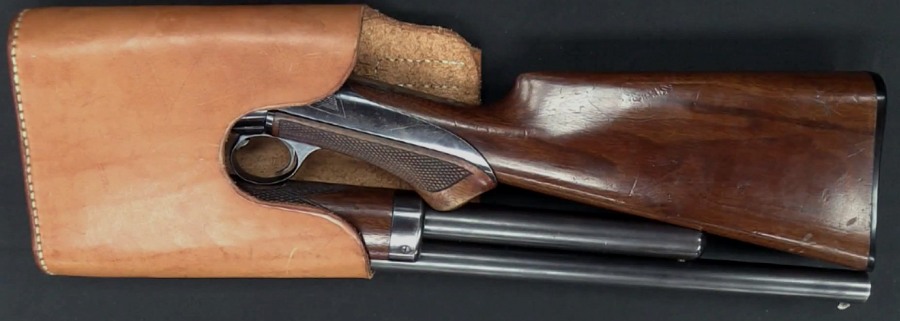
Have you ever heard of a folding shotgun? I hadn’t until I was introduced to the Burgess Folding Slide-Action Shotgun, made in the 1880s.


Andrew Burgess (1837-1908) was a photographer, arms inventor and manufacturer, who apprenticed with Mathew Brady in 1855. In late 1864, he undertook an extended tour of the war-torn South following the American Civil War, photographing as he went. He is said to be the one who took the photograph of President Abraham Lincoln that is used on our currency.


Burgess received his first patent (no. 119,115) on September 19, 1871 on an improvement to the Peabody rifle. In all, Burgess registered 894 patents. In addition to manufacturing his own guns, he produced designs for Colt, Marlin, and the Whitneyville Armory. He founded the Burgess Gun Company in Buffalo, NY, in 1893, to produce his folding shotgun. In 1899, Burgess sold the company to Winchester, who promptly discontinued production of folding shotgun, reportedly to eliminate the competition.


The folding slide-action shotgun went into production in 1884. It had a 6-round maximum load in the magazine below 19-20” barrel. The shotgun has an iron sleeve over the stock wrist that activates the bolt and breech mechanism when slid backwards. It’s hinged on the underside of the receiver with a lift lever on top to release the barrel so it can be folded. A waist holster was made to go with it with loops to secure it to a belt.


These shotguns could be purchased in in Arkansas, Texas, Oklahoma and New Mexico. It was advertised as being especially adapted for police service, express messengers like Wells-Fargo agents and shotgun messengers, U.S. Marshals, prison and bank guards. Pat Garrett had one in his wagon the day he was killed.


The shotgun was also used by police and prison guards in New York. In 1895, a zealous gun showman and salesman arrived at the New York City’s Board of Police Commissioners office of Theodore Roosevelt with a Burgess folding slide-action shotgun concealed under his coat. He proceeded to pull the gun and fire six shots—blanks, thankfully--into the ceiling. An impressed Mr. Roosevelt placed an order for the guns for the guards at the Sing-Sing prison, among others.


VIDEOS AND PHOTOGRAPHS

NRA Museum:


The Burgess Folding Slide-Action Shotgun


See you next month!
Tracy

Friday, January 25, 2013

RESEARCHING THE WEST by MEG MIMS


I love research. Always have, always will... and I soak up lush, wonderful details in the westerns I've read. Most of them since DOUBLE CROSSING, my western mystery set in 1869, was published -- but I cut my teeth on television and movie westerns since early childhood.
Did I rely on all that when I started writing my book? Heck, no! I knew costumes, sets and such generated in Hollywood were far from accurate. I spent months delving into fashion changes from hoops to bustles, what a Bowie knife looked like, Colt revolvers, train schedules and routes, what a UP Pullman Palace car looked like versus the CP Silver Palace car, Texan cowboys, etc. etc.
I knew better than to rely on western TV and movies, where the soiled doves wore glittering gowns worthy of a Ziegfeld Follies girl. Other big problems are the cliches stemming from dime novels of the 1800s, still popping up in current western novels. Lawmen tracking murderers who kill without reason. Helpless women who sat around waiting for their man to rescue them.
Pioneer women that I've researched knew how to handle weapons and protect themselves, how to survive snakebites and nurse sicknesses or wounds, and many adapted after being kidnapped by Indians. I rather doubt they lounged around in the stable (after pitching some clean hay) with their bosom exposed like Jane Russell.
Okay, maybe that is an extreme example. But take for example the Stetson hat.
Some writers have their heroes wearing these famous hats as far back as the 1850's. Check out this link for a fascinating history on how John B. Stetson got started making the trademark hats in 1865. Yep. AFTER the Civil War. Or weapons -- here's a link to a great website on military sabres, rifles, revolvers, etc. manufactured during the 1800s. And here's another link, similar to it. With dates of when those weapons were in use.
Trains are another big pitfall for writers. I've read some books where characters found their way west on the railroad before the Civil War or immediately after it ended. The first railroad crossed the vast expanse of the American west in May of 1869, when the Union and Central Pacific lines joined together at Promontory, Utah. For the first time, travelers could ride from New York to Chicago to Omaha and then to Sacramento -- not San Francisco. That took another few years. Other rail lines to Kansas and Arizona and Montana were completed by the mid 1870s or late 1880s.
I've read and seen a wide range of stories with either the total absence of native Americans or a bloodthirsty savageness of tribes (and not always the right ones in the right spots!) set on revenge. Savagery happened on both sides. The main point is to avoid "stereotypes" --  characters need reasons for the choices they make in our stories. Readers might forgive a modern word or phrase in dialogue, but when such things add up, they're "thrown out" of the story and may give up reading the rest of the book.
I love a good, juicy western where I can walk the dusty streets or ride the prairie on horseback, smell the goods on display in a general store, taste the grit in the air or touch the sweat-soaked shirt of the hero. Go beyond the visual. Make sure your characters have a goal and a motive in mind. And for your reader's sake, do the research.
They'll thank you with great reviews and word-of-mouth sales in your future career.
Meg Mims is an award-winning author and artist. She writes blended genres – historical, western, adventure, romance, suspense and mystery. Her first book, Double Crossing, won the 2012 Spur Award for Best First Novel from Western Writers of America and was named a Finalist in the Best Books of 2012 from USA Book News for Fiction: Western.

She is currently working on the sequel, Double or Nothing, which will be released this year. Interested in a sneak peek? Check out Meg's blog for The Next  Big Thing!