Showing posts with label Bounty Hunters. Show all posts

Saturday, December 1, 2018

GUNSLINGER 6: Author J. L. GUIN


By Tom Rizzo


Bounty Poachers, the latest novel by J.L. (Jerry) Guin, represents the third of a four-book series featuring Deputy U.S. Marshal James P. Stone. (Pushed Too Far, Book 1, & Lawman’s Gun (Book 2).
This time, Stone picks up the trail of two brothers who hunt men for bounty. Once, hard-working farmers, the two siblings turn bounty hunters as a way to survive. 

But success heightens their hunger for bigger paydays and one of the brothers comes up with a unique idea: killing other bounty hunters and poaching their captives. 


- GUNSLINGER 6 -


1.   The name of your latest novel is BOUNTY POACHERS. Tell me a little about the title and how you came by it.

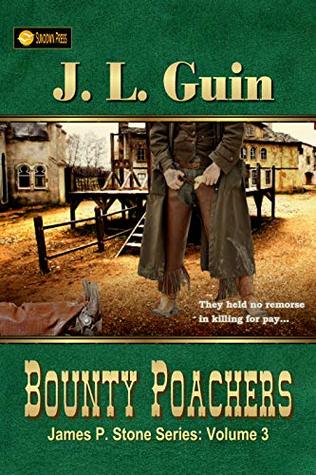


Actually, the title came about after I had written the third chapter. I felt Bounty Poachers was a perfect title because of how the story was developing.


2.   What served as the inspiration for the story? What triggered the idea for the novel or the characters?

Lots of authors write about Old West bounty hunters. I wanted something a little different. The brothers, Jasper and Jason, are two young men, who lived and witnessed their parent's failure to scratch out a living on a Nebraska homestead. 

With both parents passing, Jasper became hardened by the hand that was dealt them. He saw life as it was on the frontier, tough and demanding. Jason, being of a softer nature was used to doing as he was told by his parents. Afterward, he just went along with whatever his older brother proposed.   


3.   Antagonists play a vital role in storytelling. Yours happens to be two brothers, broke and desperate. But are they motivated by something other than mere survival? What are their good qualities?

If not for circumstance, the brothers most likely would have lived as farmers their entire life. Jasper took the temperament of his father, lashing out when things didn't suit him. 

Jason took on the qualities of his mother, quiet, reserved and agreeable. It was Jasper who came up with the idea of hunting men for bounty. He hated groveling for a mundane job for little pay. 

Later, the idea of killing a bounty hunter and poaching his captive was his too. He had no plans to return to farm life. Bringing in wanted men were paying off.


4.   Deputy US Marshal James Stone is the main character—someone you’ve written about in two other novels. Who is Stone? Why should a reader care about him?

James Stone was introduced in PUSHED TOO FAR (first in the series) He and his freighting partner were accosted and robbed in their nighttime camp in the territory. 

During the robbery, Eldon Greyson, Stone's mentor, neighbor, and partner was killed. Stone heard one of the robbers call out the name of “Laird” just before he was knocked out. After walking to safety, Stone dedicated himself to finding and killing Laird.


While chasing after a train robber, his travels take him to Eaton, Kansas where he becomes a deputy sheriff then meets Deputy Marshal Jackson Millet. 

Millet invites him to become a deputy U. S. Marshal. In Book two–LAWMAN GUN—Stone becomes a U.S. Deputy Marshal, with the idea that the position would allow him to continue his search for Laird.


5.   What was your hardest scene to write?

Coming up with a suitable ending to the book. Stone still hadn't located Laird so in order to do so required another volume to be written. Book four DUE JUSTICE will be out soon. I'd like to note that the fine folks, Cheryl and Livia over at Sundown Press have been just great in publishing this series.


6.   What is the first story you ever published and how do you think of it now?

In 1995, Douglas Sharp asked for submissions to his little magazine called Western Digest up in Calgary. I sent in my story “Caught Red Handed.” It wasn't a very good story but it was my first and I was ecstatic when Douglas sent me a check for $15.00.
I went on to write 6 more stories for Western Digest. It has been a fun ride since then and I am still learning. 


- 0 - 

Jerry and his wife Ginny live in northern California. A prolific writer, he has authored over 40 short stories and 15 novels. 

- 0 -


614-607-0949


Thursday, March 31, 2016

#HoneyBeaulieu: HOT WORK IN FRY PAN GULCH by @JacquieRogers #western


Every once in a while you have to take a risk--it's good for your heart.  Or maybe bad.  But you've just gotta do it.  One of those risks for an author is to write a series that doesn't fit neatly into a genre.  Or any three genres.  That's Honey Beaulieu.  I couldn't be happier that her story will finally be told. She's been waiting in the wings for over eighteen years—and not all that patiently, I might add.

Her wait is the story of my writing career, almost. I began writing in 1996 when I dreamed a story. That manuscript wasn't completed until two years later. About three chapters from the end, characters and situations for other books began swirling in my head, which sure didn't help to get that first one finished.

One of my critique partners told me to type them up and put them in an Ideas folder, then finish
the book, which I did. I think of that folder as my own private treasure chest. Many of those ideas developed into books--all the Hearts of Owyhee books came from that, as did Sleight of Heart.

But one of the ideas--my favorite--I knew I'd never write because the large publishers (the only option then) would never in a million years buy a non-traditional Western with a female protagonist that didn't have enough romance to be a Romance, didn't have enough paranormal to be a Paranormal, or enough mystery to be a Mystery, and at that time, there weren't any female
action/adventure protagonists that I knew of.

So this idea stayed in my treasure chest, but every once in a while Honey pounded on the lid. I never forgot her, but writing a book takes a very long time and a lot of commitment of resources, so writing an unmarketable book wasn't in the cards.

Then, last year, my critique partner and I were discussing where I should go with my next series. For some reason, Honey banged on the lid of the treasure chest again. Only I have to admit, her name was originally Pansy. She always did hate her name, which is why I changed it in the first reference to her in Much Ado About Marshals (first published in 2011), and she hasn't complained since.

So for the first time since 1998, I opened the file and sent it to my friend. She loved Honey right off the bat, almost as much as I did. She pointed out that these days we don't have to write to someone else's specifications--I can write anything I want! Furthermore, she convinced me that my readers would love it.

I was excited so didn't tell her my misgivings--at least, not many of them. But I worried that my readers wouldn't go for the grittiness or the more bawdy tone. Even so, once I got all the books that I'd committed to writing off my plate, Honey took stage, front and center. She's not wanting to move off, either.

In my initial concept back in 1998, Honey and her two sisters were all pistoleers. Over time, she brought me around to her way of thinking--this series was hers and no one else's. Her sisters' personalities haven't changed but they aren't pistoleers, and the series is definitely all Honey's.

So please enjoy the ride along with Honey Beaulieu. She's quite a gal.  She even has her own blog!

Keep up with Jacquie Rogers' latest news at the
Pickle Barrel Gazette!


Tuesday, February 18, 2014

TIN STAR: The Men Behind the Badge by Tom Rizzo


The sheriff sat at his desk fiddling with a tin can, cutting, and bending the metal to create a temporary badge that would identify him as the law. 


Since the county never needed a sheriff before, it had no badge to provide the man citizens just elected.

The new sheriff began having second thoughts about the extent of his new duties and responsibilities. Enforcing the law was only part of the job. He also served as jailer and tax collector, and served warrants, subpoenas, and jury summons. 

For the most part, the small and isolated early settlements across the frontier did a good job of self-policing. The majority of those looking to establish a new life and career in the West were  honest and law-abiding. Most were friendly, hard-working, and trusting--willing to give someone the benefit of the doubt.


Frontier families rarely secured their homes or businesses with locks. Businesses granted credit without seeking collateral.


Western communities took their time establishing a law enforcement arm, but with good reason. Many settlers who founded the towns were immigrants who previously encountered police abuse and harassment. They harbored a natural distrust for the law.


These citizens became the enforcers and often formed vigilante committees.

The need emerged for a formal entity to deal with issues of crime at the local level.

The men who wore the badges had to be diligent when it came to enforcing the law. Any communication about crimes and criminals was almost non-existent. The telegraph helped, but not every community had the service.


The U. S. mail provided lawmen with descriptions of criminals, their names and last known locations. 


Word-of-mouth helped, as did a crude likeness on a wanted poster. But, information traveled at a snail's pace. and often was unreliable and outdated by the time it got delivered.

The most effective kind of sheriff took a proactive role in the enforcement of frontier justice. A good lawman monitored the arrival of strangers in their towns. He kept tabs on who they were, where they were staying, and why they were visiting.

Sometimes, of course, the town’s sheriffs just happened to be criminals themselves. Some changed, went straight, and did their best to uphold the law, and were good at their jobs. Others used their position for financial and political gain, and influence.

It's no wonder some lawmen crossed to the dark side. The post of sheriff, although high in responsibility and visibility, proved a low-paying job.


As a general rule, some counties provided an annual salary of around $200, plus a percentage of any fees they collected. 


The fee system differed from territory-to-territory but, on average, generally reflected this schedule: 

Serving a warrant: $1
Summoning a juror: $.50
Summoning the grand jury: $5
Summoning witnesses: $.50
Attending court: $1.50
Calling each witness in court: $.05
Committing prisoners to jail: $1
Daily support of prisoners: $.25
Executing a death warrant: $15
Travel allowance: $.05 a mile 
Reasonable expenses for other services not specified. 

Sheriffs also functioned as the ex-officio tax assessor and collector. The many duties, low pay, and the risks involved often prompted good men to turn bad for the opportunity of more lucrative paydays.


The types of crimes lawmen dealt with were too widespread for just one person. 


The situation provided the perfect opportunity for the advent of bounty hunters. These individuals were in the hunt for the pay-off of reward money.

Enterprising individuals created profit-minded private companies to help fill the gap, too. The most well-known was Pinkerton National Detective Agency.

Little glamor was associated with role of sheriff.

In reality, they spent much of their time serving subpoenas, and issuing summons. Lawmen were also responsible for seizing property as directed by civil rulings. And, they often had to issue summons for a coroner’s jury. And, in some instances, they faced life-and-death situations.

Much of their daily work was mundane. As lawmen became more visible, daily life for the town's citizens improved for the better. Citizens began to recognize the need for a legitimate, organized enforcement process, leading to a more peaceful way of life.

#  #  #