Showing posts with label Kansas. Show all posts

Saturday, December 1, 2018

GUNSLINGER 6: Author J. L. GUIN


By Tom Rizzo


Bounty Poachers, the latest novel by J.L. (Jerry) Guin, represents the third of a four-book series featuring Deputy U.S. Marshal James P. Stone. (Pushed Too Far, Book 1, & Lawman’s Gun (Book 2).
This time, Stone picks up the trail of two brothers who hunt men for bounty. Once, hard-working farmers, the two siblings turn bounty hunters as a way to survive. 

But success heightens their hunger for bigger paydays and one of the brothers comes up with a unique idea: killing other bounty hunters and poaching their captives. 


- GUNSLINGER 6 -


1.   The name of your latest novel is BOUNTY POACHERS. Tell me a little about the title and how you came by it.

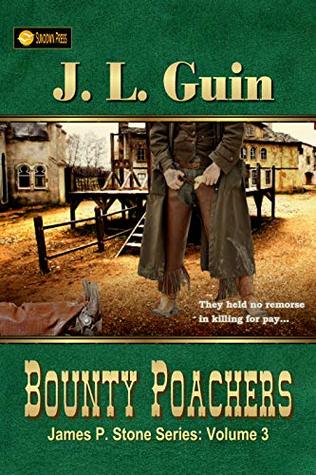


Actually, the title came about after I had written the third chapter. I felt Bounty Poachers was a perfect title because of how the story was developing.


2.   What served as the inspiration for the story? What triggered the idea for the novel or the characters?

Lots of authors write about Old West bounty hunters. I wanted something a little different. The brothers, Jasper and Jason, are two young men, who lived and witnessed their parent's failure to scratch out a living on a Nebraska homestead. 

With both parents passing, Jasper became hardened by the hand that was dealt them. He saw life as it was on the frontier, tough and demanding. Jason, being of a softer nature was used to doing as he was told by his parents. Afterward, he just went along with whatever his older brother proposed.   


3.   Antagonists play a vital role in storytelling. Yours happens to be two brothers, broke and desperate. But are they motivated by something other than mere survival? What are their good qualities?

If not for circumstance, the brothers most likely would have lived as farmers their entire life. Jasper took the temperament of his father, lashing out when things didn't suit him. 

Jason took on the qualities of his mother, quiet, reserved and agreeable. It was Jasper who came up with the idea of hunting men for bounty. He hated groveling for a mundane job for little pay. 

Later, the idea of killing a bounty hunter and poaching his captive was his too. He had no plans to return to farm life. Bringing in wanted men were paying off.


4.   Deputy US Marshal James Stone is the main character—someone you’ve written about in two other novels. Who is Stone? Why should a reader care about him?

James Stone was introduced in PUSHED TOO FAR (first in the series) He and his freighting partner were accosted and robbed in their nighttime camp in the territory. 

During the robbery, Eldon Greyson, Stone's mentor, neighbor, and partner was killed. Stone heard one of the robbers call out the name of “Laird” just before he was knocked out. After walking to safety, Stone dedicated himself to finding and killing Laird.


While chasing after a train robber, his travels take him to Eaton, Kansas where he becomes a deputy sheriff then meets Deputy Marshal Jackson Millet. 

Millet invites him to become a deputy U. S. Marshal. In Book two–LAWMAN GUN—Stone becomes a U.S. Deputy Marshal, with the idea that the position would allow him to continue his search for Laird.


5.   What was your hardest scene to write?

Coming up with a suitable ending to the book. Stone still hadn't located Laird so in order to do so required another volume to be written. Book four DUE JUSTICE will be out soon. I'd like to note that the fine folks, Cheryl and Livia over at Sundown Press have been just great in publishing this series.


6.   What is the first story you ever published and how do you think of it now?

In 1995, Douglas Sharp asked for submissions to his little magazine called Western Digest up in Calgary. I sent in my story “Caught Red Handed.” It wasn't a very good story but it was my first and I was ecstatic when Douglas sent me a check for $15.00.
I went on to write 6 more stories for Western Digest. It has been a fun ride since then and I am still learning. 


- 0 - 

Jerry and his wife Ginny live in northern California. A prolific writer, he has authored over 40 short stories and 15 novels. 

- 0 -


614-607-0949


Friday, February 17, 2017

Dodge City and Me

Dodge City and Me


Troy D. Smith
I love me some Gunsmoke.


And I’m clearly not the only one. Gunsmoke is the 
longest running dramatic series in television history 
–broadcast from 1955 till 1975, for a total of 20 seasons. 
Law and Order, a show I also love, managed to tie this feat 
–but with a caveat. The cast of L&O turned over several 
times during its run, with none of the original ensemble 
group making it the whole time. In fact, the longest tenure 
of any original first-season L&O character was five seasons 
(Mike Noth’s Det. Logan, although he did appear several 
seasons in the spinoff Criminal Intent.)


On the other hand, the four main characters introduced 
in the first episode of Gunsmoke had staying power. 
Marshal Matt Dillon remained the central protagonist for 
all 20 seasons. Doctor “Doc” Galen Adams also appeared 
for 20 seasons, although he missed most of Season 17 due 
to heart surgery. Miss Kitty made it for 19, leaving before 
the final year. Even the short-timer, Chester Goode, made 
it partway into the ninth season.


Kelsey Grammer’s “Frasier Crane” character tied Matt 
Dillon for longest run of an actor in a television role 
–but there is a similar caveat there. Frasier was not 
introduced on Cheers until the third season, and for two 
years was only a recurring guest rather than a featured 
cast member. James Arness brought Matt Dillon to the 
small screen as the main character of a program for 
twenty consecutive years –plus a series of TV movies, 
from 1987 till 1994. So in a way, James Arness played 
Matt Dillon for closer to 40 years.


But even twenty years is a big chunk of time. When 
Gunsmoke premiered my father was eleven years old. 
When it was cancelled I was almost eight –and when 
the final TV movie featuring retired marshal Matt Dillon 
aired, I was 26 and a father myself. To this day, love of 
Gunsmoke continues to be one of the bonds between my 
father and me, and we discuss it often.


I remember watching “The Deadly Innocent” with my 
grandma –and IMDB.com informs me this was on 
Dec. 17, 1973. I distinctly remember watching “The Tarnished 
Badge” –in which Victor French, whom I recognized as the 
kindly Isaiah Edwards from Little House on the Prairie, played 
a vicious sheriff that Matt had to bring to justice. The next day I 
re-enacted the story with my Marx cowboy action figures on the 
red clay banks behind our home (Johnny West was Matt Dillon, 
and Pat Garrett was the evil sheriff.) Whenever I think of that 
episode, I smell that red clay. That was Nov. 11, 1974.


That year my mom was in the hospital for awhile. My 
step-father, my older cousin, and I were on our own for 
several days. I remember our efforts to make breakfast 
that Sunday morning… the result being biscuits so hard 
you could break a window with them, and gravy so thick 
it was hard to pull the spoon out of it. And we watched 
the two-part episode “Island in the Desert,” in which 
Festus was held captive by a crazed prospector played by 
the great Strother Martin (who had a pet rattlesnake named 
Homer.) In a bizarre sort of family tradition, for years 
afterward we delighted ourselves in imitating Martin’s 
distinctive nasal voice: “Bite’im, Homer!” “I’ll cut ye, Festus, 
and I’ll cut ye good!” That was early December, 1974.


When I was 18 I had a job buffing floors at Wal-mart 
–back in the days when such stores actually closed at 
night, from 9pm till 9am. The floor guys would be locked 
in overnight. The other floor guy became my best friend 
–and he was a huge Gunsmoke fan. Syndicated repeats 
showed on the local Fox outlet at 10 pm every weeknight… 
when we were at work, yet before the rest of the employees 
went home and got out of our way. We had a contraband 
VCR tape that we kept hidden above the ceiling tiles in the 
janitor’s closet… every night, just after we got to work, we’d 
secretly stick it into one of the display TV/VCR’s, turn it to 
the proper channel, and push record. Every morning at 2am 
we’d retrieve it and watch Gunsmoke on our lunch break. 
Those are some great memories. And beyond that, the steady 
western diet contributed to me writing my own western stories 
at night while locked in those stores, never dreaming that I 
would one day be a published author.


I’m willing to bet that many of you have your own Gunsmoke stories, 
and I invite you to share them in your comments.


It’s hard to get out of Dodge.

Tuesday, January 13, 2015

SOUTH OF RISING SUN by JD MCCALL (AND A GIVEAWAY!)


If all went well, by now I should be the newest member of Western Fictioneers, so I would like to take this opportunity to say hello and introduce myself to the group. I'm John McCall, writing under the not-so-cleverly-disguised pseudonym of JD McCall (sounds a bit more like a western writer, don't you think?). The JD part isn't much of a stretch since that was the nickname some folks used to refer to me by when I was younger, those "folks' being my five older sisters. In November of 2014, Western Trail Blazer released South of Rising Sun, my second foray into the realm of the Old West. Since I have been graciously allotted the space to do so, I'd like to tell you a little bit about it, if I may.

I have to credit the existence of South of Rising Sun to Rebecca J. Vickery, the former owner of Western Trail Blazer. You see, when I wrote my first western, Four Horses/Dead Ringer (now re-released under the new title, Borrowed Guns, as well as with a new cover), I was figuring on being a one-and-done author. Rebecca, bless her heart, just assumed I was like every other aspiring writer and expected I would be cranking out my next effort in short fashion. When I balked at doing a follow up by stating I wasn't any good at coming up with new plot lines (true), she suggested I make a short story out of an incident briefly mentioned in my first book. Once it was pointed out to me, I could see the potential there, but I immediately knew there was no way I could do it justice as a short story; hence, South of Rising Sun became a full-blown novel.

It was my accidental good fortune to have concocted the aforementioned incident as taking place some twenty-some years earlier in the historically important town of Lecompton, Kansas, only a few short months since Kansas had entered the Union as a free state and just weeks after the start of the Civil War. Good fortune indeed, for it lent this new story an interesting backdrop against which it could be told. I would be willing to wager that most of you have never heard of Lecompton, and you could not be faulted for that. Prior to writing SoRS, my only knowledge of the town was that it had been the first official territorial capital of Kansas. Despite living in Kansas for all of my fifty-nine years and having a cousin who grew up in Lecompton, a mere thirty-five miles from me, I, too, knew nothing about this city's major role in precipitating the election of Abraham Lincoln. You could, in fact, make a strong argument that the shenanigans which took place in Lecompton set in motion the chain of events which ultimately led to the Civil War. Lecompton was also the site of one of the biggest gunfights in the West, again something few people have any knowledge of. But back to the story.


Alistair B. Taggart, a former school teacher long ago turned U. S. Marshal, has been assigned to the territory of Bleeding Kansas since its inception in 1854. During one of his regular visits to the fading city of Lecompton, a local rancher asks for help in stopping the rustlers who have plagued his ranch for the last several months. But before Taggart can even get started solving James Harper's problems, he's coerced into helping track down a runaway slave, forcing him to choose between his lawman's oath and his own personal values. Taggart's fight to navigate his way through helping one man gain his freedom and the other violent complications thrown in his path will challenge his skills and the faith he has in his own aging abilities. By the time he unravels the rustler's unusual scheme, Taggart will forge new friendships, renew some old ones and pay a terrible toll to get the job done. Sometimes, justice only comes with a price...

Writing South of Rising Sun was a tremendous amount of fun for me. Along with getting to write rousing action scenes, I couldn't resist the many opportunities to balance the serious with a fair amount of humor where it was appropriate. I also enjoyed the research I was able to do for the book in the way of numerous field trips to Lecompton, learning something new about this now tiny but proud community every time I visited. Located several miles east of the Kansas capital of Topeka, Lecompton has a great little museum with a lot of helpful members of its historical society who aided me in my quest to find the names of former inhabitants and places I could use in my novel. I was also blessed in that Lecompton had two newspapers (both pro-slavery) operating in the years prior to the Civil War, both of which were archived in Topeka at the Kansas Historical Society. Several key bits of information were gleaned from those sources which made it into SoRS.

I think really you'll enjoy spending time between the pages of South of Rising Sun. What meaning lies behind the title? Give it a read and find out. Here's an excerpt:

Holliman wasted only a few moments watching them leave before he turned on Taggart. "That's all you're gonna do to ‘em, dammit? Make ‘em join the army? A few minutes ago those sons of bitches were gonna burn my place down with my wife in it, and all they're gonna get for it is to have to join up with the goddammed army?" He threw the stack of hats to the ground.

Taggart's eyes narrowed and shot their own brand of lead at the farmer. "Mr. Holliman, I stopped your place from being torched and killed a man in the process. What would you have me do, ride out and kill the rest of them?"

"You didn't kill the dirty skunk. He's still alive, ain't he?"

"Not for long," Taggart said, looking cold and angry. "I shot him square in the side, clear through the chest to the other side. He'll be lucky to make it to a doctor before he bleeds to death. If he does make it, there won't be anything a doctor can do for him. He's as good as dead already. Does that make you feel better?"

Holliman withered under Taggart's gaze. "Well . . . maybe . . . some."

Taggart continued to glare at him. "Well, maybe when those men spend day after day listening to the roar of gunfire and cannons assault their ears with no end; or when they've seen countless of their friends die in front of them, seen enough dead with eyes run through by bayonets and pierced through every other body part imaginable, seen men butchered and hacked to pieces with broadswords and bodies torn in half by cannon fire; perhaps when they've buried enough fly-ridden, maggot infested corpses, maybe then when the war is over, and the one or two of them who may make it home alive put up their guns and take up quiet lives raising families, maybe that will be enough for you, Mr. Holliman."

And one more, a scene where Taggart visits with the bartender at a saloon.


"The way you tell it, I've been missing out on all the fun by not stopping in on a regular basis."
"Maybe you should stop in more often. I could do with a little less fun of such kind, and things do seem to settle down some when you're in the place."

"Are you suggesting my presence puts a damper on the festivities in here? I never considered myself as much of a stick in the mud as you make me out to be."

Criqui grinned wide enough you could see his missing tooth. "I ain't sayin' you don't know how to have a good time, but ever since you about shoved your pistol up old Pete Talbot's nose when he started actin' up, there's a lot less fightin' to be had whenever you stop in."

"Served him right. Everybody knows you don't go wasting good whiskey by cracking the bottle over someone's head. I take special offense at the transgression when it happens to be my bottle."

"I think you got your point across to him. I can still see the look on his face when you had your gun to his snout, and he glanced down and saw the badge on your shirt. I ain't never seen him back in here since then whenever you're in town. And when he does come in, he behaves pretty much."

"Good," Taggart said. "I would hate to see him take out his orneriness on another innocent bottle of spirits, which by the way, would make good company while I sit at a table and fill in some papers this afternoon."


I'm giving away an e-copy of SOUTH OF RISING SUN today to one lucky commenter! Just be sure to leave a comment and your e-mail addy so I can contact you if you won. Meanwhile, here are the buy links if you just can't wait to see if you are my winner!

http://www.amazon.com/South-Rising-Sun-J-D-McCall-ebook/dp/B00QD0D332
http://www.amazon.com/South-Rising-Sun-J-McCall/dp/1505286522/ref=tmm_pap_title_0
https://www.smashwords.com/books/view/497440">https://www.smashwords.com/books/view/497440">https://www.smashwords.com/books/view/497440


AUTHOR WEBSITE:
http://www.mccalljd.com/