Showing posts with label Pushed Too Far. Show all posts

Saturday, December 1, 2018

GUNSLINGER 6: Author J. L. GUIN


By Tom Rizzo


Bounty Poachers, the latest novel by J.L. (Jerry) Guin, represents the third of a four-book series featuring Deputy U.S. Marshal James P. Stone. (Pushed Too Far, Book 1, & Lawman’s Gun (Book 2).
This time, Stone picks up the trail of two brothers who hunt men for bounty. Once, hard-working farmers, the two siblings turn bounty hunters as a way to survive. 

But success heightens their hunger for bigger paydays and one of the brothers comes up with a unique idea: killing other bounty hunters and poaching their captives. 


- GUNSLINGER 6 -


1.   The name of your latest novel is BOUNTY POACHERS. Tell me a little about the title and how you came by it.

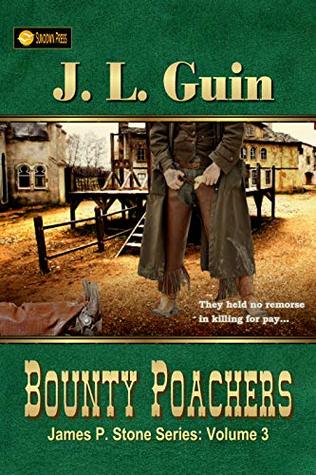


Actually, the title came about after I had written the third chapter. I felt Bounty Poachers was a perfect title because of how the story was developing.


2.   What served as the inspiration for the story? What triggered the idea for the novel or the characters?

Lots of authors write about Old West bounty hunters. I wanted something a little different. The brothers, Jasper and Jason, are two young men, who lived and witnessed their parent's failure to scratch out a living on a Nebraska homestead. 

With both parents passing, Jasper became hardened by the hand that was dealt them. He saw life as it was on the frontier, tough and demanding. Jason, being of a softer nature was used to doing as he was told by his parents. Afterward, he just went along with whatever his older brother proposed.   


3.   Antagonists play a vital role in storytelling. Yours happens to be two brothers, broke and desperate. But are they motivated by something other than mere survival? What are their good qualities?

If not for circumstance, the brothers most likely would have lived as farmers their entire life. Jasper took the temperament of his father, lashing out when things didn't suit him. 

Jason took on the qualities of his mother, quiet, reserved and agreeable. It was Jasper who came up with the idea of hunting men for bounty. He hated groveling for a mundane job for little pay. 

Later, the idea of killing a bounty hunter and poaching his captive was his too. He had no plans to return to farm life. Bringing in wanted men were paying off.


4.   Deputy US Marshal James Stone is the main character—someone you’ve written about in two other novels. Who is Stone? Why should a reader care about him?

James Stone was introduced in PUSHED TOO FAR (first in the series) He and his freighting partner were accosted and robbed in their nighttime camp in the territory. 

During the robbery, Eldon Greyson, Stone's mentor, neighbor, and partner was killed. Stone heard one of the robbers call out the name of “Laird” just before he was knocked out. After walking to safety, Stone dedicated himself to finding and killing Laird.


While chasing after a train robber, his travels take him to Eaton, Kansas where he becomes a deputy sheriff then meets Deputy Marshal Jackson Millet. 

Millet invites him to become a deputy U. S. Marshal. In Book two–LAWMAN GUN—Stone becomes a U.S. Deputy Marshal, with the idea that the position would allow him to continue his search for Laird.


5.   What was your hardest scene to write?

Coming up with a suitable ending to the book. Stone still hadn't located Laird so in order to do so required another volume to be written. Book four DUE JUSTICE will be out soon. I'd like to note that the fine folks, Cheryl and Livia over at Sundown Press have been just great in publishing this series.


6.   What is the first story you ever published and how do you think of it now?

In 1995, Douglas Sharp asked for submissions to his little magazine called Western Digest up in Calgary. I sent in my story “Caught Red Handed.” It wasn't a very good story but it was my first and I was ecstatic when Douglas sent me a check for $15.00.
I went on to write 6 more stories for Western Digest. It has been a fun ride since then and I am still learning. 


- 0 - 

Jerry and his wife Ginny live in northern California. A prolific writer, he has authored over 40 short stories and 15 novels. 

- 0 -


614-607-0949


Monday, May 7, 2018

NEW RELEASE—AND HOW I CAME TO WRITE A SERIES by J.L. Guin


My new novel, Lawman's Gun was released by Sundown Press on May l. Lawman's Gun is Volume 2 of the James P. Stone series. Volume 1, Pushed Too Far, was released January 23. Volume 3, Bounty Poachers, will be available in August of this year. It is planned as a four-volume series. I am currently writing the final volume.

I never really had the idea of writing a series in my mind—one day, it just came about.

I always liked a good challenge. When I first began writing westerns, I had it mind to just write short stories. After doing over three dozen “shortys”, I felt that I was ready to do more, so I challenged myself to step up to the next level. I wrote a couple of novellas, then further challenged myself to write novels. I'd have to say that writing a series has been at the top of my list.

When I first began writing this tale, I didn't want to do another fast gunman story; so, I came up with an ordinary guy (James P. Stone), a freight driver, running his freight between Missouri to various points in Texas. In a night-time camp, out on the prairie, in the Indian Territory, Stone awakens in time to witness an intruder shoot his partner. He is able to hear the name 'Laird' spoken, by a second intruder, just before being knocked unconscious. The next morning, Stone awakens to find his mentor partner Eldon Greyson murdered; their wagons, mules and the entire camp has been cleaned out of anything of value.
GET IT HERE: https://www.amazon.com/Pushed-Too-Far-J-Guin/dp/1983689211/ref=sr_1_3?ie=UTF8&qid=1522958270&sr=8-3&keywords=Pushed+Too+Far


Stone does the best he can to bury his friend, then walks fifty miles to Denison, Texas, to report the crimes. When he learns that the local authorities have no jurisdiction to chase after someone in the Indian Territory, he swears a vendetta to find Laird, the killer, and exact his own justice. Volume one is the beginning of Stone's quest for vengeance.

When I was fifty thousand words into the story, I could have had Stone somehow locate his nemesis and, in a cloud of gun smoke, end the tale. But, I didn’t want to have my hero find the man so quickly. I felt so strongly about the story that I decided to continue with a second book. I ended the first story by having Stone, while serving as a temporary deputy county sheriff, meet with Deputy U.S. Marshal Jackson Millet. The federal lawman suggests that when Stone’s tenure as a county deputy is completed, he might give consideration to becoming a fellow deputy U.S. marshal. He gives Stone an address to contact him.

In the sequel, Stone meets with Jackson Millet at his Dodge City office. Stone is sworn in as a deputy U.S. marshal, as well. Both men agree that locating Laird will be on their mind while doing their deputy duties.
GET IT HERE:


A second book made more sense to me than stretching the original into a ninety-thousand-word tome.

By the time I was near the end of Lawman's Gun, volume two, I saw the opportunity to turn Stone's hunt for Laird into a mini-series, so volume two's ending was written as the lead-in to number three.

I contacted Cheryl and Livia at Sundown Press to see if they might have an interest. Fortunately, for me, they agreed to take a look at my presentation. Sundown Press, headed up by Cheryl Pierson and Livia Washburn Reasoner, does exceptional work. They were very helpful in everything from editing to the cover of the book. The ladies are hardworking, supportive, tolerant, understanding, and very professional in their presentations. I am very pleased to be included in the Sundown Press line up.

How about you? Do you plan a series out before you begin your story? Or, like in my case, take advantage of the opportunity to turn the tale into a series as the story progresses?


Saturday, April 28, 2018

TELL AND SHOW by JERRY GUIN

Don’t get caught short on words.
It didn’t take me long to figure out that a story shouldn’t be all dialogue without a sense of where it is taking place. To me, the location should be as descriptive as possible in order to have the reader get a picture in his/her mind of what it would feel like to be right there alongside whomever I am talking about.


Let's suppose a scene whereby a fictitious Marshal named Jed Crane, is on the hunt for a well-known criminal named Wickes.


The Tell
Crane rode his horse down the only street of East Ridge. He guided his horse to a hitch pole in front of The Saucy Lady Saloon. He slid from the saddle, spun his reins, then stepped into the saloon.

Okay, now what picture have I just laid out for the reader? Not much.

The Show
So now let's show what came to Jed Crane’s eyes and what he did. (Remember, you are right there too.)

Jed Crane halted his horse on the edge of town, his eyes were active, searching for any movement by man or beast. There didn't appear to be anyone walking about. He didn't blame them, it was over 90 degrees out and seemed a lot hotter. He could see three horses, two sorrels and a bay, tied to a hitch pole in front of a shabby saloon. Two of the horses stood with heads down, dozing. The other one stood hip shot. All three lazed in their misery while awaiting their master's return. He tapped a heel to side of his sorrel to move forward on the dusty street of East Ridge. Both Jed and his horse were hot, sweaty, and tired from their all-day ride through the dry flat lands that stretched out twenty miles west of the one-street town.

Crane figured Wickes had not arrived yet, but he slipped the keeper thong off the hammer of his .45 single action Colt, just in case. He guided his horse to stand beside the other three. Crane slipped out of his saddle then spun the reins around the hitch pole, which leaned awkwardly to the left. He stood there for a moment taking in the Saucy Lady Saloon sign that hung above the doorway. The painted letters on the sign were faded and peeling but still readable. Over to his right, a big, yellow, shaggy dog lay stretched out in the scant shade of a bench that fronted the saloon. The dog eyed the man but did not bother to move. After Crane had stepped up two steps to the boardwalk, the dog closed his eyes. The saloon’s left swinging door stood open at an odd angle, the top rusty hinge having come loose. Crane, with one hand near the butt of his holstered .45, used his other hand he pushed the remaining door open, then stepped into the semi-darkened interior of the saloon.

Okay, a lot has been shown. Crane is hot and tired after a long ride. There are three horses, two sorrels and one bay, tied to a leaning hitch pole in front of a saloon. The street is dusty. The saloon’s sign has peeling paint. Did you see that lazy yellow dog? One of the saloon’s swinging doors is in disrepair. The inside of the saloon is in semi-darkness.

What do you think? Do you favor the tell or the show?

The show, at least, put a picture in my mind as to what the place looks like. Now is a good time for a convenient dialogue to begin between Crane and the bartender.


I am still learning and hope, in the future, to do a better job of sentence structure and punctuation. For now though, hang the word count, I do not want to be accused of being stingy with words when giving descriptions of a location.


https://www.amazon.com/Pushed-Too-James-Stone-Book-ebook/dp/B078WLBJ6G/ref=sr_1_2?ie=UTF8&qid=1522122735&sr=8-2&keywords=J.L.+Guin