Holding a reel of film in your hand isn’t like holding a Blu Ray. The weight of the film, even in Super 8, gives a feeling of substance, and emulsion has a smell that the media bits of information on DVD’s just don’t. Those plastic reels remind us of movies in the theater, in the classroom, and at home. It’s the way they used to be, and are a intangible part of their appeal.
Throwing on the BluRay of HOW THE WEST WAS WON is going to give me the entire film, beautifully presented, with extras, and extraordinary sound. Threading up the eighteen-minute super 8 sound digest that MGM/Ken Films marketed in the late 70’s is an entirely different experience.
Not better, but different.
Watching that print, which has pinked with age, the projector on a coffee table, brought back not only the joy of actually owning the movie when we couldn’t just push a button for anything we wanted to watch and hear, but also is a reminder of just how big the market for Super 8 movies became in the mid-70’s.
The early history of Castle films is the history of the hobby, and when Castle lit the fuse for the 8mm explosion in the 1960’s, other film companies fell in right behind, with one becoming Castle’s major competitor that, ultimately, vanquished them.
While Castle was releasing 8mm titles like FRANKENSTEIN MEETS THE WOLFMAN and THE VIRGINIAN from the Universal library, Ken Films of Fort Lee, New Jersey decided to step into the marketplace with their own 8mm catalog, culled primarily from American International Pictures and Republic Studios.
Founded by Bob Lane, and named for his son, Ken Films was considered by many as the “also-ran” 8mm company. This was a bit of an unfair label, since Ken had to license bits and pieces of various movie libraries for home use, rather than have major studio backing, as Castle did.
Castle had Woody Woodpecker and Ken had Mighty Mouse, which was a pretty sad state of affairs, since I wasn’t a fan of either. But the Terrytoons Ken released were home movie favorites, and with their horror titles, the moneymakers for the catalog.
Initial Ken releases I WAS A TEENAGE FRANKENSTEIN, WAR OF THE COLLOSAL BEAST and THE BLOB were big sellers, and were quickly followed by more horror titles starring Bela Lugosi and Peter Lorre. It was hard to find Ken Films in retail stores, until years later, when they were displayed in their own racks at Kmart and Sears. Castle had their own shelving units for camera departments, with Chilly Willy and Dracula painted on the side. Now, that piece of particle-board is worth more than any 8mm film they ever came up with.
Rummaging the Republic library in the 1960’s, Ken put out special editions of serials in longer formats. Although silent with subtitles, MYSTERIOUS DR. SATAN and BATMEN OF AFRICA, starring Clyde Beatty, were available in eighteen-minute versions consisting of one two 200-foot reels, something Castle never attempted with their silent editions.
And with the Republic library came John Wayne. RIO GRANDE, THE FIGHTING KENTUCKIAN and DARK COMMAND were available in nine-minute, silent editions, along with THE QUIET MAN and SANDS OF IWO JIMA. The prints of the films were good and the editing adequate, particularly on RIO GRANDE, but the problem was that the box art for the Wayne titles was absolutely horrible.
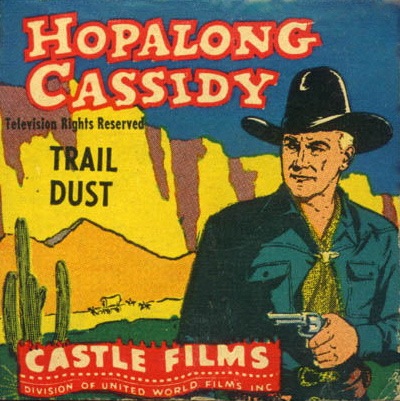
Unlike the beautiful paintings that adorned Castle’s boxes, the Ken boxes looked cheap. Original poster art was sometimes used on other titles, but their westerns relied on incredibly slap-dash images that seemed to have been put together in two minutes.
John Wayne wasn’t the only one to get the short-end when it came to box art. Ken’s digest of HIGH NOON features an atrociously sloppy rendering of Gary Cooper. Where Ken excelled was in reaching out to studios, and they would soon have several enormous libraries for their Super 8 releases, with many classic westerns in color and sound. Interestingly, it wasn’t John Wayne who helped Ken jump the competition, but THE TEN COMMANDMENTS.
At the time, Paramount Pictures had no home movie division, since their pre-1948 titles had all been acquired by Universal. It was this deal that allowed Castle to release THE VIRGINIAN with Joel McCrea, but the post ’48 titles were up for grabs and Ken grabbed them.
The silent digest of THE TEN COMMANDMENTS racked up amazing sales for the company, and was just the thing for families to watch between their home movies of days at the beach and high school graduations.
The fact was, by the early 70’s, more and more companies were bringing out 8mm films, and trying to yank Castle off their throne with newer titles and formats. While Castle continued to focus on digests of TEXAS ACROSS THE RIVER and THE HELLFIGHTERS, Ken’s impressive record with Paramount led to a deal with 20th Century-Fox that changed the Super 8 collecting hobby completely.
When Ken made a deal to release all five of THE PLANET OF THE APES films in Super 8 editions, they opened a floodgate. The films were available in the old, black and white silent format, or for a higher price, in color and sound.
The sales of the APES films was explosive, and soon Ken was releasing five and six Fox titles a month, with the first westerns being BUTCH CASSIDY AND THE SUNDANCE KID, MY DARLING CLEMENTINE, Raoul Walsh’s THE TALL MEN, and JESSE JAMES.
The color/sound nine-minute version of JESSE was astonishingly beautiful. The film’s legendary Technicolor photography was stunning on my very exclusive bedroom wall, and was the best looking Super 8 release I’d ever seen.
Since the Fox films were available with color and sound in both the nine and eighteen-minute versions, Ken made an odd choice to add narration to the shorter ones, awkwardly filling in gaps of the story. It was a terrible decision that buyers hated, and the somber narration sometimes found its way into the longer films, simply because Ken didn’t take the time to remove it, even when it wasn’t needed.
I bought the long version of BANDOLERO! and it had this problem, but that didn’t stop me from watching it twenty times the first week after it arrived in the mail.
The Ken Films Fox releases were incredibly popular, forcing Castle Films to find newer titles from the Universal vaults. Feeling that the company’s brand name was too old-fashioned, Castle was re-christened Universal 8.
Universal 8’s focus would be on theatrically complete cartoons, newsreels, and the 400-foot digests of the classic Universal horror titles, with color releases of THIS ISLAND EARTH and SSSSS, as well as a 3-D version of CREATURE FROM THE BLACK LAGOON.
For western fans, they brought out long versions of HIGH PLAINS DRIFTER, ROOSTER COGBURN, and a great digest of the Sergio Leone-produced MY NAME IS NOBODY, starring Henry Fonda. NOBODY includes the great “blowing away the posse with the nitro in their saddles” sequence, that’s preposterous in the extreme, but wonderfully shot. It was also the only true Spaghetti western that anyone was offering.
From a quality standpoint, I always found Universal 8/Castle to be the leader, with fine editing, rock-steady prints, clean sound and NO narration needed. On the negative side, with their new, “modern” look Universal dumped those beautifully painted Castle boxes, in favor of photo covers on hard plastic cases. They were more practical for storing film, but just weren’t as much fun.
Columbia 8mm had been in there pitching since the 1960’s, with the usual digests of horror movies and some select cartoons from Hanna-Barbara for home unspooling. One particularly interesting item was RIDING FOR A FALL, a behind-the-scenes featurette about the making of MAJOR DUNDEE. The short focuses on the stunt team, but Sam Peckinpah and Charlton Heston are very much in evidence.
With the success of the longer formats in the mid-70’s, Columbia jumped in with more than a dozen westerns, including the early Duke Wayne TWO-FISTED LAW, THE PROFESSIONALS, THE MAN FROM LARAMIE, COWBOY, GOOD DAY FOR A HANGING, MAJOR DUNDEE, CAT BALOU, and the Budd Boetticher films, BUCHANAN RIDES ALONE, and COMMANCHE STATION.
By the late 70’s, Super 8 collecting and filmaking had gone international, with companies around the world selling films and high-end equipment. My parents’ mailbox was always stuffed with catalogs and Super 8 Filmaker Magazine, a true sign of their tolerance, and every month brought at least a dozen new titles in the format.
Derran Films out of England became the largest distributor of Super movies in the world, offering not only all of the shorts from U.S. companies, but feature films like LAST TRAIN FROM GUN HILL and a variety of Elvis movies.
And then there was STAR WARS.
Because of their deal with Fox, Ken Films held the home movie rights to Hans Solo and Co. and made a fortune. It success brought them a deal with MGM, and soon were making available long-versions of THE WIZARD OF OZ, THE DIRTY DOZEN, and HOW THE WEST WAS WON.
Universal 8 and the rest just couldn’t keep up, and when Ken introduced the ABC Films library for sale, which included DUEL IN THE SUN, JUNIOR BONNER as well as a number of Alfred Hitchcock classics he’d directed for David Selznick. They weren’t cheap, but if you could scrape together the cash, then the features were yours (my choice was STRAW DOGS, which I still have).
And then there was VHS.
Although Beta had been introduced in the 70’s, it was the cheaper VHS that took over the home market, and drove a stake into the heart of the super 8 hobby. Who needed the digests, when you could have the whole film?
It took no time at all for the studios to close their home movie divisions or cancel deals, and the companies dried up one at a time, as the market for collectors got smaller and smaller, and then vanished. The catalogs and magazines stopped, as people looked to tape as the new miracle format to shoot in, and bring home the movies we wanted to watch.
The enthusiasts are still out there, trading precious boxes of Castle Films on message boards or through Ebay, preserving the time when to have a little piece of Hollywood in your home was very special. It seems particularly amazing that there was a time when those reels of film were how you enjoyed your movies, and the work that went into finding them, and showing them. Dad cursing an uncooperative projector was as much a part of movie night as popcorn.
It’s so much easier now, and better.
But sometimes the old projector gets hauled out of the closet, and I make the choice to thread up a spool of film instead of pressing a button on my DVD player.
The tape splicer is right there, in case of a problem, and the projector rattles on, the dialog and music coming from a speaker in its side, and I’m swept away by an old feeling of excitement; of opening a cardboard box, and threading up eight precious minutes of a movie I loved, to watch as many times as I wanted, before being ordered to go to bed.
Showing posts with label Castle Films. Show all posts
Monday, July 15, 2013
Monday, June 17, 2013
SUPER 8 STAMPEDE, PART ONE by C. COURTNEY JOYNER
The ad in the back pages of SCREEN THRILLS ILLUSTRATED was like a siren’s song: impossible to resist, but what it promised was an eternity away. If you were lucky, the eternity was closer to six weeks, depending on your mailman. The promised treasure was Castle Films’ 8mm silent digest of THE SPOILERS, starring John Wayne and Randolph Scott, that the Captain Company would deliver to your door for a mere $5.99.
What kid wouldn’t want that?
I surely did, and with pennies scraped together, I gave my Mom the cash, and she wrote the check, even throwing in a little extra for postage. It didn’t help. The wait was an eternity, but THE SPOILERS finally arrived one Saturday, and I spent the entire weekend watching Duke and Randy slug it out in one of the great fights of the movies, complete with sub-titles.
And who needed dialog, anyway? I had the rattle of my family’s old GAF projector underscoring every scene.
My first Castle Films reached my hands courtesy of FAMOUS MONSTERS OF FILMLAND and SCREEN THRILLS, but those flat boxes, with the gorgeous color paintings of The Wolfman or Joel McCrea, were available in dozens of places where we could press our noses against the glass, and dream home theater dreams.
During the 1950’s and 60’s, there was a 8mm home movie explosion. Dads in Bermuda shorts had become directors, shooting picnics and graduations, while living rooms were being turned into theaters on Saturday nights, with the shaky family flicks interspersed by newsreels and cartoons picked up at the local camera store.
A newsreel cameraman named Eugene Castle quietly started this home entertainment revolution in the 1930’s, by making newsreels, boxing films, and Oswald the Rabbit cartoons available for purchase by the general public. The first releases were in 16mm, but when he added the 8mm format at the end of the thirties, sales jumped.
Castle Films were doing well, getting the rights to short subjects and even a few features, mostly early sound westerns that they sold in “digest” versions, running nine minutes each. It was when Universal’s non-theatrical arm, United Film Distributors, stepped in with a solid money offer to Castle, that his company became the leading outfit for movies-at-home.
One of the first releases under United was Abbott and Costello doing their legendary “Who’s on First” from THE NAUGHTY NINETIES, the only feature film in which they performed their famous routine in its entirety. Released in 16mm, the film was a hit, expanding the market of at-home movie hobbyists, and prompting Castle to tear into the Universal library full-bore. The next big release in both 16 and 8mm: ABBOTT AND COSTELLO MEET FRANKENSTEIN, and it out-sold everything.
Above all else, Universal meant monsters, and the 200-foot digests of their horror classics, along with three-minute “headline editions,” became the company’s life-blood. Castle brought out a digest of DRACULA, featuring a great painting of Bela Lugosi on its lid, and was quickly followed by BRIDE OF FRANKENSTEIN, SON OF FRANKENSTEIN, and THE MUMMY.
But where were the westerns amid Karloff, Lugosi and Chaney? Actually, Lon was represented in a cut-down of a chapter of his Universal serial OVERLAND MAIL, called INDIAN RAIDERS, while Abbott and Costello chimed in again with the digest NO INDIANS, PLEASE! culled from RIDE ’EM COWBOY.
A 16mm collector himself, Lou Costello knew the money their home-movies were taking in was real, and suspected the team wasn’t getting their rightful cut. This prompted a lawsuit against Castle, which was settled without trial.
Although there were a few Johnny Mack Brown and Kirby Grant “B” titles from the Universal vaults, most westerns in the Castle catalog in the 1950’s were digest versions of Hopalong Cassidy films, such as BAR 20 RIDES AGAIN and THREE ON A TRAIL. Hoppy was all the rage, and the films that William Boyd licensed to Castle found quick buyers, but the Universal monsters were about to rise from their graves again, hauling a new Castle catalog with them.
When Universal sold their SHOCK THEATER package of classic monster films to local stations in the late 1950’s, it pre-figured a “monster boom” that included scores of magazines, Aurora model kits, comics, drinking glasses, games, coloring books, gum cards, masks, ad infinitum.
The incredible popularity of the older films made the still-living actors, Karloff, Chaney, and Rathbone, stars again, turned Lugosi into an icon, and the characters they had played became part of American folklore.
And wouldn’t it be fun to be able to watch a few minutes of TARANTULA, with a cowboy movie, and a cartoon? 8mm mania was raging, with Sears, Penny’s, and even Woolworth’s stocking projectors and screens to fit any budget, and even offering a free Castle film with your purchase. We got the 3-minute edition of ABBOTT AND COSTELLO GO TO MARS, re-titled ROCKET AND ROLL.
Castle unleashed a slew of new horror titles, as well as westerns, comedies, and Woody Woodpecker cartoons, to finally take full advantage of the Universal library.
Audie Murphy was the star of the first two new 8mm digests: THE GREAT GAMBLE, edited from DRUMS ACROSS THE RIVER, and DESTRY, with Murphy and Mari Blanchard. Both are really a composite of action scenes, but GAMBLE pointed to a Castle Films policy of re-titling most of their western releases.
Whether Castle did this to make the buyers think they were getting a new film? Or perhaps, not wanting to compete with the same full-length movies Universal had already sold to television? Whatever the reason, it seems a weird strategy to me, since the whole point of 8mm collecting was to own the movies we already loved.
The westerns marketed with their own titles included: THE SPOILERS, CANADIAN PACIFIC, CARIBOO TRAIL, both with Randolph Scott, RAILS INTO LARAMIE, GERONIMO, THE VIRGINIAN, CHIEF CRAZY HORSE, PALEFACE and Raoul Walsh’s THE LAWLESS BREED. With the exception of SPOILERS, every one of these films had been made in color. They were cut into exciting black and white digests, with the lead flying furiously, but it would take Castle years before they’d make available 8mm color westerns for our living room theaters.
Oddly, they didn’t release Anthony Mann’s great WINCHESTER ’73 under its own title, opting instead for two digests: FRONTIER FURY and GUNS OF THE WEST. These are among the best that Castle offered in any genre. The editing is excellent, with GUNS showcasing the great Calvary/Indian battle that James Stewart and Millard Mitchell stumble into, thanks to Shelley Winters. Young Tony Curtis and Rock Hudson are featured as trooper and War Chief respectively.
Castle’s print quality was generally top-notch, and these two digests show off the care they took in the lab with William Daniels’ superb black and white photography. Another note is that the sub-titles are actual dialog from the film, not narrative descriptions.
Jack Arnold’s RED SUNDOWN got the cut-down treatment in FLAMING GUNS, and a good job of it, too. The digest lays out the plot well, and includes the Rory Calhoun/Robert Middleton brawl, and the final showdown with grinning psycho, Grant INCREDIBLE SHRINKING MAN Williams.
Castle continued to re-title films for years. SHENANDOAH became two 200 footers: THE DEFIANT VIRGINIAN and THE RELUCTANT REBEL. Richard Dix’s oater TOMBSTONE – THE TOWN TOO TOUGH TO DIE was now BADMEN OF ARIZONA. On the lighter side, Bob Hope returned in the second half of THE PALEFACE, now called DR. PAINLESS, while Dean Martin and Joey Bishop cut it up in a nine-minute version of TEXAS ACROSS THE RIVER, titled WHAT, INDIANS? At nine minutes, TEXAS seemed vastly improved.
The slapstick shoot-out in WISTFUL WIDOW OF WAGON GAP, with Abbott and Costello, became DOUBLE-CROSS AT CRISS CROSS, and finally, A LADY TAKES A CHANCE was re-named to give John Wayne the top spot: THE COWBOY AND THE LADY.
But the days of the nine-minute silent souvenir of our favorite movies was closing fast. Castle was about to be re-organized as Universal 8, and introducing longer-form titles, in color, sound, and even 3D. Other companies, like Ken Films out of New Jersey that had always lagged behind Castle, were now bringing out Super 8 titles from 20th Century Fox and Warner Brothers, while Columbia and MGM set-up their own home movie divisions.
In this brief time before home video, the Super 8 market was about to go nuclear, before turning into ashes.
Thanks for stopping by, and please join me on Monday, July 15, for PART TWO: SUPER-8 SUNSET.
What kid wouldn’t want that?
I surely did, and with pennies scraped together, I gave my Mom the cash, and she wrote the check, even throwing in a little extra for postage. It didn’t help. The wait was an eternity, but THE SPOILERS finally arrived one Saturday, and I spent the entire weekend watching Duke and Randy slug it out in one of the great fights of the movies, complete with sub-titles.
And who needed dialog, anyway? I had the rattle of my family’s old GAF projector underscoring every scene.
My first Castle Films reached my hands courtesy of FAMOUS MONSTERS OF FILMLAND and SCREEN THRILLS, but those flat boxes, with the gorgeous color paintings of The Wolfman or Joel McCrea, were available in dozens of places where we could press our noses against the glass, and dream home theater dreams.
During the 1950’s and 60’s, there was a 8mm home movie explosion. Dads in Bermuda shorts had become directors, shooting picnics and graduations, while living rooms were being turned into theaters on Saturday nights, with the shaky family flicks interspersed by newsreels and cartoons picked up at the local camera store.
A newsreel cameraman named Eugene Castle quietly started this home entertainment revolution in the 1930’s, by making newsreels, boxing films, and Oswald the Rabbit cartoons available for purchase by the general public. The first releases were in 16mm, but when he added the 8mm format at the end of the thirties, sales jumped.
Castle Films were doing well, getting the rights to short subjects and even a few features, mostly early sound westerns that they sold in “digest” versions, running nine minutes each. It was when Universal’s non-theatrical arm, United Film Distributors, stepped in with a solid money offer to Castle, that his company became the leading outfit for movies-at-home.
One of the first releases under United was Abbott and Costello doing their legendary “Who’s on First” from THE NAUGHTY NINETIES, the only feature film in which they performed their famous routine in its entirety. Released in 16mm, the film was a hit, expanding the market of at-home movie hobbyists, and prompting Castle to tear into the Universal library full-bore. The next big release in both 16 and 8mm: ABBOTT AND COSTELLO MEET FRANKENSTEIN, and it out-sold everything.
Above all else, Universal meant monsters, and the 200-foot digests of their horror classics, along with three-minute “headline editions,” became the company’s life-blood. Castle brought out a digest of DRACULA, featuring a great painting of Bela Lugosi on its lid, and was quickly followed by BRIDE OF FRANKENSTEIN, SON OF FRANKENSTEIN, and THE MUMMY.
But where were the westerns amid Karloff, Lugosi and Chaney? Actually, Lon was represented in a cut-down of a chapter of his Universal serial OVERLAND MAIL, called INDIAN RAIDERS, while Abbott and Costello chimed in again with the digest NO INDIANS, PLEASE! culled from RIDE ’EM COWBOY.
A 16mm collector himself, Lou Costello knew the money their home-movies were taking in was real, and suspected the team wasn’t getting their rightful cut. This prompted a lawsuit against Castle, which was settled without trial.
Although there were a few Johnny Mack Brown and Kirby Grant “B” titles from the Universal vaults, most westerns in the Castle catalog in the 1950’s were digest versions of Hopalong Cassidy films, such as BAR 20 RIDES AGAIN and THREE ON A TRAIL. Hoppy was all the rage, and the films that William Boyd licensed to Castle found quick buyers, but the Universal monsters were about to rise from their graves again, hauling a new Castle catalog with them.
When Universal sold their SHOCK THEATER package of classic monster films to local stations in the late 1950’s, it pre-figured a “monster boom” that included scores of magazines, Aurora model kits, comics, drinking glasses, games, coloring books, gum cards, masks, ad infinitum.
The incredible popularity of the older films made the still-living actors, Karloff, Chaney, and Rathbone, stars again, turned Lugosi into an icon, and the characters they had played became part of American folklore.
And wouldn’t it be fun to be able to watch a few minutes of TARANTULA, with a cowboy movie, and a cartoon? 8mm mania was raging, with Sears, Penny’s, and even Woolworth’s stocking projectors and screens to fit any budget, and even offering a free Castle film with your purchase. We got the 3-minute edition of ABBOTT AND COSTELLO GO TO MARS, re-titled ROCKET AND ROLL.
Castle unleashed a slew of new horror titles, as well as westerns, comedies, and Woody Woodpecker cartoons, to finally take full advantage of the Universal library.
Audie Murphy was the star of the first two new 8mm digests: THE GREAT GAMBLE, edited from DRUMS ACROSS THE RIVER, and DESTRY, with Murphy and Mari Blanchard. Both are really a composite of action scenes, but GAMBLE pointed to a Castle Films policy of re-titling most of their western releases.
Whether Castle did this to make the buyers think they were getting a new film? Or perhaps, not wanting to compete with the same full-length movies Universal had already sold to television? Whatever the reason, it seems a weird strategy to me, since the whole point of 8mm collecting was to own the movies we already loved.
The westerns marketed with their own titles included: THE SPOILERS, CANADIAN PACIFIC, CARIBOO TRAIL, both with Randolph Scott, RAILS INTO LARAMIE, GERONIMO, THE VIRGINIAN, CHIEF CRAZY HORSE, PALEFACE and Raoul Walsh’s THE LAWLESS BREED. With the exception of SPOILERS, every one of these films had been made in color. They were cut into exciting black and white digests, with the lead flying furiously, but it would take Castle years before they’d make available 8mm color westerns for our living room theaters.
Oddly, they didn’t release Anthony Mann’s great WINCHESTER ’73 under its own title, opting instead for two digests: FRONTIER FURY and GUNS OF THE WEST. These are among the best that Castle offered in any genre. The editing is excellent, with GUNS showcasing the great Calvary/Indian battle that James Stewart and Millard Mitchell stumble into, thanks to Shelley Winters. Young Tony Curtis and Rock Hudson are featured as trooper and War Chief respectively.
Castle’s print quality was generally top-notch, and these two digests show off the care they took in the lab with William Daniels’ superb black and white photography. Another note is that the sub-titles are actual dialog from the film, not narrative descriptions.
Jack Arnold’s RED SUNDOWN got the cut-down treatment in FLAMING GUNS, and a good job of it, too. The digest lays out the plot well, and includes the Rory Calhoun/Robert Middleton brawl, and the final showdown with grinning psycho, Grant INCREDIBLE SHRINKING MAN Williams.
Castle continued to re-title films for years. SHENANDOAH became two 200 footers: THE DEFIANT VIRGINIAN and THE RELUCTANT REBEL. Richard Dix’s oater TOMBSTONE – THE TOWN TOO TOUGH TO DIE was now BADMEN OF ARIZONA. On the lighter side, Bob Hope returned in the second half of THE PALEFACE, now called DR. PAINLESS, while Dean Martin and Joey Bishop cut it up in a nine-minute version of TEXAS ACROSS THE RIVER, titled WHAT, INDIANS? At nine minutes, TEXAS seemed vastly improved.
The slapstick shoot-out in WISTFUL WIDOW OF WAGON GAP, with Abbott and Costello, became DOUBLE-CROSS AT CRISS CROSS, and finally, A LADY TAKES A CHANCE was re-named to give John Wayne the top spot: THE COWBOY AND THE LADY.
But the days of the nine-minute silent souvenir of our favorite movies was closing fast. Castle was about to be re-organized as Universal 8, and introducing longer-form titles, in color, sound, and even 3D. Other companies, like Ken Films out of New Jersey that had always lagged behind Castle, were now bringing out Super 8 titles from 20th Century Fox and Warner Brothers, while Columbia and MGM set-up their own home movie divisions.
In this brief time before home video, the Super 8 market was about to go nuclear, before turning into ashes.
Thanks for stopping by, and please join me on Monday, July 15, for PART TWO: SUPER-8 SUNSET.
Subscribe to:
Posts (Atom)