Showing posts with label How the West Was Won. Show all posts

Monday, August 12, 2019

My Favorite Song by Kaye Spencer #westernfictioneers #folkmusic #songs


We all have songs that mean something extra special to us whether by our associating them with a special event, a loved one, a precious moment, a situation, etc. In fact, if you’re like me, I could go on for hours singing the words to all the songs that are near and dear to me.

 But there is one song. The one song that tops all the others. The that brings a tear to my eye and a warm fuzzy feeling in my heart.


Hints:

“My” song is an American rendition of Greensleeves, which is an old English folk song of complicated, and not entirely identifiable origins. Greensleeves was a familiar song (tune) in Shakespeare’s day, because he referenced it in his play, 'The Merry Wives of Windsor' in 1595. Falstaff: “Let the sky rain potatoes! Let it thunder to the tune of ‘Greensleeves’!”

There is a legend that the original song was written by Henry VIII for his future wife, Anne Boleyn, but that is apparently a myth as there is evidence the song was around before Henry’s time.

By 1690, or so, the original song was becoming associated with Christmas and New Year’s. Then by the 19th century, any Christmas songbook worth its salt included some version of the original folk song (lyrics and tune) as a carol. Elvis Presley, Tom Jones, and a host of other crooners have recorded their renditions of Greensleeves.

Here is a clip from The Rifleman with Johnny Crawford singing Greensleeves.


As a Christmas song, we know it as What Child is This? which has also been recorded by too many artists to list here.

For those of you desiring more history about Greensleeves, click HERE, HERE, and HERE. 

My favorite song is A Home in the Meadow. The lyrics were written by Sammy Cahn and the song was performed by Debbie Reynolds in the 1962 western movie (and book by same title written by Louis L’Amour), How the West was Won.

For your viewing and listening pleasure, here is the YouTube clip from the movie. If you've not read the book How the West was Won AND watched the 1962 movie of the same name, you should remedy those most egregious oversights as soon as you can. You can thank me later. *wink*


Until next time,

Kaye Spencer

Writing through history one romance upon a time


Stay in touch with Kaye

Amazon Author Page | BookBub | Blog | Twitter | Pinterest


Monday, October 8, 2018

A quick history of the Erie Canal by Kaye Spencer #westernfictioneers #ErieCanal #AmericanHistory


With the opening of the Erie Canal on October 26, 1825, the Great Lakes was connected with Atlantic Ocean via the Hudson River. This was an engineering marvel, a masterpiece often called the Eighth Wonder of the World.

The Erie Canal represented a transportation door opening for American westward expansion.  Hardy adventurers with hope in their hearts for a new and better life beyond the horizon sold their farms, packed up their belongings, and boarded the barges and boats. Some would make it to the west. Many wouldn't make it, because of illness, lack of funds to continue, or simply from the hardships encountered along the way.

The website, Erie Canal (http://www.eriecanal.org/) offers this basic information:

'Proposed in 1808, ground was broken for the Erie Canal at Rome, New York on July 4th, 1817. The Erie Canal links the waters of Lake Erie in the west to the Hudson River in the east.

The idea of the canal was to open the lands west of the Appalachian Mountains to settlers while also creating a better (safe and efficient) mode of transportation to deliver produce to markets. Two years into construction brought the first commercial traffic on the part that was completed between the towns of Rome and Utica. Doubters now saw the visions of the developers first hand and excitement increased.'

Erie Canal Map
By Rosemary Wardley (Unpublished. Provided by author for upload) [CC BY-SA 4.0  (https://creativecommons.org/licenses/by-sa/4.0)], via Wikimedia Commons

Quick Stats:


Original Erie Canal (construction: 1817 to 1825)
  • 18 aqueducts
  • 83 locks
  • 4 feet deep and 40 feet wide
  • Boats carrying 30 tons of freight could float the canal
  • 10-foot-wide towpath along the bank provided room for horses and mules (and their drivers) to pull the boats and along.
  • Drivers were known as 'hoggees'.

Enlarged Eric Canal (construction: 1836 to 1862)
  • To keep up with increasing demands of traffic, the canal was enlarged to 70 feet wide and 7 feet deep with a 240-ton boat-weight
  • 72 locks

Barge Canal (construction: 1903 to 1918)
  • 1903 brought another enlargement with the development of the Champlain Canal, the Oswego Canal, and the Cayuga and Seneca Canal
  • 12 to 14 feet deep – 120 to 200 feet wide – 338 miles long
  • 36 locks
  • Accommodated a barge weight of up to 3,000 tons.
Little of the original Erie Canal exists as its identity has been lost in the reconstructions.

An aqueduct over the Mohawk River at Rexford, N.Y., in the early years of the Erie Canal. It was one of 32 navigable aqueducts on the Erie Canal. Photo courtesy of Creative Commons/Clifton Park Collection [https://religionnews.com/2017/06/30/the-erie-canal-and-the-birth-of-american-religion/]
Erie Canal in Pittsford, New York
By kathryn from Boston (Erie Canal in Pittsford) [CC BY 2.0 
(https://creativecommons.org/licenses/by/2.0)], via Wikimedia Commons

You can read more about the Erie Canal at the Erie Canal Museum website HERE.

I was in elementary school in the 1960s, and I remember singing this folk song about the Erie Canal. The song is "Erie Canal Song: Low Bridge, Everybody Down". It was written by Thomas Allen in 1905.


The Erie Canal plays a part in the beginning of Louis L'Amour's book How the West was Won (c. 1963 Bantam Books).

Part 1 The Rivers: "The shining land lay open—ready for conquest, and the ways into it were the rivers. Slow and mighty, turbulent and frothing, the rivers were the roads the first settlers took, building rafts, and flatboats, floating down water that was green, brown, black, flecked with foam, but that led ever onward into the heart of that dangerous but unawakened land where riches waited for the bold and the strong."

Taken from Chapter Two:

Eve Prescott stood alone, a few feet back from her family, watching the boats that thronged the Hudson River and the Erie Canal. The shore was piled high with bales, barrels, and crates, merchandise and household goods, all awaiting shipment to the West. Nothing on the farm where she had lived until then, or in the tiny village nearby, had prepared her for this...

On the river there was the shrill piping of whistles, the clang of bells, and the sound of steam exhausts... She only knew vaguely where the Ohio River lay, or the lands to which they were going, those uncertain lands, theirs for the taking, which no one had seen... The Ohio country was the wild west, the wilderness. And that was where they were going... the Promised Land.

From the Hudson River at Albany to Lake Erie at Buffalo, a ditch four hundred and twenty-five miles long had been dug. The digging had been done by several thousand wild, bog-trotting Irishmen fresh from the old country, and they had been eight years in the digging... A canal boat had a crew of three to four persons. A boy or man, working for seven to ten dollars a month, drove the team along the towpath to haul the boat. 

The steersman might earn as much as thirty dollars a month, which was good pay for the time. The captain often did his own steering; otherwise, he sat on deck smoking his pipe and shouting insults at the other boats. Sometimes the cook was the captain's wife; more often she was one of the thousands of women who followed the canal, taking up with this boater or that, as jealous of her independence as any man on the ditch. Of all shapes and sizes, and of every color, the boats moved up or down the canal, fighting or racing for cargo...

The westward movement of which they were a part was more than a hundred years old... There were always men who went west...by the Wilderness Road, the by the Natchez Trace...the Overland Trail, the Santa Fe Trail, the Oregon Trail, the Hastings Cut-off, the Applegate Road... But now there was a difference in their coming, for they brought their women along. They came to stay...

Now they went by the Erie Canal...

* * * * *

If you've not read How the West was Won AND watched the 1962 movie of the same name, you should remedy those most egregious oversights as soon as you can. You can thank me later. *wink*


Until next time,

Kaye Spencer

Writing through history one romance upon a time


Website/Blog | Instagram | Twitter | Pinterest 
Facebook | Amazon | LinkedIn | YouTube

Monday, July 15, 2013

SUPER 8 SUNSET: THE FADE OF THE SUPER 8 WESTERN--BY C. COURTNEY JOYNER

Holding a reel of film in your hand isn’t like holding a Blu Ray. The weight of the film, even in Super 8, gives a feeling of substance, and emulsion has a smell that the media bits of information on DVD’s just don’t. Those plastic reels remind us of movies in the theater, in the classroom, and at home. It’s the way they used to be, and are a intangible part of their appeal.

Throwing on the BluRay of HOW THE WEST WAS WON is going to give me the entire film, beautifully presented, with extras, and extraordinary sound. Threading up the eighteen-minute super 8 sound digest that MGM/Ken Films marketed in the late 70’s is an entirely different experience.

Not better, but different.

Watching that print, which has pinked with age, the projector on a coffee table, brought back not only the joy of actually owning the movie when we couldn’t just push a button for anything we wanted to watch and hear, but also is a reminder of just how big the market for Super 8 movies became in the mid-70’s.

The early history of Castle films is the history of the hobby, and when Castle lit the fuse for the 8mm explosion in the 1960’s, other film companies fell in right behind, with one becoming Castle’s major competitor that, ultimately, vanquished them.

While Castle was releasing 8mm titles like FRANKENSTEIN MEETS THE WOLFMAN and THE VIRGINIAN from the Universal library, Ken Films of Fort Lee, New Jersey decided to step into the marketplace with their own 8mm catalog, culled primarily from American International Pictures and Republic Studios.
Founded by Bob Lane, and named for his son, Ken Films was considered by many as the “also-ran” 8mm company. This was a bit of an unfair label, since Ken had to license bits and pieces of various movie libraries for home use, rather than have major studio backing, as Castle did.

Castle had Woody Woodpecker and Ken had Mighty Mouse, which was a pretty sad state of affairs, since I wasn’t a fan of either. But the Terrytoons Ken released were home movie favorites, and with their horror titles, the moneymakers for the catalog.

Initial Ken releases I WAS A TEENAGE FRANKENSTEIN, WAR OF THE COLLOSAL BEAST and THE BLOB were big sellers, and were quickly followed by more horror titles starring Bela Lugosi and Peter Lorre. It was hard to find Ken Films in retail stores, until years later, when they were displayed in their own racks at Kmart and Sears. Castle had their own shelving units for camera departments, with Chilly Willy and Dracula painted on the side. Now, that piece of particle-board is worth more than any 8mm film they ever came up with.

Rummaging the Republic library in the 1960’s, Ken put out special editions of serials in longer formats. Although silent with subtitles, MYSTERIOUS DR. SATAN and BATMEN OF AFRICA, starring Clyde Beatty, were available in eighteen-minute versions consisting of one two 200-foot reels, something Castle never attempted with their silent editions.

And with the Republic library came John Wayne. RIO GRANDE, THE FIGHTING KENTUCKIAN and DARK COMMAND were available in nine-minute, silent editions, along with THE QUIET MAN and SANDS OF IWO JIMA. The prints of the films were good and the editing adequate, particularly on RIO GRANDE, but the problem was that the box art for the Wayne titles was absolutely horrible.

Unlike the beautiful paintings that adorned Castle’s boxes, the Ken boxes looked cheap. Original poster art was sometimes used on other titles, but their westerns relied on incredibly slap-dash images that seemed to have been put together in two minutes.

John Wayne wasn’t the only one to get the short-end when it came to box art. Ken’s digest of HIGH NOON features an atrociously sloppy rendering of Gary Cooper. Where Ken excelled was in reaching out to studios, and they would soon have several enormous libraries for their Super 8 releases, with many classic westerns in color and sound. Interestingly, it wasn’t John Wayne who helped Ken jump the competition, but THE TEN COMMANDMENTS.

At the time, Paramount Pictures had no home movie division, since their pre-1948 titles had all been acquired by Universal. It was this deal that allowed Castle to release THE VIRGINIAN with Joel McCrea, but the post ’48 titles were up for grabs and Ken grabbed them.

The silent digest of THE TEN COMMANDMENTS racked up amazing sales for the company, and was just the thing for families to watch between their home movies of days at the beach and high school graduations.

The fact was, by the early 70’s, more and more companies were bringing out 8mm films, and trying to yank Castle off their throne with newer titles and formats. While Castle continued to focus on digests of TEXAS ACROSS THE RIVER and THE HELLFIGHTERS, Ken’s impressive record with Paramount led to a deal with 20th Century-Fox that changed the Super 8 collecting hobby completely.

When Ken made a deal to release all five of THE PLANET OF THE APES films in Super 8 editions, they opened a floodgate. The films were available in the old, black and white silent format, or for a higher price, in color and sound.

The sales of the APES films was explosive, and soon Ken was releasing five and six Fox titles a month, with the first westerns being BUTCH CASSIDY AND THE SUNDANCE KID, MY DARLING CLEMENTINE, Raoul Walsh’s THE TALL MEN, and JESSE JAMES.

The color/sound nine-minute version of JESSE was astonishingly beautiful. The film’s legendary Technicolor photography was stunning on my very exclusive bedroom wall, and was the best looking Super 8 release I’d ever seen.

Since the Fox films were available with color and sound in both the nine and eighteen-minute versions, Ken made an odd choice to add narration to the shorter ones, awkwardly filling in gaps of the story. It was a terrible decision that buyers hated, and the somber narration sometimes found its way into the longer films, simply because Ken didn’t take the time to remove it, even when it wasn’t needed.

I bought the long version of BANDOLERO! and it had this problem, but that didn’t stop me from watching it twenty times the first week after it arrived in the mail.

The Ken Films Fox releases were incredibly popular, forcing Castle Films to find newer titles from the Universal vaults. Feeling that the company’s brand name was too old-fashioned, Castle was re-christened Universal 8.

Universal 8’s focus would be on theatrically complete cartoons, newsreels, and the 400-foot digests of the classic Universal horror titles, with color releases of THIS ISLAND EARTH and SSSSS, as well as a 3-D version of CREATURE FROM THE BLACK LAGOON.

For western fans, they brought out long versions of HIGH PLAINS DRIFTER, ROOSTER COGBURN, and a great digest of the Sergio Leone-produced MY NAME IS NOBODY, starring Henry Fonda. NOBODY includes the great “blowing away the posse with the nitro in their saddles” sequence, that’s preposterous in the extreme, but wonderfully shot. It was also the only true Spaghetti western that anyone was offering.

From a quality standpoint, I always found Universal 8/Castle to be the leader, with fine editing, rock-steady prints, clean sound and NO narration needed. On the negative side, with their new, “modern” look Universal dumped those beautifully painted Castle boxes, in favor of photo covers on hard plastic cases. They were more practical for storing film, but just weren’t as much fun.

Columbia 8mm had been in there pitching since the 1960’s, with the usual digests of horror movies and some select cartoons from Hanna-Barbara for home unspooling. One particularly interesting item was RIDING FOR A FALL, a behind-the-scenes featurette about the making of MAJOR DUNDEE. The short focuses on the stunt team, but Sam Peckinpah and Charlton Heston are very much in evidence.
With the success of the longer formats in the mid-70’s, Columbia jumped in with more than a dozen westerns, including the early Duke Wayne TWO-FISTED LAW, THE PROFESSIONALS, THE MAN FROM LARAMIE, COWBOY, GOOD DAY FOR A HANGING, MAJOR DUNDEE, CAT BALOU, and the Budd Boetticher films, BUCHANAN RIDES ALONE, and COMMANCHE STATION.

By the late 70’s, Super 8 collecting and filmaking had gone international, with companies around the world selling films and high-end equipment. My parents’ mailbox was always stuffed with catalogs and Super 8 Filmaker Magazine, a true sign of their tolerance, and every month brought at least a dozen new titles in the format.

Derran Films out of England became the largest distributor of Super movies in the world, offering not only all of the shorts from U.S. companies, but feature films like LAST TRAIN FROM GUN HILL and a variety of Elvis movies.

And then there was STAR WARS.

Because of their deal with Fox, Ken Films held the home movie rights to Hans Solo and Co. and made a fortune. It success brought them a deal with MGM, and soon were making available long-versions of THE WIZARD OF OZ, THE DIRTY DOZEN, and HOW THE WEST WAS WON.

Universal 8 and the rest just couldn’t keep up, and when Ken introduced the ABC Films library for sale, which included DUEL IN THE SUN, JUNIOR BONNER as well as a number of Alfred Hitchcock classics he’d directed for David Selznick. They weren’t cheap, but if you could scrape together the cash, then the features were yours (my choice was STRAW DOGS, which I still have).

And then there was VHS.

Although Beta had been introduced in the 70’s, it was the cheaper VHS that took over the home market, and drove a stake into the heart of the super 8 hobby. Who needed the digests, when you could have the whole film?

It took no time at all for the studios to close their home movie divisions or cancel deals, and the companies dried up one at a time, as the market for collectors got smaller and smaller, and then vanished. The catalogs and magazines stopped, as people looked to tape as the new miracle format to shoot in, and bring home the movies we wanted to watch.

The enthusiasts are still out there, trading precious boxes of Castle Films on message boards or through Ebay, preserving the time when to have a little piece of Hollywood in your home was very special. It seems particularly amazing that there was a time when those reels of film were how you enjoyed your movies, and the work that went into finding them, and showing them. Dad cursing an uncooperative projector was as much a part of movie night as popcorn.

It’s so much easier now, and better.

But sometimes the old projector gets hauled out of the closet, and I make the choice to thread up a spool of film instead of pressing a button on my DVD player.

The tape splicer is right there, in case of a problem, and the projector rattles on, the dialog and music coming from a speaker in its side, and I’m swept away by an old feeling of excitement; of opening a cardboard box, and threading up eight precious minutes of a movie I loved, to watch as many times as I wanted, before being ordered to go to bed.

Tuesday, June 4, 2013

Karen Michelle Nutt: Legend and Myth of the Cowboy


Legend and Myth of the Cowboy
by Karen Michelle Nutt
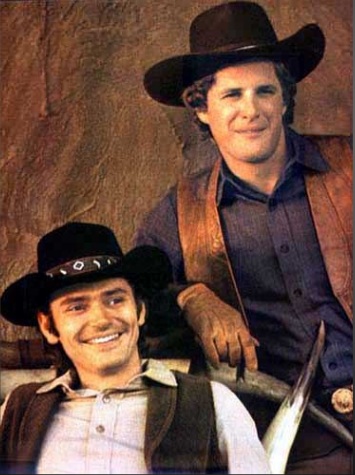
Whether it is a John Wayne classic, or the Alias Smith and Jones TV series where a pair of cousin outlaws try to reform, or the lighthearted fun of the Apple Dumpling Gang, westerns have fascinated people of all ages. What is the fascination? Is it the time period? The shootouts? The wide-brimmed hat?


I tend to think it stems back to our love for myths, legends, and folk tales. It’s the quest that calls the cowboy to take on the adventure. They have a sense of justice and chivalry the knights of medieval times once had. They’ll go out of their way to defend a woman or a child’s honor. They stand for what is right and work toward stomping out evil.


However, that’s not all that draws the attention. Who can ignore JohnWayne’s confident swagger, the cool demeanor of Bret Maverick played by James Garner? The sweet-talkin’ Luke Macahan played by Bruce Broxleitner in How the West Was Won had me dreaming about cowboys. Hannibal Heyes played by Pete Duel in Alias Smith and Jones was my first cowboy crush. At nine years old, I couldn’t resist his mischievous smile, and today I still get a kick out of watching the show.


Westerns with a sci-fi or paranormal twist fascinate me as well. Nathan Fillion as Malcolm Reynolds in the western space drama Firefly is a rugged outlaw, who still does the right thing at the end of the day. Steampunk cowboys are a favorite of mine, too. The Wild, Wild West falls into the western steampunk category, and aired long before steampunk became a known genre. James T. West (Robert Conrad) was fearless and handsome in his cowboy hat. He sure knew how to fight off bad guys. Artemus Gordon (Ross Martin) was the brilliant gadgeteer and master of disguises. Gotta love them both.
Sheriff, gambler, outlaw, steampunk adventurer- my heart skitters a beat or two faster when the man donning a cowboy hat strolls into town.
Steampunk, Cowboy Hats and Gadgets

My steampunk historical western, Storm Riders, takes place in the mining town of Bodie, located in California. The Storm Riders ride the storms for time travel. Their mission is to keep the time line flowing. There are three destinies, three paths for each decision a person makes, but if one of the roads becomes tangled, a Storm Rider must step in and repair the rift before the dimensions collide. I’ve combined the western, fantasy (time travel), and historical elements for my tale. It’s how I’d imagine the wild west would look if the future stopped by for a visit.
How could I not have a story with Outlaws and Sheriffs?


In my western tale, WANTED, six year-old Emma is convinced her Christmas wish and premonition has come true when outlaw JoBeth Riley is brought into town and locked behind bars. Emma’s father, Sheriff Jace Kelly, must keep JoBeth from being broken out by the leader of the outlaw gang, who is determined to have JoBeth by his side once more.
JoBeth finds the Kellys a strange lot when forced to spend Christmas with them. The little girl believes her dreams are tales of the future and the rugged sheriff kindness proves to be a distraction. She’s an outlaw for heaven’s sake, but Jace is bound and determined to steal her heart. 

Penning tales is my first love, but I also create book covers for Western Trail Blazer and Gillian’s Book Covers, “Judge Your Book By Its Cover”. You might recognize a few of these covers by these talented authors:


Judge Your Book By Its Cover: We offer Pre-Made Covers for all genres, but here are a few of our western pre-made covers. We will not resale the same cover. If you're looking for something in particular, but don't see it on our website, let us know. We will work with you to create the perfect cover for your next best seller!!

About the Author:


Karen Michelle Nutt resides in California with her husband, three fascinating children, and houseful of demanding pets. Jack, her Chorkie, is her writing buddy and sits long hours with her at the computer.
When she’s not fighting outlaws, vampires, shape shifters or fallen angels, she creates book covers. You can find her cover art at: Gillian’s Book Covers, “Judge Your Book By Its Cover”.
Whether your reading fancy is paranormal, historical or time travel, all her stories capture the rich array of emotions that accompany the most fabulous human phenomena—falling in love.

Gillian’s Book Covers, “Judge Your Book By Its Cover”:
Amazon Author Page: