Showing posts with label Norman Macdonnell. Show all posts

Thursday, January 19, 2017

Gunsmoke: Chronicling Dodge City, from Radio to Television


Troy D. Smith


Boy- how about that John Meston?

Some of you are nodding silently. Many of you, though, have never heard of John Meston. Not many people have, anymore, or know what a big influence he had on popular culture.

Meston started working for CBS radio in the 1940s, initially in the program practices department and soon thereafter as a writer. By the early 1950s, Meston and his friend Norman MacDonnell (a director and producer) set out to create a new kind of radio program: a western, but not one like The Lone Ranger and other popular shows aimed at kids. The two men, both in their late 30s at the time, were charged by their boss Hubell Robinson (CBS programming chief) to do a western series for adults, a serious drama rather than a melodrama.


They discovered a project that had been shelved for three years, meant to be a cross between westerns and hardboiled detective stories starring a tough lawman named Mark Dillon. They kept the "hardboiled" approach, and made a slight change to the hero's name: he would be Matt Dillon, and the program would be called Gunsmoke. It would be a tough, hard-bitten show, reflecting the rigors and vicissitudes of frontier life. Sometimes the innocent would suffer. The hero would be brave, but flawed in some ways and afflicted with occasional self-doubt and a good bit of cynicism (like any good hardboiled detective). The germ may have appeared in earlier scripts that never made it to the airwaves, but everything else was created by Norman MacDonnell and John Meston. This included the supporting characters: Doc Adams, Miss Kitty, and Chester.


Gunsmoke debuted on the radio in 1952, and was a hit. It was praised for its realism; it was one of the most explicit (for the time) programs on radio. McDonnell produced and directed, and Meston was the head writer. He wrote roughly 80% of the scripts in the show's first four seasons, fleshing out the characters (other episodes were written by McDonnell, Les Crutchfield, Kathleen Hite, John Dunkel, and a handful of others... Marian Clark would later also join the team and write many episodes).

What little the audience learned about Matt Dillon came from the mind of John Meston. Matt had been a wild young cowboy who spent several years on the border in Arizona and New Mexico. He could easily have become an outlaw, considering the company he kept -many of his old friends did- but he was inspired by an older lawman, who turned him onto the right path (in those early years it was common for Matt to meet old friends from his border days, and they were always extremely surprised that he had become a lawman.) Another marker of a Meston story: he often found ways to work his home town of Pueblo, Colorado into the dialogue. A surprising number of guest stars were on their way to or from Pueblo.

CBS decided to turn Gunsmoke into a television show, which debuted in 1955 with an all-new cast (and a new last name for Chester, who went from Proudfoot to Goode). The radio show continued simultaneously, and would run until 1961. Meston and most of the other radio writers started producing scripts for the TV show as well, many of them adapted from past radio episodes. This was relatively easy to do, as both the radio and TV versions ran for 30 minutes, Sometimes the radio origin of a TV episode is obvious in the title; the updated versions often changed the names of guest characters who appeared by their original names in the title.


MacDonnell, however, did not get to run the TV series, at least not at first: the netork hired Charles Marquis Warren as producer (and director of most episodes), with MacDonnell subservient to him. Except MacDonnell was NOT subservient to him, and the two feuded vigorously, leading Warren to quit halfway through the second season, at which point MacDonnell took over the reins completely.


The radio program was canceled in 1961, after nine seasons. The TV version underwent major changes at the same time: with season 7 (1961-1962), they expanded to a full hour. This meant the stories were no longer as tight, and in the eyes of many, no longer as dramatic and affecting. More emphasis was put on the guest-star-of-the-week, and gradually some of the show's hard edge wore off. The stories no longer tended to be as dark and somber as they had been in the first several years. Another notable change: Marshal Dillon no longer moped around the graveyard as much. During the half-hour era, many episodes started with a voice-over monologue by the marshal as he wandered through Boot Hill. We learned more about Matt's internal life and thought process in these scenes, probably, than in the rest of the series put together. Turns out Matt was cynical, and even bitter at times. He seemed to hate his job, and the necessity of killing so many people and dealing so much with the ugly side of human nature. He also had a pretty low opinion of the riff-raff with which he was forced to fill up the cemetery. Of course, those monologues added to the hardboiled atmosphere and helped set the dark tone for the stories. If one were to view the series from the inside out, as a progression of stories instead of a TV production subject to external forces, I think it would be safe to assume that the fact Matt quit going to the graveyard and agonizing so much over his part in filling it indicated he had either found internal peace and accepted his role, or that he gradually became more hardened to it.


In all, Meston wrote 183 of the radio episodes (out of 413). He went on to write 196 (of 635) TV episodes. That is 44% of the radio shows (mostly in the first four seasons) and nearly a third of the television episodes... plus 64 more that were adapted by someone else from his original radio stories. The very first episode of the TV show ("Matt Gets It") was a Charles Marquis Warren adaptation of a Meston radio script; the last episode of season ten was the final original teleplay by Meston ("He Who Steals," which centered on Festus). The first half of the show's 20-year run, and the entire Chester era, bore the heavy mark of Meston, who died in 1979. Norman MacDonnell, who also left Gunsmoke in 1965, passed away in 1979 just a few months after Meston.


Tuesday, June 17, 2014

THOSE THRILLING DAYS OF YESTERYEAR . . . By Tom Rizzo


Every morning before dawn, I strap on an arm band that holds my iPod, slip on a pair of wireless earbuds, and head to the streets to walk for an hour or so. 


But, I'm not listening to music. On my iPod are more than 1,500 Podcasts--mostly old radio shows of every genre you can imagine. Many of the Podcasts are old time radio Westerns. These programs are great sources of entertainment. Not only do they help pass the time on my walks, they keep me connected to a past that required listeners to make full use of their imaginations.

The actors were outstanding. Sound effects functioned as effective imagery, appealing to a range of human senses that helped deepen the audience's understanding of story.

One moment, you may hear dialog exchanged with the sound of a babbling mountain stream in the background. Or, the dramatic sound of gunshots exchanged in a fierce battle between the good and the bad guys.

Sometimes, all that was needed to set the stage for the right amount of tension or suspense was the sound of a character's breathing.

There were other sounds too. Doors being opened and closed. Coffee or liquor being poured. Horses galloping across the radio dial. The crackle and pop of a campfire. A dog barking. Maybe a baby crying. Based on dialog, sound effects, and scene-setting musical scores, listeners were able to add their own splashes of color and strokes of reality across a canvas of the imagination.


I didn't realize how many different Westerns were available back when radio was king. Among them:


    •    Gunsmoke  
    •    Have Gun Will Travel
    •    Frontier Gentleman
    •    The Lone Ranger
    •    Fort Laramie
    •    The Roy Rogers Show
    •    The Six-Shooter
    •    Death Valley Days
    •    Maverick
    •    Hopalong Cassidy
    •    The Cisco Kid
    •    Red Ryder
    •   . . . and many, many more.

In the Fifties, the western improved its entertainment value when writers created more complex story lines, laced with psychological motivations for the protagonist and antagonist. 


Dubbed adult westerns, these radio dramas were often referred to as "the thinking man's western"--the antithesis the traditional shoot-em-up style of western.  

The actors, of course, were key to the success of these mostly 30-minute productions. If you listened to a lot of radio, you'd eventually hear the same voices on multiple productions. But, you had to pay attention. Most of these men and women were skillful enough to alter their voices so they matched the theme or genre of a particular program. 

For this month ... a snapshot look at three of the most skillful radio professionals.


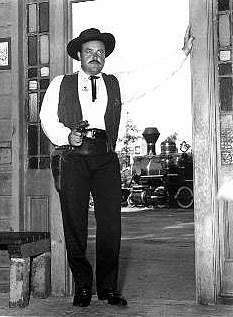
  • WILLIAM CONRAD starred in Gunsmoke, which took place in Dodge City in the mid-1880s. 

The program is considered by many the greatest radio drama ever primarily because of its authenticity, thanks to superb acting and creative sound effects.


It is difficult to imagine anyone else but Conrad playing radio's Marshal Matt Dillon. Thanks to his deep, resonant voice and veteran acting skills, he brought an unparalleled believability to the part. 

Before taking the role, he was already a prolific radio actor. In fact, he almost didn't land the role because of his extensive exposure on other radio shows.

Conrad narrated the radio drama anthology, Escape, on which all the Gunsmoke regulars happened to work. He also served as narrator for the TV shows, The Fugitive, The Invaders, Tales of the Unexpected, Rocky and his Friends, and The Wild World of Animals. In all, he worked in more than  7,500 radio productions.

When producers turned to James Arness to play Dillon on the TV series, it deeply upset Conrad. But, his short and heavy physical stature worked against him for what producers had in mind for the TV version.

Before taking on the role of Matt Dillon, Conrad made his motion picture debut in the 1947 film, The Killers.

Conrad eventually made it to theTV screen. He played the featured role in Nero Wolfe, as well as the district attorney lead in Jake and the Fat Man. Conrad also starred as detective Frank Cannon in Cannon. After it was cancelled, he remarked, "Cannon was crap. I was delighted to see it canceled."

And, Conrad once served as the voice of The Long Ranger on Saturday morning cartoons.


  • JOHN DEHNER starred in two radio Westerns: Have Gun Will Travel and Frontier Gentleman. 

Have Gun Will Travel opened September 1957 on television first--one of the few such instances. The radio show debuted more than a year later in November 1958. 

HGWT featured a gun-for-hire by the name of Paladin who tried to resolve any assignments he accepted in a peaceful way, preferably without violence.

Frontier Gentleman
revolved around a character named JB Kendall, a disgraced British Army officer on personal exile in the West. The show lasted only one season, a victim of television's growing influence.

Dehner, before hitting the airwaves, worked a variety of jobs. They included WWII army publicist, disc jockey, pianist, and animator. He once worked for Disney as an Assistant Animator. In fact, he drew the owl sequences in Bambi, and the Beethoven sequence in Fantasia.

He certainly ranks as among the best radio actors. But, based on his background and accomplishments, Dehner had the talent and commitment to be the best at whatever career he chose.
After leaving Disney, he joined the Army where the military made full use of his language and media skills in a public relations capacity. 

After the service, he went into radio as an announcer, news reporter, and news editor in California. Dehner, in fact, won a Peabody Award for his coverage of the first United Nations Conference.

But he followed his heart into acting and, along the way, appeared as a cast member in nearly every network prime-time hit. His versatile voice and acting skills kept him among the busiest radio performers in the industry.

Dehner played characters in a number of radio westerns as well as old time radio shows such as Suspense, Johnny Dollar, Phillip Marlowe, Let George Do It and Rogers of the Gazette.

  • BRACE BEEMER first became associated with The Lone Ranger as an announcer. 

But after the accidental death of Earle Graser in 1941, Beemer assumed the role of the masked legend of the Plains. 

Return with us now to those thrilling days of yesteryear . .  .

The program, which debuted on WXYZ radio in Detroit, ran for hundreds of episodes between January 1931 and September 1954. 

George Senius/Seaton held the role for five months in 1931, Graser between 1933 and 1941, and Beemer from 1941 to 1954.

He got his first radio job in 1922 in Indianapolis, Indiana, and happened to be the first ever radio personality to broadcast the Indy 500.

Beemer lent a booming voice to the part of the Lone Ranger. He stood six-feet-three, and personified the values and ideals that producer George W. Trendle and writer Fran Striker wanted to communicate through a character who played hardball with the lawless, but demonstrated understanding and kindness towards the law-abiding.

Beemer's size worked for and against him in one instance. Larger than most young men of his age, he managed to enlist in the Army and serve with the America Expeditionary Forces during World War I. He got wounded in combat, sent home, and discharged when officials discovered he was only 14.

Since Beemer played the role longer than anyone else, he's the most famous of the Lone Ranger actors. In fact, his voice was so closely associated with the role that Clayton Moore - who played the masked man on TV, imitated Beemer's speech patterns in the early episodes of the TV series.

Listening to these old, and sometimes scratchy, radio shows helps release the neurons of nostalgia. 

I remain amazed at the production quality of some of these old Westerns and other programs. Not only the acting, but the skill in blending sound effects that provided for a much richer listening experience.

But, the real truth is that it's still so darn much fun to listen. 


An Internet search will reveal countless sources from which to download recordings of these shows. Here are three different sites to start, if you're so inclined. 


# # # 


Saturday, June 4, 2011

THE OTHER GUNSMOKE


by Jim Meals (James Clay) 

No doubt, the recent death of James Arness has caused many western fans to reflect on some fine memories. I recall growing up with two very good, but also very different versions of Gunsmoke.

The story goes that Gunsmoke began when CBS President Bill Paley asked for a western radio series with a main character modeled after Raymond Chandler's Philip Marlowe. Gunsmoke premiered on radio on April 26,1952 and the early episodes would seem to confirm this account. In the words of the show's producer, Norman Macdonnell, Matt Dillon was "..a lonely, sad, tragic man."

Dodge City was a dark place in the show's early years. Doc Adams was a ghoulish character who delighted in mutilated bodies. The only man Matt could really trust, Chester, was mentally very limited. As for Kitty, well, in the words of Macdonnell, "...Kitty is a prostitute plain and simple."

As the radio series progressed the characters softened to a degree. Doc lost his morbidity, but he remained an erratic individual given to drink and a bit lecherous. Chester became, in the words of Parley Baer, the actor who played him, “...a dependable nonthinker” and the relationship between Matt and Kitty became more affectionate, if also more vague. But the biggest change came in how all of these folks related to each other. After a year or so, they actually began to enjoy each other’s company.

When the TV version of Gunsmoke was in its early stages, a pilot was made using the radio cast. Of course, ultimately, a totally different cast was employed for the tube. Apparently, the pilot with the radio actors has been lost, a sad development for students of the western.

Comparing the TV and radio casts is a fool's errand but here goes: James Arness’ Matt Dillon was more in the traditional mode, while on radio, William Conrad portrayed Matt as a short-tempered, driven man. The Chandler influence never got completely scrubbed from the radio program. Milburn Stone’s Doc was a physician the AMA would heartily approve of, unlike Howard McNear’s radio version. Chester’s limp was a TV innovation which Dennis Weaver employed well. 

A long overdue tip of the hat is here given to Georgia Ellis. Her Kitty had depth, strength and vulnerability in a characterization that Amanda Blake found hard to match.

Gunsmoke left radio on June 18, 1961. The show’s departure left behind only two half hour radio dramas. Those two programs were both on CBS and both departed on September 30, 1962. The golden age of radio was officially over.

(Thanks to John Dunning’s The Encyclopedia of Old-Time Radio which was a help in preparing this article.)