Thursday, April 26, 2018

We'd Better Open his Head!


THE DOCTOR'S BAG

The blog about 19th Century Medicine and Surgery

By Keith Souter aka Clay More


TREPHINATION AND HEAD INJURIES


Last week, knowing my interest in the history of medicine, Jacquie Rogers drew my attention to a post on Facebook about a 5,000 year old cow's skull from an excavation in France. It had a surgically created hole in the right side. No bone healing had taken place, so it was suggested that this was either an early attempt at veterinary surgery, or it was a practice attempt by an ancient surgeon before attempting a trephination on a human, possibly after a head injury.

Head injuries are common in tales about the Old West. That is not surprising, considering all those gunfights, fist-fights and falls from horses. The town doctor on the frontier would probably have to be adept at treating them. That could include trephining the skull - effectively, opening the head.


Treatment of a skull injury from Fieldbook of Medicine 1517

Nowadays we have CT and MRI scans which can give us sophisticated images of the body. A CT scan stands for Computerised Tomography, which involves taking x-rays of the brain from various angles, which are analysed by a computer to build a 3-d image of the brain. This will show any fracture or haemorrhage. A MRI scan stands for Magnetic Resonance Imaging. It uses magnetism, ultrasound and computerised technology to build up images of the inside of the body.  These can show the tissues and any abnormalities in surprising detail.

Back in the Old West there were no such luxuries. X-rays were only discovered by William Roentgen in 1895. The first use of them diagnostically only started the year after when Dr John Hall-Edwards in Birmingham, England started to use the technique. The town doctor had to use his clinical skills.

The unconscious patient
The doctor would assess the patient, by examining the scalp for a wound or local bruising. He would examine the ears and nostrils for bleeding, both of which could indicate a significant head injury, with fracture of skull bones.

Coma is the state of absolute unconsciousness when the patient does not respond to any stimulus. Squeezing the ear lobe or using the knuckles of the hand to rub over the sternum (breast bone) are extremely painful and usually will evoke a response in someone who is in a semi-coma. This means that they only respond to painful stimuli. A full coma patient will not even respond to pain.

The pulse would be taken frequently, say every 15 minutes in an unconscious patient. A slowing of the pulse is called bradycardia and may indicate internal hemorrhage somewhere, possibly inside the skull.

The semi-conscious patient
The patient may well be confused, so the level of confuse would be assessed. A rule of thumb gives mild, moderate or severe states of confusion.

Mild - some coherent conversation  is possible
Moderate - out of touch generally, but will answer with name or occupation
Severe - no sensible answers given, but will respond to simple commands such as hold my hand.

Deepening confusion may indicate hemorrhage. Sudden vomiting may also be highly significant.

Examination of the cranial nerves
There are twelve paired nerves which come directly out of the brain to supply the head and neck and some of the internal organs. These are separate from most other nerves, which come out from the spinal cord.

1st nerve - olfactory nerve - sense of smell
2nd nerve - optic nerve - vision
3rd, fourth and sixth nerves - occuolomotor, trochlear and abducent nerves move the eye and operate the pupils - get the patient to follow the finger and also shine a light in the eyes - the pupils should constrict
5th nerve - trigeminal nerve - sensory to the face and operates the masseter muscles, the large muscle that moves the jaw - tested by asking to clench the jaw
7th, facial nerve - movements of the face - ester by asking to see the teeth
8th, acoustic nerve - for hearing. Can he hear?
9th glossopharyngeal nerve - to the pharynx - cannot be tested
10th vagus nerve - multiple internal functions, but also moves the palate - tested by asking the patient to say 'Ah.' The palate should move when he does
11th nerve - accessory nerve - tested by asking to shrug the shoulders
12th nerve - hypoglossal nerve - moves the tongue.

Significantly the movements should be equal on both sides. One sided results could indicate a problem with one side of the brain.

Hutchinson's pupils
These are a set of guidelines devised by Sir Jonathan Hutchinson (1823-1913), a professor of Surgery at the Royal College of Surgeons of London. He wrote a ten volume  Archives of Surgery between 1885 and 1899.


Hutchinson's pupil, described by him indicates that an intracranial mass (a tumour or blood clot) will result in a fixed (meaning it will not change size even when light is shone on the eye) and  dilated pupil on the same side. This is very significant, since it would indicate where to make the trephination.
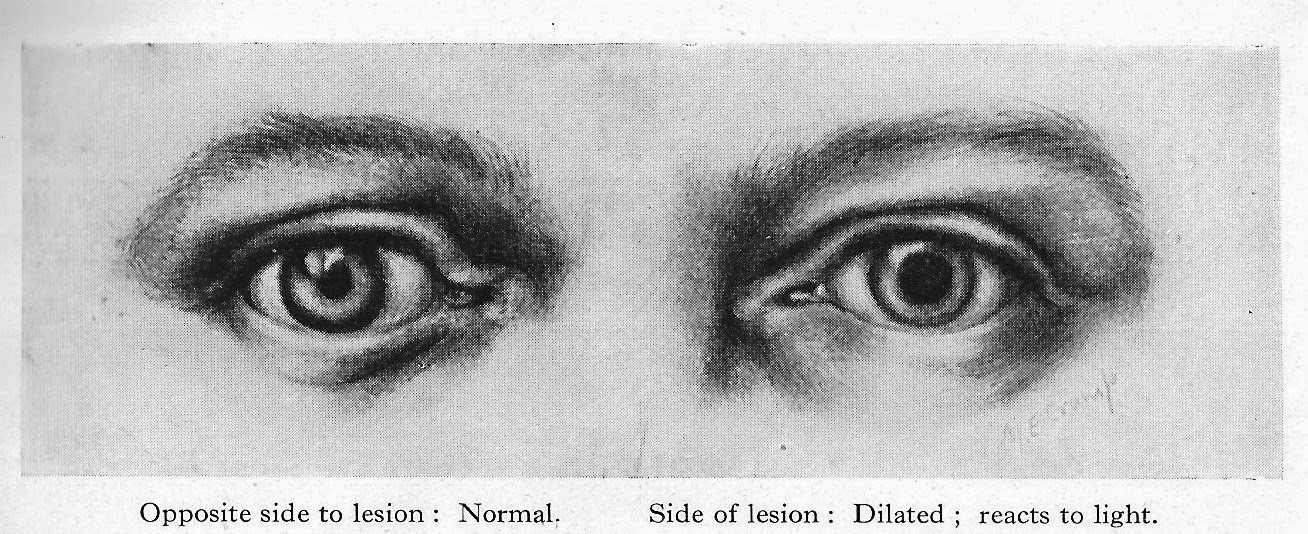


Racoon eyes and Battle's sign
Basal skull fractures, that is, fractures of the bones that make up the base of the skull, including the temporal bone, occipital bone, ethmoid and sphenoid bones, can be associated with particular bruising.

Racoon eyes

Racoon eyes, also known in the UK as Panda eyes, can occur several hours after a basal skull fracture. they look like black eyes from direct trauma, but the bruising is limited to the orbit. There are other causes, but in the context of head injuries in your fiction writing, be aware of this sign.

 Battle's sign, named after the English surgeon William Henry Battle (1855-1936) is bruising that occur can  behind the ear, again some hours after a basal fracture. Like the racoon eyes it is not necessarily a sign of trauma where it appears, but a sign of a basal skull fracture.

Battle's sign  

Your frontier doctor might not have known of them by those names, but he may well have known from past experience, or war service, that they could be of significance.


General physical examination
Here the focus is on assessing the power of each limb and comparing one see of the body with the other. Disparity between the sides could indicate developing or developed paralysis.

Also testing the reflexes with a 'patella or tendon hammer.' The following reflexes are tested:

Biceps tendon by tapping the tendon in the hollow of the elbow.
Triceps tendon by tapping the tendon on the back of the elbow when the elbow is flexed.
Patella tendon by tapping underneath the stella (kneecap) with the leg flexed.
Achilles tendon  by tapping the tendon at the back of the ankle.

Lack of reflexes on one side would be significant.

Trephination
The words trephination and trepanation are used interchangeably, since both come from the Greek trypanon, meaning 'to bore.' Archaeological evidence shows that trephination, the boring of a hole in the skull was used in early tribal societies. It was presumably thought that this would let out evil spirits. Examination of many skulls which have been trepanned in this way shows that healing of bone around the site of the boring took place, indicating that in many cases the operation was a success. Incredibly, they used three methods - cutting, scraping and drilling.

The oldest trepanned skull was found at a neolithic burial site at Ensisheim in France. It has been dated to 7,000 years ago.

The reason that it could have helped is by releasing the pressure upon the brain, which would follow a hemorrhage. Unfortunately, in those people who were not suffering from a rise in pressure it may have done actual harm.

The ancient Egyptians had actually developed a quite sophisticated system of medicine and surgery with doctors who specialised in one area of the body. thus they had eye doctors, stomach doctors and head surgeons.

The Edwin Smith papyrus, written in about 1500 BC, is essentially an ancient Egyptian textbook of surgery. It describes surgical instruments and techniques and discusses 48 cases of injuries, including head injuries.


The Edwin Smith Papyrus c 1500 BC - an ancient Egyptian textbook of surgery

A beautiful description of ancient Egyptian surgery is given in the 1945 historical novel The Egyptian by the Finnish writer Mika Waltari, which became an international bestseller and later a Hollywood blockbuster in 1954. In the novel the main character Sinuhe, who became royal physician to Pharaoh Akhenaten (father of Tutankhamen), is apprenticed to Ptahor, the 'opener of head.' He shows him how to examine a patient and diagnose where there may have been a problem in the head from an assessment of the state of consciousness and the use of the limbs. He then shows him how to remove a piece of skull and replace it with a silver plate which is bound with bandages while they await recovery. 


Ancient Greek surgical instruments. Note the trephine in diagram 'a' with a central pin

The technique of trephination was also used by the Greeks and the Romans. The instruments required became increasingly sophisticated.

We're going to have to open his head
The experience of British surgeons with  gunshot winds to the head during the the Crimean War (1853-1856) was not promising. Trephination was associated with an extremely high mortality of over 95 per cent. George H B Macleod, the chief surgeon of the British Expeditionary Force advise against the operation.

During the American Civil War the operation was performed with better results. The survival rate improved to more than 20 per cent. Then after Lister's aseptic techniques were accepted, recovery rates continued to improve.

In 1882 Samuel W Gross wrote a textbook A System of Surgery, in which he quoted a 41 per cent recovery rate after gunshot trephination. 

The trephination operation
The instruments needed:

Trephine - a cutting instrument with a cylindrical blade - usually with a cutting circle of one inch


An antique trephine with horn handle

Chisel and mallet


Rongeur - a strong forceps for grasping bone


Also needed would be a scalpel and various forceps for holding tissues, a gouge for smoothing roughed or fractured bone edges and an elevator to lift the bone disc that was cut.

The operation
The patient's head would be shaved and washed. After Lister this would have been with carbolic soap and then it would be scrubbed and washed with a 1 in 20 solution of carbolic acid in alcohol. 

The head would be supported on a sandbag and sterilised towels applied around the site to open the skull. In the earlier frontier days, this would not have been thought necessary.

When a wound already exists and a fractured spicule was apparent, the cite would be exposed by enlarging the wound. When the scalp was not wounded, as in a clubbing head injury or from a fall, then a semilunar flap of skin would be cut and raised. It would be cut so that the free end would point downwards. It would be a shallow curve, carefully made to avoid the main scalp arteries.

Alternatively, a V-shaped incision could be made, again with the V pointing downwards. It should be so arranged as to allow free-draining of blood. 

The incision should be carried down to the bone and the tissues helped with forceps. Then the flap would be turned upwards. A suture would be placed through it so that the flap could be held out of the operative territory.

Any bleeding vessels would be secured with pressure forceps to close the vessels off. 

Any spicules of fractured bone could be chiseled off with the chisel and mallet. 

If there is no fracture, then the circular trephine is applied. The central pin could be bored into the bone, then the trephine is made to cut into the skull by light, sharp movements from left to right and from right to left.

At first bone dust is dry, but it soon becomes soft and bloody. Once through the bone, the pressure changes dramatically. 

The area must be kept free of bone dust by irrigation with saline. 

The trephine is then gently rocked back and forth to allow it to move, then the elevator is inserted. The  ronguer forceps can then be applied carefully to remove the disc. 

The blood  or the blood clot can then be removed. It may well express itself. The area needs to be irrigated and any bone spicules or bone dust removed. 

The bone disc is placed in a china cup and soaked with warm (sterilised) water, ready to be replaced.

Once replaced the skin flap is brought back into place with silkworm-gut sutures.

In later years a spiral rubber tube could be used to drain between the sutures. 

It wasn't always a head injury
Abscesses could also cause raised intracranial pressure and need trephination.  


Choosing the site of trephination was important, since you need to avoid the middle meningeal artery.  The diagram shows the areas that were commonly used. They would avoid the area between A and B, since the artery runs underneath the cranium. Points A and B would be used if a middle meningeal artery haemorrhage was suspected.

This sort of hemorrhage can cause an epidural haematoma. This is a blood clot forming between the dura mater (the thick outer layer of the meninges, the membranes that cover the brain) and the cranium. Rupture of the middle meningeal artery is often the cause.  It comes on after a head injury when someone is knocked unconscious. They then recover, seem to regain lucidity and even go off and resume normal activities. Later on they very quickly go drowsy and lose into unconsciousness s the clot forms. It is a life-threatening event and the trephination could be life-saving.


Finally, a case!
Report of a Case of Fracture of the Skull treated by trephining - by Ira Perry, Assistant Surgeon, US Army 

Jesus Soldaeo, a Mexican, while at a drunken revel in Brownsville, Texas, June 1, 1866, was struck wit the stock of a gun, which used extensive contusion and fracture of the skull from the external angle of the orbit of the left eye toward the occiput. the fracture could be traced through the scalp  distance of six inches........The patient as admitted to the post hospital totally unconscious, with slow pulse and very feeble. The case being considered hopeless, water dressings only were applied....on the third day, the patient being still alive, the trephine was applied, and fragments of bone elevated; three days later the patient was slightly conscious....Until the tenth day the patient had taken nothing but cold water, and now was given some gruel; bowels were opened for the first time.....On June 25th consciousness returned completely and a gradual improvement took place.  July 17th the wound was almost healed, and the patient was removed fro the hospital by his friends. 


Be bold!
I have used trephination in some of my western stories. It is tough surgery performed in life and death situations, so the operator has to be bold. Which of course, all of us as western writers have to be.

***


Tuesday, April 24, 2018

LAW AND OUTLAW-EARLY FRONT RANGE COLORADO


When gold was found on Cherry Creek, in what is now the Denver area, the 'Pikes Peak or Bust' rush was on. I've always found that funny, because Pikes Peak is seventy miles away. Still, with the influx of people, you get crime. Added to that is the clash of cultures.

Pikes Peak from the East - Photo (c) Doris McCraw
Southern Colorado was originally settled by men and families from what is now New Mexico. Of course you had the Bent brothers and St. Vrain who had their fort along the Arkansas River, on the Mountain Trail portion of the Santa Fe Trail. But they were here for business, not to necessarily make their permanent home here. There were also other business forts, a topic to be covered in later posts.

One of the early pursuit of marauding Indians was De Anza's campaign against the Indian called Cuerno Verde (Green Horn)who had been harassing settlers in New Mexico. De Anza marched up the west side of the Front Range via South Park and down Ute Pass, near where Manitou Springs/Colorado Springs are now located. From there he pursued Cuerno Verde to an area south and west of present day Pueblo where he caught up and killed Cuerno Verde. For more on this story: De Anza campaign

Pikes Peak from the West - Photo (c) Doris McCraw
In the early 1860s the Espinoza brothers were on a revenge/rampage against the whites in Colorado, killing upwards of thirty people. The brothers were eventually killed, after many tried at capturing them, This chapter in the early history of  Colorado ended in 1863. For more on this bloody chapter in history: Espinosa

On the law side of the equation you have Rankin Scott Kelly, the first sheriff of El Paso County Colorado from 1861-1867. His story is the opposite. He fled west from New England to avoid prosecution for murder he thought he'd committed. Kelly was a good sheriff and eventually left the area and moved to California only to return to Colorado. His story is told by another former El Paso County Sheriff, John Anderson in his book "Rankin Scott Kelly". For additional information: Kelly

I'll end this post with Pat Desmond. An Irishman, with a love of fighting and drink, he made a reputation for himself as a lawman in Kit Carson and Pueblo, CO.  There are those who feel he hasn't gotten the respect he deserved as a good lawman. This may be due to his life after his first wife divorced him. He tried his hand at owning a detective agency, and other businesses but failed to succeed at any of them. He remarried and moved to Utah, where he met his demise. More of the story: Pat Desmond

Until next time.  Also, if anyone is in the Colorado Springs CO area on Saturday, June 9 join us for the Pikes Peak Library District Regional History Symposium. (They also stream the program live.) The topic this year is Remarkable Rascals, Despicable Dudes and Hidden Heroes. 2018 History Symposium

Doris Gardner-McCraw -
Author, Speaker, Historian-specializing in
Colorado and Women's History
Member of National League of American Pen Women,
Women Writing the West,
Pikes Peak Posse of the Westerners

Angela Raines - author: Where Love & History Meet
For a list of Angela Raines Books: Here 
Photo and Poem: Click Here 
Angela Raines FaceBook: Click Here


Monday, April 23, 2018

What Firearms Were Used in Successful and Near-Successful US Assassinations?


Gordon L. Rottman

Today we’ll take a look at the firearms chosen by assassins and would-be assassins to kill presidents, other political notables, or significant public figures were of varied quality (local-level politician assassinations and celebrity murders are not addressed here). We’ll only cover up to 1912 inclusive of the Old West era. This might give you some idea of the effectiveness of close-range gunfire and the effects of bullet hits.
This is an excerpt (which covers up to recent assignations and attempts) of my The Big Book of Gun Trivia: Everything you want to know, don’t want to know, and don’t know you need to know. It’s available from Amazon only on Kindle for $5.38. The 500-page book has hundreds of articles on firearms trivia, facts, and myths ranging from the Old West to the present.


Many of the firearms used in these successful and unsuccessful attempts were actually poor choices, even if they may have killed the intended victim, and were effective only due to the extremely close range or luck. It certainly was not the skill of the shooters, most of who were not known for their shooting abilities or any realistic preparation on their part. In fact, what are considered some of the poorer weapons were the most effective demonstrating the variables of bullet effects and chance.

President Andrew Jackson (1767-1845) Washington, DC; shot at twice resulting in two misfires on 30 January 1835 and emerged unharmed. (Jackson is reputed to have been involved in over 100 duels and was wounded several times. It was said he rattled when he walked. Research, however, has found he was in only 14 duels, killed only one man, and was wounded three times in combat and duels.)
Deranged, would-be assassin Richard Lawrence (1800-61) fired two small muzzle-loading, cap-and-ball pistols, one from within 13 feet (4 meters) and the second from pointblank range*—sources are in disagreement of the ranges, of which both misfired with only the percussion caps igniting. Research has not uncovered the caliber and make of the pistols. Lawrence was subsequently subdued by Jackson whaling his cane and aided by bystanders, including Congressman Davy Crockett (1786-1836). The odds of both pistols misfiring are said to be 1 to 125,000. They were test fired in the 1930s and both functioned. However, the odds were actually lower when it is considered that the make of pistols are said to have been vulnerable to moisture and the weather that day was extremely humid and possibly the cold affected the pistols (the actual January temperature is not known).
* Pointblank range is within 3 feet (1 meter)—arm’s length.

President Abraham Lincoln (1809-65) Washington, DC; shot once at point-blank range in the back of his head on 14 April 1865 and died 15 April.
Assassin John Wilkes Booth (1838-65) fired one shot from a .44-caliber Deringer (no model or serial number) cap-and-ball pocket pistol*. He was also armed with a 7-1/4-inch blade hunting knife (often misreported as a “Bowie knife” with differing blade lengths, usually longer) intended for General-in-Chief Ulysses S. Grant (1822-85), who was absent. An Army officer was slightly wounded with the knife. (One of Lincoln’s last official acts was to establish the Secret Service, mainly for anti-counterfeiting purposes, but from 1894 it would guard the US president.) Perhaps a score of innocent men throughout the East were lynched or shot in belief they were the fugitive Booth. Others were murdered because they expressed gratification with Lincoln’s death. Ironically, John Wilkes Booth can be seen standing near Lincoln in an 1861 inauguration photograph.
* The ball was actually .41-caliber to allow for a patch.

Secretary of State William H. Seward, Sr. (1801-72) Washington, DC; was slashed multiple times on the face and neck with a knife on 14 April 1865, at the same time Lincoln was assassinated. Seward recovered and is known for the purchase Alaska two years later.
Would-be assassin Lewis T. Powell (aka Lewis Paine or Payne, 1844-65), in league with the Lincoln conspirators, forced his way into Seward’s home, attempted to shoot Seward’s son at pointblank range with a .36-caliber Whitney Navy Model cap-and-ball revolver (six-round), which misfired. He pistol-whipped the son, made his way to the third floor, and attacked the bedridden Seward with a 9-inch blade Bowie knife inflicting several serious wounds. One slash penetrated his right cheek. A jaw splint deflected the knife away from his jugular vein. (Seward was recovering from multiple serious injuries received in a recent carriage accident.) Powell wounded three others in the house with the knife while escaping. He was captured three days later. Fellow conspirator David E. Herold (1842-65) had guided Powell to Seward’s home, but fled when hearing the commotion inside. He was later captured with John Wilkes Booth. Seward’s wife is said to have died the following June from the stress of almost losing her husband. Powell had served as a Confederate infantryman, was captured, escaped, joined the Confederate cavalry, and then did limited secret service work. He could be considered the only “professional” among the Lincoln conspirators and probably the only professional among all the assassins studied here.
Note: George A. Atzerodt (1835-65) was assigned by John Wilkes Booth to assassinate Vice President Andrew Johnson (1808-75) armed with an unidentified revolver and Bowie knife, but he balked when the time came.

President James A. Garfield (1831-81) Washington, DC; shot once in the chest (a second bullet grazed his sleeve) on 2 July 1881 and died 19 September of heart attack, pneumonia, and blood poisoning caused by unsanitary attempts to remove the bullet. (Garfield was the first president to speak on a telephone, his first words being, “Please speak a little more slowly” to Alexander Graham Bell, who later attempted to locate the bullet in Garfield’s body with an electric metal detector.)
Assassin Charles J. Guiteau (1841-82) fired twice with a British .44 Webley & Scott Bulldog snub-nosed revolver (six-round) at pointblank range. Guiteau later claimed he had not killed Garfield, but the president’s bungling doctors did.

Governor of Kentucky William J. Goebel (1856-1900) Louisville, Kentucky; shot once through the chest on 30 January 1900, election day, and died 3 February after being sworn in on his death bed. He is the only serving US governor to be assassinated.
Accounts are convoluted and conflicting with five or six shots fired from a .38-55 Winchester & Ballard Marlin Model 1893 lever-action rifle from a nearby building (range not provided, but less than 100 feet). Sixteen people, including the opposing gubernatorial candidate and the secretary of state, were eventually indicted, a rare instance of an actual conspiracy. It almost resulted in a state civil war. There were multiple trials and retrials with many suspects acquitted or turned state’s evidence. Henry Youtsey (1873-1942) was convicted and sentenced to life for the murder. Later Jim Howard was also convicted, but it has never been determined for certain who the actual assassin was.

President William McKinley, Jr. (1843-1901) Buffalo, NY; shot in the stomach with another shot grazing his shoulder on 5 September 1901 and died 14 September. (He was the first president to ride in a self-propelled vehicle, the electric ambulance carrying him to the hospital that fateful day.)
Assassin Leon Frank Czolgosz (1873-1901) fired two shots from a .32 S&W Iver Johnson Safety Automatic Hammerless revolver* (six-round) at pointblank range. (This assassination resulted in the Secret Service supplying round-the-clock bodyguards to presidents from 1902. From 1894 the Secret Service had provided only part-time security.)
* “Automatic” refers to it being an automatic self-ejector when the cylinder is broken open.

Note: Robert T. Lincoln (1843-1926, President Lincoln’s eldest son) is the only man known to have witnessed the assassinations of three presidents, his father, James Garfield, and William McKinley. After seeing McKinley assassinated he vowed he would never again appear in public with an incumbent president.

Presidential candidate Theodore Roosevelt, Jr. (1858-1919) Milwaukee, WI; shot once and wounded on 14 October 1912. The bullet was slowed by his eyeglasses case and his folded 50-page speech papers. With the bullet lodged three inches in his chest he declined attention and delivered the 90-minute speech first announcing, “Ladies and gentlemen, I don’t know whether you fully understand that I have just been shot; but it takes more than that to kill a Bull Moose*.” Blood seeped through his shirt during the speech. (T.R., by the way, an avid hunter, was the source of the name “Teddy Bear” as he had refused to shoot an old bear tried to a tree so he could have a “successful” hunt.)
Would-be assassin John F. Schrank (1876-1943) fired one shot with a .38 S&W Colt Police Positive Special revolver (six-round) from 6 feet (2 meters). (This was T.R.’s second presidential bid, which he lost—no sympathy vote was forthcoming.)
* “Bull Moose” refers to the 1912-16 Progressive Party.

Shout if you have any questions or comments.

Sunday, April 22, 2018

BIG LITTLE BOOKS: A CHILDHOOD TREASURE by Vonn McKee

Since I'm traveling this week, I hope you won't mind reading (or rereading) this post about Big Little Books, which first appeared a couple of years ago. I'll meet you all in May (fourth Sunday) for a fresh new blog post here at Western Fictioneers!
 

All the best,
VM


It’s possible that this book, Roy Rogers and the Mystery of the Howling Mesa, is the first western I ever read. It once sat on a crowded book shelf in one of the cozy, garret bedrooms of my grandparents' farmhouse in northwestern Minnesota, where I visited every summer of my childhood. I snuggled under handmade quilts at night, surrounded by the rag rugs, books and simple toys left from my father’s childhood days.

It’s just a little book … a Big Little Book, in fact. It’s chubby, about 4 inches square by an inch and a half thick, with a tough little hardboard cover. There were others on hand–Dick Tracy, Donald Duck and Mickey Mouse–and they were just the right length to read before nodding off.

Big Little Books were most popular during the 1930s and ‘40s. They actually came about through a series of mishaps. A young man named E.H. Wadewitz went to work for a commercial printer in Racine, Wisconsin, in order to pay for his evening bookkeeping classes (which would come in handy later). The company wasn’t doing so well and fell behind on his pay. (Mishap Number One) Finally the desperate owner offered Wadewitz ownership of the company, negotiating the back pay as part of the purchase price. He accepted and found himself in the printing business, complete with a couple of battered presses, some worn type fonts and a band-powered cutting machine.
Wadewitz christened the company “Western Printing and Lithographing.” He brought his brother onboard and they hired an experienced local printer and eventually a salesman. One of their early clients was Hammerung-Whitman, a publisher of children’s books. Western contracted to print thousands of their newly developed titles but, after the books were printed, Hammerung-Whitman defaulted on payment. (Mishap Number Two)


Western Printing Company, early days
(E.H.Wadewitz second from right)
The Wadewitz brothers had a warehouse full of children’s books and no retail experience. They decided to try selling all the books rather than writing off the cost and, over the next three years, managed to place all the inventory in various department stores.

By now, they were getting the hang of it and contracted with a major five-and-dime chain called S.S. Kresge to provide children’s titles. A miscommunication within the fulfillment department led to Mishap Number Three: Western printed TWELVE times too many books for the Kresge order! Their salesman, Sam Lowe, took a gamble. He persuaded the F.W. Woolworth Company to display the books in their stores, even though it wasn’t Christmas. (At that time, children’s books were only available for Christmas gift-giving.) Sales were brisk and Western Printing scrambled to provide more titles, even branching into boxed board games and puzzles.

With the Great Depression, the public turned to inexpensive forms of entertainment. They flocked to ten-cent movie matinees, gathered around RCA Victors to listen to free radio dramas, and bought cheap comics and pulp fiction based on popular Hollywood characters.

Western Printing hit upon the idea of providing licensed children’s books that featured the radio and cinema heroes the public loved so well. Salesman Sam Lowe designed the “Big Little Book,” a compact, chunky hardboard book, to suit the hands of small readers. After pitching the idea to some New York retailers, he walked away with orders for 25,000 books. Soon, Western had an exclusive licensing deal with Walt Disney to print books based on their cartoon characters. Some of those first edition Disney books are worth thousands of dollars today! Other titles featured Buck Rogers, Blondie & Dagwood and tons of cowboys including Tom Mix, Red Ryder, Gene Autry and Ken Maynard.
A few BIG LITTLE BOOK Western titles
Roy Rogers and the Mystery of the Howling Mesa now sits on a shelf at my mom’s house. (My dad passed away last year.) She says I’m welcome to take it home with me but, for now, I’m letting it stay there with the rest of his mementoes. Someday, I’ll read it again…just so I can say I’ve come full circle.

All the best,

Vonn

 Vonn McKee
"Writing the Range"

2015 Western Fictioneers Peacemaker Finalist (Short Fiction)
2015 Western Writers of America Spur Finalist (Short Fiction)


Facebook.com/VonnMcKee

Wednesday, April 18, 2018

WRITING--AND READING-- "SHORT" CAN SPARK YOUR IMAGINATION--by Cheryl Pierson

Hi everyone! It’s near the end of winter, thank goodness, and spring is right around the corner. I have never been a “winter” person, and it seems like the older I get the less I like to see the approach of those cold, dreary winter months. We had our yearly ice storm—we get a lot of that here in Oklahoma—but it’s over!

Growing up, I don’t remember having “cabin fever”—I was always able to entertain myself with indoor activities—coloring, paper dolls, board games, reading, and yes, even writing. This winter I was asked to participate in a little fun exercise that was very different, and not my “norm” for my writing self.

The story was to be a western historical very short piece. Two sentences were given: The shot rang out. I heard her scream at the same time the bottle crashed to the floor.

These sentences had to be used in this exact form—without any modification. The only “change” that was useable was the fact that they could come anywhere in the story, as long as they came together as shown here. And the story must be 500 words long—no longer. Mine came in at 497—and let me tell you, that was not easy for me!

It’s been a long time since I was this excited over something different like this—just something fun to try. There are 51 other participants as well, using these same two sentences. I’m so curious to see where this leads! The book will be sold for Kindle, but none of us are anticipating getting rich from it—whatever royalties it garners will go into a scholarship fund for a young writer. For me, the rewards were huge.

Also, keep your eyes peeled, as there'll be one of these coming out each quarter. I just got my copy today, and plan to settle in this evening and see what everyone else wrote with their 500 words. My imagination took off, and I know my co-authors' did, too.

I had such fun with this! Here it is—see what you think!

Two men, waiting for something. One of them is in for a huge surprise. What about the other one? Will he make it out alive?

I CAN WAIT by CHERYL PIERSON

FROM: THE SHOT RANG OUT!


“Let’s see…‘The shot rang out. I heard her scream at the same time the bottle crashed to the floor.’ That’s your story, right, fast gun?” Marshal Ferris smirked as he moved closer to the chair where his prisoner, Johnny Kilgore, was tied.

“Yeah,” Johnny muttered through split lips, blood streaming from the busted nose Ferris had given him. “It’s my story because that’s how it happened, pendejo.”

Ferris shot him a wary glance, unsure if he’d been insulted.

Johnny looked toward the narrow, barred window just in time to see a small hand disappear. Seeing things? Hoping for a miracle… He shook his head to clear it in the stifling air.

Ferris leaned down close, blocking Johnny’s view of the window. “You killed that woman, and you’re gonna admit it, you son of a bitch. We got all night. I can wait.” Ferris cracked his knuckles. Another vicious uppercut rocked Johnny’s head back. “You’re gonna write your confession.”

Who was the kid outside the window? Damn…why even think of that? I’ll be dead before midnight. There’s no help coming. No miracle for me…not this time… Wrong place, wrong time, just once too often…

He’d killed—but he’d never murdered a woman—especially not this one. Maria Lopez had been little more than a girl herself—and her scream from her upstairs room had been one of pure terror. By the time Johnny’d gotten to her, she was already dead. She wasn’t going to tell who did it, but Johnny had a fair idea from the dogged way Ferris kept after him about a confession.

Ferris crossed his arms. “It’s gonna be a long night. I got a powerful hunger. You just sit tight—I’ll be back after dinner. Just in time for you to confess…before you try to escape, and get killed doing it. Think about that while I’m gone,” he chortled as he walked away toward the outer office, banging the door shut like a death knell.

Johnny slipped his hands through the loose knots of the rope Ferris had tied him with. He untied his ankles, then stood and stumbled to the window. He told himself he didn’t believe in miracles anymore, but a pistol had been placed on the sill inside the bars—if that wasn’t a miracle, he didn’t know what was. He broke it open to be sure it was loaded. Six bullets.

“SeƱor.” The husky whisper with a hint of tears came from the outside wall. “Marshal Ferris killed my sister. I beg you…”

“Lo siento, m’ijo,” Johnny answered quietly. “I’ll do what I can. Thank you for this.”

The small hand appeared again, laying a hatpin on the ledge. His “key” to the cell door. Johnny smiled, even though it hurt.
One last miracle was his tonight, and with a little luck, he’d be halfway to the border by sunrise. After he killed Ferris.

He settled in behind the door. It's gonna be a long night. But I can wait…

PROCEEDS GO TO A SCHOLARSHIP FUND FOR A YOUNG WRITER SET UP BY SCOTT HARRIS. You can't find a better reading bargain anywhere for only .99!
BUY IT HERE: https://www.amazon.com/dp/B07C2GFV2B/ref=sr_1_1?ie=UTF8&qid=1523322349&sr=8-1&keywords=The+Shot+Rang+Out+by+Scott+Harris

Saturday, April 14, 2018

Fair Fight or Foul - By Michael R. Ritt

(The following story originally appeared on my own blog and is about a controversial – but little-known incident in the life of an iconic western figure. I am a huge fan of Paul Harvey, and this story was written in the style of his The Rest of the Story radio program. My sincerest apologies to Mr. Harvey.)
It was a Wednesday afternoon, December 2nd, 1896, and J.J. Groom and his associate, John Gibbs hurriedly walked across the busy San Francisco street, dodging horses and carriages as they made their way to the Baldwin Hotel. The two men were desperate and were hoping that one of the hotel’s guests would be able to help them out.

Groom and Gibbs were boxing promoters and had arranged for the Heavyweight Championship boxing match to take place that very night between Bob Fitzsimmons and Tom Sharkey. There hadn’t been a championship bout since the reigning champ, James Corbett, retired the previous year.

Bob Fitzsimmons
In the closing years of the nineteenth century, baseball was only about fifty years old; the first college football game between Rutgers and Princeton had been played only thirty years ago, and a new game that was being called “Basketball” was still in its infancy. Boxing, however, had been around as a sport for thousands of years. And this fight between Fitzsimmons and Sharkey was the most anticipated boxing match in the country.

The two boxing promoters had obtained San Francisco’s Mechanics’ Pavilion as the venue for the match, and nearly fifteen thousand tickets had been sold. The only problem – and the thing that had Groom and Gibbs so desperate – was that they still did not have a referee for the fight. They had made numerous attempts to obtain someone to judge the contest, but so far had been unable to get someone that both sides would agree to. After all, not only was there a ten thousand dollar purse on the line for the winner, but as was always the case with sporting events, there was considerable money being bet on the side on each of the two participants; Fitzsimmons being the heavy favorite, drawing three-to-one odds in the days leading up to the fight.

As the two men made their way to the lobby of the Baldwin, they spotted their man sitting in a chair reading the newspaper. They had heard that he was staying at the hotel and were feeling hopeful that they would be able to persuade him to lend a hand with their problem.

He was a forty-eight year old with the unusual name of “Berry” who was currently working as a private security consultant. He had in the past worked as a miner, a gambler, and had even done some work as a lawman. But most importantly, he had officiated at a number of other boxing matches, and he had a reputation as being fearless, cool-headed and honest.

The two boxing promoters laid out their predicament to Mr. Berry. Would he agree to referee the match that evening? After a few minutes of thought, Mr. Berry related that he really wasn’t interested in the job, but he did tell Groom and Gibbs that he would be dining that evening at Goodfellow’s Restaurant across the street from the pavilion, and if they couldn’t find anyone else, they should come and get him and he would referee the fight for them.

Groom and Gibbs did not find anyone else. So, only minutes before the opening bell was scheduled to ring, they retrieved Mr. Berry from his dinner.

As he parted the ropes and stepped in to take his place in the center of the ring, Mr. Berry removed his jacket to reveal a .45 caliber Colt Navy revolver sticking out of the pocket of his trousers.

San Francisco Police Captain, Charles Whitman, who was watching the fight from ringside, climbed into the ring and informed Mr. Berry that it was illegal to be carrying a weapon in town. Mr. Berry promptly turned over the weapon to Captain Whitman and the fight began.

It was pretty clear to most in attendance that evening that Fitzsimmons was dominating his opponent from the first round. He was taller and quicker than Sharkey, and he had a combination left-hook/right-uppercut that had proved devastating to his previous challengers.

By all accounts, Mr. Berry did a good job with his responsibilities as referee, making sure that each boxer adhered strictly to the Marquess of Queensberry rules.

Tom Sharkey

Suddenly, in the eighth round, the two boxers came at each other with vigor; exchanging blows so quickly, and with such fury, that it was difficult to see which boxer was prevailing. Then Fitzsimmons landed his combination left-hook/right-uppercut and Sharkey went down. Fitzsimmons stood over his opponent who was sprawled out on the canvas, “limp as a rag,” as some witnesses described him.

Then referee Berry did the unexpected. He called the fight. Reaching down and grabbing Sharkey’s arm, he raised it up into the air, declaring him the winner. He said that Fitzsimmons had landed an illegal punch below the belt which automatically disqualified him.

The spectators were in an uproar. For his own safety, Mr. Berry had to quickly exit the ring and leave the pavilion before the angry crowd fully realized what had taken place.

The uproar had not diminished by the next morning. If anything, it had increased in intensity and scope. Fitzsimmons’ manager got an injunction against distributing the prize money, and the papers were calling for an investigation to determine if the fight had been fixed. Within a week, Judge Sanderson from Oakland began hearing testimony in the incident. Mr. Berry, who a few days earlier had to appear in court and pay a fifty dollar fine for wearing his revolver into the ring, testified that he was never offered money to throw the fight and that had he been asked to do so, he would have refused. He added that anyone who knew him would not doubt his word.

Finally, on December 17th, Judge Sanderson ruled that the evidence presented to show that the fight was fixed was insufficient and was all hearsay. Furthermore, as it turned out, boxing exhibitions were illegal within city limits and the city supervisors had no right to issue a license for the event. Therefore, because it wasn’t a properly sanctioned fight, it was not something worthy of the court's consideration. In the end, Sharkey was issued the prize money, but his title to Heavyweight Champion was disputed and would have to wait for some future date to be settled.

Although he was never officially found guilty of being involved in fixing the fight, Mr. Berry was never fully vindicated of any wrongdoing. Furthermore, the story had been reported not only throughout California but across the country by the Associated Press. He became a pariah and as much as thirty years later, his name became a synonym for “crooked referee.”

Not able to bear the ostracism that the un-forgetting and unforgiving public bestowed on him, Mr. Berry eventually moved to Alaska and only returned to California years later.

It’s funny which events history decides to hold onto, and which events slip into obscurity and out of the collective national conscience.

Although hurt and humiliated by the incident that first brought him into national scrutiny in 1896, most people today don’t remember the Heavyweight Boxing Championship fight of December 1896 or Mr. Berry’s part in the scandal that followed. Instead, they remember an earlier incident from his life; a rather insignificant incident of only local importance. It happened more than fifteen years earlier when Mr. Berry was working as a lawman in Arizona. It was a mere thirty seconds of history in the town of Tombstone when Wyatt Berry Earp got in a little scuffle behind the OK Corral.


Mike describes himself as Conservative, Christian, Pro-life, and Pro-gun. Drinker of copious amounts of coffee. Happily married to his redheaded sweetheart, Tami. They live in the mountains of western Montana. He is a writer of western short stories and humorous fiction and has been published in a number of anthologies and magazines. You can visit his blog at http://michaelrritt.blogspot.com and his Facebook page at https://www.facebook.com/MichaelRRittAuthor