Showing posts with label Rebecca Vickery. Show all posts

Tuesday, January 13, 2015

SOUTH OF RISING SUN by JD MCCALL (AND A GIVEAWAY!)


If all went well, by now I should be the newest member of Western Fictioneers, so I would like to take this opportunity to say hello and introduce myself to the group. I'm John McCall, writing under the not-so-cleverly-disguised pseudonym of JD McCall (sounds a bit more like a western writer, don't you think?). The JD part isn't much of a stretch since that was the nickname some folks used to refer to me by when I was younger, those "folks' being my five older sisters. In November of 2014, Western Trail Blazer released South of Rising Sun, my second foray into the realm of the Old West. Since I have been graciously allotted the space to do so, I'd like to tell you a little bit about it, if I may.

I have to credit the existence of South of Rising Sun to Rebecca J. Vickery, the former owner of Western Trail Blazer. You see, when I wrote my first western, Four Horses/Dead Ringer (now re-released under the new title, Borrowed Guns, as well as with a new cover), I was figuring on being a one-and-done author. Rebecca, bless her heart, just assumed I was like every other aspiring writer and expected I would be cranking out my next effort in short fashion. When I balked at doing a follow up by stating I wasn't any good at coming up with new plot lines (true), she suggested I make a short story out of an incident briefly mentioned in my first book. Once it was pointed out to me, I could see the potential there, but I immediately knew there was no way I could do it justice as a short story; hence, South of Rising Sun became a full-blown novel.

It was my accidental good fortune to have concocted the aforementioned incident as taking place some twenty-some years earlier in the historically important town of Lecompton, Kansas, only a few short months since Kansas had entered the Union as a free state and just weeks after the start of the Civil War. Good fortune indeed, for it lent this new story an interesting backdrop against which it could be told. I would be willing to wager that most of you have never heard of Lecompton, and you could not be faulted for that. Prior to writing SoRS, my only knowledge of the town was that it had been the first official territorial capital of Kansas. Despite living in Kansas for all of my fifty-nine years and having a cousin who grew up in Lecompton, a mere thirty-five miles from me, I, too, knew nothing about this city's major role in precipitating the election of Abraham Lincoln. You could, in fact, make a strong argument that the shenanigans which took place in Lecompton set in motion the chain of events which ultimately led to the Civil War. Lecompton was also the site of one of the biggest gunfights in the West, again something few people have any knowledge of. But back to the story.


Alistair B. Taggart, a former school teacher long ago turned U. S. Marshal, has been assigned to the territory of Bleeding Kansas since its inception in 1854. During one of his regular visits to the fading city of Lecompton, a local rancher asks for help in stopping the rustlers who have plagued his ranch for the last several months. But before Taggart can even get started solving James Harper's problems, he's coerced into helping track down a runaway slave, forcing him to choose between his lawman's oath and his own personal values. Taggart's fight to navigate his way through helping one man gain his freedom and the other violent complications thrown in his path will challenge his skills and the faith he has in his own aging abilities. By the time he unravels the rustler's unusual scheme, Taggart will forge new friendships, renew some old ones and pay a terrible toll to get the job done. Sometimes, justice only comes with a price...

Writing South of Rising Sun was a tremendous amount of fun for me. Along with getting to write rousing action scenes, I couldn't resist the many opportunities to balance the serious with a fair amount of humor where it was appropriate. I also enjoyed the research I was able to do for the book in the way of numerous field trips to Lecompton, learning something new about this now tiny but proud community every time I visited. Located several miles east of the Kansas capital of Topeka, Lecompton has a great little museum with a lot of helpful members of its historical society who aided me in my quest to find the names of former inhabitants and places I could use in my novel. I was also blessed in that Lecompton had two newspapers (both pro-slavery) operating in the years prior to the Civil War, both of which were archived in Topeka at the Kansas Historical Society. Several key bits of information were gleaned from those sources which made it into SoRS.

I think really you'll enjoy spending time between the pages of South of Rising Sun. What meaning lies behind the title? Give it a read and find out. Here's an excerpt:

Holliman wasted only a few moments watching them leave before he turned on Taggart. "That's all you're gonna do to ‘em, dammit? Make ‘em join the army? A few minutes ago those sons of bitches were gonna burn my place down with my wife in it, and all they're gonna get for it is to have to join up with the goddammed army?" He threw the stack of hats to the ground.

Taggart's eyes narrowed and shot their own brand of lead at the farmer. "Mr. Holliman, I stopped your place from being torched and killed a man in the process. What would you have me do, ride out and kill the rest of them?"

"You didn't kill the dirty skunk. He's still alive, ain't he?"

"Not for long," Taggart said, looking cold and angry. "I shot him square in the side, clear through the chest to the other side. He'll be lucky to make it to a doctor before he bleeds to death. If he does make it, there won't be anything a doctor can do for him. He's as good as dead already. Does that make you feel better?"

Holliman withered under Taggart's gaze. "Well . . . maybe . . . some."

Taggart continued to glare at him. "Well, maybe when those men spend day after day listening to the roar of gunfire and cannons assault their ears with no end; or when they've seen countless of their friends die in front of them, seen enough dead with eyes run through by bayonets and pierced through every other body part imaginable, seen men butchered and hacked to pieces with broadswords and bodies torn in half by cannon fire; perhaps when they've buried enough fly-ridden, maggot infested corpses, maybe then when the war is over, and the one or two of them who may make it home alive put up their guns and take up quiet lives raising families, maybe that will be enough for you, Mr. Holliman."

And one more, a scene where Taggart visits with the bartender at a saloon.


"The way you tell it, I've been missing out on all the fun by not stopping in on a regular basis."
"Maybe you should stop in more often. I could do with a little less fun of such kind, and things do seem to settle down some when you're in the place."

"Are you suggesting my presence puts a damper on the festivities in here? I never considered myself as much of a stick in the mud as you make me out to be."

Criqui grinned wide enough you could see his missing tooth. "I ain't sayin' you don't know how to have a good time, but ever since you about shoved your pistol up old Pete Talbot's nose when he started actin' up, there's a lot less fightin' to be had whenever you stop in."

"Served him right. Everybody knows you don't go wasting good whiskey by cracking the bottle over someone's head. I take special offense at the transgression when it happens to be my bottle."

"I think you got your point across to him. I can still see the look on his face when you had your gun to his snout, and he glanced down and saw the badge on your shirt. I ain't never seen him back in here since then whenever you're in town. And when he does come in, he behaves pretty much."

"Good," Taggart said. "I would hate to see him take out his orneriness on another innocent bottle of spirits, which by the way, would make good company while I sit at a table and fill in some papers this afternoon."


I'm giving away an e-copy of SOUTH OF RISING SUN today to one lucky commenter! Just be sure to leave a comment and your e-mail addy so I can contact you if you won. Meanwhile, here are the buy links if you just can't wait to see if you are my winner!

http://www.amazon.com/South-Rising-Sun-J-D-McCall-ebook/dp/B00QD0D332
http://www.amazon.com/South-Rising-Sun-J-McCall/dp/1505286522/ref=tmm_pap_title_0
https://www.smashwords.com/books/view/497440">https://www.smashwords.com/books/view/497440">https://www.smashwords.com/books/view/497440


AUTHOR WEBSITE:
http://www.mccalljd.com/

Thursday, January 2, 2014

Western Trail Blazer Day: Kevin Crisp


Troy D. Smith

For our first Western Trail Blazer Day of the New Year, we are shining the spotlight on brand-new Western Fictioneers member Kevin Crisp. I'll turn the space over to Kevin in a moment, but first I want to say a few words about WTB.

This imprint was founded by Rebecca Vickery and her associate Laura Shinn in 2010. As of yesterday my wife Robin and I have assumed the reins, but Becca is staying on for awhile as an adviser- and truth to tell, since WTB was her brainchild, her touch will always be on it. I speak for many of my fellow authors and WF members when I sing her praises as a publisher, author, friend, and human being in general.

Robin and I are ready to forge ahead. We have a lot of exciting projects in mind... and are open for more. If you have a western novel or short story manuscript you'd like us to consider, send it to us at CaneHollowPress@gmail.com.

Now let's let Kevin introduce himself!

KEVIN CRISP:

This morning, as I write this in my home in a small town in the middle of nowhere in Minnesota, it's eleven degrees below zero.  Over a century ago, the historian Judge Charles Flandrau wrote that our state's "climate, taken the year round, surpasses in attractive features that of any part of the North American continent."  This morning, Mr. Flandrau is staring up at a couple of feet of frozen soil in a cemetery about twenty miles from here.  It never ceases to amaze me how the early settlers prospered here.  These pioneers braved furious winters as cold as sixty-five degrees below zero, and tornadic summers with heat that occasionally reached 115 degrees.   They survived famines and blizzards and plagues of grasshoppers.  They lived among the American Indians, trading, warring and intermarrying.  These men and women must have had incredible stories of courage, sacrifice and perseverance, but like pioneers everywhere, they took most of these stories to their graves with them.  I love western fiction because it immortalizes the pioneer spirit.

I grew up in the Washington, D.C. suburbs, but always considered myself a midwestern transplant.  My summers were spent between relatives in rural Illinois and at camp, where I learned to shoot, ride, camp and love the outdoors in general. On weekends, I spent countless hours watching westerns at my neighbor's, whose dad was in the army and a transplant as well.  I don't suppose today you can run around the Washington streets waving a toy gun around, but in the '80's that was still considered healthy boyish behavior and we did much of it.

I spent college between Philadelphia and London, England, but after graduation I moved west to Minnesota, and other than a brief stint in Miami have been here ever since.  I married a beautiful girl with a farm and horses, and we bought a house in the country south of the Twin Cities where things are nice and quiet, and weekends are filled with day trips to trout streams and long hikes in the woods.

I've loved to write as far back as I can remember.  When I was a teenager, I had a story rejected from Isaac Asimov magazine.  The rejection letter was personalized, which is to say it was a from letter with the words "Please proof read your next submission!" handwritten across the bottom.  I was very proud of that rejection letter, although my "next submission" was delayed a few decades by the wonderful business of starting a family, getting my PhD and then tenure, and writing a lot of science articles and book chapters.  In the last few years, I've published a few western short stories in Frontier Tales eZine, and a few horror stories here and there, and it feels great to be writing fiction again!

Perhaps not surprisingly, my first novel, Trouble at Timber Ridge, is about a cowboy named Harlan Shea who's returned after a long a mysterious hiatus.  In the book, he's working to unravel a plot against his former employer that involves a crooked telegraph agent.  This particular plot was inspired by my efforts as an amateur radio operator  to master the international Morse code, a form of electronic communication which has changed little since before the American Civil War, and has been common in radio since the 1890s.  As I started to study the Morse code, it struck me how much power these telegraphers held at their finger tips.  Imagine if every phone message, email, letter, and text message you received arrived in a code you had to trust someone else to translate!  Seemed like these agents were in a position to stir up a heap of trouble, given the right motivation...

Buy it at amazon
Buy it at smashwords


And check out these two new Western short stories, by recent Peacemaker Award nominees...


 A FIRE IN BRIMSTONE


A new short story by Peacemaker nominee Tom Rizzo, author of the acclaimed western novel Last Stand at Bitter Creek. Cass Ryan is the trusted sheriff of Brimstone -but he has a dark secret. Now the past has caught up with him, and a day of reckoning is at hand...

amazon
smashwords


 "It had been an accident—a trick of the relentless, shimmering heat—that had made Luke pull the trigger. At least, that had been the story he told, and the tale he stuck to in his own mind, until he had almost come to believe the fabrication himself."

This tense psychological thriller by acclaimed author Cheryl Pierson begins with envy and makes its way to madness, as a young farm boy on the American frontier finds his life unraveling due to a moment of rage..

amazon
smashwords

Wednesday, July 3, 2013

Western Trail Blazer Day: WAYNE DUNDEE


Troy Smith here. Today, Wayne Dundee has graciously agreed to talk a bit about his works available from Rebecca Vickery's WESTERN TRAIL BLAZER imprint. I'll turn it over to Wayne in a minute, but first I want to say a few words about HIM.

Wayne has been a force in the crime fiction genre for some time, but in just the past few years a lot of us have discovered him to be one of our favorite western authors, as well. In 2010, the first year of the Peacemaker Awards, Wayne's "This Old Star" won for best short story. The next year, his first western novel, Dismal River, won for -well, best first western novel. Then this year he won another Best Short Story Peacemaker, for "Adeline."


I just wanted to throw all that in, because it oughtta be said. Now here's Wayne, to talk about WTB.


On the long and rocky road that I laughingly refer to as my "writing career", I have dealt with a handful of different editors and publishers. For the most part (putting aside the subject of copy editors), these dealings have been pleasant enough—except for those occasions when my sales didn't warrant continuing a business relationship. 
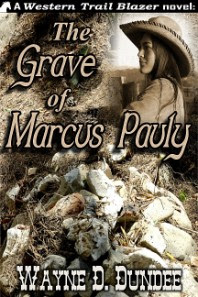
But I have never come close to dealing with anyone more personable or genuinely charming than Rebecca "Becca" Vickery and her staff at Western Trail Blazers. Having only just broken into the Western genre a few months prior, with the publication of my first novel, I submitted a novella entitled "The Grave of Marcus Pauly" to WTB for consideration as part of their Dime Novel line. In this age of e-mails, I heard back very promptly from Becca and was delighted to hear she wanted to publish "Grave". That was in June of 2011. In quick order, Becca also accepted two more works I submitted: "O'Doul", another short Dime Novel; and HARD TRAIL TO SOCORRO, my first novel-length work for WTB and the first title in my Bodie Kendrick – Bounty Hunter series. These all appeared in 2011, and another Dime Novel, "This Old Star", came out in 2012. [Note: "This Old Star" originally appeared in a 2010 anthology, Bad Cop...No Donut (Padwolf Publishing.)]

"O'Doul" spent a nice amount of time in Amazon's Top 100 sales ranking for Westerns, and I often joked that I wished to heck I hadn't killed off the title character by the end of that tale. But, alas, it was too late. My Bodie Kendrick character, however, I definitely did not kill off in HARD TRAIL TO SOCORRO. He was planned right from the get-go as an ongoing series protagonist. And while HARD TRAIL didn't enjoy much time in the Top 100, its sales were nevertheless encouraging enough for me to continue with more adventures featuring Kendrick. Hence, RIO MATANZA appeared in 2012 and Book #3 in the series, DIAMOND IN THE ROUGH, came out just last week.


I can't overstate the importance Becca and WTB has been to my writing in the Western genre. Through much of it, Becca has been fighting health issues yet in no way has this affected her charm or professionalism. The prayers and best wishes—certainly including mine—of all who know Becca on a personal or professional level (and the two are really one and the same) are with her in her brave battle. When the battle is won, I look forward to working more with her in the future. The world of Western fiction needs Becca and WTB.

Persevere-   Wayne Dundee


Note: To find all these works and many more, check out Wayne's Amazon Home Page and check out his BLOG

Friday, February 1, 2013

THE HELP YOU GET ALONG THE WAY--by Cheryl Pierson


Do you have a “collection” of special people in your life? People that helped you in ways maybe you hadn’t really given much thought to, but that turned out to be extremely important? One of the first milestones in my writing career—becoming a finalist in the EPIC Awards with my first novel, FIRE EYES—brought this realization home to me. I got curious. I know there are incidents in people’s lives that are pivotal to their entire careers, dreams, and goals, that, perhaps at the time, don’t seem that important. Later, looking back on it, it becomes an “aha” moment—you understand that THIS was the moment when you made the decision to do something you might not have done otherwise, or because of a word of encouragement you continued on when you’d been ready to stop.

Most people that I’ve met in the last half of my adulthood would never describe me as “shy,” but as a youngster, I was—horribly. That’s one reason I turned to writing. It was a great way for me to get my feelings out without actually having to say them. I could have someone else say it all for me.

I imagine that’s how many of my fellow writers started, too. I sometimes wonder what might have happened had we all known each other when we were younger. Would we have developed into the writers we are today, or would we have found our “niche” with one another and NOT turned so much to writing?

If you can relate to the “shy” part, then maybe you felt this way, too: I was never competitive. Not like so many sports contenders might be. The things I enjoyed, writing and music, were open to everyone, I felt. I am not a “joiner” and I am not one to enter a lot of contests. I entered FIRE EYES in the 2010 EPIC Awards competition, and something odd happened when I did.


From the moment I entered, my attitude about myself changed. BEFORE I entered, I thought, “I probably don’t have a chance.” But my mom always used to say, “If you don’t enter, you certainly are NOT going to win!” I remembered those words, and sent in my entry that very day. Once it was sent, I began to feel some confidence growing. As I analyzed WHY, here’s what I came up with.

FIRE EYES was a joint project. I wrote it, but I couldn’t have if I hadn’t had the cooperation and support of my family—my kids and my husband. While I was writing it, my oldest sister, Annette, was constantly asking about “how it’s coming” and she was the one I could bounce ideas off of. Once written, my business partner read it for glaring mistakes, and my best friend of 45 years read it for moral support. The Wild Rose Press accepted it, and my editor, Helen Andrew, was so phenomenal in helping me mold it and shape it into the story that was released last May. My cover artist, Nicola Martinez, did a superb job on the beautiful cover. My family and friends were all pulling for me, and constantly offering encouragement. With all these people behind me and my story, my confidence rose. Whatever would be, would be—and entering the competition was a win/win situation. Even if I didn’t make it to the finals, I would still have taken the chance and had the experience.

When I received the news that my book was, indeed, a finalist, I thought immediately of all the people who had helped me get to this point; people in my life who had faith in me, and in my ability, and in the story itself. I thought of that saying, “It takes a village to raise a child.” It’s true, even in the broader sense of our lives as writers. The experiences we had growing up, people who encouraged us even then, our spouses, our children, mentors and teachers we’ve had along the way, and peers that have helped and encouraged us. Editors, artists, publishers and organizations such as EPIC that give us a chance to compete and strive to be better and better, along with our readers, are all part of the completed circle of a successful writer’s endeavors.


Though FIRE EYES didn’t win that year, the experience of entering the competition and finaling in it was more important that I could have realized when I sent my entry in. It was the thing that made me understand just how many people had been involved in the entire process of writing that book. And it gave me the impetus and encouragement to move forward with the rest of my writing projects since that time. That realization was far more important than winning the contest, and has been with me every day, like a component of myself that I didn’t have before; another part of my make-up.

Since then, FIRE EYES has gone to a different publisher, WESTERN TRAIL BLAZER. With yet another great cover, this time by Karen Nutt, and a fantastic publisher, Rebecca Vickery, it’s once again seeing renewed success. But moreover, that’s yet another example of the help I’ve gotten on my writing journey.

Does anyone have a “special person” that helped them along the way? Not just in writing, but in your life’s goals and dreams? What about a “collection” of special people? My “collection” of special people in my life is the thing that I am most thankful for above all else. Without them, my dreams could have never happened. I could never have done it alone.

Cheryl's Amazon Author Page:
https://www.amazon.com/author/cherylpierson