Showing posts with label West of the Big River. Show all posts

Tuesday, May 1, 2018

Western Fictioneers Book Review


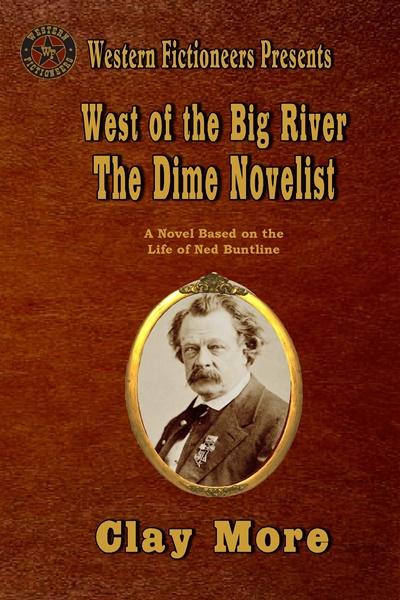
West of the Big River: The Dime Novelist
by Clay More

The historical novels in the West of the Big River series from Western Fictioneers have centered around a number of actual figures from the Old West, exploring the realities of their existence as well as some of the myths and legends that have grown up around them. Now, in THE DIME NOVELIST, the latest volume in the series, acclaimed Western author Clay More takes a closer look at someone who knew many of those historical figures and helped mold their myths and legends: Colonel Edward Zane Carroll Judson, better known to the millions of readers of his hundreds of dime novels by his most famous pseudonym, Ned Buntline.

Judson lived an adventurous and exciting life himself, running away from home at an early age to become a sailor and going on to a career packed with events. Married six times—or was it seven?—he dabbled in business and politics but more than anything else was a writer, publishing several different magazines as well as authoring millions of words of dime novels, articles, and essays. More’s narrative, as Judson reminisces about his life to a young journalist, is one fascinating and colorful story after another, most of them with a germ of truth but also a great deal of embellishment. Buffalo Bill, Wild Bill Hickok, Wyatt Earp, and many more come into and out of Judson’s life, strutting their stuff in the words of a great yarn-spinner. Judson yearned for literary success and respect that he never quite achieved, but in its place he entertained countless people who read his work.

As Ned Buntline, Edward C.Z. Judson is sometimes credited with creating the mythic version of the Wild West. THE DIME NOVELIST is a fascinating exploration of that legend and a brilliant portrayal of a largely forgotten but hugely influential figure in American popular culture. Those of us who write Westerns owe a lot to him, whether we know it or not.


—James Reasoner author of  Outlaw Ranger


Marta’s Ride 

by Gordon L Rottman

Brutal and violent, but beautifully written, Marta’s Ride is both a love story and a story of survival. The tale is told in the first person by Marta, a young, mute, Mexican girl who manages to create a “normal” life for herself in spite of the circumstances of her birth, her infirmity, and her lack of family and money. After meeting Bud, an Anglo man on the road, they become inseparable and their life assumes a semblance of normalcy as she becomes a cook and he becomes a rider for a successful rancher.  Life, however, takes a horrific turn as four young girls, including Marta, are kidnapped by a ruthless band of bandidos that terrorizes the borderlands between Texas and Mexico. Can and will Marta and the other three girls be able to survive daily assaults, rapes, hunger, and fatigue makes up the major part of this story. First person narratives are difficult to execute, but Rottman not only undertakes the task but proves to be efficacious in doing so.

For those readers who enjoy a good western; a strong, well-developed protagonist; and rich imagery, I suggest they tackle Marta’s Ride. I must warn the readers that many of the scenes are brutal, but they only corroborate the strength of Marta’s and the other girls’ characters. One caveat: do not begin reading in the evening, because you’ll be in for an all-nighter. As with so many first-rate novels, I had difficulty putting it down. 

 —Jesse J Elliot, author of Death at Gran Quivera


Showdown at Squaw Pass 

by  Robert B McNeill


When two drovers are found dead on the Western Trail near the Texas town of Cutter's Crossing, marshals Hank Ross and Abe Naylor aim to find their killers and bring them to justice. But their task is complicated when the local schoolteacher, Alice Carnaby, is kidnapped by the drovers' killer, who heads for Mexico with her. Ross and Naylor join forces with George Bowman, a half-breed Indian tracker, and set out after them. However, an unscrupulous local rancher has his own reasons for making sure the marshals don't succeed in freeing Alice, and sends four men to kill both her and the marshals. The rancher is determined there will be no witnesses - and therefore no trial …

This was a great, easy to read story with enough action to keep the pages turning.

When the son of a wealthy man takes it into his head to kill a drover who shows some attention to the woman he loves, it leads to an abduction and chase towards the border.

Except the father has his own agenda and sends his foreman after the wanted and the posse with the instructions that no one apart from his son should return.

After a bloody pursuit it all comes down to one day in court where the only thing from setting two killers free is the word of a woman.

This author knows his stuff and I'll be reading more of his stories.

—Brent Towns Author of Lightning Strike!

Beneath A Horse-Thief Moon

by Elizabeth Clements

Chase Reynolds is on the trail of stolen gold -- but he runs into a woman from his past. A woman he'd long believed dead. Can he find romance with Sara again, or is she somehow involved in the theft? 

This is an exciting read, with outlaws, kidnappings, missing gold and stolen horses. If you like a good romantic adventure, this is a good choice.Chase and Sara are believable characters, and you want everything to work out between them. I can tell you that you'll be satisfied with the ending without giving away any of the surprises along the way.

—J.E.S. Hays Author of Devon Day and the Sweetwater Kid: Down the Owlhoot Trail


Monday, April 30, 2018

Now Available -- West of the Big River: The Dime Novelist by Clay More


Adventurer, showman, charlatan, best-selling author, Ned Buntline was all of these things and more, including one of the most colorful characters in American history. Buntline, whose real name was Edward Zane Carroll Judson (he called himself Colonel Judson, but the rank was as fictional as the pseudonym), produced hundreds of dime novels during the second half of the 19th Century and was the leading author of popular fiction during this period. He was also a womanizer, a liar, and a self-promoter who made heroes out of Buffalo Bill Cody and Wild Bill Hickok but never missed a chance to build his own name and legend. Acclaimed Western author Clay More has painted a vivid portrait of this larger than life figure in THE DIME NOVELIST, the latest historical novel in the popular West of the Big River series from Western Fictioneers. It’s a tale filled with adventure, fantastic characters, and the raw enthusiasm of a young, expanding country.

“Ned Buntline is sometimes credited with creating the mythic version of the Wild West. THE DIME NOVELIST is a fascinating exploration of that legend and a brilliant portrayal of a largely forgotten but hugely influential figure in American popular culture.” – James Reasoner, best-selling author of THE LAWMAN

EXCERPT

Nashville, Tennessee

March 14, 1846

     The judge rapped his gavel on his desk and called for order.
     “I will have silence in this court! Now pipe down all of you or I’ll have the marshal and his deputies begin arresting folk.”
     He grunted, pushed his wire-framed spectacles further up his aquiline nose and turned his attention to the defendant sitting nonchalantly as he wrote in a small notebook at the table by the window.
     “You, Mister Edward Judson, have stirred up a dust storm of trouble for yourself. If you haven’t already, I would suggest you start praying that Robert Porterfield makes a full recovery, instead of scribbling away. Now put that book away and have some respect for this hearing.”


Friday, December 16, 2016

STICK TO THE FACTS by JERRY GUIN


I wrote my first book back in 1995. It is a nonfiction book titled Matsutake Mushroom, which was published in 1997. It is simply a true story about the harvest and sale of wild forest mushrooms, from the Pacific Northwest, for profit.

My education began when I started selling the book.

https://www.amazon.com/West-Big-River-Western-Novels-ebook/dp/B01I5T0LVA/ref=asap_bc?ie=UTF8
I visited the publisher to pick up a few copies to get started. When the publisher learned of my intended five-day, three-state tour, she insisted that I take on 400 copies. Despite my reluctance to attempt to sell so many, I took the books. What the heck, if they did not sell, I could always bring them back.

I was received warmly by many small book stores and convenience stores. The average sale was three to five copies. I visited the area where the actual story of the book took place and found that I had many critics. Men would thumb the pages and ask, “Where's the pictures?” Women would ask, “What kind of recipes are in here?” That book contained neither. Where did I go wrong? The story is based on actual facts, which no one can dispute. It seemed that some folks expected something other than what I was offering but, thankfully, by the end of my tour I had sold over 300 copies.

I learned quickly that if you are going to write nonfiction, number one, you better know what you are talking about and number two, don't get too far off the beaten path of what is expected. The book, hard copy only, still sells modestly.

Around 1995 I turned to writing what was and is my predominant interest, which is western fiction.
I never expected to write award winning stories such as those by greats Louis L'Amour, Zane Grey or Max Brand but I felt that I could spin a yarn, which could be construed as actually happening.

https://www.amazon.com/Code-West-Classic-Western-Novels-ebook/dp/B01JM2UONO/ref=asap_bc?ie=UTF8
I began writing short stories and presented them for consideration with mild success.

https://www.amazon.com/Traditional-West-Western-Fictioneers-ebook/dp/B005E1JI8U/ref=asap_bc?ie=UTF8
In 2011 I was accepted as a member of Western Fictioneers. Happy to correspond with well known authors Robert Randisi, James Reasoner, Frank Roderus, Jory Sherman and others. I was greatly inspired by having a story included in the Fictioneers first anthology, The Traditional West. It got the creative juices flowing.

Troy, Livia, Cheryl and others offered and encouraged me to write compelling stories that aren't necessarily true but could have happened, if given enough historical facts to support the tale. The more facts you can produce, the better.

https://www.amazon.com/Once-Drover-Jerry-Guin-ebook/dp/B01D7P3MD6/ref=asap_bc?ie=UTF8
The actual history involved in a story could leave a writer scratching his head to find a way around it. I will not attempt to change history in any of my stories. The story has to revolve around the facts.

The Wolf Creek series is purely fiction and locked into 1871, now 1872.

In Wolf Creek 16, Luck of The Draw, part two, one of my characters is Luke Short, yes the famous gambler and gunman. Young Luke Short, eighteen at the time, according to history, did participate in driving a herd of cattle to Abilene, Kansas. He wanted to be a gambler so bad that he gave up trailing cattle and set out to make his own way as a professional gambler.

https://www.amazon.com/Wolf-Creek-Luck-Draw-part-ebook/dp/B01GFCWVR6/ref=asap_bc?ie=UTF8
For the purpose of putting a well known name into 'Bet The Boots' I used Luke Short. One, he was a gambler. Two he was in Abilene in 1871 and turned to gambling as a way of life. So I had him stop into Wolf Creek for the poker tournament. In actuality, as far as anyone knows, after Luke left Abilene he was known to be selling rotgut whiskey in a buffalo camp on the plains near what would later become Dodge City.

If Wolf Creek existed at the time, lured by the gambling, why wouldn't Luke pay a visit? In my mind his appearance in the story is believable without disturbing historical facts.

Stretching the truth a little, such as a potion salesman's claims of the miracle cures by the consumption of his product is as far as I will go in pushing the envelope.

Creating heroes, hardships, finding a lost love or having a character cheat, steal, or kill others are enough to keep any writer busy crafting a believable story around historical facts.

https://www.amazon.com/Wolf-Creek-Hunters-Moon-18/dp/1540539717/ref=asap_bc?ie=UTF8
Nobody can change history and a good story will reflect the facts as they are.


Jerry Guin is a member of Western Fictioneers and Western Writers of America.

He has authored more than 40 western fiction short stories and 7 western novels.

His latest novel– Once a Drover – was first introduced in 2014 by Western Trailblazer.
It was re-introduced by Sundown Press in 2016.


Thursday, March 5, 2015

BOOK REVIEW: JERRY GUIN'S "WEST OF THE BIG RIVER: THE BANDIT" by Charlie Steel


                                                                   Author Jerry Guin
 

Even though WEST OF THE BIG RIVER: THE BANDIT has been out for a while, it is a book well worth reviewing.
I admire and like the way Western Author Jerry Guin writes.  He has a clean, no nonsense style that makes the message clear and the meaning of words and sentences shine.  He writes a well-researched book about the outlaw Sam Bass and he does it in a manner that can be read by all ages, young and old.  I respect his choice to describe adult situations in a manner that offends no one, yet remains clear as to the gritty seriousness of life.
Guin starts his book with Sam Bass as a helper in a jail.  It holds the outlaw Claude Rankin who that very day is going to hang for murder.  Bass, a fairly innocent young man, asks Rankin if he is afraid.  The response is no, and then the outlaw proceeds to calmly and elaborately describe to Bass what the hanging will be like.  Afterwards, he explains that he chose to live the life of an outlaw and, therefore, he has no regrets and is not afraid to die.  THAT sets the tone for this Western Fictioneers, West of the Big River, novel.
Despite the youthful Sam Bass being befriended by an honest sheriff, the reader begins to discern Sam’s dislike for the drudgery of hard work.  It isn’t that Bass is afraid or incapable of working hard, it is that he just wants an easier way of making a living.  Looking for fast money and a way of getting it, the young Sam Bass turns to card gambling and horse racing.  This leads to association with unsavory characters.
From horse racing, to a clever cattle rustling scheme from Texas to Kansas, to the Dakota gold strike at Deadwood, Sam Bass continues to set his footsteps toward the dangerous excitement of thievery.
Jerry Guin has a way with words that evokes clear images of living history, here’s an example:

 “It was a brisk, sunshiny October day when the foursome rode into Deadwood.  Sam figured the place was the grubbiest burg that he had ever laid eyes on.  It didn’t appear to be much of a town that was built in a gulch.  The middle of the single street was deep in mud with ditches, holes, manure, and tree stumps.  One and two-story, frame buildings snugged together on both sides of the roadway.”
Here is a further unique historical description of Deadwood:

“By nightfall they found out everything in this northern town was at least double or triple the price of what they were used to paying.  A sleeping cot in a large room full of snoring drunks cost a dollar a night.  A decent room cost up to five dollars a night as opposed to fifty cents to two dollars, depending on the quality, in Texas or Kansas.  When it came to food, fifty cents would buy a bowl of gruel or greasy stew, while a decent meal of meat, potatoes, and bread cost one to two dollars, whereas twenty-five cents to fifty cents was common for fare in cattle towns.  It cost a dollar a day just to feed and house a horse.  The high prices were merely the cause of high demand by the growing crowd of wide-eyed strangers coming to the gold rush.  At times during the day or night a thousand men or more crowded the streets and business establishments.  It was indeed a carnival atmosphere to merely sit and watch the activities up and down the street.  Freighters coming in to deliver goods and getting their wagon stuck in the muck on the street while teetotalers pointed and laughed, others would rush out to lend a hand to the stranded wagon.  Hammers banged in the clear morning air as carpenters worked at a frenzied pace in getting a new building erected, while nearby in the street, donkeys brayed and freighters urged on their teams with cussing commands.  This was Deadwood.”
And, there is a lot more to this book.  As time goes on, Sam Bass and the partners he meets up with fall on hard times.  The winter in Deadwood is cold, the prices high, and the mining and freighting he tries, fails miserably.  Bass resigns himself to petty stealing.  Then with five other men he robs a train and finds aboard thousands in gold coins.  The six men split up and travel away from the train robbery.

Sam Bass’s continuing adventures can best be left to the reader.  For certain, this is a finely researched historical piece of fiction written by one of the best and upcoming writers of the west.  Jerry Guin has a way with words and description.  I give it five stars.  Readers of all ages will devour it without qualm and come away knowledgeable in the way of a real life outlaw.


                                                        Reviewed by Charlie Steel
 

Saturday, December 6, 2014

Western Fictioneers Presents -- WEST OF THE BIG RIVER: THE SHERIFF by Chuck Tyrell


Outlaws ran wild in Apache County, Arizona Territory, until the day a long-haired, straight-shooting cowboy with the unlikely name of Commodore Perry Owens pinned on the sheriff's badge and set out to rid the county of lawlessness. Owens would need every bit of his gun skill just to stay alive as he cleaned up the territory!

Acclaimed Western author Chuck Tyrell brings the illustrious career of Commodore Perry Owens to vivid life in THE SHERIFF, the latest entry in the West of the Big River series from Western Fictioneers. An action-packed blend of history and fiction, this novel is a compelling portrait of a brave man in a time and place that have become legendary. It's excitement all the way in this new West of the Big River saga!

EXCERPT

    Four riders pounded toward us from the east, raising a cloud of dust and firing like they had all the bullets in the world. I took a bead on the lead horse, a three-color paint, and squeezed off a shot. The horse went down and the rider tumbled head over heels to the ground. When he scrambled to his feet, I put him down again with a shot in the brisket. I jacked another shell into my Winchester. 
    I switched my aim to another rider, not worrying about the one I’d shot. He was dead.
    The other three scattered. There wasn’t all that much cover on the flat, but they ran for what there was. Andy was firing, but the running horses showed that his lead took little effect.
    “Aim for the horses,” I hollered.
    A six-gun cracked and a bullet plowed into the dirt not an inch from my left foot. I whirled and pulled the trigger when the Winchester’s muzzle lined up with Denny, whose hand worked at earing back the hammer of an old Colt Army M1861. My bullet took him just above the belt buckle and knocked him on his butt, where he sat, staring with disbelieving eyes at the blood stain spreading on his shirt.

BIO
Charles T. Whipple, an international prize-winning author, uses the pen name of Chuck Tyrell for his Western novels. Whipple was born and reared in Arizona’s White Mountain country only 19 miles from Fort Apache. He won his first writing award while in high school, and has won several since, including a 4th place in the World Annual Report competition, a 2nd place in the JAXA Naoko Yamazaki Commemorative Haiku competition, the first-place Agave Award in the 2010 Oaxaca International Literature Competition, and the 2011 Global eBook Award in western fiction. Raised on a ranch, Whipple brings his own experience into play when writing about the hardy people of 19th Century Arizona. Although he currently lives in Japan, Whipple maintains close ties with the West through family, relatives, former schoolmates, and readers of his western fiction. Whipple belongs to Western Fictioneers, Western Writers of America, Arizona Authors Association, American Society of Journalists and Authors, Asian American Journalists Association, and Tauranga Writers Inc.

BUY LINKS     B&N Nook      Smashwords


Saturday, May 31, 2014

Western Fictioneers Presents West of the Big River: The Doctor by Clay More

In Tombstone, Arizona Territory, the town too tough to die, Dr. George Goodfellow is known as the Surgeon to the Gunfighters. Friends with the Earp brothers and Doc Holliday, his services as a doctor are needed in the aftermath of the Gunfight at the O.K. Corral, but Goodfellow is handy with a gun and his fists, too, and he needs those skills to survive when he's stalked by a crazed miner and has to untangle a deadly murder mystery!

The West of the Big River series continues with THE DOCTOR, an all-new, exciting novel based on actual historical characters and incidents by acclaimed Western author Clay More, author of STAMPEDE AT RATTLESNAKE PASS and many other novels from the Western Fictioneers Library. One of the most stirring time periods in Old West history comes to vivid life in this tale of vengeance and heroism and a frontier sawbones dedicated to healing.

Excerpt:

Tombstone, Arizona Territory, 1891
Dr. George Goodfellow removed his stethoscope from the man’s bare back and went back to his roll-top desk.
“You can get dressed now, Stanley,” he said as he picked up his pen and made some notes on the record card in front of him. “You have a slight bronchial irritation, but nothing too serious. I’ll make up a cough linctus for you and drop it off at your office before lunch.”
Stanley C. Bagg, the five-foot tall owner and editor of the Tombstone Prospector and laterally, also the owner of the Tombstone Epitaph, tucked his shirt into his pants and pulled on his jacket. Then he pulled out a pair of wire-framed spectacles from his breast pocket and settled them on his thin nose.
“Thank you, George,” he said, standing and immediately provoking a coughing fit. He covered his mouth with his hand and then thumped the front of his chest, which seemed to have the desired effect in stopping the cough. “I guess it is inhaling all that darned paper dust and ink fumes that does it.”
The two men were old friends, as were their wives and daughters. Or at least, their wives had been good friends until the month before when Dr. Goodfellow’s wife Katherine died in Oakland from the tuberculosis that had plagued her for years. And both men were known to be forthright in their opinions and in their manners. Stanley was a bullish, combative newspaperman who for all his lack of height was a formidable man to cross. He had been prepared to serve a jail sentence for contempt of court when he refused to pay a fine imposed upon him by District Judge Barnes. Fortunately, several of his friends, including his friend and doctor had donated money to keep the newspaperman out of jail, while leaving his personal integrity intact.
As for Dr. George Emory Goodfellow, he had built the premier medical practice in Tombstone and garnered a considerable reputation throughout the Southwest as the surgeon to have operating on you, if you had a choice. He was prepared to push back the frontiers of his craft and perform operations that no one had tried before or even thought to be possible.
“It is probably more to do with those evil-smelling cigars that you insist on smoking. I’ve told you before, you are poisoning your system.”
Stanley guffawed. “And that is coming from a man who was advising me that a good pipe keeps a lot of diseases away when we were chatting just last week.”
George stood up. He was taller than the newspaperman. He was thirty-six years old and powerfully built, like the boxing champion he had been at the United States Naval Academy at Annapolis in his youth. He had been hotheaded back then and gotten involved in a fight at the Academy, the result being a win for George. Unfortunately, his prize was expulsion and discharge for lack of respect for discipline. That had been the time when he had chosen to make his career in medicine.
He had black hair with a central parting, a full mustache and steely eyes that could smolder with anger, twinkle with amusement or which could be reassuring in the extreme. As usual he was wearing a bow tie and a dark suit with his polished knee high boots.
He pointed to the wall above his desk upon which hung his framed medical degree beside a framed copy of the Hippocratic Oath, and in a small glass-fronted box a silver double-headed eagle medallion of Austria, which had once been the property of Emperor Maximilian of Mexico. Stanley had written an article about it when it had been presented to Doctor George Goodfellow by President Porfirio Diaz, along with a horse named El Rosillo in 1888 following the Sonora earthquake. They were given as tokens of Mexican esteem after he had loaded up his wagon with medical supplies and led a party ninety miles to Bavispe, Sonora, Mexico to treat survivors and injured. Then in the following months he had returned along with Camillus Sidney Fly, the town photographer, to study and record the effects of the earthquake. Together they travelled over seven hundred miles through the Sierra Madre Mountains. Both Camillus Fly’s photographs and George Goodfellow’s maps and reports earned national praise. The photographs of the earthquake rupture scarp were widely syndicated and George’s geological study had been praised by the united States Geological Service.
Stanley knew that his friend was proud of the award, yet he was far prouder of the fact that the townsfolk of Bavispe had called him El Santo Doctor, the sainted doctor. His fluency in Spanish had helped, since he could communicate, explain and reassure the injured in their own tongue. It was typical of the man that he cared more about what his patients thought of him as a doctor than he did for all the accolades and prestige that he seemed to accumulate with little effort. He was just a natural subject for newspaper coverage, one of those characters that the frontier seemed to throw up every now and then.
But it was to the framed Oath that George directed his attention. “See that Hippocratic Oath, Stanley?” he asked rhetorically. “You know as well as I do that I live by it, as best I can. If I take someone on as a patient I’ll give him or her the best treatment I can and advise them to the best of my ability. You have to accept that sometimes, like when we were chatting last week, my best may be impaired. If you recall we were playing poker at the time in the Crystal Palace saloon and we had both drunk four or five whiskies. I actually said that a good pipe kept some diseases away, on account of pipe tobacco’s natural ability to keep pesky flies and bluebottles away from the vicinity. And as you well know, the good Lord blessed us here in Tombstone with more than our fair share of the creatures.”
His hands went up to grasp the lapels of his coat, a slightly pompous mannerism of his that many folks found intimidating, because it was usually accompanied by a slight raising of his jaw and a triumphant twinkle in his eye that signaled, at least in his mind, that he had either won, or was about to win an argument.
“So, my friend, you can see that the advice I gave you was the best I could give under the circumstances.”
Stanley opened his mouth to protest when there was a sudden commotion from the waiting room outside. Voices were raised and there were exclamations of amazement. Then there was the noise of heavy boots racing across the wood floor and a beating on the door was followed by it being immediately thrown open.
“Doc Goodfellow! You’ve got to come over to Campbell and Hatch’s Pool Parlor. There’s a guy dying there.”
George recognized the messenger as Walt Harper, one of the ushers from the Schieffelin Hall. He could see the panic in his face.
“I didn’t hear any shooting. What is it, a knifing?”
“It’s Red Douglas. He’s choking and seems to be having some kind of fit.”
The doctor had already sprung into action. He had grabbed his black bag then dashed to a cupboard from which he took out a couple of small wooden cases which he threw into the bag.
“Stanley, don’t you come. That cough will start up if you try to run. Get going, Walt, I’m right behind you.”
“And miss a story?” Stanley rejoined him. “Not on your life. I’ll just take the stairs nice and easy and I’ll meet you there.”
But the town doctor had already gone. As he charged through the waiting room he barked a quick, “Emergency call, folks. I should be back in half an hour.”
Then he was out the door and dashing down the outer steps of the Crystal Palace Saloon from his office.
As was often the case when folks saw Dr. Goodfellow racing someplace he attracted a number of followers who tagged on behind him. Tombstone was that sort of place. It had a lot of folks who seemed to have an unhealthy interest in sudden death. As long as it wasn’t their own.

Clay More is the western pen-name of Keith Souter, a part time doctor, medical journalist and novelist. He lives and works within arrowshot of the ruins of a medieval castle in England. In 2014 he was elected as Vice President of Western Fictioneers and he is also a member of Western Writers of America, The Crime Writers’ Association, International Thriller Writers and several other writers organizations. 

He writes novels in four genres – crime as Keith Moray, Westerns as Clay More, Historical crime and YA as Keith Souter. His medical background finds its way into a lot of his writing, as can be seen in this novel about Doctor George Goodfellow as well as in most of his western novels and short stories. His character in Wolf Creek is Doctor Logan Munro, the town doctor, who is gradually revealing more about himself with each book he appears in. Another of his characters is Doctor Marcus Quigley, dentist, gambler and bounty hunter. He has recently published a collection of short stories about him in Adventures from the Casebook of D Marcus Quigley, published by High Noon Press.

If you care to find out more about him visit his website: http://www.keithsouter.co.uk
Or check out his regular contribution about 19th Century Medicine here on the WF blog.

Saturday, December 14, 2013

Holiday Sale -- West of the Big River: The Artist Only 99 Cents


For one month, the ebook of this amazing western about Charlie Russell will be on sale for only 99 cents. This is a series that does not have to be read in any order, so if you haven't read one of the West of the Big River novels, this is the perfect chance to start.  It has ten 5 star reviews on Amazon.

Before he was a world-famous Western artist, Charles M. "Charlie" Russell was a horse wrangler on a ranch in Montana during the worst winter in that state's history. The danger of freezing to death while riding for the brand isn't the only threat Russell has to face, however. A ruthless band of rustlers is sweeping the range of cattle, and a beautiful but trouble-making rancher's daughter complicates Russell's life even more. He'll need more than his artistic ability to survive this deadly winter!

THE ARTIST is the third volume in the popular West of the Big River series from the Western Fictioneers. Acclaimed author Jackson Lowry spins as entertaining a tale as any of those from Charlie Russell himself in this superb new historical novel.

Sample:

Chapter One

    "Kin I have this here dance?"
    I looked up at about the ugliest galoot I'd ever laid eyes on. He was more a scarecrow than a wrangler, but my opinion formed more because of his shabby clothes, which looked as if he had stripped them from said scarecrow out in some granger's cornfield. The red-and-black checked flannel shirt could have been used as a checkerboard, if you didn't mind the pieces getting greasy while they waited to be jumped around and turned into kings. His voice screeched above the tune the piano player hammered out with less skill than enthusiasm.
    Nobody else in Gus' Watering Hole cared that the piano player missed every other note in The Boogaboo. For my part, I appreciated that he hit that many. In the past he had missed most notes 'til the song about the poor girl fearing a man's parts sounded more like a scalded cat dancing across the keys than a talented musician plying his trade. His voice had been sandpapered down to a hoarse croak easily drowned out by his piano work, which was likely a good thing. But I appreciated his sprightliness.
    "I ain't much the dancin' sort." I watched his face cloud over at the insult. "Not sayin' you ain't my type, mind you, but you'd have to let me lead."
    "Won't do that," he said, hitching up his gun belt, more to show off his brand spanking new .32 caliber Lemon Squeezer than to be menacing. He wore that double action Smith & Wesson high on his right hip in a soft leather holster. Not a shootist but a wrangler like me. Unfortunately I had left my iron back at the bunkhouse. All I had was a knife shoved into the broad rainbow colored nine-foot-long Hudson's Bay sash I wore wrapped around my middle.
    "Aw, go on, Charlie," my partner said, reaching over to nudge me hard. "You jist sit and suck up Gus' tarantula juice scratchin' pitchers into the table. Have yerse'f some fun fer a change."
    Rusty Rawlins brushed away some spilled foam from my beer that had hidden the latest effort I'd made with my knife point in the wood tabletop. Since I had lost my drawing pencil I had to make do with whatever came to hand. His stubby fingers traced over a carved likeness of the best looking whore in town. Or had been in town until a week ago Thursday when she climbed on the stagecoach. Most men in town had lined the streets, hats doffed and heads bowed like they were at a funeral. I was pining for Maggie something fierce myself, but she and most all of the other soiled doves had gone south for the winter because Montana winters could freeze the balls off a brass bull. She had asked me to go along with her, but I couldn't let down Jesse Phillips, the owner of the OH Ranch, who had been so good to me. As much as I longed to share Maggie's bed all winter long, loyalty to Mr. Phillips was greater than lust.
    Ever since I'd got a job riding night herd from Horace Brewster, nothing but wrangling interested me. Well, not like Maggie interested me, but I don't talk about women much, even if I have a way with them. More than one of the whores in the same crib as Maggie showered their affections on me in exchange for a little drawing of them. I always was careful to make sure they showed up in fancy dresses. They liked that. Maggie, well, Maggie I did a few for her naked as a jaybird because she enjoyed showing them to other customers. Truth is, I didn't mind her posing for me like that one little bit.
    But I was a tad ashamed of the etching I'd put into the table.
    The drover who'd asked me to dance leaned over. His mouth fell open and a drop of chaw spattered onto the table. Rusty hastily wiped it away since it had fallen right on Maggie's likeness.
    "You and her, you do that to her? She let you do that to her?" The wrangler moved closer and poked his S&W in my ear, crowding to get a better look. The new gun oil made my nostrils flare.
    "Naw," I said, lying like an Indian rug. I wished I hadn't added the extra details — me — along with the scratching. "Wanted to but never did."
    The wrangler stared hard at me, then stepped back and squared off, like he was fixing on throwing down.
    "You're a liar. And you don't wanna dance with me."
    The piano player had finished butchering The Boogaboo and moved on to the even raunchier The Keyhole in the Door. I'd always appreciated that one, having taken some pleasure myself spying on Maggie when she wasn't wearing even "a sky blue garter."
    "You gonna dance with me? Or are you too consarned good for that, you who's done that with a woman?" He glanced toward the etching in the wood, then he shot a gob of tobacco juice in the direction of Gus' fine cherrywood bar.
    The gob hit the corner and trickled down. I stood and pointed.
    "See that brass turtle on the floor? That there's a cuspidor."
    "What?" He looked confused at the way I'd gone from denying him the pleasure of a dance, our spurs clinking and our boots tromping on one another's toes, to the cuspidor.
    "I designed that brass turtle for Gus." I stepped over, applied the toe of my boot on its tail and the shell stood upright to reveal a right fine spittoon. Gus hadn't bothered cleaning it out in a while, so even the brass was corroding. "You want to dance, you got to act polite."

      
  nook link
Also available on Smashwords

Friday, November 29, 2013

Western Fictioneers Presents West of the Big River: The Bandit By Jerry Guin

Sam Bass was just a farm boy from Indiana, but he wound up in Texas and became one of the most notorious outlaws in the history of the Old West. Texas history has often referred to Bass as "Texas' Beloved Bandit" or "Robin Hood on a Fast Horse"  Jerry Guin's historical novel THE BANDIT takes an unflinching look at the life and times of Sam Bass, from his almost accidental incursion into a life of lawlessness to his ill-fated end, and provides a vivid portrait of this violent era. Western Fictioneers is proud to present the latest entry in the acclaimed West of the Big River series.

Jerry Guin is best known as a short story writer with 28 to his credit. His book, "Trail Dust" captures 12 of those stories.

Jerry has written "Matsutake Mushroom," a nature guide book. He wrote his first western novel, "Drover's Vendetta" in 2011. Followed by "Drover's Bounty," a Black Horse Western released by Robert Hale Ltd. August 2013.

Recently he had stories appear in the following anthologies, "Outlaws and Lawmen" by La Frontera publishing and "Six-Guns and Slay Bells, A Creepy Cowboy Christmas" by Western Fictioneers. Also through Western Fictioneers, Jerry wrote chapter one of "Wolf Creek, Dog Leg City, Book 3."

Jerry lives in the extreme Northern California community of Salyer with his wife Ginny.

Kindle                              Trade
   

Barnes & Noble Nook Link

Smashwords Link

Saturday, October 5, 2013

THE FORTY-NINERS (WEST OF THE BIG RIVER SERIES)--BY CHARLIE STEEL


I am honored that under the direction of Livia Reasoner, September 30, 2013, my book, THE FORTY-NINERS (part of the West of the Big River Series) was published by Western Fictioneers in digital format and as a trade paperback.

THE FORTY-NINERS follows three main groups who end up traveling to the gold fields. People went to the gold fields in California for many reasons, some to escape poverty, others for adventure, and some who were simply running away from their past lives.

The main protagonist is a white slave named Lance, living in St. Louis, Missouri. In the south and southwest, after generations of relations with female slaves, there were many captives who appeared as white as their masters. Following the “one drop of blood” rule, any slave who had documented proof of being black, Indian, or Spanish, regardless of skin, hair, and eye color, was still considered to be of that race, no matter their outward appearance. Such white skinned slaves were common, and are one of the many reasons abolitionists were so incensed as to call for the immediate emancipation of slaves and the end of all racial segregation.

In my story, Lance has reached his twenty-first birthday and has all he can take of slavery. He would rather die than face one more day without freedom and so he decides to run. Chased by a mounted slave patrol, their dogs pursue Lance to the shore of the Mississippi River. Lance swims into its choppy waves and disappears from the searchers. He grabs a rope of a sailing scow, which is hauling freight up the river and is greeted by its captain. The ship’s captain is Irish and taking one look at the stowaway, greets him with the following:

"The Saints be praised," exclaimed the Irishman, putting down the cup and crossing himself, "If it ain't the glory of Adonis himself!"

Lance stood in wet, thread-bare clothing that stretched tightly across his muscular frame. Every muscle was clearly outlined through a nearly transparent shirt, and snug-fitting pants. He did look like a living picture of Adonis—a figure of Greek mythology he had never seen or even heard of.

"My name's not Adonis, it's Lance. I'm hitching a ride and I won't cause trouble if you don't cause me none."

"Glory be! I'll not be sending you to the depths. I'd rather fling my own son overboard than the likes of you. Welcome aboard and if you be wanting work, I pay fair wages."


It turns out, that Lance, through a miracle of nature, despite bad food and a lifetime of whippings has grown up to be an extraordinary example of mankind.

For three weeks Lance works for the Irish captain loading and unloading freight. Discovering the freighter is returning to St. Louis, Lance quits his job and becomes a dock worker in Davenport, Iowa.

Starting from Davenport, Lance along with a new companion named Fast Eddy, face many challenges and adventures. One of them is to meet a westerner and buffalo hunter named Horse.

Together the three men load a wagon with supplies and head west. Once on the plains, Lance and Fast Eddy learn how to shoot and skin buffalo. One night, camped on a high hill, the following scene unfolds:

A terrific blast broke the quiet of the night, making dark into daylight, shaking the ground, and deafening the three men. Horse was immediately up and yelling.

"Lightning!" screamed the old man. "Knock those rifles down and push that wagon off the hill!"

More lightning strikes hit, one after another, and it seemed as if the night was gone. Arcs of light, too intense for the eyes to endure, lit up the sky. The dark image of the old man was brightly exposed as he stood knocking over the line of rifles. A lightning bolt struck the top of Horse's head. The bright electric flash tore through his body, smoke billowed, raised his hair, tore his clothing, and the bolt exited and traveled along the ground. In the flash of light, both Eddy and Lance, still on their bedrolls, clearly saw the gruesome sight. Then other lightning bolts struck, hit the wagon repeatedly, and fire erupted around an iron wheel. More smoke billowed and flames spread across the wagon.

Eddy hurried to Horse and then lightning struck again and Eddy fell. Lance jumped from his blankets and raced to Eddy, threw him over his shoulders and ran down the hill. At the bottom, he placed Eddy on the ground. They both lay prone as the lightning and blowing storm raged around them. At the top of the hill, grass was now burning as well as the wagon, and a wind blew at a terrific force, howling fiercely. Flames pushed down the hill and towards where the two men lay. Once again, Lance picked up his partner and in bare feet hurried away from the rushing fire.

A wall of flames headed toward Lance and he feared that it would over-take them. This was exactly as the old man had described. Lightning flashed once more at the top of the hill, a terrific fork of white hot heat, followed by deafening thunder. Then it was as if the sky cracked in two, and a cascade of water fell, drenching the flames. The water poured as if thrown from buckets and in a moment the dry ground turned to grease. Sticky mud slid under Lance's bare feet and he fell, Eddy coming down hard on top of him. The fall brought the other man to consciousness.

"What? What's happened?" asked Eddy.

"Lightning struck and knocked you out," shouted Lance above the sound of the wind and pouring rain. "It started a fire and I picked you up and ran."
They both stared up at the knoll and, despite the heavy rain; areas of grass, bushes, and the wagon were still engulfed in flames. As the rain poured on, they watched the fires ebb and then go out.

"Did you see the old man?" asked Eddy. "He . . . he was struck in the head. I saw the bolt go through him and then hit and travel along the ground. He fell and when I ran towards him there was smoke . . ."

"I saw it too," said Lance. "Let's wait the storm out and . . ."

A terrific wind blew and water struck their faces and stung. Both men lay flat along the ground and put arms over their heads to protect themselves. Then as quickly as it came, the storm moved off. Lightning strikes moved with it, and then further and further away, until it was only a distant flash and low rumble. The wind stopped and with it the rain. Both men sat up and stared into inky blackness. A few flashes more, a distant clap of thunder, and the storm was gone.

"Come on," said Lance, "maybe we can save the old man."


In the distance the sun slowly formed a thin orange disk on the horizon and the darkness fled. Clouds swirled above and began to quickly dissipate. Blue sky appeared and the sun began to rise. Orange rays were replaced with bright yellow. Daylight flooded across the land.

This concludes an excerpt from my book THE FORTY-NINERS, a short novel about three groups of adventurers journeying west and eventually becoming California miners.

Charlie Steel

Monday, September 30, 2013

Western Fictioneers Presents West of the Big River: The Forty-Niners by Charlie Steel


The discovery of gold in California launched a stampede of fortune-seekers across the continent in search of wealth. Willing to face any hardship – outlaws, hostile Indians, bad weather, thirst, starvation, and the horrors of disease – they battled fiercely to overcome these challenges and seize their destiny. But sometimes the treasures they found were not the ones they were expecting . . .

THE FORTY-NINERS is the fifth novel in the exciting West of the Big River series from the Western Fictioneers. Charlie Steel's story of courage, romance, and danger is based on historical incidents and vividly illustrates a compelling chapter in American history, recreating a lawless era that exemplifies both the best and the worst in a vital young nation!


Monday, July 29, 2013

Western Fictioneers Presents West of the Big River: The Ranger

Acclaimed author James J. Griffin, noted for his fine stories of the Texas Rangers, joins the West of the Big River stable with THE RANGER, a short novel featuring real-life Ranger Sergeant J.S. Turnbo. Tangling with rustlers, bank robbers, and road agents is all in a day's work for Turnbo as he fights to bring law and order to the area around Abilene and San Angelo, Texas, but solving a deadly mystery will put Turnbo's life in more danger than ever before. It'll take all of the Ranger's wits and gun-handling skills to keep him alive as he untangles the strands of a lethal conspiracy!


THE RANGER is a novel based on historical characters and situations in the bestselling West of the Big River series from Western Fictioneers. Don't miss any of these action-packed tales!

Excerpt: 

    "Travelin' by overnight stagecoach is sure blasted uncomfortable, ain't it, Ranger?" Las Cruces, New Mexico Deputy Sheriff W.L. Jerrell said. He shifted around in his seat, trying to ease the pain in his butt, and then settled deeper into his coat in an attempt to ward off the early February cold. "No heat, cramped and smelly, and this road's sure rough. I don't think our driver's missed a chuckhole yet. Too bad the rails don't run to San Angelo."
    "I'd rather be ridin' my horse," Texas Ranger Sergeant J.S. Turnbo answered. "When all's said and done, though, don't much matter to me how I travel, long as I get where I'm goin'. Besides, it's not all that far to San Angelo. We'll be there before sun-up. For now, I'm gonna try and get some more shut-eye before we reach town."
    Turnbo leaned back in his seat and pulled his hat down over his eyes. He'd prefer to be back in Abilene, having a beer at John Billings' saloon rather than taking a ninety mile ride in a jouncing stagecoach. Even more appealing was the thought of returning home and to Company A in El Paso, but that wasn't about to happen until most of the rustlers and robbers plaguing the Abilene area had been run to ground. He'd been sent to Abilene to solve those problems, but this assignment was taking him away from doing just that.
     Jerrell had taken a Texas and Pacific train from Las Cruces to Abilene, the closest point the T & P tracks came to San Angelo. He had a warrant for a man wanted for armed robbery back in Las Cruces, and needed a Texas lawman's authority to serve it. Turnbo had been given the chore of accompanying the New Mexico deputy to San Angelo. Ordinarily a Ranger wouldn't have drawn the menial job of serving a warrant on a penny-ante out of state criminal, but Jerrell's brother-in-law was El Paso County Sheriff James White. When White wired Austin asking for Ranger assistance, his request was promptly granted. 
    Besides Turnbo and Jerrell, there were four other passengers inside the coach: Corporal Adam McGee, a cavalryman on his way to Fort Concho, Sam P. Cochran, a Dallas businessman, rancher John Reed, and a dry goods drummer named Paul Dunham. In addition, one other man, Wade Thurston, a Kansas City cattle buyer, had decided to ride alongside the driver in the shotgun seat. He wanted to take advantage of the relatively cool night air and breeze, as opposed to being crammed in the stuffy coach along with six other men.
    Despite the rough ride Turnbo dozed off, for a Ranger grabbed sleep whenever and wherever he could. However, when the stage slowed he was instantly alert.
    "Hey, driver! What're you slowin' for?" he called as he eased his six-gun from its holster.
    "Eastbound stage's comin'," the driver answered. "Wavin' for me to stop. Looks like trouble."
    He pulled the horses to a halt. A moment later, the Abilene-bound stage rolled up and stopped.
    "Hey, Albie, what's wrong?" the westbound driver shouted.
    "Robbers! Bandits! That's what's wrong, Jake. Sons of bitches hit us about a mile back," the eastbound driver answered. "Warned me not to turn back to San Angelo but to keep headin' east."
    Turnbo and Jerrell, along with the other passengers, had climbed out of the coach.
    "They shoot anyone?" Turnbo asked.
    "Nah," Albie answered. "Robbed the passengers of some cash and valuables and rifled through the mail. Jake, I'd bet my hat they're waitin' on you to do the same thing."
    "They ain't gonna get the chance," Jake said. "I'm turnin' around right here. We'll head back to the last way station, spend the night there, then head for San Angelo come daylight."
    "No, you're not, driver," Turnbo said. "You'll get back in your seat and start this stage movin' for San Angelo again."
    "You can't give me orders like that, Mister," Jake snapped.
    "This says I can." Turnbo dug in his shirt pocket and pulled out his badge. "I'm Texas Ranger Sergeant J. S. Turnbo of Company A in El Paso."

This is the 4th West of the Big River novel, fictional tales starring historical characters. Below are some links where you can find this book.

Trade Paperback  Kindle           nook    Smashwords