Sunday, August 29, 2010

NEVER SAY DIE


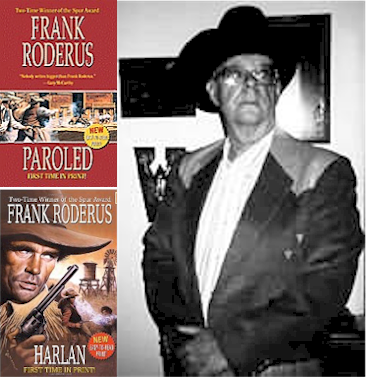
Frank Roderus

If you intend to make it as a professional, perhaps the most important quality you can have is simple stick-to-it’iveness. Bloody-minded stubbornness is more like it.

And no matter what, do not – do not ever – allow yourself to be dissuaded from the dream.

Let me tell you a true story about my struggling years. I was a newspaper reporter and as such spent a great deal of time sitting through murder trials. Now there is nothing so boring as a murder trial. The lawyers laboriously, studiously, boringly go into incredible details of arcane law, frantic lest they forget some technicality.

Sitting and listening to this nonsense in real life is most unlike the drama you see on TV. To keep myself busy I wrote, in longhand in steno pads. And I wrote what I thought was a pretty good yarn.

I typed that up into a manuscript in the style specified in Writers’ Markets, then had to find a publisher. Now how do you go about such things when you have no track record and know nothing about the business?

Why, you get an expert to handle it for you. Of course.

So I went through the books again and found a likely agent. Mailed the manuscript off and started chewing my nails waiting for the response.

Boy, did I ever get one. My manuscript came back in due time and along with it a letter. The letter said, not quite in so many words but very bluntly, that I was not a writer, should not bother her or anyone else again and to find something else to occupy my time.

To say that I was crushed is an understatement. I was devastated. I took her advice. Because, after all, this woman was a New York agent and New York agents know everything. Right? Sure they do.

I put that manuscript aside and tried to give up the thought of writing. It was three years before the desire to write overcame me to the point that I had to try again.

I pulled that same manuscript out, read it over and decided it really was not that terrible. Sent it off again, this time to a small, mid-western press.

They bought it, and Duster was a Spur Award finalist that year. I have been writing and consistently selling ever since.

My point here is that the all-knowing New York agent (I have completely forgotten her name, but her initials are Ann B Elmo) very nearly stopped my career before it ever happened. And would have had I not been so determined to try again regardless of that ‘professional opinion’ from on high.

Believe in yourself. That is the key.

Monday, August 23, 2010

BEAT to a PULP: ROUND ONE

By David Cranmer

I’m involved in putting together a print anthology that will hopefully be of interest to western aficionados and to pulp fiction fans in general. At just under 400 pages, BEAT to a PULP: Round One is a gargantuan collection jam-packed with twenty-seven stories running the gamut of crime fiction, noir, sci-fi, hardboiled, western, literary, ghost and fantasy genres as well as a foreword by Bill Crider and a history of pulp by Cullen Gallagher.

For western enthusiasts is the inclusion of three gunslinger adventures. The first by Scott D. Parker is “You Don’t Get Three Mistakes,” a fast-paced oater in The Wild Wild West style with a twisty ending. The next sees the return of Cash Laramie, who made his first appearance in A Fistful of Legends, in a traditional western called “The Wind Scorpion” by Edward A. Grainger where revenge comes in unexpected forms. In the third story, if you favor the genre turned upside-down and inside-out, Chap O’Keefe sends everyone’s favorite outlaw through space and time in “The Unreal Jesse James.”

Authors well-known for their westerns, and writings in other genres too, have stepped onboard with some brain-teasing, spine-tingling tales for Round One. Ed Gorman weaves a psychological yarn about a broken-down marriage and infidelity called “Killing Kate.” Robert J. Randisi brings back Miles “Kid” Jacoby where the detective gets in deep with a case involving the paparazzi in “Crap is King.” Then James Reasoner takes us to Pearl Harbor where a beautiful nurse carries a deadly scent of “Heliotrope” for a haunting tale.

Plus there is an original short story by pulp legend Paul S. Powers. Mr. Powers had a prolific and successful career in pulp fiction, writing over 400 stories for such magazines as Wild West Weekly, Weird Tales, Thrilling Western and dozens of others spanning four decades. His granddaughter Laurie kindly supplied us with the never-before-published “The Strange Death of Ambrose Bierce.” Mr. Powers’ brilliant homage to the fiery editor and writer Bierce grounds our anthology and bridges pulp-of-the-past to the present.

I had hoped for an August release, however, due to some last minute additions to the cover design, we are looking at middle to late September but the extra time will be well worth the wait. Credit for the sensational cover goes to James O'Barr of The Crow fame and John Bergin.

A complete list of authors and story titles can be found on the BTAP website ( http://www.beattoapulp.com/roundone.htm ) and updates will be posted on my blog, The Education of a Pulp Writer, ( http://davidcranmer.blogspot.com/ ) as details become available. Updates will also be announced on the BEAT to a PULP Facebook page setup by Hilary Davidson and Patricia Abbott. ( http://www.facebook.com/pages/Beat-to-a-Pulp/120622367985562 )

Hope you enjoy!


Monday, August 16, 2010

Will Rogers Medallion Award

Texas Blood Feud by Dusty Richards won the Will Rogers medallion award for best fiction of the year. The award will be presented in Lubbock at the Symposium in September.

Congratulations Dusty!

Tuesday, August 10, 2010

The Edge Series is Back!

The first book of this popular series of exciting westerns featuring the lone character Edge by George Gilman will be re-released by Solstice Publishing in ebook and paperback in August of 2010.

Monday, August 9, 2010

Dorchester Letter

Here's a letter I received today from Leah Hultenshmidt, the Editorial Director of Dorchester Books, in an attempt to clear up their situation. Apparently, word of their demise, or the demise of their western line, have been greatly exaggerated. In addition, in an email to me Editor Don D'Auria said that Dorchester would be publishing just as many original western novels as they ever have.

Here is Leah's letter:

Don, Chris & I have been working to contact as many people as we could before sending out a blanket announcement regarding some of the new format changes many of you have already read about. Unfortunately, news broke online before anticipated.

Given the many changes in the publishing industry over the last several years, Dorchester has made the decision to more tightly focus its distribution models so that we may fully capitalize on the most profitable emerging technologies.

Starting with September titles, we will be moving from mass-market to trade paperback format. This will delay new releases roughly 6-8 months, but it will also open many new and more efficient sales channels.

And we’re pleased to say all titles will be available in ebook format as originally scheduled. The substantial growth we’ve seen in the digital market in such a short period—combined with the decline of the mass-market business—convinced us that we needed to fully focus our resources in this segment sooner rather than later.

Dorchester has always been known as a company ahead of the curve and willing to take risks. As bookstores are allocating the bulk of their capital to the digital business, it only makes sense that we do the same. Everyone keeps hearing that the industry has to change if it’s going to survive. We’re excited to be at the forefront of that change and will continue to keep you posted on further developments.

And to help answer some of the questions you might have:

When will my book be coming out?
Ebook editions will be out in the month the mass-market was originally scheduled. The trade paperback will follow roughly 6-8 months after. We have tentatively rescheduled many of the Sept.-Jan. titles through June or July 2011. But we're still working on books scheduled farther out.

Why the delay?
Some of the delay will be in reformatting the typeset mass-market so that it better fits a trade size. But most of the extra time is so that the sales force we’re working with will have a chance to sell books in to the accounts. Just like mass-market, stores will be placing their orders about 4-6 months before the books are printed.

I read in an article that these are print-on-demand. Does that mean they won’t be offered to the general market?

We’ve partnered with Ingram Publishing Services, who will be selling in books to libraries, Borders, B&N, Books a Million and all other retail and wholesale accounts that we've called on previously. But by having many more sales reps, we'll also be able to target accounts, such as many independent stores, who have not ordered our books in the past. Just as for mass-market books, stores will place their orders and we will print to fill them. Books will be on the shelves for readers to browse. However, using print-on-demand technology, we will not have to keep as many books in inventory incurring warehousing fees. Books will be available for reorder just as they are now, but we will only have to print as many copies as we need instead of a minimum of 5000.

What happens to backlist titles?
We’re currently in the process of changing warehouses, but once set, reorders will continue as normal. When a book goes out of stock, we will make the determination of whether to reprint—just as we do now. Reprints will most likely be in trade format, though we haven’t completely ruled out the possibility of some staying in mass-market.

Thank you for your patience and support as we make this transition.

Best,
Leah

Leah Hultenschmidt
Editorial Director
Dorchester Publishing
http://www.romanticreads.net/
http://www.dorchesterpub.com/

Someone described this letter to me as "defensive." I prefer to think of it as "encouraging." On the other hand Dorchester's decision to go heavily into E-publishing is not one that I endorse. But I tend to hang on to the "old ways." And I love mass market books. But if I equate what's happening with mass market books to what happened years ago with cassette tapes, can almost understand it. Not accept it, but understand it.

RJR

P.S. I think I made my photo too big in this post. So sorry. My blogging needs work.

Who Am I Today?


By James Reasoner

At last count, novels and stories I’ve written have been published under at least 35 different names. I say “at least” because back in the Seventies and Eighties I sold a few short stories that I never saw when they were published in various men’s magazines, but I know they appeared under other names. Some of these other identities were personal pseudonyms, some were house-names. Long before I ever became a writer, I used to read the Mike Shayne mystery novels by Brett Halliday. At that time I never had any idea that one day I would actually be “Brett Halliday”. But I was, contributing 36 novellas under that name to MIKE SHAYNE MYSTERY MAGAZINE during the Seventies and Eighties. To me, things like that are among the great pleasures of being a writer. (Along with not having to commute and being able to go to work in my pajamas if I want to, of course.)

The first Western I ever wrote was an entry in a house-name series: PECOS, #27 in the Stagecoach Station series, published by Bantam under the house-name Hank Mitchum. Since then I’ve written books in a number of different Western series, and in many cases, I was already a fan of the books before I ever joined the stable of authors. Working under a house-name has its advantages and disadvantages. The biggest disadvantage is that you receive little or no credit for the work you’re doing. Your name is nowhere on the book when it comes out, and although some people (mostly in the industry) know who writes which books, the vast majority of the readers have no idea and don’t really care. They just want an entertaining story, and I can’t blame them for that at all, since I was once the same way.

For example, back in the Sixties, I used to read paperback Westerns featuring Texas Rangers Jim Hatfield and Walt Slade. The Hatfield novels were published under the name Jackson Cole, the Slades as by Bradford Scott. I didn’t know the history of these novels, didn’t know that the Hatfields originally were published in the pulp magazine TEXAS RANGERS or that Walt Slade first appeared (although in shorter works) in the pulp THRILLING WESTERN. I certainly had no idea that the same author who wrote the Walt Slade novels as Bradford Scott (real name: Alexander Leslie Scott) also created the Jim Hatfield character and wrote many, but by no means all, of those novels by Jackson Cole. I just knew that I enjoyed the stories. The same holds true with the house-name Western series being published today. (As an aside, the Stagecoach Station series was created by long-time Western author D.B. Newton, and he was the first “Hank Mitchum”. During the Forties and Fifties, Newton wrote some of the Jim Hatfield novels for TEXAS RANGERS as “Jackson Cole”, though none of the ones that were reprinted in paperback. Still, as a fan of the Hatfield series, I found it very cool that I worked on a series created by one of the Hatfield authors and even shared a house-name with him.)

The advantages of working on a house-name series outweigh the disadvantages, as far as I’m concerned. With a long-running series, as a writer you have a vast legacy of previous books to draw on for inspiration. You have a solid, well-developed main character to work with, and yet at the same time you have the freedom to put your own spin on that character (within reason, of course). I’ve written nearly fifty novels featuring a certain mustachioed deputy U.S. marshal. In his appearance, his actions, his way of talking, are dozens of bits of influence from the other authors who have contributed to the series. Those influences combine with my own instincts as to how he should act and what he should say to create my own version of the character who is the same in many respects but subtly different in others. Those differences make it possible for me to read books in the series by other authors and still enjoy them, because they each have their own individual take on the character. You also have an established readership for these series, and your job is to entertain those readers as they’ve been entertained by previous books. It’s a challenge, but for me, a very enjoyable one.

Speaking of challenges, when you’re writing quite a few books under different names, often different types of books, sometimes you actually can get confused about who you are and what you’re supposed to be doing that day. Years ago, I was working on a novel set in Old Testament times while having a Western novel also underway. I was talking to the editor of the Western novel on the phone and mentioned that I had to be careful not to have the hero of the Biblical novel say, “Well, I reckon I’m gonna go slay me some Philistines.”

In the past month I’ve worked on projects that will be published under four different names, none of them my own. People have asked me, “How can you write a book knowing that your name won’t be on it?” For years my standard answer was, “I don’t care as long as my name is on the check.” Of course that’s not completely true, now or then. Writing has been my job for more than three decades now, and getting paid is important. But most writers love to see a new book with their name on it, and I’m no different. If we didn’t have egos, it probably wouldn’t even occur to us that people might want to read what we write, would it? I’ve been blessed with the ability to put those feelings aside when I’m working, at least to a certain extent. When I’m sitting at the computer, the words appearing on the monitor are my words. The book I’m writing is mine. When it’s published, my name may not be anywhere on it, but that has no bearing on the writing itself. I know it’s good, and I feel a surge of pride when I see the books in the store and know that people are reading them and enjoying them. So when you come right down to it, the answer to the question “Who am I today?” is simple and always the same.

I’m a guy writing a book, spinning a yarn. That’s all I ever wanted to be.

Friday, August 6, 2010

Saturday, July 24, 2010

Writing the West When You Don’t Live There

By Larry D. Sweazy

I didn’t grow up in the West. There were no mountains with snow-capped peaks outside my window, or streams brimming with cutthroat trout, or elk grazing on the moraine. I didn’t know what a moraine was when I was a kid.

Instead, there were corn fields. Miles and miles of them. Acre after acre of giant, tall grass, always reaching for the sky during the day, and aching and moaning as it grew at night. Beyond the corn fields was a park. Mounds State Park. I could see Indian burial mounds from my back yard. We hunted for arrowheads in the fields after it rained.

There were shallow rivers and creeks that ran high and fast in the spring, and low and dry in the summer. No cascading waterfalls, no deep glacial lakes. The land was as flat as a pancake. You could see a storm coming from miles away. Still, there were trees; maple, oak, sycamore, elm, towering to great heights in what remained of a once great and endless forest.

White-tail deer were an uncommon sight, and the only animals we saw regularly were squirrels and chipmunks. Eagles were on coins, not in the sky. And the only cowboy I ever saw was Cowboy Bob who came on TV at 3:30 in the afternoon to introduce a half hour of cartoons; original Bugs Bunny, Porky Pig, and Popeye.

The West came into our house, at night, like a welcome guest, offering a pleasant relief from the trials of the day. Gunsmoke, Bonanza, The Big Valley, and The Wild, Wild West, were in their first-runs. Marshal Dillon, Ben Cartwright, and James West were indelibly imprinted on my young mind. And then there were the movies, westerns all day on Saturday with Audie Murphy or John Wayne, or at the drive-in on Saturday nights. We made grocery sacks full of popcorn, sat under the stars, stared up at that big screen and learned how to dream.

It didn’t matter that Monument Valley was not outside my window...the entire West was alive and well in that little black and white box that sat in the corner. TV was not an idiot to me, it was a window to the world.

And later, though not that much later, the West came into my house by way of books, another window, and escape. I was lucky to grow up in a house where books were welcomed, traded back and forth among friends and family like little gifts, intended to make life a little better. Stories shared together were treasures, that were far and few between, otherwise.

Paperbacks were often worn, creased and dog-eared, the books fully used up before they were put on the shelf for the final time, generally Scotch-taped together. I was lucky that what I read was not censored. Oh, don’t get me wrong, Mandingo was out of the question, but Raymond Chandler and Jack London weren’t, and I tackled them at a younger age than I probably should have. Elmore Leonard was an early influence, too. Imagine my thrill the day, years later, when I got to pick up the phone and call the man, and spend almost two hours talking about his books and writing. Talk about a full-circle moment.

My first big trip as a kid was when I was 14, and I went to Austin, Texas, to spend time with my sister and brother-in-law who had been transferred there. Texas, I tell you, was the promised land. Big hats, big boots, big everything. I expected to see John Wayne saunter around every corner. It was like home, except the grass felt different on my bare feet, and the air was not as heavy, just hotter. Hotter than I had ever experienced before. And holy crap, you could drink Dr. Pepper and eat Moon Pies, and it meant you were normal. Folks where I lived turned their noses up at Dr. Pepper. Leaving Texas was hard, because I didn’t get to see everything I wanted to see on that trip. No Alamo, no Chisum Trail. No Texas Ranger. Next time. It would have to wait.

And it wouldn’t be long. Basic Training for the U.S. Air Force took me to Lackland AFB in San Antonio. Back to Texas three years later after that first trip. This time I was 17, and I wasn’t on a sightseeing tour. Then off to North Dakota, Lewis and Clark country, and then back to Texas for four more years.

And then back home. East of the Mississippi. To plant roots. Settle in. Grow up and start chasing the dream.

I would always feel part Westerner, part Texan, part wanderer. Books, TV, and Movies went with me everywhere I went. A.B. Guthrie, Owen Wister, the classics, as well as the paperbacks that hit the book racks at the 7-Eleven every month. I knew I wanted to be a writer from a young age, knew I wanted to tell stories about quests and adventures, but that’s another story. It’s not a mistake that I ended up writing westerns, it just took me a little while, and a big nudge from the universe, to figure it out.

I’ve been back to the West many times since, traveling, sightseeing, but never putting my boots under the bed for very long. Someday, I may live there again. Retiring in Texas has a nice ring to it. I have a feel for the land, know the people, and the past a little bit. That helps, I think, to be comfortable.

The West still comes into my house. Movies. Books. Art. And from books that I write myself, now. I may sit at a desk and view the West from a distance, but I’m about as close as one can get without being there.

I miss the West everyday, but I get to ride the Hill Country alongside my protagonist, Josiah Wolfe, a Texas Ranger in 1874, trying to make a life for himself. The red-tail hawks soar overhead while the jack rabbits scamper for cover. Rattlesnakes ready for their prey on the shady side of a rock, and rooter skunks dig for food for their young. I listen for the fight for survival that will surely ensue, and I swear I can hear the whimper of death as the skunk succumbs. Leander McNelly lives in my world, and Juan Cortina and John Wesley Hardin, too, along with a host of made up characters, but all true Texans, I promise you.

I don’t apologize for writing about a place I don’t live in. I’ve been there, spent time there, and I go there everyday in my imagination, and with the extensive research I do for each and every book that I write. The cool thing is, nowadays, I get to bring people along with me.

Larry D. Sweazy (http://www.larrydsweazy.com/) is the author of the Josiah Wolfe, Texas Ranger series (Berkley). THE RATTLESNAKE SEASON and THE SCORPION TRAIL are available at bookstores everywhere. The third book in the series, THE BADGER’S REVENGE, will be released in April, 2011. He lives in Noblesville, Indiana, with his wife Rose, two dogs, and a cat.

Monday, July 19, 2010

Writing Professionally

By Frank Roderus

I’ve been writing professionally for 45 years, first as a newspaper reporter and for the past 35 years as a novelist. I consider this a joy, a privilege and a blessing.

During the course of these years I have been asked countless times for the ‘secret’ to the writing and/or the selling. If there were such a secret I would gladly pass it on to another generation of writers. Sadly, there is no such thing.

What there is, however, is almost as simple as following a secret path to writing success. It is, in short, persistence. Ideally you should be mule stubborn and Polyanna optimistic if you want to write for a living.

But first – please – read.

Yes, I said read. I cannot tell you how many times people have told me that they want to become writers. When I ask what types of books they prefer to read, amazingly often the response will be that they do not read. They don’t have time. They don’t have (insert excuse here).

Incredible. If you do not read, you will not be able to write. Period.

Next, write. A lot. You find your voice and hone it by writing.

Often, perhaps even usually, I am told that the would-be writer really would write a book if only s/he had time. Hoo-ha! Everyone has time enough because no one sits down and writes a book. You sit down and write a scene, a chapter, a paragraph. Just one. At a time. Add a whole lot of those together and you have a book.

I started writing longhand in steno pads. Those go anywhere without trouble. You can write a sentence in the morning while the kids are having breakfast, a paragraph on the bus, a scene while the family is at the beach. Any scrap of idle time can be productive for someone who really wants to write.

Have a manuscript? Think it is good enough to market? Good. Now comes the hard part. Sell it.

First, though, if you really want to succeed, do your homework. Haunt the bookstores to see what publishers are buying and which publishing houses those are. Find a copy of Writers’ Markets and study it. Do keep in mind that a great deal of lead time was built into the publication and a publisher’s needs may have changed since those entries were made.

Don’t ignore the small and regional presses. Those may be a suitable outlet for your manuscript. But don’t be afraid to shoot for the stars either.

If at all possible, attend a convention or two. Want to write westerns? Come to a convention put on by Western Writers of America and/or Western Fictioneers (WF meets are scheduled in conjunction with WWA). I cannot stress enough how helpful it is to meet the editors who will be appraising your work. Get to know them. Ask what they like. Not just what they need but what they like.

Editors are people. I know. That is hard to believe but it’s true. They have preferences and prejudices just like the rest of us. Find out what those are if possible and then tailor your mss to them. That effort can help pay off in sales.

But first you must produce that ms so compelling that it cannot be turned down.

I wish you luck with it.

Thursday, July 15, 2010

Bless My Soul Pilgrim

By Kerry Newcomb

I’m just sitting back and letting the mind wander which it tends to do whether I will it or not, sort of like nodding off while in the middle of a scene or a conversation or halfway through the preacher’s sermon, alas. I grow old and like some Prufrock wear the bottoms of my trousers rolled. But all decrepitude aside, I shall press on with an actual blog entry, although I like to think of it as a morsel of my own brand of idyllic mind chatter, though my non-fans (and you know who you are) might think of it as mind swill. Dear me do I digress? Shall I stop to eat a peach? I always say there is nothing better than a good old-fashioned digression. Actually I don’t always say that, in fact I don’t even know what it means. And I could care even less. Why?

I write fiction, like a sailor setting out without his charts, spinning yarns and typing my manuscripts by the seat of my pants (which really looks odd at the local Starbucks) and hoping against hope I’ll not be hoisted on my own petard for taking liberties with the facts. Just the facts…ma’am.

Writers get asked a lot of things by their editors and fans. Often it’s about a manuscript that might have been turned in several months, maybe even a year ago. One’s head is jam-packed with the necessary information relating to the next work in progress. And then suddenly out of the blue….

(Ring ring)

“Hello.”

“Hey, Newcomb, it’s Smartypants, your editor on that book you handed in last September.”

“Oh. (gulp) Hi. Nice to hear from you.”

“I’ve got a question for you, about that scene on page 432.”

(Holy crap was the book that long?) “No problem.”

“How far can a man run without a head?”

“Uh, how far did I have him run, counting momentum and all?”

“You wrote that he covers about seven feet and then collapses.”
“Yep. That’s it. A man with a good full out run can continue on for about seven feet after losing his head, provided he doesn’t run into a tree first.”

“Ok. I’ll tell the copy editor. Thanks.”

OR

(Ring ring)

“Hello.”

“Newcomb, Smartypants here. Say, do alligators eat raccoons?"

(A pregnant pause. Huh? Say something you fool. What alligator? Raccoon who? Bluff. Bluff.)

“Yep.”

“Ok. I’ll tell the copy editor. Thanks.”

OR

Many years after my novel Dawn Wind saw the light of day, I had a chance meeting with a fan who loved the book. He approached me with this:

“Hi Mr. Newcomb. Would you sign this for me? Say I loved the story. It was sure different. You know there is something I have been meaning to ask you. In the first part of the novel, that section in the town in Maine before the Confederate states secede and the war starts, you have a trio of children in the town running along the street, playing with a leopard stick. I hate to show my ignorance but I have always wondered, what exactly is a “leopard stick”? Was it some Colonial American toy?”

My mind went blank. I mumbled something about Yankee woodsmiths and the curious names for children’s amusements. As soon as I returned home from the signing I dug out a copy of the book and found the passage in question. Leopard stick? What on earth. In those days I hand wrote every novel and used a typist to turn my manuscript into a finished product that I could send off to the publishing house. As luck would have it I kept the handwritten manuscript.

I searched through the yellowed pages and came to at last to the scene. My penmanship was then, and still is, terrible. Dialogue and description tended to crawl off into the margins, whole passages were marked out and resembled barbed wire fences separating the sentences. And there it was.

Leopard stick…?

Wait…no, oh for pete’s sake, that’s “hoop and stick!”

My typist making the best of my handiwork had read it as “leopard stick” and never looked back. It had slipped past me. It had slipped past all the editors. And escaped.

My name is Kerry Newcomb. I write fiction.

Trust me.

Tuesday, July 6, 2010

What Is A Western Writer?


By Jory Sherman

We are the long-stilled voices of your ancestors speaking from the past. We are echoes of those who were already here in the New World and those who came after and settled these now United States. We are the Native Americans who roamed the West, first on foot, and later on horseback. We are the explorers, the fur trappers and traders, the soldiers, the men and women who rode in wagons across the Great Plains and left our bones on silent prairies and in frozen mountain keeps.

We are the people with long memories who sat by lonesome campfires and listened to the stories told under the stars. We are the ones who first saw the greatness of the land and the mingling of peoples, who found the gold and the timber and the oil, who saw life and death and greed and avarice and theft and slaughter. We are those who remind you of who you are, where you came from and where you are going.

We are your conscience and your guilt. We are those who surveyed the unnamed places and put names and measurements to towns and cities and rivers and streams and mountains and valleys. We are those who followed the buffalo and the eagle, who first spoke to the Redman in sign language and died on trackless plains with dreams in our hearts and prayers on our lips.

We are the chroniclers of those times when our nation was raw and young and untamed and restless and without boundaries. We are the voices of all who came westward and we speak to those now living and to those who will come after and wonder what the land was like, and who the people were and what happened over the centuries of blood and violence and progress.

We are those who paint pictures with words, who relate the forgotten stories, who look into the dark caves and light a torch so that all may see what lies inside and beyond.

We are those who live part of our lives in the past and ride a horse called History and who bring life to everything and everyone who died on the westward trek.

We are who you really are if you will but look in your hearts and wonder. We come from everywhere and come in all sizes and shapes. We are people born of another time and place who inscribe our stories in your hearts. We are those who write down the names on tombstones and mark the olden trails so that you who read us might trace the steps of your fathers and mothers, your grandfathers and grandmothers, your great grandfathers and great grandmothers and see what they saw and wrote down in their diaries and told their children who told their children who then told us.

We are the observers of both fate and destiny; the alchemists who transform the lead of the past into the gold of the future. We are the bearers of tidings, both ill and good. We are the keepers of the flame who refuse to let the old campfires die out.

We are those who write down what we see and hear and feel, taste and touch so that all may know what the West really was and what it means to all future generations. We are those who never die, who live as long as words are spoken and ears will hear. We are those who see through the mists of time and walk through the valleys of shadows and wander the long prairies of memory so that you will know that we passed by all those places that are now paved over and gouged out and dammed up and slashed down and scarred and vacant of all former life, where the old footprints have been obliterated.

We are those now called Western writers and we are proud to carry the label. We still ride the West on a horse called History, singing our old songs and telling the grand stories of yesteryear.