Wednesday, May 21, 2014

LASSOING A BRIDE? or LASSOING A GROOM? GET BOTH! by Cheryl Pierson


Prairie Rose Publications is going strong with several new anthologies for the summer! Cowboy Cravings and Lassoing a Mail-Order Bride will be released early in June, but read on, cause we've just released LASSOING A BRIDE and LASSOING A GROOM yesterday, and what a great group of stories these are! Take a look!


LASSOING A GROOM

How is a woman supposed to catch a husband? In the wild, wild west, she’s got to find a way to Lasso a Groom! Some of them are lawmen…some are outlaws. Ranchers and homesteaders are fair game, as well—none of ’em safe from love’s lariat, or the women who finally manage to rope ’em in!

DON’T GO SNARING MY HEART by Jacquie Rogers
Can rancher Dex Madsen get past loner Betsy Lynch's goats and killer chicken to help save her mining claim and win her heart?

RACE TO MARRY by Kirsten Lynn
He’s in town to tame a man-killer. She’s accused of being one. When she proposes marriage the race is on.

WANTED: THE SHERIFF by Tracy Garrett
He’s a confirmed bachelor…but she’ll capture his heart.

CANYON CROSSING by Kristy McCaffrey
In search of her brother, Annabel Cross enters Grand Canyon. When U.S. Deputy Marshal Angus Docherty rescues her from a cliff side, her most guarded secret might save them.

THE PERFECT HOMESTEAD BRIDE by Linda Hubalek
Will a dangerous man from Gussie Hamner’s past sabotage the future she’s building with Noah Wilerson?

THE WORST OUTLAW IN THE WEST by Kathleen Rice Adams
An inept bank robber and a bossy spinster team up to rob an empty vault. What could go wrong?


LASSOING A BRIDE

Some brides are hard to get a rope on, for sure! But in these wild west romance tales, being married is like sugar and lots of spice—with a dash of pepper in the mix! Ain’t nothin’ tame about these brides, who have a delicious story of their own—each falling under the spell of a handsome devil she thought was out of her reach. Unanswered prayers, broken dreams and unexpected circumstances are sometimes the best way for a groom to get the gal he loves when he’s looking at Lassoing a Bride!

PRETTIEST LITTLE HORSE THIEF by Gail L. Jenner
Sometimes it’s the stolen and unexpected love that has the power to heal a broken heart

UNEXPECTED BLESSINGS by Sarah J. McNeal
A broken dream…a cancelled wedding…and an unexpected blessing.

NO LESS THAN FOREVER by Tracy Garrett
Love always finds a way…

THE BANK ROBBER'S LAMENT by Sara Barnard
Smith found equal amounts of both anonymity and trouble in Gabriel's Settlement. But when he sets eyes on a beautiful woman and her young daughter who are being abused, might some other emotion be fated to bloom in that desert town of far west Texas?

THE BRIDE AND THE BADGE by Livia J. Washburn
Was Emily just bait for an outlaw trap—or did she mean more than that to the handsome Texas Ranger?

Covers were ALL designed by our very own Livia Reasoner! Aren't they gorgeous?

Available at B&N, Amazon and other fine booksellers in digital and print!

Amazon link for Lassoing a Bride:
http://www.amazon.com/Lassoing-Bride-Gail-L-Jenner-ebook/dp/B00KFFFJ6K/ref=sr_1_1?ie=UTF8&qid=1400645844&sr=8-1&keywords=Lassoing+a+Bride

Amazon link for Lassoing a Groom:
http://www.amazon.com/Lassoing-Groom-Jacquie-Rogers-ebook/dp/B00KFFS2O6/ref=sr_1_1?ie=UTF8&qid=1400645166&sr=8-1&keywords=Lassoing+a+Groom

Tuesday, May 20, 2014

Black Valor by Tom Rizzo


The ten-man patrol left Fort McKavett, Texas, just before daybreak on May 20, 1870, to track down an Apache raiding party that staged several attacks against local settlements, stealing horses and livestock. 


 Four days earlier, one raiding party kidnapped two brothers. Ten-year old Herman Lehmann and his eight-year old brother, Willie, were in the fields near their home trying scare away birds from the wheat when they were taken.

Leading the Army mission was Sergeant Emanuel Stance, Company F of the 9th Cavalry Regiment. 

About fourteen miles from the fort, near Kickapoo Springs, Sergeant Stance spotted a band of Apaches and ordered his men to engage them.


Caught by surprise, the Apaches abandoned the stolen horses and fled. In the commotion, Willie Lehman managed to escape.


Herman Lehmann, his older brother, remained captive.  was eventually adopted by an Apache war chief, trained as a warrior, and waged war on Apache enemies. 

Once he killed an Apache medicine man in self-defense and fled to the Southern Plains where he lived until joining the Comanches. 

Lehmann was returned to his family in 1879, but against his will. 


Stance and his patrol of Buffalo soldiers rescued the young boy, rounded up the stolen horses, and made camp. 


The next morning, on the way back to Fort McKavett, Stance's men came across a band of Apaches preparing to attack a government wagon train.

He ordered his troops to charge and "set the Spencers to talking and whistling about their ears so lively that the broke in confusion and fled to the hills."

The soldiers recovered five more stolen horses in the gun battle and headed to the fort. The Indians weren't giving up that easily. When they fired shots at the soldiers from long-range, Stance barked another order to charge. Minutes later, the raiding party disappeared.

Stance's patrol reached the fort in early afternoon of the 21st with 15 head of horses recovered from the Apaches.

The Kickapoo Springs skirmish marked the fifth time that Stance engaged Indians.


The following month, on June 28, 1870, Stance was cited for gallantry in the Indian wars and awarded the Medal of Honor, first black American regular to be so honored. 


Stance was born 1843 in Carroll Parish, Louisiana. He served with the US Army from 1866 to 1887, achieving the rank of First Sergeant. 

After receiving the coveted honor, Stance has several run-ins with his own troops. 

Army officials took action to counter what they concluded were "behavioral issues." 

At one point, according to author Frank N. Schubert in his book, Black Valor, Stance "was reduced to private, and not for the last time."


The end for Emanuel Stance came under tragic circumstances.


One year after sewing on his fourth gold five-year chevron, the Medal of Honor winner was found dead alongside the road of Crawford, Nebraska. He had been shot several times. 

The evidence, although circumstantial, pointed to privates in Stance's own troops. He was buried at Fort McPherson National Cemetery, Maxwell, Nebraska.


-0-

Monday, May 19, 2014

The Day Things Changed--The Poe School Bombing by Gordon L. Rottman


This is not an Old West related topic, but Cheryl suggested I write this up out of general interest, because of the era it occurred, and to contrast the differences on how things used to be compared to today.
It’s a sad tale as it discusses the 1959 bombing of Edgar Allen Poe Elementary School at 5100 Hazard Street in Houston, Texas. It was the first tragic example of a deadly school attack in modern times. I say “modern times” as there was a much more horrendous 1927 school attack in Bath, Michigan resulting in 44 deaths by an intentionally set dynamite explosion. Also there was the 1937 New London, Texas school explosion caused by a gas leak in which 295 students and teachers perished.
Books have been written on those tragedies, but no one has tackled the Poe School bombing. I’ve considered it, have undertaken initial research, and have access to official investigation records. Frankly, it would be a depressing effort and I’ve so many more fun projects on my plate including the sequel to The Hardest Ride; Ride Harder.

10:10am, September 15, 1959—Tuesday
Mrs. Kirby, our 5th grade teacher, stopped mid-sentence when the explosion boomed a shock wave through the school. Shattering glass rattled from the far side of the building. Our clock fell from the wall and a linear cloud of dust puffed around the room from the baseboards. One boy nearest the door leapt up and headed for it.
Mrs. Kirby very coolly said, “Be seated, the fire alarm’s not gone off.”
The moment he sat the alarm sounded and out we went as we had practiced monthly. We filed down the 6th grade hall, each class in-turn, and though the building’s end doors onto the playground.
We stepped into hell.
To our right was the asphalt hard-surface area and the first thing that came to my mind was that it looked like a burned trash pile spread across the double-basketball court. Lying closer was a young boy, his clothes blown off, his intestines spilled (I promise not to be any more graphic—it’s just that that was my first realization that people were hurt.) I realized then the smoldering trash pile included people.
The 5th and 6th grade teachers quietly moved us to the playground’s far side and we sat by class on the softball diamond, backs to the carnage, not that everybody didn’t turn to look. I saw a few injured kids staggering amid the ruinage along with a tall, thin teacher doing what she could.
 Our class exited the school from the doors at the upper left. This is the body of the first child I saw. A desperate mother searches for her child.

The first on the scene were fire trucks, then police, and then more cops. Ambulances arrived, but not that many. These were old-style station wagon-like ambulances, not the high-tech EMS ambulances we know today. There were no EMTs then. Ambulance crews merely scooped up the injured and hoped they could get them to a hospital alive. Most belonged to private ambulance companies or hospitals. ERs were nothing like they are today and they certainly were not prepared for anything like what had just occurred. Fortunately the main county emergency hospital and other hospitals were within 15 minutes.
The hard-surface area with the school in the background. Miss Johnson was moving the kids to the building wing on the left behind the trees when the bomb detonated.
I don’t know if it was confusion, shock, or the steadiness our teachers displayed that keep things under control. My parents were among the first to appear as they went into open their restaurant later in the morning. We lived three blocks away. Unlike today there was no lockdown. Parents got their kids and went home. Some kids walked home on their own—everyone lived close—there was no busing then. We even took a neighbor kid home as his parents were at work. You simply told the teacher and left.
I wasn’t rattled a bit and that perplexed me. My only confusion was that I didn’t know what to do the rest of the day. I ended up going to Kemah southeast of Houston with my dad. He had a restaurant there and it was strange hearing customers discuss what I’d seen a couple of hours earlier.

Some ambulances had to park in the school's front circular drive to load the injured. No EMS ambulances in those days. The metal awnings had recently been installed to shade the windows as there was no air conditioning.

Earlier that morning
Okay, what happened? A somewhat mentally disturbed man, 47-year old Paul Orgeron, had divorced his wife and abducted his son, 7-year old Dusty. Orgeron had brought his son to the school earlier to enroll him, but was turned away. He had no birth certificate or immunization records. The staff hadn’t felt he was a problem other than acting very confused and didn’t know his son’s former school’s name or the New Mexico town it was in. He soon returned, but instead of entering through the front, he went on the playground while 2nd grade recess was underway. Some kids though were inside taking assessment tests. In fact two girls from our class were detailed to help the teachers on the playground.
With son in tow and carrying a briefcase, Orgeron approached a 2nd grade teacher, Miss Patricia Johnson, and passed her two incomprehensible notes. She was concerned about his manner and noticed a doorbell buzzer on the briefcase’s bottom. Another teacher, Miss Jennie Kolter, sensed trouble and came to the scene. Orgeron wanted Johnson to gather the children around. Instead, she sent two kids to fetch the only adult male in the school, James Montgomery, the custodian, and the principal, Miss Ruth Doty. While Kolter talked to Orgeron, Johnson discreetly herded kids away. Doty, a very stern and strong-willed woman, feared and admired by us kids, took charge and began trying to get Orgeron off the school grounds.
It’s not clear what happened. Orgeron set the briefcase on his foot. It’s thought that it slipped rather than being intentionally set off. Six dynamite sticks detonated. Orgeron was disintegrated, his son shattered, Kolter and Montgomery blown apart, and two 2nd grade boys killed. Miss Doty was terribly injured and almost lost a leg. She had been standing behind the others. Two nearby boys each lost a foot and 15 other students were injured by blast and asphalt gravel including the two girls from our class who were helping get the kids away. They were among the most seriously injured.
At first, since they couldn’t find Orgeron’s body, the police thought he might still be on the grounds. His car was located and found wired with dynamite to detonate if started. He had purchased 150 sticks in a New Mexico hardware store—you could do that then—which were never located. It took time to piece together events leading up to the bombing and some questions were never answered.

The aftermath
As I was able to leave early, I didn’t see what arose when “every” fire truck, ambulance, tow truck, cop, reporter, and TV crew in the city showed up. Since there had been no preparations for such a catastrophic event, the teachers’ initial control evaporated. Frantic parents had to park blocks away as there was no place closer. Ambulances had difficulty getting through jam-packed streets. Parents ran all about trying to find kids who had been taken back inside. The National Guard was called to secure the school, as well as others that received bomb threats. Realistically, even if practiced to any degree, there’s little that could have been done to control it better.
How was it different from today? The next day school was open. About half the students attended with more returning each day. Mosquito-control trucks fogged the grounds to keep flies down as there were small body parts on roofs and in trees. We took a minute to bow our heads in silence. The following Monday all students were back. A couple of weeks later we had had a simple memorial service in the auditorium with Cub Scouts posting the flags. There was no army of counselors. No TV crews seeking interviews. No closing the school for the rest of the year or calls to tear it down. Not a single law suit. We moved on.
The hard-surface area was re-blacktopped and a chain-link fence installed around the playground. In October the two boys who’d lost a foot led the Halloween Festival parade in a go-cart. Our two severely injured girls, Martha Jo Mullen and Leah Tomlinson, returned and were applauded at lunch. Months later Miss Doty returned as principal and remained until she retired. New elementary schools were named after Miss Kolter and Mr. Montgomery. Occasional bomb threats were phoned in and each class was assigned garages at nearby homes for shelter as winter was coming on. Neighbors left their cars out so we could use the garages. We moved on. Every few years the local paper does a brief write-up on the anniversary, virtually a copy of previous years’.
As a personal note, the hero of the day was Pat Johnson who never received the credit she was due. Thirteen years later, after returning from Vietnam, I visited the school and looked up Miss Johnson. She’d been my 2nd grade teacher. She was still teaching 2nd graders. I had to tell her something. I’d seen some real heroes; real soldiers who kept steady no matter how bad things got. I told her she was a hero, she’d kept cool, did all the right things—recognized a threat, got the kids away, sent for help, and then took care of the injured and she was steady though out. It was her I’d seen on the smoldering hard-surface. Pat and I became close friends. It was an honor to have known such a woman.
It was simply a life experience. Things happen and you move on.

Sunday, May 18, 2014

THE LONE SURVIVOR by Vonn McKee


Frequently, Google just doesn’t cut it. 
In an effort to get historical details just right, we writers sometimes insist on going that extra furlong or two in the name of research. I thought of this as I lay on the dusty planked floor of a north Georgia barn trying to photograph the undersides of a two-hundred-year-old wagon. My husband stood nearby, bundled against the cold drizzle outside. He knew not to interfere. I would not rest until I had documented the joinery of the wagon’s wheels, the twists of its hand-forged chains…and pretty much every cut of its jib.
This wasn’t just any old wagon. It’s known as “The Zuraw Wagon” and is the most-prized exhibit at Foxfire Museum and Heritage Center in Rabun Gap, Georgia. Handed down through four generations, it is the only documented “Trail of Tears” wagon in existence. (Did you just get chills reading that?)
The Zuraw Wagon
Foxfire Museum & Heritage Center (GA)
This old “tar-grinder” (its wheel hubs were lubricated with a pine sap-based substance) was originally owned by Green B. Daves, who contracted with the U.S. Army to move the Cherokees out of Georgia in 1838. According to Foxfire Museum curator Barry Stiles, it is difficult to prove that this particular wagon traveled the entire “Trail of Tears” route to Oklahoma, although the fact that a total of 645 wagons were utilized creates some probability. At the very least, Daves, a member of the Georgia Militia, used it for supply runs and to round up Cherokee “captives,” who were forced into stockades until the time of removal.
A few stats: the wagon was built in Pennsylvania in the late 1700’s and measures nine and a half feet long sans the wagon tongue…making it closer to the size of a “Prairie Schooner” than a “Conestoga.” Both box ends are raked outward (unusual for southern freight wagons).
Stiles adds that a local oral history collected by Foxfire recounts that the wagon was also used to transport area Mormon converts to Utah sometime after the Civil War. What a colorful history!

(Author's photos)


Oak beam and undercarriage

Whether or not the Zuraw Wagon journeyed to Oklahoma, it exists as a rare artifact from one of American history’s darkest chapters. As more than fifteen thousand displaced Cherokees marched westward during the winter of 1838, a third were lost to disease and exhaustion. Only the very weakest, youngest and oldest were allowed to ride in the wagons, which were reserved for the tribe’s few belongings. Certainly, countless tears would have been shed onto those floorboards during the thousand-mile ride.
With that in mind, I could not bring myself to crawl inside the Zuraw wagon’s narrow box…not even in the name of research. It’s been 175 years…and the tears are still not dry.   VM
Painting by Jerome Peabody
“One can never forget the sadness and solemnity of that morning. Chief John Ross led in prayer and when the bugle sounded and the wagons started rolling many of the children rose to their feet and waved their little hands good-by to their mountain homes, knowing they were leaving them forever.” Army Captain John G. Burnett, writing of the Cherokee Indian Removal 1838-39.


Vonn McKee is Louisiana-born but has called Nashville, Tennessee, home for over twenty years. She has a real heart for historical fiction, especially the Old West.

Saturday, May 17, 2014

A Cloud of Dust and a Hearty Hi-Ho Silver


Rod Thompson


FROM OUT OF THE PAST COMES THE THUNDERING HOOFBEATS OF THE GREAT HORSE, SILVER!  THE LONE RANGER RIDES AGAIN! And with that the Lone Ranger and Tonto galloped out of the past, out of the radio, and into the hearts and minds of millions of boys and girls who sat eagerly enthralled in front of their radios listening to the exclusion of all else. Happily, I was one of them.

I remember an instance when I was hovering as close as possible to not miss a single word or shot and my dad was sitting across the room behind me.  After a few failed attempts to get my attention, he reared back in his easy chair, as they were then called, raised his feet into the air and simultaneously slammed them down on the floor, clapped his hands loudly together, and yelled “HEY!”   He got my attention, after which he laughed heartily and told me whatever it was he wanted to tell me.   While he was talking, The Lone Ranger on Silver and Tonto on Scout galloped at least five or ten miles, shot three or four outlaws, and rescued a damsel or two in distress. Now, I ask you, how important could what he had to say have been when I can’t even recollect what it was, and that was only sixty years ago. 

After that came television where we got to actually see them doing the galloping and who can say they weren’t thrilled when the galloping was accompanied by The William Tell Overture? And then there was Gene and Roy galloping across the screen before slowing down to an easy walk that allowed them to sing while millions of kids groaned and cried, “Oh quit singing and go shoot somebody.” 

In between walking and galloping are trotting, loping, and cantering and a few miscellaneous other gaits.  All simple enough, yet I see them frequently misused.  Although I spent the first years of my life on a South Dakota farm, rode a horse to school, and generally know the difference, I did some research to make sure I was portraying them accurately and found it quite interesting.  And like many things I research, I found I didn’t know as much about the subject as I thought. As in most research, there are more specific details to be had but I found this information adequate for my needs. You may want to delve deeper.

There seems to be two main gaits, the “natural” gait which most horses do without special training, and what are called “ambling” gaits which are footfall patterns that occur in certain breeds but frequently require many hours of special training, ones that can be called for on command. In order by speed, they are walk, trot, canter, and gallop, some with three beats and some with four. In western terminology, a canter is called a lope. 

Walk:  Averaging approximately four miles per hour, is a four-beat pattern with the left hind leg being followed by the left front leg, right hind leg, right front leg in a steady 1-2-3-4 beat.  While walking, one foot will always be raised and the other three on the ground except the brief instant when weight is transferred from one foot to another. The advancing rear hoofs generally overstep where the advancing front hoof touched the ground and the farther the overstep, the smoother the ride. As the horse speeds up and loses the four beat gait it moves into the Trot.

Trot:   Trotting is a two-beat gait varying widely in speeds, generally averaging about 8 miles per hour.  Trotting very slowly is also called jogging; a fast trot has no special name, and in harness racing, the trot can be faster than the gallop of a non-racehorse. While trotting, the horse’s legs move in unison in diagonal pairs causing much movement of the head and neck for balancing and is the “working gait” for horses.  Cantering and galloping can only be done for short distances at a time before needing rest to recover, but well-conditioned horses can maintain a trot for hours.  It is the main way for horses to get from place to place quickly, but is difficult for the rider to sit because horse’s body actually drops some between beats and bounces up again when the next step hits the ground.  Every time a pair of legs hits the ground, the rider can be upwardly jolted out of the saddle and coming down, meets the horse which is on the way back up.  At most speeds above a jog, experienced riders post to the trot, matching their rising up and down rhythm with that of the horse so as not to be jolted, and it is also easier on the horse’s back.

Canter (lope):  A three-beat gait faster than a trot but slower than a gallop with an average speed of 10 – 17 miles per hour, depending on the length of the horse’s stride.  A three-beat gait is just that, sounding like beating a drum three times in succession…rest…three more beats…rest, etc.  The faster the horse is moving, the longer the rest.

While cantering, one rear leg propels the horse forward and is the only hoof touching the ground while the other three are moving forward and the following step timing and hoof movement is complicated and too lengthy for this writing but non-the less important. An extended foreleg matched with an extended hind leg on the same side is called a lead and important in various situations such as setting up the horse properly for a jump over fence, log, or stream. When the horse jumps over something, it is stretched out, typically taking the first two steps of the galloping stride with its back legs and making contact on the other side of the obstacle with its front two, thus completing the stride.


Gallop:  Very similar to a canter only faster. Although The American Quarter Horse in a short sprint of a quarter mile or less can make up to 55 miles per hour, the gallop typically covers about 25 miles per hour with the three-beat cadence changing to a four beat and covering more ground. Moderately paced gallops can sometimes go longer distances before the horse becomes winded and needs to be slowed down, most can only make a mile or two at top speed.  Unlike people, horses will not slow down when they begin to weaken to protect themselves.  They will go full out as long as their rider asks them too, oft times until death.  Riders switching between two horses will generally lope, allowing the horsed to fall into a comfortable pace that matches each other.  Keeping an eye from above, the rider can tell when their nostrils begin to flare in order to take in more air signifying the time to switch.

Thoroughbred horse races are seldom longer than 1.5 miles, though Arabian horses are sometimes as far as 2.5.  In fact, there is a Bedouin belief stating “The Arabian horse was created by Allah from the four winds...His Spirit from the North, Strength from the South, Speed from the East, and Intelligence from the West and will take care of its owner as will no other,” which is why I chose them as the horses of choice for The Black Hills.  Lop Ear is a purebred Arabian and Horse is a Mustang/Arabian.

How’s that for a sneaky segue into my series, The Black Hills Thrilogy -- I found that misspelling a few months ago and have been having fun with it since.  Book #2 in the series, The Saga of Jane Hicks, is already number four in the nation and Troy only released it on the 6th.  I know it is fourth because I was told it was so by the fellow interviewing me last night in my dream.  Unfortunately, I awoke to find that fact to be incorrect but that’s also what happened with my dream about Raquel Welch: wish that one could have lasted about another three minutes.


The Saga of Jane Hicks is about the protagonist in book #1, of course, Cormac Lynch, being sent a letter by a woman he never heard of demanding he come to the rescue of her and her children since he was responsible for her husband’s death in a gunfight. The story is complicated by the facts that he is newly married, doesn’t want to go, and he will have to pass through the territory under control of the mighty Sioux Indians who all want his horses, scalp, and his bride’s red hair – and one Indian has him measured for a spit.  It’s further complicated by the fact that he knows nothing of the dangers. He only knows what he reads in the letter from Jane Hicks he finds in his pocket when he wakes up on the ground, miles from anywhere, with no memory.  Troy let me design the book cover which is actually a photo of one of the story’s fans and an authentic 1874 Winchester. 
 Also on the 6th, book #1, The Black Hills, was re-released by Penguin Berkley with a foreword written by James Drury, the star of The Virginian TV series who called me to tell me it was the best book of any kind he has read in years.  I haven’t been able to get my hat on since.

My thanks to anyone who came to read this and double thanks to anyone who stayed till the end. I’m  obliged.           

  HIHO SILVER! AWAY!!!!!!!!


Thursday, May 15, 2014

Martial Arts and the Western


A Look at Shanghai Noon

My exchange son is a Japanese actor.  Shogen is in his first US production, Street Fighter: Assassin’s Fist, which premiers May 23. This is an action/ adventure martial arts series that can be shown either by episode or as a whole movie (info below). So I got to thinking about Asian martial arts actors, and of course the first that came to mind was Bruce Lee. I was interested in martial arts movies with a western theme, though, bringing on memories of Kung Fu with David Carradine. But humor hooks me every time so Shanghai Noon with Jackie Chan and Owen Wilson won out.

If your movies have to be “authentic,” then this film isn’t for you. If you want a gritty movie, don’t pick this one. However, if you’re an aficionado of irreverence (which I am), enjoy a good belly laugh along with some terrific fight scenes (which I do), then you can’t go wrong with Shanghai Noon. It has lovable protagonists, nasty villains, and strong women. Chon and Roy wouldn’t have lived through the first trip to town without Chon’s “wife,” Falling Leaf, and the bargirls saved Roy many a time. The princess was a wuss up to the very end, but even she redeemed herself.

This is one of the most unlikely buddy movies of all time. Chon Wang is intense, Chinese, and skilled at martial arts. Roy O’Bannon is laid-back, very Caucasian, and can’t fight his way out of a paper bag. Chon doesn’t waste words—you can’t shut Roy up. Chon is dedicated to loyalty and honor. Roy is dedicated to getting laid. As Roy says, “I am like a wild horse. You can’t tame me. You put the oats in the pen, though, and I’ll come in for a nibble every day. But the minute you shut that gate, I’ll jump the fence and you’ll never see me again.” But he says it in such a loving and sincere way.

Traditional Chinese warrior meets western new-age outlaw. Check out the trailer:


The main character is Chon Wang, played by Jackie Chan. (“Chon Wang? That’s a terrible name for a cowboy.”) He’s a member of the Chinese Imperial Guard and when the princess comes up missing, Chon feels responsible, so he sets out to rescue her from the kidnappers who had taken her to Carson City, Nevada. On the train, robbers kill his uncle and Chon ends up on his own in a strange land with a stranger partner—Roy O’Bannon, the leader of the outlaws that caused the ruckus on the train in the first place.

A fun part of the movie’s script is how they use anachronistic language.
Chon Wang: I got an idea: why don’t I pretend I’m sick, and then you can attack the guard when they come in?
Roy O’Bannon: Oh, you mean the sick prisoner routine? Does that still work in China? ’Cause here it’s sorta been done to death.

I love the bar fight—it’s clever, funny (the moose antlers are the perfect touch), and a thrill a second with ZZ Top playing in the the background.


And one of the most unique jail-escape scenes ever:


This movie is pure braincandy, and it did well enough that they made a sequel, Shanghai Knights, where Chon Wang and Roy O’Bannon head to London. Yes, I enjoyed that one, too.

There’s no comparison with my exchange son’s movie, Street Fighter: Assassin’s Fist, other than asian actors and martial arts. This is a gritty action/adventure film (or series, depending on how they choose to show it), full of martial arts and angst—and it's Japanese, not Chinese. Shogen plays Young Gouken and he appears at about 58 seconds in:


Here’s a picture of Shogen:


Since I don’t know the whats and wherefores about indie films, I copied a quote about SF:AF’s release.
Machinima.com will first release it as a 12-part web series at 11–12 minutes each. The 12 episodes will then be combined into 6 episodes at 21–22 minutes each for a TV mini-series on a currently undisclosed network. Afterwards, it will release as an edited 105-minute TV movie for syndicated television, and finally as the full 2+ hour uncut feature film as it was originally shot for release on DVD/Blu-ray. The series will first be released via Machinima.com on May 23, 2014, followed by the release in other formats at later dates.”

And there you have it—a plug from a proud momma.  Indulge me. And now I have to get the beer-butt chicken ready to grill because he said he might show up sometime around the premier.  Hope so!  


Wednesday, May 14, 2014

The wicked may live in your own house--Wicked Wednesday

Yeah, I know we’re engaged in the worthy cause of writing Westerns, but that automatically means we’re writing historicals as well. That’s why readers get upset if you get a date wrong or have people using tools that had not been invented in the times of the story.

So let’s take a tip or two from a historical novel—World Without End.

In Ken Follett’s novel, it seems the times are very much a part of the wickedness the protagonist, Merthin, must face. But another one is close to home. His brother Ralph.

The standoff begins in the first paragraph of chapter 2:

Merthin was eleven, a year older than his brother, Ralph, but, to his intense annoyance, Ralph was taller and stronger.

How’s that for a setup? Well, the next paragraph is the setup, actually:

This caused trouble with their parents. Their father, Sir Gerald, was a soldier, and he could not conceal his disappointment when Merthin proved unable to lift the heavy lance, or became exhausted before the tree was chopped down, or came home crying after losing a fight. Their mother, Lady Maud, made matters worse, embarrassing Merthin by being overprotective, when what he needed her to do was pretend not to notice. When Father showed his pride in Ralph’s strength, Mother tried to compensate by criticizing Ralph’s stupidity.

So we have Merthin, who is smart and whose name reminds us of Merlin, the magician of Camelot, and we have Ralph, who is strong and dumb.

A little farther on, we get a glimpse of Ralph’s wickedness. The scene is about a 3-legged dog named Hop, kinda:

Hop had dropped all three of the arrows at Gwenda’s feet, and now the little girl picked them up and handed them to Ralph.

Tomlin
He took aim without drawing the bow, sighting the arrow at the tree trunk, while there was no pressure on his arms. Merthin realized he should have done the same. Why did these things come so naturally to Ralph, who could never answer a riddle? Ralph drew the bow, not effortlessly, but with a fluid motion, seeming to take the strain with his thighs. He release the arrow and it hit the trunk of the oak tree, sinking an inch or more into the soft outer wood. Ralph laughed triumphantly.

Hop scampered off after the arrow. When he reached the tree, he stopped, baffled.

Ralph was drawing the bow again. Merthin realized what he was intending to do. “Don’t—” he said, but he was a moment too late. Ralph shot at the dog. The arrow hit the back of its neck and sunk in. Hop fell forward and lay twitching.

Gwenda screamed. Caris said, “Oh, no!” The two girls ran to the dog.

Ralph was grinning. “What about that?” he said proudly.

“You shot her dog!” Merthin said angrily.

“Doesn’t matter—it only had three legs.”

So we see that Ralph has no sympathy for those weaker than he, and Merthin, it says a few lines later, “could not hide his admiration,” after Ralph shot a hare.

A few moments later, Ralph killed a soldier with the bow and arrow, saving a man who was running
for his life.

Put in Western terms, Ralph might be the young gunfighter with a natural talent for putting a bullet where he pointed his gun. One moment he draws quickly and shoots a 3-legged dog, then plinks a rabbit, and then puts his gun away. Then three men are beating another who seems to be running from them. Ralph whips out his six-gun and plugs one. The single man fighting for his life takes out a second man with his knife. The third assailant runs. So it looks like Ralph might be a good guy, too.

So, at the age of eleven, our protagonist has a brother who may turn into his bane. Fast forward to Methlin’s age twenty-one. The rains came, and part of the cathedral caved in. Methlin is a builder’s apprentice, and his “master” is Elfric, who would do anything for a farthing and who could not care less about building quality. They are discussing how to rebuild the collapsed portion.

Elfric said: “Well, the first thing to do is obviously to rebuild the vaulting over the first two bays of the aisle.”

Thomas said: “It’s a long time since anyone in Kingsbridge built rib-vaulting.” He turned to Merthlin. “Could you make the formwork?”

Merthin knew what he meant. At the edge of the vault, were the masonry was almost upright, the stones would stay in place by their own weight; but higher up, as the curve turned toward the horizontal, some support was needed to keep everything in place while the mortar dried. The obvious method was to make a wooden frame, called formwork or centering, and lay the stones on top of that.

So the normal way to make vaults was with formwork. But, after Elfric condescends to answer a question directed at Merthlin, saying, “Under my supervision, he can do it, yes.”

Then Merthlin turns the tables.

“I can make formwork,” Merthlin said, already thinking about how the frame would be supported by the scaffolding, and the platform on which the masons would have to stand. “But these vaults were not built with formwork.”

Takes a tough-minded apprentice to talk like that to his boss.

“Don’t talk nonsense, boy,” Elfric said. “Of course they were. You know nothing about it.”

He should not argue with his employer, but in a year or two, he would be a free journeyman, and the church provided much of the employment. Besides, Elfric’s condescending attitude ruffled Merthlin’s feathers.

“Look at the extrados,” he said indignantly. “Having finished one bay, surely the masons would have reused the same formwork for the next. In which case, all the vaults would have the same curve. But, in fact, they are all different.”

“Obviously they didn’t reuse their formwork,” Elfric said irritably.

“Why wouldn’t they? Merthlin persisted. “They must have wanted to save on timber, not to mention the wages of skilled carpenters.”

“Anyway, it’s not possible to build vaulting without formwork.”

“Yes, it is,” Merthlin said. “There’s a method—”

“That’s enough,” Elfric said. “You’re here to learn, not teach.”

Godwyn put in: “Just a minute, Elfric. If the boy is right, it could save the priory a lot of money.” He looked at Merthin. “What were you going to say?”

So Merthlin told the priest how the job could be done, which severely ruffled the feathers of his employer. Now we have two wicked men: Ralph and Elfric.

What happens when a wicked man has position and authority over others? Ralph shows us:

Roland did not ask Ralph to sit, "The priest of Wigleigh is here,” he said.

Ralph was surprised. “Father Gaspard? At Earlcastle?”

Roland did not bother to answer these rhetorical questions. “He complains that you raped a woman called Annet, the wife of Billy Howard, one of your serfs.”

Ralph’s heart missed a beat. He had not imagined the peasants would have the nerve to complain to the earl. It was difficult for a serf to accuse a lord in a court of law. But they could be sly, and someone in Wigleigh had cleverly persuaded the priest to make the complaint.

Ralph put on an expression of carelessness. “Rubbis said. “All right, I lay with her, but she was willing.” He gave Roland a man-to-man grin. “More than willing.”

An expression of distaste came over Roland’s face, and he turned to Father Jerome with an inquiring look.

As the story (untrue) comes out, as Ralph explains it, Roland the Lord says, “That’s a bit oafish, isn’t it, Ralph?”

Ralph was not sure what he meant. Did he expect his men to behave like damned monks?


Roland went on. “I was warned you’d be like this. My daughter-in-law Always said you’d give me problems.”

“Philippa?”

“Lady Philippa to you.”

Enlightenment dawned on Ralph, and he said incredulously: “Is that why you didn’t promote me after I saved your life—because a woman was against me? What sort of army will you have if you let girls pick your men?”

Ralph’s wickedness gets him into trouble after trouble, and his high rank gets him out of trouble time after time.

As an earl, Ralph gets a death sentence passed on a boy named Sam, the son of Gwenda, whom he slept with once. Here’s the scene with wicked Ralph and vindictive Gwenda. She goes to see him.

Ralph stood by the window in his undershirt. His boots and outer clothing were piled on the floor. His face was flushed with drink, but his speech was clear and steady. “Take off your dress,” he said with a smile of anticipation.

Gwenda said, “No.”

He looked startled.

“I’m not taking my clothes off,” she said.

“Why did you tell Alan you wanted to see me in private?”

“So you would think I was willing to have sex with you.”

“But if not . . .  why are you here?”

“To beg you to ask the kind for a pardon.”

“But you are not offering yourself to me.”

“Why would I? I did that once before and you broke your word. You reneged on the deal. I gave you my body and you did not give my husband his land.” She allowed the contempt she felt to be heard in the tone of her voice. “You would do the same again. Your honor is nothing. You remind me of my father.”

Ralph colored. It was an insult to tell an earl that he could not be trusted, and even more offensive to compare him to a landless laborer who trapped squirrels in the woods. Angrily he said, “Do you imagine this is the way to persuade me?”

“No. But you are going to get that pardon.”

“Why?”

“Because Sam is your son.”

Then Gwenda goes into all the inherited personality traits that Sam has. At last she says: “Where does the killer instinct come from, Ralph? Look in your own black heart. Sam is your son. And, God forgive me, he is mine.”

So Sam is Gwenda’s oldest son, and also son of Ralph. And in the end, Sam kills Ralph. Just desserts, you might say. But Ralph’s wickedness flavors the entire book, from chapter one through the end of chapter ninety, page 998. Often he has nothing to do with his brother Merthlin, but he makes those around him miserable . . . as a wicked man must.
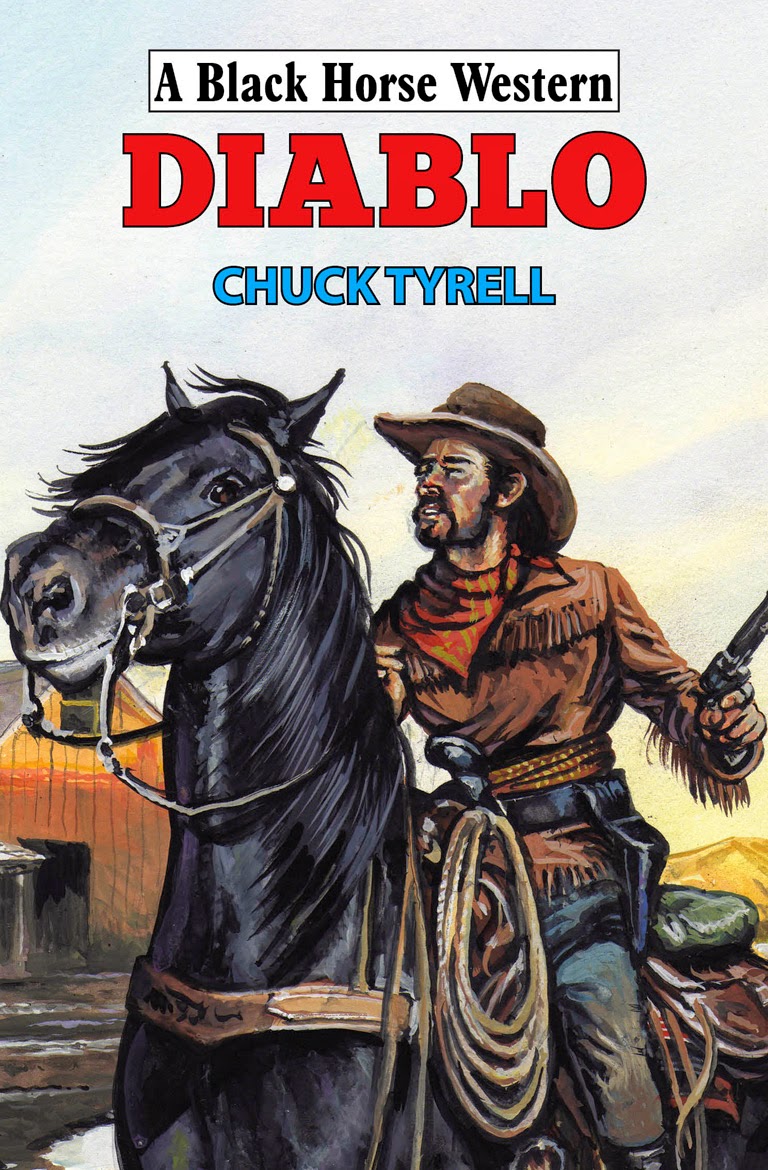


Available now from Black Horse Western or Amazon or Book Depository,
which offers free shipping.