Tuesday, August 27, 2019

LIVING AT 14,000 FEET

Post by Doris McCraw
writing as Angela Raines

Okay, unless you live in Peru, Tibet or China, most of us don't and probably wouldn't consider living at 14,000 plus feet. In the United States, there are few mountainous areas that even would qualify or have ground enough for living quarters. Those problems didn't stop the Army Signal Corps from giving it a try in the 1870s.

Yes, Colorado had towns at high altitude. Even today the towns of Alma, Blue River, and Leadville are over 10,000' in elevation.  In 1894 the town of Altman in the Cripple Creek Mining District had an elevation of 10,630', almost 300' higher than Alma. (Altman sat on the south side of Pikes Peak)
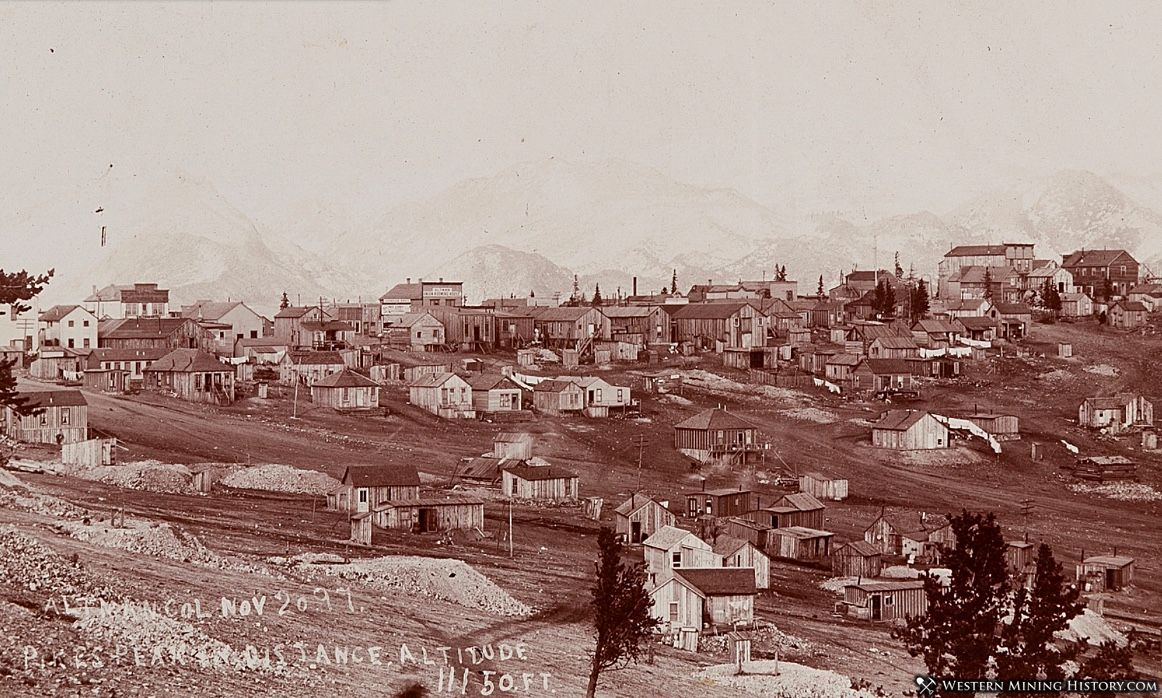
Altman, CO. from Western Mining History.
If you look closely you can see the top of Pikes Peak
 in the background.

Alma, CO 1870
courtesy Wikipedia
Although many lived at these altitudes, in 1873 the US Army Signal Corps decided that the top of Pikes Peak would be a great place to build a signal station and have it manned year-round. This would place the men at least 3 to 4000 feet higher than the highest town. To say that Colorado Springs, at the base of the mountain was excited is an understatement. The local paper, The Gazette Telegraph on Oct. 4, 1873, had this to say, "There is every prospect that the new station on Pike's Peak will be in working order within six weeks; as it is hoped that the delay arising from the chief office, misapprehending the difficulties attended on this location, and thereby failing to secure an adequate appropriation, will be quickly remedied.
Once, however, established, it's importance as the highest station in the world cannot be overestimated; and its records and observations will be anxiously scanned by the meteorologist of all countries."

Oh, how the thought of having such a place in their own backyard, so to speak, was exciting to this new town, which had been established two years earlier in 1871. They were excited and wanted bragging rights when the wind at the Mt. Washington station in New Hampshire, with an elevation of only 6,288' only about 200' higher than the town of Colorado Springs, reported one-hundred mph winds. Of course, the paper of Sept. 27,1873, had this to say: "The signal Corps report high wind on the peak on Thursday — the highest they have experienced there. The velocity was fifty miles an hour. The signal Corps on Mount Washington have been reporting a wind of one hundred miles an hour, but our boys intend to beat them yet, even if they have to "blow" themselves."

So excited were the citizens arrange a celebration on the peak to begin Oct 11, 1873. The Gazette published the following program in the Oct 4. 1873 issue:
The following program has been arranged for the ceremonies attending the opening of the signal station on the summit of the peak next Saturday.

Friday, — invited parties expecting to attend the dedication of the US Signal Station, will please meet at 8:00 AM at the Colorado Springs hotel. At 9 AM, starting; arriving at the summit at 5 PM. Tea. Ladies to stay on summit — Gentleman at Camp Howgate the S.S. camp near timberline.

Saturday, — Breakfast. Dedication of the building. Presentation of flag. Photographic view of the ceremonies. Dinner. Remainder of the day employed in amusement and conversation. Tea. Ladies remain on the summit — Gentleman at Camp Howgate overnight.

Sunday morning, — start for Colorado Springs, arrived toward evening. 

The photograph shows Albert James Myer, holding binoculars, and another man standing outside a stone observation station on Pikes Peak, Colorado
Library of Congress photo.
 Of course for the men who would be living there, well that was yet another part of the story. They lived in a building 40'x40' with one wall 11 feet high and the other 9 feet, creating a sloping roof. There was also a 10'x12' foot storeroom built onto the original station. The original staff consisted of six people. There were three in the first crew on top of the mountain and two more in Colorado Springs, and another who had the job of handling supplies. Originally, the weather reports were to be sent using their flashes, but the unpredictable visit ability at the top of the mountain a telegraph line was built.

Although the sun would shine, there were days when the thermometer told another story. In November 1880 a Mr. F. L. Jones, the signal officer stationed at the peak, said that one Tuesday night was one of the coldest ever experienced by him on the peak. The thermometer showing a minimum of 36° below zero during the entire night and at 5 o'clock yesterday morning it was 31° below.

Two left under clouds of suspicion of fraud, while others simply moved on. Of course, one cannot tell the story of the signal station without mentioning O'Keefe. With the aid of a conspirator in Colorado Springs, O'Keefe told some amazing tales about the top of the peak that were printed worldwide. They even went so far as to stage a funeral and headstone to the child of O'Keefe and his wife lost to the large rats that ate the child. Of course, O'Keefe was a bachelor. I did find an interesting article written years later that tells of death at the station. From Dec. 31, 1933, Gazette, the following information was shared from stories told by the early construction workers.

"All went well at the new station during the first few months of occupation. Following the Christmas holidays, the pair reported 'snowing continuously. Wind blowing a perfect gale.' These reports did not vary from day to day. The monotony and steady grind were upon the boys on the peak. About the middle of January Sgt. O'Leary reported his companion as being a very sick man and growing worse. They had been provided with a medical kit, but nothing so far administered had been of any effect and in the daily reports he grew fearful and apprehensive. Sgt. Lamont called in a well-known physician of Colorado Springs and advised with O'Leary what was best to do. O'Leary grew fearful and called for immediate help, admitting at the same time that no man could live long in the blizzard constantly raging on the mountain. Reports from the peak were discouraging; the stricken man had now developed pneumonia and was rapidly sinking. At 3 o'clock one morning O'Leary called up Lamont and sent a cryptic message,' he is dead.' Little was heard from the peak the days following. O'Leary's hand on the key lack the firm touch of his former self. He was evidently laboring under a great mental strain as his nervous spasmodic touch of the key indicated. When asked what he had done with his companion his brief reply was that he had been buried "military." The story went on to say that they had difficulty getting O'Leary down from the top of the mountain. "The three beef hides were lashed together and he was wrapped in blankets and brought down on an improvised sled. At one point the sick man was shot off the sled but without injury." O'Leary's story ended by saying "O'Leary improved physically and mentally, but never became his former self and shortly afterward died in a federal asylum for the insane."

Image result for images of the summit house on pikes peak
Second Summit House/Cog Railway station
from Wikipedia
The experiment of the signal station ended around 1888. There are still people who travel to the top of the mountain today and you can see the remains of the second signal station building, but no one lives up there year-round.

For those who would like to know more, the early editions of the Gazette and other Colorado Springs publications can be found at Pikes Peak Newsfinder on the PPLD.org website. There is also the book "Weather Pioneers" by Phyllis Smith along with mentions in various older publications found on Google Books and other such sites.

Doris Gardner-McCraw -
Author, Speaker, Historian-specializing in
Colorado and Women's History
For a list of Angela Raines Books: Here 
Photo and Poem: Click Here 
Angela Raines FaceBook: Click Here


Tuesday, August 20, 2019

DOG DAYS OF AUGUST by CHERYL PIERSON

Hey everyone! I do have some book news but it's too soon to share it,  BOO HOO--so I'll share some updates on my sweet boys you might want to see. We just passed a milestone in our family! We've had Sweet Seminole Sammy for one whole year as of the 18th of August! (Yes, I gave him and his furry brother Max both a small dish of vanilla ice cream to celebrate, but no party hats for fear of them being eaten, too!) Here's the first day we brought Sammy home to live with us, August 18, 2018--he was (they thought) about 6 months old. He'd been adopted and brought back because he dug holes in the adoptive family's yard. What a lucky day for US, because he is the perfect dog for our home! Here he is at the shelter before we brought him home with us.


And here he is on his little bed--it's amazing to see how "small" he was compared to NOW. No way he could even fit in that bed a year later!


Here are my two babies in March of this year--Sammy is about a year older than Max, and this was taken on Max's first day with us, March 11, 2019. Sammy was thrilled from the beginning, and he has been such a protective big brother ever since Max came to live with us. We got them both from the same shelter, but they never knew each other before, as Max came much later after Sammy was gone. This was taken in March of 2019, when Sammy had been with us about 7 months, and Max was a tiny puppy--only about 10 weeks old. He was so uncertain and afraid, but Sammy took him under his wing and made him feel right at home!


Here they are this past week and look how both of them have grown! They are best buddies and love each other dearly.
They spend almost every minute together and wouldn't know what to do without one another at this point. They are such a joy and so much fun to have in our family--always up to something (and not always something good--they are a lot like kids!)

Judging how Max has grown, I think he's going to be taller than Sammy, but I believe Sammy will always be more muscular. They didn't know what breeds either of them were, but it doesn't matter. Their hearts are pure gold, and their breed is LOVE!


This is one of my favorite pictures of the two of them. I took this just a few weeks ago. Max has gathered all their toys around him on the floor, looking up so proudly, and Sammy is on the couch beside me with the look that says, "Oh, brother. See what I have to put up with?" But he wouldn't have it any other way! 


Do you have a pet you cherish with all your heart? Let's hear about them! I am such an animal lover, and I know many of you all are, too!

Monday, August 12, 2019

My Favorite Song by Kaye Spencer #westernfictioneers #folkmusic #songs


We all have songs that mean something extra special to us whether by our associating them with a special event, a loved one, a precious moment, a situation, etc. In fact, if you’re like me, I could go on for hours singing the words to all the songs that are near and dear to me.

 But there is one song. The one song that tops all the others. The that brings a tear to my eye and a warm fuzzy feeling in my heart.


Hints:

“My” song is an American rendition of Greensleeves, which is an old English folk song of complicated, and not entirely identifiable origins. Greensleeves was a familiar song (tune) in Shakespeare’s day, because he referenced it in his play, 'The Merry Wives of Windsor' in 1595. Falstaff: “Let the sky rain potatoes! Let it thunder to the tune of ‘Greensleeves’!”

There is a legend that the original song was written by Henry VIII for his future wife, Anne Boleyn, but that is apparently a myth as there is evidence the song was around before Henry’s time.

By 1690, or so, the original song was becoming associated with Christmas and New Year’s. Then by the 19th century, any Christmas songbook worth its salt included some version of the original folk song (lyrics and tune) as a carol. Elvis Presley, Tom Jones, and a host of other crooners have recorded their renditions of Greensleeves.

Here is a clip from The Rifleman with Johnny Crawford singing Greensleeves.


As a Christmas song, we know it as What Child is This? which has also been recorded by too many artists to list here.

For those of you desiring more history about Greensleeves, click HERE, HERE, and HERE. 

My favorite song is A Home in the Meadow. The lyrics were written by Sammy Cahn and the song was performed by Debbie Reynolds in the 1962 western movie (and book by same title written by Louis L’Amour), How the West was Won.

For your viewing and listening pleasure, here is the YouTube clip from the movie. If you've not read the book How the West was Won AND watched the 1962 movie of the same name, you should remedy those most egregious oversights as soon as you can. You can thank me later. *wink*


Until next time,

Kaye Spencer

Writing through history one romance upon a time


Stay in touch with Kaye

Amazon Author Page | BookBub | Blog | Twitter | Pinterest


Saturday, August 10, 2019

Old West Trivia

Here are some snippets and bits of trivia about the Old West. You may or may not be able to use them in your writing, but they do make interesting reading.


Rumor has it that the habit of spreading sawdust on the floor of a bar or saloon began in Deadwood, South Dakota. So many miners were spilling gold dust that saloon owners began using sawdust to hide how much dust was actually on the floor. At the end of the night, the dust (and gold) would be swept up and separated.

“Hanging” Judge Roy Bean once killed a Mexican official in a battle over a young lady. A friend of the official tried hanging Bean, but the young lady cut him down in time to save his life. However, afterwards, the judge could never fully turn his head due to his injuries.

The term “red light district” came from the Red Light Bordello in Dodge City, Kansas. The entire front door was made of red glass, and the glow lit the way to the brothel. The name later came to mean that entire part of the city.

Wyatt Earp was indicted for horse theft in Van Buren, Arkansas on May 8, 1871. He jumped bail to escape his trial and fled to Kansas.


Harry Longabaugh became known as the Sundance Kid because he served a term in Sundance, Wyoming for horse theft.

The Oregon Trail, from Independence, Missouri to Fort Vancouver, Washington, measured 2,020 miles. An estimated 350,000 emigrants took this route. One in 17 died along the way. The most common cause of death was cholera.

The infamous Dalton Gang only operated for a year and five months – beginning with a train robbery in Wharton, Oklahoma on May 9, 1891 and ending with the shootout at Coffeyville, Kansas on October 5, 1892.

Although the term “stick ‘em up” is widely used in Western film and literature, the term wasn’t actually coined until the 1930s.

In Tombstone, Arizona’s brief heyday (from 1878 to 1886) some 80 million dollars’ worth of silver was mined there.

America’s first train robbery is believed to have taken place on October 6, 1855 in Jackson County, Indiana. The two bandits, John and Simeon Reno, got away with $13,000 from the Ohio and Mississippi Railroad.

From the end of the Civil War until 1890, some 10 million head of cattle were driven from Texas to Kansas.

On September 8, 1883, Sitting Bull delivered a speech at the celebration of driving the last spike in the Northern Pacific railroad joining the transcontinental system. He delivered this speech in the Sioux language, deviating from the one prepared for him by the army translator. In this speech, Sitting Bull denounced the army, settlers, and the U.S. Government, though listeners believed he was praising them. Periodically, the Lakota chief would pause for applause, bow and smile, then continue insulting the audience as the translator delivered the original speech in English.


The famous gunfight at the O.K. Corral only lasted about 30 seconds.

Jesse James was called “Dingus” by his friends.

The telephone was invented in 1876. After the White House, the first community to have one was Deadwood, South Dakota.

According to witnesses, Wild Bill Hickock could hit a dime tossed into the air nine out of ten times at 25 paces. At the same distance, he could knock an apple from a tree with one shot, then hit the same apple on the way to the ground.

Doc Holliday claimed he almost lost his life nine times. Four attempts to hang him were made, and he was shot at five times.

Annie Oakley (Phoebe Anne Mozee) never lived further west than Ohio.

The first gold rush in the United States was not the California gold rush of 1849 – it took place in Georgia in 1828. It was her that terms such as bonanza, gold digger, placer and gold belt were coined.

After surviving decades of notorious outlaws, retired marshal Bill Tighman was shot and killed by a corrupt Prohibition Officer in 1924 – he was 70.

About one-third of gunmen died of “natural causes,” living 70 or so years. Of those who did die violently (shot or executed), the average life span was 35. Gunfighters-turned-lawmen lived longer lives than their totally criminal counterparts.


One practice credited to the Old West is the Indian practice of taking scalps. However, that actually began in the French and Indian War when General Edward Braddock offered five pounds sterling to his soldiers and their Indian allies for every French scalp. The Indians actually learned the practice from the British.

Female bandit Pearl Hart was the last person to rob a stagecoach in the Old West in 1899.

Friday, August 9, 2019

Western Comics Focus: The Seven Deadly Sins


Troy D. Smith

The western comic book continues its ride... they are not as plentiful as they were in the 1930s-1970s (when they were ubiquitous), but they seem  more common now than they were a couple of decades ago. This is due, in part, to the existence of smaller, independent comics publishers (and a growing amount of online content).

TKO is one such publisher. Their recent western entry was a six-part miniseries (collected last year in a single graphic novel volume) called The Seven Deadly Sins. It is written by Tze Chun, who is best known for his television work (including as writer for the show Gotham). The illustrator is Russian comics artist Artyom Trakhanov. The plot is sort of a mashup of The Magnificent Seven and The Dirty Dozen, as directed by Quintin Tarantino.


The book is set in Texas in 1867. A kind priest, Father Antonio, rescues six killers from a stagecoach that is taking them to their just reward (to wit, hanging in San Antonio). The priest describes each as a "deadly sin," with himself providing the seventh -sloth. He had been peripherally involved in a great injustice ten years earlier, you see, and had only now summoned the courage to try to set it right.


Antonio is the subordinate of Father Threadgill, who is head of the mission. Father Threadgill has a maniacal hatred of Indians, but wants to save the souls of their children... save them from their very Indianness. In 1857, after taking Antonio in when his own mission had failed, Threadgill took his new assistant along on a secret mission. He had hired a company of corrupt Texas Rangers to attack a Comanche village while the men were away hunting, kill all the adults, and capture their children. The kids were to be taken back to the mission, identified as Mexican, and give away for adoption (well, not exactly given away.) It was not the first time.

One infant was deemed too small to make the trip back, so the Rangers were going to kill her. Antonio begged for the child's life and took responsibility for her. He named her Grace, and from then on he was her surrogate father, Her real father, though, was the fierce war chief Black Cloud. His fury at his child's abduction caused him to step up his band's war on whites along the border tenfold, and for years he wreaked his vengeance by slaughtering settlers and stealing their children.


Finally, Father Antonio's conscience could take no more. He stole a large amount of money from the mission -money "earned" by selling Indian children -and freed the six outlaws, offering them a hefty payday if they would help him accomplish his mission.

Taking Grace deep into Comanche country in search of the dreaded Black Cloud -to give her back. Pursued along the way, of course, by Father Threadgill and his corrupt Rangers.

Father Antonio has assembled a colorful crew...


JERICHO  MARSH (wrath). Clearly modeled on Samuel L. Jackson's character in The Hateful Eight, Marsh had led a group of black Union guerrillas during the Civil War and was wanted for war crimes. When the war ended, his two daughters were forced to sign labor contracts- their contracts were sold and they were taken away. This is a pretty rare pop culture reference to the very real historical situation for ex-slaves in the years immediately after the Civil War, when state legislated "Black Codes" were passed that kept them enslaved every way but in name.

Jericho Marsh will do anything, and kill anyone, to find his daughters.


MALENE JOHNSON (envy). A pregnant ex-slave. The father was her former master, with whom she was in love and who had promised to marry her -but who betrothed himself to a proper white lady instead, whereupon his whole family perished in a house fire. Malene was convicted of arson and murder.


HOGG SMYTHE (gluttony). An overweight and simple-minded Confederate veteran who, when besieged by Yankees, killed and ate ten of his comrades.


IRISH CLAIRE (greed). A foul-mouthed, hot-tempered young Irish woman who is a notorious bank robber -described by others as a "tomboy" and a Lesbian (or more accurately, a Trans person who identifies as male, and wants to be called Clarke.)


DAPPER DUDLEY (lust). A crack shot, formerly a pistoleer in Wild West shows... also a vain con man and a consummate showman. His face is scarred because his former wife mixed mercury in with his stage makeup to get revenge for his raping her ten-year-old sister.


CHANG (pride). A brilliant surgeon in China and San Francisco who was forced into indenture and made to work on the railroad. He killed in order to make his escape.

The above description may seem like I am telling you a lot... but it is really just setting the scene for the story. Needless to say, there are a lot of shootouts, double crosses, and occasional acts of redemption (sort of).


It may not be for everyone. If you think Tarantino's westerns are too violent and profane, you won't like this. I certainly enjoyed it, though- it was fresh take on some very time-honored themes, and felt a lot like a spaghetti western.


Friday, August 2, 2019

The 10th Annual Peacemaker Awards Now Open for Submissions


Submissions for the 10th Annual Western Fictioneers Peacemaker Awards are now being accepted for works originally published in the year 2019.


Qualifications:


First time in print must be between January 1, 2019, and December 31, 2019, no reprints or revisions. Limit of 2 entries per category.


Books and short stories may be published in any country in the world (submissions must be in English) in print or electronic format. Electronic submissions must be made with Kindle/mobi, PDF, or Word/text files. WF reserves the right to decline any submission for consideration of an Award.


Authors, agents, or publishers may submit a work for consideration of an Award.


At least three entrants in a category must be received during the submission period for an Award to be presented.


Novels and short stories must be set in the time period between 1830-1920 to be considered Westerns under WF guidelines. Time periods beyond the 1830-1920 traditional western focus may be included in submissions as long as the periods outside of the 1830-1920 span constitute no more than 50% of the story. At least 50% of the story MUST TAKE PLACE in the 1830-1920 period. NO EXCEPTIONS.


Finalists for the Peacemaker Awards will be announced on May 15, 2020 and the winners will be announced on June 15, 2020.


The WF Peacemaker Award will be awarded in three categories:


Best Western Novel – Any novel published during the award year set in the appropriate time period (1830-1920), at least 30,000 words in length. There are no format requirements. The novel may be a hardcover, trade paperback, mass market paperback, or eBook.


Best Western Short Fiction – Any short story, novelette, or novella published during the award year set in the appropriate time period (1830-1920), from 500 words to 29,999 words. There are no format requirements. The short story may be published in any publication, print or electronic.


Best First Western Novel – Must meet the same requirements as Best Novel, and must be the author’s first published Western novel. If the author has published novels in any other genre they will not disqualify the author from the Best First Western Novel Award competition. Submissions for Best First Western Novel may also be submitted in the Best Novel category in the same year.


Procedures:


If sending print form, one copy of the work must be sent to each judge (3 per category), and the Awards Chair for a total of four, accompanied by the appropriate form.


Electronic versions should be emailed to the Awards Chair, James Reasoner, with the appropriate submission form. The electronic submissions will be distributed to the judges by the Awards Chair. All entries must be postmarked or received via email by midnight, CST, January 15, 2020. Judges should not be contacted by any entrant concerning their entry during the consideration period. Doing so may result in disqualification of eligibility for the WF Peacemaker Award. Works submitted will not be returned after the awards have been announced. There is no fee to enter. There will be no exceptions made to the submission procedures, for any reason.


Links to forms to include are at the bottom of the list of judges. You will need 4 copies for each printed entry, one for each judge and one for the Awards Chair.


Awards Chair: James Reasoner

P.O. Box 931

Azle, TX 76098-0931

EMAIL james53@flash.net


Tuesday, July 23, 2019

ANTHOLOGIES AND WRITING SHORT

Post by Doris McCraw
writing as Angela Raines

Photo property of the author
First I'll get the joke out of the way, yes I write short because I am. Well, maybe not a short as some, but when I go to the market I always have to find someone to reach things from the back of the top shelf.

All joking aside, I love the challenge of writing a short story, and to be truthful, some stories are better told in short form. There were some masters of the short I loved to read. Harlan Ellison, Ray Bradbury, Louis L' Amour, and Elmore Leonard. While I may never reach their level, it is something to strive for. Of course, you notice, they are all no longer with us. There are some wonderful authors now who are also an inspiration.

Probably the best thing I've done recently is to judge short stories. I am so in awe of the talent writing today. You learn so many things when judging and it helps to improve your own writing, at least it did mine. (Or so I want to believe).

This leads me to Anthologies. Unless you have a large enough following for a collection of your shorter work, most short stories find their home in anthologies or in the few magazines left that accept the Western genre. I'm thrilled that both options are available to writers today. My four authors learned and perfected their craft in those magazines of yesterday. Now, for many of us, it's the online and anthologies that are our training ground.


The other wonderful advantage of an anthology is you share the pages with other authors. By default, your audience expands. There is nothing wrong with that, especially in the market today.

Personally, I love reading anthologies and short stories. The exposure to new authors is exciting to me. I also enjoy the shorter stories when life is so busy I don't have time for the longer form. I get a great complete story and can finish it in one or two sittings. That is a win-win for me.

Lately, I've been reading the short stories of Peter Dawson, T.T. Flynn and others from that earlier time. Who is your favorite short story writer?

Of course, I would be remiss if I didn't do a short piece about the current anthology I have a story in. If you haven't heard of "Hot Western Nights", edited by Cheryl Pierson and published by Praire Rose Publications,  you are about to. There are six stories to this anthology, each different, yet all taking place in the early West.  Below is a short excerpt from my story, 'Duty':


Miranda Foster climbed the hill overlooking the ranch her stepfather left her to run for his heirs. Clouds flew across the sky. Standing on the hilltop, she watched a storm building, its track headed toward the ranch house. She didn't begrudge her duty, but by the time her step-brother Byron was old enough to take over, she'd be an old maid.
No one knew she wasn't the owner. It was her step-father's way of keeping the ranch safe. She remembered their conversation. "I know I'm asking a lot of you, but you'll be taken care of."
Miranda thought back on that conversation as she caught movement near the leading edge of the storm. Watching, she saw five specks detach and draw closer. The wind was pushing her back the way she'd come, trying to guide her to safety.
Miranda would not be moved. "You may threaten, cajole, or do me harm, but I will not be swayed from my duty," Miranda sent back to the wind as she waited for the oncoming riders, shotgun in hand. She never left the ranch house without it since the coming of Tate Browning. She stood, a calm determination not to give in.
"A woman can't hold such a place as this," the old man said as he rode up, almost on top of Miranda.
Miranda stood her ground, looking each of the men in the eye. "I've been charged with keeping this land safe, to never sell for any reason. Tell Tate Browning, it's a duty I shall discharge to the best of my ability."
The man glared back, looking for a way to pierce Miranda's armor. The wind whipped by the men and Miranda. Thunder sounded in the distance.
Miranda stood firm as the wind spent its fury. The old man growled, his anger a living thing, pressing on her as was the wind.

Purchase book from Amazon here


Doris Gardner-McCraw -
Author, Speaker, Historian-specializing in
Colorado and Women's History
Angela Raines - author: Where Love & History Meet
For a list of Angela Raines Books: Here 
Angela Raines FaceBook: Click Here

Monday, July 22, 2019

How Roy Bean Made the National Limelight, and Saved a Heavyweight Prize Fight


The Fitzsimmons/Maher Fight of 1896

Bob Fitzsimmons and Peter Maher
The heavyweight boxing championship fight of 1896 was arguably the most controversial sporting event of all time, escalating at one point into an international incident that involved three great athletes, the Texas state legislature, an ambitious boxing promoter, U.S. marshals, Texas Rangers, the Mexican army, and last, but not least, an eccentric and entrepreneurial saloon keeper and part-time Justice of the Peace by the name of Roy Bean.

John L. Sullivan held his heavyweight championship title from 1882-1892. He is recognized as the last champion of the bare-knuckle fighters under the London Prize Ring Rules, and the first champion of the gloved boxers under the Marquess of Queensberry Rules. Sullivan is said to have won more than 450 fights during his career, finally losing the heavyweight title on September 7, 1892, in a fight with “Gentleman” Jim Corbett that lasted 21 rounds.
Press Pass for the Sullivan/Corbett fight
September 7, 1892

Corbett wasn’t interested in defending his title; instead, he used his champion status to put on theatrical “boxing” exhibitions from which he derived a substantial living.

An English boxer from Cornwall by the name of Bob Fitzsimmons held the U.S. middleweight title and began to fight as a heavyweight. He repeatedly challenged Corbett to a fight, but Corbett repeatedly refused, stating that Fitzsimmons wasn’t in his league as a fighter. Finally, in 1894, a boxing organization called the Olympic Club named Fitzsimmons the heavyweight champ because Corbett refused to fight, essentially forcing Corbett to fight Fitzsimmons to defend his title.

A gambler and boxing promoter in Dallas, Texas, by the name of Dan Stuart, saw an opportunity and started promoting the fight in an effort to bring it to Dallas. He arranged for special railroad fairs for people around the country who wanted to come to Dallas to see the fight. He even started plans for a fifty-two thousand seat arena to be called the Dallas Coliseum. Through his contacts with Dallas businessmen, Stuart was able to raise forty-one thousand dollars for the purse.

But there was opposition to the fight. The Dallas area clergy condemned the fight because they believed that it would draw the worse elements of society to the city. Other issues arose as well. Corbett was distracted by a very public and ugly divorce, and Fitzsimmons was about to go on trial for manslaughter, having killed his sparring partner in a boxing exhibition the previous year. Furthermore, the laws in Texas at the time were vague as to the legality of boxing.

The Governor, Charles Culberson, under pressure from the Dallas clergy, called the state legislature into a special session in October of 1895 in order to pass a law prohibiting boxing in Texas. The issue was settled once for all. The fight would not take place in Texas.

Texas Rangers sent to El Paso to make sure
the fight didn't take place on Texas soil
Stuart considered other states in which to hold the fight, but one by one they all turned him down. Governor Clarke of Arkansas went so far as to threaten to enlarge the state penitentiary to accommodate the crowds if Stuart brought the fight to his state.

To make matters worse for Stuart, Corbett decided to retire from boxing, believing that the fight was never going to happen. He relinquished his title to a little-known Irishman by the name of Peter Maher who had just fought Corbett’s sparring partner and knocked him out in sixty-three seconds. Stuart was now left with only one fighter and no venue for the fight. Things were looking pretty hopeless.

Fitzsimmons, who had been eager to fight Corbett, was furious about the champ bowing out of the fight, so he immediately challenged the new champion, Peter Maher, who accepted the challenge. Fitzsimmons and Maher had fought once before, in 1892, with Fitzsimmons emerging the victor. The fight was on once again. All they needed was a place to battle. The people of El Paso came to the rescue with a plan of their own.

Souvenir coins from the fight before
the last-minute change of venue
When Texans want a fight, they will find a way. They knew that they couldn’t have the fight in Texas because of the new law, so, raising fifteen thousand dollars for the purse, their plan was to have the fight across the border in Juarez, Mexico.

Everything seemed to be falling into place. Fitzsimmons arrived in El Paso to begin training and Maher set up his training camp not far away in Las Cruces, New Mexico. The spectators started pouring into El Paso, and with them came a contingent of law enforcement, including U.S. marshals and thirty-two Texas Rangers, to make sure that the fight didn’t take place in Texas.

No one had considered asking Mexico what they thought about having the fight in Juarez, but they found out when the Mexican government sent 150 soldiers to Juarez to keep the championship bout out of their country. Once again, the fight had no venue.

Enter Roy Bean.

The eccentric saloon keeper/Justice of the Peace from Langtry, Texas on the Rio Grande said that he would guarantee a venue for the fight that would satisfy everyone.

Stuart kept the location of the fight a secret and arranged for a special train to carry the spectators, sportswriters, gamblers, and lawmen from El Paso to the location of the fight. On February 20th of 1896, passengers loaded onto a special ten-car Southern Pacific train, paying twelve dollars each ($300 in today’s money), to head east toward a secret destination. It wasn’t until the train stopped in Langtry that anyone knew where they were going.


Bean, always the entrepreneur, had arranged for a train from San Antonio to deliver a fresh supply of beer, which he sold for a dollar a bottle ($25 today) to the thirsty spectators. Then he directed them to the Rio Grande where he had set up a boxing ring on a sand bar in the middle of the river. He had constructed a canvas wall around the ring to discourage any non-paying on-lookers who couldn’t afford the twenty-dollar price of admission. However, the canyon walls of the Rio Grande rose up high enough so that many people who couldn’t get a seat inside the canvas wall were able to climb up on the heights to get a free show. The Texas Rangers, who had accompanied the train, stood along the banks of the Rio Grande at the extent of their jurisdiction.

Historical Marker at the site of the Fitzsimmons/Maher fight
The fight had been gestating for four years. After months of preparation, after spending thousands of dollars on promotion, after bouncing from one city to the next not knowing where the fight would take place, after overcoming special legislation and special interest and armies of soldiers and law enforcement, the fight was finally happening…and it ended in ninety-five seconds with a knockout by Fitzsimmons.

(Author’s note: The very next fight by Fitzsimmons in December of 1896 was almost as controversial, but for different reasons, and involved another Wild West icon. You can read about it in one of my previous articles here.)


Mike describes himself as Conservative, Christian, Pro-life, and Pro-gun. He is a drinker of copious amounts of coffee. Happily married to his redheaded sweetheart, Tami, they live in the mountains of western Montana. He is a writer of Western short stories and humorous fiction and has been published in a number of anthologies and magazines. His first novel, The Sons of Philo Gaines, is scheduled for release in May of 2020. You can visit his blog at: 
and his Facebook page at: