The list goes on.
When I lose sight of the good in life, I bring out this reminder.
Official Blog of the Western Fictioneers, Professional Authors of Traditional Western Novels and Short Stories
The list goes on.
When I lose sight of the good in life, I bring out this reminder.
November 11 is Veteran’s Day. Of course, Veteran’s Day wasn’t actually invented until 1947, but your characters may have had their own version of the Great War, in 1861. More than three million people (all but around 300 were male) fought in the U.S. Civil War, which lasted until 1865. About two percent of the population, or over 600,000, died during the war. Considering that we only lost around 116, 000 in World War I, you’d think the country would have celebrated some sort of yearly memorial to those soldiers. Of course, in fairness, we should remember that diseases actually killed twice as many men as battle. The men were confined in poorly-ventilated tents and camps became breeding grounds for childhood illnesses like mumps, measles, and chickenpox.
The main weapon of that war – and the one responsible for 80 percent of wounds – was the single-shot, muzzle-loading rifle. Your character’s odds of actually surviving a wound during the war was seven to one, chiefly because doctors of that time had no idea of germ theory or blood types. Additional weapons utilized during the Civil War included the cannon, the revolver, swords or cutlasses, hand grenades and land mines, and “Greek fire” (the recipe for which probably included petroleum, pitch, sulfur, pine or cedar resin, lime, and bitumen).
Lest you think muzzle-loading weapons fairly ineffective in a pitched battle, the average soldier could reload and fire three times a minute, or once every twenty seconds. In addition to his rifle, a soldier typically carried about seven pounds of ammunition, including a cartridge box with 40 rounds in it. If he expected an extensive battle, he might even carry another 60 rounds along with him. Although artillery was heavily utilized during the war, only about 10 percent of the wounded were actually injured by it.
After the battle of Gettysburg, discarded rifles were gathered and sent to Washington to be inspected and reissued. Out of over 37,000 rifles that were recovered, 24,000 were still loaded. Most rifles were equipped with bayonets, but very few men showed up at the hospitals with bayonet wounds. This was taken to mean the bayonet just wasn’t a lethal weapon, but what actually happened was that soldiers rarely made it to grappling range, and if they did, they were more likely to use the rifle butts as clubs.
If your character was a Union soldier, he’d have gotten $13 to $16 a month for his work (if he was white, that is; black soldiers only got $10 to $13). That three-dollar raise came in June of 1864. Black soldiers weren’t too happy about that pay difference, either, especially as they were charged three dollars a month for clothing! In protest, black regiments refused to accept this inferior pay. Eventually (in September of 1864), pressure from the abolitionists, along with the bravery shown by black regiments in battle, persuaded Congress to rectify the inequality. Black soldiers finally received equal pay retroactive to their enlistment date.
Officers for artillery or infantry units earned the following at the beginning of the war:
· Colonels: $212
· Lieutenant Colonels: $181
· Majors: $169
· Captains: $115.50
· Lieutenants: $105.50
Pay for one-, two-, and three-star generals was $315, $457, and $758, respectively, so it certainly paid to work your way up in rank. The Confederate pay schedule was modeled on the U.S. Army. Privates made $11 a month until that magic date of June 1864, when every soldier got an eighteen dollar raise.
Of course, since your general usually led the regiment into battle, they earned those paychecks. Generals were 50 percent more likely to die in battle than privates. Just at the Battle of Antietam, three generals were killed and six wounded – on each side.
Nobody knows the age of the youngest soldier of the war. One George S. Lamkin from Mississippi joined the Confederate army at age 11. And one entire regiment of volunteers in Albany, New York was composed of men over the age of 45. And then there’s Private Thomas Stewart of Ohio, who served at the age of 92.
One-third of the Union forces were immigrants, and almost one in ten were black. In fact, one in four regiments were made up mostly of foreigners. You’ve probably heard about Irish soldiers – they made up around 7.5 percent of the army. However, there were even more Germans in the Union (around 10 percent), such as the Steuben Volunteers. Also counted were Englishmen, Frenchmen, Polish, Italians, and Scots.
If your character didn’t actually serve in the Civil War, he or she may have had relatives or friends who did. I hope these bits of trivia will help add a dash of flavor to your character’s fictional life. Check out the sources for even more facts.
J.E.S. Hays
Source:
Legends of America’s Civil War Facts - https://www.legendsofamerica.com/ah-civilwarfacts/
History.com’s 10 Surprising Civil War Facts - https://www.history.com/news/10-surprising-civil-war-facts
Post by Doris McCraw writing as Angela Raines
| Headstones of members of the National Typographical Union Evergreen Cemetery photo property of the author |
In 1892 the International/Nationa Typographical Union built a facility in Colorado Springs for the care of its ill members. Part of the reason for the choice was the reputation Colorado and Colorado Springs had for curing diseases of the lungs.
| Image from Pinterest |
It was during the founding of the town in the Pikes Peak region during the early 1870s that those suffering from lung problems found that the clean air helped alleviate the symptoms. Dr. Samuel Edwin Solly and his wife arrived in the region hoping the cure the tuberculous they both were suffering from. Dr. Solly survived. His wife did not. Still, Dr. Solly remained and did much to promote the region as a cure. He published papers and articles on the subject.
At the time the typographical union decided to build its facility in Colorado Springs, a number of its members were suffering lung problems as a result of the carbon-based ink used in their profession. Due to this problem, the average life expectancy of a printer was about forty-one years. The facility and its grounds grew over the years to encompass more than 260 acres and included a dairy farm, gardens, and a power plant.
| Image from the Historic Preservation Alliance, Colorado Springs |
The Printers Home also had/has a large area in the local cemetery for their deceased members. Although the home is now closed, its presence and history continue to fascinate. And for those who might be interested, it is located close to where Nikola Tesla had his laboratory in 1899.
One such resident was Ezekial H Brady. Born in 1852 and he worked as a book-binder and printer in Des Moines, Iowa. The census shows he was still in Iowa in 1925 with his wife Mary, who he married in 1872, and still working as a printer. Sometime between 1925 and 1937, he moved into the home to live out his remaining years. He died in 1937 and is buried in the Printers Home section of the cemetery.
| Image property of the author |
My short story in the Western Fictioneers anthology "Under Western Stars" is about a newspaperman. Although the work of reporters, printers, and others involved in the dissemination of the news is what we know, there was so much that we don't think about. Histories of places like the Union Printers Home help us to understand.
| Amazon |
This article kicks off my series of 13 Days of Spooky Blogging for Halloween, that I will post daily on my blog HERE and on Facebook HERE.
Several of these 13 spooky blog articles are my first-hand, paranormal experiences.
On to my first spooky article...
Every state has its paranormal stories and urban legends.
Since I’m a native Coloradoan, I’m sharing five ghost stories from my home
state.
Baldpate Inn, Estes Park, Colorado – Newlyweds Gordon and Ethel Mace homesteaded in Estes Park in 1911. They built a cabin for themselves along with small tourist cabins as a money-making endeavor. In 1917, they were financially able to build their inn. They named their inn after a novel in which guests received their own metal keys to the inn. They continued this until WWI when metal was too expensive to continue doing this. Instead, their regular visitors started bringing them metal keys, which became a “Key Room” of over 20,000 keys from all over the world. After their deaths, staff and visitors have continued to encounter Ethel in the Key Room, where she sits in a wing-backed rocker near a fireplace reading the Bible.
![]() |
Baldpate Inn - Key Room (citing HERE) |
Brown Palace Hotel, Denver, Colorado – This hotel is
host to several ghost stories.
Henry Cordes Brown opened the hotel in 1892. It soon became ‘the place’ to stay. One of the ghost stories involves a Denver socialite who lived in Room 904 from 1940 – 1955. The story of her life involves heartbreak and a lost love. When the hotel began offering tours after 1955, phone calls started coming into the switchboard from her room, which was undergoing renovations and did not have telephone service connected. Once Room 904 was removed from the tour, the mysterious phone calls stopped.
Ellyngton’s is the current name of the main dining room. It was the San Marco Room during the Big Band Era. The story goes one night an employee heard sounds in the room. He investigated and discovered a string quartet practicing. He told the musicians there weren’t allowed there. The reply was not to concern himself, because they lived there.
The apparition of a man dressed in ‘old-fashioned train conductor’s uniform’ was seen for a moment then it disappeared through a wall. The wall was where the railroad ticket used to be.
A uniformed waiter is frequently seen in the service elevator.
Happy, laughing children have been seen running in the hallways.
A baby’s cry is often heard in the boiler room.
![]() |
Brown Palace Hotel (citing HERE) |
Stanley Hotel, Estes Park, Colorado – Stephen King
put the Stanley Hotel on the map as a result of his book, and later movie, The
Shining. Freeland Oscar Stanley opened the hotel in 1908 as a summer hotel, because
the hotel was unheated. For whatever paranormal reasons, the hotel has had hauntings
and odd happenings throughout its history.
The ghost of a Lord Dunraven has been seen in Room 407 where he stands or peers out one of the windows. Lights in the bathroom also turn on and off of their own accord.
Inside and outside of Room 481, sounds of children playing can be heard when there are no children around. Doors open and shut by themselves, elevators take off on their own, invisible footsteps move along the hallways, music plays without musicians, and apparitions of men, women, children, and Mrs. and Mrs. Stanley are regular occurrences.
![]() |
Stanley Hotel (citing HERE) |
Red Rocks, Morrison, Colorado – Red Rocks, the outdoor
amphitheater, is the site of the legend of the Headless Hatchet Lady. There are
various renditions of this legend from the hatchet lady simply being a homeless
woman who chased people away from the cave she lived in to her being a headless
woman with her coat over her head who rides a horse and wields a bloody hatchet
as she chases anyone, particularly young couples, who dare explore the remote
Red Rocks.
Yet another version explains the hatchet lady as a woman homesteaded in the Red Rocks area, who guarded her daughters’ reputations with that hatchet. Any man she caught taking liberties with her girls would come up missing important body parts.
Hence, the reason the rocks are red.
![]() |
Town of Morrison - Red Rocks in background (citing HERE) |
The Hotel Colorado, Glenwood Springs, Colorado – The Hotel
Colorado opened in 1893 as a luxury resort. This hotel is associated with all
sorts of paranormal activity. One origin story for the on-going and unexplained
paranormal happenings is the land where the hotel sits was cursed by the Ute
Indians, when they were forced to relocate around 1880.
Since then, there have been sightings of ghosts of people who died in the hotel walking the halls, sounds of women’s voices and the clicking of typewriters where neither exist, and faces peering in (and out) of windows.
The basement served as a naval hospital and morgue during World War II. On the main floor, the story of a ghost named Bobbie has been traced back to the 1940s. She was a nurse in the naval hospital, and she was possibly killed by her jealous lover/military officer who was stationed at the hotel/hospital. A cover-up followed, but hospital staff spilled the story.
Soon after the murder became common conversation around town, guests and staff began smelling a specific perfume in the area of Bobbie’s favorite table to the buffet line and back to the table. (‘Gardenia’ – perfume from 30s and 40s and no long produced)
Another ghost named Walter hangs out in the hallways and in the lobby, particularly in the evening. When Walter shows up, cigar smoke accompanies him. There is controversy over the identity of Walter. It’s thought he might be the spirit of E. E. Lewis, who became the general manager in 1905. Lewis took great pride in the hotel.
In Room 661 upstairs, a ghostly woman wearing a floral dress is often seen standing over the bed, and she will doggedly come into the room and close the window when a guest opens it. She has been heard to insist people stay out of the draft.
![]() |
Hotel Colorado (citing HERE) |
Until next time,
Kaye Spencer
Sources:
American Farmhouse Style
Legends of America
Denver Post
Colorado Homes Magazine
Hotel Colorado
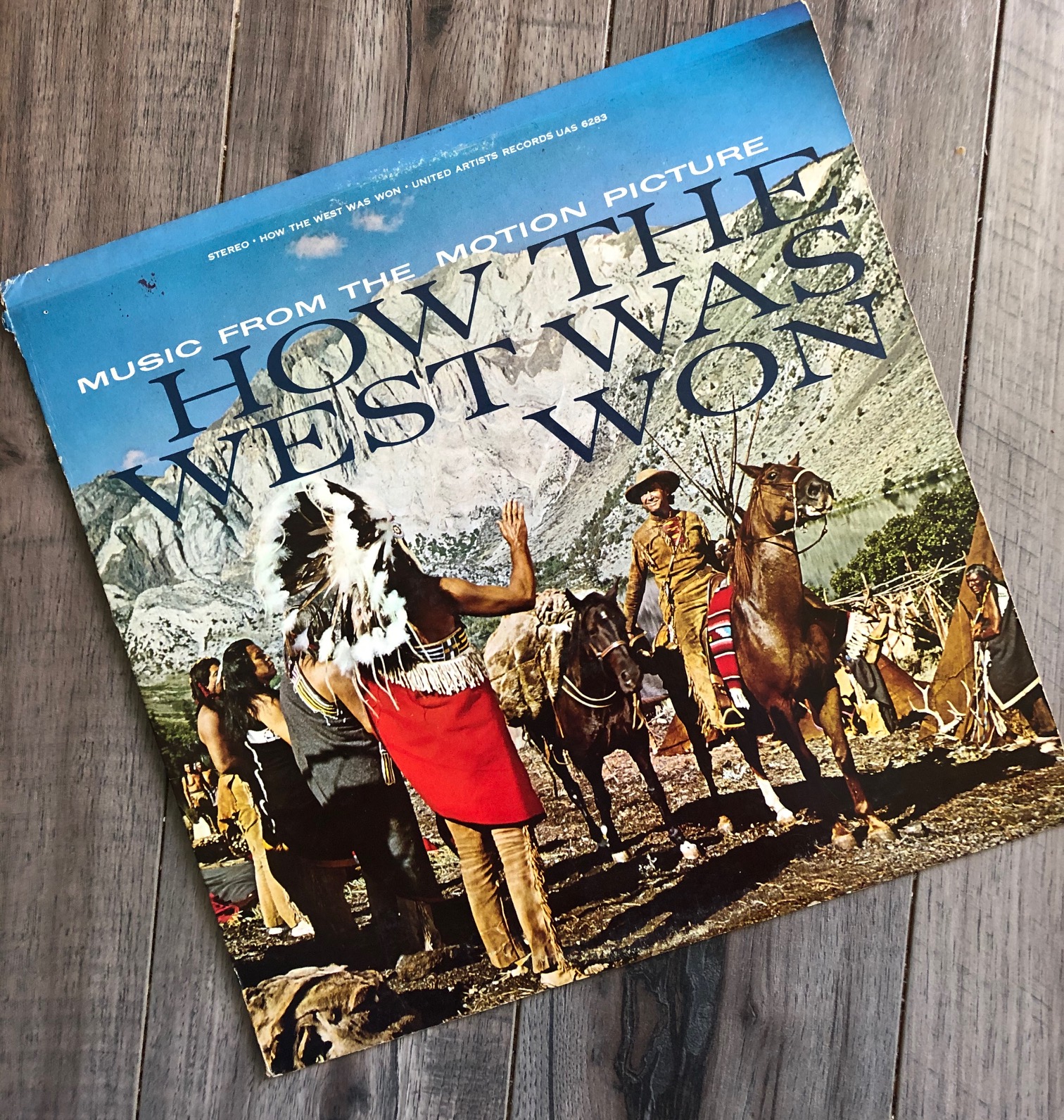
My copy of the United Artists LP, produced by the Hollywood Sound Stage Orchestra, features linear notes by Norman Weiser, president of Chappell Music Company of New York, part of London’s Warner-Chappel, the world’s largest music publisher. Weiser says “The music has the potential of long-span popularity for it has been critically acclaimed as one of the best motion picture scores to be heard in many years.” Weiser wasn’t wrong, in 2005, the score was listed at number 25 on the American Film Institute’s 100 Years of Film Scores.
Composed and conducted by Alfred Newman and originally released by MGM Records, the music was nominated for an Academy Award by lost to Tom Jones.
The movie’s story is told through a series of five vignettes: The Rivers, The Plains, The Civil War, The Railroad, The Outlaws, spanning 50 years and following four generations of the Prescott family as they move west from New York. What makes the full-length score so spectacular is the way Newman arranged for particular styles of music to play off specific settings.
This clip, the original recording by the MGM Orchestra is sweeping in its majesty, energetic and fun. Just like the film.
The original selections on my United Artists LP are rounded out with Newman and Ken Darby’s arrangements of traditional tunes, “When Johnny Comes Marching Home,” “I’m Bound for the Promised Land,” and “Battle Hymn of the Republic.”
Compared to the original recording in the clip above, the Hollywood Sound Stage Orchestra version of the theme I have here is anemic at best, and just goes to prove the old saying of Let the Buyer Beware — “Music from the Motion Picture” might be stretching the truth.
After growing up on a Nebraska farm, Richard Prosch worked as a professional writer, artist, and teacher in Wyoming, South Carolina, and Missouri. His western crime fiction captures the fleeting history and lonely frontier stories of his youth where characters aren’t always what they seem, and the windburned landscapes are filled with swift, deadly danger. In 2016, Richard roped the Spur Award for short fiction given by Western Writers of America. Read more at www.RichardProsch.comAnthony Mann (1906-1967) directed some of the most respected western films of the 20th century (WINCHESTER '73, BEND OF THE RIVER) and arguably his crowning achievement was MAN OF THE WEST (1958). Somehow, this extraordinary cinematic gem starring Gary Cooper and Lee J. Cobb escaped my viewing until last month. I've now watched it three times (it's currently streaming on Amazon Prime) and plan to watch it even more. In my ever shifting top five, MAN OF THE WEST joins McCABE & MRS. MILLER, MONTE WALSH, WILL PENNY, and THE OX-BOW INCIDENT.
The demonstrative screenplay by Reginald Rose was based on THE BORDER JUMPERS (1955) by Will C. Brown. I savor so many aspects of this narrative with the King Lear hat tip, the cowboy who can't escape his past trope (but packaged fresh here), and how, once bitten, you can never quite rid yourself of the venom that flows through your psyche. No character is so minor as not to have a well developed backstory, helping to drive the overall plot.
Inspired by MAN OF THE WEST, I wrote this little free verse homage. I hope you enjoy. And I'm interested in what you think of Mann's movies.
Like a Sickness Come Back (after Man of the West)
David Cranmer is the editor of the BEAT to a PULP webzine and whose own body of work has appeared in such diverse publications as The Five-Two: Crime Poetry Weekly, Needle: A Magazine of Noir, LitReactor, Macmillan’s Criminal Element, and Chicken Soup for the Soul. Under the pen name Edward A. Grainger he created the Cash Laramie western series. He's a dedicated Whovian who enjoys jazz and backgammon. He can be found in scenic upstate New York where he lives with his wife and daughter.
A brand new Western adventure from A.L. Shane!
Cowboy James Martin was nicknamed Parson Jim because he carried a Bible in his saddlebags. However, Martin turned out to be anything but godly. He killed Cocheta, the beautiful Creek Indian wife of Abilene Marshal Ed Bright, and later shot two cowboys who worked for rancher John Chisum. Then he fled to Indian Territory.
Marshal Bright and Pete Butterman, Chisum’s foreman, began the search for the murderer. With the help of Standing Bear, chief of the Creek Nation, and Red Eagle, a Creek warrior, Marshal Bright finally catches up to Parson Jim who was hiding with a rogue sheriff in Broken Arrow.
The colorful characters, the inevitable showdown and surprise ending will keep the reader flipping the pages of this exciting story.
October 9 is World Post Day, celebrating the anniversary of the Universal Postal Union, established by the Treaty of Bern in 1874. Before the establishment of the Postal Union, every pair of countries that exchanged mail had to negotiate a postal treaty with each other. These negotiations could sometimes drag on for years. The United States took the lead in 1863, calling for improvements to international mail arrangements, but the first International Postal Congress failed. Then, in 1874, Heinrich von Stephan, Postmaster-General of the German Reichspost, called for another congress, during which the 21 delegates agreed to all of von Stephan’s proposals.
The treaty provided that:
1. There should be a uniform flat rate to mail a letter anywhere in the world
2. Postal authorities should give equal treatment to foreign and domestic mail
3. Each country should retain all money it collected for international postage.
From 1799 to 1815, a letter in the United States cost:
· 8 cents/sheet, sent 40 miles or fewer.
· 10 cents/sheet, sent over 40 and up to 90 miles.
· 12.5 cents/sheet, sent over 90 and up to 150 miles.
· 17 cents/sheet, sent over 150 and up to 300 miles.
· 20 cents/sheet, sent over 300 and up to 500 miles.
· 25 cents/sheet, sent more than 500 miles.
In 1845, the Department began charging rates based on weight and whether a letter was going more than or fewer than 300 miles. In 1851, the distance limit for the lowest rate increased to 3,000 miles, which included most of the United States, while an even lower rate was charged if postage was prepaid. In 1855, the prepayment of letter postage became mandatory (previously, postage could be paid by the sender or the recipient, or partially by each).
At first, envelopes were rarely used, as they would count as another sheet of paper. Instead, the sender simply folded the letter so that a rectangle on the outside was blank, wrote the address there, and sealed the letter with wax. To save space, people usually filled one side of the sheet of paper, then turned the paper 90 degrees and wrote cross-wrote the rest of the letter to fill in the blank spots. Postage stamps were invented in 1847 and became mandatory in 1856.
On March 3, 1863, U.S. postage was charged based on letter weight, without consideration of distance. The same act that decreed this also created three classes of mail:
· Letters (First-Class Mail)
· Newspapers and other periodicals (Second-Class Mail)
· All other mailable items (Third-Class Mail)
In 1800, the speed of the U.S. mail was limited by natural forces like wind, water currents, or a horse’s pace. By the end of the century, mail trains were crisscrossing the country with postal clerks aboard, sorting mail in transit. In between, the Postal Service utilized whichever form of travel was speediest and most dependable: steamships, stagecoaches, trains, and horses. Perhaps the most famous of these delivery services was the Pony Express, in operation from April 1860 to October 1861. It ended when the first transcontinental telegraph line was completed, but during those 18 months, the young riders made history.
Railway mail clerks had one of the most dangerous jobs in the postal service. They worked elbow-to-elbow on the fast-moving cars, trying to accurately sort the mail before they reached the next destination. Often the train wouldn’t even stop – the clerks had to toss the mailbags out the car’s window while snagging the town’s mailbag on the fly. Until the 1920s, most mail cars were made of wood, lit by oil lamps and heated with woodstoves. They were also sandwiched between the heavier locomotive and passenger coaches, which made the mail car vulnerable in case of a wreck. Trains derailed because of livestock on the track, open switches, broken rails, washed out bridges, and oncoming trains (to name only a few hazards of rail travel). Even a sudden lurch could injure a clerk if he lost his balance.
The first mail contractors were on horseback, but in 1785, the Continental Congress instructed the Postmaster General to award mail transportation contracts to stagecoach lines, which were preferred over horseback even though they cost more and were sometimes less efficient. In March 1845, an act took steps to reduce mail transportation costs. Congress offered contracts to the lowest bidder for “what may be necessary to provide for the due celerity, certainty and security of such transportation.” These were known as “celerity, certainty and security” bids, but postal clerks shortened it to three asterisks (***) or stars, and they became known as star bids. The routes were then called star routes. Still, throughout the 1850s, the Department kept on preferring stagecoaches to horseback over some routes.
In 1859, Postmaster General Joseph Holt criticized the “enormous sums” paid to stagecoach companies to transport mail. He declared, “In advertising for the new lettings, ‘Star Bids’ … will alone be invited … without any designation of modes of conveyance.” The 1860 annual report is the last one to discriminate between “coach” and “inferior” modes of transportation. Contractors had to be at least 16 years old (until 1902, when the age was raised to 21), and were bonded, having taken an oath of office. Until 1865, carriers must be free white persons, and their typical four-year contract didn’t provide payment for missed trips (regardless of weather conditions). They provided their own equipment, too. Most star route carriers traveled by horseback or horse-drawn vehicle, with the odd boat, sled, snowshoe, and ski thrown in during the winter. Dogsleds were used in Alaska until 1963.
If your character utilizes the Postal Service for any reason, consider the travel time and danger involved in its delivery. One thing for certain: your character wouldn’t be able to expect same-day delivery!
J.E.S. Hays
www.facebook.com/JESHaysBooks
Source:
The United States Postal Service: An American History - https://about.usps.com/publications/pub100.pdf