Showing posts with label Writing Advice. Show all posts

Saturday, September 25, 2021

Larry D. Sweazy - A Pantser who Plots


This next interview is with Larry D. Sweazy, an award-winning author of Westerns, Mysteries, and more.  I love that he is a Pantser who also does some plotting. These interviews give the reader and writer an insight into the process of various writers and the work that goes into telling a story on the page. Read on, there is so much to learn.


Author Larry D. Sweazy


1. When did you realize you wanted to be a writer? 

I was an early reader, but I really fell in love with stories via the television. We had a black-and-white nineteen-inch Motorola with rabbit ears (with aluminum foil on the tips) that brought the outside world into our one-bedroom apartment. It was the 1960s, so there were a lot of Westerns on TV at the time, Gunsmoke, Bonanza, and my mom’s favorite, The Big Valley. I liked Batman, but I didn’t fall for Star Trek or cops shows like The Mod Squad and Mannix until I was older. All of those shows were an escape, and I found the same kind of escape in books. It wasn’t until eighth grade when a poem that I’d written to a girl got intercepted by a teacher that I began thinking I might be able to write. He held me after English Lit class, told me the poem was pretty good, gave me a few books to read, and suggested that I pay attention in class. I did. It was the first good review I had. “You’re pretty good at this,” can go a long way to a small-town kid with no other visible talents.  I continued to write poetry in high school, and then after I left home, I pretty much decided that writing was what I wanted to do with my life. At that point, in my early twenties, everything I did, read, and invested in, revolved around becoming a published writer. 


Amazon


2. Did you chose the genre you write in or did it choose you?

Interesting question. I didn’t start out writing westerns, or mysteries for that matter. I started writing short stories, some speculative fiction, some horror in the Stephen King vein. Carrie came out while I was in high school, and I was an instant King fan. I still admire his work and his dedication to the craft and the writing life. I moved on to writing novels after a few years, and the third unpublished novel I wrote was a modern-day police procedural. There was a mystery conference not far from where I lived, and I attended out of curiosity, hoping to learn more about the genre. That conference really changed the direction I was heading. Once writers were real and in-person, the writing dream seemed more possible than it ever had. I tried writing mysteries for several years after that with no luck. I came close a couple of times, but I just couldn’t find a way to get published. Fate intervened a few years later. Or being in the right time, right place. Whatever you want to call it. A little luck brought an invitation to me to write a short story for a Marty Greenberg/Ed Gorman anthology. Ed asked me to write a modern-day Texas Ranger mystery short story and I did. It came out in a western anthology, with my story being the only modern story in the collection. I thought I was writing a mystery. That story, my first professionally published short story, went on to win the WWA Spur Award for short fiction. I was shocked. I went to the conference, met some amazing writers like Elmer Kelton, Don Coldsmith, and Loren Estleman, and a new world was introduced to me. But, of course, it wasn’t a new world. I had loved all of those western TV shows and movies as a kid. My first published novel (but the seventh one I’d written) was The Rattlesnake Season, the first book in the (seven-book, so far) Josiah Wolfe series. I would say westerns chose me, but maybe I was destined to write westerns from the beginning.  


3. Do you write in other genres? 

So far, I have published eight westerns and eight mysteries. But it depends on how you look at each novel. Most of my novels have elements of both genres in them, western and mystery, so the lines become blurred as far as I’m concerned. Genre gets defined by other people, librarians, publishers, booksellers, etc. And I don’t mind working in the confines of genre—just like I’m sure John McEnroe didn’t mind playing tennis inside the tennis court. It’s what a writer brings to the table that counts. What I love more than anything is story. And most of my stories involve characters on their own, facing the elements of nature, the harshness of life, loss, the cruelty of humans, all the while doing their best to survive, and being productive people making a contribution to the greater good. I like stories about reinvention and survival. Westerns are a great place for that kind of tale. But so is science fiction, horror, and every other genre. At this point, I hope to continue to grow and get better as a writer, and I think writing in other genres helps to keep me fresh, but I also think there’s a wide palette to work off of when it comes to writing westerns. I have a lot more stories to tell. 


Amazon

4. Are you a plotter or a pantser?

I’m a pantser who plots two or three chapters ahead. I usually work off a synopsis of the story while giving myself permission to stop in and take in the view or visit someplace that looks interesting that I didn’t know existed when I started out. I think there has to be room for spontaneity, but I also like to know where I’m going (most of the time) when I pull out of the garage to take a trip or sit down to write a story. E. L. Doctorow said, “Writing is like driving at night in the fog. You can only see as far as your headlights, but you can make the whole trip that way.” I think that pretty much covers how I write.


5. Is there a writing routine you follow or do you write when the muse strikes?

I grew up in a factory town and come from a blue-collar background. Punch in, punch out, show up every day or you don’t get paid. Slack off and you lose your job. I show up everyday. That’s pretty much my routine. I write a thousand words a day, five days a week, and most times seven days a week when I’m writing a first draft. If I waited for the muse to strike, I’d never hit a deadline. I would get distracted by something else. Oh, look a squirrel! I’m curious about everything. I have to be disciplined and regimented in most all of the aspects of my life, or I would just sit and watch the birds at the birdfeeder all day (or the squirrels) and get nothing done.


Amazon

6. Where did you get the idea for your latest release and tell a bit about the story?

I really wanted to explore a western hero who is a hero until he screws up. Then what is he? Lost Mountain Pass is the first book in my new series from Kensington featuring Trusty Dawson, a Deputy U.S. Marshal in 1888 Indian Territory. Trusty makes a fatal mistake while escorting a federal judge home from a trial and spends the rest of the book trying to redeem himself and regain the meaning of his name. I wanted to defy expectations a little bit. Trusty is not the usual western hero. I know that’s a risk, but I’m hoping readers will enjoy the ride, all the while experiencing the expected trappings of what a western is supposed to be and what a western can be. 


Pre-order from Amazon


7.  What advice would you give to those who dream of writing, or what advice would you give your younger self?

Don’t be desperate to get published. If you’re going to be desperate about something, be desperate about becoming a good writer. Be willing to serve an apprenticeship. No one is a master craftsman out of the gate. Don’t publish until you’re ready. Just because you can publish your work doesn’t mean you should. You won’t avoid rejection. If you self-publish and have no sales, that’s rejection. If you send your work out too soon to an agent or publisher and get rejected, that’s part of the journey for us all. Rejection is part of the deal. I still get rejected. I have a project out on submission right now that’s been rejected thirty-four times. Writing doesn’t get any easier. It’s a long-haul proposition. But if you stick with it, don’t let anyone or anything discourage you, then maybe luck will find you sitting at your desk. Maybe luck will ask you to write a story for them. You never know where that bit of luck will take you. But you have to be ready. And the only way to be ready is to write. Read and write. That’s the secret. Read and write as much as possible, and don’t give up, no matter what.  


I hope you enjoyed this interview and perhaps learned even more about this career we call writer/author. 


Amazon Author Page

http://www.larrydsweazy.com/

Follow on Twitter: @larrydsweazy 

http://www.facebook.com/larrysweazyauthor


Post (c) by Doris McCraw All Rights Reserved


Saturday, August 21, 2021

Peter Brandvold - Obsession & Stubborness a Key to Success


Peter Brandvold, this month's interviewee is the Western Fictioneers Lifetime Achievement Award winner for 2020. Thank you to Peter for taking the time to share his insights into writing and his writer's life.  

Author Peter Brandvold and his trusty assistant.


*  When did you realize you wanted to be a writer? 

You know, I can’t remember NOT wanting to be a writer, so I’d have to say very early on. Maybe when I was six and just starting school and I learned there was such a thing.


*  Did you chose the genre you write in or did it choose you?

I would say it chose me. I’d gone to undergrad and grad school wanting to be the next Ernest Hemingway, but I wasn’t having any fun. So after I got out of school and still wasn’t having any fun writing the “literary” stuff, I asked myself what I’d really LIKE to write. That turned out to be westerns because I’d grown up on them. They were the first books I fell in love with. 


*  What was the nudge that gave you faith that you could and wanted to be published?

I was extremely naïve. After I had the desire to be a writer it never really occurred to me that I couldn’t be a writer. I was very obsessed, and sometimes obsession is what it takes. Obsession and stubbornness. I was very stubborn. I wasn’t NOT going to be a writer.


*  Do your life experiences influence or hinder your writing?

I think they always influence it, definitely. Even the bad stuff.

Peter's latest release from Wolfpack

*  Where did you get the idea for your latest release and tell a bit about the story?

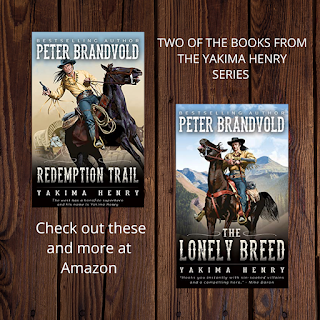
I can’t say much about my latest releases—I’ve had three books come out in July alone—but they’re all pseudonymous books and I’m not at liberty to divulge their titles. Let’s call my latest release REDEMPTION TRAIL published by Wolfpack. It’s a Yakima Henry yarn. I have no idea where the idea for it came from. Sometimes I just come up with an opening scene and a character or two and put them into play and simply write to discover what happens. As I remember, that’s what happened with REDEMPTION TRAIL. Most of my books come about that way.  


*  Are you a plotter or a pantser?

Definitely a pantser!


*  Is there a writing routine you follow or do you write when the muse strikes?

I follow a fairly strict routine. 500 words right after breakfast, another 500 before noon. After lunch, another 500. Then some work around the house or yard or a nap or an errand run then another 500 before happy hour. Happy hour is a big incentive for me!


* If you had a choice, which is your favorite to write, short stories, novellas, or full-length novels?

Full-length novels. I need room for my imagination to breathe and wander.


* Do you ‘interview’ your characters before or at any time while telling their story and what do you do if they don’t cooperate with your story idea?

No, I don’t do any of that stuff. Sometimes I actually like it when they don’t cooperate with the story. Sometimes that makes the story more interesting. A nice surprise. Otherwise, if I get off on the wrong track, I backtrack and force them onto the right trail. But that rarely happens. Sometimes you just have to have confidence that what you're writing is good and to just keep going and entertain yourself. That’s the best trick for entertaining the reader that I know. Entertain yourself first.


*  Is there a process where you find your next story or does the idea just hit you?

Usually just hits when I’m out walking with my dog. I have a vivid imagination, and I can just start the camera rolling and images start appearing on the screen. It’s weird but it works.

Amazon


*  Is there anything else you feel people would like to know or would be surprised to learn about you?

I make beer and wine. 


* Do you write in other genres?

I’ve written two “weird” westerns, sci-fi westerns, or fantasy westerns. CANYON OF A THOUSAND EYES and DUST OF THE DAMNED.

Amazon

*  What are your favorite areas of research and why they are important to you?


Reading nonfiction books about the West. I’ve read a ton of them including the autobiography of John Wesley Hardin, one of my favorites. I also like to travel out west, camp in the mountains, and visit out-of-the-way museums. I once spent three summers in the Sawatch Mountains of Colorado and three winters in the Arizona desert, boondocking in my fifth wheel. Great way to soak up the Old West atmosphere. 


*   When do you start to ‘market’ your new released?

The publishers usually do that for me, thank God. I’m not much of a marketer.


*  What advice would you give to those who dream of writing, or what advice would you give your younger self?


Only do it if you can’t NOT do it. That’s what I did, but I came by it naturally. And I really think that’s the only way to do it. Because it’s a damn tough business and your chances of succeeding—well, let’s just say you probably have a better chance of getting hit by lightning in your basement in January than making a living as a writer.

Amazon

*  Are there authors you grew up with or inspired you to take pen to paper?

There are so many, I hesitate to name any. Certainly Jack London. He was probably the biggest for me and still really is.


*  If it were possible would you choose to go forward in time or back?

Nah, I like it right here. As long as I’m making up stories and telling big lies just as I did uncontrollably as a little kid—who had an imaginary friend named “Cousin”—I’m doing just fine. 

For more about Peter and his books:

Amazon Author Page - Peter Brandvold 

https://peterbrandvold.com/

https://wolfpackpublishing.com/peter-brandvold/


Post (c) Doris McCraw All Rights Reserved (interviewees have full use of this post)


Saturday, July 17, 2021

A Million Words - Then Westerns James Reasoner Interview


If you're like me, the authors who make a living writing are a source of inspiration and in some way a role model for what is possible. Over the course of this continuing author interview series, there have been many such authors. James Reasoner is no exception. It is hoped you will enjoy and learn as much as I have in this fun and inspiring interview.

Author James Reasoner

1. When did you realize you wanted to be a writer? 

That started very early. When I was growing up in the late Fifties/early Sixties, my friends and I played mostly with toy guns. Instead of being content with running around and pretending to shoot each other, I had to come up with a story to explain who we were and why we were doing that. They probably thought I was crazy, but they put up with me. The first time I put pen to paper to write my own stories was in 1964 when I was in the fifth grade.


2. What was the nudge that gave you faith that you could and wanted to be published?

I wrote for my own enjoyment all through junior high and high school, started submitting to magazines, and trying to sell when I was in college but had no success whatsoever. I was just about ready to give up, but right after Livia and I got married, she told me that if it was something I really wanted to do, I should stick with it and work harder at it. Less than six months later, I sold my first story.


Book 1 of 6
Amazon

3. Do your life experiences influence or hinder your writing?

My late good friend Ed Gorman once described a writer as somebody who sits in a room and types for 30 years. There’s a lot of truth to that, and in my case, it’s going on 45 years now. So maybe my lack of life experiences hinders my writing at times. Now and then, I get to work in something in which I have some direct experience, and that’s always nice. 


4. Are you a plotter or a pantser?

I’m mostly a plotter. I write fairly detailed outlines but try to give myself enough leeway to veer off if I want or need to. In a few cases, I’ve had to be a pantser, when I needed to write a book in a hurry. I’ve started books with only a vague idea of where I was going. They worked out fine, but the experience was a little nerve-wracking.


5. Is there a writing routine you follow or do you write when the muse strikes?

Life seems to be so busy all the time that it’s more a case of I write when I can find the opportunity. I always start by editing and polishing the pages I wrote the last time. On a “normal” day, I write for about three hours in the morning, break for lunch, and then write for three to five more hours in the afternoon. Recently, days like that seem to be rare, though.

Amazon

6. If you had a choice, which is your favorite to write, short stories, novellas, or full-length novels?

I love books that are 40,000 to 50,000 words. I consider those to be novels, although some people refer to them as novellas. I’d spend the rest of my career writing that length if I could (unless I had some bigger idea that needed more words).


7. Is there a process where you find your next story or does the idea just hit you?

It’s really a mixture of processes. I work a lot in established series, so sometimes what comes next is just part of the natural flow of an overall storyline. Sometimes the editor will come up with a title or concept or both that he likes, and I take that and flesh it out. And then sometimes ideas just come to me, although those are usually for stand-alone books.

Amazon

8. Do you write in other genres?

I’ve written in just about every genre there is. There must be at least one I haven’t tackled, but I can’t think of it. I started out to be a mystery writer and had written and sold more than a million words of mystery fiction before I wrote my first Western, although I always loved Westerns as a reader.


9.  What advice would you give to those who dream of writing, or what advice would you give your younger self?

Mystery writer Dennis Lynds once told me, “If you work hard enough at it, all your dreams will come true. It’ll just take you ten years longer than you think it should.” As I mentioned above, Livia told me, “If it’s something you really want to do, you’ve got to work at it.” I think that sums up my writing philosophy: patience and hard work. In fact, if I could talk to my younger self, I’d tell myself to work harder and try to take advantage of every opportunity.


10. Are there authors you grew up with or inspired you to take pen to paper?

Oh, my, yes. The list would be almost endless. But some highlights . . . Robert E. Howard, who taught me it was possible to live in a small Texas town, not know any other writers, and still be a success. Mike Avallone, who taught me it was possible for a writer to have a distinctive voice and write books that didn’t sound like anybody else’s. Stan Lee and Jack Kirby, who taught me how to plot and write dialogue. Howard again, along with Lester Dent, who taught me how to write action. And a ton of Western, mystery, and science fiction pulp and paperback authors whose work I read and absorbed for many, many years. All that time I spent with my nose stuck in a book, flipping the pages so I could find out what was going to happen, I was actually studying and preparing for my career. I just didn’t know it at the time. (And let’s be honest. I probably would have read the books anyway.) 

For more of James' work, visit his Amazon Author Page
 

Post (c) Doris McCraw - All Rights Reserved.


Saturday, May 1, 2021

I CAN WRITE A NOVEL - KEN FARMER INTERVIEW


Some of us come to our calling early in life. Some find it much later. Then, of course, there are those who have many careers. Some always question choices while others just do it. Hope you all enjoy your time with Ken. I know I had a blast reading the answers.


Author - Ken Farmer

  1. When did you realize you wanted to be a writer?

At age 69 after I adapted a friend's novel to a screenplay. I just thought, 'Hell, I can write a novel'.


  1. Did you choose the genre you write in or did it choose you?

I chose the first, Military Action, with a close friend, Buck Stienke, a retired fighter pilot and Delta Airlines pilot. Me being in the Marine Corps...It was a good fit. Our second genre was always my first love...Westerns. I had written several western screenplays and the first western we published was “The Nations”, that just took off. It won several awards and became a best seller. We wrote 13 novels together and I've written 27 alone.


  1. What was the nudge that gave you faith that you could and wanted to be published?

There was never a 'nudge of faith', my confidence level is such that the thought I might fail never entered my mind. My dad always taught me - 'If you think you can, or you think you can't...You're right'.


  1. Do your life experiences influence or hinder your writing?

Mostly influence. My novel #37 was a move to the Southern Noir Mystery genre with, “Three Creeks”. Inspired mostly by my life as a child spending my summers in rural southern Arkansas with my grandparents in the late '40s and early '50s. It was a modern Western-style, quasi memoir, and won Best Mystery of 2020 with Firebird Awards, and is in the running for several more. It has been compared to Harper Lee's, “To Kill a Mockingbird”, Delia Owens, “Where the Crawdads Sing”, J. D. Salinger's “Catcher in the Rye”, and Reavis Wortham's “The Rock Hole”. Pretty heady company and very humbling. Currently, I'm finishing book #4 of the Three Creeks Mystery Series.

The series is a departure from my normal third-person omniscient style I use with my Westerns. I write this series in first person. The entire series is seen through the eyes of Foot Lee (Foot is short for Henry Lightfoot Lee a combination of names from my own ancestors on my daddy's side...Henry 'Lighthorse Harry' Lee of the American Revolution and Robert E. Lee's father, and Francis Lightfoot Lee, a signer of the Declaration of Independence) from the ages of 8 through 10 (so far) in book #4.


Image provided by Ken Farmer

  1. Where did you get the idea for your latest release and tell a bit about the story?

My latest release was book # 3 of the Three Creeks Mystery series...“The Pond”, a murder mystery involving two thirty-five year old murders...Best friends, ten-year-old Foot and Hutch (Foot is based on my own persona and a colored boy who lives close by, named Hutch Grant). Foot and Hutch discover the skeletons in a spring-fed pond, deep in the piney woods of southern Arkansas—each with two bullet holes in their foreheads, in 1950. Who were they?
Who is Motshan Bieler and why are members of the new Nazi party from Argentina determined to find him? What is he hiding?
Are Foot, Hutch, and Foot's ten-year-old cousin visiting from Texas, Frances Ann, in danger?
Does their friend, WWI Marine Corps Medal of Honor recipient, Tom Rayford, come to their aid...Only time will tell.


  1. Are you a plotter or a pantser?

I am a pure Pantser. I think being a professional actor for 45 years has something to do with it. I write like doing an Improv scene. I create the who, what, where, when, and sometimes why and go. I make a movie in my head and write down what the characters say and do. I stay the heck out of the way and let the characters tell the story. I usually have no idea how the story is going to end...sometimes I'm as surprised as the reader. Wow, didn't see that coming.


  1. Is there a writing routine you follow or do you write when the muse strikes?

I write as the muse strikes. I get asked a lot what I do for 'writer's block'. Well, I've never had it. I think it's the writer's sub-conscious saying 'I don't like this story or where it's going...I'm shutting down.' I've written 40 novels and 2 short stories in the last 10 years.


  1. If you had a choice, which is your favorite to write, short stories, novellas or full-length novels?

Oh, full-length novels. I've written some short stories for a couple of anthologies but I prefer the longer format.


Amazon


  1. Do you ‘interview’ your characters before or at any time while telling their story and what do you do it they don’t cooperate with your story idea?

Never had that problem. I'm an instinctive writer...I trust my gut and the characters. I use as my mantra a quote from Edgar Rice Burroughs. - “I have been successful probably because I have always realized that I knew nothing about writing and have merely tried to tell an interesting story entertainingly.”


  1. Is there a process where you find your next story or does the idea just hit you?

I never know whence or when...they just come, sometimes in the dead of night.


  1. Is there anything else you feel people would like to know or would be surprised to learn about you?

Had no idea I could write until I was 69. Wish I knew earlier, but I suppose to paraphrase Orson Welles, “There is no wine before its time.”


  1. Do you write in other genres?

I have written in Military Action, Police procedural mystery, Historical Fiction Western, SyFy, and now, Southern Noir Mystery.


Amazon


  1. What are your favorite areas of research and why they are important to you?

I'm not sure I could write without the Internet. I intersperse my stories with a lot of facts, albeit some are obtuse. I have this thing about being accurate and sometimes telling things the reader might not know.


  1. When do you start to ‘market’ your new released?

Usually I start marketing the day I write the first word. I always create my cover first and write around it. I will periodically post WIP excerpts as I go along with the cover.


  1. What advice would you give to those who dream of writing, or what advice would you give your younger self?

Don't dream about it...just do it. You have to act on it.


  1. Are there authors you grew up with or inspired you to take pen to paper?

My main inspiration is and always has been Edgar Rice Burroughs. Also, Louis L'Amor was inspirational. I own every book either man has written.

Thank you Ken for your time and for sharing your journey and advice with all of us. Wishing you continued success.

For more from and about Ken Farmer:

The Nations - Classic Western novel Winner - Laramie Award 2014
Haunted Falls - Historical Western novel - Winner - Laramie Award - 2013
Book Trailer - https://vimeo.com/109625264
http://tinyurl.com/KenFarmerAmazon

FaceBook:
www.facebook.com/KenFarmerAuthor
Ken's VO Demo:

(c) by Doris McCraw All Rights Reserved.


Saturday, March 27, 2021

Left-Handed with a Pencil - Interview with Vonn McKee


The final post for March's National Women's History Month is with Vonn McKee. Not only is she a wonderful writer, but she is also an amazing musician and so much more. I've enjoyed learning so much about and from the talented women in this series. Each of us has something we can share and I have appreciated the response from everyone from the authors to those who comment and share their stories and insights. So, without further ado, here is more wisdom to glean from the woman who is, as her tagline says, " Writing the Range". 


When did you realize you wanted to be a storyteller as a writer and musician?


Honestly, I was far down the writer/musician path before I realized what was happening. I was a scrawny asthmatic kid with a big strong singing voice. Go figure. I sang in church by age seven. Beginning at ten years old, I was a circuit funeral singer in Louisiana. I mean, probably hundreds of funerals! In that environment, I saw people at their most emotional and vulnerable, and I learned to observe it without reacting myself. They told me my songs brought them comfort, and that’s something I’ve never forgotten as a singer and a writer … that all of us are given gifts to be used to touch others in some way. At thirteen I joined a contemporary Christian band called the Jesus Christ Power & Light Company and, by fifteen, I was the headliner for Shreveport’s “Louisiana Hayride,” which was like a farm team for the Grand Ole Opry. I was privileged to record for MCA and tour nationally for several years, including two Opry guest appearances. Can you say, “no dating life?” That’s when I started writing my own songs, something I still do.

Entwined with all this was poetry and essay writing. During elementary school I wrote poems, one of which was published in the school newspaper. It was a clever piece, I thought, on dropping a marble during class and getting busted by the teacher. I made up whimsical Ogden Nash sorts of words. Would you believe the editor “corrected” those words, completely destroying the rhyme scheme? Sheesh. That wasn’t my last tangle with an editor, by the way.

My seventh-grade English teacher was the first to suggest I should consider writing as a career. Sometimes it only takes one person to encourage you to do the thing you’re meant for.


Did you chose the genre you write in or did it choose you?


I grew up in the Deep South, surrounded by stories and porch singings and plenty of Tennessee-Williams-type relatives. (Gee, I hope none of them read this.) My dad, however, was born in North Dakota and he and his Oklahoma-born father broke and sold horses. They were cowboys at heart and I got to spend summers on the family farm in northwestern Minnesota soaking up what I considered to be the Western life. In the kitchen, my grandmother told me stories from her childhood that rivaled those of Laura Ingalls Wilder.

I had a complete set of Zane Grey novels by the time I was eighteen and was writing a few cowboy songs. Fast forward to about 2012: I started going to writing conferences and eventually met Troy D. Smith, who asked me for some Western material. And off I went.


What was the nudge that gave you faith that you could and wanted to be published?


Songwriter Don Schlitz accepted his first CMA award for the Kenny Rogers recording of “The Gambler” by saying, “This is the first song of mine that anybody ever recorded, and I find all this very encouraging.” Although I didn’t kick off my literary writing career with a smash hit, my first short story published on Troy Smith’s Trailblazer imprint, “The Songbird of Seville,” was a WWA Spur finalist (2015). The same year, my second story, “The Gunfighter’s Gift” was a Western Fictioneers Peacemaker finalist. And I naively thought, “Hey, there ain’t nothin’ to this!”

I have since learned that no one has a Midas touch. It’s a little bit about talent and a lot about working hard to perfect your craft and also getting out and networking.


Is there a writing routine you follow or do you write when the muse strikes?


I’m a high-ADHD multitasker and discipline is a constant challenge. Also, I have many writing irons in the fire. I just finished judging for the Spurs (historical fiction) and am about to judge a short story contest. I’m a contributor and proofreader for Roundup magazine. Requests for short stories pop in, and I’m working on a novel. I belong to a writers critique group and I’m writing songs for a Western recording project. So I just try to spend time every day working on one or more of those. Just keep moving forward.


Is there a process where you find your next idea or does it just hit you?


Ideas are never a problem. It’s the getting them written that’s tough. Right now, I have four or five book ideas queued up in my head and, unfortunately, I’m a slow writer. The ideas spring up from research or sometimes from meeting someone. No kidding, people “bring” me stories all the time. My WIP was inspired by reading about artists like Albert Bierstadt, George Catlin and A.D.M. Cooper, who beautifully documented the 1800s Western landscape and people on canvas.


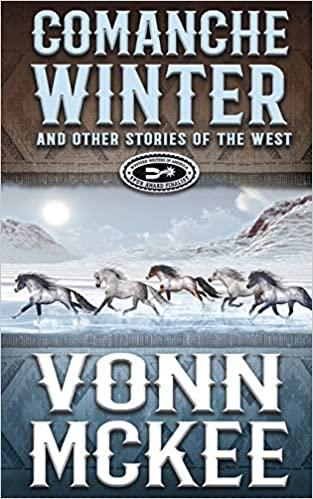
My anthology, Comanche Winter, was released on Wolfpack last year. Those stories are all over the place. A schoolboy has to defend his classmates against a Comanche attack. A circus troupe is caught behind enemy lines during the Civil War. An outlaw unwittingly steals a preacher’s identity.

Book Link

Do you ‘interview’ your characters before or at any time while telling their story?


Most characters show up with at least the essence of who they are and the story they wish me to tell. But I don’t like to start writing until I know them down to their bones. This is especially crucial when writing short stories. My goal is to make the reader feel very intimate with the character(s), as soon into the story as possible.

It’s all about believability and emotion with me. I work hard to stay accurate with historical and other details, but every story or song has to leave the reader or listener with an emotion. I’ve been told I write “with an ache,” and I do tend to write characters who carry both sweetness and pain inside them.


Is there anything you feel people would like to know or would be surprised to learn about you?


Gosh, I don’t assume anyone is interested. But, let’s see. I’m left-handed with a pencil but ambidextrous with most other things. I play baseball equally bad with either hand.


I have an engineering degree and worked in commercial construction as a precast project manager for several years at a time when there were virtually no women in the industry, so I have building babies across the Southeast. I’ve been a volunteer naturalist at a park and I’m a botany/zoology/astronomy nerd.


Do you consider music poetry and does the rhythm translate into your other writing?


Oh, I like this question. When people comment that I have a background in wildly different fields, I explain that I see countless parallels in music, math, architecture, and stories. Good design incorporates rhythm or pacing (visual or audible), color (even words have this!) and climaxes or highs and lows. And things have to add up at the end!


You’ve planned WF Conventions. What prompted you to take that on?


Well, when WF members first mentioned wanting to have a convention, I threw out a few suggestions. Next thing I knew, I was named convention chairman! (You know who you are, Cheryl Pierson.)


I’ve often said that every single thing you learn will be used later, eventually. I enjoy throwing big gatherings and have cooked for 50 people all by myself a number of times. Laying out a spread and making sure rooms and tables look good may or may not be a Southern thing. Also, my years working as a project manager taught me to break down a project into schedules, logistics and inventory needs.


That said, I nominate Cheryl Pierson to be chairman of the next WF convention.


Book Link

What advice would you give to those who dream of writing, or what advice would you give your younger self?


To aspiring writers … first, read your arse off. See what good, and bad, writing looks like. See which genre lights you up. Romance? (I leave that to the professionals.) Historical fiction? Nonfiction? Juvenile/YA? Mystery? Straight-up Western?


Read a few (but not too many) books on writing. Some of my favorites are How to Read Literature Like a Professor by Thomas C. Foster and On Writing by Stephen King. I loved Alexandra Sokoloff’s Screenwriting Tricks for Authors because it taught me about storyline pacing and to conjure up mental pictures of every scene as I write it.


Go to where other writers are. You’ll meet someone at every conference who will help you on your path. Might even be your next publisher. At the very least, you’ll spend time among your tribe.


Then, start typing. Yes, the page will be blank. And, no, you won’t have any idea what you’re doing. None of us did when we started. And some of us still don’t but we write anyway.


And to my younger self, I would say, “Have faith. It’s going to work out okay. But PLEASE don’t marry that curly-haired guy from California.”

For more, check out the following links: 

Facebook

Amazon 


Thank you to everyone who has been so gracious to take part in these interviews. I have enjoyed and appreciated every one of you.

See you all in April for more from our Western Fictioneers Members. Be safe, stay well, and keep those fingers moving.


Saturday, March 20, 2021

One Brick at a Time - Interview with Cheryl Pierson

I'm excited to be showcasing the women writers of Western Fictioneers for National Women's History Month. Let me introduce you to Cheryl Pierson. What a career Cheryl has and the knowledge she is sharing with us. Grab your coffee or tea and have a read.


Amazon ebook


1. When did you realize you wanted to be a writer?

Hi Doris, and thanks for interviewing me!  I think I always knew I wanted to from the time I got in trouble for writing my name all through my Little Golden Books. At church, when I was little, my mom would give me a little notepad and pen to write my letters on—before I could really spell words. I would make up my own words and write them, and my mom would pretend she was reading them. LOL But I wrote a LOT of stories from the time I was able to string words together.


2. Did you chose the genre you write in or did it choose you?

In the beginning, I knew I wanted to write what I most liked to read—historical romance. And I did that, but as time went on, I branched out into other genres. I loved doing that because it let me spread my wings a little bit and try writing in new areas that were interesting to me, as well. I started out writing feature articles for newspapers, then progressed to very short stories for Adams Media’s Rocking Chair Reader books and various Chicken Soup for the Soul books. Meanwhile, though, I was working on my western historical romance novels and submitting those. I had one agent who asked, “Can you write contemporary?” So I tried my hand at that—and then paranormal. But my first love(s) have always been historical romance and westerns. 

Amazon ebook


3. Do your life experiences influence or hinder your writing?

I do think my life experiences influence my writing to a great extent. I’m very empathetic, a trait I got from my mother. Growing up, she’d always say, “Just think how you’d feel if that happened to you.” Or some variation of that, and of course, I did try to think how I would feel if faced with that particular situation. So, when I write, it’s easy for me to put myself in the other person’s shoes and write their feelings.


4. Are you a plotter or a pantser?

I’m definitely a pantser. I plot when the story gets to a certain point, but even then, it’s not plotting. It’s a timeline I make so I will know I haven’t made a pregnancy last only 6 months, or have them celebrating Christmas a month early. I’ve always made a lot of lists, so this is part of that—a timeline “list” to keep everything straight within the story.


5. If you had a choice, which is your favorite to write, short stories, novellas, or full-length novels?

I love to write full-length novels because I have a chance to develop the characters more and give the plot several twists and turns. But I love writing short stories because it flexes those mental muscles and makes me have to say more in less time/space. 

Amazon


6. Is there a process where you find your next story or does the idea just hit you?

No, I really don’t have a “process”—but I usually come up with my ideas when I have quiet time to think about the different possibilities that “might have been” and go from there. When my kids were younger and in school, I spent a lot of time waiting for them after school and would always carry a notebook with me in the car “in case”—and that sure came in handy. These days, time for daydreaming is a lot scarcer. But I still keep coming up with one idea after another, somehow! 


7. Do you write in other genres?

I do. I write contemporary romantic suspense, western, historical romance, and have written a young adult western novel, RIDE THE WILD RANGE, and some middle grade and YA short stories that were contemporary.

Amazon


8.  What advice would you give to those who dream of writing, or what advice would you give your younger self?

Don’t be so hard on yourself when you don’t sell the very first thing you submit. 


Start small and build your portfolio one brick at a time instead of hoping you’ll hit that “grand slam home run” the first time you submit something. Writing a best-selling first novel doesn’t happen all that often.


Don’t sabotage your writing efforts by setting yourself up for failure.


Celebrate the small wins and achievements.


Don’t give up—keep writing. Even if it doesn’t sell, it improves your skills, your mental abilities, and your critical thinking. And it’s entertaining!


Write for yourself. Write what makes YOU happy.


Don’t quit your day job.


Remember to always lift other authors up. Putting out someone else’s candle doesn’t make yours shine brighter.


Thank you, Cheryl. For those who would like to follow or know more about Cheryl and what she does, check out the links below.


Cheryl Pierson

Editor-in-Chief and Co-owner
Prairie Rose Publications

PRAIRIE ROSE PUBLICATIONS WEBSITE:
http://prairierosepublications.com

E-mail: prairierosepublications@yahoo.com 


Amazon: www.amazon.com/author/cherylpierson


Saturday, March 6, 2021

EVERYONE NEEDS A 'HERO' - INTERVIEW WITH CAROLINE CLEMMONS

 In honor of National Women's History Month, the next interview will be with Caroline Clemmons, another Woman who Writes stories that take place in the West, mostly the Old West. We hope you are enjoying this short series. 

And now we give you Caroline Clemmons. 

            Did you chose the genre you write in or did it choose you?


I think it chose me. My first book was contemporary, but then I wrote a couple of western historical romances for Kensington. I felt and still feel so comfortable with post-Civil War historical settings. My dad used to tell stories about his family’s adventures after they came to Texas in 1876. He didn’t mention the year, but I learned that when I became interested in genealogy. I loved hearing the stories no matter how many times I’d heard them before.


What was the nudge that gave you faith that you could and wanted to be published?

Oddly enough, my mother-in-law gave me a grocery bag (remember the large brown bags?) filled with romance novels and told me I could write them. I always thought she didn’t like me so that was a BIG surprise. I used to write long, long letters detailing everything my Hero or our precious children did. She said she could tell from my letters that I could write books. Hero agreed. Up until then, I’d only written newspaper articles. Soon after that, I had pneumonia. While I was ill and recovering, I came up with a plot. My sister complained that once I started writing books, she never got nice, long letters again. That’s true.


Did your life experiences influence or hinder your writing?


In my opinion, our life experiences influence our writing in many ways. I don’t mean I take a real event and use it per se. We are the sum of all we have seen, hears, read, or experienced. When writing, we draw on our inner well and pour out the necessary emotions and events to convey what we want our readers to experience.


Where did you get the idea for your latest release and tell a bit about the story?


For a while now I have been participating in multi-author projects (MAPs) in which the MAP creator sets a parameter and each author sets her story within the context. The one I’m writing now is for the Proxy Brides series. Thinking of reasons for a woman to become a proxy bride or mail-order bride is difficult. There were not enough eligible men in the East after the Civil War and that left many women unable to marry unless they did something drastic. I love marriages of convenience such as mail-order brides or proxy brides or Pinkerton Matchmaker brides. Having the husband and wife getting to know one another while forced to battle an assailant adds complexity to the story. The current story is A BRIDE FOR HOUSTON, and V. McKevitt of Black Widow Cover Designs created the gorgeous cover.


Is there a writing routine you follow or do you write when the muse strike?


I write every day. I’m NOT a morning person, so the first thing I do when I sit at the computer is answer email, comment on blogs, and check my groups on Facebook. By then I’m awake and can dive into my work in progress. I usually take a break with my husband and watch a movie on television at about six. Often, I go back and work a while afterward.


            If you had a choice, which is your favorite to write, short stories, novellas or full-length novels?


Ah, I DO have a choice because I’m indie-published. I choose novellas of 30K-50K. With that length, there is room for secondary characters and their stories. My second choice would be full-length novels. I do enjoy writing the longer story but have become used to writing novellas. I’ve tried but don’t like writing short stories.


            Is there anything else you feel people would like to know or would be surprised to learn about you?


I’m an introverted homebody. However, I love to travel with my husband, whom I call Hero but am not one who enjoys huge conventions. The Western Fictioneers conference I attended was a perfect size and my husband could attend with me without feeling out of place. Jacquie Rogers “nudged” me to attend and I’m glad she did. She’s a great “nudger” and a great writer—and not an introvert!


Do you write in other genres?


Yes, I have written a couple of mysteries and have a third ¾ complete. Our youngest daughter and I are considering writing a duet where we each write a cozy mystery set in the same small Texas town with overlapping characters and businesses.


What are your favorite areas of research and why they are important to you?


Having details right are important to make the story credible. Many people who read historical novels are familiar with the history. An error in one place makes them suspicious of other details. A friend and I stopped reading one author because of her anachronisms. The friend’s mother insisted she didn’t care and kept reading the author’s books.

Even if only part of a sentence appears in the book, it’s worth researching to be certain it’s correct. In addition, I love learning the unusual facts of each locale. Getting sidetracked by research is all too easy for those who love history.


When do you start to ‘market’ your new release?


Thank you for that opening—I already have. A BRIDE FOR HOUSTON will be released in April of 2021. It will be available in e-book for $2.99 and in print (I don’t yet know the print price). Where available, it will be free on Kindle Unlimited. 


To follow Caroline or learn more, check out the following links:

 Website

Amazon Author Page


Saturday, February 27, 2021

LOTS OF VARIETY - INTERVIEW WITH LIVIA

As part of the interview with the authors, we are doing a series of interviews with some of the female members of this organization. Since March is National Women's History Month, and the Old West is History, what better way to celebrate both. This post is with Livia Reasoner (Livia J. Washburn) and what a fun interview it is.


 1. When did you realize you wanted to be a writer?


It started with me sitting on a swing telling stories to my cats. However, I didn’t get serious about it until after I married James Reasoner. He always wanted to be a writer and would write with a fountain pen in a spiral notebook during his breaks at work. He’d give me the edited pages and I’d type them for him. Then I started suggesting things he might do. After a while, he trusted my instincts enough that he would say, “You go ahead and make those changes,” and it snowballed from there.


2. Did you chose the genre you write in or did it choose you?


I’ve always had trouble sticking to a genre, and at times I’ve mixed them like in my Lucas Hallam series. Lucas is an older, bigger-than-life stunt man/PI during the 1920s in my mysteries, and in his younger years, he’s a man handy with a gun/lawman in my Westerns. I’ve also been known to write cozy mystery, paranormal, romances, and fantasy. As a writer and reader both, I like a lot of variety. 


3. What was the nudge that gave you faith that you could and wanted to be published?


I was lucky. I married someone I had faith could be published, and that gave me the courage to give it a try.


4. Do your life experiences influence or hinder your writing?


Health issues throughout my life had hindered me from having a normal life. I wasn’t able to finish college because of too many missed days, and I couldn’t hold a 9-5 job for the same reason. I knew James wanted to write fiction for a living, and that wouldn’t be easy to accomplish, especially without me having an income. Because of that, I came up with the bright idea of building my own house, and with the help of family, we did just that. I drew up a simple floor plan with all the plumbing close together and a plain roof. I pulled nails for a bunch of boards from a house my father tore down. We started working on the house soon after James and I married. I worked with my father during the day, and my mother, brother, and James would join us on the weekends. I found that even when I felt lousy, I could still hold a board, or nail a couple together. James and I had a paid-for house before our second year of marriage, so that took some of the sting out of not having that second income.


5. Where did you get the idea for your latest release and tell a bit about the story?

I’m presently working on a cozy mystery in my Fresh Baked series, Never Trifle with Murder. I was coming out with a book a year in this series, but I was only able to write a short story last year. 


It’s been a hard couple of years health-wise, and I did some online work along with publishing at Prairie Rose Publications, so I’ve had very little time when I felt well enough to write. Prairie Rose Publications is a publishing company that Cheryl Pierson and I started a few years back to help authors get their books and stories published.


The idea for Never Trifle with Murder came after my daughters took an English cooking class. I hope I’m able to get it written and published later this year.

6. Is there a process where you find your next story or does the idea just hit you?


Usually, the idea will just hit me, but then James and I will discuss it and work out the plot together to see the best steps forward. Lucas Hallam came to me when I was watching an old Western movie that featured stuntman Yakima Canutt. He was amazing. The pieces starting fitting together and I was so excited I called James at work and told him my idea. His response was, “Sounds like a fun idea, but you’ll never sell it.” I sold the story “Hallam” to the first place I sent it, and that led to a three-book contract with Tor. 


James and I bounce ideas back and forth when we get to drive any distance, and when we eat out in restaurants. Westerns are much safer to discuss in restaurants. Makes for some interesting looks when we’re trying to figure out the best way to murder someone with people eating nearby. Of course, that has all shut down since the virus went nuts. 


7.  Do you write in other genres?


I started out writing hardboiled mysteries and then Westerns soon after that. I was a big fan of Nero Wolfe, and that and a suggestion from my agent, Kim Lionetti, led to me trying culinary mysteries. I really loved mixing mysteries with Westerns with my Lucas Hallam character, and even in my cozy Fresh Baked series, one of the regular characters is always reading Western novels and watching Western movies. I think that pioneer sensibility is never far from the surface in everything that I write. 


8.  What advice would you give to those who dream of writing, or what advice would you give your younger self? 


Don’t expect to get rich writing. If you work very hard you can succeed, but the chances of being rich are very, very slim. It’s very hard to even make a living writing fiction. But it sure is fun when it happens.

Thank you, Livia!  


For more about Livia and to find her work, check out the following: