Wednesday, March 1, 2017

#2 One-room Schoolhouse: The Teachers     
March 1, 2017
By Julie A Hanks, Ph.D. aka Jesse J Elliot

     “The San Francisco Board of Education has voted to discharge any female teacher who may commit the crime of marriage.” FLIN, June 16, 1870, 215-4.


We can romanticize all we want about the teachers in the one-room schoolhouse, but those intrepid souls faced many challenges. Their job descriptions often entailed cleaning, maintaining the classroom, and teaching. Their salaries were low, and often they had no home of their own. Yet in spite of these many challenges, these amazing pioneers were America’s main conductors of education for almost two hundred years.
Teachers in the one-room schoolhouse were both male (the schoolmaster) and female (the schoolmarm). Except in the mission schools, if a female teacher married, she had to quit teaching “because her most important job then became taking care of the household for her husband.” Every family in the community would take care of the teacher’s needs, often providing a place to live until he or she could establish one. In some rural communities, families paid the teacher’s salary while others provided food and staples (Oak Hill School Teacher’s Resource and Curriculum Guide.)
One might ask: why did anyone become a teacher at an isolated schoolhouse in an isolated community? One reason is teaching school was one of the few respectable jobs available for unmarried women (and men without means). Teaching offered a job and an opportunity to travel. Although the one-room schoolhouse appeared to be a fifty-hour workhouse, it often was more than that.
All through the nineteenth century the one-room school was frequently the focus for people’s lives outside the home. Besides being used for the daily routine of educating children, it was a place where church services, Christmas parties and hoe-downs were held. The school provided social contacts outside the family unit and became an extended family itself. (Oak Hill School Teacher’s Resource and Curriculum Guide).
Though the pay was little and the opportunity for advancement was almost nonexistent, the one-room schoolhouse was usually able to fill the position of schoolmarm or schoolmaster. Interestingly, the academic qualifications were not an issue, but the moral and job demands were. According to “Rules for Teachers – 1872” (an unauthenticated list):
RULES FOR TEACHERS - 1872
1. Teachers each day will fill lamps, clean chimneys.

2. Each teacher will bring a bucket of water and a scuttle of coal for the daily' session.

3. Make your pens carefully. You whittle nibs to the individual taste of the pupils.

4. Men teachers may take one evening each week for courting purposes, or two evenings a week if they go to church regularly.

5. After ten hours in school, the teachers may spend the remaining time reading the Bible or other good books.

6. Women teachers who marry or engage in unseemly conduct will be dismissed.

7. Every teacher should lay aside from each pay a goodly sum of this earnings for his benefit during his declining years so that he will not become a burden on society.

8. Any teacher who smokes, uses liquor in any form, frequents pool or public halls, or gets shaved in a barber shop will give good reason to suspect his worth, intention, integrity and honest.

9. The teacher who performs his labor faithfully and without fault for five years will be given an increase of twenty cents per week in his pay, providing the Board of Education approves.

10. You must be home between the hours of 8 p.m. and 6 a.m. unless attending a school function.

11. You may not travel beyond the city limits unless you have permission of the chairmen of the board.

12. You may not smoke cigarettes.

13. You may not under any circumstances dye your hair.

14. You may not dress in bright colors.                                                  Snopes.com
            
       However, the rules on this list must not have been far from the truth, because similar restrictions appeared on a 1923 Contract:

            Ironically, some of the earliest teachers on the frontier were mothers who taught the local children in her own home or wives of missionaries, but as communities grew, and one-room schools were built, the only women allowed to teach in classrooms were unmarried.

 “The marriage of Miss Alice Tomilson reminds us that our premium school teachers are being gathered into the matrimonial net by men who place self above the public welfare. Suppose all the marriageable female teachers in the world were to be married tomorrow, the country would go to rack and ruin.” Grand Island, Nebraska, Time, September 15, 1883.

Marriage aside, there was also the challenges of maintaining the school. As there was no custodial support, the teacher in the one-room schoolhouse was responsible for keeping it clean and heating it up in the morning. How extensive some of these duties were varied with the community. Some teachers even had to deal with cleaning the privies, while others did not.
Maybe, one of the advantages/disadvantages of teaching in the 19th Century was the lack of paper—too expensive, so at least the teacher didn’t have to take home piles of papers to correct every night and on week-ends. J

Next week:  Meeting some of the individuals who went out west to teach in the one-room schools.


Bibliography
Oak Hill School Teacher’s Resource and Curriculum Guide.
“Rules for Teachers – 1872” (an unauthenticated list), snopes.com
 Gittleson, Wendy.  “EARLY 20TH CENTURY TEACHERS CONTRACT PROVES WE HAVE COME A LONG WAY, BABY,” Feminist Issues, March 8, 2015. http://www.ifyouonlynews.com/feminist-issues/early-20th-century-teachers-contract-proves-we-have-come-a-long-way-baby/

Moulton, Candy. (1999). “Education,” in Writer’s Guide to Everyday Life in the Wild West from 1840-1900. Writers Digest Books: Cincinnati, Ohio.

Grand Island, Nebraska, Time, September 15, 1883.
FLIN, June 16, 1870, 215-4.  (Source unknown)


Sunday, February 26, 2017

WAR HORSES (Part Two) by VONN McKEE


"The history of mankind is carried on the back of a horse."
                                         –Author Unknown
In my previous blog, WAR HORSES: Part One, we took a look at notable horses ridden by prominent generals of the Civil War. This time, we travel further back in history to examine more war horses whose names and bravery in battle are nearly as legendary as those of their owners.


Alexander tames Bucephalus
     The year was 346 B.C. and Philip II of Macedon had just paid the exorbitant price of thirteen talents for a gorgeous black stallion, only to find that he could not be ridden. No one was able to even mount the huge beast. Philip’s ten-year-old son, Alexander, watched the proceedings and stepped forward, declaring the horse’s handlers spineless and challenging his father that he could ride the stallion. The boy was so adamant that he was granted the chance. Alexander took the horse’s reins, turned him to face the sun, and promptly leaped onto his bare back! Only Alexander had noticed that the stallion was afraid of his own shadow. He named the enormous horse Bucephalus and they became inseparable. Alexander the Great rode him into every battle from the conquest of Greece and Thebes through Guagamela into India.


Napoleon Bonaparte and Marengo
     Paintings of Napoleon Bonaparte often depict him on horseback (not surprising since the French general stood only five feet, six inches in height). A favorite mount was “Marengo,” a fierce, stocky grey who was wounded eight times without ever throwing his master from the saddle. It was aboard Marengo that Bonaparte met his Waterloo (1815), ending the Napoleonic Era of European history. His last horse was a white Arabian named Le Vizir, who lived to the age of thirty-three. He was mounted and is currently on display at the Army Museum in Paris.


     Closer to home, America’s founding father, George Washington was a revered horseman. Thomas Jefferson called him "the best horseman of his age, and the most graceful figure that could be seen on horseback." Most paintings of Washington show him astride “Blueskin,” a flashy white half-Arab with a dark mane. However, the General usually rode a chestnut gelding named “Nelson” into battle, since he was calmer under cannon fire. After his service during the Revolutionary War, Nelson lived out his days at Mt. Vernon and was reported to “…run, neighing, to the fence, proud to be caressed by the great master's hands.”
 
Washington on Blueskin
Washington and war horse, Nelson


     Speaking of the Revolution, Paul Revere’s midnight ride forever stands as the event heralding the beginning of the conflict between England and the fledgling colony of America. And who was the horse he rode? Unfortunately, we may never know. Revere borrowed a horse from a merchant named John Larkin for the hellbent-for-leather ride to Lexington. The steed’s name is lost to history.


Andrew Jackson and Sam Patch
     Tennessee native son Andrew “Old Hickory” Jackson favored thoroughbreds, raising and training them himself. Most well-known was “Truxton.” A favorite story of Jackson is that he engaged in a duel after a local rival forfeited a race between Truxton and a horse named “Ploughboy.” Old Hickory caught a bullet near his heart and, since doctors were afraid to remove it, there it stayed throughout the future president’s life. “Sam Patch” is the white stallion shown in Jackson’s presidential portrait and the horse who holds the title of being the General’s true “war horse.” Sam Patch was named for a daredevil celebrity of the era, who died attempting a jump across the falls of the Genesee River.


Kit Carson and Apache
     The Plains Indian Wars from the 1850s through the late 1870s are possibly the most iconic of all conflicts between mounted opponents. Christopher “Kit”Carson was one of the earliest Indian fighters. He was another leader who lacked in stature at five feet, one and a half inches tall but possessed an abundance of daring. According to the first Carson biography, The Life and Adventures of Kit Carson, the Nestor of the Rocky Mountains by De Witt C. Peters, the “Fighting Trapper” rode a horse with the ironic name of “Apache.”


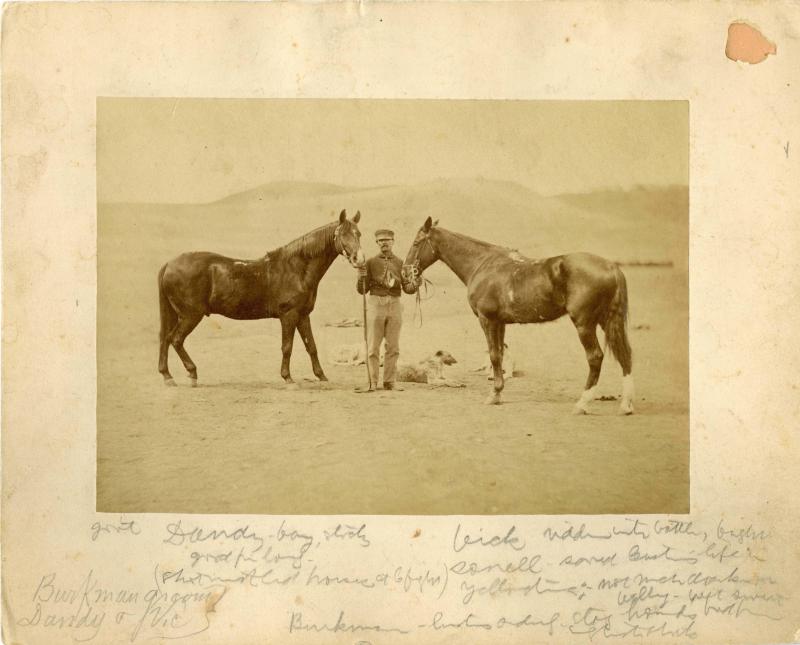
     General George Armstrong Custer’s most famous horses were “Dandy” and “Vic.” It was Vic, a stockinged sorrel with a blazed face, that Custer rode during the infamous Battle of the Little Bighorn. The Sioux claimed that Vic was captured after the massacre.
Dandy (left) and Vic (right), belonged to Gen. George Custer

 Rough Rider Teddy Roosevelt and Little Texas
     During the Spanish American War, Theodore Roosevelt led the charge of the Rough Riders in the Battle of San Juan Hill (July, 1898) on “Little Texas,” a chestnut described as a “pony” by historians. After the war, Roosevelt brought Little Texas back to the family's Sagamore Hill estate on Long Island where he lived out his days as playmate to the five Roosevelt children.


Two legends: Villa, Siete Luegas
     In the early 1900s, Francisco “Pancho” Villa blazed a rebel’s trail across Mexico (and one raid on U.S. soil) on his stallion “Siete Leguas,” which translates to “Seven Leagues.” Villa was proud of the horse’s stamina and speed. Supposedly, Siete Leguas regularly covered seven leagues (about twenty-four miles) during conquests.


     I have barely touched on the history of horses in warfare. Since the Greek myth of the Trojan Horse, the majestic animals have been a part of military battle lore. Did you know that, soon after the 9/11 attacks, a small band of U.S. Special Forces soldiers secretly entered Afghanistan and went to war against the Taliban…riding horses? Isn’t that thrilling? Here is Doug Stanton's book about the raid.


"Look back at our struggle for freedom,

Trace our present day's strength to it's source;

And you'll find that man's pathway to glory

Is strewn with the bones of the horse."


- Unknown author


 All the best,

Vonn 


2015 Western Fictioneers 
Peacemaker Finalist (Short Fiction)

2015 Western Writers of America
Spur Finalist (Short Fiction)

Keep up with Vonn:
Facebook 
(I just love "likes!")

Thursday, February 23, 2017

TREATING BULLET WOUNDS IN THE CIVIL WAR

THE DOCTOR'S BAG

the blog about the medicine and surgery of yesteryear

Keith Souter aka Clay More


Two of the earliest posts I wrote for this blog were  entitled Dig It Out Doc. Part one was about treating arrow wounds. It was based on a paper written by Dr Joseph H Bill, published in the American Journal of the Medical Sciences in 1862. Part 2 was about treating bullet wounds. It was essentially about the methods used by Dr George Goodyear, the surgeon to the gunfighters and was based on his papers on the subject.

In this blog I am going back to the Civil War to see what the eminent surgeon, Dr John Julian John Chisolm had to say. You might find this useful in your writing about the way bullet wounds actually heal.

Dr Julian John Chisolm (1830-1903)
Julian John Chisolm, often referred to as John Julian Chisolm, or as J.J. Chisolm was born in Charleston, South Carolina in 1830. H obtained his MD medical degree from the Medical College of South Carolina in 1850, then travelled to Europe to study medicine and surgery in Paris and London.


Dr Julian John Chisolm (1830-1903)

He returned to Charleston in 1860 and took up the post of Professor of Surgery at the Medical College, from whence he had graduated a decade previously. He kept the position throughout the War and in 1861 published the first edition of his textbook A Manual of Military Surgery for the use of Surgeons in the Confederate States Army.


Here is what he says in his book:

In gunshot wounds the swelling of the soft parts, which commences a few hours after the injury has been received, usually continues to increase until the completion of the fourth day, when it has attained its acme, with commencing suppuration.  Should sloughing occur, it will show itself by the sixth or seventh. On the eighth or north day the slough has, in most cases, separated itself from the edges of the track of the ball, and in a few days more will have been disengaged. With the cleansing of the wound, when no complication with foreign bodies exist, the inflammation gradually subsides, the swelling diminishes, purulent discharge lessens in quantity, and the wound commences to contract. The middle portion of the track first closes, and with with utmost frequently the opening of the exit, leaving a funnel shaped canal, which diminishes from day to day, becoming more superficial, until no depth is left to the orifice of entrance. The wound cicatrizes (scars) with a depression, marking distinctly the nature of the injury which has been received. In the experience of many army surgeons the most dependant orifice heals last, without reference to the entrance or exit of the ball. Should the orifices, however, be situate at the same place, the orifice of exit is usually the first to close. This is the ordinary course which gunshot wounds take when judiciously treated in good constitutions. 

In the general treatment of gunshot wounds, interfere with the general health as little as possible. The commonly prescribed antiphlogistic (anti-inflammatory) remedies are, with but rare exceptions, not required. The endless list of emetics, purgatives, diuretics, and diaphoretics, to which some European writers still cling with wonderful tenacity, can, with decided benefits, be dispensed with. 

Guthrie, who represents this class, in speaking of the inflamed stage of gunshot wounds, says that the treatment for subduing this should be active: "The patient, if robust, ought to be bled (if no endemic disease prevails), vomited, purged, kept in the recumbent position, and cold applied as long as it shall be found agreeable to his feelings; when that ceases to be the case, arm fomentations ought to be resorted to, but they are to be abandoned the instant the inflammation is subdued and suppuration well established."

From this tract you can see that he strongy disagreed with Professor George James Guthrie, a British surgeon who had seen service in the Peninsula and the Napoleonic Wards and who was regard as the founder of British Military Surgery. He did not disagree with his surgical techniques, but with his use of bleeding, blistering and purging, which had been the accepted testament up until then. I will be returning to Professor Guthrie in a later post.


Professor George James Guthrie (1785-1856)


Give them whiskey
Chisolm goes on to discuss aftercare.


We have, therefore, abandoned the plan of starving wounded men, or, by mistaken policy of a rigorous diet, to keep off inflammation. We look upon inflammation as always depressing in its character - nature requiring assistance from without to enable her to cope successfully with disease. We do not hesitate, therefore, as soon as the stage of reaction has passed, to feed the wounded with strong, nourishing diet, and also further to support the system by the use of stimuli. Whiskey has been freely given to our wounded, particularly during the suppurative stage, and with decided benefit. 

_____


THE DOCTOR'S BAG - MEDICINE AND SURGERY OF YESTERYEAR has been published by Sundown Press, available on ebook or paperback.


Clay More's novel about Dr George Goodfellow is published in the West of the Big River series by Western Fictioneers. 

Available at Amazon.com:


Friday, February 17, 2017

Dodge City and Me

Dodge City and Me


Troy D. Smith
I love me some Gunsmoke.


And I’m clearly not the only one. Gunsmoke is the 
longest running dramatic series in television history 
–broadcast from 1955 till 1975, for a total of 20 seasons. 
Law and Order, a show I also love, managed to tie this feat 
–but with a caveat. The cast of L&O turned over several 
times during its run, with none of the original ensemble 
group making it the whole time. In fact, the longest tenure 
of any original first-season L&O character was five seasons 
(Mike Noth’s Det. Logan, although he did appear several 
seasons in the spinoff Criminal Intent.)


On the other hand, the four main characters introduced 
in the first episode of Gunsmoke had staying power. 
Marshal Matt Dillon remained the central protagonist for 
all 20 seasons. Doctor “Doc” Galen Adams also appeared 
for 20 seasons, although he missed most of Season 17 due 
to heart surgery. Miss Kitty made it for 19, leaving before 
the final year. Even the short-timer, Chester Goode, made 
it partway into the ninth season.


Kelsey Grammer’s “Frasier Crane” character tied Matt 
Dillon for longest run of an actor in a television role 
–but there is a similar caveat there. Frasier was not 
introduced on Cheers until the third season, and for two 
years was only a recurring guest rather than a featured 
cast member. James Arness brought Matt Dillon to the 
small screen as the main character of a program for 
twenty consecutive years –plus a series of TV movies, 
from 1987 till 1994. So in a way, James Arness played 
Matt Dillon for closer to 40 years.


But even twenty years is a big chunk of time. When 
Gunsmoke premiered my father was eleven years old. 
When it was cancelled I was almost eight –and when 
the final TV movie featuring retired marshal Matt Dillon 
aired, I was 26 and a father myself. To this day, love of 
Gunsmoke continues to be one of the bonds between my 
father and me, and we discuss it often.


I remember watching “The Deadly Innocent” with my 
grandma –and IMDB.com informs me this was on 
Dec. 17, 1973. I distinctly remember watching “The Tarnished 
Badge” –in which Victor French, whom I recognized as the 
kindly Isaiah Edwards from Little House on the Prairie, played 
a vicious sheriff that Matt had to bring to justice. The next day I 
re-enacted the story with my Marx cowboy action figures on the 
red clay banks behind our home (Johnny West was Matt Dillon, 
and Pat Garrett was the evil sheriff.) Whenever I think of that 
episode, I smell that red clay. That was Nov. 11, 1974.


That year my mom was in the hospital for awhile. My 
step-father, my older cousin, and I were on our own for 
several days. I remember our efforts to make breakfast 
that Sunday morning… the result being biscuits so hard 
you could break a window with them, and gravy so thick 
it was hard to pull the spoon out of it. And we watched 
the two-part episode “Island in the Desert,” in which 
Festus was held captive by a crazed prospector played by 
the great Strother Martin (who had a pet rattlesnake named 
Homer.) In a bizarre sort of family tradition, for years 
afterward we delighted ourselves in imitating Martin’s 
distinctive nasal voice: “Bite’im, Homer!” “I’ll cut ye, Festus, 
and I’ll cut ye good!” That was early December, 1974.


When I was 18 I had a job buffing floors at Wal-mart 
–back in the days when such stores actually closed at 
night, from 9pm till 9am. The floor guys would be locked 
in overnight. The other floor guy became my best friend 
–and he was a huge Gunsmoke fan. Syndicated repeats 
showed on the local Fox outlet at 10 pm every weeknight… 
when we were at work, yet before the rest of the employees 
went home and got out of our way. We had a contraband 
VCR tape that we kept hidden above the ceiling tiles in the 
janitor’s closet… every night, just after we got to work, we’d 
secretly stick it into one of the display TV/VCR’s, turn it to 
the proper channel, and push record. Every morning at 2am 
we’d retrieve it and watch Gunsmoke on our lunch break. 
Those are some great memories. And beyond that, the steady 
western diet contributed to me writing my own western stories 
at night while locked in those stores, never dreaming that I 
would one day be a published author.


I’m willing to bet that many of you have your own Gunsmoke stories, 
and I invite you to share them in your comments.


It’s hard to get out of Dodge.

Wednesday, February 15, 2017

LOST SISTER-- MY FAVE WESTERN SHORT STORY--BY CHERYL PIERSON


Hi everyone! Sorry for the re-post, but this one bears repeating and you may have missed it the first time around--I ran out of time and thought I'd put up this "oldie but goodie" about this wonderful, wonderful Dorothy M. Johnson story rather than totally miss my blog date! Heaven forbid! Hope you enjoy--even if you may have seen it before. What's YOUR favorite short story?

I know we’ve talked before about Dorothy M. Johnson, the iconic western short story writer who penned such classics as The Man Who Shot Liberty Valance, The Hanging Tree, and A Man Called Horse; but today, I wanted to tell you about another short story of hers that I read a few days ago. Quite possibly, the best short story –in any genre—that I’ve ever read.

You may never have heard of it. It wasn’t made into a movie, because it too closely mirrored the true life of a real person, Cynthia Ann Parker, mother of Quanah Parker. The story is called Lost Sister.

I’d heard this story mentioned before by a couple of friends, and thought, “I need to read that—I’ve never read much of Mrs. Johnson’s work but the movies have all been good.” I know. I hate it when people say that, too. Anyhow, I bought a collection from Amazon that contained the three stories I mentioned in the first paragraph and Lost Sister as the fourth. Of course, I had to read The Man Who Shot Liberty Valance, since that’s tied for my all-time favorite western movie, along with Shane. I was so disappointed. The characters in the short story were not the same as my beloved Jimmy Stewart and John Wayne! Hmmm. Well, even though I was disappointed, I decided to give Lost Sister a shot.

It more than made up for my lukewarm feelings for The Man Who Shot Liberty Valance.

Lost Sister is the story of a woman who has been kidnapped as a young child by “the hostiles”. She has an older sister, who remembers her well from childhood, and loves her with the devotion that most older sisters have for a younger sister. Through the forty years she has been gone, the oldest sister, Mary, has cherished memories of her younger sibling.

There are three younger sisters, as well, who have no recollection of the Lost Sister, Bessie. The older sister doesn’t live with them, but in a different town a thousand miles away. The three sisters are notified that their sister, Bessie, has been “rescued” and is being brought back to them. The story is told from the eyes of a nine-year-old boy, whose mother lives with the sisters. She is the widow of their brother, who was killed by the Indians. The boy has dreams of growing up and avenging his father’s death, but something changes once his Aunt Bessie comes back to live with them.

Up until Bessie is returned to them, they have gotten much attention from the neighbors, and have been pitied as being the family who had a sister stolen by the savages so many years ago. Once Bessie is returned, their standing in the community takes a subtle twist. The other sisters don’t know how to handle Bessie’s homecoming. They make plans to go into her room and “visit” with her every day. One of them decides to read to Bessie from the Bible for thirty minutes each day. The others come up with similar plans, none of which include trying to understand Bessie’s feelings at being ripped away from her Indian family.

The oldest sister, Mary, comes to visit. What’s different? Mary loves Bessie, and accepts her; and Bessie loves her—they both remember their childhood time together. The language of love overcomes the barriers of the spoken language that neither of them can understand, for Bessie has forgotten English, and Mary doesn’t know Bessie’s Indian dialect. But Bessie has a picture of her son, and Mary admires it, and by the time Mary is to go home, she has made arrangements for Bessie to come live with her—a huge relief to the other pious sisters who had made such sympathetic noises about her being reunited with them in the beginning.

In a fateful twist, Bessie makes her own decision about what she will do, taking her own life back, and helping her son avoid capture. This is one story you will not forget. Once you read it, it will stay with you and you’ll find yourself thinking about it again and again. It doesn’t fit the mold of a romance story, except for the fact that I think of Bessie being in love with her husband, having children with him, and then being “rescued” and forced to live in a society she had no ties with any longer…except one—the love and understanding of her older sister, Mary.

No specific Indian tribe is mentioned in the story, probably for a purpose. I think, one of the main reasons is to show us the cultural differences and how, in this case, the “civilized” world that Bessie had come from and been returned to was not as civilized as the “savages” who had kidnapped her. Also, as I say, Cynthia Ann Parker’s story, at the time this story was published, was not that old. There were still raw feelings and rough relations between whites and Indians. But by leaving the particular tribe out of the story, it provides a broader base for humanity to examine the motives for “rescue” and the outcome for all concerned, of a situation such as this in which it would have been better to have let Bessie (Cynthia Ann) remain “lost.”

I’ve posted the link below for the story as it was printed in Collier’s Weekly on March 30, 1956. It’s also available on Amazon in several collections.
http://www.unz.org/Pub/Colliers-1956mar30-00066

Do you have a favorite short story to tell us about? Please share--I'm all about making an ongoing reading list!